


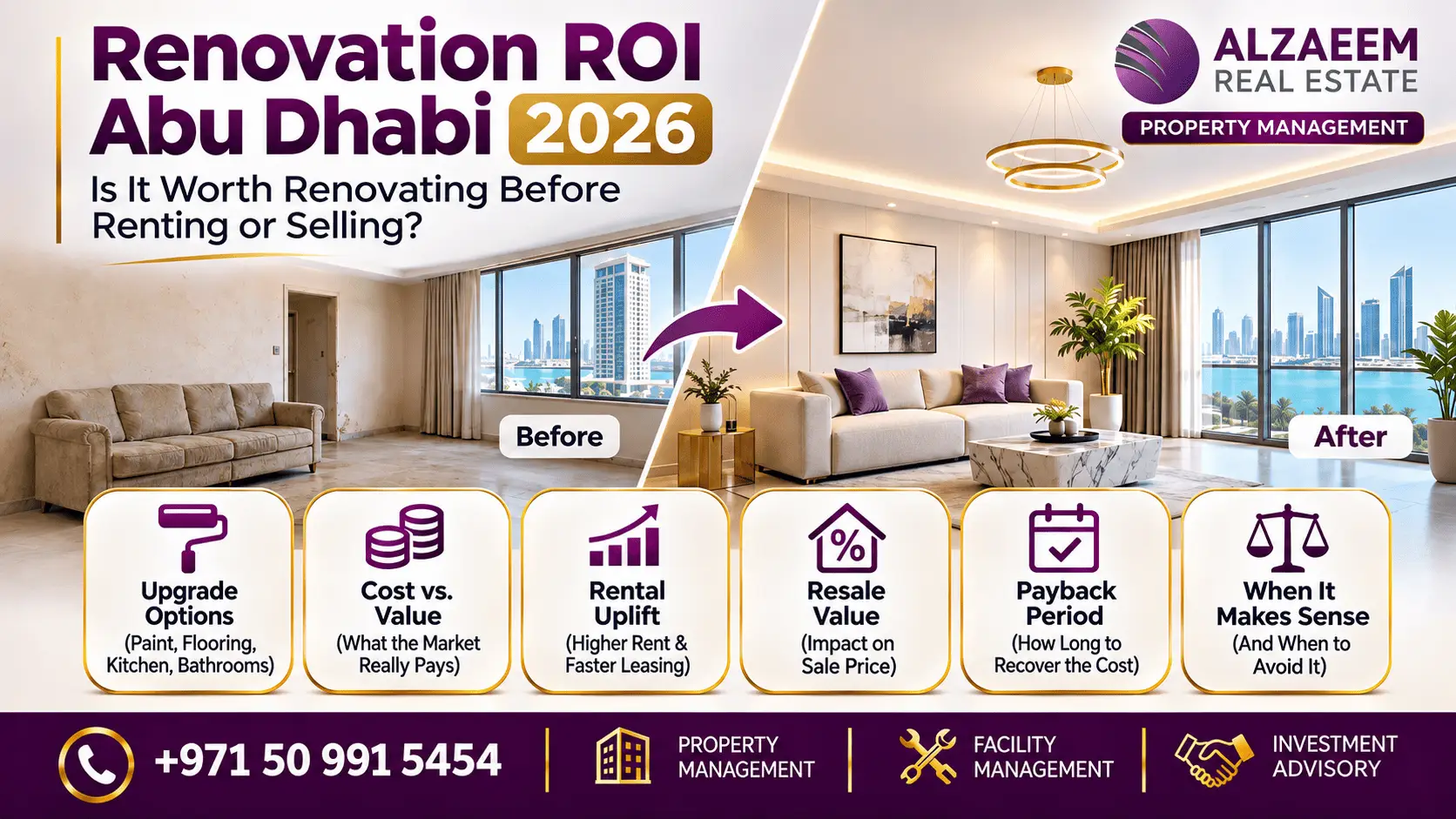
Renovating a property can increase its:
- rental appeal;
- achievable rent;
- resale value;
- leasing speed;
- buyer interest.
But there is one major problem:
Renovation cost is not automatically renovation value.
Spend AED 100,000 renovating an apartment and the market does not automatically add AED 100,000 to the property value.
Spend AED 50,000 furnishing and upgrading a rental property and tenants do not automatically pay enough extra rent to justify the investment.
A renovation only makes financial sense when the incremental economic benefit is strong enough to justify:
- renovation cost;
- time;
- vacancy;
- risk;
- maintenance implications;
- capital tied up.
For an Abu Dhabi property investor, the right question is therefore not:
Would this property look better after renovation?
Almost every property would.
The real question is:
Will the market pay enough more — through rent, faster occupancy, resale value or liquidity — to justify what I spend?
That is renovation ROI.
Why Renovation Analysis Matters More in Abu Dhabi in 2026
Abu Dhabi entered 2026 with a strong residential market.
ADREC’s H1 2026 data reported approximately:
- AED 70.4 billion in residential sales;
- 20% year-on-year repeat-sale price growth for apartments;
- 12% for villas;
- approximately 233,000 active residential leases;
- around 409,000 residential units in existing supply.
ADREC also projects approximately 71,000 additional residential units through 2030, with deliveries expected to peak around 2028.
For owners, this creates two forces.
Strong Market
Buyers and tenants may pay premiums for attractive, ready-to-use properties.
Future Competition
More supply means landlords and sellers may increasingly compete on:
- condition;
- layout;
- presentation;
- functionality.
Renovation can therefore create differentiation.
But only if the owner upgrades the right things.
The Basic Renovation ROI Formula
For a rental property:
Rental Renovation ROI
Annual Incremental Net Income ÷ Renovation Cost × 100
Suppose:
Renovation cost:
AED 40,000
Old annual rent:
AED 100,000
New annual rent:
AED 112,000
Additional gross rent:
AED 12,000
Assume additional annual maintenance/depreciation associated with the upgrades:
AED 2,000
Incremental net income:
AED 10,000
Renovation ROI:
AED 10,000 ÷ AED 40,000 = 25% per year
Simple payback:
4 years
That could be attractive.
But only if the higher rent is actually achievable.
Renovation ROI for Resale Is Different
For a sale:
Resale Renovation Gain
Increase in achievable sale price − renovation cost − selling/holding costs
Suppose:
Property before renovation could sell for:
AED 1,800,000
Renovation costs:
AED 100,000
After renovation, realistic achievable price becomes:
AED 1,980,000
Gross value uplift:
AED 180,000
Less renovation:
AED 100,000
Gross renovation gain:
AED 80,000
That looks attractive.
But if the renovated property only achieves:
AED 1,900,000
then the owner spent AED 100,000 to create only AED 100,000 of value.
Before considering:
- vacancy;
- financing;
- selling expenses;
- owner time.
That renovation may have produced almost no economic profit.
Renovation Cost Does Not Equal Market Value
Our guide on Asking Price vs Market Value vs Bank Valuation in Abu Dhabi already establishes an important valuation principle:
A seller may spend AED 250,000 renovating a property, but that does not mean the market value rises by AED 250,000.
The market decides how much of that renovation is recoverable.
A buyer may value:
- new kitchen;
- upgraded bathrooms;
- better flooring;
- improved layout.
But may assign almost no value to:
- highly personal wallpaper;
- expensive decorative features;
- unusual colour schemes;
- luxury furniture they do not want.
Value-Add Renovation vs Personal Renovation
This distinction is fundamental.
Value-Add Renovation
Designed around the market.
Examples:
- neutral repainting;
- modern lighting;
- repairing worn flooring;
- improving kitchen functionality;
- refreshing bathrooms;
- fixing storage problems;
- improving general condition.
Personal Renovation
Designed around the current owner’s preferences.
Examples:
- highly specific colours;
- unusual feature walls;
- expensive bespoke furniture;
- niche design themes;
- decorative elements with limited resale appeal.
An end user can renovate however they want.
An investor should usually renovate for:
the next tenant or buyer.
Start With the Property’s Current Position
Before spending anything, answer:
Is the property already competitive?
What do comparable units look like?
Is the property genuinely dated?
Is the problem cosmetic or structural?
Is the target tenant price-sensitive or quality-sensitive?
Is the target buyer an investor or end user?
What is the realistic rent or resale uplift?
Do not renovate simply because:
“The unit is five years old.”
Age alone does not determine renovation need.
Cosmetic Renovations Usually Have the Best Risk-Adjusted ROI
For many investment properties, the highest-return improvements are relatively simple.
These can include:
- paint;
- lighting;
- minor flooring repair;
- silicone and grouting;
- cabinet repairs;
- door hardware;
- deep cleaning;
- AC servicing;
- plumbing repairs.
Why?
Because they improve the property’s visual and functional condition without requiring major capital.
Example: AED 15,000 Cosmetic Refresh
Suppose an apartment needs:
Paint:
AED 5,000
Lighting:
AED 2,000
Deep cleaning:
AED 1,500
Minor carpentry:
AED 2,000
Bathroom sealant and fittings:
AED 1,500
Other repairs:
AED 3,000
Total:
AED 15,000
Without the refresh:
Realistic rent:
AED 100,000
With the refresh:
Realistic rent:
AED 106,000
Annual rent uplift:
AED 6,000
Simple payback:
2.5 years
If the improved condition also reduces vacancy by two weeks, the effective payback could be even faster.
Vacancy Reduction Can Be Part of Renovation ROI
This is often ignored.
Renovation does not need to increase rent to create value.
It may simply help the property lease faster.
Our How to Reduce Rental Vacancy in Abu Dhabi 2026 explains why every vacant day has a financial cost.
Suppose:
Annual rent:
AED 120,000
Monthly economic rent:
AED 10,000
A AED 12,000 cosmetic refresh does not increase rent.
But the refreshed unit leases one month faster.
Vacancy avoided:
AED 10,000
The renovation has already recovered most of its cost through occupancy alone.
Renovation Can Improve Tenant Quality
A well-presented property may attract a broader pool of tenants.
That can improve the landlord’s ability to choose based on:
- documentation;
- income;
- stability;
- intended tenancy length.
Our How to Screen a Tenant in Abu Dhabi 2026 explains why the strongest tenant is not necessarily the tenant offering the highest rent.
Better condition can expand the pool of qualified applicants.
Paint: Often One of the Highest-Return Improvements
Fresh paint can completely change perceived property condition.
It can make a unit feel:
- cleaner;
- newer;
- brighter.
For investment property, neutral tones usually provide broader market appeal than highly personalised colours.
The objective is not to make the interior boring.
It is to remove unnecessary barriers to:
- tenant imagination;
- buyer imagination.
Lighting Can Transform Perception
Poor lighting can make even an expensive property appear:
- dark;
- old;
- poorly maintained.
Upgrading:
- light fittings;
- damaged switches;
- inconsistent colour temperatures;
can improve presentation at relatively low cost.
This is particularly useful before:
- professional photography;
- viewings.
Flooring — Repair Before Replacing
Flooring can become expensive very quickly.
Before replacing the entire floor, ask:
- can damaged sections be repaired?
- can polishing restore it?
- is replacement genuinely needed?
A landlord should avoid spending:
AED 40,000
to solve an appearance problem that:
AED 8,000
could fix adequately.
Kitchen Renovation
The kitchen can strongly influence:
- family tenants;
- end-user buyers.
But full kitchen replacement can be expensive.
Before replacing everything, consider:
Cabinets
Can they be repaired or refinished?
Handles
Can a small hardware change modernise the look?
Countertops
Are they genuinely damaged?
Appliances
Are they operational and appropriate?
A partial refresh can sometimes produce most of the visual benefit at a fraction of the cost.
When Full Kitchen Replacement Makes Sense
A full replacement becomes more defensible where the kitchen is:
- badly damaged;
- functionally outdated;
- materially below competing properties;
- limiting the property’s resale audience.
For a premium villa or high-end apartment, buyers may heavily discount an outdated kitchen.
In a mid-market rental unit, they may simply want:
- clean;
- functional;
- modern enough.
Different markets justify different renovation budgets.
Bathrooms
Bathrooms are similar.
Small improvements can include:
- new sealant;
- grout repair;
- taps;
- shower fittings;
- mirrors;
- lighting;
- damaged vanity repairs.
A full bathroom replacement may not be necessary.
Investors should first solve:
visible deterioration.
Then decide whether a full redesign produces incremental economic value.
Wardrobes and Storage
Storage is a functional upgrade.
Tenants and buyers may value:
- built-in wardrobes;
- efficient shelving;
- usable storage.
Unlike decorative upgrades, storage solves a practical problem.
That can make it more defensible economically.
Balcony Upgrades
A balcony may benefit from:
- cleaning;
- flooring repair;
- safe lighting;
- minor landscaping.
But landlords should avoid overcapitalising.
A AED 30,000 luxury balcony fit-out may not meaningfully increase rent on a mid-market apartment.
Furnishing Is a Separate Investment Decision
Renovation and furnishing should not be mixed casually.
Our Furnished vs Unfurnished Property in Abu Dhabi 2026 explains why furniture requires separate return analysis.
A furnished unit may command higher rent.
But the investor must account for:
- furniture depreciation;
- appliance replacement;
- damage;
- cleaning;
- turnover.
Do not say:
“Renovation cost AED 80K.”
when AED 50K of that is actually movable furniture.
Analyse them separately.
Renovating Before Renting
A rental renovation should focus on:
income and occupancy.
Ask:
Will it increase achievable rent?
Will it reduce vacancy?
Will it attract stronger tenants?
Will it reduce maintenance complaints?
Will it increase renewal probability?
If the answer is no to all of these, the renovation may not be financially necessary.
Renovating Before Selling
A resale renovation has a different objective.
It may aim to improve:
- buyer perception;
- transaction speed;
- price;
- financeability;
- inspection outcome.
The key metric becomes:
incremental sale proceeds.
Not annual rent.
Should You Renovate Before Selling?
Not always.
Sometimes the correct strategy is:
Sell as-is and let the buyer renovate.
This can be appropriate when:
- property is heavily dated;
- renovation cost is large;
- target buyer may want their own design;
- owner needs liquidity quickly.
A large renovation before sale adds:
- execution risk;
- delay;
- capital exposure.
The “Buyer Will Pay Me Back” Trap
Suppose:
Property as-is market value:
AED 2.5M
Owner spends:
AED 300K
Owner expects:
AED 2.8M + profit
But buyers value renovated property at:
AED 2.7M
The owner has spent:
AED 300K
to create:
AED 200K value.
Economic loss:
AED 100K
before holding costs.
This is why renovation should be based on comparable renovated transactions where possible.
What Buyers Actually Pay For
Buyers may pay premiums for:
- ready-to-move condition;
- modern kitchen;
- modern bathrooms;
- good flooring;
- quality lighting;
- functional layout;
- neutral professional design.
They may not fully reimburse:
- luxury furniture;
- expensive art;
- bespoke decorative features;
- personal design preferences.
Market Value vs Renovation Spend
Use the framework from our Asking Price vs Market Value vs Bank Valuation guide:
Renovation Spend
What you paid.
Renovation Value
What the market recognizes.
These are different numbers.
The investor makes money only when:
recognized market value > total renovation cost and holding cost.
Renovation and Bank Valuation
Mortgage buyers add another issue.
Even if a buyer loves an expensive renovation, the bank valuer may not assign the same premium.
A seller asking:
AED 2.5M
because they spent:
AED 250K
on interiors may still face a bank valuation of:
AED 2.3M
if comparable market evidence does not support the premium.
That can reduce the buyer’s financing.
Renovating an Apartment vs Villa
These are different strategies.
Apartment
Typical high-value improvements:
- paint;
- kitchen;
- bathroom;
- lighting;
- flooring;
- storage.
Villa
May additionally involve:
- external paint;
- landscaping;
- garden;
- pool;
- gates;
- exterior lighting;
- multiple AC systems.
Villa renovation can become substantially more expensive.
Villa Renovation Risk
A villa owner can easily spend:
AED 300K–AED 1M+
depending on scope.
That does not mean the investment is wrong.
But once the budget becomes large, the owner should analyse:
- local resale ceiling;
- competing new villas;
- plot size;
- location;
- age;
- buyer profile.
Do not put AED 800K into a property where comparable renovated villas sell only AED 400K above unrenovated ones.
Older Villa vs Newer Villa
Older villas can offer:
- larger plots;
- established landscaping;
- mature communities.
But may require more:
- AC work;
- plumbing;
- electrical;
- waterproofing;
- pool work;
- roof maintenance.
A full technical inspection should come before aesthetic renovation.
The worst renovation is:
new flooring above an unresolved leak.
Maintenance vs Renovation
This distinction matters.
Maintenance
Restores normal function.
Examples:
- fixing AC;
- repairing leak;
- replacing failed water heater.
Renovation
Improves the property beyond its previous condition.
Examples:
- new kitchen;
- upgraded flooring;
- modern bathroom;
- layout improvement.
The landlord should usually complete necessary maintenance first.
Our Landlord vs Tenant Maintenance Abu Dhabi 2026 explains why maintenance obligations and investment upgrades should not be confused.
Structural Alterations Require More Caution
Do not assume ownership means unlimited freedom to alter the property.
ADREC’s current community-management guidance states that owners or occupants must obtain prior written approval from the developer or management company for alterations affecting:
- structure;
- external appearance;
- common parts;
unless those works are expressly permitted under approved building, floor or community rules.
That makes renovation planning more than a design question.
It can also involve:
- community approval;
- technical review;
- contractor requirements.
Always Check the Community Before Major Works
Especially before:
- removing walls;
- changing façade elements;
- changing balconies;
- modifying common-system connections;
- major plumbing changes.
The exact approval process depends on the property and community.
Do not start work first and ask permission later.
Renovation While Tenanted vs Vacant
Renovation is usually easier when vacant.
Vacant Property
Advantages:
- unrestricted contractor access;
- faster work;
- easier photography;
- no tenant disruption.
Disadvantage:
- no rental income during works.
Tenanted Property
Advantage:
- ongoing income.
Disadvantages:
- access restrictions;
- tenant disruption;
- slower execution.
Major renovation during an active tenancy can be operationally difficult.
Renovation Vacancy Must Be Included in Cost
Suppose:
Renovation budget:
AED 50,000
Work duration:
6 weeks
Annual market rent:
AED 120,000
Six-week lost rent:
approximately AED 13,850
True economic renovation cost is closer to:
AED 63,850
before other holding costs.
This changes ROI materially.
Renovation Payback Period
A simple formula:
Renovation Cost ÷ Annual Incremental Net Income
Example:
Renovation:
AED 60,000
Additional net annual rent:
AED 12,000
Payback:
5 years
Now ask:
Am I likely to hold the property at least five years?
If you plan to sell in 18 months, that rental payback may not be attractive unless the renovation also increases resale value.
Required Rent Uplift Formula
Suppose you want renovation capital to pay back in:
4 years
Renovation cost:
AED 40,000
Required incremental annual income:
AED 10,000
If added annual maintenance from the upgraded property is:
AED 2,000
you need approximately:
AED 12,000 additional gross rent
to achieve your target.
If market evidence supports only:
AED 5,000 extra rent
the renovation does not meet the target.
Case Study 1 — Apartment Cosmetic Upgrade
Property
1BR apartment
Current achievable rent:
AED 85,000
Renovation
Paint: AED 4,000
Lighting: AED 2,000
Minor flooring repair: AED 3,000
Bathroom refresh: AED 2,000
Cleaning: AED 1,000
Total:
AED 12,000
Post-Renovation Rent
AED 91,000
Additional rent:
AED 6,000
Simple annual renovation ROI:
50%
Simple payback:
2 years
If the better condition also reduces vacancy, economic performance becomes even stronger.
This is the type of renovation investors should like:
low capital + visible improvement + realistic rent uplift.
Case Study 2 — Large Apartment Renovation
Property
2BR apartment
Current value:
AED 1.8M
Current rent:
AED 110K
Renovation
Kitchen: AED 55K
Bathrooms: AED 40K
Flooring: AED 35K
Lighting/paint: AED 20K
Total:
AED 150K
Post-Renovation Rent
AED 125K
Rent uplift:
AED 15K
Simple rental payback:
10 years
That is weak if rental income is the only benefit.
But suppose renovated resale value rises from:
AED 1.8M
to:
AED 2.05M
Value uplift:
AED 250K
Then renovation becomes more interesting.
The same renovation can therefore be:
- weak as a rental strategy;
- strong as a resale strategy.
Case Study 3 — Villa Over-Renovation
Existing Villa Value
AED 4.5M
Renovation Budget
AED 700K
Owner installs:
- premium imported kitchen;
- luxury marble;
- designer lighting;
- bespoke wardrobes;
- expensive landscaping.
Total capital:
AED 5.2M
Comparable renovated villas in the community sell around:
AED 4.9M–AED 5.0M
The owner has created:
- a beautiful villa;
- but a poor investment.
The market does not care what the renovation cost.
It cares what competing buyers are willing to pay.
Avoid Over-Renovating Mid-Market Property
This is one of the biggest risks.
A mid-market rental property does not necessarily need:
- marble;
- premium European kitchen;
- designer fittings.
Tenants may appreciate them.
But they may not pay enough extra rent to justify them.
The renovation specification should match the property’s market segment.
Match Renovation Quality to Location
A premium Saadiyat residence and a mid-market rental apartment should not automatically receive the same renovation budget.
The stronger the underlying:
- location;
- view;
- buyer profile;
- rental segment;
the more the market may reward premium finishes.
But even luxury markets have ceilings.
Do Not Renovate to Compensate for a Fundamental Weakness
Renovation cannot fix:
- poor location;
- bad view;
- weak layout;
- excessive service charges;
- poor building management;
- low parking availability.
Do not spend AED 150K trying to solve a problem the renovation cannot solve.
Layout Changes Can Create Value — But Carry More Risk
Changing layout can be powerful.
Examples:
- improving kitchen connection;
- creating storage;
- improving circulation.
But layout changes can involve:
- approvals;
- structural limitations;
- MEP systems;
- fire-safety considerations.
Do not treat wall removal as a cosmetic project.
Get the proper technical and community approvals.
Before-and-After Photography Helps Resale
If you renovate for sale, document the transformation.
This can support:
- listing presentation;
- buyer confidence;
- evidence of work completed.
Keep:
- invoices;
- contractor documentation;
- warranties.
Professional records can help distinguish a genuine renovation from superficial cosmetic staging.
Renovation Quality Matters
A cheap renovation executed badly can reduce value.
Watch for:
- uneven flooring;
- poor paint;
- bad tile installation;
- leaking plumbing;
- exposed wiring;
- badly fitted cabinetry.
The buyer may immediately budget to redo the work.
Then your renovation has created:
cost without value.
Lowest Contractor Quote Is Not Automatically Best
Suppose:
Contractor A:
AED 60K
Contractor B:
AED 80K
If Contractor A produces defects that require:
AED 30K rework
the cheaper contractor cost:
AED 90K
Quality control matters.
Renovation Contingency
Renovation budgets often expand.
A useful investor approach is to include contingency.
For example:
Base budget:
AED 100,000
10% contingency:
AED 10,000
Underwritten cost:
AED 110,000
This makes the ROI model more realistic.
Renovation Timeline Also Needs Contingency
A four-week project can become:
- six weeks;
- eight weeks.
Reasons may include:
- material delays;
- approval delays;
- contractor scheduling;
- hidden defects.
If the property is vacant, each delay has a rental cost.
Renovation and Future Supply
ADREC projects around 71,000 additional residential units through 2030, with significant supply expansion expected across major districts.
For owners of older properties, this matters.
New buildings often enter the market with:
- new kitchens;
- new bathrooms;
- modern amenities;
- fresh interiors.
Older units may need selective renovation to remain competitive.
But do not try to make a 15-year-old building look like a brand-new development through interiors alone.
The building itself still matters.
Renovation Can Protect Competitiveness
Sometimes the objective is not higher rent.
It is preventing rent from falling relative to newer competition.
Example:
Without upgrade:
Expected rent:
AED 90K
After upgrade:
AED 100K
But current rent was already:
AED 100K
The renovation did not create visible growth.
It protected income.
That can still be valuable.
Resale Liquidity Matters
A renovated property may sell:
- faster;
- with fewer objections.
That has economic value.
Suppose:
As-is property takes:
8 months
Renovated property takes:
3 months
If the seller has:
- mortgage;
- service charges;
- capital tied up;
five months less holding time can materially improve the result.
Renovation Before Selling vs Price Discount
Sometimes the simpler strategy is to reduce the asking price.
Example:
Property needs AED 100K renovation.
Instead of spending AED 100K, seller discounts the property:
AED 70K
Buyer accepts.
Seller saves:
- renovation risk;
- time;
- capital.
This can be economically superior.
How to Decide
Ask:
What is the as-is value?
What is the renovated value?
What is the full renovation cost?
How long will it take?
What income will be lost?
What does the market actually reward?
Then compare.
Renovation Decision Matrix
| Situation | Likely Strategy |
|---|---|
| Good property, cosmetic wear | Light refresh |
| Rental unit with weak presentation | Targeted upgrade |
| Older premium villa | Technical + selective renovation |
| Major structural defects | Inspect before cosmetic work |
| Selling quickly | Consider as-is vs light staging |
| Strong end-user buyer market | Selective resale renovation |
| Mid-market rental | Avoid luxury over-specification |
| Highly personal existing interior | Neutralise selectively |
| New competing supply nearby | Upgrade for competitiveness |
| Weak building/location | Avoid trying to renovate away structural market weakness |
Rental Renovation Checklist
Before renovating for rent:
Market Rent
What does an unrenovated comparable achieve?
Renovated Rent
What does an upgraded comparable achieve?
Cost
Full budget including contingency?
Vacancy
How much income is lost during work?
Payback
How many years?
Tenant Profile
Does the target tenant value the upgrades?
Maintenance
Will new finishes increase operating cost?
Exit
Will the upgrades help resale?
Resale Renovation Checklist
Before renovating for sale:
As-Is Value
What can you sell for today?
Renovated Value
What do comparable upgraded properties sell for?
Renovation Cost
Including contingency.
Holding Cost
Mortgage, service charges and lost time.
Buyer Profile
Investor or end user?
Bank Valuation
Will financeable value support the premium?
Design
Broad appeal or personal taste?
Exit Timing
How long do you intend to hold?
What Should Usually Be Fixed Before Renting?
At minimum, a rental should have:
- functioning AC;
- safe electrical systems;
- functioning plumbing;
- working appliances where included;
- clean walls;
- usable doors and locks;
- clean kitchen;
- clean bathrooms.
These are closer to rental readiness than optional luxury renovation.
What Should Usually Be Improved Before Selling?
Prioritise the things buyers notice immediately:
- entrance;
- paint;
- lighting;
- flooring;
- kitchen;
- bathrooms;
- cleanliness.
The first impression influences:
- viewing experience;
- perceived maintenance;
- negotiation.
Professional Property Management Can Help Identify the Right Scope
A property manager sees:
- tenant feedback;
- competing inventory;
- maintenance history;
- rental performance.
Through Al Zaeem Property Management, landlords can use that operational information to decide whether a property needs:
- simple maintenance;
- cosmetic refreshing;
- or more substantial upgrading.
That is more useful than renovating purely from personal preference.
Facility Management and Renovation Preparation
Before major cosmetic work, technical defects should be identified first.
Al Zaeem Facility Management can support areas such as:
- AC;
- electrical;
- plumbing;
- painting;
- flooring;
- woodwork.
The logical sequence is:
inspect → repair → renovate → market.
Not:
decorate → discover hidden defect → redo renovation.
The Best Renovation Is Not Always the Biggest
For investors, the strongest upgrade may be:
- AED 10K;
- AED 20K;
- AED 50K;
rather than AED 300K.
The objective is not to create the most impressive property.
It is to create the best:
incremental return on capital.
Renovation ROI Framework
Before approving any renovation, calculate four numbers.
1. Total Capital Cost
Renovation
- contingency
- furnishing where applicable
2. Income Lost During Work
Vacancy × monthly economic rent
3. Incremental Benefit
Additional annual rent
- vacancy reduction
- estimated resale uplift
4. Payback / Return
How long does it take for the incremental benefit to recover the investment?
If these numbers are unclear, the renovation decision is not ready.
Final Verdict
Renovating an Abu Dhabi property can be an excellent investment.
But:
renovation does not create value simply because money was spent.
The strongest renovations solve a market problem.
They may:
- raise achievable rent;
- reduce vacancy;
- attract stronger tenants;
- improve resale value;
- increase buyer liquidity;
- keep older property competitive with new supply.
The weakest renovations are usually:
- overly personal;
- over-specified;
- expensive relative to the property’s price segment;
- unsupported by market evidence.
For rental investors, focus on:
incremental annual net income ÷ total renovation cost.
For sellers, focus on:
incremental sale value − total renovation and holding cost.
And always remember:
AED 100,000 spent is not automatically AED 100,000 added to the property.
The market decides what your renovation is worth.
In a 2026 Abu Dhabi market showing strong transaction and rental activity but also substantial future residential supply, selective upgrades can be a powerful way to protect competitiveness — but disciplined capital allocation matters more than renovation size.
For landlords and investors, the best sequence is:
inspect → identify the market gap → calculate ROI → obtain required approvals → renovate selectively → professionally market the result.
Official Sources
Abu Dhabi Real Estate Centre — H1 2026 Market Report
ADREC’s H1 2026 report provides current residential sales, price, lease and future-supply data. ADREC H1 2026 Market Report
ADREC — Community Affairs
Current guidance confirms that prior written approval is required for alterations affecting structure, external appearance or common parts unless otherwise expressly permitted. ADREC Community Affairs
Disclaimer
This article is for general real-estate education and investment analysis only. It does not constitute legal, engineering, valuation, financial or renovation advice.
All costs, rents, values, payback periods and ROI examples are illustrative only. Actual renovation costs and financial outcomes depend on the property, scope, contractor, location, approvals, market conditions and buyer or tenant demand.
Property owners should verify community, developer, municipal and technical requirements before carrying out alterations.
Last reviewed: November 2026.