

One of the most common disputes in a rental property begins with a very simple question:
Who has to pay for this repair?
The landlord says:
“The tenant is using the property.”
The tenant says:
“The landlord owns the property.”
Neither statement alone answers the question.
In Abu Dhabi, maintenance responsibility depends on several factors, including:
- the type of repair;
- whether the issue is necessary to keep the property usable;
- whether the tenant caused the damage;
- what the tenancy agreement says;
- whether the repair is considered a customary rental repair.
Under Abu Dhabi’s tenancy framework, the general legal structure is relatively clear.
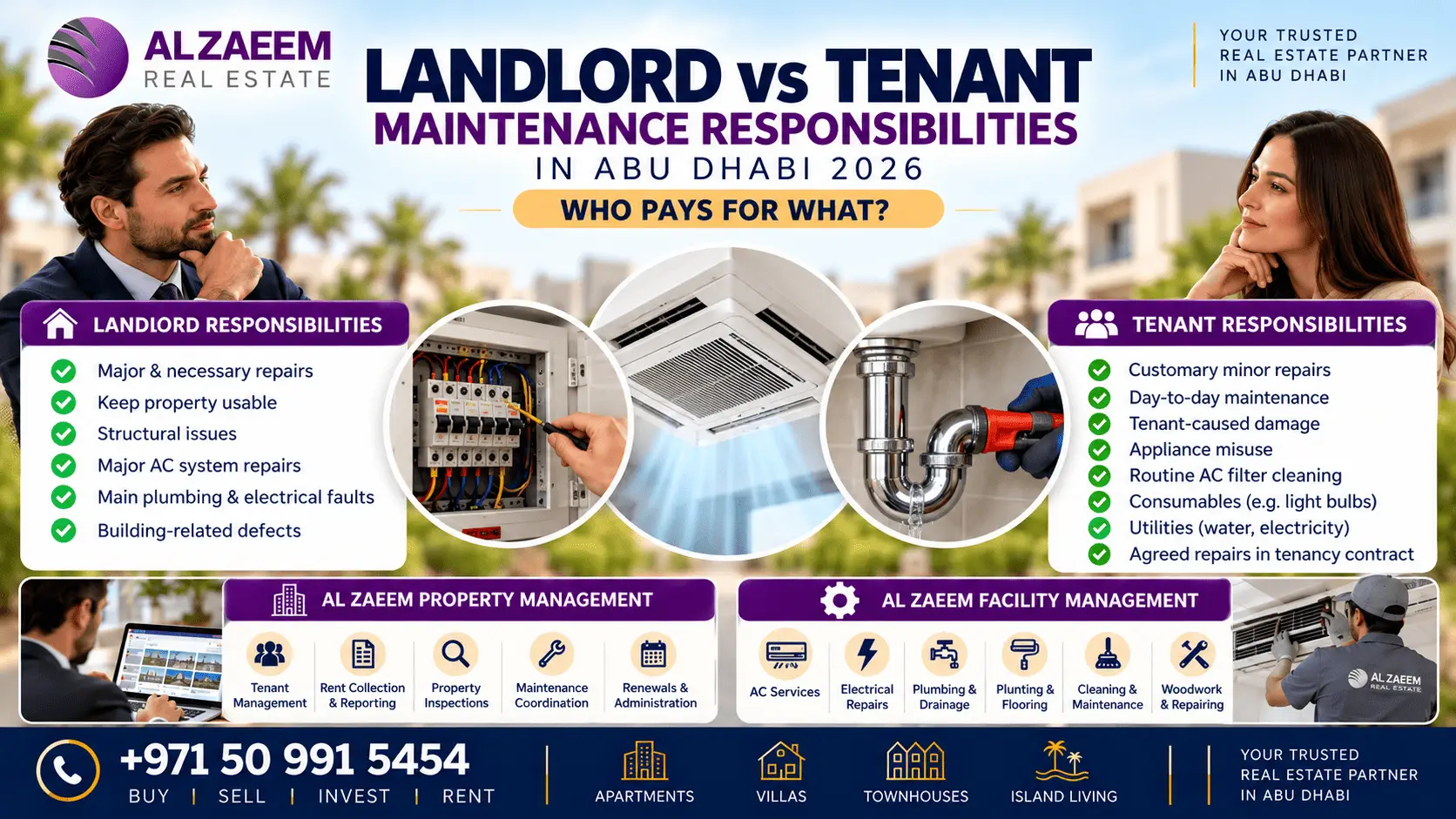
The landlord is responsible for maintaining the leased property so it remains fit for its intended use and for carrying out necessary repairs, excluding customary rental repairs, unless otherwise agreed. The tenant is responsible for customary or agreed rental repairs and for damage caused by the tenant. Adrec
For landlords and investors, understanding that distinction is essential.
Because maintenance is not only a tenant-service issue.
It affects:
- occupancy;
- tenant retention;
- operating costs;
- property condition;
- resale value;
- net rental yield.
The Basic Abu Dhabi Rule
Abu Dhabi Law No. 20 of 2006 defines two important categories.
Necessary Repairs
These are urgent or essential repairs needed:
- to protect the property from deterioration or destruction;
- or to allow the tenant to properly use the property.
The law places these responsibilities generally on the landlord. Adrec
Rental Repairs
These are minor repairs that tenants customarily undertake.
These are generally the tenant’s responsibility, or may be allocated by agreement. Adrec
This distinction is much more useful than the informal rule people sometimes use:
“Anything under AED X is tenant responsibility.”
There is no universal Abu Dhabi legal rule in the cited tenancy provisions saying that every repair below a fixed dirham amount automatically belongs to the tenant.
The nature and cause of the repair matter.
What Is Normally the Landlord’s Responsibility?
The landlord’s responsibility generally relates to keeping the property fit for normal use.
Examples can include major or necessary issues involving:
- core plumbing systems;
- major electrical faults;
- essential AC system failures;
- significant water leakage;
- structural or building-related defects;
- major equipment forming part of the leased property.
The exact outcome depends on:
- the cause;
- the contract;
- the actual defect.
The legal principle is that the landlord must keep the leased property usable and perform necessary repairs unless there is a valid agreement allocating matters differently. Adrec
What Is Normally the Tenant’s Responsibility?
The tenant is generally responsible for:
- customary minor rental repairs;
- repairs specifically assigned to them under the tenancy agreement;
- damage caused by their actions or misuse.
The law also states that the tenant must pay for damage they cause to the leased property, unless otherwise agreed. Adrec
So the question is not simply:
Is this broken?
It is:
Why is it broken?
Normal Wear vs Tenant Damage
This distinction is fundamental.
Consider two doors.
Door A
The hinge fails after years of ordinary use.
Door B
The door is damaged because it was forcibly slammed or altered.
Same object.
Different cause.
The responsibility may therefore be different.
Landlords should separate:
normal deterioration
from
tenant-caused damage.
AC Maintenance in Abu Dhabi Rentals
Air conditioning is particularly important in Abu Dhabi.
An AC issue may involve:
- filters;
- thermostat;
- drainage;
- fan motor;
- compressor;
- central cooling system;
- building-level infrastructure.
A simple filter-cleaning obligation may be treated very differently from a failed compressor or major system defect.
This is why tenancy contracts should define AC responsibilities clearly.
If the failure is a major necessary repair required to keep the property usable and was not caused by tenant misuse, landlord responsibility may be engaged under the general statutory framework. Adrec
For landlords who do not want to coordinate these issues personally, Al Zaeem Facility Management provides AC servicing and wider technical maintenance support.
Plumbing: Who Pays?
Plumbing is another common dispute area.
Examples include:
- leaking tap;
- blocked drain;
- damaged pipe;
- leaking water heater;
- hidden plumbing failure.
The correct question is again:
Is it minor routine upkeep?
Is it a major system defect?
Did the tenant cause it?
A blockage caused by improper use is not equivalent to a concealed pipe failure.
Documenting the cause matters.
Electrical Repairs
Electrical issues can range from:
- replacing a simple light bulb;
- replacing a switch;
- circuit faults;
- distribution-board problems;
- wiring defects.
Routine consumables and minor customary items may sit differently from essential electrical-system repairs.
For serious faults, professional inspection is preferable to guesswork.
Appliances
If the landlord provides appliances such as:
- refrigerator;
- washing machine;
- dishwasher;
- cooker;
the tenancy agreement should clarify maintenance responsibility.
A key distinction remains:
Equipment failure through normal use
versus
damage caused by misuse.
A professional move-in inventory makes these disputes much easier to resolve.
Furnished Properties Require Better Documentation
Furnished properties contain more owner-supplied assets.
That can include:
- sofas;
- beds;
- televisions;
- appliances;
- tables;
- chairs.
Without a detailed condition report, it can become difficult to prove whether damage:
- already existed;
- developed through normal wear;
- was caused during the tenancy.
Our Furnished vs Unfurnished Property in Abu Dhabi 2026 explains why furnished investments require more operational management.
The Tenancy Contract Matters
Abu Dhabi’s tenancy law provides the general framework.
But it also repeatedly recognises that parties may agree differently in certain areas.
For example, Article 7 places necessary repairs on the landlord unless otherwise agreed, while Article 14 places customary or agreed rental repairs on the tenant. Adrec
This makes the tenancy contract extremely important.
A good contract should clearly address:
- routine maintenance;
- AC servicing;
- appliances;
- damage;
- emergency repairs;
- approval process.
Vague wording creates disputes.
Avoid Arbitrary Repair Thresholds
Some tenancy agreements use a maintenance threshold such as:
Tenant pays repairs up to AED X.
Commercially, parties may agree contractual arrangements.
But investors should not confuse a negotiated contract threshold with a universal Abu Dhabi statutory rule.
The law itself distinguishes between:
- necessary repairs;
- customary rental repairs;
- tenant-caused damage.
So always read the specific tenancy agreement together with the applicable legal framework. Adrec
What Happens if the Landlord Does Not Carry Out a Necessary Repair?
Abu Dhabi law specifically addresses this situation.
If the landlord is notified but delays carrying out the required obligations, or cannot be contacted, the tenant may seek permission from the relevant committee to carry out the work and deduct the cost from rent.
The law also preserves potential remedies relating to termination or reduction of rent where use of the property is materially affected. Adrec
The important point:
A tenant should not simply deduct arbitrary repair costs from rent without following the proper process.
Emergency Repairs
Emergency repairs may involve issues such as:
- serious water leakage;
- critical electrical fault;
- essential cooling failure;
- damage threatening the property.
The law also states that the tenant may not prevent the landlord from carrying out urgent repairs necessary to preserve the property. Adrec
That means both sides have responsibilities.
The landlord needs to act.
The tenant needs to provide reasonable access for legitimate urgent repair work.
Access Should Be Managed Professionally
Repair access can become a practical problem.
A landlord should not simply arrive unexpectedly.
A tenant should not unreasonably block urgent necessary repairs.
Good property management coordinates:
- appointment time;
- contractor;
- access;
- tenant communication;
- completion reporting.
This is one reason we recommend professional management for most rental investors.
See Self-Manage vs Property Management Abu Dhabi 2026.
Tenant Damage
The tenant is responsible for damage they cause to the property under Abu Dhabi’s tenancy framework, unless otherwise agreed. Adrec
Potential examples could include:
- damaged doors;
- broken fittings;
- damage from unauthorised alterations;
- misuse of equipment.
Evidence is essential.
Without documentation, the landlord may struggle to establish what happened.
Unauthorized Alterations
The tenancy law states that the tenant may not make changes to the property without written landlord permission, except where the change does not cause damage.
Where unauthorized changes exceed the permitted scope, the landlord may require the property to be restored and may seek compensation where applicable. Adrec
That is why tenants should obtain written approval before making significant modifications.
Move-In Condition Report
One of the strongest tools for avoiding disputes is a proper move-in inspection.
Record:
- walls;
- floors;
- doors;
- windows;
- kitchen;
- bathrooms;
- appliances;
- AC;
- furniture.
Use dated photographs.
Then both parties know the starting condition.
Move-Out Inspection
At the end of the tenancy, compare the property against the original condition report.
Separate:
Normal Wear
Expected deterioration through reasonable use.
Tenant Damage
Damage beyond normal use.
This creates a much more defensible process.
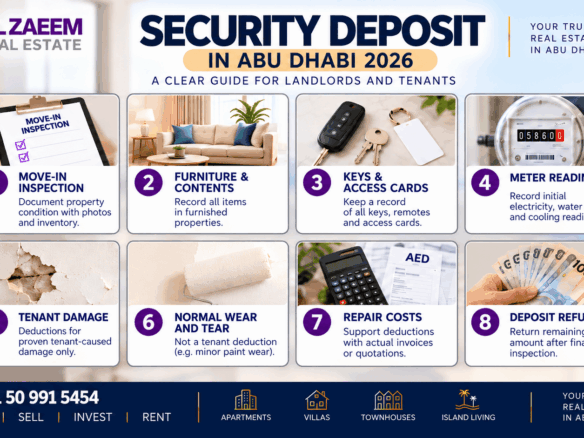
Security Deposit
A security deposit can help protect the landlord against certain legitimate losses.
But it should not become an automatic maintenance fund.
Any deduction should relate to documented contractual or tenant responsibilities.
This is another reason condition reports are important.
Utilities Are Different From Maintenance
The Abu Dhabi tenancy law states that the tenant generally pays for consumption of:
- water;
- electricity;
- telephone;
and other legally required fees from possession until surrender, unless otherwise agreed. Adrec
That is separate from deciding who pays for a physical repair.
Consumption and maintenance are different categories.
District Cooling Creates Another Layer
Cooling arrangements may involve:
- tenant consumption charges;
- landlord charges;
- service charges;
- building arrangements.
Our District Cooling vs Chiller-Free Abu Dhabi 2026 explains why landlords should separate:
cooling consumption
from
cooling-system maintenance.
Maintenance and Net Rental Yield
Maintenance directly affects investment return.
Suppose:
Annual rent:
AED 120,000
Service charges:
AED 18,000
Maintenance:
AED 6,000
Management:
AED 6,000
Vacancy allowance:
AED 5,000
Net operating income:
AED 85,000
If the property cost:
AED 1.8M
net operating yield is approximately:
4.72%
That tells a very different story from a headline gross yield of:
6.67%.
Our Abu Dhabi Property ROI Guide 2026 explains why maintenance must be included in net return.
Cheap Maintenance Can Become Expensive Maintenance
Consider an AC issue.
Option A
Professional repair:
AED 1,500
Option B
Temporary low-cost repair:
AED 400
But if Option B fails three times and eventually damages another component, the landlord may spend more overall.
The correct objective is:
lifecycle cost
not:
cheapest invoice.
Preventive Maintenance Matters
Not every repair should begin with a breakdown.
Preventive maintenance can help reduce:
- emergency failures;
- tenant complaints;
- larger repair costs.
Examples may include:
- AC servicing;
- plumbing inspection;
- drainage maintenance;
- electrical checks.
This is where Al Zaeem Facility Management becomes especially relevant to landlords.
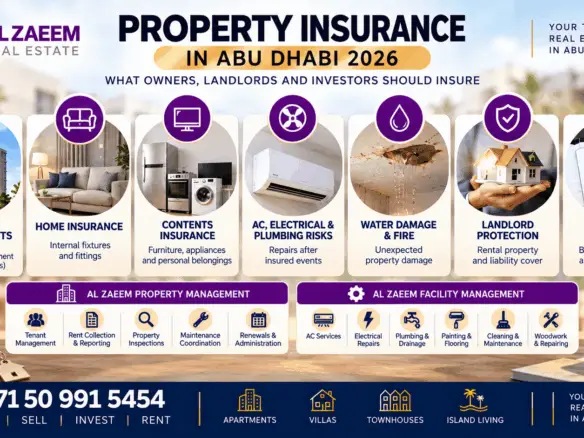
Al Zaeem Facility Management
Al Zaeem Facility Management provides technical and property-maintenance support including:
- AC services;
- electrical repairs;
- plumbing and drainage;
- cleaning;
- painting and polishing;
- tile and floor repairs;
- woodwork and repairing.
For rental investors, this creates a practical link between:
tenant reports issue
and
technical team resolves issue.
Property Management + Facility Management
The strongest operational setup is often not just a maintenance contractor.
It is an integrated management structure.
Through Al Zaeem Property Management, landlords can receive support around:
- tenant management;
- rent collection;
- renewals;
- inspections;
- maintenance coordination;
- reporting.
Through Al Zaeem Facility Management, the physical work can be coordinated professionally.
That creates:
commercial management + physical asset management.
Why This Matters for Overseas Investors
A landlord living abroad cannot easily inspect:
- an AC leak;
- damaged flooring;
- electrical fault.
They need a local process.
Our Buying Abu Dhabi Property From Overseas guide explains why remote investors should establish local management before problems occur.
Maintenance Approval Limits
A good management agreement can define clear authority.
For example:
- routine small repairs can be approved automatically;
- larger repairs require owner approval;
- genuine emergencies may have separate authority.
The exact thresholds should be agreed between owner and manager.
This keeps maintenance efficient without giving unlimited spending authority.
Document Every Repair
For investment properties, maintenance records are useful.
Keep:
- contractor invoice;
- photographs;
- work description;
- date;
- cost.
This helps with:
- future troubleshooting;
- resale;
- owner reporting.
Recurring Repairs Are a Warning Sign
If the same issue returns repeatedly, stop treating it as a small repair.
Examples:
- repeated AC drainage;
- recurring leakage;
- repeated electrical tripping.
A recurring problem may indicate a deeper defect.
Professional diagnosis becomes more important.
Common Areas Are Different
Not every problem belongs to the individual landlord or tenant.
Issues involving:
- lifts;
- corridors;
- lobby;
- shared systems;
- common landscaping
may involve the building or joint-property management framework.
Abu Dhabi’s property framework separately regulates management and maintenance of common parts. Adrec
So first identify:
Is the defect inside my unit or part of the common property?
Example: Water Leak
Imagine water enters an apartment.
Possible causes:
Tenant
Overflow caused by misuse.
Landlord Unit
Failed internal pipe.
Building
Common pipe or façade issue.
Three very different responsibility scenarios.
Do not assign blame before finding the source.
Example: AC Failure
Possible cause:
Minor Tenant Maintenance
Routine filter neglected.
Landlord Equipment
Compressor fails from normal equipment failure.
Building System
Central cooling infrastructure problem.
Again:
diagnosis first.
Payment second.
Example: Broken Appliance
Was the appliance:
- already old?
- properly maintained?
- misused?
- damaged accidentally?
A five-year-old refrigerator failing normally is different from physical damage caused during use.
Maintenance and Tenant Retention
Fast maintenance response can significantly improve the landlord-tenant relationship.
A tenant whose:
- AC fails;
- leak appears;
- electrical problem develops
cares less about who eventually pays than whether someone responds quickly.
Poor response can encourage non-renewal.
Tenant retention has financial value.
One Month of Vacancy Can Cost More Than Several Repairs
Suppose rent is:
AED 120,000 annually.
Monthly equivalent:
AED 10,000.
If poor maintenance causes the tenant to leave and creates one additional month of vacancy:
AED 10,000 is lost.
The landlord may have saved AED 1,000 by delaying a repair and lost ten times that amount.
Maintenance Is Part of Property Value
A rental property is a physical asset.
Repeatedly postponing:
- paint;
- AC servicing;
- plumbing;
- flooring
can gradually reduce its condition.
Eventually that affects:
- rent;
- buyer perception;
- resale value.
Maintenance should therefore be treated as asset protection, not just an expense.
Landlord vs Tenant Maintenance — Quick Guide
| Situation | General Responsibility |
|---|---|
| Necessary repair to keep property usable | Landlord, unless validly agreed otherwise |
| Customary minor rental repair | Tenant |
| Tenant-caused damage | Tenant |
| Major normal equipment failure | Often landlord depending on facts/contract |
| Tenant misuse | Tenant |
| Utilities consumption | Generally tenant unless otherwise agreed |
| Common-area defect | Building/common-property management may be involved |
| Unauthorized tenant alteration | Tenant may be required to restore/pay |
This is a practical summary, not a substitute for the tenancy contract or legal advice. The governing Abu Dhabi law and specific facts should be checked for any dispute. Adrec
Al Zaeem Maintenance Checklist for Landlords
Before leasing a property, establish:
Contract
Who pays for what?
AC
Who handles servicing and major repairs?
Appliances
Which are landlord-supplied?
Damage
How will tenant-caused damage be documented?
Inspections
Will there be move-in and move-out reports?
Emergency
Who does the tenant call?
Approval
What repair authority does the property manager have?
Facility Management
Who will physically carry out repairs?
Records
Will invoices and photographs be retained?
Reporting
How will the owner be updated?
Common Landlord Mistakes
Mistake 1: Treating Every Repair as Tenant Responsibility
The law does not support that broad approach.
Mistake 2: Ignoring Necessary Repairs
This can affect the tenant’s right to use the property and create legal and financial problems. Adrec
Mistake 3: No Condition Report
Then damage becomes difficult to prove.
Mistake 4: Choosing Contractors Only on Price
Cheap work can become recurring work.
Mistake 5: Responding Slowly
Maintenance response affects tenant retention.
Common Tenant Mistakes
Mistake 1: Assuming Every Repair Is the Landlord’s Problem
Customary rental repairs and tenant-caused damage may be the tenant’s responsibility. Adrec
Mistake 2: Making Unauthorized Changes
Get written permission where required. Adrec
Mistake 3: Ignoring Small Problems
A small leak can become major damage.
Report issues early.
Mistake 4: Deducting Repair Costs From Rent Without Proper Process
The law provides a process where the landlord does not fulfil necessary repair obligations; tenants should use the proper route rather than act unilaterally. Adrec
Why Professional Management Is Better for Most Landlords
Maintenance disputes often happen because there is no clear operational structure.
The tenant calls the owner.
The owner calls a contractor.
The contractor does not arrive.
The tenant calls again.
Professional property management creates a single chain:
Tenant → Property Manager → Facility Management → Repair → Report → Owner
For investment landlords, that is typically more scalable than personal coordination.
Al Zaeem Property Management and Facility Management
Al Zaeem can support both sides of the process.
Property Management
Handles:
- tenant communication;
- tenancy administration;
- rent collection;
- inspections;
- maintenance coordination;
- renewals;
- landlord reporting.
Facility Management
Supports technical work including:
- AC;
- electrical;
- plumbing;
- cleaning;
- painting;
- flooring;
- woodwork.
That means the investor can operate through one coordinated property ecosystem rather than building a new contractor network every time something fails.
Final Verdict
The question:
Who pays for maintenance in Abu Dhabi?
does not have one universal answer.
The general framework is:
Landlord
Responsible for keeping the property fit for use and carrying out necessary repairs, unless otherwise agreed.
Tenant
Responsible for customary/agreed rental repairs and damage caused by the tenant.
That framework comes directly from Abu Dhabi’s tenancy law. Adrec
But good property management should aim to prevent every repair from becoming a dispute.
The best system is:
identify the problem → establish the cause → check the tenancy agreement → determine responsibility → repair quickly → document everything.
For most investment landlords, professional management makes that process much easier.
Through Al Zaeem Property Management and Al Zaeem Facility Management, owners can combine tenant administration, inspections, rent management and maintenance coordination with practical technical support.
Because good maintenance does more than repair a property.
It protects:
tenant satisfaction → occupancy → rental income → asset condition → long-term investment value.