



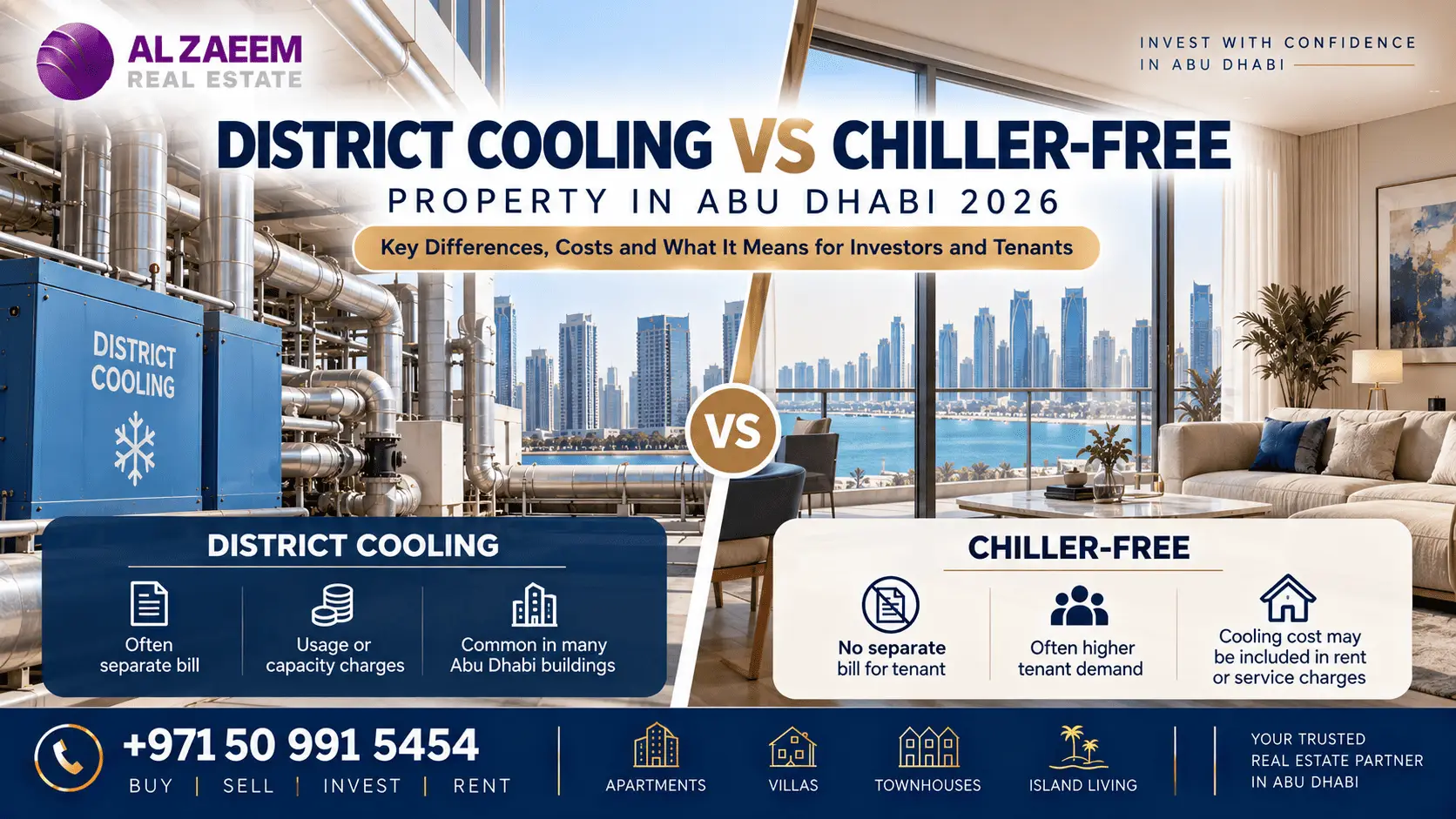
Two apartments may look almost identical.
They may have the same:
- bedroom count;
- floor area;
- view;
- rental price;
- building quality.
But their actual annual occupancy cost can still be different because of one issue buyers regularly underestimate:
Cooling.
One apartment may use a district-cooling system where cooling is separately metered or charged.
Another may be advertised as:
“Chiller Free.”
At first glance, the second property sounds obviously better.
But that conclusion can be misleading.
A “chiller-free” apartment does not mean cooling has no economic cost.
It usually means the occupant is not separately paying the cooling charge under the particular rental or building arrangement.
Someone is still funding the cooling system.
That cost may ultimately sit with:
- the landlord;
- the building;
- the service-charge structure;
- another contractual arrangement.
For investors, the correct question is therefore not:
Which property has free air conditioning?
It is:
Who pays for cooling, how much does it cost, and how does that affect rent, tenant demand and net yield?
This issue is important enough that our existing Hidden Costs of Buying Property in Abu Dhabi 2026 guide identifies cooling as a cost buyers should specifically investigate before acquisition. azcb.co
What Is District Cooling?
District cooling is a centralised cooling system.
Instead of every apartment relying entirely on an independent cooling plant, chilled water is produced through a central system and distributed to connected buildings.
The system can serve:
- residential towers;
- mixed-use developments;
- commercial buildings;
- large masterplanned communities.
The exact billing model can differ by project.
Charges may potentially include elements related to:
- consumption;
- capacity;
- account fees;
- other provider-specific charges.
That is why an investor should never ask only:
“Does this building have district cooling?”
The more useful question is:
What exactly is charged, who receives the bill, and who is contractually responsible for paying it?
AZCB’s existing ownership-cost guide makes the same point: two apartments with similar service charges can still have different utility economics because their cooling arrangements differ. azcb.co
What Does “Chiller Free” Mean?
“Chiller free” is commonly used in rental advertising.
It generally communicates that the tenant does not receive a separate cooling bill under that tenancy arrangement.
That sounds simple.
But investors need to ask:
Free for whom?
Cooling infrastructure still has an operating cost.
Depending on the building, that cost may be:
- absorbed by the landlord;
- included within another building charge;
- embedded indirectly within rent;
- structured differently by the owner or operator.
Therefore:
Chiller free is a payment arrangement, not zero-cost cooling.
This distinction matters to investors because the tenant’s attractive utility position can become the landlord’s expense.
Why Tenants Care About Chiller-Free Apartments
Tenants generally prefer predictable housing costs.
If two apartments rent for:
AED 100,000 per year
but one requires a separate cooling account while the other does not, the second may appear more affordable.
That can affect:
- enquiry volume;
- leasing speed;
- tenant retention;
- rent negotiation.
AZCB’s existing Abu Dhabi renting guide specifically warns tenants that separate chiller charges can create an additional expense and recommends checking whether cooling is included before signing. azcb.co
For landlords, that tenant preference can create real market value.
Why Investors Should Care
Cooling economics affect at least five investment variables:
- Achievable rent
- Tenant demand
- Vacancy
- Owner operating expenses
- Net yield
That means cooling should be investigated before purchasing — not after the first annual bill arrives.
District Cooling Does Not Automatically Mean Bad Investment
This is an important point.
Some buyers hear “district cooling” and immediately assume:
High bills. Avoid.
That is too simplistic.
A district-cooled building may still offer:
- excellent rental demand;
- strong energy infrastructure;
- premium location;
- high occupancy;
- attractive purchase price.
The correct approach is to quantify the costs.
Investment decisions should be based on:
price + rent + operating cost + demand
not labels.
Chiller-Free Does Not Automatically Mean Better Investment
The opposite mistake is equally common.
A listing says:
CHILLER FREE
and the investor assumes the building must be more profitable.
But what if:
- the landlord bears significant cooling-related costs;
- service charges are substantially higher;
- the purchase price carries a large premium;
- competing buildings achieve similar rent?
Then the chiller-free advantage may be smaller than it appears.
Example: Tenant Perspective
Imagine two identical 1-bedroom apartments.
Apartment A — District Cooling
Annual rent:
AED 90,000
Separate cooling expense to tenant:
AED 6,000 per year
Effective housing cost:
AED 96,000
Apartment B — Chiller Free
Annual rent:
AED 94,000
Separate cooling bill:
AED 0 to tenant
Effective tenant housing cost:
AED 94,000
Even though Apartment B has higher advertised rent, the tenant may still consider it cheaper overall.
That can improve demand.
Figures are illustrative only.
Example: Landlord Perspective
Now look at the same properties from the owner’s side.
Apartment A
Rent:
AED 90,000
Cooling paid by tenant.
Owner cooling expense:
AED 0 under the assumed structure
Apartment B
Rent:
AED 94,000
Owner-related cooling contribution:
AED 5,000
Effective income before other expenses:
AED 89,000
Suddenly, the supposedly superior chiller-free unit is producing slightly less effective income.
Again:
tenant economics and landlord economics are not always the same.
Gross Rent Can Hide Cooling Cost
Investors regularly compare properties using gross yield:
Annual Rent ÷ Purchase Price × 100
Suppose:
Property A
Purchase price: AED 1.5M
Rent: AED 100K
Gross yield:
6.67%
Property B
Purchase price: AED 1.5M
Rent: AED 105K
Gross yield:
7.00%
Property B looks better.
But if the landlord bears AED 8,000 of additional annual cooling-related cost:
Effective income:
AED 97,000
Effective yield before other costs:
6.47%
Now Property A may actually perform better.
Our How to Calculate Abu Dhabi Property ROI in 2026 explains why net operating income matters more than headline gross yield.
Cooling Cost Belongs Inside Net Yield
A proper rental model should include all material operating costs.
For example:
Gross Rent
minus:
- service charges;
- maintenance;
- management;
- vacancy;
- insurance;
- recurring leasing costs;
- owner-paid cooling costs;
- other building-specific expenses.
What remains is much closer to the actual investment return.
AZCB’s Abu Dhabi Property Taxes & Ownership Costs 2026 specifically recommends including district-cooling arrangements when reviewing annual property economics. azcb.co
Service Charges and Cooling Are Not Always the Same Thing
This is another common mistake.
A buyer asks:
“What is the service charge?”
Then assumes they now understand the annual ownership cost.
Not necessarily.
Cooling may be:
- separate;
- partially separate;
- consumption based;
- included differently under the building’s commercial structure.
Therefore request both:
Service-charge information
and
Cooling arrangement information.
Never assume one automatically includes the other.
District Cooling vs Chiller-Free — Quick Comparison
| Factor | District Cooling / Separate Cooling | Chiller-Free Arrangement |
|---|---|---|
| Tenant cooling bill | Often separate depending on building | Often not separately paid by tenant |
| Tenant cost predictability | Lower | Higher |
| Tenant marketing appeal | Moderate | Often stronger |
| Landlord expense | Depends on contract | May be higher depending on arrangement |
| Rent premium potential | Property dependent | Can be stronger |
| Utility administration | May require separate account | Often simpler for tenant |
| Net yield impact | Depends on who pays | Must verify owner cost |
| Vacancy advantage | Property dependent | Can help in competitive markets |
| Best use | Cost-transparent properties | Tenant-focused leasing strategy |
This is a framework, not a universal rule.
Why Building-Level Verification Is Essential
Cooling arrangements vary.
Even two neighbouring towers can have different:
- providers;
- billing structures;
- capacity charges;
- landlord responsibilities.
Therefore never rely on:
“Most buildings in this area work like this.”
Verify the exact building.
AZCB’s existing ownership-cost content explicitly advises investors not to generalise cooling arrangements from one Abu Dhabi property to another. azcb.co
What to Ask Before Buying
Before purchasing an apartment, ask:
1. What cooling system does the building use?
2. Is there a separate cooling provider?
3. Who pays the cooling bill?
4. Are there fixed charges?
5. Are there consumption charges?
6. Are there capacity charges?
7. Are any cooling costs included in service charges?
8. What did the previous occupant actually pay?
9. If rented, does the tenancy make the tenant or landlord responsible?
10. Does the building market units as chiller free?
These questions can materially change your yield calculation.
Ask for Real Bills
This is one of the most useful due-diligence steps.
Instead of asking:
“Is cooling expensive?”
request evidence.
Where available, review:
- previous cooling bills;
- annual statements;
- service-charge breakdowns.
Actual historical costs are more useful than broad estimates.
Our Abu Dhabi Property Due Diligence Guide 2026 follows the same principle:
verify financial assumptions before buying.
Cooling and Tenant Demand
Suppose two apartments are equally attractive.
Building A
Tenant pays separate cooling.
Building B
Chiller free.
If rent is similar, Building B may generate more enquiries.
This can influence:
- vacancy;
- renewal;
- rent negotiation.
Tenant demand should therefore be analysed as part of the full leasing market.
Our How to Analyse Rental Demand Before Buying Property in Abu Dhabi explains how investors should evaluate competing listings and tenant preferences before acquisition.
Chiller-Free Can Be a Powerful Listing Feature
Rental advertising often highlights features tenants immediately understand.
Examples:
- Sea View
- Furnished
- Balcony
- Chiller Free
“Chiller Free” communicates:
lower apparent monthly occupancy cost.
That can make a listing stand out.
But the landlord should understand whether they are effectively subsidising that marketing advantage.
Chiller-Free Rent Premium
Imagine:
Standard Cooling Unit
Rent: AED 100,000
Chiller-Free Unit
Rent: AED 106,000
Premium:
AED 6,000
If owner-paid cooling costs only:
AED 3,500
then the landlord may still gain economically.
Incremental benefit:
AED 2,500
But if owner cost is:
AED 8,000
then the premium does not compensate for the expense.
That is why the feature must be quantified.
Vacancy Can Make Chiller-Free More Valuable
Suppose offering chiller-free terms reduces vacancy by one month.
At AED 10,000 equivalent monthly rent, avoiding one month of vacancy can preserve:
AED 10,000
of annual income.
That may be more valuable than the cooling expense itself.
This is why tenant demand matters as much as utility cost.
Renewal Can Also Matter
Tenants who understand their total occupancy costs may be more willing to renew a property with predictable bills.
Tenant retention can save landlords:
- vacancy;
- repainting;
- cleaning;
- leasing costs;
- agent fees;
- time.
Therefore chiller-free economics should be assessed over the full tenancy lifecycle.
Furnished Apartments and Cooling
Furnished properties often target:
- relocating professionals;
- corporate tenants;
- convenience-driven renters.
For these tenants, bundled occupancy costs can be attractive.
A furnished apartment marketed as:
Ready to Move | Furnished | Chiller Free
may have strong leasing appeal.
But bundled expenses must be included in the landlord’s net-return model.
See our Furnished vs Unfurnished Property in Abu Dhabi 2026 guide for the wider furnishing economics.
Short-Term Rentals and Cooling
Cooling can become even more important in short-term rental economics.
In a conventional tenancy, the tenant may pay certain utilities separately.
In a short-term operation, the owner often bears more operating expenses directly.
That can include:
- electricity;
- cooling;
- internet;
- cleaning.
Therefore high cooling costs can reduce short-term net margins significantly.
Our Short-Term vs Long-Term Rental in Abu Dhabi 2026 guide explains why gross short-term revenue should never be confused with net investment return.
Building Age Can Affect Cooling Perception
Older and newer buildings may differ in:
- glazing;
- insulation;
- façade performance;
- AC systems.
A newer building does not automatically guarantee lower cooling costs.
But building-envelope efficiency can influence consumption.
This should form part of physical property due diligence.
Orientation Can Affect Cooling Demand
A west-facing apartment with extensive glazing may receive stronger late-afternoon solar exposure.
That can increase cooling demand compared with a more shaded orientation.
This is exactly why our East-Facing vs West-Facing Property in Abu Dhabi 2026 guide treats orientation as an investment variable rather than a decorative detail.
Cooling system and orientation should be analysed together.
Floor-to-Ceiling Windows Can Matter
Premium apartments often have large glass façades.
That can improve:
- light;
- view;
- luxury appeal.
But greater glazing can also change solar heat gain.
The quality of:
- glass;
- shading;
- insulation
therefore matters.
A beautiful sea-view apartment can still have higher cooling requirements.
Large Units Magnify the Difference
Cooling cost matters even more when comparing:
- large 3BR apartments;
- penthouses;
- duplexes.
A small difference in cooling efficiency across a large property can create a meaningful annual cost difference.
Investors should avoid assuming:
“It is only a utility bill.”
For large units, it may become a substantial operating variable.
Villas Require Separate Analysis
Villas may use a different cooling setup from apartment towers.
The investor should investigate:
- AC system;
- age;
- efficiency;
- maintenance history.
A villa with multiple independent AC units creates a very different maintenance profile from a district-cooled apartment.
Our Villa vs Townhouse in Abu Dhabi 2026 guide explains why maintenance and utility economics should be included when comparing low-density property.
Cooling and Resale
Most buyers do not purchase property because of the cooling system alone.
But expensive occupancy costs can affect resale indirectly.
Buyers may ask:
- How much are annual bills?
- Is cooling included?
- Are tenants happy with building costs?
A building known for unusually high recurring costs may become less attractive compared with nearby alternatives.
A Lower Purchase Price Can Compensate
Suppose Building A has less attractive cooling economics.
But units trade:
AED 100,000 cheaper
than comparable Building B.
That discount may more than compensate for several years of additional cooling expenses.
This is why investors must compare:
capital cost versus operating cost.
Not operating cost alone.
Illustrative 5-Year Comparison
Assume:
Property A — Separate District Cooling
Purchase price:
AED 1,400,000
Owner cooling cost:
AED 0
Annual rent:
AED 95,000
Property B — Chiller-Free to Tenant
Purchase price:
AED 1,500,000
Owner-related cooling cost:
AED 5,000/year
Annual rent:
AED 103,000
Over five years:
Additional rent from Property B:
AED 40,000
Additional cooling expense:
AED 25,000
Net operating advantage:
AED 15,000
But purchase premium:
AED 100,000
The chiller-free property may still have:
- stronger resale;
- lower vacancy;
- better tenant demand.
But the investor can now see that the premium is not justified purely by annual rent.
Illustrative example only.
Purchase Premium Matters
This is the same principle we apply to:
- sea views;
- high floors;
- balconies;
- corner units.
A desirable feature has investment value only when:
benefit justifies premium.
A chiller-free property bought at an excessive premium can still underperform.
Do Not Use Cooling Cost Alone to Choose a Building
A building with slightly higher cooling expenses may compensate through:
- lower service charges;
- stronger rent;
- better location;
- cheaper purchase price;
- higher occupancy.
Investment analysis must consider the complete package.
District Cooling and Service-Charge Comparison
Suppose:
Building A
Service charge:
AED 15/sq ft
Separate cooling.
Building B
Service charge:
AED 20/sq ft
Chiller free for tenant.
Simply saying:
Building B is chiller free
does not tell you which one is cheaper to own.
Calculate the full annual cost.
Our Hidden Costs of Buying Property in Abu Dhabi 2026 explains why investors should build a full cost stack rather than analyse expenses individually. azcb.co
Example Full Cost Stack
For a 1,000 sq ft apartment:
Building A
Service charge:
AED 15,000
Owner cooling:
AED 0
Total before other costs:
AED 15,000
Building B
Service charge:
AED 20,000
Owner cooling:
AED 4,000
Total:
AED 24,000
Difference:
AED 9,000 annually
If both properties rent for nearly the same amount, Building A may be materially stronger for the investor.
Who Should Pay Cooling?
There is no universal answer.
The correct arrangement depends on:
- building structure;
- tenancy contract;
- market practice;
- landlord strategy.
The key requirement is clarity.
Both parties should understand their obligations before signing.
Overseas Investors Need Extra Care
Remote buyers may rely heavily on agent summaries.
Do not settle for:
“Chiller is cheap.”
or
“Chiller free.”
Ask for documentation.
For overseas investors, recurring costs can be harder to discover after purchase.
Our Buying Abu Dhabi Property From Overseas guide explains why operating costs should be confirmed before committing remotely.
Common Cooling Mistakes Investors Make
Mistake 1: Assuming Chiller Free Means Zero Cost
Someone is still funding the cooling.
Mistake 2: Assuming District Cooling Is Always Expensive
Building economics differ.
Mistake 3: Looking Only at Service Charges
Cooling may sit outside them.
Mistake 4: Using Gross Yield
Owner-paid cooling reduces net income.
Mistake 5: Ignoring Tenant Preference
Utility simplicity can affect leasing demand.
Mistake 6: Trusting Area-Wide Generalisations
Check the exact building.
Mistake 7: Not Asking for Historical Bills
Real bills are better than estimates.
Al Zaeem Cooling Due-Diligence Checklist
Before buying or leasing an Abu Dhabi property, verify:
Cooling System
District cooling or another arrangement?
Provider
Who supplies the service?
Account
Whose name is the account under?
Fixed Charges
Are there recurring capacity or account charges?
Consumption
How is usage measured?
Responsibility
Tenant or landlord?
Service Charges
Is any cooling component included?
Historical Cost
What did previous occupants pay?
Rent Premium
Does chiller free support higher rent?
Vacancy
Does it improve leasing speed?
Net Yield
What remains after all owner expenses?
Which Is Better for Tenants?
From the tenant’s perspective, chiller-free arrangements often provide:
- simpler budgeting;
- fewer separate bills;
- lower perceived occupancy cost.
That can make them attractive.
But tenants should still compare total rent.
A property charging AED 10,000 more annual rent may not actually be cheaper just because it is chiller free.
Which Is Better for Landlords?
For landlords, the answer depends on the numbers.
Chiller free can be attractive when:
- it commands higher rent;
- reduces vacancy;
- improves retention;
- owner cost is manageable.
Separate cooling can be attractive when:
- tenant directly bears consumption;
- building remains competitive;
- rent remains strong.
Which Is Better for Investors?
There is no universal winner.
The better investment is the property with the stronger:
net return after cooling costs.
Do not buy the phrase.
Buy the economics.
Final Verdict
District cooling and chiller-free property in Abu Dhabi should not be treated as simple good-versus-bad categories.
A district-cooled apartment can be an excellent investment if:
- tenant demand is strong;
- cooling costs are transparent;
- purchase price is attractive;
- net yield remains competitive.
A chiller-free apartment can also be highly attractive when:
- tenants value the convenience;
- vacancy falls;
- rent premium exceeds the owner’s additional cost.
The key question is not:
Is the apartment chiller free?
It is:
Who pays the cooling cost, what is the real annual amount, and how does that change the property’s net rental return?
For serious investors, cooling is not merely a utility issue.
It is part of the operating economics of the asset.