


A property agent tells you:
“This apartment gives a 7% ROI.”
That sounds excellent.
But what exactly does 7% ROI mean?
Does it mean:
7% gross rental yield?
7% net rental yield after service charges?
7% return on the cash you personally invested?
Or does it include:
capital appreciation?
These are completely different calculations.
And confusing them is one of the easiest ways to misunderstand a property investment.
Consider a simple example.
An Abu Dhabi apartment costs:
AED 2,000,000
and rents for:
AED 140,000 per year.
The simple calculation is:
AED 140,000 ÷ AED 2,000,000 × 100 = 7%
So the property appears to offer a 7% gross rental yield.
But the owner may still need to pay:
service charges,
maintenance,
property management,
insurance,
vacancy costs,
leasing expenses,
mortgage interest,
and other ownership costs.
Once those are deducted, the real income return may be materially lower.
And if the property increases from AED 2 million to AED 2.4 million, another return appears:
capital appreciation.
If the buyer only invested AED 700,000 of their own money because the rest was financed or deferred through an off-plan payment plan, another metric becomes relevant:
cash-on-cash return.
That is why serious investors should stop using ROI, yield, profit, and appreciation as if they all mean the same thing.
They do not.
In Abu Dhabi’s 2026 market, this distinction has become especially important. ADREC reported AED 70.4 billion in residential sales during H1 2026, with off-plan property representing 89% of residential sales value and 82% of deals. Repeat-sale prices increased 20% year-on-year for apartments and 12% for villas. Meanwhile, the emirate recorded approximately 233,000 active residential lease contracts worth AED 9.3 billion.
Both sides of the investment equation are therefore active:
rental income
and
capital appreciation.
But the only way to know whether a property genuinely performs well is to calculate the return correctly.
Abu Dhabi Property ROI — The Five Numbers You Need
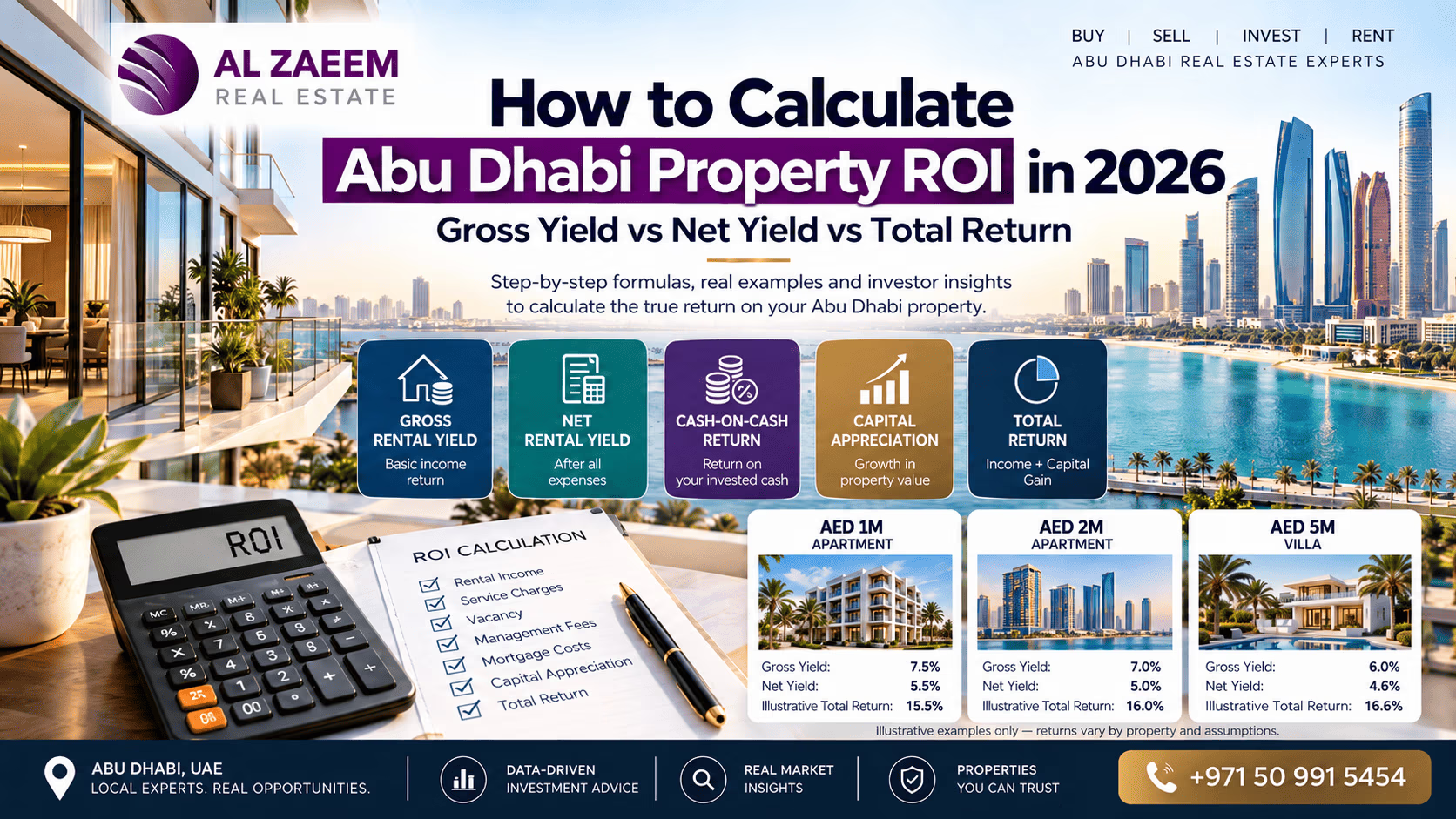
For most property investors, there are five useful return calculations:
| Metric | What It Measures |
|---|---|
| Gross Rental Yield | Rent relative to property price before expenses |
| Net Rental Yield | Income after recurring operating expenses |
| Cash-on-Cash Return | Return relative to your own cash invested |
| Capital Appreciation | Increase in property value |
| Total Return | Income + realised capital gain after costs |
These numbers answer different questions.
A professional investor should know which one they are discussing.
1. Gross Rental Yield
This is the simplest and most commonly advertised calculation.
Formula
Annual Gross Rent ÷ Property Purchase Price × 100
Suppose:
Property price:
AED 2,000,000
Annual rent:
AED 140,000
Calculation:
140,000 ÷ 2,000,000 × 100
= 7% gross rental yield
Simple.
Useful.
But incomplete.
Why Gross Yield Is Useful
Gross yield is excellent for quickly comparing properties.
For example:
Property A
Price: AED 2M
Rent: AED 140,000
Gross yield:
7%
Property B
Price: AED 2M
Rent: AED 110,000
Gross yield:
5.5%
Property A clearly generates more gross income relative to its purchase price.
That makes gross yield useful for screening opportunities.
But it should rarely be the final investment calculation.
Why Gross Yield Can Mislead You
Imagine two apartments.
Both cost:
AED 2 million
Both rent for:
AED 140,000
Both advertise:
7% gross yield.
But:
Apartment A
Service charges:
AED 15,000
Apartment B
Service charges:
AED 35,000
Their real income performance is not equal.
The gross-yield calculation hides that difference.
2. Net Rental Yield
Net rental yield gives a much more realistic picture of the property’s operating performance.
Basic Formula
Annual Net Rental Income ÷ Total Property Cost × 100
Annual net rental income means:
Gross rent − recurring ownership expenses
Depending on the property and strategy, those expenses may include:
- service charges;
- maintenance;
- property management;
- insurance;
- vacancy allowance;
- leasing or renewal costs;
- landlord-paid utilities or other charges.
Service Charges Matter
ADREC states that service charges cover the management, operation, maintenance and repair of common areas and facilities. They are subject to regulatory approval, and the unit owner remains responsible for paying them even when the property is rented to a tenant.
That means service charges belong in your investment calculation.
They are not an optional detail.
Net Yield Example — AED 2 Million Apartment
Suppose:
Purchase price:
AED 2,000,000
Annual rent:
AED 140,000
Service charges:
AED 22,000
Maintenance reserve:
AED 5,000
Property management:
AED 7,000
Vacancy allowance:
AED 7,000
Total recurring costs:
AED 41,000
Net rental income:
AED 99,000
Now calculate:
99,000 ÷ 2,000,000 × 100
= 4.95% net rental yield
The marketing number was:
7% gross.
The operating number is:
approximately 5% net.
That is a very different investment conversation.
How a “7% Property” Can Become a 4.5–5% Property
This is why investors should be careful when hearing:
“The ROI is 7%.”
The agent may simply be calculating:
annual asking rent ÷ property price.
But if you add:
service charges,
vacancy,
maintenance,
management,
and other costs,
your actual income return can be materially lower.
A property advertising 7% gross does not automatically produce 7% in the owner’s pocket.
Asking Rent vs Achieved Rent
Another important distinction:
advertised rent is not necessarily achieved rent.
An owner may list at:
AED 150,000.
But ultimately lease at:
AED 140,000.
ROI should ideally be calculated using:
realistic achievable rent
rather than the highest portal listing.
Abu Dhabi’s rental market has shown strong recent movement. ADREC reported H1 2026 new-lease price growth of 17% for apartments and 9% for villas, rising to 21% and 16% respectively inside investment zones.
Those are broad market figures.
They do not mean every individual unit can increase rent at the same rate.
Use building-level and unit-level evidence.
Vacancy Is a Real Cost
Investors often calculate:
12 months of rent.
But the property may not remain occupied for 12 months every year.
Suppose:
Monthly equivalent rent:
AED 10,000
One vacant month costs:
AED 10,000
Two vacant months:
AED 20,000
Vacancy is not an invoice.
But economically, it reduces your return.
Vacancy-Adjusted Income Example
Annual contractual rent:
AED 120,000
Expected vacancy:
one month every year.
Effective annual income:
approximately:
AED 110,000
That is the number an investor should use for conservative underwriting.
Not automatically AED 120,000.
Property Management
An overseas investor may use a professional company to handle:
tenant communication,
rent collection,
maintenance,
renewals,
inspection,
move-in,
move-out.
That service costs money.
If an agent quotes:
6% gross rental yield
without including the property-management expense you personally require, the figure is not your true return.
Maintenance Reserve
Even new property needs maintenance eventually.
A sensible owner should budget for:
AC repairs,
appliances,
painting,
plumbing,
electrical issues,
furniture replacement if furnished,
and general wear.
You may not spend the reserve every year.
But pretending maintenance will always be zero produces an unrealistic yield.
3. Cash-on-Cash Return
This metric becomes particularly important for:
mortgage buyers
and
off-plan investors.
It measures the return relative to the amount of your own cash invested.
Formula
Annual Cash Flow ÷ Cash Invested × 100
Mortgage Example
Suppose:
Property price:
AED 2,000,000
Your total cash invested:
AED 800,000
Mortgage finances the remainder.
After:
rent,
service charges,
maintenance,
management,
and mortgage payments,
your annual positive cash flow is:
AED 60,000
Cash-on-cash return:
60,000 ÷ 800,000 × 100
= 7.5%
Notice something important.
The property’s net rental yield and your personal cash-on-cash return can be different.
Leverage changes the investor-level return.
Mortgage Leverage Can Improve or Hurt Returns
Borrowing allows an investor to control a larger asset using less personal capital.
That can increase returns when:
property income and appreciation exceed financing costs.
But it can reduce returns when:
interest costs are high,
rent weakens,
or property values fall.
Leverage magnifies outcomes.
It does not only magnify profits.
Current Abu Dhabi Mortgage Context
The current CBUAE framework limits mortgage LTV for property purchased off-plan to 50%, regardless of property value, buyer category or purpose. For second or subsequent/investment properties, the published maximum is 60% of property value. Actual lender approval can be lower and remains subject to bank underwriting.
This matters when comparing returns because financed and unfinanced investors can experience completely different cash economics on the same property.
4. Capital Appreciation
Rental income is only one source of property return.
The other major component is:
the change in property value.
Formula
Current Value − Original Purchase Price
For percentage appreciation:
Capital Gain ÷ Original Purchase Price × 100
Example
Original purchase price:
AED 2,000,000
Current value:
AED 2,400,000
Capital gain:
AED 400,000
Appreciation:
400,000 ÷ 2,000,000 × 100
= 20%
That property has appreciated 20%.
But this is still not the investor’s final return.
Why?
Because selling costs exist.
Paper Appreciation vs Realised Capital Gain
Suppose your apartment is worth:
AED 2.4 million
but you have not sold it.
Your gain is:
unrealised.
You only convert it into actual sale proceeds when another buyer completes the purchase.
And even then, you need to deduct relevant selling and ownership costs.
So:
AED 400,000 appreciation is not automatically AED 400,000 profit.
Asking Price Is Not Market Value
If a neighbouring apartment is listed for:
AED 2.5 million
that does not prove your unit is worth AED 2.5 million.
ADREC’s 2026 market updates distinguish listing-price behaviour from actual transaction activity, which is precisely why investors should use completed comparable transactions rather than relying only on portal asking prices.
Use:
executed transactions
where possible.
Abu Dhabi Capital Appreciation in 2026
At the emirate level, ADREC reported H1 2026 repeat-sale prices up:
20% year-on-year for apartments
and
12% for villas.
Those numbers demonstrate substantial recent price growth.
They do not mean:
every Abu Dhabi apartment appreciated 20%
or
every villa appreciated 12%.
Different:
areas,
buildings,
developers,
plots,
views,
and unit types
can behave very differently.
5. Total Return
This is one of the most useful long-term measures.
Total return combines:
income
and
capital gain.
A simplified formula is:
Net Rental Income + Realised Capital Gain − Investment Costs
Then compare that amount with the capital invested.
Five-Year Total Return Example
Suppose:
Purchase price:
AED 2,000,000
Property sold after five years:
AED 2,500,000
Capital appreciation:
AED 500,000
Net rental income collected over five years:
AED 450,000
Combined gain before exit-related costs:
AED 950,000
Now deduct:
selling costs,
financing costs,
and other relevant expenses.
Suppose those total:
AED 100,000
Net gain:
AED 850,000
Relative to AED 2 million:
42.5% total return over five years
before considering the timing of individual cash flows.
That is much more meaningful than saying:
“The apartment went up 25%.”
Annualised Return Matters
A 30% return sounds excellent.
But how long did it take?
30% in one year
Very different.
30% in seven years
Still positive, but much lower on an annualised basis.
Investors should consider:
time
as part of the calculation.
Simple Annualised Thinking
Suppose:
Property increases:
20%
over four years.
Dividing 20 by four gives:
approximately 5% per year,
but this ignores compounding.
For more accurate investment comparison, use compounded annual growth calculations.
The important principle is simply:
Return without time is incomplete information.
Yield on Purchase Price vs Yield on Current Market Value
This is one of the most important concepts for existing property owners.
Suppose:
You bought an apartment for:
AED 1,200,000
It now rents for:
AED 96,000
Gross yield on original cost:
8%
Sounds excellent.
But the property is now worth:
AED 2,000,000.
Rent of AED 96,000 relative to today’s value equals:
4.8%.
Both numbers are mathematically correct.
But they answer different questions.
Why Current-Value Yield Matters
If you could sell today for AED 2 million, then economically you have:
AED 2 million of capital tied up in the asset.
The relevant hold-or-sell question is:
Would I invest AED 2 million today to earn this level of income?
This is why yield based on current market value becomes extremely useful for existing owners.
A Successful Property Can Become a Low-Yield Investment
Imagine:
Original purchase:
AED 1M
Annual rent:
AED 80,000
Original gross yield:
8%.
Property rises to:
AED 1.6M
Rent rises to:
AED 90,000
Current gross yield:
5.6%.
The property has been an excellent investment.
But future capital allocation deserves reassessment.
This does not mean you should sell.
It means:
past performance and current investment efficiency are different questions.
Off-Plan ROI Is Different
Off-plan property requires special treatment because the buyer often does not pay the full purchase price immediately.
Suppose:
Property price:
AED 2M
Cash paid so far:
AED 600,000
Current resale value:
AED 2.3M
Property appreciation:
AED 300,000
Asset appreciation:
15%.
But relative to the AED 600,000 already deployed:
AED 300,000 equals:
50% of invested cash.
This is why off-plan investing can create powerful returns on deployed capital.
But Do Not Call the 50% “Property ROI” Without Explanation
The property itself appreciated only:
15%.
Your cash exposure experienced a larger percentage change because much of the purchase price has not yet been paid.
Calling the gain simply:
“50% ROI”
without explaining the leverage can mislead readers.
Better terminology:
15% asset appreciation; 50% gross gain relative to cash deployed so far.
Precision matters.
Off-Plan Leverage Works Downwards Too
Same property:
Purchase:
AED 2M
Cash paid:
AED 600,000
Market value falls to:
AED 1.8M
Property value decline:
AED 200,000
Asset decline:
10%.
But AED 200,000 relative to AED 600,000 cash deployed represents:
approximately 33%.
That is why payment-plan leverage is powerful.
And dangerous.
Off-Plan ROI Before Handover
Before calculating a potential flip return, identify:
Original contract price
Amount paid
Outstanding developer balance
Expected actual resale price
Assignment/registration costs
Brokerage
Other transaction expenses
Then calculate the net gain.
Do not simply use:
latest developer price − your launch price.
The developer’s latest asking price is not your resale proceeds.
Example — Off-Plan Resale
Purchase price:
AED 2,000,000
Cash paid:
AED 800,000
Remaining developer balance:
AED 1,200,000
Actual resale transaction price:
AED 2,350,000
Gross property appreciation:
AED 350,000
Assumed sale-related costs:
AED 70,000
Approximate net gain:
AED 280,000
Return relative to original property value:
14%
Return relative to AED 800,000 deployed:
35%
These are two different performance metrics.
Both are useful.
The Danger of Ignoring the Outstanding Balance
Suppose:
Property purchased:
AED 2M.
You have paid:
AED 500,000.
Current market value:
AED 2.4M.
An inexperienced investor might say:
“I turned AED 500,000 into AED 2.4 million.”
No.
You still owe:
AED 1.5 million.
Your equity has grown.
But the entire property value does not belong to you free of the contractual obligation.
Always subtract outstanding liabilities.
Rental ROI on Off-Plan Property
Rental yield cannot properly begin until the property:
is completed,
handed over,
prepared for occupancy,
and actually leased.
During construction:
rental income = zero.
This means a three-year off-plan investment should be compared with the rental income that could have been earned from a ready property during the same period.
That is the opportunity cost of waiting.
Example — Ready vs Off-Plan
Both cost:
AED 2M.
Ready Property
Net income:
AED 100,000 per year.
Three years:
AED 300,000
Off-Plan
No rental income for three years.
But suppose it appreciates:
AED 400,000.
Now compare:
AED 400,000 capital appreciation
with
AED 300,000 income + whatever capital appreciation the ready property also generated.
This is why simplistic off-plan-vs-ready ROI comparisons can be misleading.
Total Acquisition Cost Should Be the Denominator
Another common mistake:
calculating yield using only the advertised purchase price.
Suppose:
Property price:
AED 2,000,000
But after transaction and setup costs, your all-in acquisition cost becomes:
AED 2,060,000
If annual net income is:
AED 100,000
Net yield based on purchase price:
5%
Net yield based on total acquisition cost:
approximately:
4.85%
The difference may look small.
Across large portfolios and long holding periods, it matters.
Acquisition Costs Can Include
Depending on the transaction:
registration,
brokerage,
mortgage charges,
valuation,
transaction services,
furnishing,
initial repairs,
snagging,
and other property-specific expenses.
Not every cost applies to every purchase.
The investor should calculate the actual transaction.
Service Charge Example
Suppose two AED 1.5M apartments each rent for:
AED 110,000
Gross yield:
approximately:
7.33%
Property A service charges
AED 12,000.
Property B service charges
AED 30,000.
Before other costs:
Property A income:
AED 98,000
Property B:
AED 80,000
Net yield difference before other expenses:
Property A
6.53%
Property B
5.33%
One recurring expense changed the return significantly.
Abu Dhabi Service Charges Are Regulated
ADREC confirms that service-charge budgets are subject to approval and must cover the management, operation and maintenance of shared property. The regulator’s current Community Affairs framework shows annual service charges of approximately AED 560.97 million across regulated communities and confirms that outstanding charges must be settled before a property sale or transfer.
This is why investors should request current service-charge information before purchasing ready property.
Furnished vs Unfurnished ROI
Suppose an unfurnished apartment can rent for:
AED 120,000
A furnished version might achieve:
AED 140,000.
That extra AED 20,000 looks attractive.
But furnishing costs:
AED 100,000.
Now calculate:
incremental income:
AED 20,000 annually.
Investment in furniture:
AED 100,000.
Gross incremental return:
20% annually
before:
replacement,
higher wear,
vacancy differences,
management,
and other costs.
Now you have a proper comparison.
Do Not Treat Furniture as Free
If you spent AED 120,000 furnishing an investment property, that capital belongs in the return calculation.
Otherwise your yield is overstated.
Short-Term vs Long-Term Rental ROI
The same principle applies if you compare different rental models.
A higher gross revenue strategy can also carry higher:
management,
utilities,
cleaning,
vacancy,
furnishing,
and operational costs.
Therefore:
Higher rent does not automatically mean higher net return.
Calculate what the owner retains.
Mortgage ROI Example
Property:
AED 2M
Cash equity and acquisition capital:
AED 800,000
Annual net property income before financing:
AED 100,000
Annual interest and financing-related cash cost:
AED 55,000
Cash flow after financing:
AED 45,000
Cash-on-cash return:
45,000 ÷ 800,000
= 5.625%
If the property also appreciates:
that creates additional return.
But appreciation should be shown separately from annual income.
Principal Repayment Is Different From Interest
Mortgage payments usually contain:
interest
and
principal.
Interest is a financing cost.
Principal repayment builds equity.
For detailed investment accounting, those should not be treated identically.
If you pay AED 100,000 to the bank in a year and AED 45,000 reduces the outstanding loan balance, that AED 45,000 is not simply “lost.”
Your equity increased.
This is why leveraged property analysis can become more sophisticated than a basic yield formula.
AED 1 Million Property Example
Let’s run a simple hypothetical investment.
Purchase price:
AED 1,000,000
Rent:
AED 75,000
Service charges:
AED 10,000
Maintenance:
AED 3,000
Vacancy/management allowance:
AED 7,000
Net rental income:
AED 55,000
Gross yield:
7.5%
Net yield:
5.5%
If the property appreciates to:
AED 1.1M
after one year:
capital appreciation:
10%
Combined economic benefit before sale costs:
AED 55,000 income + AED 100,000 unrealised appreciation
= AED 155,000
That is:
15.5%
relative to original purchase price.
But remember:
the AED 100,000 is unrealised until sold.
AED 2 Million Property Example
Purchase:
AED 2M
Rent:
AED 140,000
Recurring costs:
AED 40,000
Net income:
AED 100,000
Gross yield:
7%
Net yield:
5%
Property rises to:
AED 2.2M
Appreciation:
10%
Combined first-year economic return before exit costs:
AED 100,000 income + AED 200,000 appreciation
= AED 300,000
or:
15%
Again, capital appreciation remains unrealised until sale.
AED 5 Million Villa Example
Purchase price:
AED 5M
Annual rent:
AED 300,000
Community/maintenance/management allowance:
AED 70,000
Net income:
AED 230,000
Gross yield:
6%
Net yield:
4.6%
Suppose villa value rises to:
AED 5.6M
Capital appreciation:
AED 600,000
= 12%
Combined one-year economic benefit before sale costs:
AED 830,000
= 16.6%
The villa produces lower rental yield than the earlier apartment example.
Yet its overall return could be stronger if appreciation is greater.
This illustrates why yield alone is not ROI.
Rental Yield vs Capital Growth
Some properties are primarily:
income assets.
Others are primarily:
growth assets.
A Reem apartment might be analysed heavily around:
rent,
service charges,
and occupancy.
A scarce Saadiyat or Hudayriyat villa might rely more heavily on:
land,
scarcity,
future masterplan development,
and capital appreciation.
Neither strategy is automatically better.
The investor needs to know which return source they are paying for.
A 4% Yield Property Can Beat a 7% Yield Property
Imagine:
Property A
Net yield:
7%
Capital appreciation:
0%
Total economic return:
approximately 7%.
Property B
Net yield:
4%
Capital appreciation:
8%
Total economic return:
approximately 12% before applicable transaction effects.
Property B has the lower income yield.
But potentially the stronger total return.
This is why investors should not automatically rank properties using gross yield alone.
A 7% Yield Property Can Also Be Better
Reverse the scenario.
Property A
Net yield:
7%.
Strong occupancy.
Stable value.
Property B
Net yield:
4%.
Expected appreciation never materialises.
Then Property A may outperform.
Capital appreciation is not guaranteed.
Rent that has actually been collected is no longer theoretical.
Total Return Should Include Exit Costs
Suppose:
Buy:
AED 2M.
Sell:
AED 2.4M.
Headline gain:
AED 400,000.
But selling costs:
AED 80,000.
Realised gain:
AED 320,000.
If you ignore exit costs, your ROI is overstated.
Service Charges Also Affect Exit
ADREC states that outstanding service charges must be cleared before a property can complete a sale or transfer.
So unpaid operating costs do not disappear simply because you decide to sell.
They eventually affect net proceeds.
Why ROI Should Be Calculated Before Buying
Most buyers calculate ROI after receiving a property recommendation.
A better process is:
Step 1
Set your required return.
Step 2
Determine realistic rent.
Step 3
Estimate recurring costs.
Step 4
Calculate net yield.
Step 5
Stress-test vacancy.
Step 6
Compare capital-growth assumptions.
Step 7
Evaluate financing.
Step 8
Compare alternative properties.
Then decide whether the price works.
This reverses the usual sales process.
Reverse-Engineer the Maximum Price
Suppose you want:
5% net yield.
Expected annual net income:
AED 100,000
Then:
100,000 ÷ 5%
=
AED 2,000,000
Approximately AED 2 million is the maximum property value consistent with a 5% net yield under those assumptions.
If the seller asks AED 2.3 million, your yield falls.
Now the negotiation has a mathematical basis.
Example
Net income:
AED 100,000.
At AED 2M price:
5% net yield.
At AED 2.2M:
4.55%.
At AED 2.5M:
4%.
The property’s rent did not change.
Only your acquisition price did.
This demonstrates one of the most important principles of real estate:
Return is often created when you buy.
Do Not Use Developer Rental Projections Blindly
For off-plan property, rent may be projected years before completion.
Market conditions can change.
Supply can change.
Unit quality can differ.
Use developer projections as one input.
Then compare with:
current nearby rents,
similar ready communities,
future supply,
and conservative scenarios.
Run Three Rental Scenarios
Instead of one rent figure, model:
Conservative
AED 120,000.
Base Case
AED 135,000.
Optimistic
AED 150,000.
Then calculate net yield for all three.
If the investment only works under the optimistic scenario, the margin for error is small.
Do the Same for Capital Appreciation
Do not assume:
10% annual appreciation forever.
Run:
Downside
0% or a decline.
Base
moderate appreciation.
Upside
strong appreciation.
Ask whether you would still be comfortable owning the asset under the downside case.
Abu Dhabi’s Recent Growth Should Not Become Your Forecast
Abu Dhabi’s 2026 market has been exceptionally active.
Total real-estate transaction value reached AED 117 billion in H1 2026, while foreign direct investment reached AED 13.8 billion, up 309% year-on-year. Non-resident investors from 116 nationalities participated in the market.
Those figures describe recent market conditions.
They do not guarantee:
future appreciation,
future rents,
or your individual ROI.
Historical momentum is context.
Not a promise.
Supply Needs to Be Included in ROI Analysis
ADREC projects approximately 71,000 additional residential units through 2030, with six major districts accounting for 77% of projected incremental supply.
When forecasting rent and appreciation, ask:
How much competing inventory arrives before I sell?
How much competes directly with my:
unit type,
price point,
view,
community?
Future supply can influence both:
rental growth
and
capital appreciation.
More Supply Does Not Automatically Mean Lower ROI
Development can also bring:
schools,
retail,
parks,
restaurants,
hotels,
transport,
and greater population.
That can increase demand.
The correct analysis is:
future demand relative to future competing supply.
Not simply:
“more units are coming.”
ROI and Property Scarcity
Two properties can have the same rent today but different long-term return potential.
Generic unit
Many substitutes.
Scarce unit
Permanent waterfront.
Corner.
Oversized plot.
Low-density building.
Rare floorplan.
The scarce unit may have stronger resale pricing power.
That potential does not necessarily appear in today’s rental yield.
ROI for End Users Is Different
An owner-occupier does not receive rent from themselves.
Their return includes:
potential appreciation
plus
the economic and lifestyle value of living in the property.
Therefore, applying rental-investor ROI formulas blindly to an end-user purchase can be inappropriate.
An end user may rationally pay more for:
school proximity,
privacy,
larger plot,
or personal lifestyle value.
ROI for Golden Residency Buyers
Some buyers also place value on residency eligibility.
Current ICP guidance recognises qualifying real-estate investments totalling at least AED 2 million, subject to current requirements, including certain approved off-plan purchases. Residency eligibility can be valuable to a buyer, but it should not be confused with financial ROI.
The property still needs to make sense as an asset.
The Broker Says “ROI 8%” — What Should You Ask?
Ask immediately:
8% of what?
Then ask:
Is that gross or net?
What rent is being assumed?
Is that achieved rent or asking rent?
Are service charges included?
Is vacancy included?
Is management included?
Does the calculation use purchase price or total acquisition cost?
Does it include capital appreciation?
Does it include financing?
Once those questions are answered, the number becomes meaningful.
The Five Most Misleading ROI Statements
“Guaranteed 8% ROI”
Ask exactly what is contractually guaranteed, by whom, for how long and under what conditions.
“The area gives 10% returns.”
Areas do not produce one universal return.
Units differ.
“The property increased AED 500,000.”
That does not show how much cash was invested, how long it took or what selling costs apply.
“My yield is 10% because I bought cheaply years ago.”
Useful historically, but current capital efficiency may be different.
“The rent pays the mortgage.”
Maybe.
But calculate:
mortgage + service charges + maintenance + vacancy.
A Professional ROI Worksheet
Before buying, fill in:
Acquisition
Property price
Registration costs
Brokerage
Mortgage fees
Furnishing
Initial repairs
Other transaction costs
Income
Expected annual rent
Other property income
Operating Expenses
Service charges
Maintenance
Management
Insurance
Vacancy allowance
Owner-paid utilities
Leasing costs
Financing
Mortgage amount
Interest
Annual debt service
Exit
Expected holding period
Expected resale price
Selling costs
Outstanding mortgage/developer balance
Once those numbers exist, ROI becomes measurable rather than promotional.
Core ROI Formulas
Gross Rental Yield
Annual Rent ÷ Purchase Price × 100
Net Rental Yield
Annual Net Rental Income ÷ Total Acquisition Cost × 100
Cash-on-Cash Return
Annual Cash Flow After Financing ÷ Cash Invested × 100
Capital Appreciation
Current or Sale Value − Original Purchase Price
Percentage:
Capital Gain ÷ Original Purchase Price × 100
Total Return
Net Rental Income + Realised Capital Gain − Relevant Costs
Then divide by the capital base appropriate to the analysis.
Which Formula Should You Use?
Comparing rental properties quickly?
Use:
Gross Yield
Evaluating actual landlord income?
Use:
Net Yield
Buying with mortgage or off-plan leverage?
Use:
Cash-on-Cash Return
Measuring value growth?
Use:
Capital Appreciation
Measuring the whole investment?
Use:
Total Return
There is no need to choose one forever.
Use the number that answers the question you are asking.
FAQs — Abu Dhabi Property ROI
What is property ROI?
ROI measures the return generated by a property relative to the amount invested. The exact calculation depends on whether you are measuring rental income, capital growth, cash invested or total investment performance.
How do I calculate gross rental yield?
Divide annual gross rent by the property purchase price and multiply by 100.
How do I calculate net rental yield?
Subtract recurring property expenses from annual rental income, then divide the remaining net income by your acquisition cost.
Should service charges be included in ROI?
Yes when calculating landlord net income. ADREC confirms that service charges are the owner’s responsibility even when the unit is rented.
Is gross rental yield the same as ROI?
Not necessarily. Gross rental yield measures rental income before expenses. ROI can also account for expenses, financing and capital appreciation.
What is cash-on-cash return?
It measures annual cash flow relative to the investor’s own cash invested rather than the full property value.
Why can an off-plan property show a high cash return?
Because the investor may have paid only part of the property price while appreciation occurs across the entire asset value. This payment-plan leverage can magnify gains and losses.
Should I calculate rental yield using purchase price or current market value?
For assessing your original investment, purchase-price yield is useful. For deciding whether to continue holding today, yield based on current market value can be more informative.
Is a 7% gross yield good?
The percentage alone is insufficient. Review service charges, vacancy, maintenance, management, unit quality, future supply and capital-growth prospects.
Can a lower-yield property be a better investment?
Yes. A lower-yield property may generate stronger capital appreciation or preserve value better. Total return should be considered.
Does capital appreciation count as ROI?
Yes, when assessing total investment performance. But appreciation is unrealised until the property is sold.
Should I use asking price to calculate appreciation?
Prefer realistic transaction evidence. Asking prices reflect seller expectations and can differ from completed sale prices.
Are Abu Dhabi rents rising in 2026?
ADREC reported H1 2026 new-lease price growth of 17% for apartments and 9% for villas, with stronger increases inside investment zones. These are market-wide measurements and do not represent every individual property.
Are Abu Dhabi property values rising?
ADREC reported H1 2026 repeat-sale prices up 20% year-on-year for apartments and 12% for villas. Individual property performance can differ materially.
How large is Abu Dhabi’s current real-estate market?
ADREC reported AED 117 billion in total transactions during H1 2026, including AED 86.1 billion in sales transactions.
How should mortgage buyers calculate ROI?
They should consider net rental income, financing costs, principal repayment, cash invested and changes in property equity rather than using gross rent alone.
Is off-plan ROI better than ready-property ROI?
Not automatically. Off-plan can benefit from payment leverage and development-stage appreciation, while ready property can generate rental income immediately. Compare total return over the same holding period.
Final Takeaway — Stop Asking Only “What Is the ROI?”
A property does not have one universal ROI number.
It can simultaneously have:
7% gross rental yield
5% net rental yield
8% cash-on-cash return
10% capital appreciation
and
a completely different total return over five years.
All of those numbers can be correct.
They simply describe different aspects of the investment.
That is why a serious Abu Dhabi property investor should always separate:
Income
from
Capital Growth
and separate:
Asset Return
from
Return on Personal Cash Invested.
Start with gross yield for quick comparison.
Move to net yield to understand the landlord economics.
Use cash-on-cash return when financing or payment-plan leverage is involved.
Track capital appreciation separately.
And when the investment is eventually sold, calculate the full:
net income + realised capital gain − total costs.
That is the closest measure of what the property actually earned for you.
Most importantly, do not ask an agent only:
“What ROI does this property give?”
Ask:
“Show me exactly how you calculated that return.”
Because once you understand the formula, assumptions and expenses behind the percentage, you can determine whether the investment works for you.
For buyers comparing Abu Dhabi property yields, off-plan returns, ready rental assets and investment opportunities, Al Zaeem Real Estate can help evaluate the actual numbers behind the property rather than relying only on headline percentages.
Call: +971 50 991 5454
Abu Dhabi, UAE
Useful Al Zaeem Resources
Abu Dhabi Property Investor Insights
Best Abu Dhabi Areas for Rental Income vs Capital Growth
Hidden Costs of Buying Property in Abu Dhabi
Off-Plan vs Ready Property in Abu Dhabi 2026
Abu Dhabi Off-Plan Payment Plans Explained
Abu Dhabi Property Exit Strategy
Primary Official Sources
ADREC — Abu Dhabi Real Estate Market Report H1 2026
Current residential sales, leasing activity, off-plan share, repeat-sale price growth and future residential supply.
ADREC — Community Affairs
Official framework covering service charges, owner responsibility, community-management costs and service-charge clearance requirements.
ADREC — H1 2026 Transaction Report
Current transaction value, mortgage activity, investment zones and foreign-investor participation.
CBUAE — Mortgage Loan Regulations
Current mortgage LTV and lending-ratio framework applicable to property financing, including off-plan purchases.
Disclaimer
This article is for general real-estate research and educational purposes only and does not constitute financial, investment, mortgage, tax or legal advice. All numerical property examples are hypothetical unless specifically identified as official market data. Rental income, vacancy, service charges, financing costs, property values and capital appreciation vary by property and can change over time. Buyers should verify current transaction evidence, achieved rents, approved service charges, financing terms and total acquisition costs before making an investment decision.