



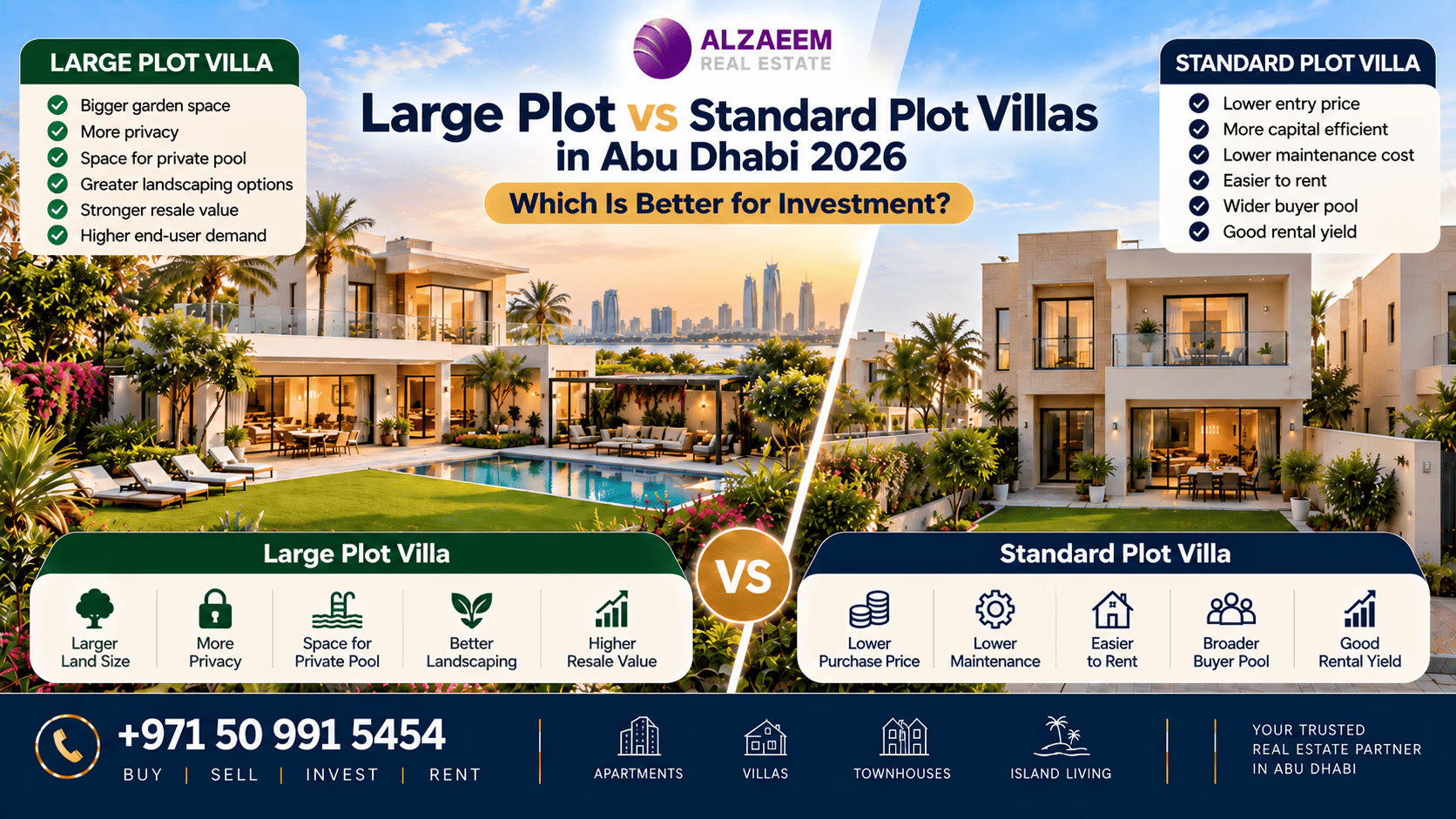
When buyers compare two villas in the same Abu Dhabi community, the obvious differences are usually:
- bedrooms,
- built-up area,
- corner vs middle,
- single row vs double row,
- park-facing vs road-facing.
But one of the most important villa-specific variables is often overlooked:
plot size.
Two villas can have:
- exactly the same floor plan,
- exactly the same BUA,
- the same number of bedrooms,
- the same developer,
- the same community,
yet one may sit on a significantly larger plot.
That larger plot can provide:
- a bigger garden,
- more privacy,
- greater distance from neighbours,
- additional landscaping,
- potential pool space,
- more outdoor entertaining area,
- stronger end-user appeal.
But it can also come with:
- a higher purchase price,
- greater landscaping costs,
- more maintenance,
- and a premium that tenants may not fully pay back through rent.
So the investment question is not:
Is a bigger plot better?
It is:
How much additional value does the extra land create relative to the additional capital required?
For villa investors, this distinction matters because land scarcity can be a much stronger long-term value driver than simply adding more internal square footage.
What Does Plot Size Mean?
The plot size is the total land area allocated to the property.
It can include:
- building footprint,
- front setback,
- rear garden,
- side garden,
- driveway,
- parking,
- landscaping,
- pool area.
This should not be confused with:
BUA — Built-Up Area.
A villa may have:
- 4,500 sq ft BUA
- on a 5,500 sq ft plot
while another identical villa may have:
- 4,500 sq ft BUA
- on an 8,000 sq ft plot.
The building is the same size.
The land is not.
BUA and Plot Size Measure Different Things
This is critical.
BUA
Measures the constructed space.
Plot Size
Measures the land allocated to the home.
For apartments, BUA is usually one of the dominant size metrics.
For villas, analysing only BUA can hide a substantial part of the asset’s value.
Large Plot Does Not Automatically Mean Better Plot
A 9,000 sq ft plot can sound impressive.
But the investor needs to ask:
Where is the extra land located?
Extra land may be:
- useful rectangular garden,
- wide side setback,
- awkward triangular strip,
- oversized driveway,
- unusable frontage.
Only usable land creates meaningful lifestyle value.
Usable Plot vs Headline Plot
Consider two villas.
Villa A
Plot: 7,500 sq ft
Large rectangular rear garden.
Villa B
Plot: 8,200 sq ft
But much of the additional land is:
- side setback,
- driveway,
- irregular corner.
Villa A may actually offer the superior outdoor experience.
So investors should examine:
plot geometry, not just plot area.
Large Plot Advantage 1: More Garden Space
This is the most obvious benefit.
A larger garden can provide room for:
- lawn,
- children’s play,
- outdoor dining,
- BBQ,
- seating,
- landscaping.
For family buyers, this can materially improve the property’s appeal.
Large Plot Advantage 2: Greater Privacy
More land can increase the physical distance between:
- house,
- neighbouring villas,
- road.
That can create:
- greater privacy,
- fewer direct sightlines,
- stronger sense of exclusivity.
In premium villa markets, privacy can be a major resale driver.
Large Plot Advantage 3: Space for a Private Pool
A standard villa plot may physically fit a pool.
A large plot may allow:
- proper pool,
- deck,
- garden,
- seating
without making the exterior feel crowded.
That distinction matters.
A pool that consumes the entire garden is different from a villa that retains substantial landscaping around it.
But a Pool Is Not Free Value
A private pool also creates:
- maintenance,
- cleaning,
- water,
- equipment,
- repairs.
A landlord should calculate whether:
higher rent + stronger resale
justify those costs.
Large Plot Advantage 4: Better Landscaping
Premium buyers often value mature landscaping.
A larger plot provides room for:
- trees,
- hedges,
- shaded areas,
- outdoor architecture.
Well-designed landscaping can materially improve:
- privacy,
- appearance,
- resale presentation.
Large Plot Advantage 5: Stronger End-User Demand
A family buying a villa for long-term occupation may care less about maximum rental yield and more about:
- space,
- privacy,
- garden,
- lifestyle.
That can make large-plot villas particularly attractive to end users.
End-user demand matters because it can support resale values independently of investor yield calculations.
Large Plot Advantage 6: Land Scarcity
Buildings can be renovated.
Interiors can be upgraded.
Land usually cannot be expanded.
If a community has only a limited number of oversized plots, that scarcity can create a structural advantage.
This becomes particularly important in:
- mature communities,
- island developments,
- waterfront districts,
- low-density projects.
Standard Plot Advantage 1: Lower Entry Price
For investors, this may be the strongest advantage.
Illustrative example:
Standard Plot Villa
AED 4.2M
Large Plot Villa
AED 5.0M
Additional investment:
AED 800K
The investor should ask:
What does that extra AED 800K actually produce?
The Incremental Plot Test
Suppose:
Standard Plot
Purchase price: AED 4.2M
Annual rent: AED 250K
Large Plot
Purchase price: AED 5.0M
Annual rent: AED 280K
Additional capital:
AED 800K
Additional annual rent:
AED 30K
Incremental gross rental return:
3.75%
That is not the overall yield of the large-plot villa.
It measures how effectively the extra capital spent on land generates additional rental income.
Compare Overall Gross Yield
Standard Plot
AED 250K ÷ AED 4.2M =
5.95%
Large Plot
AED 280K ÷ AED 5.0M =
5.60%
The large-plot villa earns:
AED 30K more annual rent
but the standard plot produces the stronger percentage yield.
This is common in premium villa investing.
Bigger Land Often Helps Resale More Than Rent
This is one of the key investment concepts.
A tenant may appreciate a larger garden.
But they may not pay:
20% more rent
for:
20% more land.
An owner-occupier purchasing the property may value that land much more strongly.
Therefore large plots can sometimes function primarily as:
capital-growth and resale features
rather than:
income-yield features.
Standard Plot Advantage 2: Better Capital Efficiency
A standard plot allows the investor to deploy less capital.
If the rental difference is small, this can create stronger:
- gross yield,
- net yield,
- cash-on-cash return.
This matters particularly for leveraged investors.
Standard Plot Advantage 3: Lower Maintenance
More land generally means more:
- irrigation,
- landscaping,
- gardeners,
- exterior maintenance.
A standard plot can reduce:
- recurring operating costs.
Landscaping Costs Can Add Up
Suppose:
Standard Plot Landscaping
AED 8K–12K annual allowance.
Large Plot
AED 15K–25K.
Over a five-year holding period, the difference can become significant.
Illustrative:
AED 10K extra annually × 5 years
=
AED 50K
That should be included in total-return analysis.
More Garden Can Also Mean More Water Consumption
Depending on:
- landscaping type,
- irrigation,
- pool,
a larger plot can increase utility-related operating expenses.
This does not make it unattractive.
It simply means:
land is not maintenance-free.
Large Plot + Corner Can Be Particularly Strong
Now combine:
- large plot,
- corner/end position.
That can produce:
- additional side garden,
- fewer neighbours,
- greater frontage,
- more windows.
This can create genuinely premium positioning.
But investors must avoid paying multiple overlapping premiums without analysing the total price.
Large Plot + Single Row
Another strong combination is:
- large plot,
- single row.
This can provide:
- larger garden,
- no direct rear row,
- privacy,
- more open outlook.
For an end-user buyer, this can be highly desirable.
Large Plot + Park Facing
This may create an attractive family proposition:
- private garden,
- external park,
- open outlook.
But the investor should ask whether the property is becoming too expensive relative to achievable rent.
Large Plot + Waterfront
At the premium end, plot size can combine with:
- direct waterfront,
- beach,
- marina.
In this case, the pricing is no longer driven simply by:
extra garden area.
It may be driven heavily by:
- frontage,
- land scarcity,
- water access.
These properties require a more capital-growth-oriented framework.
Frontage Width Matters
Plot size alone does not capture:
frontage.
Consider two 8,000 sq ft plots.
Plot A
Wide frontage.
Plot B
Long narrow plot.
The user experience may be very different.
Wide plots can provide:
- better façade presence,
- more parking,
- stronger landscaping.
Rear Garden Depth Matters Too
A family may prefer:
- deep rear garden
over:
- extra side land.
A good plot should be assessed through:
- width,
- depth,
- geometry.
Irregular Corner Plots Need Care
Corner plots are sometimes larger because their boundaries follow:
- curved roads,
- turning circles,
- irregular masterplan geometry.
Headline plot size may therefore overstate usable garden value.
Always inspect the plot plan.
Plot Efficiency Is Similar to Layout Efficiency
Just as an apartment can have:
- wasted internal corridors,
a villa can have:
- wasted land.
So we can think about:
effective plot area.
The question becomes:
How much of this additional land can the owner actually use?
Large Plot Does Not Necessarily Mean Larger Villa
This creates an interesting opportunity.
Suppose:
Villa A:
4,500 sq ft BUA
6,000 sq ft plot
Villa B:
4,500 sq ft BUA
8,500 sq ft plot
Villa B’s entire premium is mostly related to land.
That makes the investment comparison relatively clean.
Large BUA vs Large Plot Is a Different Decision
Another comparison may be:
Property A
Larger house
Smaller plot.
Property B
Smaller house
Larger plot.
Which is better?
It depends on target buyer.
Some families prioritise:
- internal bedrooms,
- office,
- maid room.
Others prioritise:
- garden,
- pool,
- privacy.
There is no universal winner.
Rental Tenants Usually Pay More for Bedrooms Than Empty Land
This is an important rental principle.
Moving from:
3BR → 4BR
may materially expand usable accommodation.
Moving from:
6,000 sq ft plot → 8,000 sq ft plot
may improve lifestyle but not change bedroom capacity.
Therefore bedroom count may sometimes produce a stronger rental premium than land.
End Users Can Value Land More
A homeowner may see the garden as:
- children’s area,
- long-term lifestyle asset,
- future landscaping opportunity.
Their willingness to pay can therefore exceed that of tenants.
This is why large plots can be attractive resale assets even at slightly lower rental yield.
Larger Plot Can Create Renovation Flexibility
Subject to:
- developer,
- community,
- authority approvals,
owners may potentially improve:
- pool,
- pergola,
- landscaping,
- outdoor kitchen.
Investors should never assume extension rights automatically.
But more land can provide more design flexibility.
Do Not Assume You Can Extend the Building
A larger plot does not automatically permit:
- additional room,
- guest house,
- structural expansion.
Planning and community rules matter.
Before purchasing for expansion potential, verify the applicable approvals.
Standard Plots Can Be Easier to Compare
If a project contains hundreds of identical standard plots, investors benefit from:
- more transaction comparables,
- clearer rent evidence.
Large or irregular plots may have fewer direct comparables.
That creates:
- scarcity,
- but also valuation uncertainty.
Bank Valuation Matters
Suppose:
Standard comparable villa:
AED 4.2M
Seller asks:
AED 5.5M
for a large plot.
If the transaction evidence does not support the full premium, bank valuation may come in below the agreed purchase price.
The buyer may need additional cash.
Measure Plot Premium Separately
Useful formula:
Large Plot Price − Standard Plot Comparable Price = Plot Premium
Example:
Large plot:
AED 5.0M
Standard:
AED 4.3M
Plot premium:
AED 700K
Then ask:
What percentage of price does that represent?
AED 700K ÷ AED 4.3M =
16.3%
Now the premium can be analysed.
Then Calculate Land Added
Suppose:
Standard plot:
6,000 sq ft
Large plot:
8,000 sq ft
Additional land:
2,000 sq ft
Plot premium:
AED 700K
Implied price paid for additional land:
AED 350 per additional sq ft
This is not necessarily a formal land valuation.
But it can help investors structure the comparison.
Compare Additional Land With Future Resale Value
Ask:
Would a future buyer likely pay:
- AED 700K more,
- AED 900K more,
- only AED 400K more?
This is difficult to predict.
But comparable transactions can provide evidence.
Developer Launch Premium Can Be Different
In off-plan projects, developers often price:
- standard plot,
- corner plot,
- large plot
at predetermined premiums.
That premium may or may not survive in the resale market.
A developer’s price sheet is not proof of future market value.
Early Buyers Should Compare Plot Premiums Across Phases
Suppose Phase 1 large plots carry:
AED 400K premium.
Phase 2:
AED 800K premium.
That can tell investors:
- developer pricing has changed,
- market appetite may have increased.
But again, transaction evidence matters.
Large Plot Scarcity Should Be Quantified
Suppose a project has:
500 villas.
Standard plots:
Large plots:
Extra-large plots:
The premium may be supported by genuine scarcity.
If half the project has large plots, scarcity is weaker.
Count Comparable Inventory
Ask:
- how many standard?
- how many large?
- how many corner large?
- how many waterfront large?
This helps identify true rarity.
Standard Plot Can Be Better for Pure Rental Yield
If the objective is:
maximum income efficiency
then a lower-priced standard plot may make more sense.
Especially if:
- same bedrooms,
- same BUA,
- similar rent.
Large Plot Can Be Better for Capital Preservation
An investor focused on:
- premium asset quality,
- long-term scarcity,
- family end-user demand
may prefer larger land exposure.
The optimal choice depends on strategy.
Illustrative Side-by-Side Comparison
| Metric | Standard Plot | Large Plot |
|---|---|---|
| Purchase Price | AED 4.2M | AED 5.0M |
| BUA | 4,500 sq ft | 4,500 sq ft |
| Plot Size | 6,000 sq ft | 8,000 sq ft |
| Annual Rent | AED 250K | AED 280K |
| Gross Yield | 5.95% | 5.60% |
| Service Charges | AED 20K | AED 20K |
| Maintenance | AED 18K | AED 27K |
| Other Costs | AED 8K | AED 10K |
| Net Operating Income | AED 204K | AED 223K |
| Operating Yield | 4.86% | 4.46% |
| Garden | Standard | Larger |
| Privacy | Good | Stronger |
| Resale Scarcity | Standard | Potentially Stronger |
These figures are illustrative.
The large plot generates:
AED 19K more net annual income
but requires:
AED 800K additional capital.
Incremental net operating return on that extra capital:
2.38%
This tells us that the large plot’s investment case is not primarily about rental income.
Its thesis depends more heavily on:
- land scarcity,
- end-user demand,
- resale premium,
- capital appreciation.
Now Reduce the Plot Premium
Suppose the large-plot villa can be bought for:
AED 4.6M
instead of:
AED 5.0M.
Suddenly the economics improve significantly.
This demonstrates a recurring principle:
The feature is not automatically good or bad — the price paid for the feature determines the investment outcome.
Maintenance Can Change the Result
A beautifully landscaped large garden can look impressive.
But if annual outdoor maintenance increases by:
AED 20K,
the income advantage may disappear.
Investors should use:
net operating income
not gross rent.
Vacant Large Plots Can Be a Weak Use of Capital
Another issue:
A large plot may simply contain:
- unused sand,
- minimal landscaping.
The buyer may later need to spend significantly to make it attractive.
Add landscaping capex to acquisition cost.
Landscaping Capex Example
Purchase premium:
AED 600K
Additional landscaping:
AED 150K
Pool:
AED 250K
Total additional capital:
AED 1M
Now the investor should compare returns against:
AED 1M, not just the purchase premium.
Fully Landscaped Resale Can Be Different
A ready villa with mature:
- garden,
- pool,
- pergola
may justify more than a bare large-plot off-plan unit.
Again, compare complete asset condition.
Large Plot Can Improve Photography and Marketing
At resale, outdoor images showing:
- landscaped garden,
- pool,
- privacy
can create strong emotional appeal.
This is especially relevant for high-value family villas.
Standard Plots Can Still Sell Faster
A large plot often means a higher total asking price.
That can reduce the future buyer pool.
Standard plots may remain affordable to a broader group.
So:
rarer does not always mean more liquid.
Total Price Matters More Than Premium Percentage Alone
A 10% premium on:
AED 2M
is:
AED 200K.
A 10% premium on:
AED 10M
is:
AED 1M.
At higher price points, small percentage differences represent substantial capital.
Mortgage Buyers Need to Include Financing Cost
If the additional plot premium is financed, then the investor also pays:
- interest
on part of that premium.
The extra land must justify:
capital + financing cost.
Cash Buyers Have Opportunity Cost Too
Even without a mortgage:
AED 800K placed into extra land cannot simultaneously be invested elsewhere.
That opportunity cost should be considered.
Portfolio Investors Should Compare Alternatives
Suppose:
Large plot premium:
AED 1M.
That AED 1M might alternatively fund:
- part of another apartment,
- another investment asset,
- mortgage reduction.
The land premium therefore has an opportunity cost.
Plot Position Can Matter More Than Plot Size
A standard-sized plot that is:
- park-facing,
- corner,
- single row
can outperform a larger plot that is:
- road-facing,
- double row.
This is why investors must analyse multiple positional variables together.
Large Plot + Weak Position Can Be Inferior
Example:
Large Plot
8,000 sq ft
Main-road exposure
Standard Plot
6,500 sq ft
Single row + park facing
Many buyers may prefer the standard plot.
So land quantity and land quality are separate issues.
The Best Large Plot Is Usually Efficient and Well Positioned
Look for:
- usable rectangular garden,
- good orientation,
- privacy,
- attractive outlook,
- meaningful scarcity.
That is very different from simply:
largest plot number on the price list.
Orientation Matters for Gardens
A huge garden that receives intense afternoon sun may be less enjoyable than a slightly smaller shaded garden.
Check:
- sun,
- shade,
- home orientation,
- landscaping possibilities.
Trees Can Improve the Plot Over Time
A new off-plan community may initially appear exposed.
As landscaping matures:
- privacy,
- shade,
- visual appeal
can improve.
Large plots can benefit particularly from mature trees.
But Large Landscaping Takes Time
Premium garden presentation may require:
- years of growth,
- ongoing maintenance.
Off-plan buyers should consider the difference between:
rendered mature landscaping
and
actual handover condition.
Large Plot Villas Can Target a Different Tenant
The tenant may be:
- larger family,
- executive,
- high-income household.
That tenant pool may be willing to pay more.
But it may also be smaller.
Higher rent bands generally reduce the number of potential tenants.
Standard Plot May Have Broader Rental Demand
A more affordable villa can attract:
- more households.
This can support:
- faster leasing,
- lower vacancy.
Therefore yield investors should not automatically chase the biggest plot.
Resale End-User Demand Can Reverse This
For a wealthy buyer looking for a long-term home:
- extra garden,
- privacy,
- pool
may carry much more value.
That can support stronger resale pricing than rental economics would suggest.
Large Plot vs Standard Plot by Investor Type
Income Investor
May prefer:
standard plot
when rent difference is modest.
Growth Investor
May prefer:
large plot
if land scarcity is strong.
End User
May rationally value:
- garden,
- privacy,
- outdoor living.
Balanced Investor
Should seek:
meaningfully larger usable plot at a reasonable premium.
Large Plot Warning Signs
Be cautious when:
- premium is excessive,
- extra land is unusable,
- plot is oddly shaped,
- landscaping cost is high,
- rent premium is weak,
- many similar large plots exist.
Standard Plot Warning Signs
Be cautious when:
- garden is too small,
- neighbours are extremely close,
- privacy is weak,
- outdoor area does not suit target family tenants.
Strong Large-Plot Signals
More constructive characteristics include:
- rectangular usable land,
- scarce plot category,
- privacy,
- good outlook,
- strong orientation,
- family demand,
- reasonable premium.
A Practical Plot Comparison Framework
Before selecting a villa, compare:
House
- BUA,
- bedrooms,
- layout.
Land
- plot size,
- width,
- depth,
- usable garden.
Position
- corner/middle,
- single/double row,
- park/road,
- waterfront.
Economics
- purchase premium,
- rent premium,
- maintenance,
- net yield.
Exit
- scarcity,
- end-user demand,
- resale comparables.
Final Large Plot vs Standard Plot Checklist
Before paying extra for land, ask:
- What is the exact plot size?
- What is the BUA?
- Is the villa itself identical?
- How much extra land am I receiving?
- Where is that land located?
- Is the garden rectangular and usable?
- Is the plot wider or simply deeper?
- Is it also corner?
- Is it single row?
- Is it park or road facing?
- Am I double-paying for overlapping premiums?
- What is the exact purchase premium?
- What is the additional rent?
- What is the incremental rental return?
- What additional landscaping is required?
- Will a pool materially improve value?
- What will maintenance cost?
- How many similar large plots exist?
- What future supply is coming?
- Will end users pay the same premium at resale?
The strongest villa investment is not necessarily the home with the largest plot.
It is the property where additional land is genuinely usable, scarce and desirable enough to justify the additional capital committed to it.
How Al Zaeem Real Estate Can Help
Villa plot analysis requires more than comparing square-foot numbers.
At Al Zaeem Real Estate, buyers and investors can compare specific Abu Dhabi villas based on:
- BUA,
- plot size,
- usable garden,
- plot geometry,
- corner position,
- row position,
- outlook,
- rental premium,
- maintenance,
- and resale scarcity.
The objective is to determine whether the larger plot represents real long-term land value or simply more expensive unused space.
Al Zaeem Real Estate
Abu Dhabi, UAE
+971 50 991 5454
BUY | SELL | INVEST | RENT