


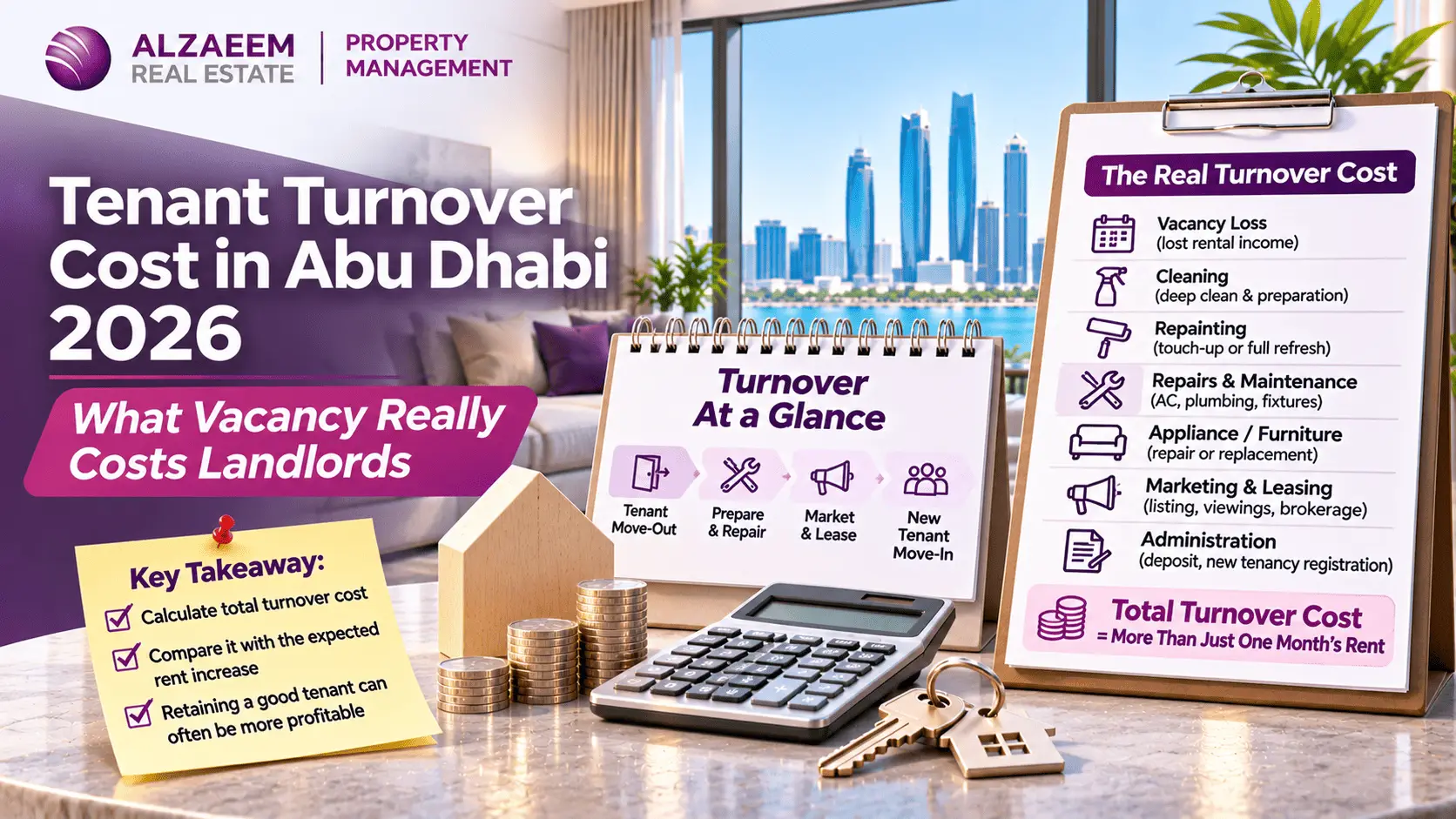
When a tenant leaves a rental property, many landlords think the cost is simply:
one month without rent.
Usually, it is more complicated than that.
Tenant turnover can involve:
- lost rent;
- cleaning;
- repainting;
- minor repairs;
- appliance or fixture replacement;
- move-out inspection;
- deposit reconciliation;
- new photography;
- re-marketing;
- viewings;
- tenant screening;
- tenancy registration;
- move-in preparation.
The real cost of turnover is therefore:
vacancy loss + property preparation + re-leasing cost + administrative time.
For landlords, this matters because a seemingly small difference in annual rent can be completely wiped out by one avoidable month of vacancy.
What Is Tenant Turnover?
Tenant turnover is the period between:
one tenant leaving
and
the next tenant taking possession.
It can include:
- previous tenant move-out;
- inspection;
- repair work;
- cleaning;
- property preparation;
- marketing;
- viewings;
- tenant selection;
- tenancy registration;
- move-in.
The faster this cycle is managed properly, the lower the avoidable financial loss.
Turnover Cost Is Not Just Vacancy
A practical turnover-cost formula is:
Lost Rent
Cleaning & Repairs
Re-Leasing / Marketing Costs
Administrative & Registration Costs
Preparation Costs
=
Total Tenant Turnover Cost
This gives a much more realistic picture than looking only at empty days.
Vacancy Is Usually the Biggest Component
Suppose annual rent is:
AED 120,000
Monthly equivalent:
AED 10,000
Approximate daily rental value:
AED 329
If the property remains vacant for:
7 days
Approximate lost gross rent:
AED 2,300
14 days
Approximately:
AED 4,600
30 days
Approximately:
AED 9,900
That is before any cleaning, maintenance or leasing expenditure.
The Vacancy Formula
Use:
Annual Rent ÷ 365 × Vacant Days
Example:
AED 150,000 annual rent:
150,000 ÷ 365 ≈ AED 411/day
30 vacant days:
approximately AED 12,330
Vacancy therefore needs to be treated as an actual operating cost.
Why Landlords Underestimate Turnover
Turnover costs are fragmented.
You might separately pay:
- AED 800 cleaning;
- AED 1,200 painting;
- AED 600 plumbing;
- AED 300 lock work.
Each amount feels small.
But combined with:
AED 10,000 lost rent
the turnover event can become materially expensive.
Example: AED 120,000 Rental
Illustrative only.
Annual rent:
AED 120,000
Vacancy:
30 days = approximately AED 9,870
Cleaning:
AED 700
Painting/touch-ups:
AED 1,800
Minor repairs:
AED 1,200
Listing/preparation/admin:
AED 800
Illustrative turnover cost:
AED 14,370
That is almost:
12% of annual gross rent
lost in one turnover cycle.
Example: Higher-Rent Property
Annual rent:
AED 240,000
One month vacancy:
approximately:
AED 20,000
Even if turnover repairs cost only AED 5,000, total impact can approach:
AED 25,000
The higher the rent, the more expensive vacant days become.
Tenant Retention Has Financial Value
A good tenant who renews may save the landlord:
- vacancy;
- repainting;
- cleaning;
- marketing;
- screening;
- move-in administration.
Therefore, renewal should not be judged only by:
“Can I get more rent from someone else?”
It should be judged against:
the total cost of replacing the tenant.
Example: Keep Tenant or Re-Let?
Current rent:
AED 120,000
Landlord believes market rent could be:
AED 126,000
Potential annual increase:
AED 6,000
But replacing the tenant may create:
- 3 weeks vacancy: approx. AED 6,900;
- cleaning/repairs: AED 2,000;
- re-leasing costs: AED 1,500.
Total turnover impact:
AED 10,400
The landlord may spend more replacing the tenant than the annual rent increase would generate.
Higher Rent Is Not Automatically Higher Profit
This is one of the most important landlord principles.
Compare:
Tenant A
AED 120,000 rent.
Renews immediately.
Tenant B
AED 128,000 rent.
But property stays vacant for one month before B moves in.
One month vacancy at AED 128,000 annual rent:
approximately AED 10,667
Extra annual rent:
AED 8,000
The higher rent has already been more than offset by the vacancy.
Current Abu Dhabi Rental Rules Also Matter
As of the temporary rental measure announced by ADREC on 3 June 2026, annual rental increases for renewals were reduced to 0% until further notice, with registered Tawtheeq rental rates forming part of the current framework.
This makes renewal and re-leasing strategy particularly important in 2026.
Landlords should verify the latest ADREC position before making rent decisions.
Move-Out Inspection
The turnover process should begin with a formal move-out inspection.
Check:
- walls;
- floors;
- doors;
- kitchen;
- bathrooms;
- appliances;
- AC;
- plumbing;
- balcony;
- furniture where applicable.
Compare against:
- move-in photos;
- inventory;
- condition report.
Tenant Damage vs Normal Wear
Do not classify everything as tenant damage.
Abu Dhabi tenancy law places tenant responsibility on:
- customary/agreed rental repairs;
- damage caused by the tenant.
The landlord generally remains responsible for necessary repairs required to keep the property fit for use unless otherwise agreed.
This distinction is important during deposit reconciliation.
Security Deposit Is Not Free Turnover Money
The deposit should not be treated as:
“Landlord refurbishment fund.”
Deductions should be linked to legitimate tenant responsibility.
Normal ownership costs such as:
- ageing AC;
- ordinary repainting;
- failed equipment from normal use
should not automatically be charged to the tenant.
Cleaning Cost
Even a well-kept unit may need:
- deep cleaning;
- kitchen cleaning;
- bathroom cleaning;
- windows;
- balcony cleaning.
A clean property:
- photographs better;
- shows better;
- rents faster.
Cleaning is therefore not only a cost.
It is part of leasing performance.
Repainting
Repainting may range from:
- minor touch-ups;
- one-room repaint;
- complete apartment refresh.
Do not automatically repaint the whole unit after every tenant.
Inspect first.
Sometimes:
targeted repair
is more efficient than:
full refurbishment.
Minor Repairs
Common turnover work can include:
- leaking tap;
- sealant;
- loose handle;
- cabinet adjustment;
- light fixture;
- damaged lock;
- AC servicing.
Small issues can collectively delay the next tenant if not coordinated immediately.
Appliance Replacement
For furnished units, turnover may reveal:
- old refrigerator;
- damaged washing machine;
- worn sofa;
- broken dining chair.
Ask:
Does this need repair, replacement or nothing?
Do not replace everything merely because a tenant moved out.
Furnished Properties Usually Have Higher Turnover Exposure
A furnished property has more:
- inventory;
- inspection points;
- replacement risk;
- cleaning requirements.
But it may also achieve:
- different tenant demand;
- faster occupancy in some segments.
The turnover calculation should include furnishing wear.
Unfurnished Properties Can Be Simpler
Unfurnished turnover may involve:
- cleaning;
- paint;
- basic maintenance.
There are fewer owner-supplied items to inspect or replace.
That can reduce turnover cost.
Villa Turnover Can Be More Expensive
A villa may require:
- more painting;
- larger cleaning area;
- garden work;
- pool work;
- more AC systems;
- exterior inspection.
Turnover planning should therefore reflect property type.
Apartment Turnover
Apartment turnover may be simpler, but building procedures can add:
- move-out permits;
- lift booking;
- access coordination;
- move-in permits for the new tenant.
The Community Management Company should be involved where required.
Start Before the Tenant Leaves
The cheapest turnover is usually the one planned early.
If the tenant has confirmed non-renewal, landlords can begin:
- pricing;
- listing preparation;
- photography planning;
- contractor scheduling
before the final day.
Do not wait until keys are returned to begin everything.
Pre-Marketing Can Reduce Vacancy
Where legally and operationally appropriate, a landlord can prepare the next leasing campaign before move-out.
This can include:
- updated listing copy;
- current market analysis;
- photography scheduling;
- prospective viewing arrangements.
The goal is:
reduce dead time.
But Do Not Mislead Prospective Tenants
If the property is still occupied:
- state availability clearly;
- respect current tenant privacy;
- coordinate viewings properly.
Do not advertise:
“Ready now”
if it is not.
7-Day Turnover Plan
For a property in good condition:
Day 1
Move-out inspection.
Day 2
Cleaning and minor repair list.
Day 3
Repairs.
Day 4
Photography refresh.
Day 5
Listing launch.
Day 6
Viewings.
Day 7
Offers.
This is aggressive but achievable for some properties.
14-Day Turnover Plan
For a property needing moderate work:
Days 1–2
Inspection and contractor quotes.
Days 3–6
Repairs and paint.
Day 7
Deep cleaning.
Day 8
Photography.
Day 9
Listing launch.
Days 10–14
Viewings and offers.
30-Day Turnover Often Signals a Problem
A full month may be reasonable in some markets or units.
But if turnover is prolonged because of:
- delayed decisions;
- poor coordination;
- unrealistic price;
- slow repairs,
the loss is avoidable.
Every Decision Has a Vacancy Cost
Suppose landlord delays repainting approval for 5 days.
Annual rent:
AED 144,000
Daily rental equivalent:
about AED 395
Five-day delay costs roughly:
AED 1,975
That may exceed the amount being debated with the contractor.
The AED 500 Repair Trap
Landlord spends three days negotiating an AED 500 repair down to AED 350.
Savings:
AED 150
Three days of vacancy at AED 120,000 rent:
approximately:
AED 986
Commercially, that was a bad decision.
Speed Matters, But Quality Still Matters
The answer is not:
“Approve every repair immediately.”
The correct approach is:
prioritise repairs by impact.
Fix first:
- safety;
- AC;
- plumbing;
- visible damage;
- issues blocking marketing.
Less important cosmetic upgrades can wait.
Photography Refresh
You may not need new photography after every tenancy.
But update images if:
- furniture changed;
- paint changed;
- property condition improved;
- old photos are misleading.
Current images improve trust.
Marketing Cost
Turnover may create costs for:
- brokerage;
- listing promotion;
- photography;
- advertising;
- leasing administration.
The exact amount varies by arrangement.
Do not use one universal number.
New Tenancy Registration
DARI supports registration of new tenancy contracts.
Current DARI guidance lists a AED 50 service fee for residential lease contracts under four years, while separate municipality fees may apply to the tenant depending on the case.
Fees should always be rechecked at the time of registration.
Renewal Can Be Cheaper Operationally Than Turnover
DARI currently lists tenancy renewal as a separate digital service.
The renewal-service page shows a request cost of AED 50.
The bigger saving, however, is not the registration fee.
It is avoiding:
- vacancy;
- cleaning;
- re-marketing;
- screening;
- move-in logistics.
Tenant Screening Takes Time
A rushed landlord may accept the first applicant simply to stop vacancy.
That can create future problems.
Screen:
- identity;
- employment;
- affordability;
- intended occupants;
- payment terms.
A few extra days of disciplined screening may be better than a poor tenancy lasting a year.
But Excessive Screening Delay Also Costs Money
Once you have a suitable tenant:
do not let the process sit unnecessarily.
Turnover efficiency requires:
fast decision-making after adequate due diligence.
Move-In Preparation
Before new tenant arrival:
- utilities operational;
- property clean;
- repairs closed;
- keys counted;
- access cards ready;
- parking confirmed;
- inventory prepared;
- community move-in procedure checked.
A smooth first day improves the landlord-tenant relationship immediately.
Close the Previous Lease Properly
DARI provides services to:
- cancel active lease contracts;
- close expired tenancy contracts.
The appropriate process depends on the tenancy status.
Do not leave old lease administration unresolved while starting a new tenancy.
DARI Currently Lists a Lease-Closure Fee
The current DARI property-management services page lists:
AED 50 registration fee
for closing an expired lease contract.
Again, verify current fees when processing the service.
The Cost of Bad Coordination
Imagine the following:
Tenant leaves Sunday.
Cleaning booked Wednesday.
Painting booked Saturday.
Photography booked next Tuesday.
Listing launches Thursday.
Nearly two weeks have passed before the property even reaches the market.
This is a coordination problem.
Not a market problem.
Better Coordination
Before move-out:
- contractor booked;
- cleaner reserved;
- photography date held;
- listing prepared.
Then:
Day 1 inspection.
Day 2 work.
Day 3 clean.
Day 4 photography.
Day 5 market.
The difference can be substantial.
Renovate During Turnover or Re-Let Immediately?
Turnover is often the easiest time to renovate because the property is empty.
But renovation makes sense only when the expected return justifies the vacancy.
Example: Renovation Decision
Renovation cost:
AED 30,000
Extra vacancy:
20 days
Annual current rent:
AED 120,000
Vacancy cost:
approximately AED 6,575
Total economic commitment:
roughly:
AED 36,575
If the upgrade only increases rent by:
AED 5,000 annually,
payback is long.
When Renovation Can Make Sense
Potentially when:
- property looks significantly outdated;
- current condition prevents competitive rent;
- resale is planned;
- repeated defects need proper correction.
Our Renovation ROI Abu Dhabi 2026 guide explains this separately.
Do Not Renovate Just Because the Unit Is Empty
Vacancy can create pressure to:
“Do everything now.”
But not every upgrade generates return.
Focus on:
- functional;
- visible;
- market-relevant improvements.
Tenant Retention vs Maximum Rent
A landlord should compare:
renewal economics
with:
turnover economics.
Formula:
Proposed Rent Increase
minus
Expected Turnover Cost
If the result is negative, retaining the existing tenant may be financially superior.
Example: AED 10,000 Proposed Increase
Current tenant rent:
AED 150,000
New tenant expected rent:
AED 160,000
Extra annual rent:
AED 10,000
Expected turnover:
- 20 days vacancy ≈ AED 8,767
- cleaning and repair = AED 3,000
- leasing/admin = AED 1,500
Total:
AED 13,267
Financially, the rent increase does not recover first-year turnover cost.
Second-Year Economics Can Differ
A higher new rent may become more valuable over a longer holding period.
But landlords should still understand:
break-even time.
Do not judge only year one or only the headline rent.
Calculate Turnover Payback
Formula:
Total Turnover Cost ÷ Annual Rent Increase
Example:
Turnover cost:
AED 12,000
Rent increase:
AED 6,000/year
Payback:
2 years
That is a much more useful decision metric.
High Tenant Turnover Can Damage Yield
A property that changes tenants every year may incur:
- repeated vacancy;
- repeated repainting;
- repeated leasing.
Another property with stable tenants may produce better net performance even at slightly lower gross rent.
Tenant Retention Is Part of Asset Management
Retention depends partly on:
- responsive maintenance;
- fair communication;
- smooth renewal;
- good property condition.
A good landlord strategy does not begin when the tenant gives notice.
It begins during the tenancy.
Maintenance Response Can Influence Renewal
If tenants repeatedly experience:
- slow AC repair;
- ignored leaks;
- communication problems,
they are less likely to renew.
Turnover can therefore be partly preventable.
Landlord Maintenance Reserve Helps Turnover
A properly funded maintenance reserve allows the owner to immediately handle:
- paint;
- repairs;
- cleaning;
- appliance issues.
Our Landlord Maintenance Reserve Abu Dhabi 2026 guide explains how to build that buffer.
Vacancy Reserve Helps Separately
A landlord should also have liquidity to absorb some vacancy without panic.
Otherwise, the landlord may:
- accept poor tenants;
- rush decisions;
- delay necessary work.
A reserve improves decision quality.
Turnover for Overseas Landlords
Overseas owners face additional friction:
- approvals;
- contractor coordination;
- inspections;
- key management;
- viewings;
- tenant onboarding.
Without a local management process, every small decision can add days.
Al Zaeem Property Management
Al Zaeem Property Management can coordinate the complete turnover cycle:
- move-out inspection;
- maintenance;
- cleaning;
- property preparation;
- rental assessment;
- marketing;
- viewings;
- tenant screening;
- tenancy administration;
- move-in coordination.
The objective is to reduce:
avoidable vacant days
while still protecting tenant quality and property condition.
Al Zaeem Facility Management
Where turnover repairs are required, Al Zaeem Facility Management can coordinate:
- AC;
- plumbing;
- electrical;
- painting;
- flooring;
- woodwork;
- general property preparation.
Integrating leasing and maintenance can reduce the delays created when multiple unrelated vendors work sequentially.
Turnover Dashboard
Track:
Tenant Move-Out Date
When possession returns.
Rent-Ready Date
When repairs/cleaning are completed.
Listing Date
When marketing begins.
First Viewing Date
When prospects begin viewing.
Offer Date
When acceptable terms arrive.
New Tenant Move-In Date
When income restarts.
This allows you to identify where time is being lost.
Three Types of Vacancy
Repair Vacancy
Property cannot yet be rented.
Marketing Vacancy
Property is ready but has not secured a tenant.
Administrative Vacancy
Tenant selected but registration/move-in is delayed.
Each requires a different solution.
Repair Vacancy Solution
Improve:
- contractor speed;
- maintenance planning;
- approval thresholds.
Marketing Vacancy Solution
Review:
- price;
- photographs;
- listing quality;
- demand.
Administrative Vacancy Solution
Improve:
- documentation;
- tenancy preparation;
- move-in coordination.
12-Point Turnover Checklist
Before the old tenant leaves, confirm:
1. Non-renewal date
2. Move-out appointment
3. Market rent analysis
4. Contractor availability
5. Cleaner availability
6. Photography requirement
After move-out:
7. Condition inspection
8. Deposit reconciliation
9. Repairs
10. Cleaning
11. Listing launch
12. New tenancy onboarding
The Landlord Turnover Formula
The clearest framework is:
Vacancy Days
×
Daily Rental Value
Preparation Costs
Leasing Costs
Administrative Costs
=
Total Turnover Cost
Then compare that number against:
- proposed rent increase;
- expected lease length;
- tenant quality.
Final Verdict
Tenant turnover in Abu Dhabi costs more than an empty month.
The total financial impact can include:
lost rent
cleaning
repairs
repainting
marketing
leasing
registration
administrative delay
That is why landlords should not chase a higher headline rent without calculating the cost of replacing a good tenant.
Abu Dhabi tenancy law also makes it important to separate genuine tenant-caused damage from landlord-side necessary repairs: tenants are responsible for customary/agreed rental repairs and damage they cause, while landlords generally handle necessary repairs required to maintain the property’s usability unless otherwise agreed.
DARI provides digital services for registering, renewing and closing tenancy contracts, with current service fees that should be included in the turnover administration process and verified when the transaction occurs.
For landlords, the better strategy is:
prepare before move-out → inspect immediately → repair quickly → price accurately → market professionally → screen efficiently → register promptly → move the next tenant in.
The objective is not zero turnover cost.
That is unrealistic.
The objective is:
minimum avoidable turnover cost.
A well-managed property can reduce downtime while maintaining:
- property condition;
- tenant quality;
- rental income;
- long-term asset performance.
Official Sources
Abu Dhabi Real Estate Centre — Tenancy Law
Current framework governing landlord repair responsibility, customary tenant repairs and tenant-caused damage.
DARI — Lease Registration Services
Current services for registering, renewing, cancelling and closing Abu Dhabi tenancy contracts.
Disclaimer
This article provides general real-estate and property-management information only. It does not constitute legal, tax, accounting or investment advice.
Cleaning, maintenance, vacancy, brokerage and turnover costs vary materially by property, tenancy, management arrangement and current market conditions. All financial examples in this article are illustrative only.
DARI and other government fees can change and should be verified at the time the relevant service is processed.
Last reviewed: November 2026.