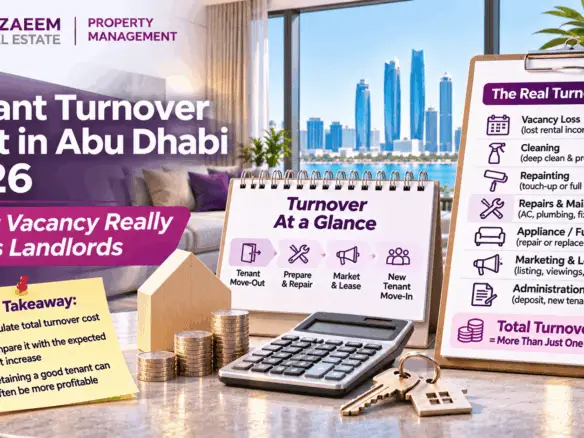




Vacancy is one of the most expensive costs in rental property.
The problem is that landlords often do not see it as a cost because no invoice arrives.
There is no bill saying:
Vacancy expense: AED 10,000
Instead, the money simply never arrives.
Consider a property renting for:
AED 120,000 per year
Monthly economic rent:
AED 10,000
If the property remains vacant for:
30 days
Lost gross rent:
AED 10,000
60 days
Lost gross rent:
AED 20,000
90 days
Lost gross rent:
AED 30,000
And during that period the landlord may still be paying:
- service charges;
- mortgage instalments;
- maintenance;
- utilities where applicable;
- insurance;
- property-management costs;
- cleaning and preparation expenses.
That is why serious landlords should not think only about:
How much rent can I ask?
They should also ask:
How consistently can I keep this property occupied?
In Abu Dhabi’s H1 2026 market, ADREC reported approximately 233,000 active residential lease contracts worth AED 9.3 billion, with lease values up 8% year-on-year. New-lease prices increased 17% for apartments and 9% for villas, rising even faster inside investment zones.
That confirms a large and active rental market.
But it does not mean every property rents quickly.
Vacancy still depends on the individual:
- building;
- location;
- unit type;
- price;
- condition;
- landlord responsiveness;
- competing supply;
- property management.
The strongest rental strategy is therefore not simply:
Maximise rent.
It is:
Maximise occupied, collectable, sustainable rent.
Vacancy Is a Return Problem, Not Just a Leasing Problem
Suppose two identical apartments are worth AED 1.8 million.
Property A
Annual rent:
AED 125,000
Vacancy:
2 months
Effective gross rent:
approximately AED 104,167
Property B
Annual rent:
AED 118,000
Vacancy:
0 months
Effective gross rent:
AED 118,000
Property A advertises the higher rent.
Property B generates more money.
This is why an investor should evaluate:
effective annual rent
rather than:
maximum asking rent.
Our guide on How to Analyse Rental Demand Before Buying Property in Abu Dhabi explains the same principle from the acquisition side: days on market, competing inventory and rental absorption can matter as much as headline rent.
The Vacancy Equation
A useful landlord formula is:
Vacancy Cost = Monthly Economic Rent × Vacant Months
For a AED 150,000 annual rental:
Monthly rent:
AED 12,500
Two months vacancy:
AED 25,000
Now add:
- AED 4,000 repainting;
- AED 2,500 repairs;
- AED 2,000 cleaning and preparation;
- leasing or marketing costs where applicable.
Total transition impact can easily exceed:
AED 30,000
before the next tenant pays anything.
Why Properties Stay Vacant
Vacancy usually has a reason.
Common causes include:
- unrealistic pricing;
- poor listing quality;
- slow maintenance;
- weak presentation;
- delayed landlord approvals;
- excessive competing inventory;
- unsuitable payment terms;
- poor building reputation;
- incorrect unit positioning;
- weak tenant experience;
- poor property management.
The solution depends on the actual cause.
Simply reducing rent without understanding the problem can leave money on the table.
1. Price the Property Correctly From Day One
The most common leasing mistake is starting too high.
The thinking usually goes like this:
“Let’s list at AED 140,000. We can always reduce later.”
But the first few weeks of a listing are often the most valuable.
That is when the property is:
- new to the market;
- receiving fresh portal visibility;
- appearing in saved searches;
- attracting active tenants.
If the initial rent is unrealistic, that early demand can be wasted.
Asking Rent Is Not Achieved Rent
Suppose ten similar units are listed between:
AED 120,000 and AED 140,000
That does not prove your property will achieve AED 140,000.
Some listings may:
- be duplicated;
- have better views;
- be furnished;
- include incentives;
- have been online for months.
A landlord should compare:
- exact building;
- bedroom count;
- BUA;
- view;
- condition;
- floor;
- furnishing;
- parking;
- achieved rents where possible.
Our How to Analyse Rental Demand Before Buying Property in Abu Dhabi guide explains why current competing listings need to be filtered carefully rather than accepted at face value.
The Cost of Waiting for AED 5,000 More
Imagine:
Realistic market rent:
AED 120,000
Landlord insists on:
AED 125,000
Potential annual uplift:
AED 5,000
But the property stays empty for one month.
Lost rent at AED 120,000 annually:
AED 10,000
The landlord lost twice the amount they were trying to gain.
This is a classic vacancy mistake.
2. Launch the Listing Before the Existing Tenant Leaves
A landlord does not always need to wait until the unit becomes completely vacant before beginning the re-leasing process.
Where:
- the tenancy arrangement allows;
- tenant access is handled properly;
- viewings can be coordinated respectfully;
marketing can begin before move-out.
That creates a possible sequence:
Existing tenant gives notice
↓
Landlord prepares listing
↓
Photography / marketing begins
↓
Viewings start
↓
Existing tenant moves out
↓
Final maintenance
↓
New tenant moves in
The objective is to reduce the dead period between tenancies.
Vacancy Should Be Managed Before It Starts
If the lease expiry date is known six months in advance, there is little reason to discover the tenancy is ending only one week before move-out.
A professional landlord should track:
- expiry date;
- renewal discussion;
- tenant intention;
- property condition;
- marketing launch.
That turns vacancy reduction into a planned process rather than a last-minute emergency.
3. Retain Good Tenants Where the Economics Make Sense
Sometimes the cheapest vacancy is the vacancy that never happens.
If a tenant:
- pays reliably;
- looks after the property;
- communicates professionally;
- wants to remain;
retaining that tenant can be more profitable than chasing a slightly higher rent.
Our Tenant Retention vs New Tenant Abu Dhabi 2026 explains this in detail.
A new tenant may offer a higher headline rent but also create:
- vacancy;
- repainting;
- cleaning;
- leasing work;
- uncertainty.
Example: Retain or Replace?
Existing tenant:
AED 120,000
Potential new tenant:
AED 130,000
Headline increase:
AED 10,000
But replacing the tenant creates:
One month vacancy:
AED 10,833
Repainting and preparation:
AED 4,000
Total immediate turnover impact:
AED 14,833
The higher rent may take more than a year simply to recover the switching cost.
Abu Dhabi’s 2026 Renewal Context
Landlords should also remember that Abu Dhabi introduced a temporary 0% annual rental increase for residential, commercial and industrial tenancy renewals in June 2026, stated to remain in place until further notice. ADREC also said renewals and new agreements during the measure would reference the property’s last registered Tawtheeq rental rate.
That makes renewal strategy and vacant-property assumptions particularly important in 2026.
See our dedicated guide:
Abu Dhabi Rent Increase Rules 2026
4. Prepare the Property Before It Hits the Market
Tenants make decisions quickly.
A rental that looks:
- tired;
- dirty;
- poorly maintained;
can lose enquiries even when the location is strong.
Before marketing, inspect:
- paint;
- AC;
- plumbing;
- lighting;
- silicone and grouting;
- doors;
- kitchen;
- appliances;
- flooring;
- curtains where applicable.
A property should look:
ready to occupy.
Not:
ready for repairs.
Small Repairs Can Have Large Leasing Value
Suppose the apartment has:
- damaged cabinet hinge;
- stained wall;
- weak lighting;
- leaking tap.
Total repair cost:
AED 1,500
If fixing those issues helps lease the apartment two weeks faster on a AED 120,000 annual rent, the recovered vacancy value is approximately:
AED 5,000
Small maintenance decisions can therefore have strong return.
Al Zaeem Facility Management
Where technical work is needed, Al Zaeem Facility Management can support areas including:
- AC;
- electrical repairs;
- plumbing and drainage;
- cleaning;
- painting;
- flooring;
- woodwork.
The objective is to reduce the time between:
tenant leaves
and
property becomes market-ready.
5. Use Professional Photography
Rental portals are visual marketplaces.
The tenant often sees:
- thumbnail;
- price;
- location;
before reading anything else.
Poor photography can make an excellent property appear weak.
Avoid:
- dark rooms;
- vertical distortion;
- clutter;
- messy beds;
- closed curtains;
- blurred phone photographs.
Professional images should communicate:
- space;
- natural light;
- condition;
- layout;
- view.
Do Not Misrepresent the Property
Professional presentation should not become deceptive presentation.
Avoid:
- fake views;
- digitally adding amenities;
- making rooms appear materially larger;
- using photographs from another unit.
The property should look attractive because it is presented well, not because the listing creates a false impression.
6. Write the Listing for the Actual Tenant
A good rental listing does not simply say:
Luxury living. Amazing lifestyle. Premium location.
It tells the tenant what actually matters.
For example:
- bedroom count;
- BUA;
- balcony;
- view;
- parking;
- furnishing;
- available date;
- payment structure;
- amenities;
- commute or nearby destinations where relevant.
The property should be positioned around the likely tenant profile.
Know Who You Are Targeting
A studio may appeal to:
- professionals;
- younger expatriates;
- single residents.
A 2BR may attract:
- couples;
- families;
- professional sharers.
A villa may attract:
- families;
- executives;
- households needing outdoor space.
Marketing should match the tenant.
7. Respond to Enquiries Fast
Leasing is competitive.
A tenant viewing five properties today may sign one tomorrow.
If an enquiry receives a response:
two days later
the lead may already be gone.
Landlords or their managers should respond quickly to:
- enquiries;
- viewing requests;
- documentation questions;
- offers.
Speed is part of vacancy management.
Slow Landlord Approval Can Lose Good Tenants
Imagine a tenant submits:
- passport;
- employment details;
- offer;
- payment structure.
Then waits four days because the landlord is travelling.
By Day 4, they may have rented another property.
A landlord should define:
- acceptable rent range;
- payment terms;
- approval authority.
This allows the property manager to move efficiently.
8. Make Payment Terms Competitive
Some tenants may prefer:
- 1 payment;
- 2 payments;
- 4 payments;
- more flexible schedules.
The highest-rent structure is not always the best leasing structure.
If rigid payment terms reduce your tenant pool significantly, vacancy can cost more than the additional payment convenience is worth.
Our guide on payment structures can be linked here where relevant:
1 Cheque vs 4 vs 12 Cheques Abu Dhabi Rent 2026
9. Screen Tenants Efficiently, Not Slowly
Tenant screening is important.
But screening should not take so long that every qualified applicant leaves.
A structured process should review:
- identity;
- employment;
- income;
- payment terms;
- rental history where relevant;
- occupants.
Our How to Screen a Tenant in Abu Dhabi 2026 explains the full process.
Good screening means:
verify quickly.
Not:
delay indefinitely.
10. Measure Days on Market
One of the most important landlord KPIs is:
Days on Market
Track:
- listing date;
- first enquiry;
- first viewing;
- first offer;
- signed tenancy date.
Then compare performance.
If similar units normally lease in 20 days and yours is still vacant after 60 days, something is wrong.
Possible causes:
- price;
- presentation;
- marketing;
- condition;
- payment terms.
11. Track Enquiry-to-Viewing Conversion
Suppose a listing receives:
40 enquiries
but only:
3 viewings
That may indicate:
- misleading advert;
- poor enquiry handling;
- pricing mismatch.
Suppose it receives:
20 viewings
but:
0 offers
That may indicate:
- property condition;
- layout;
- rent;
- competition.
These metrics help diagnose the problem.
A Simple Leasing Funnel
Track:
Listing Views
↓
Enquiries
↓
Viewings
↓
Offers
↓
Qualified Applicants
↓
Signed Tenancy
Each stage tells you something.
12. Watch Competitor Price Reductions
If five comparable units begin at:
AED 130K
and within three weeks they fall to:
AED 120K
that tells you the market rejected the original pricing.
A landlord should respond to actual demand, not pride.
13. Avoid Repeated Small Price Cuts
Another common mistake:
Week 1: AED 140K
Week 3: AED 138K
Week 5: AED 136K
Week 7: AED 134K
Meanwhile, realistic market rent may have been:
AED 125K
The property spent two months vacant while slowly discovering the correct price.
Sometimes a decisive correction is economically better than multiple cosmetic reductions.
14. Building Reputation Matters
A landlord cannot control everything.
Tenant demand may be reduced by:
- poor lift maintenance;
- weak security;
- parking problems;
- bad common areas;
- recurring AC issues;
- management complaints.
These problems can create building-level vacancy even when individual units are attractive.
When buying for rental income, investigate the building before purchase.
15. Unit Condition Matters More Than Landlords Think
Two identical units in the same tower can lease at different speeds.
Unit A:
- fresh paint;
- clean kitchen;
- working appliances;
- clean balcony;
- good lighting.
Unit B:
- wall marks;
- damaged sealant;
- poor lighting;
- small unresolved repairs.
Tenants notice.
16. Furnished vs Unfurnished Strategy Should Match Demand
Furnishing can help in some tenant markets.
But unnecessary furnishing can also:
- increase rent;
- shrink tenant pool;
- increase maintenance;
- create inventory issues.
Our Furnished vs Unfurnished Property in Abu Dhabi 2026 explains when each model may make sense.
The correct strategy should reflect:
- location;
- tenant profile;
- expected rent premium.
17. Handle Move-Out Faster
One of the biggest sources of avoidable vacancy is the period between:
old tenant leaves
and
new property becomes ready.
A poorly managed turnover can look like:
Day 1:
Tenant leaves.
Day 5:
Landlord inspects.
Day 10:
Contractor visits.
Day 15:
Quote approved.
Day 20:
Painting begins.
Day 27:
Property photographed.
Day 30:
Listing goes live.
The landlord has already lost one month.
Better Turnover Workflow
Before Move-Out
Prepare contractor and inspection schedule.
Day 0
Tenant exits.
Day 1
Final inspection and repair list.
Day 1–3
Cleaning and minor maintenance.
Day 2–4
Photography and listing preparation.
Day 3–5
Marketing live.
The exact timing varies.
The principle is:
eliminate unnecessary idle days.
18. Coordinate Move-In and Move-Out Permits Early
In managed communities, access logistics can delay handover.
Our Move-In & Move-Out Permit Abu Dhabi 2026 explains why landlords and tenants may need:
- community approval;
- service lift;
- gate clearance;
- moving slot.
Poor coordination can delay possession even after the tenancy is signed.
19. Security Deposit Administration Should Not Delay Re-Leasing
At move-out:
- inspect promptly;
- document damage;
- obtain repair costs;
- reconcile deposit.
Do not leave the unit untouched for weeks because a deposit dispute is unresolved.
Our Security Deposit Abu Dhabi 2026 explains the documentation process.
20. Maintenance Response Helps Prevent Future Vacancy
Vacancy reduction is not only about finding the next tenant.
It is also about keeping the current tenant.
A resident dealing with:
- unresolved AC problems;
- repeated plumbing issues;
- poor communication;
may decide not to renew.
That creates an avoidable turnover.
Maintenance Is a Retention Tool
Suppose a landlord delays a:
AED 1,500 repair
The tenant becomes frustrated and leaves.
One month vacancy:
AED 10,000
Repainting and turnover:
AED 4,000
Attempted saving:
AED 1,500
Potential economic cost:
AED 14,000
Property management should be rational, not merely cheap.
21. Professional Property Management Can Reduce Operational Gaps
Vacancy is often caused by coordination failures.
The owner may need to coordinate:
- tenant;
- broker;
- maintenance company;
- cleaner;
- photographer;
- building management.
If those actions happen sequentially rather than simultaneously, days disappear.
Through Al Zaeem Property Management, landlords can place:
- tenant coordination;
- rent collection;
- inspections;
- maintenance coordination;
- renewal management;
- reporting;
under one management process.
Al Zaeem currently reports 650+ managed properties, 98% average occupancy and 570+ investor clients on its property-management materials. These are company-reported figures. (AZCB Property Management)
Management Fee vs Vacancy Cost
This is why landlords should not compare:
management fee
against:
zero.
The real comparison is often:
management fee
against:
- vacancy;
- owner time;
- leasing delays;
- maintenance inefficiency.
Our Property Management Fees Abu Dhabi 2026 explains how management cost should be evaluated against total management value.
Illustrative Example
Annual rent:
AED 120,000
Assume professional management:
AED 6,000 annually
If better coordination prevents:
one month vacancy:
AED 10,000
Then the gross economic benefit from that vacancy reduction alone is:
AED 4,000 above the management cost
before considering:
- tenant retention;
- rent collection;
- maintenance;
- owner time.
Illustrative example only.
22. Do Not Ignore Future Supply
ADREC reported that Abu Dhabi had approximately 409,000 residential units in H1 2026, with around 71,000 additional units projected through 2030, and deliveries expected to peak in 2028.
This matters.
A project may have excellent occupancy today but face greater competition when:
- nearby towers;
- villas;
- communities
are delivered.
Landlords should monitor upcoming supply.
New Supply Can Create Temporary Vacancy Pressure
Imagine:
1,500 apartments complete in the same district within six months.
Many investor-owned units may enter the rental market simultaneously.
Landlords may compete through:
- price;
- furnishing;
- payment terms;
- condition.
Even a strong area can experience temporary leasing pressure.
23. Do Not Depend Only on Market-Wide Rent Growth
ADREC’s H1 2026 report recorded new-lease price growth of:
- 17% for apartments
- 9% for villas
- 21% for apartments in investment zones
- 16% for villas in investment zones.
These are market-level statistics.
They do not mean every:
- tower;
- villa;
- layout
will lease instantly.
Rental performance remains property-specific.
24. Create a Vacancy Reserve
Even excellent properties can become vacant.
Landlords should financially plan for it.
Instead of assuming:
12 months occupied every year
consider a conservative vacancy allowance.
Example:
Annual rent:
AED 120,000
5% vacancy reserve:
AED 6,000
This creates a more realistic investment model.
Vacancy Should Be Included in Net Yield
Purchase:
AED 2,000,000
Headline rent:
AED 140,000
Gross yield:
7.0%
Now assume:
Vacancy allowance:
AED 7,000
Service charges:
AED 20,000
Maintenance:
AED 6,000
Management:
AED 7,000
Net operating income:
AED 100,000
Operating yield:
5.0%
That is a much more useful investment number.
25. Review the Property Every 7 Days While Vacant
A vacant listing should not simply sit online.
Every week ask:
Enquiries
Increasing or weak?
Viewings
How many?
Feedback
What are tenants saying?
Price
Still competitive?
Competition
Any new listings?
Condition
Anything holding the unit back?
Marketing
Are photos and description strong?
A vacant property should be actively managed.
The 14-Day Al Zaeem Re-Leasing Framework
A practical landlord workflow can look like this:
Day 1 — Position the Property
Review:
- comparable rents;
- target tenant;
- furnishing;
- payment structure.
Day 2 — Property Inspection
Identify:
- maintenance;
- cosmetic repairs;
- cleaning.
Days 2–4 — Prepare the Unit
Complete:
- AC;
- plumbing;
- paint;
- cleaning;
- repairs.
Days 3–5 — Create Marketing
Professional:
- photographs;
- listing;
- key selling points.
Day 5 — Launch
Publish at a realistic market position.
Days 5–10 — Measure Demand
Track:
- enquiries;
- viewings;
- feedback.
Day 10 — Review
If demand is weak:
- check price;
- photos;
- payment structure;
- presentation.
Days 10–14 — Convert
Prioritise:
- qualified tenants;
- efficient screening;
- clear decision-making.
This is not a guarantee that every property will lease within 14 days.
It is a framework designed to prevent the property from spending 14 days doing nothing.
Vacancy KPIs Every Landlord Should Track
For each property:
Days Vacant
How long between tenants?
Days on Market
How long from listing to signed tenancy?
Enquiries
How many serious leads?
Viewings
How many physical/virtual viewings?
Offer Rate
How many viewers make offers?
Conversion Rate
How many leads become tenants?
Renewal Rate
How many existing tenants stay?
Turnover Cost
How much does each tenant change cost?
These metrics make leasing performance measurable.
Common Vacancy Mistakes
Mistake 1: Overpricing at Launch
The strongest marketing period is wasted.
Mistake 2: Waiting Until the Tenant Leaves to Start Marketing
Creates unnecessary dead time.
Mistake 3: Poor Photography
Good properties look weak.
Mistake 4: Slow Repairs
Property cannot be marketed confidently.
Mistake 5: Slow Applicant Approval
Good tenants move elsewhere.
Mistake 6: Chasing Maximum Rent
One month vacancy can erase the entire rent premium.
Mistake 7: Ignoring Tenant Retention
The cheapest re-leasing cost is often zero turnover.
Mistake 8: No Weekly Review
The listing sits online without diagnosis.
Vacancy Warning Signs
Be cautious when you see:
- many identical listings;
- repeated price reductions;
- properties advertised for months;
- heavy incentives;
- poor reviews;
- recurring maintenance complaints;
- high tenant turnover;
- large incoming supply.
One factor may not matter.
Several together can materially affect performance.
Positive Leasing Signals
Look for:
- limited genuine availability;
- quick leasing;
- strong renewal activity;
- clear tenant demographic;
- responsive building management;
- good transport access;
- strong employment or lifestyle demand;
- efficient layouts;
- realistic rents.
Al Zaeem Vacancy Reduction Checklist
Before listing:
Rent
Realistic?
Competition
Comparable inventory checked?
Property
Fully repaired?
Cleaning
Complete?
Photography
Professional?
Description
Target-tenant focused?
Payment Terms
Competitive?
Tenant Screening
Process ready?
Approval
Landlord decision limits clear?
Maintenance
Contractors ready?
Move-In
Community procedure known?
During marketing:
Enquiries
Tracked?
Viewings
Tracked?
Feedback
Collected?
Offers
Compared?
Price
Reviewed weekly?
Before handover:
Tenant
Verified?
Contract
Complete?
Deposit
Recorded?
Inspection
Completed?
Keys
Documented?
Move-In
Coordinated?
Final Verdict
Rental vacancy should never be treated as:
“the property is empty for a while.”
It is an operating loss.
A AED 120,000 rental that remains vacant for one month loses approximately:
AED 10,000
before:
- maintenance;
- service charges;
- mortgage;
- turnover costs.
The most effective vacancy strategy combines:
correct pricing
early marketing
strong presentation
fast maintenance
tenant retention
efficient screening
professional management
Abu Dhabi’s rental market remains large and active, with ADREC reporting approximately 233,000 active residential lease contracts worth AED 9.3 billion in H1 2026. But strong city-wide rental demand does not automatically protect an individual landlord from vacancy.
The landlord still has to make the property competitive.
For most investors, the objective should therefore not be:
Get the highest asking rent possible.
It should be:
Keep the property occupied at the strongest sustainable net return.
Through Al Zaeem Property Management, landlords can bring leasing coordination, tenant management, inspections, maintenance, rent collection and reporting into one operating structure — helping reduce the avoidable gaps that turn good properties into underperforming investments.
Primary Official Sources
Abu Dhabi Real Estate Centre — H1 2026 Market Report
https://adrec.gov.ae/en/market_reports
ADREC — Temporary Update to Annual Rental Cap Increase in Abu Dhabi
https://adrec.gov.ae/en/news/press-release-26—rental-freeze-update
Disclaimer
This article is for general real-estate education and research only and does not constitute legal, investment, financial, valuation or property-management advice.
All vacancy-cost examples, management costs, maintenance costs, yields, rent assumptions and leasing timelines are illustrative only. Actual performance depends on the property, building, location, market conditions, tenant profile, competing supply and prevailing regulations.
Landlords and tenants should verify current ADREC rules and the applicable tenancy agreement before making decisions involving rental increases, non-renewal, possession or tenancy changes.
Last reviewed: November 2026.