



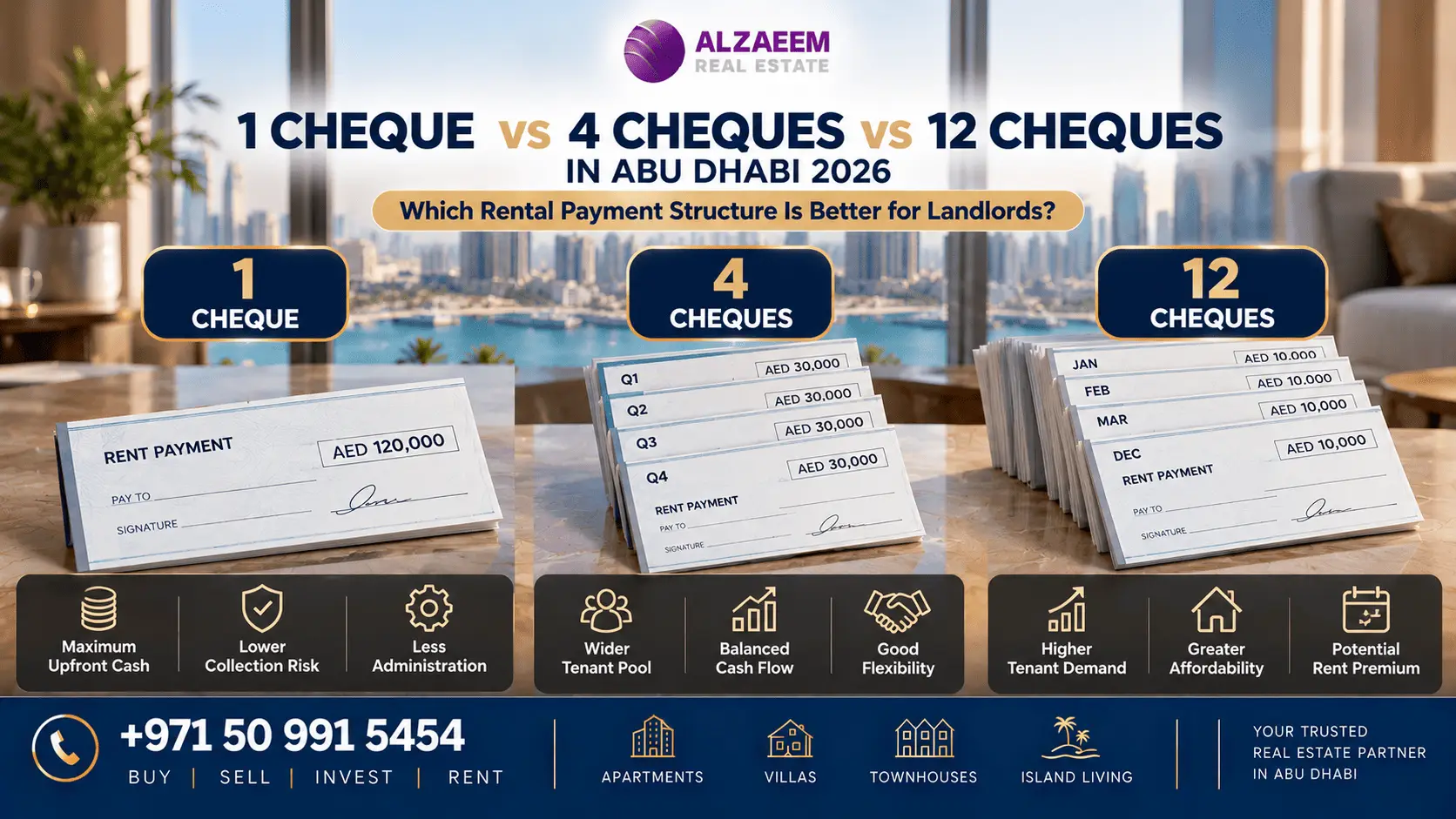
A landlord may advertise an apartment at:
AED 120,000 per year.
But that does not tell you how the rent will actually be collected.
The tenant might pay:
- AED 120,000 in 1 cheque;
- AED 30,000 every quarter in 4 cheques;
- or AED 10,000 per month across 12 payments.
The annual headline rent may be identical.
But for the landlord, these three arrangements create very different:
- cash-flow patterns;
- tenant pools;
- collection risk;
- liquidity;
- leasing flexibility;
- effective return.
That means rental payment structure should not be treated as an administrative detail.
It is part of the investment strategy.
The right question is not:
Which tenant pays the highest annual rent?
It is:
Which payment structure produces the strongest combination of rent, occupancy, cash flow and risk for this particular property?
This distinction is especially important for investors who already understand that gross rent alone does not determine performance. Our Short-Term vs Long-Term Rental in Abu Dhabi 2026 guide explains the same principle at a broader strategy level: net economics matter more than headline revenue.
How Rental Cheque Structures Work
In conventional Abu Dhabi leasing, the annual rent can be divided into an agreed number of payments.
Common structures include:
- 1 payment;
- 2 payments;
- 4 payments;
- sometimes more frequent instalments.
The exact commercial arrangement depends on:
- landlord;
- tenant;
- property;
- market conditions;
- negotiation.
The key point is simple:
Number of cheques changes timing — not necessarily annual rent.
A landlord can therefore offer flexibility without automatically reducing the contractual rent.
However, greater flexibility may affect what tenants are willing to pay.
Why Some Landlords Prefer One Cheque
From the landlord’s perspective, one payment can be very attractive.
The major advantage is:
Cash is collected early.
If annual rent is AED 120,000 and the full amount is received near the beginning of the tenancy, the landlord has immediate access to that capital.
It can then be used for:
- mortgage payments;
- service charges;
- maintenance;
- another investment;
- liquidity reserves.
This reduces dependence on future collections.
Advantages of 1-Cheque Rent
1. Strong Upfront Cash Flow
This is the clearest advantage.
Instead of waiting throughout the year, the landlord receives most or all contractual rental cash early.
For an investor managing multiple properties, that can improve portfolio liquidity substantially.
2. Lower Collection Administration
One payment means fewer payment events to monitor.
The landlord or property manager does not need to repeatedly track:
- due dates;
- reminders;
- payment processing.
That makes the tenancy simpler operationally.
3. Lower Future Collection Exposure
Once the annual amount is received, the landlord is less exposed to future payment timing during that tenancy period.
That can provide greater financial certainty.
4. Useful for Owners With Large Annual Expenses
Some ownership costs may arrive in substantial amounts.
For example:
- service charges;
- insurance;
- major maintenance;
- mortgage obligations.
Receiving annual rent upfront can help fund these expenses.
Our Abu Dhabi Property Taxes & Annual Ownership Costs 2026 explains why rental investors should budget using real annual costs rather than simply comparing gross yields.
Disadvantages of Requiring One Cheque
The biggest problem is straightforward:
Not every strong tenant can or wants to pay an entire year’s rent upfront.
A household may comfortably afford:
AED 10,000 per month
but may not want to transfer:
AED 120,000
at once.
That means strict one-payment requirements can reduce the tenant pool.
One Cheque Can Increase Vacancy Risk
Imagine two identical apartments.
Apartment A
AED 120,000
1 cheque only
Apartment B
AED 123,000
4 cheques
Apartment B actually costs more annually.
But many tenants may still prefer it because the cash-flow burden is easier.
If Apartment A stays vacant longer, the apparent advantage of one upfront cheque can disappear.
Vacancy Can Cost More Than Payment Flexibility
Suppose your apartment rents for:
AED 120,000 per year.
Monthly equivalent:
AED 10,000.
If insisting on one cheque causes the property to remain vacant for one additional month, the lost income is approximately:
AED 10,000.
That is a meaningful amount.
A slightly more flexible payment structure may therefore produce better annual economics.
Why Four Cheques Are Attractive
Four payments create a middle ground.
The tenant pays quarterly.
Using AED 120,000 annual rent:
AED 30,000 × 4.
This may offer landlords:
- reasonably strong cash flow;
- a wider tenant pool;
- manageable administration.
It is often a more balanced structure than the extremes.
Advantages of 4-Cheque Rent
1. Wider Tenant Affordability
Quarterly payments require less upfront cash.
This can make the property accessible to more tenants.
A wider tenant pool can support:
- faster leasing;
- lower vacancy;
- stronger negotiating position.
2. Reasonable Landlord Cash Flow
AED 30,000 every three months still provides meaningful cash inflows.
For many investors, that is sufficient to cover:
- recurring expenses;
- mortgage instalments;
- maintenance.
3. Balance Between Convenience and Risk
One cheque maximises upfront cash.
Twelve payments maximise tenant flexibility.
Four payments sit between the two.
That makes quarterly collection a practical compromise.
Why 12 Payments Can Be Attractive
Monthly payment structures reduce the tenant’s cash-flow burden significantly.
At AED 120,000 annual rent:
AED 10,000 × 12.
This is much closer to the way many households receive salary and budget expenses.
That can make a property highly attractive to tenants.
But the landlord gives up substantial upfront liquidity.
Advantages of 12-Payment Rent
1. Much Wider Tenant Pool
Monthly affordability can bring more tenants into consideration.
This can be particularly useful when:
- competition is strong;
- supply is high;
- landlord wants fast occupancy.
2. Potential Rental Premium
Some tenants may be willing to pay a slightly higher annual rent in exchange for more convenient payment terms.
For example:
1 cheque
AED 120,000
12 payments
AED 126,000
The tenant pays more annually but avoids a large upfront payment.
That can work for both sides if priced sensibly.
3. Lower Tenant Entry Barrier
Moving into a property already involves:
- security deposit;
- moving costs;
- furniture;
- broker fees where applicable;
- utility setup.
Reducing the initial rental payment burden can make the leasing process easier.
Disadvantages of 12 Payments
1. Lower Upfront Liquidity
The landlord receives only a fraction of annual rent at the beginning.
That may be less attractive for owners who need immediate cash.
2. Greater Administrative Burden
More payments mean more:
- due dates;
- bookkeeping;
- tracking.
For professionally managed portfolios this may be manageable.
For self-managed landlords, it adds complexity.
3. Greater Collection Exposure Over Time
Future payments still need to arrive.
The landlord therefore retains greater payment-timing exposure throughout the tenancy.
That does not automatically make monthly rent bad.
It simply means the risk profile differs from upfront collection.
1 Cheque vs 4 vs 12 — Quick Comparison
| Factor | 1 Cheque | 4 Cheques | 12 Payments |
|---|---|---|---|
| Upfront landlord cash | Highest | Medium | Lowest |
| Tenant affordability | Lowest | Good | Highest |
| Tenant pool | Narrower | Broad | Broadest |
| Collection administration | Lowest | Moderate | Highest |
| Future collection exposure | Lowest | Medium | Highest |
| Leasing flexibility | Low | Good | High |
| Potential rent premium | Lower need | Moderate | Can be higher |
| Vacancy protection | Depends on demand | Strong balance | Potentially strongest |
| Best for liquidity-focused landlord | Strong | Good | Weakest |
| Best for tenant convenience | Weakest | Good | Strongest |
The correct choice depends on the property and market.
Payment Structure Can Change Effective Rent
This is where investors need discipline.
Suppose:
Option A — One Cheque
Annual rent:
AED 120,000
Vacancy:
0 months
Collected:
AED 120,000
Option B — Four Cheques
Annual rent:
AED 123,000
Vacancy:
0 months
Collected:
AED 123,000
Option C — One Cheque, But Harder to Lease
Advertised rent:
AED 125,000
Vacancy:
1 month
Effective annual income approximately:
AED 114,583
The highest advertised rent produced the lowest effective revenue.
This is why investors must analyse:
Effective collected rent
rather than:
Advertised annual rent.
Vacancy Is One of the Most Expensive Rental Costs
Investors often focus heavily on:
- service charges;
- maintenance;
- broker commission.
But vacancy can be more expensive than all three.
A property worth AED 10,000 per month that sits empty for two months loses:
AED 20,000.
Payment flexibility may therefore be economically valuable if it reduces vacancy.
Illustrative Landlord Comparison
Consider an apartment worth:
AED 1.8 million.
Strategy A — One Cheque
Annual rent:
AED 118,000
Vacancy:
2 weeks
Effective gross rent:
approximately AED 113,462
Strategy B — Four Cheques
Annual rent:
AED 122,000
Vacancy:
0 weeks
Effective gross rent:
AED 122,000
Strategy C — Twelve Payments
Annual rent:
AED 128,000
Assume slightly higher management/admin cost:
AED 3,000
Effective before other ownership costs:
AED 125,000
In this hypothetical example, the most flexible structure produces the strongest cash economics despite slower collection.
Illustrative figures only.
Cash Timing Also Has Value
However, AED 120,000 received today is not economically identical to AED 10,000 received every month.
Why?
Because upfront cash can be:
- invested;
- used to reduce debt;
- held for opportunities;
- used to cover ownership costs.
This is the concept of:
Time value of money.
So landlords should not compare annual totals alone.
Mortgage Investors May Prefer Predictability
A leveraged landlord has regular debt obligations.
That changes the analysis.
If mortgage payments occur monthly, a landlord may not necessarily need the entire annual rent upfront.
But they do need reliable cash flow.
A four-payment or monthly structure can still work very well if rent comfortably covers debt and operating expenses.
Our Cash vs Mortgage Property in Abu Dhabi 2026 explains why financing structure changes how investors should evaluate property cash flow.
Cash Investors Can Be More Flexible
A landlord without mortgage obligations may have greater flexibility to accept monthly or quarterly payments.
They may prioritise:
- tenant quality;
- higher annual rent;
- lower vacancy
over immediate cash collection.
Tenant Quality Matters More Than Cheque Count
This is crucial.
A landlord should not automatically prefer:
1 cheque
from a weaker tenant
over:
4 payments
from a stronger tenant.
The tenancy should be evaluated more broadly.
Consider:
- employment stability;
- household profile;
- references where appropriate;
- payment history;
- documentation.
Payment schedule is only one variable.
Property Type Matters
Payment strategy may differ across property categories.
Studio / 1BR
Tenant base may include:
- professionals;
- younger residents.
Payment flexibility can matter considerably.
2BR / 3BR
Family renters may balance:
- school expenses;
- household costs;
- annual rental payments.
Quarterly terms may widen demand.
Luxury Property
High-income tenants may still value liquidity and flexibility even when they can afford annual payment.
Do not assume:
expensive property = one cheque only.
Location Matters
Some locations have deep rental demand.
A landlord in a highly sought-after micro-market may have more negotiating power.
In weaker rental conditions, rigid payment terms can prolong vacancy.
This is why rental strategy must be based on actual demand, not habit.
Furnished vs Unfurnished Can Affect Payment Strategy
A fully furnished unit may attract:
- relocating executives;
- shorter-stay residents;
- corporate tenants.
Their payment preferences may differ from long-term family tenants.
Our Furnished vs Unfurnished Property in Abu Dhabi 2026 examines how tenant profile changes rental economics.
Existing Tenant vs Vacant Property
Payment structure also matters when purchasing a tenanted investment.
If the tenant already has:
- contractual rent;
- agreed payment schedule;
the new owner inherits an existing income pattern rather than choosing freely.
This is why investors should understand tenancy terms before buying. Our Vacant vs Tenanted Property in Abu Dhabi 2026 explains the broader trade-off.
Do More Payments Automatically Mean Higher Rent?
No.
A landlord cannot assume:
12 payments = charge any premium.
The market determines the acceptable difference.
If comparable units rent for AED 120,000 and you demand:
AED 140,000
simply because you offer monthly payments, tenants may choose another property.
Payment flexibility has value.
But that value has a limit.
Calculate the Payment Premium
Suppose:
1 cheque
AED 120,000
4 cheques
AED 123,000
12 payments
AED 128,000
Premium over one cheque:
Four payments
AED 3,000
= 2.5%
Twelve payments
AED 8,000
= 6.7%
Now ask:
Does the additional revenue adequately compensate for:
- slower cash receipt;
- additional administration;
- collection risk?
That is the correct analysis.
Do Not Confuse Gross Rent With Net Yield
A landlord may proudly achieve:
AED 130,000
instead of:
AED 120,000.
But if the higher-payment strategy also involves:
- property management;
- vacancy;
- maintenance;
- service charges;
the net difference may be much smaller.
For proper investment comparison, use the methodology in our How to Calculate Abu Dhabi Property ROI in 2026.
Example of Net Yield
Assume property price:
AED 2,000,000
Annual rent:
AED 130,000
Operating expenses:
- service charges: AED 20,000
- maintenance: AED 5,000
- management: AED 6,000
- vacancy allowance: AED 5,000
Net operating income:
AED 94,000
Net operating yield:
4.7%
This is more meaningful than simply quoting:
6.5% gross yield.
When One Cheque Can Be the Best Choice
One cheque can be attractive when:
- tenant demand is strong;
- tenant can comfortably pay upfront;
- landlord values liquidity;
- mortgage or annual obligations require cash;
- property leases quickly without concessions.
In that situation, there may be little reason to offer additional flexibility.
When Four Cheques Can Be the Best Choice
Four payments can work particularly well when:
- landlord wants a broad tenant pool;
- quarterly cash flow is sufficient;
- annual rent improves slightly;
- vacancy is reduced.
For many landlords, this may represent the most balanced structure.
When Monthly Payments Can Be the Best Choice
Monthly payment can make sense when:
- market competition is strong;
- landlord wants maximum tenant accessibility;
- rental premium is meaningful;
- professional management handles collection;
- property needs faster occupancy.
But cash flow must be managed carefully.
Overseas Landlords Should Consider Management
For overseas owners, receiving twelve payments may create more administration.
A professional property manager can handle:
- tenancy coordination;
- collection;
- maintenance;
- tenant communication.
But management costs reduce net return.
Our Buying Abu Dhabi Property From Overseas explains why remote investors should factor operational management into the investment before buying.
Payment Flexibility Can Be a Marketing Tool
Instead of immediately reducing rent, a landlord facing weak demand may first offer better payment terms.
For example:
Instead of:
AED 120,000 → reduce to AED 112,000
the landlord might test:
AED 120,000 with more flexible instalments.
If the property leases faster, the landlord preserves annual rent while improving tenant affordability.
This can be a more efficient concession.
Rent Discount vs Payment Flexibility
Suppose a tenant asks for:
Option 1
AED 115,000 in one cheque
or
Option 2
AED 120,000 in four payments.
The landlord should compare:
- AED 5,000 additional rent;
- versus delayed cash collection.
The answer may depend on liquidity needs.
Renewal Strategy Matters
A good tenant has economic value.
When renewal arrives, landlords should not focus only on maximising nominal rent.
Consider:
- vacancy risk;
- leasing costs;
- maintenance between tenants;
- time without income.
Keeping a strong tenant under sensible payment terms may sometimes outperform replacing them for a slightly higher headline rent.
Turnover Costs Can Erase a Rent Premium
Suppose changing tenants costs:
- 1 month vacancy: AED 10,000;
- maintenance/repainting: AED 4,000;
- leasing cost: AED 5,000.
Total economic friction:
AED 19,000.
Replacing a tenant simply to achieve AED 8,000 more annual rent may not improve the first year’s return.
Cheque Count Should Match the Investment Strategy
Different landlords have different objectives.
Income-Maximising Landlord
May prefer higher annual rent through flexible payments.
Liquidity-Focused Landlord
May favour one upfront payment.
Conservative Landlord
May choose four payments from a high-quality tenant.
Portfolio Landlord
May optimise payment schedules across multiple properties to create regular cash inflows.
There is no universal ideal.
Common Landlord Mistakes
Mistake 1: Insisting on One Cheque Without Testing Demand
This can increase vacancy.
Mistake 2: Offering 12 Payments Without Pricing the Flexibility
Flexibility has economic value.
Mistake 3: Looking Only at Annual Rent
Timing matters.
Mistake 4: Ignoring Tenant Quality
Payment count is not credit quality.
Mistake 5: Ignoring Vacancy
Empty property produces zero rent.
Mistake 6: Comparing Gross Income Only
Net return is what matters.
Mistake 7: Forgetting Management Costs
More payment events can require more administration.
Al Zaeem Rental Payment Checklist
Before deciding on payment structure, calculate:
Market Rent
What are comparable units actually asking and achieving?
Tenant Pool
Who is likely to rent this property?
Vacancy
Will strict terms slow leasing?
Cash Requirement
Do you need rent upfront?
Mortgage
What are your debt-payment obligations?
Flexibility Premium
Will tenants pay more for instalments?
Collection Administration
Who will manage payments?
Net Yield
What remains after all operating costs?
Tenant Retention
Will reasonable terms help keep a strong tenant?
Which Is Better for Landlords?
There is no single winner.
1 cheque is strongest when:
- liquidity matters;
- tenant demand is deep;
- landlord wants minimal collection administration.
4 cheques are strongest when:
- landlord wants balance;
- tenant accessibility matters;
- quarterly cash flow is acceptable.
12 payments can be strongest when:
- flexibility commands a rental premium;
- vacancy reduction matters;
- collection is professionally managed.
Which Produces the Highest Yield?
Not necessarily the structure with the highest nominal rent.
The correct calculation is:
Effective collected rent − vacancy − operating costs = net rental income.
Then compare that figure against:
total capital invested.
That is your real operating return.
Final Verdict
Rental payment structure in Abu Dhabi is more than a negotiation detail.
It can influence:
- tenant demand;
- vacancy;
- cash flow;
- collection risk;
- annual rent;
- net yield.
A landlord demanding one cheque may receive excellent upfront liquidity but reduce the tenant pool.
A landlord accepting twelve payments may widen demand and possibly achieve a higher annual rent, but sacrifice upfront cash and increase administration.
Four payments often provide a practical middle ground.
The strongest strategy therefore is not:
Always demand one cheque.
Nor is it:
Always offer monthly payments.
It is:
Use the payment structure that produces the highest risk-adjusted effective rent for the specific property and tenant market.
For an investor, AED 120,000 collected efficiently can be more valuable than AED 130,000 advertised badly.