


Receiving the keys is not the end of an investment property purchase.
For a landlord, it is the beginning of the most important operational stage:
turning an empty property into an income-producing asset.
Every day between:
key collection
and
tenant move-in
has a financial cost.
A newly handed-over apartment may look complete, but it can still require:
- defect follow-up;
- utilities;
- cleaning;
- furnishing decisions;
- photography;
- rental pricing;
- advertising;
- enquiries;
- tenant screening;
- tenancy registration;
- deposit collection;
- move-in coordination.
If these steps are handled one after another with no preparation, the property can remain vacant unnecessarily.
A better approach is:
run them as a coordinated 30-day launch.
Why the First 30 Days Matter
Assume a property could rent for:
AED 120,000 per year
Equivalent monthly rent:
AED 10,000
Approximate weekly rental value:
AED 2,300
A four-week avoidable delay can therefore represent roughly:
AED 10,000 of potential gross rental opportunity
before considering leasing costs and other expenses.
This does not mean every property will rent immediately.
It means vacancy should be actively managed.
The Objective
The goal after handover is not:
“List the apartment as quickly as possible.”
The goal is:
Make the property genuinely ready, price it correctly, market it professionally and secure an appropriate tenant efficiently.
Launching too early with:
- unresolved defects;
- poor photographs;
- incomplete utilities;
- unrealistic price
can damage first impressions and prolong vacancy.
The 30-Day Framework
A practical launch can be divided into four phases:
Days 0–3
Control the asset
Days 1–7
Make it operational
Days 5–14
Launch to market
Days 10–30
Convert enquiries into a tenancy
Several stages should overlap.
That is what saves time.
Days 0–3: Secure the Property
Immediately after handover, create a complete record of what you received.
Check:
- keys;
- access cards;
- parking remote;
- mailbox key;
- parking bay;
- storage area;
- meter readings;
- handover documents;
- warranties;
- community contacts.
Photograph everything.
Do not rely on memory.
Create a Handover Property File
Your landlord file should include:
Ownership
- title deed;
- SPA;
- handover certificate.
Financial
- purchase-payment statement;
- service-charge information;
- mortgage documentation where applicable.
Technical
- snagging report;
- warranties;
- appliance manuals;
- defect correspondence.
Community
- building rules;
- access procedures;
- community manager details.
Leasing
Later add:
- listing permit;
- tenancy contract;
- tenant ID;
- deposit record;
- inventory;
- move-in inspection.
One organised file can prevent significant future disputes.
Confirm the Property Is Actually Rent-Ready
Do not confuse:
handed over
with:
ready for tenant occupation.
Immediately test:
- AC;
- hot water;
- taps;
- drainage;
- toilets;
- lights;
- sockets;
- doors;
- locks;
- appliances;
- balcony doors;
- windows.
A beautiful apartment that cannot cool properly is not rent-ready.
Days 1–7: Follow Up Snagging
If defects were recorded before handover, check whether they were rectified.
Common unresolved items may include:
- paint defects;
- loose fittings;
- damaged tiles;
- leaking fixtures;
- cabinet alignment;
- door adjustments;
- AC problems.
Prioritise defects affecting:
safety,
functionality,
or
tenant usability.
Minor cosmetic items can be handled separately where appropriate.
Do Not Renovate Over Developer Defects
One of the worst post-handover mistakes is immediately:
- repainting;
- changing flooring;
- installing cabinetry;
- modifying bathrooms
before original defects are properly documented.
That can make responsibility harder to establish later.
Our Property Snagging Abu Dhabi 2026 and Property Defects Liability Period Abu Dhabi 2026 guides explain this distinction in detail.
Utilities Should Start Immediately
Utility delays can create unnecessary vacancy.
Depending on the property, this may involve:
- electricity;
- water;
- cooling;
- telecom.
Start the applicable setup as soon as possible after handover.
A tenant viewing should ideally experience:
- working AC;
- lighting;
- water;
- functioning appliances.
Cooling Is Especially Important
Abu Dhabi tenants will judge an apartment very quickly if:
- AC is weak;
- rooms do not cool evenly;
- thermostat is not functioning;
- unusual noise is present.
Do not wait for the tenant to discover the issue.
Test cooling before marketing.
Deep Cleaning Before Photography
A newly completed property may contain:
- construction dust;
- adhesive marks;
- fingerprints;
- grout residue;
- packaging debris.
Even if it is technically new, it may not photograph well.
A professional deep clean can improve:
- photography;
- viewings;
- perceived quality.
Days 2–5: Furnished or Unfurnished?
This decision should be commercial.
Do not furnish simply because:
“Furniture makes the apartment look nicer.”
Ask:
Who is the likely tenant?
What does the competing market offer?
Is the property type commonly rented furnished?
Will the achievable rental premium justify the investment?
Furnished Strategy
Furnished may suit:
- certain professionals;
- short-to-medium relocation profiles;
- tenants who want move-in convenience.
But costs include:
- furniture;
- appliances;
- wear;
- replacement;
- inventory management.
Unfurnished Strategy
Unfurnished can appeal to:
- longer-term residents;
- families;
- tenants with their own furniture.
It may also reduce:
- upfront capital;
- maintenance responsibility;
- inventory disputes.
There is no universally superior model.
Avoid Over-Furnishing
Suppose furniture costs:
AED 70,000
but increases annual rent by only:
AED 8,000
Simple payback:
8.75 years
before accounting for:
- damage;
- replacements;
- maintenance.
That may not be an attractive return.
Furniture should be an investment decision.
Minimum Rent-Ready Standard
Even an unfurnished apartment should normally present as:
- clean;
- fully functioning;
- professionally maintained;
- free of obvious defects.
Depending on the property and tenancy arrangement, essential installed items should be tested before listing.
Days 3–7: Prepare the Property for Photography
Before photography:
- remove boxes;
- remove contractor equipment;
- clean windows;
- open curtains;
- turn on lights;
- remove protective plastic;
- tidy balcony;
- fix obvious defects.
Photography should represent the property at its best.
Not:
“We will improve it after someone books a viewing.”
Professional Photography Matters
The first property viewing normally happens:
online.
Tenants compare:
- dozens of listings;
- photographs;
- rent;
- location;
- layout.
Poor photography can reduce enquiry volume before the tenant ever speaks to an agent.
Do Not Use Misleading Photos
Avoid:
- fake views;
- images from different units;
- excessively manipulated dimensions;
- outdated images.
Abu Dhabi’s current real-estate advertising ecosystem is increasingly focused on verified listings through ADREC’s Madhmoun MLS, which is designed to ensure property listings are authentic and traceable.
Accuracy builds trust.
Madhmoun and Verified Advertising
ADREC’s current framework requires licensed real-estate practitioners to operate through the verified Madhmoun ecosystem for applicable property advertising.
Madhmoun is designed to:
- verify properties;
- reduce duplicate or fake listings;
- improve listing accuracy;
- connect approved brokers and inventory.
For landlords, this reinforces a basic principle:
use a properly authorised brokerage and a verified listing process.
Days 4–7: Determine the Asking Rent
Do not start with:
“My neighbour said his apartment rents for AED 150,000.”
Instead analyse:
- same building;
- same unit type;
- similar size;
- comparable view;
- similar floor;
- furnished vs unfurnished;
- current competing stock.
The correct asking rent should reflect:
the market today.
Asking Rent vs Achievable Rent
These are different.
A portal may show:
AED 145,000
But if competing units stay online for weeks and ultimately lease near:
AED 135,000
then AED 145,000 may be an aspiration rather than market-clearing rent.
The Highest Asking Rent Is Not Always the Best Strategy
Imagine:
Strategy A
Ask AED 150,000.
Vacant for six weeks.
Strategy B
Ask AED 142,000.
Lease within two weeks.
Four weeks of extra vacancy at AED 142,000 annual rent represents approximately:
AED 10,900
of gross rental opportunity.
The additional AED 8,000 target rent may therefore be economically inferior.
Calculate the Cost of Vacancy
Formula:
Annual Rent ÷ 365 × Vacant Days
Example:
Annual rent:
AED 120,000
Daily equivalent:
approximately AED 329
30 vacant days:
approximately:
AED 9,870
This is why pricing must be judged against vacancy.
Days 5–7: Launch the Listing
A strong rental listing should include:
- correct bedroom count;
- accurate BUA where available;
- view;
- floor;
- parking;
- balcony;
- amenities;
- furnishing status;
- availability;
- rental terms.
Avoid generic filler.
Make the Headline Specific
Weak:
Amazing Luxury Apartment
Better:
2BR | Balcony | Pool View | Ready to Move
Clarity attracts relevant enquiries.
Highlight Genuine Advantages
Depending on the property:
- corner unit;
- high floor;
- balcony;
- waterfront view;
- parking;
- storage;
- upgraded interior;
- new handover;
- community amenities.
Do not invent scarcity.
Launch When the Property Can Actually Be Viewed
Advertising too early can waste enquiries.
A tenant asks:
“Can I view tonight?”
If the answer is repeatedly:
“Not yet, maybe next week,”
the lead may disappear.
Ideally the property should be:
viewable immediately or within a clearly defined timeframe.
Days 7–14: Measure Enquiry Quality
Do not simply count calls.
Track:
- enquiries;
- viewing requests;
- completed viewings;
- offers;
- feedback.
This creates a leasing funnel.
Example:
30 enquiries
→ 12 qualified prospects
→ 7 viewings
→ 2 offers
That is useful.
Zero Enquiries Is a Signal
If a correctly advertised property receives almost no enquiries, possible causes include:
- price too high;
- poor photography;
- weak listing visibility;
- undesirable terms;
- inaccurate positioning.
Do not wait four weeks before reacting.
Enquiries but No Viewings
Possible causes:
- rent;
- location mismatch;
- payment terms;
- unclear information.
Review lead feedback.
Many Viewings but No Offers
This can indicate:
- property condition;
- asking rent;
- furnishing;
- layout disadvantage;
- stronger competing units.
The market is giving you information.
Use it.
Use a 7-Day Review
After the first week, assess:
How many enquiries?
How many serious enquiries?
How many viewings?
What feedback repeated?
How many competing units appeared?
Did any competitors reduce price?
Then decide whether the strategy needs adjustment.
Do Not Change Rent Every Day
Constant pricing changes make decision-making chaotic.
Use structured review points.
For example:
Day 7
Review.
Day 14
Review again.
Day 21
Make stronger adjustment if necessary.
Payment Terms Matter
Two properties at the same annual rent may not be equally attractive.
Example:
Property A
AED 120,000 in 1 cheque.
Property B
AED 120,000 in 4 payments.
Tenant demand may differ.
Landlords should consider:
- tenant profile;
- cash flow;
- market norms;
- risk.
More Instalments Do Not Necessarily Mean Lower Quality Tenant
Payment frequency is a commercial term.
Tenant quality should instead be evaluated through:
- identity;
- income;
- employer;
- affordability;
- history where available.
Do not confuse payment structure with reliability.
Days 10–20: Tenant Screening
Once offers arrive, do not automatically choose:
the highest offer.
Review the full tenancy profile.
Possible checks include:
- Emirates ID or relevant identity documents;
- employment details;
- income affordability;
- intended occupants;
- intended use;
- proposed payment terms;
- move-in date.
Tenant Screening Is Risk Management
A strong tenant can reduce:
- late payments;
- disputes;
- property damage;
- early departure.
The best offer is often the best overall combination of:
rent + reliability + timing + terms.
Do Not Discriminate Illegally or Arbitrarily
Tenant selection should focus on legitimate tenancy and affordability criteria.
Use consistent screening standards.
Security Deposit
The security deposit should be clearly documented in the tenancy arrangement.
Record:
- amount;
- payment;
- purpose;
- move-in property condition.
The deposit should not become a substitute for proper inventory and inspection records.
Our Security Deposit Abu Dhabi 2026 guide explains this in detail.
Prepare a Move-In Condition Report
Before the tenant takes possession, photograph:
- walls;
- flooring;
- kitchen;
- bathrooms;
- appliances;
- doors;
- balcony;
- furniture where applicable.
Record:
- existing marks;
- existing defects;
- meter readings;
- key count.
This protects:
landlord and tenant.
Furnished Properties Need an Inventory
For furnished units, list:
- sofa;
- beds;
- tables;
- chairs;
- TVs;
- appliances;
- curtains;
- accessories where material.
Include condition where appropriate.
Avoid:
“Fully furnished apartment”
with no actual inventory record.
Tenancy Contract Registration
Abu Dhabi tenancy contracts can currently be registered digitally through DARI.
The lessor starts the process by selecting the property and entering:
- contract type;
- tenant details;
- rent amount;
- start and expiry dates;
- deposit;
- payment method;
- number of instalments;
- municipality-fee responsibility;
- sublease permission.
The tenant then receives the contract through DARI to review and accept or return for changes.
The Tenancy Contract Should Match the Commercial Deal
Before registration, confirm:
Annual rent
Start date
End date
Number of payments
Deposit
Included amenities
Utility responsibilities
Subletting position
Do not sign first and resolve key terms later.
DARI Registration Fee
DARI’s current service information lists the request to register a new lease contract at:
AED 50
for the standard service, with separate rules for longer-term contracts.
Fees can change, so verify the current service page at the time of registration.
Tawtheeq Terminology
Many landlords and tenants still commonly refer to the registered Abu Dhabi tenancy contract as:
Tawtheeq.
The current digital registration process is handled through DARI.
ADREC’s 2026 rental-freeze announcement also continues to refer to the property’s last registered Tawtheeq rental rate.
So both terms can appear in the market.
Current 2026 Rental Freeze Matters
As of the temporary update announced on 3 June 2026, ADREC set the annual rental increase for residential, commercial and industrial renewals at:
0%
until further notice.
ADREC also stated that renewals and new agreements during the measure reference the property’s last registered Tawtheeq rental rate.
For newly handed-over properties with no previous registered tenancy, landlords should verify how the current rule applies to their specific unit rather than assuming the treatment of an existing lease.
Do Not Invent a Previous Rent
If the property is newly completed and never leased before:
verify its registration/rental position through the applicable official system.
Do not create artificial tenancy history.
Move-In Permit
A registered tenancy contract does not automatically mean the tenant can arrive with movers at any time.
Some managed communities require:
- move-in registration;
- advance date/time;
- security approval;
- service-lift booking.
For example, Aldar’s current community process allows owners or tenants to request a move-in permit, choose a moving time and reserve a service elevator where required.
This is community-specific, not a universal identical Abu Dhabi process.
Check Community Rules Before Move-In
Before confirming the tenant’s moving date, ask the Community Management Company about:
- move-in permit;
- mover requirements;
- lift booking;
- permitted hours;
- access-card registration;
- moving deposits if applicable.
Avoid discovering restrictions when the moving truck arrives.
Days 20–30: Finalise Occupancy
Once the tenant is approved:
- finalise commercial terms;
- register tenancy;
- collect agreed payments;
- complete condition report;
- provide keys/access;
- coordinate move permit;
- hand over property.
Then document:
possession date.
First Rent Collection
Maintain a clear record of:
- rental payment;
- receipt;
- due dates;
- future payment dates.
For multi-payment leases, create reminders before each due date.
A property-management system should not depend on memory.
Move-In Day
On move-in:
Confirm key count.
Confirm access cards.
Confirm parking.
Confirm property condition.
Confirm meter readings.
Sign inventory where applicable.
Provide maintenance contact route.
A clean handover reduces first-week complaints.
Give the Tenant a Clear Maintenance Route
Tenants should know:
- who to contact;
- what constitutes emergency maintenance;
- how to report defects;
- what information to provide.
Weak process:
“Call me if anything goes wrong.”
Better:
send issue + photo + unit number + urgency through agreed channel.
Private Unit vs Common Area
Not every tenant complaint belongs to the landlord.
Examples:
Internal plumbing
Potential unit-level issue.
Lift
Community-management issue.
Swimming pool
Community-management issue.
Internal AC component
Usually unit-level investigation first.
Our Common Area vs Private Unit Responsibility Abu Dhabi 2026 guide explains these boundaries.
First 30 Days After Tenant Moves In
Landlord responsibilities do not end once rent is collected.
Monitor:
- early maintenance issues;
- access problems;
- community registration;
- outstanding defect claims.
The first weeks can reveal handover defects that were not obvious when the property was vacant.
New Property Does Not Mean Zero Maintenance
Even a brand-new apartment can experience:
- AC drainage issue;
- sealant failure;
- cabinet adjustment;
- plumbing leak;
- appliance issue.
New-build defects and normal maintenance should be classified correctly.
Developer Defect or Landlord Maintenance?
When something fails soon after handover, ask:
Is it an original construction defect?
Is it a defective building installation?
Is it normal use-related maintenance?
Did the tenant cause it?
Do not automatically pay for everything.
Our Property Defects Liability Period Abu Dhabi 2026 guide explains the post-handover framework.
The Vacancy Trap
Many landlords think:
“I will wait for my ideal rent.”
But vacancy compounds.
Example:
Target rent:
AED 150,000
Realistic market rent:
AED 140,000
Difference:
AED 10,000 annually
If holding for the higher price causes one extra month vacancy:
Approximate lost gross rent at AED 140,000:
AED 11,667
You may lose more waiting than the annual rent premium you hoped to gain.
The First Tenant Can Influence Future Rental History
The first registered lease creates an important market reference for the unit.
This is particularly relevant under Abu Dhabi’s current temporary rental-freeze framework because ADREC states that rental rates are being referenced to the property’s last registered Tawtheeq contract during the measure.
That makes pricing the first lease a strategic decision, not something to handle casually.
But Do Not Overprice Just to Establish a Higher Baseline
A theoretical higher registered rent is worthless if:
- nobody rents the unit;
- vacancy continues;
- cash flow disappears.
Market-clearing rent remains critical.
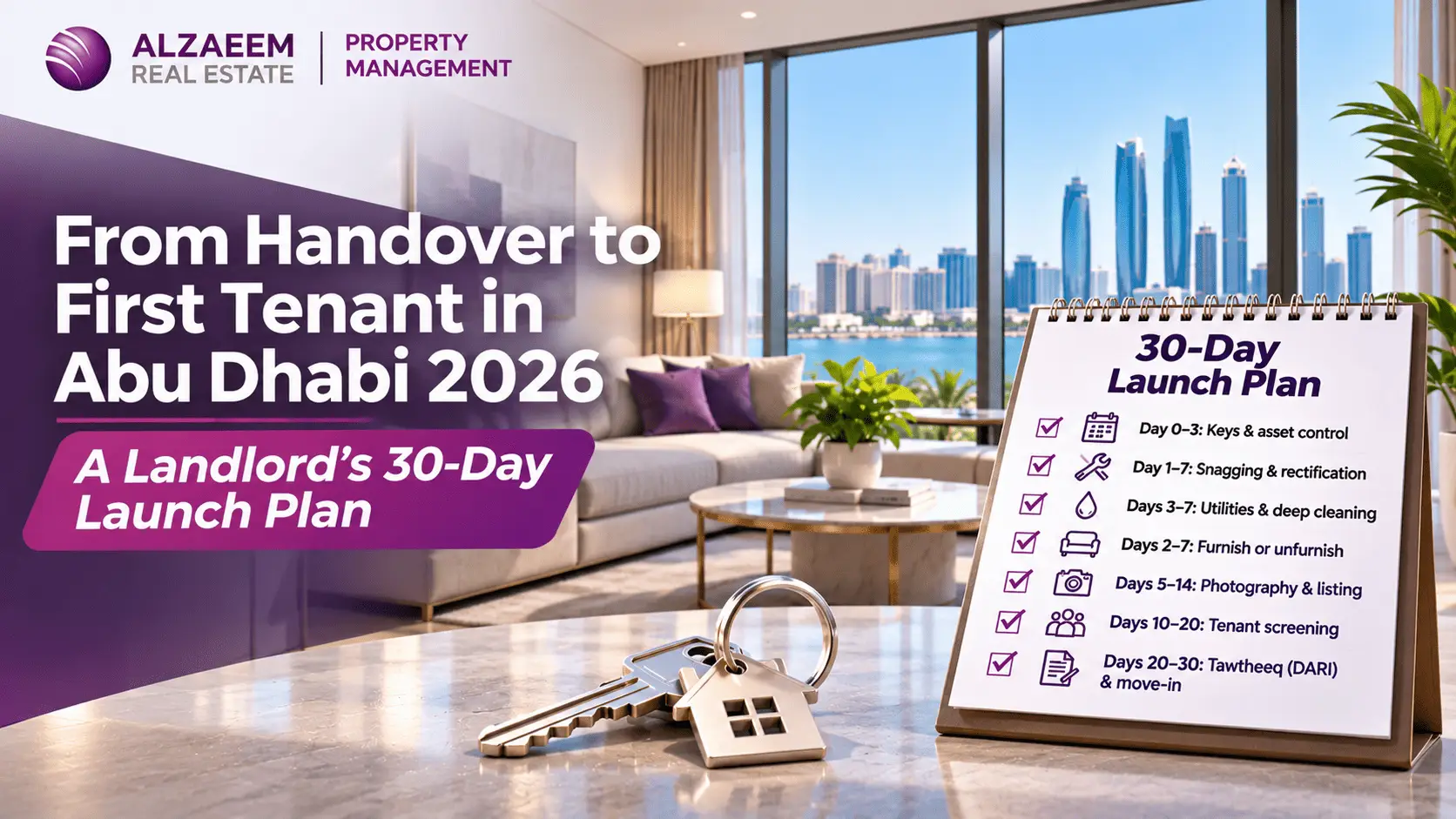
30-Day Landlord Launch Plan
Day 0
Receive keys and documents.
Day 1
Photograph property and meters.
Day 2
Review unresolved snags.
Day 3
Start utilities and maintenance.
Day 4
Deep clean.
Day 5
Decide furnished vs unfurnished.
Day 6
Prepare property.
Day 7
Professional photography.
Day 8
Complete rental analysis.
Day 9
Approve asking rent.
Day 10
Launch verified listing.
Day 11–14
Track enquiries and conduct viewings.
Day 15
Review pricing and feedback.
Day 16–21
Screen offers and negotiate.
Day 22–24
Select tenant.
Day 25–26
Prepare tenancy contract.
Day 27
Complete registration.
Day 28
Condition report and inventory.
Day 29
Arrange move permit where required.
Day 30
Tenant move-in.
This is an ideal operating model.
Actual leasing time will vary with:
- property;
- market;
- rent;
- demand.
A Faster Launch Is Possible
Several tasks can happen simultaneously.
For example:
While developer rectifies minor snags:
- prepare market analysis;
- arrange utilities;
- choose furnishing strategy.
While furniture is being installed:
- arrange photography date;
- prepare listing copy.
Operational overlap reduces vacancy.
Landlord Launch Dashboard
Track five numbers:
Days Vacant
How long since property became marketable?
Enquiries
How many leads?
Viewings
How many physical visits?
Offers
How many serious proposals?
Asking vs Offer Gap
How far below asking are credible offers?
These metrics reveal where the problem is.
Example: Strong Demand
First 7 days:
- 30 enquiries;
- 14 viewings;
- 5 offers.
This suggests:
pricing is probably competitive.
Example: Weak Demand
First 7 days:
- 4 enquiries;
- 1 viewing;
- zero offers.
Investigate:
- price;
- marketing;
- property readiness.
Example: Plenty of Leads, No Conversion
First 7 days:
- 25 enquiries;
- 9 viewings;
- zero offers.
This suggests the listing attracts attention but something about the actual proposition is weak.
Possible reasons:
- view;
- condition;
- furniture;
- price.
Property Management Can Compress the Timeline
A landlord managing alone may process tasks sequentially:
keys
→ defects
→ cleaning
→ photos
→ listing
→ tenant.
Professional property management can coordinate several streams at once:
- maintenance;
- leasing;
- tenant communication;
- registration;
- move-in.
That can reduce avoidable vacancy.
Al Zaeem Property Management
Al Zaeem Property Management can act as the operational bridge between:
handover
and
occupied rental property.
Support can include:
- handover coordination;
- property readiness;
- maintenance;
- rental assessment;
- marketing;
- tenant screening;
- tenancy administration;
- rent collection;
- inspections;
- renewal management.
For overseas owners, this can be particularly valuable because the owner does not need to physically manage each stage.
Al Zaeem Facility Management
Where unit preparation is required, Al Zaeem Facility Management can coordinate private-unit services such as:
- AC;
- plumbing;
- electrical;
- painting;
- flooring;
- woodwork;
- general property preparation.
This helps move the property from:
new
to:
rent-ready.
12 Mistakes That Delay the First Tenant
Mistake 1 — Waiting for every cosmetic snag before doing anything else
Run parallel tasks.
Mistake 2 — Listing before the property is viewable
Bad first impressions waste leads.
Mistake 3 — Poor photography
The listing loses clicks.
Mistake 4 — Pricing from emotion
Use current comparables.
Mistake 5 — Ignoring vacancy cost
Waiting has a price.
Mistake 6 — Over-furnishing
Furniture may not generate adequate return.
Mistake 7 — Not testing AC and utilities
Tenant discovers problems.
Mistake 8 — Accepting the first applicant without screening
Fast is not always safe.
Mistake 9 — No condition report
Future deposit disputes become harder.
Mistake 10 — No inventory
Especially risky for furnished properties.
Mistake 11 — Forgetting community move-in requirements
Tenant’s moving day can be disrupted.
Mistake 12 — Treating registration as an afterthought
Complete the tenancy properly.
Pre-Tenant Checklist
Before signing:
Property cleaned?
Utilities functioning?
AC tested?
Defects documented?
Rent analysed?
Listing verified?
Tenant screened?
Deposit agreed?
Payment schedule agreed?
Community requirements checked?
Move-In Checklist
Before handing over keys:
Tenancy registered?
Initial rent received?
Deposit recorded?
Inventory completed?
Condition photos taken?
Meter readings recorded?
Keys counted?
Access cards issued?
Parking confirmed?
Move permit approved if required?
The Real Investment Transition
Off-plan investors often focus intensely on:
- launch price;
- payment plan;
- handover.
But profit is ultimately created through:
operational performance.
The real journey is:
purchase
→ completion
→ handover
→ property preparation
→ leasing
→ rent collection
→ tenant retention.
A poor final operational stage can erase some of the advantage gained at purchase.
Final Verdict
The fastest route from handover to first tenant is not:
List immediately and hope someone rents it.
It is:
prepare → price → market → measure → screen → register → move in.
The first few days after handover should focus on:
- asset control;
- snagging;
- utilities;
- property readiness.
The next stage should focus on:
- rental analysis;
- verified marketing;
- professional presentation.
Then:
- enquiries;
- viewings;
- tenant screening;
- tenancy registration;
- move-in.
Abu Dhabi’s current DARI system allows landlords to register a tenancy digitally, including the rent, deposit, payment structure and tenant information, after which the tenant reviews and accepts the agreement electronically.
Current Abu Dhabi advertising regulation also places property marketing within the verified Madhmoun MLS ecosystem, reinforcing the importance of accurate, approved property listings.
And in managed communities, the final move may require a separate community permit or service-lift booking depending on the project, as demonstrated by current Aldar community procedures.
For landlords, the financial principle is simple:
every unnecessary vacant day has a cost.
A professionally managed 30-day launch can help turn:
a newly completed property
into:
an operating rental asset
with less avoidable downtime.
Official Sources
Abu Dhabi Real Estate Centre / DARI — Tenancy Contract Registration
Current digital process for landlord initiation and tenant acceptance of registered tenancy contracts.
Abu Dhabi Real Estate Centre — Madhmoun MLS
Current verified property-listing framework for Abu Dhabi.
ADREC — Temporary Rental Cap Update, 3 June 2026
Current temporary 0% renewal-increase measure and Tawtheeq rental-rate reference framework.
Community Management / Developer Guidance
Move-in and community access requirements can vary by development and should be confirmed with the relevant community manager.
Disclaimer
This article provides general real-estate and property-management information only. It does not constitute legal, financial or investment advice.
Rental demand, achievable rent, vacancy periods, service requirements and community procedures vary by property and market conditions. Landlords should verify current ADREC, DARI and community-management requirements before registering a tenancy or arranging tenant move-in.
All numerical examples are illustrative only.
Last reviewed: November 2026.