



One of the most confusing questions in Abu Dhabi property ownership is:
Who is actually responsible when something breaks?
The answer is not always:
- the landlord;
- the tenant;
- the building;
- the developer.
It depends on where the problem originates, what type of asset is affected, who caused it, and whether the issue belongs to the private unit or the jointly owned common property.
A leaking pipe may be:
- inside the apartment;
- part of a shared building riser;
- caused by the tenant;
- an original developer defect.
The visible symptom may be identical.
The responsibility may be completely different.
That is why owners should begin with one question:
Is this a private-unit issue or a common-area/common-system issue?
Under ADREC’s current community framework, the Community Management Company (CMC) is responsible for maintaining common parts and facilities using approved service-charge funds. Separately, Abu Dhabi tenancy law generally requires the landlord to maintain the leased premises and carry out necessary repairs, while tenants handle customary rental repairs and damage they cause, unless otherwise agreed.
This article explains how those responsibilities fit together.
The Five Parties You Need to Distinguish
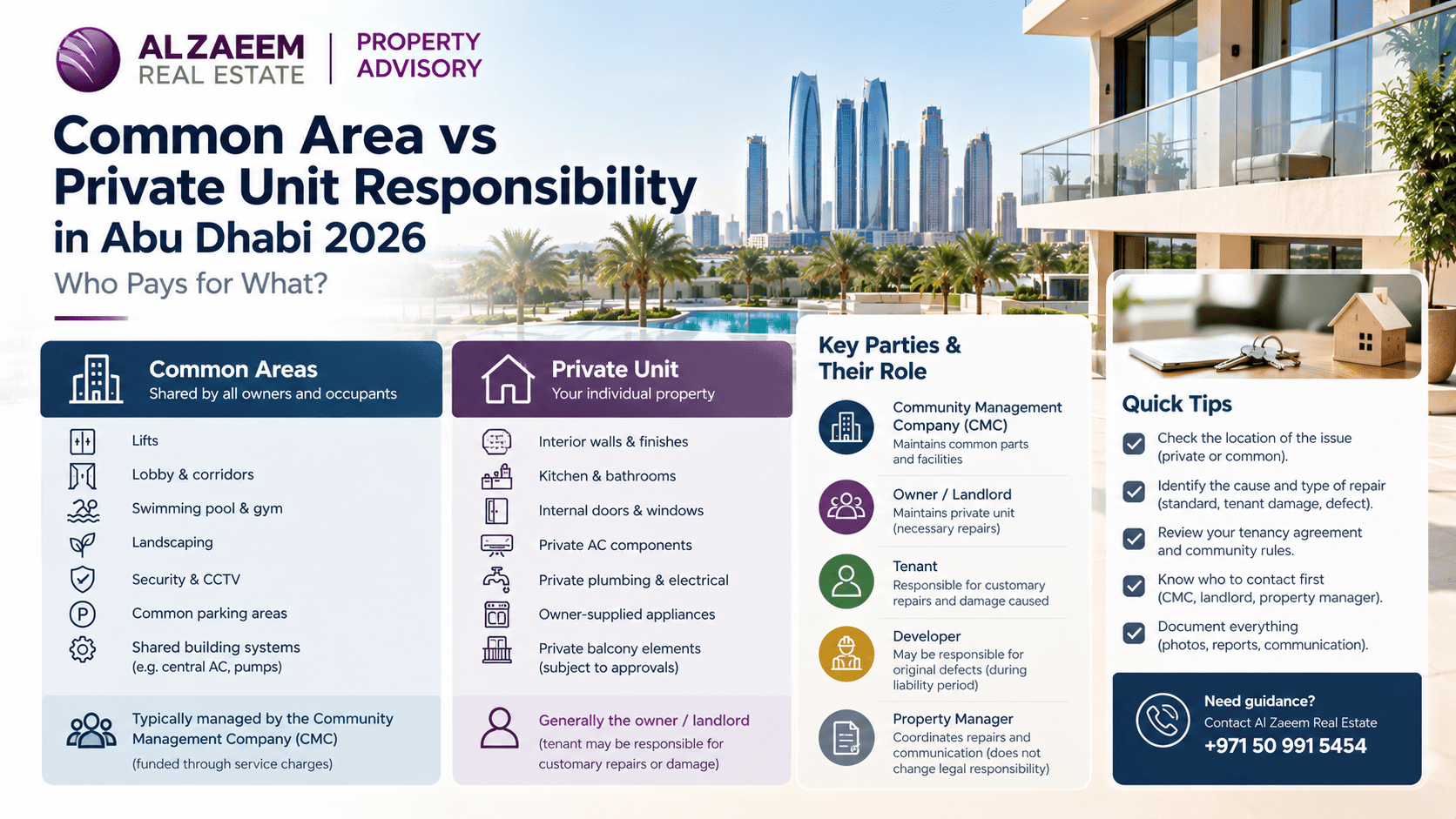
Most property-repair issues involve one or more of these parties:
1. Unit Owner / Landlord
Responsible for the privately owned property and, in a tenancy, generally for necessary repairs required to keep the premises fit for use, unless otherwise agreed.
2. Tenant
Responsible for customary or agreed rental repairs and for damage they cause to the leased premises.
3. Community Management Company
Responsible for operating, maintaining and repairing common parts and facilities using approved service-charge funds.
4. Developer
May remain responsible where the issue is an original developer defect covered by the applicable defects-liability framework rather than normal ongoing maintenance.
5. Owner-Appointed Property Manager
May coordinate the issue on behalf of the owner, but does not automatically become the party legally responsible for paying for it.
That distinction is important.
A property manager may manage the repair without being the party that ultimately bears the cost.
What Is a Private Unit?
A private unit generally means the property individually owned by the owner.
For an apartment, this commonly includes the interior of the unit and its private fixtures, subject to the project’s registered plans and management regulations.
Examples may include:
- internal walls and finishes;
- kitchen;
- bathrooms;
- internal doors;
- wardrobes;
- owner-supplied appliances;
- private AC components;
- private plumbing fixtures.
But not every pipe or wall inside the physical boundary of an apartment is automatically private.
Some systems can remain common infrastructure.
Always verify the project’s approved community/building documents where classification matters.
What Are Common Parts?
Common parts are shared areas or systems serving multiple owners or the jointly owned property.
Examples commonly include:
- lobbies;
- corridors;
- lifts;
- swimming pools;
- gyms;
- landscaping;
- common parking areas;
- common lighting;
- shared mechanical systems;
- shared structural elements.
ADREC states that the CMC is responsible for maintaining these common parts and facilities using approved service charges.
Common Does Not Mean “Free”
When the CMC pays for maintenance of common parts, the money usually comes from:
service charges paid by owners.
ADREC states that service charges cover the management, operation and maintenance of common parts and facilities, and the unit owner remains responsible for paying those charges even when the property is rented.
So technically:
“The building pays.”
often means:
“Owners collectively pay through approved service charges.”
Private Does Not Automatically Mean Tenant Pays
This is another common misunderstanding.
If the issue is inside the apartment, the tenant does not automatically become responsible.
Abu Dhabi tenancy law generally places necessary repairs on the landlord, excluding customary rental repairs unless otherwise agreed.
So the first distinction is:
location.
The second is:
type of repair.
Necessary Repairs vs Rental Repairs
Abu Dhabi tenancy law defines two important categories.
Necessary Repairs
Repairs necessary to:
- protect the property;
- keep it fit for the tenant’s use.
These are generally the landlord’s responsibility unless otherwise agreed.
Rental Repairs
Minor customary repairs normally undertaken by the tenant.
Article 14 places these customary or agreed rental repairs on the tenant.
The tenancy agreement can therefore be very important.
Tenant-Caused Damage Is Different
Article 15 makes the tenant responsible for damage they cause to the leased premises, unless otherwise agreed.
That means an item can normally be the landlord’s responsibility but become the tenant’s responsibility if the tenant caused the damage.
Example:
Normal AC component failure
Potential landlord maintenance issue.
Tenant physically damages thermostat
Potential tenant responsibility.
Cause matters.
Quick Responsibility Matrix
| Issue | Likely Starting Point |
|---|---|
| Lift breakdown | Community Management Company |
| Lobby lighting | Community Management Company |
| Pool maintenance | Community Management Company |
| Landscaping | Community Management Company |
| Internal leaking tap | Landlord / tenant depending on cause and contract |
| Major internal plumbing failure | Usually landlord unless caused by tenant |
| Tenant breaks cabinet door | Tenant |
| Internal AC major failure | Usually landlord unless contract/cause changes position |
| Common chilled-water/shared system issue | CMC / building system |
| Structural common-part defect | Developer / common-property route depending on cause and liability stage |
| Owner’s private renovation defect | Owner / contractor |
| Service charges | Owner |
| Rent collection | Landlord / appointed property manager |
| Common-area rule enforcement | Community Management Company |
This is a practical starting framework, not a substitute for reviewing the actual project documentation and tenancy contract.
Lifts
A lift serves multiple units and forms part of common building infrastructure.
So:
CMC responsibility
is the normal starting point for:
- lift maintenance;
- lift breakdown;
- common lift servicing.
The cost is typically funded through approved service charges.
A tenant should not normally be told:
“Your landlord must repair the lift.”
That is a community-management matter.
Lobby and Corridors
Common lobbies and corridors are also community-managed areas.
Examples:
- common lighting;
- cleaning;
- flooring;
- wall maintenance;
- shared doors.
Again, these are typically CMC matters funded through service charges.
Swimming Pool
Pool operation and maintenance are common-facility functions.
That may include:
- water quality;
- cleaning;
- pumps;
- filtration;
- surrounding common areas.
If the pool belongs to the jointly owned community, the CMC is the appropriate starting point.
A private pool inside an individually owned villa is different.
Gym
Common gym facilities are managed as shared amenities.
Issues may include:
- common equipment;
- cleaning;
- access;
- lighting;
- AC within the shared gym.
These are community-level matters.
Landscaping
Shared landscaping is normally a community-management responsibility.
That can include:
- irrigation;
- common plants;
- trees;
- landscaping contractors.
Private villa gardens may be different depending on the title structure and community rules.
Security
Common-property security is also generally an operational community matter.
Examples:
- entrance security;
- guards;
- CCTV for common areas;
- access-control systems.
The CMC manages the service under the community framework.
Common Parking Areas
Shared parking infrastructure may include:
- common gates;
- lighting;
- ramps;
- signage;
- access systems.
These are typically common-property matters.
But an owner’s individually allocated parking space may involve separate questions depending on:
- title;
- physical damage;
- community rules.
Internal Apartment Door
An internal bedroom door is generally part of the private unit.
If it fails because of ordinary age:
potential landlord responsibility.
If the tenant breaks it:
potential tenant responsibility.
If it was defective from original handover and remains within developer liability:
potential developer issue.
One physical item.
Three possible responsibility paths.
Apartment Entrance Door
The main entrance door can be more complicated.
Depending on the project documentation, elements such as:
- door leaf;
- frame;
- external finish;
- access-control hardware
may involve both private and common-property considerations.
Do not assume solely from physical location.
Check:
- building management regulations;
- unit plans;
- CMC guidance.
Windows
Windows are another area where classification can become project-specific.
An internal handle failure may be a private-unit issue.
But façade-related window systems or external building-envelope issues may involve:
- common property;
- developer defect;
- community management.
Where the distinction matters financially, verify it.
Balcony
Owners often assume:
“The balcony is mine, therefore everything on it is my responsibility.”
Not necessarily.
A balcony can include both:
- private-use components;
- elements affecting the building façade or common structure.
ADREC requires prior written approval for alterations affecting:
- structure;
- external appearance;
- common parts.
That alone shows that a balcony cannot always be treated like an entirely independent private room.
Balcony Drainage
Suppose water pools on a balcony.
Possible cause:
Blocked private drain
May begin as unit maintenance.
Defective common drainage design
Could involve common-property/developer responsibility.
Tenant blocks drainage
Could create tenant liability.
Again:
diagnose first.
Assign cost second.
Internal AC Unit
An internal AC issue may often begin as a landlord/owner maintenance matter in a rental.
Examples:
- thermostat failure;
- fan-coil issue;
- private drain problem.
But if the issue originates in a shared district-cooling or common mechanical system, the CMC/building route may be more appropriate.
Common Cooling System
Some developments rely on shared systems.
If:
- multiple apartments lose cooling;
- shared pumps fail;
- a common mechanical system fails;
the problem is unlikely to be purely the landlord’s private unit issue.
The CMC should investigate the building system.
AC Servicing vs AC Replacement
Do not confuse:
routine servicing
with
major repair.
The tenancy contract may allocate minor servicing responsibilities differently.
But a major system failure needed to keep the property usable will generally fall closer to the landlord’s necessary-repair obligation unless another cause or contractual arrangement applies.
Internal Plumbing
Examples:
- leaking basin;
- toilet issue;
- kitchen tap;
- internal water heater.
These usually start as private-unit issues.
Then determine:
- normal failure?
- minor customary repair?
- tenant damage?
- developer defect?
Shared Plumbing Riser
A pipe running through or near the apartment may serve many units.
If the leak originates from a shared riser, the fact that water appears inside one apartment does not automatically make it that owner’s private plumbing problem.
This is where technical diagnosis matters.
Example: Ceiling Leak
Apartment 1204 has water staining.
Possible source:
Apartment 1304 bathroom leak
May involve the upstairs unit/owner.
Common pipe
CMC/common system.
AC drainage inside 1204
Landlord/private unit.
Original waterproofing defect
Potential developer issue.
The damaged ceiling does not tell you who pays.
The source does.
Electrical Issues
Internal switches, sockets and private wiring generally begin as unit-level concerns.
Common electrical infrastructure such as:
- corridor lighting;
- building distribution systems;
- common emergency lighting;
is a community-management matter.
Technical diagnosis should determine the boundary.
Smoke Detectors and Fire Systems
Fire-safety systems may involve a combination of:
- private devices;
- common building systems.
Do not independently modify safety equipment.
Where there is a defect, contact the appropriate:
- CMC;
- qualified contractor;
- building management.
Kitchen Appliances
If the landlord supplied:
- refrigerator;
- oven;
- dishwasher;
the tenancy agreement should clarify repair responsibility.
A normal appliance failure may typically be an owner matter.
Tenant-caused damage may be tenant responsibility.
An appliance warranty may also apply.
Owner-Installed Appliances
If the owner installs an appliance after handover, that is not ordinarily a common-property issue.
The responsibility would more likely sit with:
- owner;
- warranty provider;
- installer.
Developer-Supplied Appliances
For a newly handed-over property, a defective included appliance may initially fall under:
- developer;
- manufacturer’s warranty;
depending on the applicable documentation and timing.
This is different from normal maintenance five years later.
Internal Walls
Normal internal finishes are typically part of the unit.
But structural walls or separating elements may involve different classifications.
Abu Dhabi’s real-estate legislation notes that walls separating adjacent units can be considered shared where they form part of the common parts.
Do not remove or modify structural/separating walls without proper approval.
Façade
The external façade is not something an individual apartment owner should independently alter or repair as if it were purely private property.
Façade issues can involve:
- common parts;
- developer defects;
- community maintenance.
ADREC requires approval for changes affecting external appearance.
Roof
For a tower or jointly owned building, roof systems are typically common infrastructure.
For a standalone villa, responsibility may differ depending on:
- title;
- community structure;
- developer liability.
Again, classification matters.
Private Villa
A standalone or individually owned villa generally creates more direct owner responsibility for:
- internal systems;
- private garden;
- private pool;
- private external areas.
But gated-community common infrastructure can still include:
- roads;
- landscaping;
- security;
- shared amenities.
So villa ownership does not eliminate common-area responsibility.
Private Pool
If a villa has its own pool:
- pump;
- filtration;
- private pool cleaning;
- private pool repairs
are generally private-owner matters unless another contractual arrangement applies.
A shared community pool is different.
Private Garden
A private garden may be the owner’s responsibility, but some communities control:
- landscaping appearance;
- irrigation standards;
- external modifications.
Review the community rules before major changes.
Service Charges
ADREC states clearly that the owner remains responsible for service charges at all times, including when the unit is leased.
So:
tenant occupies the unit
does not mean:
tenant becomes legally responsible to the community for service charges.
The commercial arrangement between landlord and tenant is separate.
Can a Landlord Pass Service Charges to a Tenant?
A tenancy agreement may structure rent and charges in different ways where legally permitted.
But from the CMC/community perspective, ADREC’s published position remains:
the owner is responsible.
If the tenant fails to reimburse the landlord under a private agreement, the CMC can still pursue the owner for the service charge.
Common-Area Insurance
ADREC states that the CMC arranges insurance for the building and common parts, funded through approved service charges.
This does not automatically mean the owner’s:
- contents;
- furniture;
- personal belongings
are insured.
Private insurance may still be appropriate.
Developer Defects vs Common Maintenance
This is one of the most important distinctions after handover.
Imagine a common-area waterproofing issue.
If caused by:
- original defective construction;
it may still be a developer-defect matter.
If caused by:
- normal ageing years later;
it may be normal community maintenance.
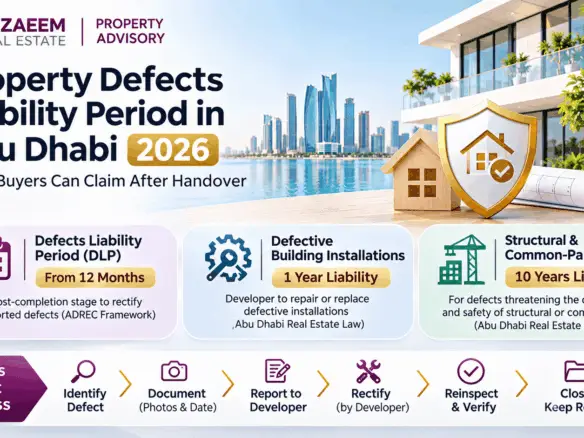
Our Property Defects Liability Period Abu Dhabi 2026 guide explains this in more detail.
Developer Responsibility Does Not Last Forever for Everything
Do not send every repair request to the developer simply because the property was originally bought off-plan.
Responsibility changes over time.
The issue may become:
- normal owner maintenance;
- normal CMC maintenance.
The defect type and applicable liability period matter.
Property Manager vs Community Manager
This is another area owners confuse.
Owner-Appointed Property Manager
Example:
Al Zaeem Property Management
May manage:
- tenant;
- rent;
- unit inspection;
- internal maintenance coordination;
- renewal.
Community Management Company
Manages:
- common facilities;
- common systems;
- community operations.
The two managers operate at different levels.
Example: AC Complaint
Tenant calls Al Zaeem Property Management:
“AC is not cooling.”
The property manager should not immediately assume:
“Owner pays.”
First determine:
Internal fan coil problem?
Unit-level.
Entire building cooling issue?
CMC.
Original installation defect?
Potential developer route.
The property manager’s value is partly in directing the issue correctly.
Example: Lift Complaint
Tenant says:
“Lift has been broken for three days.”
That is not an internal unit repair.
The appropriate operational party is:
CMC.
The owner’s property manager may still help escalate or monitor the complaint on behalf of the landlord.
Example: Water Leak From Upstairs
Tenant reports water from ceiling.
The process should be:
- document leak;
- identify source;
- contact relevant unit or CMC;
- prevent further damage;
- determine liability.
Do not simply repair the ceiling first.
Fix the source.
Tenant Responsibility for Damage
Examples may include:
- broken door caused by misuse;
- damaged furniture;
- blocked drain due to misuse;
- unauthorized alterations.
Article 15 supports tenant liability for damage caused to the leased premises.
Evidence still matters.
Normal Wear Is Not the Same as Tenant Damage
Examples of ordinary deterioration can include:
- ageing sealant;
- faded paint;
- normal appliance ageing;
- minor wear.
Do not classify every repair needed at move-out as tenant damage.
Our Security Deposit Abu Dhabi 2026 guide explains why condition evidence is essential.
Unauthorized Tenant Alterations
Article 13 states that the tenant may not make changes to the premises without written landlord permission except where the change does not cause damage.
If a tenant makes significant unauthorized alterations, responsibility may shift to the tenant for:
- reinstatement;
- damage.
Owner Alterations Affecting Common Parts
Owners also have restrictions.
ADREC requires prior written approval for alterations affecting:
- structure;
- external appearance;
- common parts.
So an owner cannot say:
“I own the unit, therefore I can modify anything touching it.”
Joint ownership creates shared constraints.
Who Handles Complaints About Common Areas?
ADREC gives a clear escalation path.
Step 1
Community Management Company
Step 2
Owners’ Committee
Step 3
ADREC
where further escalation is required.
This is the correct route for unresolved community-operation concerns.
Who Handles Private-Unit Landlord-Tenant Disputes?
Private tenancy disputes are different.
Abu Dhabi tenancy law provides for Lease Disputes Resolution Committees within the Judicial Department to determine landlord-tenant disputes.
So:
common-area complaint
and
landlord-tenant repair dispute
do not necessarily use the same escalation route.
Why This Distinction Matters
If you send a private bathroom repair dispute to the Owners’ Committee:
wrong route.
If you send a broken lift complaint to the rental dispute committee:
also likely wrong route.
Correct classification saves time.
Responsibility Flowchart
When something breaks, ask in this order:
1. Where is the problem?
Private unit or common area?
2. What is the source?
Private system or shared system?
3. Who caused it?
Normal failure, tenant damage, contractor work or developer defect?
4. What does the tenancy agreement say?
Especially for minor/customary repairs.
5. Is a developer liability still applicable?
For a qualifying original defect.
6. Who should coordinate?
Owner, property manager, CMC or developer?
Then assign the cost.
Common-Area Responsibility Examples
Generally begin with the CMC:
- lifts;
- common corridors;
- lobby;
- common pool;
- common gym;
- security;
- landscaping;
- shared building systems;
- common lighting.
These are funded through approved community service charges.
Private-Unit Responsibility Examples
Generally begin with owner/tenant analysis:
- kitchen fixtures;
- bathroom fixtures;
- internal doors;
- private appliances;
- internal AC components;
- private electrical points;
- private plumbing fixtures.
Then determine whether the cost belongs to:
- landlord;
- tenant;
- developer;
- warranty provider.
Common-Area vs Private Responsibility Table
| Problem | First Party to Contact | Who May Ultimately Pay |
|---|---|---|
| Broken lift | CMC | Service-charge/common budget |
| Dirty lobby | CMC | Service-charge/common budget |
| Pool pump failure | CMC | Service-charge/common budget |
| Landscaping issue | CMC | Service-charge/common budget |
| Internal AC failure | Landlord/property manager | Owner unless another cause applies |
| Whole-building cooling failure | CMC | Common/community route |
| Tenant breaks internal door | Landlord/property manager | Tenant |
| Internal plumbing leak | Landlord/property manager | Owner/tenant/developer depending cause |
| Shared riser leak | CMC | Common budget/developer depending cause |
| Structural common defect | CMC/developer | Developer/common route depending liability |
| Private appliance failure | Landlord/property manager | Owner/warranty/tenant depending cause |
| Façade issue | CMC | Common/developer route |
| Private pool repair | Owner | Owner |
| Shared pool repair | CMC | Service-charge/common budget |
Investor Example
Suppose an apartment generates:
AED 120,000 annual rent
Tenant reports:
- AC failure;
- lift failure;
- bathroom leak.
Weak landlord response:
“Everything is maintenance. Pay from property expenses.”
Better analysis:
AC
Diagnose private vs common cooling issue.
Lift
CMC issue.
Bathroom leak
Identify whether private plumbing, tenant damage or shared pipe.
Correct classification can materially reduce unnecessary owner expenses.
Why Property Managers Need to Know the Boundary
A property manager should not simply:
- receive complaint;
- send contractor;
- bill owner.
They should ask:
Is this actually the owner’s responsibility?
Good management protects the landlord from paying for:
- common-area repairs;
- developer defects;
- tenant-caused damage
that may belong elsewhere.
Al Zaeem Property Management
Through Al Zaeem Property Management, owners can coordinate unit-level matters including:
- tenant communication;
- inspections;
- rent collection;
- maintenance;
- renewals.
Where the issue belongs to the community, the property manager can help direct and follow up with the appropriate CMC rather than treating the problem as an owner-funded private repair.
Al Zaeem Facility Management
Where the defect is confirmed as a private-unit technical issue, Al Zaeem Facility Management can support areas such as:
- AC;
- plumbing;
- electrical;
- painting;
- flooring;
- woodwork.
The ideal process is:
identify responsibility first → repair second.
Not the reverse.
Common Owner Mistakes
Mistake 1: Paying for Every Tenant Complaint
Some issues belong to the CMC.
Mistake 2: Assuming Every Internal Problem Is Private
Shared systems can pass through units.
Mistake 3: Calling Every Repair Tenant Damage
Cause must be established.
Mistake 4: Ignoring the Tenancy Agreement
Minor repair allocation can be contract-sensitive.
Mistake 5: Paying for a Developer Defect
Check applicable liability first.
Mistake 6: Renovating Common/External Elements Without Approval
Written approval may be required.
Common Tenant Mistakes
Mistake 1: Reporting Common-Area Problems Only to the Landlord
The CMC may be the operational party.
Mistake 2: Assuming Every Repair Is the Landlord’s Responsibility
Customary repairs and tenant-caused damage can remain with the tenant.
Mistake 3: Making Alterations Without Permission
This may create reinstatement liability.
Common CMC Misunderstanding
The Community Management Company manages:
common property.
It is not automatically the repair company for every individual apartment.
An owner cannot expect service charges to pay for:
- their private refrigerator;
- damaged bedroom door;
- internal private renovation.
That would shift private ownership cost onto all other owners.
Why Clear Boundaries Protect Service Charges
If private-unit costs were incorrectly charged to the common budget:
all owners would subsidize individual repairs.
If common-area costs were incorrectly charged directly to one owner:
that owner would subsidize the community.
The legal and management framework exists partly to prevent those distortions.
Common Property Documentation Matters
Where classification is unclear, review:
- title documentation;
- community management regulations;
- building plans;
- registered common-area definitions.
The exact boundary can differ between projects.
Avoid making legal conclusions solely from:
“It is physically inside my apartment.”
Service-Charge Due Diligence Before Buying
Before purchasing, ask:
- what is included in service charges?
- who manages the community?
- are major works planned?
- any recurring building-system issues?
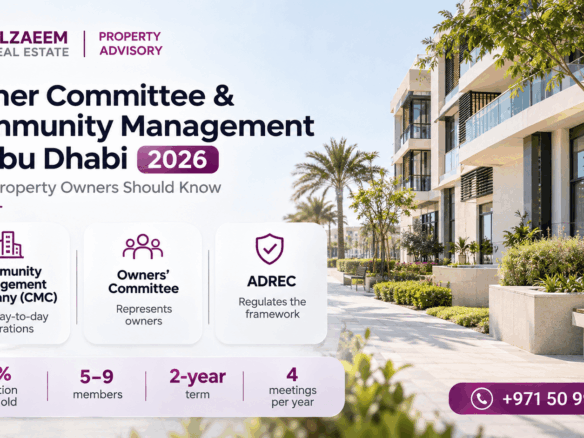
Our Owner Committee & Community Management Abu Dhabi 2026 and Property Service Charges Abu Dhabi 2026 guides explain why this matters for net return.
Developer Due Diligence Also Matters
A building with recurring:
- waterproofing;
- AC;
- façade;
- common-system defects
may create future disputes between:
- owners;
- developer;
- CMC.
Review defect history where possible.
Rental Yield Can Be Affected by Responsibility Confusion
If a landlord repeatedly pays for issues that should have been:
- common-budget;
- developer;
- tenant
costs, net yield falls.
Good maintenance classification is therefore an investment-management function.
15-Point Responsibility Checklist
When a problem appears, ask:
1. Is it inside the private unit?
2. Is the underlying system shared?
3. Does it affect multiple units?
4. Is it a common facility?
5. Is it normal maintenance?
6. Is it a necessary repair?
7. Is it a customary tenant repair?
8. Did the tenant cause it?
9. Did an owner’s contractor cause it?
10. Could it be an original developer defect?
11. Is a warranty still active?
12. What does the tenancy agreement say?
13. What do the community regulations say?
14. Who should coordinate the repair?
15. Who should ultimately bear the cost?
If those questions are answered, most responsibility disputes become much easier to manage.
Final Verdict
The most important rule in Abu Dhabi property maintenance is:
do not decide who pays until you know what failed and where the responsibility boundary sits.
For common property:
Community Management Company is normally the operational starting point, with costs funded through approved service charges.
For a rented private unit:
Landlord generally handles necessary repairs required to keep the property fit for use, while the tenant handles customary/agreed rental repairs and damage they cause, unless otherwise agreed.
For original qualifying construction defects:
Developer liability may still apply depending on the defect and applicable liability period.
And for coordination:
an owner-appointed property manager can help identify the right route, but does not change the underlying legal responsibility simply by managing the property.
The best workflow is:
locate → diagnose → classify → identify responsible party → repair → document.
Not:
repair first → argue about the invoice later.
For landlords and investors, getting this distinction right can protect:
- maintenance budgets;
- service charges;
- tenant relationships;
- rental yield;
- long-term property value.
Official Sources
Abu Dhabi Real Estate Centre — Community Affairs
Current guidance on common parts, service charges, CMC responsibilities, alterations and complaint escalation.
Abu Dhabi Tenancy Law — Law No. 20 of 2006 and amendments
Current landlord and tenant maintenance responsibilities, rental repairs and tenant-caused damage.
Disclaimer
This article is for general real-estate and property-management information only. It does not constitute legal, technical, engineering or tenancy-dispute advice.
The exact boundary between private and common property can vary by project, title documentation, approved community regulations, building systems and the facts of the defect. Owners should verify the relevant project documents and obtain qualified technical or legal advice where responsibility is disputed or material.
Last reviewed: November 2026.