


Property handover does not necessarily end the developer’s responsibility.
A buyer may:
- complete snagging;
- receive the keys;
- move into the property;
- rent it to a tenant;
and still discover defects later.
Examples can include:
- water leakage;
- AC problems;
- waterproofing failures;
- defective building installations;
- structural issues;
- defects that were not visible during the original snagging inspection.
That is where the Defects Liability Period, or DLP, becomes important.
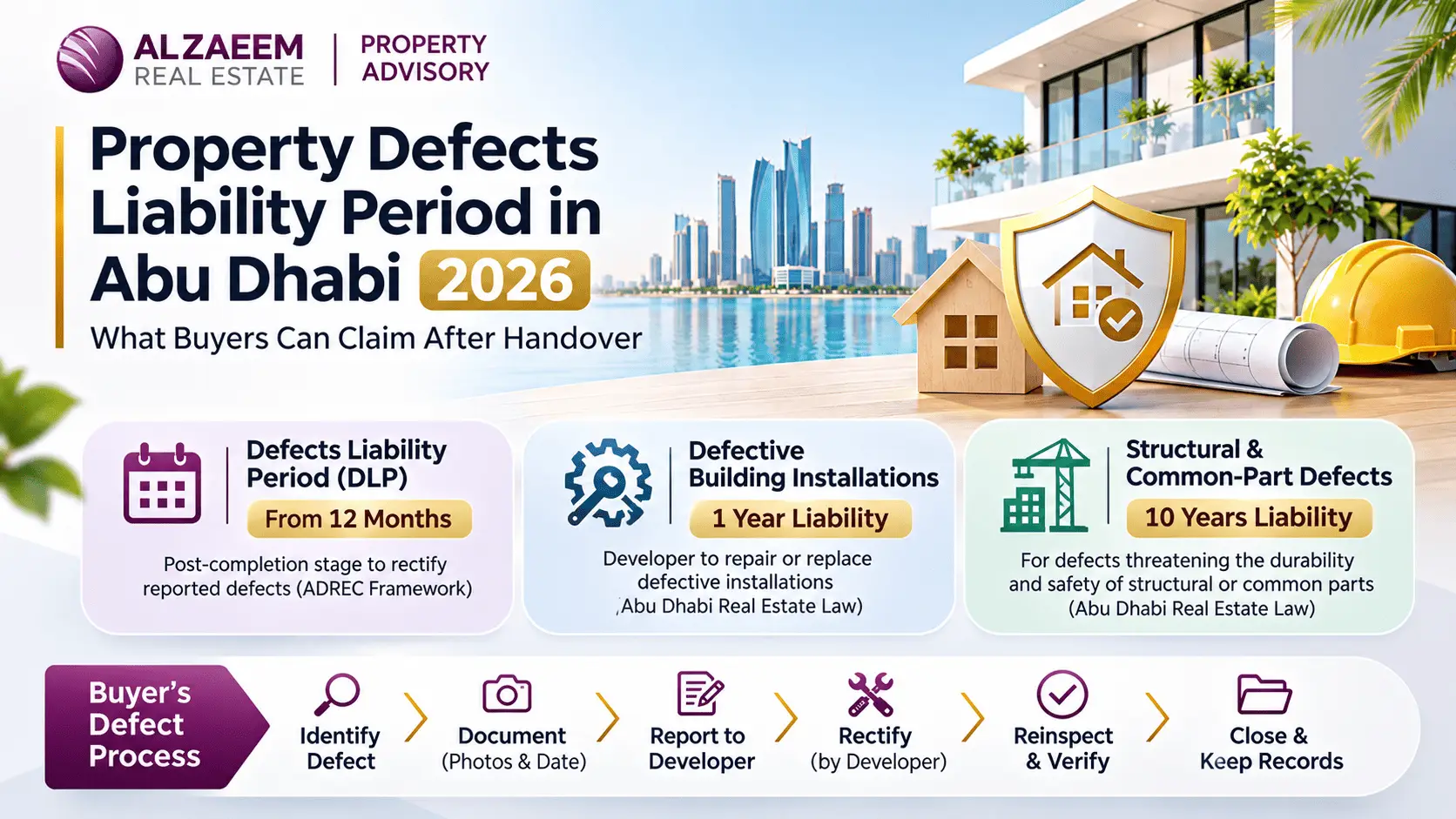
ADREC’s current developer journey treats the Defects Liability Period as a formal post-completion stage after project handover. During this stage, developers must address defects reported by buyers, while 5% of total construction cost is retained from the Taking Over Certificate stage and released only after ADREC confirms that outstanding defects have been resolved. ADREC describes this stage as starting from 12 months.
But there is an important distinction:
the project Defects Liability Period is not the only defect protection available.
Abu Dhabi’s real-estate legislation also establishes longer statutory developer liabilities for certain:
- structural/common-part defects;
- defective building installations.
Understanding these separate layers is essential.
Snagging and Defects Liability Are Not the Same Thing
These processes happen at different stages.
Snagging
Usually happens:
before or around handover.
Its purpose is to identify visible defects and unfinished work before the property begins normal use.
Examples:
- scratched door;
- cracked tile;
- damaged cabinet;
- leaking tap;
- faulty socket;
- poor paint.
Defects Liability
Applies after completion and handover when defects:
- remain unresolved;
- appear later;
- become visible only after occupation or normal operation.
The two processes work together.
The ideal sequence is:
snag → rectify → reinspect → handover → monitor → report later defects
Our previous article, Property Snagging Abu Dhabi 2026, explains the pre-handover stage in detail.
ADREC’s Formal Defects Liability Period
ADREC’s developer journey places the Defects Liability Period immediately after project handover.
The current framework states that:
- 5% of total construction cost is withheld in a retention account;
- defects reported by buyers during the liability period must be addressed;
- retained funds are released after ADREC confirms resolution of the outstanding issues.
ADREC describes the DLP duration as:
starting from 12 months.
This creates a formal post-completion safeguard.
Why the 5% Retention Matters
The retention mechanism is important because it gives the developer a financial incentive to complete post-handover rectification properly.
Conceptually:
Construction completed
↓
Project handed over
↓
5% construction-cost retention remains
↓
Buyer defects reported
↓
Developer rectifies
↓
ADREC confirms resolution
↓
Retention released
This is more structured than simply relying on goodwill.
The DLP Is Not the Same as a 10-Year Structural Liability
This is one of the most important distinctions in the entire article.
Abu Dhabi real-estate legislation states that the developer remains liable for defects threatening the durability and safety of:
- structural parts of a building;
- common parts of a real-estate development project;
for:
10 years
from the date of the final Certificate of Completion issued by the municipality.
This statutory structural liability is much longer than the ordinary project DLP.
Building Installations Have a Separate One-Year Liability
The same Article 73 also states that the developer remains liable for the repair or replacement of defective building installations for:
1 year
from the date the final Certificate of Completion is received from the municipality.
That makes three different concepts important:
Project DLP
Post-completion defect rectification stage, beginning from 12 months under ADREC’s developer journey.
Defective Building Installations
One-year statutory developer liability.
Structural / Common-Part Safety and Durability Defects
Ten-year statutory developer liability.
Do not collapse these into one generic “one-year warranty.”
What Counts as a Structural Defect?
Article 73 focuses on defects threatening:
- durability;
- safety
of structural or common parts.
Potentially serious examples may include issues affecting:
- structural integrity;
- major structural components;
- safety-critical common parts.
A small paint crack should not automatically be labelled a structural defect.
The nature and severity should be assessed by appropriately qualified professionals.
Structural Crack vs Cosmetic Crack
Imagine two cracks.
Crack A
Hairline paint crack in plaster.
Possible issue:
Cosmetic finish.
Crack B
Significant recurring structural movement crack.
Potential issue:
Requires engineering assessment.
They may look superficially similar to a non-expert.
Do not diagnose structural failure based only on appearance.
Document it and obtain qualified technical assessment where appropriate.
What Are Building Installations?
The legislation refers separately to defective installations in the building.
Depending on the property and technical circumstances, installation-related issues may involve systems such as:
- plumbing;
- electrical;
- mechanical installations;
- cooling-related installations;
- other installed building systems.
The exact classification of a defect can depend on:
- what failed;
- where;
- how the building system was designed;
- expert findings.
AC Defects
Air conditioning is particularly important in Abu Dhabi.
An AC problem discovered shortly after handover might involve:
- thermostat;
- drainage;
- installation;
- cooling performance;
- ducting;
- condensation.
Do not immediately assume:
“Developer defect.”
First determine whether the issue is:
- original defective installation;
- normal maintenance;
- later damage;
- owner modification.
Water Leakage
Water leakage is one of the most important post-handover defect categories.
Possible causes include:
- defective plumbing;
- poor waterproofing;
- seal failure;
- drainage problem;
- common building system;
- neighbouring unit;
- later owner work.
The visible symptom:
water stain
does not identify responsibility.
The cause must be diagnosed.
Waterproofing Defects
Waterproofing defects may take time to appear.
Possible areas include:
- bathrooms;
- balconies;
- terraces;
- roofs;
- external areas.
A property may appear perfect on handover day but show moisture only after:
- repeated water use;
- rainfall;
- irrigation;
- occupancy.
That is one reason post-handover monitoring matters.
Cosmetic Defects
Some defects are mostly cosmetic.
Examples:
- paint imperfection;
- scratch;
- chipped finish;
- joinery mark.
These are usually strongest when documented during the initial snagging process.
Waiting many months can make it more difficult to establish whether the defect:
- existed at handover;
- developed later;
- resulted from use.
Latent Defects
A latent defect is a problem that may not have been reasonably visible during ordinary initial inspection.
Examples may include:
- concealed water leak;
- hidden installation problem;
- waterproofing failure;
- concealed technical defect.
Latent defects are precisely why buyers should retain complete records after handover.
Common-Part Defects
Owners should also distinguish between:
defect inside the private unit
and
defect affecting common parts.
Common-area issues may involve:
- corridors;
- lifts;
- structural common elements;
- shared mechanical systems;
- shared waterproofing;
- building façade;
- common facilities.
Article 73 expressly covers qualifying defects affecting common parts for the ten-year structural/common-part liability.
Developer Defect vs Community Maintenance
Not every issue in a common area remains a developer defect forever.
After completion, community management and normal operational maintenance begin.
The correct question is:
Is this an original defect covered by developer liability, or normal maintenance after completion?
This distinction can require:
- technical evidence;
- project records;
- community-management information.
Developer Defect vs Owner Maintenance
Another common mistake is reporting every maintenance issue to the developer.
Examples of normal owner maintenance may include:
- AC servicing;
- cleaning;
- seal replacement after normal ageing;
- damaged owner-installed fixture.
The fact that a property is relatively new does not mean the developer is responsible for every future repair.
Developer Defect vs Tenant Damage
For rental investors, this distinction is critical.
Suppose:
A bathroom cabinet is damaged six months after handover.
Possible explanations:
Original manufacturing/installation defect
Potential developer issue.
Water leak from defective plumbing
Potential installation issue.
Tenant physically damaged cabinet
Potential tenant responsibility.
Do not decide based on timing alone.
Renovation Can Complicate Defect Claims
Suppose the owner receives a brand-new property and immediately:
- changes flooring;
- remodels bathroom;
- alters kitchen;
- moves plumbing.
Later, water leakage appears.
It may become harder to determine whether the cause is:
- original developer work;
- owner’s contractor;
- later alteration.
That is why our Renovation ROI Abu Dhabi 2026 guide recommends completing snagging and defect documentation before optional upgrades.
Keep the Original Handover Condition Record
Retain:
- snagging report;
- de-snagging report;
- photographs;
- videos;
- developer correspondence;
- handover documents;
- completion information.
These records create your starting baseline.
Without them, later defect discussions can become more difficult.
What to Do When You Discover a Defect
Do not simply send:
“There is a problem in my apartment.”
Use a structured defect report.
Step 1 — Stop Further Damage Where Necessary
If the issue is urgent, such as significant leakage:
- protect the property;
- take reasonable emergency action;
- notify the relevant responsible party immediately.
Do not allow a small issue to become major damage merely because you are waiting for an email reply.
Step 2 — Photograph the Defect
Take:
Wide photo
Shows where the problem is.
Close-up
Shows the defect.
Progress photos
If the problem changes over time.
Step 3 — Record the Date
Write down:
- discovery date;
- when symptoms first appeared;
- whether problem is continuous or intermittent.
Timing can matter.
Step 4 — Describe the Defect Precisely
Weak:
“Bathroom leaking.”
Better:
“Master bathroom: water appears beneath vanity after basin use and spreads approximately 40cm onto floor.”
That is actionable.
Step 5 — Record Unit Information
Include:
- project;
- building;
- unit;
- room/location.
For common-area defects, identify the precise common location.
Step 6 — Avoid Unnecessary Tampering
If possible, do not dismantle the defective installation before the developer or technical team has had a reasonable opportunity to inspect it.
Emergency safety repairs may be different.
But unnecessary alteration can make cause harder to establish.
Step 7 — Submit Through the Official Developer Channel
Use whatever channel the project provides:
- app;
- portal;
- customer-care system;
- email;
- defect-management platform.
The important thing is:
create a written trail.
Do Not Rely Only on Phone Calls
A telephone conversation may be useful for urgency.
But follow it with written confirmation.
Example:
Reported water leak today at 10:30am under reference number X.
The objective is traceability.
Step 8 — Keep the Reference Number
Every defect should ideally have:
- ticket number;
- case number;
- email thread;
- other reference.
This becomes important if escalation is required.
Step 9 — Allow Technical Inspection
The developer or appointed contractor may need to inspect.
Make reasonable access arrangements.
Document:
- inspection date;
- person/company attending;
- findings where provided.
Step 10 — Reinspect After Repair
Do not close the issue simply because someone says:
“Completed.”
Verify:
- original defect fixed;
- repair quality;
- no secondary damage.
The same principle applies as with pre-handover de-snagging.
Example: Post-Handover Leak
Day 1
Owner notices ceiling stain.
Day 1
Photographs and reports it.
Day 2
Technical inspection identifies AC drainage defect.
Day 3
Drainage repaired.
Day 5
Ceiling dries.
Day 7
Paint and damaged finish restored.
Day 10
Owner reinspects and closes case.
That is a complete defect-resolution workflow.
Do Not Accept Cosmetic Repair Without Fixing the Cause
Suppose the wall has water damage.
Contractor:
- paints wall.
Two weeks later:
water stain returns.
The paint was not the repair.
The underlying leak needed rectification.
Always distinguish:
symptom
from
cause.
Defect Severity Categories
A practical internal system can classify issues as:
Cosmetic
Examples:
- paint;
- scratches;
- finish marks.
Functional
Examples:
- door not closing;
- faulty tap;
- AC issue.
Urgent
Examples:
- major leak;
- safety concern;
- electrical hazard.
Structural / Specialist Review
Potential issue affecting:
- safety;
- durability;
- major building elements.
This helps prioritise response.
Buyer Should Not Self-Diagnose Structural Liability
An owner may believe:
“This crack means the developer owes me under the 10-year rule.”
That conclusion may require:
- structural engineer;
- technical report;
- legal assessment.
The ten-year statutory rule relates specifically to defects threatening durability and safety of structural/common parts.
Get evidence before escalating the classification.
The 10-Year Period Starts From the Final Completion Certificate
This is important.
Article 73 states that the ten-year developer liability runs from:
the date of the final Certificate of Completion issued by the Municipality.
Do not automatically count ten years from:
- booking date;
- SPA date;
- your personal move-in date.
The One-Year Installation Period Also Uses the Completion Certificate
The one-year liability for defective building installations also runs from the date the developer receives the final Certificate of Completion from the municipality.
That distinction can matter if:
- different buyers receive keys at different times.
Keep Completion Information
Where available, retain or verify:
- project completion date;
- handover date;
- relevant completion documentation.
This helps establish applicable timelines.
DLP and the 5% Retention Account
ADREC’s project-development framework states that 5% of total construction cost is held in a retention account from the Taking Over Certificate stage.
The retained amount is released only after:
- defects are addressed;
- ADREC confirms resolution.
For buyers, this demonstrates that defect rectification is built into the regulated project lifecycle.
Developer Costs Should Not Simply Be Passed to Owners
The executive regulations state that the developer bears costs associated with rectifying defects covered by the statutory guarantees and those costs should not be transferred to the owners’ association.
That is important for common-property governance.
A qualifying original developer defect should not simply become an ordinary owner service-charge expense because the project has been handed over.
Common-Area Defects and Owners’ Associations
In buildings with shared areas, defects may be reported through:
- community manager;
- owners’ association structure;
- developer;
- other applicable management channels.
The correct route depends on:
- type of defect;
- ownership structure;
- project stage.
Owners should document the issue even if it is not inside their unit.
Overseas Owners
Overseas buyers need a stronger defect-management system because they cannot personally inspect every repair.
A remote owner should request:
- photographs;
- written defect reports;
- contractor findings;
- before-and-after evidence.
Through Al Zaeem Property Management, owners can coordinate local:
- inspections;
- maintenance;
- access;
- tenant communication;
- reporting.
This helps overseas investors maintain visibility without being physically present.
Rental Property and DLP
If the property is rented immediately after handover, the tenant may become the first person to discover a hidden defect.
For example:
- AC drainage fails;
- shower leaks;
- socket fails;
- water pressure problem appears.
The property manager should classify the issue before simply paying for repair.
Ask:
Could this still be a developer defect?
That may save the owner unnecessary cost.
Tenant Reporting Should Be Fast
Tenants should have a clear process for reporting:
- leaks;
- AC failures;
- electrical problems;
- unusual cracks.
The faster an issue is reported, the easier it is to:
- reduce damage;
- preserve evidence;
- identify cause.
Maintenance History Matters
Keep a file showing:
- defect;
- date;
- contractor/developer response;
- repair;
- cost;
- status.
This helps distinguish:
- recurring developer defect;
- new maintenance issue.
Recurring Defects Are Important
Suppose the same AC drain fails:
- Month 2;
- Month 5;
- Month 9.
Do not treat each incident as unrelated automatically.
The recurring pattern may indicate:
- incomplete rectification;
- underlying system issue.
Track history.
Defects Can Affect Rental Performance
A new property with recurring problems can create:
- tenant frustration;
- non-renewal;
- vacancy;
- poor building reputation.
Defect management therefore affects more than repair cost.
It can affect:
rental yield.
Defects Can Affect Resale Value
A buyer considering your resale unit may ask about:
- leaks;
- building defects;
- AC;
- structural concerns;
- repair history.
Unresolved defects may reduce:
- buyer confidence;
- sale price;
- liquidity.
Fix problems while liability routes may still be available.
Developer Defect vs Renovation Opportunity
Do not use a developer defect claim to fund an optional upgrade.
Example:
Defect
Kitchen cabinet door installed incorrectly.
Renovation
Owner wants entirely different premium kitchen.
The developer may be responsible for restoring the contracted condition.
That does not automatically mean they must pay for the owner’s upgrade.
Do Not Destroy Evidence Before Escalating
If there is a serious recurring defect:
- photograph it;
- document it;
- obtain technical evidence.
Do not immediately demolish the affected area unless necessary for safety or urgent damage prevention.
Evidence matters.
Escalating an Unresolved Defect
If the issue is not being resolved, maintain a structured record.
Include:
Original Report
Date and reference.
Follow-Ups
Dates and responses.
Technical Findings
Reports or contractor observations.
Evidence
Photos and videos.
Rectification Attempts
What was done?
Current Status
Still unresolved?
This makes any later escalation much stronger.
Avoid Emotional Escalation
Weak:
“Your building is terrible and nobody cares.”
Stronger:
“Defect reference D-028 was first reported on 4 February. The leak returned after rectification on 18 February and again on 3 March. Attached are dated photographs and previous closure records.”
Evidence gets attention.
Independent Technical Report
For significant disputes, consider obtaining an appropriate independent technical assessment.
This may help establish:
- cause;
- seriousness;
- recurrence;
- required repair.
Especially for:
- structural;
- waterproofing;
- complex MEP issues.
Defects Liability Does Not Replace Due Diligence
Some buyers think:
“Developer has liability, so I do not need to inspect.”
Wrong.
Your strongest position begins with:
- proper snagging;
- handover documentation;
- early reporting.
Legal protections are not a substitute for good property management.
The Ideal Buyer Timeline
Before Handover
Snag.
At Handover
Record final condition.
First Months
Monitor systems closely.
During DLP
Report defects promptly.
Before DLP Ends
Review unresolved or recurring issues.
Long Term
Keep statutory structural/common-part protections in mind for qualifying defects.
Before the 12-Month Stage Ends
Owners should conduct a detailed condition review before the ordinary DLP stage finishes.
Check:
- AC;
- water;
- bathrooms;
- plumbing;
- electrical;
- doors;
- windows;
- balcony;
- moisture;
- recurring defects.
Do not wait until the last day to report known issues.
Post-Handover 20-Point Defect Checklist
Internal Finishes
- Walls
- Ceilings
- Flooring
- Tiles
- Doors
- Windows
Wet Areas
- Bathroom drainage
- Shower waterproofing signs
- Kitchen plumbing
- Water pressure
- Visible leakage
Mechanical / Electrical
- AC cooling
- AC drainage
- Thermostats
- Electrical points
- Lighting
Installed Components
- Kitchen cabinets
- Appliances supplied by developer
- Built-in wardrobes
External / Common
- Balcony, terrace and visible common-area concerns
For villas, also check:
- pool;
- garden irrigation;
- external drainage;
- gates;
- external walls;
- roof-related signs where safely observable.
Documents Buyers Should Retain
Keep:
SPA
Your contractual baseline.
Specification / Finish Schedule
What was promised.
Snag Report
Original defects.
De-Snagging Report
What was rectified.
Handover Documents
Possession record.
Photos / Video
Starting condition.
Developer Defect Tickets
Post-handover reports.
Technical Reports
For serious defects.
Completion Information
Useful for statutory timelines.
Maintenance Records
Shows what happened after handover.
Common Buyer Mistakes
Mistake 1: Assuming Handover Ends Developer Responsibility
It does not necessarily.
Mistake 2: Calling Everything a 10-Year Defect
The ten-year rule is specific to qualifying structural/common-part durability and safety defects.
Mistake 3: Missing the One-Year Installation Window
Defective installations have a separate statutory one-year liability.
Mistake 4: Reporting Without Evidence
Document properly.
Mistake 5: Renovating Before Defects Are Resolved
This can complicate causation.
Mistake 6: Closing Repair Tickets Without Reinspection
Verify the fix.
Mistake 7: Ignoring Recurring Problems
Patterns matter.
Common Investor Mistakes
Mistake 1: Paying for Developer Defects as Normal Maintenance
Check liability first.
Mistake 2: Tenant Reports Problem and Owner Delays
The defect may become more expensive.
Mistake 3: No Local Representative
Overseas owners need inspection capability.
Mistake 4: Losing Handover Records
Documentation supports future claims.
How Property Management Helps
Professional property management can create one continuous record from:
handover
to:
tenancy
to:
maintenance
to:
defect reporting.
Through Al Zaeem Property Management, investors can coordinate:
- property inspections;
- tenant communication;
- maintenance;
- defect escalation;
- owner reporting.
This is especially valuable where the investor is overseas.
Facility Management and Developer Defects
Technical maintenance teams can help diagnose whether an issue appears to involve:
- routine maintenance;
- component failure;
- possible original installation defect.
But do not automatically carry out extensive owner-paid repair before checking whether developer responsibility may apply.
The ideal sequence is:
inspect → diagnose → identify responsibility → repair → verify
Buyer Protection Framework — Quick Summary
| Issue | General Framework |
|---|---|
| Pre-handover visible defects | Snagging process |
| Project post-completion defect stage | ADREC DLP, starting from 12 months |
| DLP financial safeguard | 5% construction-cost retention |
| Defective building installations | Developer liability for 1 year from final completion certificate |
| Structural/common-part durability and safety defects | Developer liability for 10 years from final completion certificate |
| Normal owner maintenance | Owner responsibility unless another basis applies |
| Tenant-caused damage | Not automatically developer liability |
| Owner renovations | Can affect responsibility analysis |
The exact classification of a real defect can depend on technical and legal facts.
Final Verdict
Property handover is not the end of defect protection in Abu Dhabi.
The framework operates in layers.
First:
Snagging
identifies defects before or around handover.
Then:
Defects Liability Period
provides a regulated post-completion rectification stage, with ADREC retaining 5% of total construction cost until reported defects are addressed and confirmed resolved. ADREC describes this stage as starting from 12 months.
Beyond that, Abu Dhabi real-estate legislation provides:
1 year
of developer liability for defective building installations,
and:
10 years
for defects threatening the durability and safety of structural or common parts, calculated from the final municipal Certificate of Completion.
For buyers, the strongest process is therefore:
snag → handover → monitor → document → report → rectify → reinspect → retain records.
Do not assume:
“I have the keys, so everything is now my problem.”
But also do not assume:
“The developer must repair everything for ten years.”
The type of defect, cause, timing and applicable legal category matter.
For investors, proper defect management protects:
- maintenance budget;
- rental performance;
- resale value;
- tenant satisfaction;
- long-term asset condition.
And for owners who are not physically present in Abu Dhabi, a professional local property-management and inspection process can help ensure defects are identified and followed through before valuable rights or evidence are lost.
Internal Linking Suggestions
Link this article naturally to:
- Property Snagging Abu Dhabi 2026
- Abu Dhabi Property Handover Guide 2026
- Rental Property Inspection Checklist Abu Dhabi 2026
- Renovation ROI Abu Dhabi 2026
- What Happens After Buying Property in Abu Dhabi
- Buying Abu Dhabi Property From Overseas
- Property Management Agreement Abu Dhabi 2026
- Property Management Fees Abu Dhabi 2026
Disclaimer
This article is for general real-estate education only and does not constitute legal, structural-engineering, technical or warranty advice.
Whether a particular issue qualifies as a developer defect, structural defect, defective installation, common-property defect, owner maintenance issue or tenant-caused damage depends on the specific facts, project documents, technical evidence and applicable law.
For serious structural, recurring or disputed defects, buyers should obtain qualified technical and legal advice and verify the latest ADREC requirements.
Last reviewed: November 2026.