



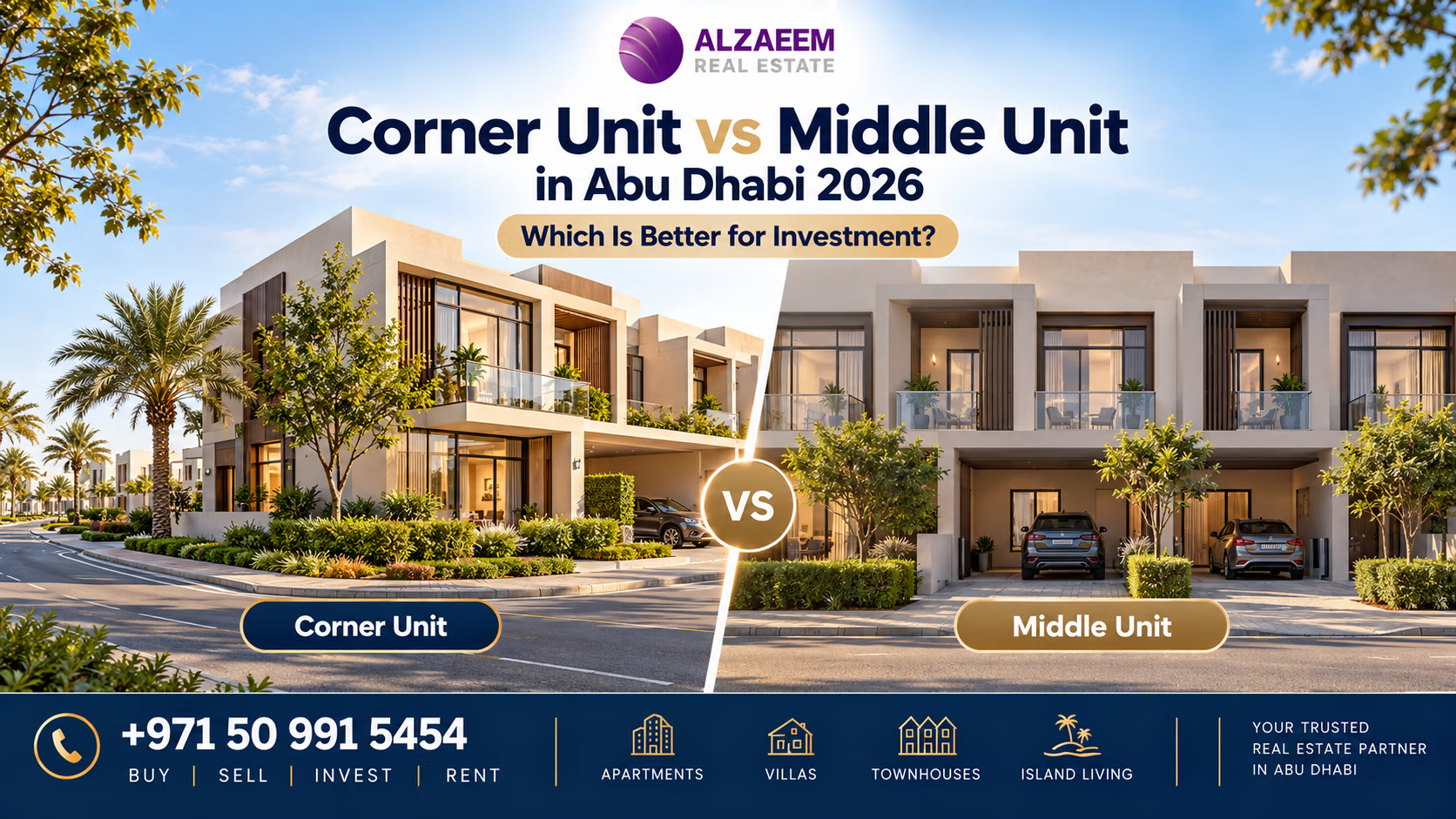
Two apartments can sit on the same floor, inside the same building, with almost identical built-up area — yet one may command a noticeably higher price simply because it is a corner unit.
Why?
A well-designed corner apartment can potentially offer:
- windows on two sides,
- wider views,
- greater privacy,
- stronger natural light,
- fewer shared walls,
- better cross-building positioning,
- and stronger resale appeal.
But none of those benefits are guaranteed.
A badly designed corner unit can also have:
- awkward geometry,
- excessive glazing,
- stronger afternoon heat,
- inefficient corridors,
- higher cooling exposure,
- or an expensive purchase premium that rental income does not justify.
Meanwhile, a well-positioned middle unit can offer:
- a more efficient floor plan,
- lower entry price,
- easier furnishing,
- more controlled sunlight,
- and potentially better rental yield.
So the correct investment question is not:
“Are corner units better?”
It is:
“Does this specific corner unit provide enough additional usable value to justify its premium over the comparable middle unit?”
That distinction matters particularly in Abu Dhabi’s current market. ADREC reported AED 70.4 billion in residential unit sales during H1 2026, with off-plan accounting for 89% of residential sales value. Residential supply stood at approximately 409,000 units, with another 71,000 units projected through 2030. Adrec
In a market with substantial transaction activity and a large future pipeline, simply buying into the right project is not enough.
Unit selection increasingly matters.
What Is a Corner Unit?
A corner unit sits at the edge or corner of a building’s floor plate rather than between two neighbouring apartments.
Depending on architecture, it may have exterior walls on:
- two sides,
- occasionally three sides.
This can allow additional:
- windows,
- balconies,
- views,
- natural light.
But the actual benefit depends entirely on the design.
What Is a Middle Unit?
A middle or internal unit is positioned between other apartments along the same floor.
It may have:
- one primary external-facing façade,
- neighbouring units on both sides,
- a more rectangular layout.
Middle units are often:
- more numerous,
- more standardised,
- and sometimes cheaper on a like-for-like basis.
That does not make them inferior.
For many investors, standardisation can actually improve the economics.
Corner Unit Does Not Automatically Mean Better Unit
This is the first important rule.
A developer may price a corner unit higher simply because it is:
corner + larger + marketed as premium.
But investors still need to inspect:
- actual view,
- window placement,
- usable area,
- balcony,
- orientation,
- privacy,
- layout.
A corner position is only valuable if the architecture uses that position effectively.
Advantage 1: More Windows
One of the clearest advantages of many corner apartments is additional glazing.
Instead of windows only along one façade, the unit may receive windows from two directions.
This can create:
- brighter interiors,
- wider visual exposure,
- greater sense of space.
For end users, this can be highly desirable.
For landlords, attractive daylight can improve:
- property photography,
- viewings,
- tenant appeal.
But More Windows Can Also Mean More Heat
This is particularly relevant in Abu Dhabi.
A heavily glazed corner apartment may experience greater solar exposure depending on orientation.
For example:
Northeast Corner
May receive:
- softer morning sunlight,
- good daylight,
- less harsh afternoon exposure.
Southwest Corner
May receive:
- strong afternoon sun,
- greater heat,
- more glare.
So the correct question is not:
How many windows?
It is:
Where do those windows face?
Advantage 2: Multiple Views
A corner unit may offer:
- sea + skyline,
- marina + community,
- park + city,
- golf + water.
This can substantially improve premium appeal.
A middle unit may face one direction only.
For premium Abu Dhabi property, multiple view corridors can matter because the buyer experiences more of the location.
Dual-Aspect Views Can Create Real Scarcity
Suppose a waterfront tower contains:
300 apartments.
Perhaps:
- 220 are standard internal units,
- 60 are corner units,
- 20 are special larger layouts.
That structural scarcity can support corner pricing.
The effect becomes stronger if the corner unit also has:
- full water view,
- higher floor,
- efficient layout.
Corner + View Is More Important Than Corner Alone
A corner apartment facing:
- road on one side,
- neighbouring tower on the other
may not deserve a large premium.
Another corner apartment facing:
- sea on one side,
- skyline on the other
may be materially more valuable.
Therefore corner positioning should always be analysed alongside view quality.
Advantage 3: Fewer Shared Walls
A corner unit may share fewer walls with neighbours.
This can improve:
- privacy,
- noise separation,
- perceived exclusivity.
For luxury buyers, this can be meaningful.
But actual acoustic quality depends heavily on:
- construction,
- wall specification,
- corridor layout.
Do not assume fewer shared walls automatically means silence.
Advantage 4: Greater Privacy
Corner apartments are sometimes positioned at the end of corridors.
Potential benefits:
- less foot traffic past the entrance,
- fewer neighbouring doors,
- greater separation.
This can strengthen end-user appeal.
It can be particularly attractive in:
- premium towers,
- low-density floors.
Advantage 5: Larger Layouts
Developers often place larger units on corners.
A typical pattern might be:
- internal 1BR,
- internal 2BR,
- corner 2BR,
- corner 3BR.
This can create confusion.
If the corner apartment costs more, the premium may be caused by:
- extra BUA,
- extra bedroom,
- better view,
- corner position.
Investors should isolate each factor.
Do Not Call Every Price Difference a Corner Premium
Suppose:
Middle Unit
Price: AED 1.8M
Size: 1,000 sq ft
Corner Unit
Price: AED 2.2M
Size: 1,200 sq ft
The AED 400K difference is not purely a corner premium.
Calculate PSF:
Middle:
AED 1,800 PSF
Corner:
AED 1,833 PSF
The true size-adjusted premium is only around 1.8%.
That tells a completely different story.
Use Price per Sq Ft Properly
This is exactly where the previous PSF framework becomes useful.
Compare:
same project + same unit type + similar floor
and then calculate:
corner PSF vs middle PSF.
That helps identify whether the buyer is paying a genuine premium for positioning.
Illustrative Same-Size Comparison
Suppose both apartments are:
1,000 sq ft
Middle Unit
AED 1.75M
PSF:
AED 1,750
Corner Unit
AED 1.95M
PSF:
AED 1,950
Corner premium:
AED 200,000
Percentage premium:
11.4%
Now the investor can ask:
What does the extra AED 200K actually produce?
The Incremental Corner Test
Suppose:
Middle unit annual rent:
AED 110K
Corner unit annual rent:
AED 120K
Additional rent:
AED 10K
Additional purchase cost:
AED 200K
Incremental gross rental return:
5%
That does not mean the corner property’s total yield is 5%.
It means the additional AED 200K spent on the premium is generating AED 10K more rent.
This is useful because it isolates the premium economics.
Compare Overall Yield Too
Using the same example:
Middle
AED 110K ÷ AED 1.75M =
6.29% gross yield
Corner
AED 120K ÷ AED 1.95M =
6.15% gross yield
The corner unit earns more rent.
But the middle unit offers slightly better headline yield.
This is common with premium unit characteristics.
Corner Units May Be Better for Capital Growth
Yield is only one part of property return.
A superior corner unit may have:
- stronger resale demand,
- lower comparable supply,
- better end-user appeal.
This can potentially improve capital appreciation.
But buyers should not assume that every premium feature automatically appreciates faster.
Resale Value Often Rewards Differentiation
When many apartments in a project are listed simultaneously, standard units may compete primarily on:
- price.
A rare corner unit can compete on:
- uniqueness.
That can matter in a future resale market.
ADREC projects another 71,000 residential units through 2030, while Knight Frank tracks approximately 36,900 units currently under construction for delivery across 2026–2030 under its narrower pipeline methodology. Adrec
As supply grows, differentiated units can potentially stand out more effectively than generic inventory.
Middle Units Can Be Easier to Price
Standard middle units often have:
- more comparable transactions,
- more rental evidence,
- more identical layouts.
This can make:
- valuation,
- rental pricing,
- bank appraisal
more straightforward.
A rare corner unit may have fewer exact comparables.
That can be both:
- an advantage,
- and a valuation challenge.
Corner Units Can Have Valuation Risk if Premium Is Excessive
Suppose comparable middle units trade around:
AED 1,800 PSF
but the seller asks:
AED 2,250 PSF
for the corner.
That is a 25% premium.
If comparable corner transactions do not support it, the bank valuation may be conservative.
A financed buyer may then need:
- more cash.
The corner designation does not force a lender to accept the seller’s premium.
Middle Units Often Have More Efficient Shapes
Many internal apartments are designed around:
- rectangular rooms,
- straighter walls,
- simpler circulation.
This can improve:
- furniture placement,
- usable floor area.
Corner units sometimes use unusual external geometry.
Examples:
- angled walls,
- curved façades,
- deep window zones.
Architecturally attractive does not always mean space-efficient.
Layout Efficiency Is More Important Than BUA
Consider:
Corner Apartment
1,200 sq ft
but:
- 140 sq ft corridor,
- difficult curved living room,
- oversized entrance.
Middle Apartment
1,080 sq ft
but:
- efficient rooms,
- little wasted circulation,
- useful storage.
The smaller middle unit may function better.
Investors should analyse usable living space, not just advertised area.
Extra Balcony Area Can Distort the Corner Value
Corner apartments sometimes have:
- wraparound balconies.
That looks attractive.
But a large terrace contributes to total area differently from internal living space.
Suppose:
Corner unit:
1,300 sq ft total
including:
300 sq ft balcony.
Middle unit:
1,100 sq ft
including:
100 sq ft balcony.
Their internal living areas may actually be very similar.
The buyer needs to understand the composition of BUA.
Wraparound Balcony Can Still Be Valuable
A well-designed wraparound balcony can create:
- panoramic views,
- outdoor entertaining,
- strong luxury appeal.
This may strengthen:
- photography,
- resale,
- owner-occupier demand.
But it should not automatically be valued at the same rate per sq ft as internal space.
Orientation Is Critical for Corner Units
Because corner units have multiple exposed façades, orientation matters more.
Possible combinations include:
- north + east,
- east + south,
- south + west,
- west + north.
In Abu Dhabi, strong western exposure can materially change:
- solar heat,
- glare,
- balcony comfort.
A corner unit with the wrong orientation can become less comfortable than a middle unit.
Afternoon Sun Should Be Tested
Ask:
- Which rooms face west?
- Is the living room heavily glazed?
- What glazing specification is used?
- Is balcony shading adequate?
Luxury appearance should not replace practical analysis.
Natural Light Can Be an Asset
On the positive side, dual orientation can create much better daylight distribution.
A middle apartment may receive light primarily from:
- one façade.
A corner unit may remain brighter across:
- morning,
- afternoon
depending on orientation.
That contributes to perceived quality.
Ventilation Can Feel Better
Some corner units can feel less enclosed due to:
- multiple window directions,
- spatial openness.
But modern tower apartments often depend on mechanical HVAC rather than true natural cross-ventilation.
Do not assume opening windows on both sides will always be possible.
Building design matters.
Corner Units Can Have More Exterior Wall Exposure
More exterior wall surface can theoretically influence:
- cooling load,
- thermal exposure.
The actual effect depends on:
- insulation,
- glazing,
- façade specification.
A well-designed modern tower may control this effectively.
Still, it is worth considering in very heavily glazed units.
Service Charges Usually Depend More on Area Than Position
In many buildings, annual service charges are connected more directly to:
- unit area,
- applicable charge structure
than whether a unit is corner or middle.
That means two same-size units may have similar recurring charges despite different purchase prices.
This can help the premium unit if its rent is higher.
But actual project charges should always be verified.
Middle Units May Offer Better Rental Yield
Because middle units may cost less while renting for only slightly less, they can produce stronger yields.
Example:
Middle Unit
Purchase: AED 1.5M
Rent: AED 100K
Yield:
6.67%
Corner Unit
Purchase: AED 1.8M
Rent: AED 115K
Yield:
6.39%
Corner earns AED 15K more rent.
But requires AED 300K more capital.
Renters May Not Pay the Same Premium as Buyers
This is a recurring real-estate principle.
Buyers may pay heavily for:
- uniqueness,
- prestige,
- long-term view.
Tenants are often more budget-sensitive.
Therefore:
purchase premium can exceed rental premium.
That can reduce income yield.
Luxury Tenants May Value Corner Units More
At the premium end, the calculation can change.
A tenant paying:
AED 250K+ annually
may care strongly about:
- panoramic view,
- privacy,
- windows,
- wraparound balcony.
In that market, corner-unit rent premiums may be more meaningful.
Target Tenant Matters
For a standard investment apartment:
- practical layout,
- rent
may dominate.
For an executive or luxury residence:
- view,
- privacy,
- prestige
may carry more weight.
The correct choice depends on the target tenant.
Corner Units May Perform Better in Short-Term Rental
Short-term guests choose visually.
A corner apartment with:
- panoramic glazing,
- spectacular view,
- large balcony
can photograph extremely well.
That may support:
- higher ADR,
- stronger booking conversion.
But again:
higher acquisition cost must be included.
Middle Units Can Be Easier for Long-Term Rental
For a long-term resident:
- efficient room size,
- storage,
- rent,
- parking
may matter more than a second view.
That can make a well-priced middle unit highly competitive.
Corner Apartments Can Have Stronger Listing Language
Marketing language such as:
Corner Unit | Dual Aspect | Full Sea & Skyline View
creates clear differentiation.
A generic listing might say:
2BR | Community View
The differentiated listing can attract attention more easily.
That matters at resale.
But Marketing Language Cannot Fix a Weak Unit
A corner unit facing:
- service road,
- mechanical roof,
- neighbouring building
is still weak.
Always verify the actual view.
End-of-Corridor Corner Units Can Be Strong
Some of the strongest corner layouts combine:
- end-of-corridor location,
- low neighbour traffic,
- dual exposure,
- privacy.
These can be excellent premium units.
But not every corner stack has these benefits.
Some Corner Units Are Near Service Areas
Architectural constraints sometimes place corners near:
- service lifts,
- mechanical rooms,
- staircases.
That can reduce desirability.
Review the entire floor plan, not only the apartment plan.
Check the Core Position
On a tower floor plan, examine:
- lifts,
- stairs,
- rubbish/chute rooms,
- service areas,
- mechanical shafts.
A corner apartment may look private but be adjacent to a service core.
Middle Units Can Benefit From Building Protection
A middle unit may be partially buffered from:
- external heat,
- wind
by neighbouring units.
Again, modern engineering can reduce these differences.
But from a physical-building perspective, more interior adjacency means less external envelope.
Corner Premium Varies Dramatically by Project
There is no universal:
“corner units should cost 10% more.”
In one project:
corner might be 3% higher.
In another:
25%.
The premium depends on what the corner creates.
A Strong Corner Premium May Be Justified When It Adds Several Benefits
For example:
- full water view,
- skyline view,
- wraparound balcony,
- fewer shared walls,
- rare layout.
A 15% premium may make sense.
A corner with only:
- one extra small window
probably does not justify the same premium.
The Multi-Benefit Principle
The more premium features bundled into the unit, the more defensible the premium may become.
For example:
Corner + High Floor + Full Water + Efficient Layout
is fundamentally different from:
Corner + Low Floor + Road View.
Do not treat corner as a standalone label.
Corner Unit Supply Can Be Limited but Future Competition Still Matters
Even if only four corner units exist per floor, a large project can still have many.
Suppose:
40 floors × 4 corners =
160 corner apartments
That is not extremely rare.
True scarcity depends on:
- exact layout,
- view,
- bedroom count.
Same-Stack Transaction Analysis Is Useful
If possible, compare previous sales from the same stack.
For example:
Unit 1201
Unit 1801
Unit 2501
These may share:
- layout,
- orientation,
- corner position.
This provides stronger evidence than comparing unrelated units.
Compare Corner-to-Corner, Not Corner-to-Average
If evaluating a premium corner apartment, the strongest comparables are other:
- corners,
- similar floors,
- similar views.
Comparing it only against the cheapest middle unit can exaggerate apparent overpricing.
Off-Plan Buyers Need to Read the Floor Plan Carefully
Corner value can be difficult to understand from a glossy render.
Review:
- floor plate,
- exact apartment position,
- north arrow,
- neighbouring buildings,
- future masterplan.
Do not rely only on interior renderings.
Ask for the Stack Plan
A good off-plan investment analysis should include:
- unit layout,
- floor plate,
- orientation,
- stack.
The stack plan tells you where the apartment actually sits within the building.
That is critical for corner analysis.
Future Buildings Can Affect One Side of the Corner
A corner may currently offer:
- two open views.
Future development may block one side.
Then the buyer may have paid a dual-view premium that does not fully survive.
Check future plots.
Abu Dhabi’s Supply Pipeline Makes This More Relevant
ADREC projects approximately 71,000 additional residential units by 2030, with deliveries expected to peak in 2028. Adrec
Knight Frank’s separate under-construction estimate identifies around 36,900 units due between 2026 and 2030, with Yas, Fahid and Saadiyat among significant pipeline locations. Knight Frank AE
Because new development can alter:
- sightlines,
- competition,
- comparable inventory,
future planning matters when paying for a premium position.
Corner Unit vs Middle Unit: Illustrative Comparison
The following is hypothetical.
| Metric | Middle Unit | Corner Unit |
|---|---|---|
| Purchase Price | AED 1.75M | AED 2.0M |
| Size | 1,000 sq ft | 1,000 sq ft |
| PSF | AED 1,750 | AED 2,000 |
| Annual Rent | AED 110K | AED 123K |
| Gross Yield | 6.29% | 6.15% |
| Service Charges | AED 18K | AED 18K |
| Other Costs | AED 7K | AED 7K |
| Net Operating Income | AED 85K | AED 98K |
| Operating Yield | 4.86% | 4.90% |
| Views | One direction | Dual aspect |
| Privacy | Standard | Stronger |
Interesting result:
The corner unit costs AED 250K more.
But because recurring costs remain similar while rent rises, its operating yield becomes roughly comparable.
That can make the premium more defensible.
Now Change the Rent Assumption
Suppose corner rent is only:
AED 116K
Net income becomes:
AED 91K.
Operating yield:
4.55%
Now the middle unit looks better for income.
Small changes in the rent premium can materially affect the investment case.
This Is Why Investors Should Stress-Test the Corner Premium
Model:
Conservative
Very small rent premium.
Base Case
Moderate premium.
Optimistic
Strong premium.
Then ask:
Does the corner still make sense?
Capital Appreciation Scenario
Suppose after five years:
Middle:
AED 1.75M → AED 2.1M
Gain:
AED 350K
Corner:
AED 2.0M → AED 2.5M
Gain:
AED 500K
Percentage appreciation:
Middle:
20%
Corner:
25%
In this hypothetical scenario, scarcity improves the corner outcome.
But this must remain an assumption, not a promise.
The Best Middle Unit Can Beat a Weak Corner Unit
This is critical.
A middle unit with:
- full sea view,
- high floor,
- efficient layout
can be much better than a corner unit with:
- blocked views,
- inefficient shape,
- harsh sun.
Never buy based solely on the word:
corner.
The Best Corner Units Combine Five Things
An especially strong corner investment often has:
- Efficient layout.
- Multiple genuine views.
- Sensible orientation.
- Privacy.
- Reasonable premium.
If all five are present, the corner designation can create real long-term value.
When a Middle Unit May Be Better
Consider a middle unit when:
- corner premium is excessive,
- middle view is already excellent,
- layout is more efficient,
- yield is materially stronger,
- target tenant is price-sensitive,
- future obstruction affects the corner.
When a Corner Unit May Be Better
Consider the corner when:
- dual views are genuinely superior,
- inventory is scarce,
- rent premium is meaningful,
- resale market values the position,
- price premium is reasonable.
Income Investor vs Growth Investor
Income Investor
May favour:
middle unit
when price is materially lower and rent is close.
Growth Investor
May favour:
corner
when scarcity and resale differentiation are strong.
End User
May rationally pay more for:
- light,
- view,
- privacy.
Balanced Investor
Should seek:
corner benefits without an excessive corner premium.
Current Abu Dhabi Market Context
Abu Dhabi’s residential market continues to show strong activity.
ADREC reported:
- approximately AED 70.4B residential unit sales in H1 2026,
- 89% of sales value from off-plan,
- approximately 409,000 residential units,
- around 71,000 additional units projected through 2030. Adrec
Knight Frank reported around 18% year-on-year apartment price growth on Yas and Reem and approximately 21% on Saadiyat in the year to June 2026. Knight Frank AE
When markets rise quickly, buyers can become less disciplined about unit selection.
That is exactly when the premium attached to:
- corner,
- high floor,
- view,
- larger balcony
should be tested more carefully.
Final Corner vs Middle Checklist
Before paying extra for a corner apartment, ask:
- How much more does the corner cost?
- What is the PSF premium?
- Is the BUA genuinely comparable?
- Does the corner have extra internal space or mainly balcony?
- What are the two views?
- Are both views protected?
- What is the orientation?
- Is western exposure excessive?
- Is the layout more or less efficient?
- How many shared walls?
- Is corridor privacy better?
- Is the unit near a service core?
- What is realistic rent for both units?
- What is the incremental rent premium?
- Does net yield remain competitive?
- How many similar corner units exist?
- What future development could affect the views?
- Will the corner be easier to resell?
- Would an end user pay the same premium later?
- Does the deal still make sense without aggressive appreciation assumptions?
The corner position should not be purchased simply because it sounds premium.
The strongest corner unit is one where the architecture actually converts the corner into better light, better views, greater privacy and stronger resale appeal — at a premium that remains economically sensible.
How Al Zaeem Real Estate Can Help
Choosing between a corner and middle apartment requires more than comparing unit numbers.
At Al Zaeem Real Estate, buyers and investors can assess Abu Dhabi units based on:
- stack,
- layout,
- orientation,
- views,
- floor,
- PSF,
- corner premium,
- rental potential,
- future obstruction,
- and resale liquidity.
The objective is not automatically to buy a corner apartment.
It is to identify which exact unit converts its position into the strongest long-term investment value.
Al Zaeem Real Estate
Abu Dhabi, UAE
+971 50 991 5454
BUY | SELL | INVEST | RENT