


Property investors regularly make one dangerous assumption:
“The building is insured, so my apartment is insured.”
That is not necessarily true.
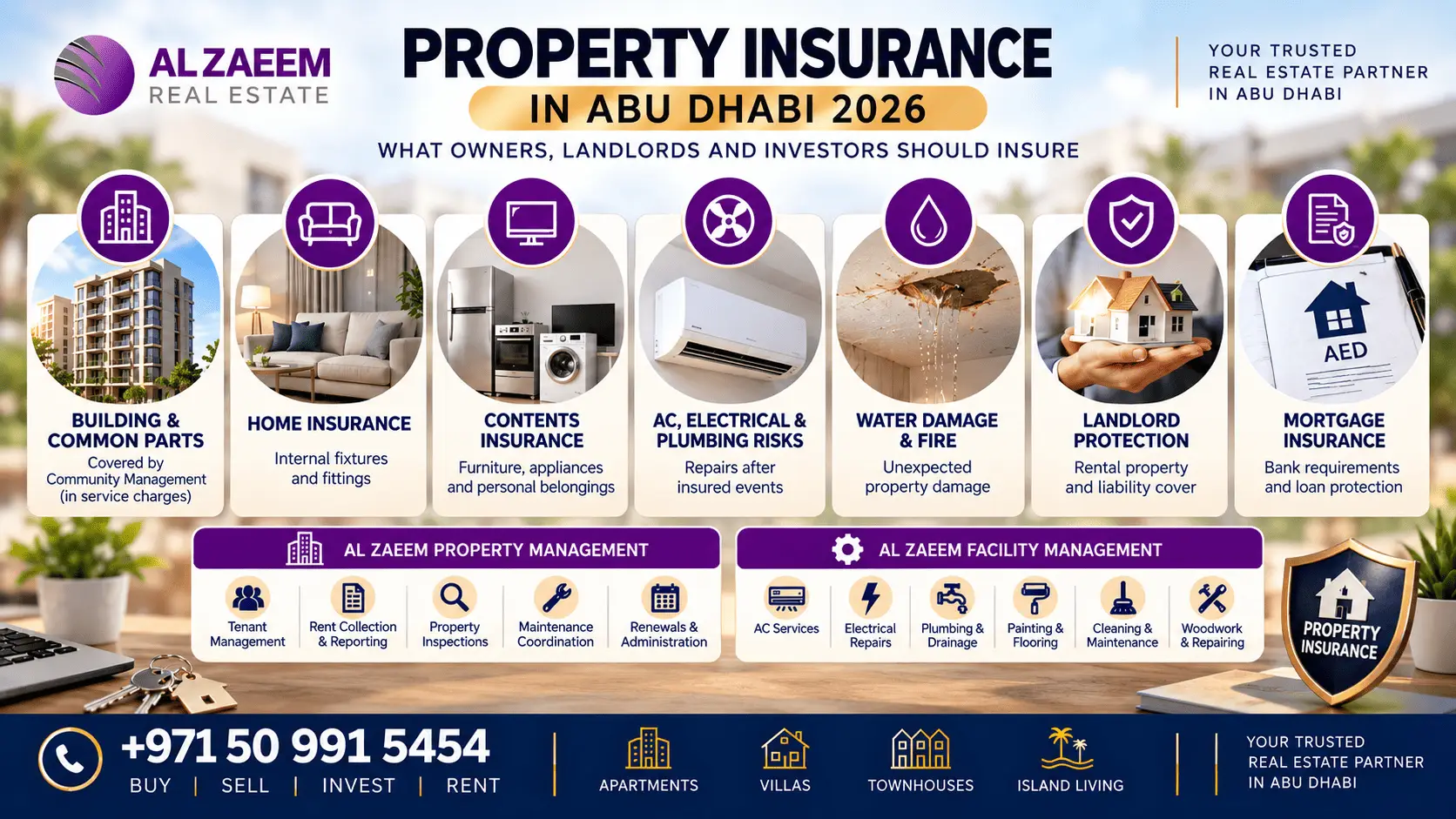
In Abu Dhabi, a jointly owned building can have insurance arranged for the building and common parts, while the individual owner may still need separate protection for:
- the unit;
- internal fixtures;
- furniture;
- appliances;
- landlord contents;
- personal belongings;
- liability exposures.
ADREC confirms that Community Management Companies procure and renew insurance for jointly owned buildings and common parts, with the related insurance cost included within approved service charges. ADREC separately encourages owners to arrange their own home and contents insurance where appropriate. Adrec
That distinction is fundamental.
For investors, insurance should therefore be analysed in layers.
Property Insurance Is Not One Policy
When people say:
“property insurance”
they may actually be referring to several different forms of protection.
These can include:
- Building/common-property insurance
- Individual home or unit insurance
- Contents insurance
- Landlord-specific insurance
- Liability cover
- Mortgage-related insurance
Each protects a different risk.
A policy protecting the building structure does not automatically protect your:
- sofa;
- television;
- washing machine;
- fitted upgrades;
- landlord furniture.
And a contents policy does not automatically rebuild the building.
What Insurance Does the Building Already Have?
For jointly owned property, ADREC states that the Community Management Company is responsible for procuring and renewing insurance for:
- the building;
- common parts.
The cost is incorporated into the approved service-charge structure. Adrec
Abu Dhabi’s joint-property framework also requires insurance against damage and bodily injury affecting owners and occupants while within the jointly owned property, with these premiums forming part of the service-fee structure. Adrec
This means apartment owners are already indirectly contributing toward certain building-level insurance through service charges.
But that does not mean the owner’s entire private unit exposure is covered.
Common Property vs Your Individual Unit
This is the easiest way to understand the distinction.
Common Property
May include areas such as:
- lobby;
- corridors;
- lifts;
- shared plant;
- structural/common elements;
- shared facilities.
These fall within the building-management framework.
Individual Owner Exposure
May include:
- internal finishes;
- furniture;
- appliances;
- upgrades;
- personal belongings;
- landlord-owned contents.
These may require additional insurance depending on the policy structure.
Service Charges Do Not Mean Full Personal Insurance
This is important for investors.
Our Abu Dhabi Property Taxes & Ownership Costs 2026 already explains that common-building insurance may form part of approved service charges, while home and contents insurance remain separate considerations.
So when a seller says:
“Insurance is included in service charges.”
Ask:
Which insurance?
Do not assume that statement covers everything inside the apartment.
What Is Home Insurance?
Home insurance generally refers to insurance protecting the residential property against defined risks under the policy.
Depending on the insurer and policy, cover may relate to:
- internal fixtures;
- certain structural elements;
- accidental damage;
- fire;
- water-related damage;
- other insured events.
Coverage varies significantly.
The policy wording matters more than the marketing name.
What Is Contents Insurance?
Contents insurance generally protects movable belongings.
Examples can include:
- furniture;
- electronics;
- appliances;
- personal belongings.
For landlords, contents insurance may be particularly relevant where the rental property is:
- furnished;
- partially furnished.
If you own the furniture but the tenant occupies the property, those assets still belong to you.
Furnished Landlords Have More to Protect
A furnished apartment may contain:
- beds;
- sofas;
- televisions;
- dining furniture;
- washing machine;
- refrigerator;
- curtains;
- decorative items.
The landlord’s financial exposure is therefore greater than in an unfurnished apartment.
Our Furnished vs Unfurnished Property in Abu Dhabi 2026 explains why furnished investments have a different cost and operating profile.
Insurance should reflect that difference.
What Is Landlord Insurance?
Landlord insurance is a broad commercial term that may refer to insurance designed around a rented property.
Depending on the provider and policy, it may potentially include elements such as:
- building/unit protection;
- landlord-owned contents;
- liability;
- certain tenant-related risks.
Not every policy includes the same protection.
That is why landlords should never rely only on the policy title.
Read the actual coverage and exclusions.
Does Landlord Insurance Cover Unpaid Rent?
Sometimes investors assume:
“If the tenant stops paying, insurance covers the rent.”
That should never be assumed.
Loss-of-rent or rent-protection provisions, where offered, are policy-specific and usually subject to:
- conditions;
- exclusions;
- limits.
Unless your policy explicitly includes this protection, do not build it into your investment model.
Does Insurance Cover Tenant Damage?
Again:
not automatically.
The answer depends on:
- cause of damage;
- policy wording;
- exclusions;
- deductible;
- whether damage is accidental or deliberate.
Tenant-caused damage should also be managed through:
- tenant screening;
- security deposit;
- move-in inventory;
- move-out inspection.
Our How to Screen a Tenant in Abu Dhabi 2026 explains why insurance should complement — not replace — good tenant selection.
Normal Wear and Tear Is Usually Different
Insurance is not normally intended to function as a maintenance plan.
A property gradually deteriorates through use.
Examples may include:
- paint ageing;
- worn flooring;
- old appliance failure;
- ageing sealant;
- normal AC maintenance.
These are generally operating or maintenance issues rather than sudden insured events.
This is why Landlord vs Tenant Maintenance Abu Dhabi 2026 should be read separately from insurance.
Maintenance and insurance solve different problems.
Insurance Does Not Replace Facility Management
This is especially important for Al Zaeem landlords.
Insurance deals with defined financial risks after insured events.
Facility management deals with keeping the property operational.
Through Al Zaeem Facility Management, landlords can coordinate services such as:
- AC servicing;
- electrical repairs;
- plumbing;
- drainage;
- cleaning;
- painting;
- flooring;
- woodwork.
A strong ownership strategy requires both:
maintenance
and
risk protection.
Insurance Does Not Replace Property Management Either
A policy cannot:
- screen your tenant;
- collect rent;
- organise renewals;
- coordinate contractors;
- inspect the apartment.
That is the role of Al Zaeem Property Management.
For rental investors, the strongest structure is usually:
Property Management → Facility Management → Appropriate Insurance
Each layer addresses a different part of the investment risk.
Why Investors Should Care About Insurance
An investor normally calculates return using:
rent − operating expenses = net income
Insurance premiums can be part of those operating expenses.
Our Abu Dhabi Property ROI Guide 2026 already includes landlord insurance among potential operating costs when calculating Net Operating Income.
That means insurance should not be ignored when modelling true return.
Illustrative Example
Suppose an apartment costs:
AED 1,800,000
Annual rent:
AED 120,000
Other annual owner costs:
- service charges: AED 18,000
- maintenance: AED 5,000
- management: AED 6,000
- insurance: AED 1,500
Net operating income before vacancy:
AED 89,500
Net operating yield:
4.97%
Without including insurance, the calculation would be slightly overstated.
Illustrative figures only.
Insurance Premium Is Usually Small Compared With Asset Value
Consider a multimillion-dirham property.
Even a relatively modest annual premium can potentially protect against a much larger financial loss.
This does not mean:
Buy every possible policy.
It means:
Evaluate risk relative to premium.
Investors should insure economically meaningful risks rather than simply minimising annual cost.
Apartment vs Villa Insurance
The appropriate insurance profile can differ by property type.
Apartment
Building/common-property insurance may already cover significant common elements.
The owner may then focus on:
- internal unit cover;
- contents;
- landlord exposure.
Villa
A villa owner may have more direct exposure to:
- building structure;
- roof;
- external elements;
- landscaping;
- private facilities.
The exact policy requirement depends on the ownership/community structure.
Private Pool Villas Need Extra Attention
A villa with:
- private pool;
- landscaped garden;
- external structures
has a more complex physical risk profile than a compact apartment.
Owners should confirm whether relevant external features are:
- covered;
- excluded;
- subject to special conditions.
Never assume.
Waterfront Property
Waterfront apartments and villas may have particular environmental exposure.
But the investment principle is unchanged:
read the policy.
Do not assume a premium location automatically creates broader insurance protection.
Our Waterfront vs Non-Waterfront Property in Abu Dhabi 2026 explains why lifestyle premium and asset risk should be analysed separately.
Mortgage Buyers May Face Insurance Requirements
Insurance becomes particularly important when financing is involved.
Mortgage lenders may impose their own requirements concerning:
- property insurance;
- mortgage protection;
- life cover.
AZCB’s Abu Dhabi Property Fees & Closing Costs 2026 already notes that mortgage-related insurance requirements can vary by lender.
Therefore:
do not assume one bank’s requirements apply to another.
Ask the lender for the full insurance requirement before signing the mortgage.
Property Insurance vs Life / Mortgage Protection
These are not the same thing.
Property Insurance
Protects defined property-related risks.
Life / Mortgage Protection
May relate to the borrower and the financing obligation.
Mortgage buyers should separate these costs when comparing financing offers.
Our Cash vs Mortgage Property in Abu Dhabi 2026 explains why borrowers should evaluate:
rate + fees + insurance + total financing cost
rather than the interest rate alone.
Common-Area Insurance Does Not Cover Your Mortgage
Another important distinction.
The building’s common insurance protects the insured property/common-area risk.
It does not eliminate:
- your loan repayment;
- your personal financing obligations.
Insurance layers solve different risks.
What Should a Landlord Consider Insuring?
A rental investor should consider the following questions:
Building
What is already covered by the Community Management Company?
Internal Unit
What elements inside the property are excluded from common insurance?
Contents
Do I own furniture or appliances?
Liability
What happens if an incident causes injury or third-party damage?
Rent
Does the policy offer any relevant loss-of-rent protection?
Mortgage
What does the lender require?
Deductible
How much must I pay before insurance responds?
Exclusions
What events are not covered?
Deductibles Matter
A policy may include a deductible or excess.
Suppose:
Claim:
AED 3,000
Deductible:
AED 2,500
Insurance may provide little financial benefit for that small event.
Insurance is generally more valuable for larger financial risks than routine minor repairs.
Policy Limits Matter
If contents are worth:
AED 100,000
but the policy limit is:
AED 40,000
the landlord may be underinsured.
Likewise, an excessive limit may create unnecessary premium cost.
Coverage should broadly reflect actual exposure.
Underinsurance Can Become Expensive
Investors should update insured values when:
- furnishing the property;
- renovating;
- upgrading kitchens;
- installing expensive equipment.
A policy purchased years ago may no longer reflect the value of the asset inside the unit.
What Does Building Insurance Cover?
There is no universal answer.
The building policy is arranged by the relevant Community Management Company and should be reviewed for its actual scope.
ADREC confirms the core regulatory framework: insurance must be arranged for the building and common parts, with the associated insurance cost included in approved service charges. Adrec
Owners should request clarification from the Community Management Company if they need to understand specific coverage.
Insurance and Service Charges
Owners sometimes complain:
“Why am I paying insurance twice?”
It may not actually be duplicate coverage.
One premium within service charges may relate to:
- common property;
- building risk.
The owner’s separate policy may relate to:
- contents;
- internal unit;
- landlord-specific exposure.
The policies can protect different risks.
Ask the Community Management Company
Before buying additional coverage, ask:
- What building insurance currently exists?
- What exactly does it cover?
- What does it exclude?
- What should unit owners insure separately?
- How are claims involving individual units handled?
This avoids buying insurance blindly.
Water Damage: A Useful Example
Imagine water damages your apartment.
Possible causes:
Common Building Pipe
Building/common insurance may become relevant.
Internal Unit Pipe
Owner/unit insurance may be relevant.
Tenant Misuse
Tenant responsibility may also be involved.
Neighbouring Unit
Another owner’s or building insurance may enter the situation.
One incident can involve multiple layers of responsibility.
This is why documentation matters.
Fire: Another Example
A fire may affect:
- building structure;
- common areas;
- your unit;
- your furniture;
- neighbouring property.
Different policies may respond to different components of the loss.
A single “the building is insured” statement is therefore not sufficient.
Liability Risk
Suppose an incident inside the rented unit causes:
- third-party injury;
- damage to another property.
Landlords should understand whether their policy includes relevant liability protection.
Liability can sometimes create a much larger financial exposure than the direct physical repair.
Tenant Contents Are Usually Separate From Landlord Contents
If a tenant owns:
- furniture;
- television;
- personal electronics;
those belongings are not the landlord’s assets.
The tenant may need their own contents protection if they want those possessions insured.
The landlord’s policy should be designed around what the landlord actually owns and is responsible for.
Insurance for Vacant Property
Vacancy can affect insurance conditions.
Some policies may contain:
- occupancy requirements;
- vacancy exclusions;
- notice requirements.
Investors should check policy terms when a property remains empty for extended periods.
Our Vacant vs Tenanted Property in Abu Dhabi 2026 explains why vacancy creates operational risk beyond lost rent.
Short-Term Rental Insurance
Short-term rental use may create a different risk profile from a conventional long-term tenancy.
Owners operating holiday-style accommodation should not assume a standard owner-occupier policy automatically covers the activity.
Confirm the intended use with the insurer.
Our Short-Term vs Long-Term Rental in Abu Dhabi 2026 explains why short-term operation should be treated as a different business model.
Insurance and Property Management
A professional property manager can help the landlord maintain:
- inspection records;
- maintenance records;
- tenancy documentation;
- property condition information.
These records may become useful if a claim occurs.
Al Zaeem Property Management provides support across:
- tenant management;
- rent collection;
- inspections;
- maintenance coordination;
- reporting.
That creates stronger documentation than informal self-management in many cases.
Insurance and Facility Management
Likewise, professional maintenance records can help establish:
- what failed;
- when it was repaired;
- what contractor attended;
- what work was completed.
Al Zaeem Facility Management supports technical property care across AC, electrical, plumbing and other maintenance disciplines.
For landlords, this means insurance and facility management work best together — not as substitutes.
Common Insurance Mistakes Property Owners Make
Mistake 1: Assuming Service Charges Insure Everything
They generally do not.
Mistake 2: Insuring the Building but Not Furnishings
A furnished landlord has additional exposure.
Mistake 3: Treating Insurance as Maintenance
Routine deterioration is different from an insured event.
Mistake 4: Ignoring Deductibles
A policy can look broad but still provide limited value for small claims.
Mistake 5: Ignoring Exclusions
The exclusion section can be as important as the coverage section.
Mistake 6: Forgetting to Update the Policy
Renovations can change insured value.
Mistake 7: Assuming Mortgage Insurance Equals Property Insurance
They solve different risks.
Al Zaeem Property Insurance Checklist
Before finalising coverage, ask:
Common Building Insurance
What does the Community Management Company already insure?
Unit
What inside my unit remains my responsibility?
Contents
How much landlord-owned furniture or equipment exists?
Tenancy
Is the property owner-occupied or rented?
Property Type
Apartment or villa?
Mortgage
Does my bank impose specific insurance conditions?
Liability
Does the policy include appropriate third-party protection?
Deductible
What amount do I bear on each claim?
Exclusions
What events are excluded?
Vacancy
Are there occupancy conditions?
Documentation
Do I have inventories, photographs and maintenance records?
How Much Property Insurance Do You Need?
There is no universal answer.
The appropriate cover depends on:
- property value;
- property type;
- contents value;
- financing;
- tenancy structure;
- risk tolerance.
This is why investors should obtain a policy designed around the actual asset rather than buying the cheapest generic option.
Is Property Insurance Mandatory for Every Cash Buyer?
The ADREC sources cited here establish mandatory building/common-part insurance within jointly owned property management and encourage owners to arrange additional home and contents insurance. They do not establish a blanket rule in the material reviewed here that every cash buyer must purchase the same separate individual home-insurance policy. Adrec
Specific:
- lender;
- development;
- contractual
requirements should therefore be checked separately.
Is Common Building Insurance Enough for a Landlord?
Usually, an investor should at least investigate whether there are material exposures outside the common-building policy.
Especially where the unit contains:
- furniture;
- appliances;
- expensive improvements.
The answer depends on actual policy coverage.
Which Insurance Matters Most for an Investor?
There is no single universally correct policy.
The priority should be to identify:
the risks that would materially damage the investment.
For one landlord, that may be:
- furnished contents.
For another:
- liability.
For a villa owner:
- broader physical-property exposure.
Insurance should follow the risk.
Final Verdict
Property insurance in Abu Dhabi should be understood as a layered protection structure, not one blanket policy.
For jointly owned properties, ADREC confirms that the Community Management Company insures the building and common parts, with the cost incorporated into approved service charges. Owners are separately encouraged to arrange home and contents protection according to their needs. Adrec
For investors, the practical structure is:
Building/common insurance
protects the shared asset framework.
Individual home/unit insurance
can protect relevant owner-level property exposure.
Contents insurance
can protect landlord-owned furniture and belongings.
Mortgage-related insurance
may satisfy lender-specific financing requirements.
The best investment strategy is therefore not:
Buy the cheapest policy.
It is:
Identify what is already insured, identify what remains exposed, and insure the risks that could materially damage your investment.
For professionally managed rental properties, that protection works best alongside Al Zaeem Property Management and Al Zaeem Facility Management, so that the property’s tenancy, maintenance, condition and documentation are managed as carefully as its financial risk.