



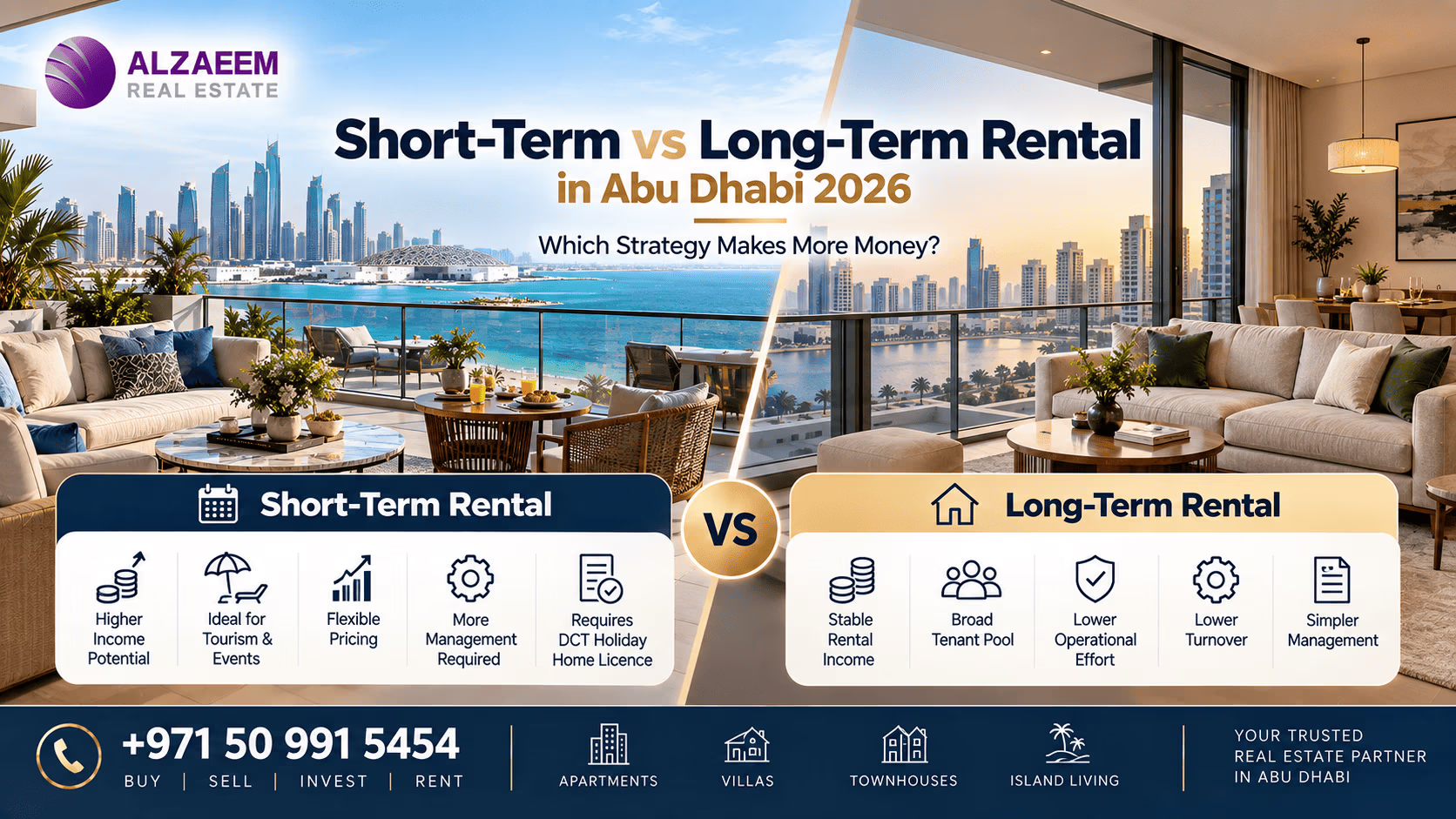
A rental property can produce income in two very different ways.
One investor may lease a unit for:
12 months to one tenant.
Another may rent the same type of property:
night by night or week by week to visitors.
The second model can produce a much higher headline nightly rate.
But it also comes with:
- vacancy,
- cleaning,
- furnishing,
- guest management,
- platform commissions,
- licensing,
- utilities,
- operational costs,
- and much greater management intensity.
The first model may earn less in gross revenue but provide:
- predictable rent,
- lower turnover,
- less administration,
- simpler operating costs,
- and greater income stability.
So the correct question is not:
Which one has the higher rent?
It is:
Which strategy produces the stronger net return after occupancy, operating costs, regulation and management?
That question is especially relevant in Abu Dhabi because both markets are substantial.
ADREC reported approximately 233,000 active residential lease contracts in H1 2026, with a combined lease value of around AED 9.3 billion. Rental units accounted for 69% of occupied homes in Abu Dhabi Region, demonstrating the depth of the conventional long-term rental market. Adrec
At the same time, Abu Dhabi also has a formally regulated holiday-home sector. DCT Abu Dhabi operates a licensing framework for holiday homes, and from 1 January 2026, a valid holiday-home licence became a mandatory condition for listings on online booking platforms. Department of Culture and Tourism
This means short-term rental is not simply:
buy apartment → put it online → collect nightly rent.
It is an operating business model.
What Is a Long-Term Rental?
A long-term rental usually involves leasing the property to a residential tenant for an extended contractual period.
Typically, the landlord receives:
- annual rent,
- several rental cheques or agreed payment structure,
- a security deposit,
- and a registered tenancy arrangement.
The landlord usually does not need to manage:
- daily check-ins,
- cleaning after every stay,
- guest reviews,
- constant pricing,
- or booking calendars.
The economic model is relatively straightforward.
Annual rent − operating costs = landlord income.
What Is a Short-Term Rental?
A short-term rental — often operated as a holiday home — provides temporary accommodation to visitors rather than a conventional long-term residential tenant.
Possible guests include:
- tourists,
- business travellers,
- relocating professionals,
- families,
- event visitors,
- short-stay residents.
Abu Dhabi’s official tourism platform actively lists holiday homes ranging from apartments on Yas, Saadiyat and Reem to villas and other alternative accommodation. Experience Abu Dhabi
Unlike a long-term rental, the operator must actively manage:
- pricing,
- bookings,
- check-in,
- cleaning,
- guest communication,
- maintenance,
- listing performance,
- reviews,
- occupancy.
This is closer to a hospitality business than a passive tenancy.
The Biggest Difference: Stability vs Revenue Potential
The simplest distinction is:
Long-Term Rental
Lower operational intensity + more predictable occupancy
Short-Term Rental
Higher revenue potential + higher operating complexity
That does not mean one is automatically better.
It depends on:
- location,
- property type,
- occupancy,
- daily rate,
- costs,
- licensing,
- management.
Short-Term Rental Is Regulated in Abu Dhabi
This needs to be understood before any revenue model is built.
DCT Abu Dhabi’s holiday-home framework requires owners or operators to comply with licensing requirements before offering a property as holiday accommodation. Department of Culture and Tourism
From 1 January 2026, DCT stated that all units require a valid licence before being listed for holiday-home advertisement or booking on online platforms, and the licence number must be displayed on those platforms. Shared-unit listings are prohibited under that enforcement framework. Department of Culture and Tourism
DCT also introduced mandatory use of its Holiday Homes electronic system from 15 April 2026 for relevant operational processes. Department of Culture and Tourism
Therefore:
short-term rental should be analysed as a regulated operating model, not informal rental income.
Community Rules Also Matter
Even if DCT regulations permit holiday-home activity, the residential community itself may impose operational rules.
ADREC’s June 2026 guidance states that community management companies and owners’ committees should establish clear governance for short-term and holiday-home rentals, while all such policies must remain aligned with DCT Holiday Homes Guidelines. Third-party operators must maintain valid licences. Adrec
This means an investor should verify:
- DCT compliance,
- building/community policy,
- operator eligibility,
- management rules
before assuming a property can be run short-term.
A Higher Nightly Rate Does Not Mean Higher Profit
Suppose a long-term apartment rents for:
AED 120,000 per year
A short-term operator believes the property can achieve:
AED 600 per night
At first glance:
AED 600 × 365 = AED 219,000
That looks dramatically better.
But 365 occupied nights are unrealistic.
If occupancy is 65%:
237 nights × AED 600 =
AED 142,200
The gap has already narrowed significantly.
And operating costs still need to be deducted.
Short-Term Rental Revenue Formula
A more realistic formula is:
Average Daily Rate × Occupied Nights = Gross Booking Revenue
Then deduct:
- platform commissions,
- management fees,
- cleaning,
- utilities,
- internet,
- furnishing,
- linen,
- consumables,
- maintenance,
- licence/compliance costs,
- vacancy.
Only then do you reach something close to operating income.
Long-Term Rental Formula
Long-term income is simpler:
Annual Rent − Service Charges − Maintenance − Management − Vacancy Allowance = Net Operating Income
The model has fewer moving parts.
That simplicity itself has economic value.
Illustrative Comparison
Consider the same hypothetical one-bedroom apartment.
Purchase price:
AED 1,600,000
Long-Term Rental
Annual rent:
AED 110,000
Service charges:
AED 18,000
Maintenance:
AED 5,000
Management:
AED 5,000
Net operating income:
AED 82,000
Operating yield:
5.13%
Short-Term Rental
Average nightly rate:
AED 600
Occupancy:
65%
Occupied nights:
237
Gross revenue:
AED 142,200
Now deduct:
Platform / booking costs: AED 18,000
Management: AED 21,000
Utilities + internet: AED 12,000
Cleaning / linen / consumables: AED 13,000
Service charges: AED 18,000
Maintenance allowance: AED 7,000
Other operating/licensing allowance: AED 4,000
Net operating income:
AED 49,200
Operating yield:
3.08%
Despite much higher gross revenue, the short-term unit produces less net income in this hypothetical scenario.
This is why investors must model net income, not nightly rates.
But Short-Term Can Also Outperform
Now consider a stronger short-term location.
Average nightly rate:
AED 850
Occupancy:
75%
Occupied nights:
274
Gross revenue:
AED 232,900
Assume total operating expenses:
AED 105,000
Net operating income:
AED 127,900
On AED 1.6M:
Operating yield:
7.99%
In this scenario, short-term rental materially outperforms.
The difference comes from:
- higher daily rate,
- stronger occupancy,
- efficient management.
The strategy only works if these variables are genuinely achievable.
Occupancy Is the Most Important Short-Term Variable
A high nightly rate means very little if the unit sits empty.
Example:
AED 900/night at 40% occupancy:
146 nights × AED 900 =
AED 131,400
AED 650/night at 75% occupancy:
274 nights × AED 650 =
AED 178,100
The cheaper nightly rate produces more annual revenue.
Therefore investors should focus on:
ADR + occupancy together
not ADR alone.
Seasonal Demand Matters
Short-term demand can fluctuate with:
- tourism seasons,
- events,
- exhibitions,
- school holidays,
- weather,
- business travel,
- entertainment calendars.
A property may achieve exceptional revenue in one month and much weaker performance in another.
Long-term tenancy smooths out this seasonality.
Yas Island Can Naturally Suit Short-Term Demand
Yas has several demand drivers that can support visitor accommodation:
- theme parks,
- events,
- retail,
- entertainment,
- airport proximity.
Official tourism listings already feature several holiday-home units on Yas Island. Experience Abu Dhabi
This does not mean every Yas property will produce strong short-term returns.
But the location has clear visitor demand drivers.
Saadiyat Can Serve Premium Short-Stay Guests
Saadiyat’s appeal includes:
- beaches,
- cultural attractions,
- luxury hotels,
- premium lifestyle.
This can support higher-value short stays.
However, high acquisition prices can reduce yield even when nightly rates are strong.
The relevant question is:
How much revenue is produced relative to the capital invested?
Reem Can Serve a Different Guest Profile
Al Reem Island may appeal more to:
- business travellers,
- relocating residents,
- temporary professionals,
- visitors needing city access.
The demand profile is different from resort-style tourism.
Short-term strategy should reflect the specific location rather than copying the same pricing model everywhere.
Long-Term Demand Is Much Deeper
The conventional residential rental market is structurally larger.
ADREC recorded 233,000 active residential leases in H1 2026, with lease values of AED 9.3 billion. Adrec
That broad tenant base includes:
- professionals,
- families,
- couples,
- long-term expatriates,
- UAE residents.
For many investors, this depth reduces demand risk.
Abu Dhabi Long-Term Rents Have Been Strong
ADREC reported that new apartment lease prices rose 17% year-on-year in H1 2026, while new apartment rents in investment zones increased 21%. Adrec
That makes the long-term strategy particularly relevant.
Investors should not automatically assume they need short-term rental to achieve strong income.
Existing Tenancy Regulation Also Matters
In June 2026, Abu Dhabi temporarily moved annual rent increases on tenancy renewals to 0% until further notice. New agreements and renewals reference the property’s last registered Tawtheeq rental rate during the measure. Adrec
This can affect long-term rental strategy when buying a property with an existing tenant.
A landlord may have less immediate ability to increase an older contractual rent.
Short-Term Rental Avoids Some Long-Term Rent Lock-In
A holiday-home operator does not rely on the same annual tenancy structure.
Rates can potentially change more frequently based on:
- demand,
- events,
- seasonality,
- weekends,
- occupancy.
This creates revenue flexibility.
But that flexibility also requires active management.
Dynamic Pricing Is a Major Advantage
A short-term operator can charge:
AED 450 on weak nights
and potentially:
AED 1,000+ during stronger periods
depending on market demand.
This can maximise revenue.
A long-term landlord generally agrees one contractual rent for a longer period.
Dynamic Pricing Is Also a Management Burden
To use the advantage properly, the operator needs to manage:
- competitor rates,
- booking pace,
- events,
- seasonal demand,
- minimum stays,
- discounts.
Poor pricing can reduce both:
- occupancy,
- revenue.
Furnishing Is Mandatory Economically, Even If Not the Main Legal Question
A long-term property can often be rented unfurnished.
A short-term property typically needs to provide a complete guest experience.
That may require:
- beds,
- sofas,
- dining furniture,
- television,
- kitchen equipment,
- linen,
- towels,
- décor,
- appliances.
That creates significant upfront capital.
Furniture Depreciates
Suppose furnishing costs:
AED 80,000
and needs substantial refresh after four years.
Economic furniture cost:
Approximately:
AED 20,000 per year
before individual repairs and replacements.
That should be included in the short-term model.
Short-Term Requires Higher Maintenance
More guests usually mean:
- more doors opened,
- more appliances used,
- more luggage movement,
- more linen cycles,
- more cleaning.
This can increase:
- wear,
- repairs,
- replacement costs.
Long-Term Tenants Can Reduce Operational Work
A stable tenant may remain for several years.
That can reduce:
- leasing commissions,
- cleaning,
- vacancy,
- repainting,
- management.
A reliable tenant has real financial value.
But Long-Term Tenant Risk Exists
Potential issues include:
- delayed rent,
- maintenance disputes,
- property damage,
- renewal uncertainty.
Long-term leasing is simpler.
It is not risk-free.
Short-Term Guest Risk Is Distributed
Instead of one tenant, there may be dozens of guests annually.
That means no single guest dominates annual income.
But it also means:
- repeated check-ins,
- repeated cleaning,
- repeated guest risk.
Different operating profile.
Management Fees Can Change the Result Completely
If the owner manages the holiday home personally, short-term returns may improve.
But many investors — especially overseas buyers — need an operator.
Suppose operator fee is:
15%–20% of booking revenue
That can significantly reduce net income.
An investor should request the exact management contract before buying.
Overseas Owners Should Be Particularly Careful
A buyer living abroad cannot easily handle:
- midnight guest issues,
- cleaning coordination,
- maintenance,
- access,
- pricing.
For overseas investors, short-term rental often requires professional management.
That means gross revenue comparisons become even less useful.
Utilities Are Usually an Owner Cost in Short-Term Rentals
Holiday-home guests usually expect:
- electricity,
- water,
- internet,
- cooling
to be included.
A long-term residential tenant may carry more of these operating costs directly.
That difference should be included in ROI.
Cleaning Is a Real Operating Expense
Suppose:
80 bookings per year
Average cleaning cost:
AED 180
Annual cleaning:
AED 14,400
Even if some of that cost is recovered from guests, the operator needs to understand:
- gross cleaning fees,
- actual cleaner costs,
- platform treatment.
Linen and Consumables Are Often Forgotten
Short-term operators may need:
- sheets,
- towels,
- toiletries,
- coffee,
- water,
- cleaning products.
Small recurring costs can become significant across many bookings.
Platform Fees Matter
Online booking platforms charge fees under their own commercial structures.
The exact amount varies.
Do not model:
nightly price × occupied nights
as owner revenue.
Use net booking receipts.
Long-Term Leasing Also Has Transaction Friction
Long-term landlords may still incur:
- broker leasing commission,
- maintenance,
- vacancy,
- property management.
The cost structure is lower in complexity, not zero.
Short-Term Can Produce Higher Cash Flow in High-Demand Micro-Locations
The strongest short-term investments are often not simply in:
popular areas
but in:
very specific demand nodes.
Examples might include proximity to:
- major attractions,
- event venues,
- premium beaches,
- business districts.
Micro-location matters.
A Generic Apartment May Perform Better Long-Term
If the property lacks:
- tourism appeal,
- unique view,
- convenient visitor location,
then short-term demand may be weak.
A conventional long-term tenant may value the same property for:
- affordability,
- commute,
- practical layout.
Studio vs 1BR vs 2BR Can Produce Different Results
Studio
Advantages:
- lower entry price,
- lower furnishing cost,
- easier short-stay pricing.
Potential weakness:
- smaller guest pool for families.
1BR
Often offers a useful balance between:
- couples,
- business travellers,
- longer stays.
2BR
Can attract:
- families,
- groups.
But:
- higher purchase price,
- furnishing,
- cleaning.
Unit type matters to the business model.
A Larger Unit Can Produce More Revenue but Lower Yield
Example:
1BR:
AED 1.4M purchase
AED 170K short-term revenue
2BR:
AED 2.2M purchase
AED 230K revenue
The 2BR earns more.
But revenue relative to capital is lower.
Always compare percentages and net income.
Short-Term Investors Should Track RevPAR
A useful hospitality metric is:
Revenue per Available Night
Calculated approximately as:
Average Daily Rate × Occupancy
Example:
ADR:
AED 700
Occupancy:
70%
RevPAR:
AED 490
This allows more realistic property comparisons than daily rate alone.
Example RevPAR Comparison
Property A:
ADR AED 900
Occupancy 50%
RevPAR:
AED 450
Property B:
ADR AED 650
Occupancy 80%
RevPAR:
AED 520
Property B generates more revenue efficiency even with a lower nightly rate.
Long-Term Investors Should Track Effective Annual Rent
For long-term property:
Contract rent:
AED 120K
But if the unit remains empty one month between tenants:
Effective annual collected rent:
AED 110K
This makes comparison with short-term more realistic.
Do Not Compare Short-Term Gross With Long-Term Net
This is a common mistake.
Wrong comparison:
Short-term gross revenue:
AED 180K
vs
Long-term net income:
AED 90K
That exaggerates the short-term advantage.
Compare:
net vs net
A Fair Comparison Framework
For both strategies calculate:
Revenue
Vacancy
Service Charges
Management
Maintenance
Utilities
Furnishing
Compliance/Licensing
Other Operating Costs
Then calculate:
Net Operating Income
Illustrative Side-by-Side Comparison
| Metric | Long-Term | Short-Term |
|---|---|---|
| Purchase Price | AED 1.6M | AED 1.6M |
| Gross Revenue | AED 115K | AED 180K |
| Service Charges | AED 18K | AED 18K |
| Management | AED 5K | AED 27K |
| Utilities | Tenant/limited owner cost | AED 12K |
| Cleaning/Consumables | Minimal | AED 16K |
| Maintenance | AED 5K | AED 8K |
| Furnishing Allowance | AED 3K | AED 18K |
| Other Operating Costs | AED 2K | AED 5K |
| Net Operating Income | AED 82K | AED 76K |
| Operating Yield | 5.13% | 4.75% |
These figures are illustrative.
The short-term property generates 57% more gross revenue.
But the long-term property still produces more net operating income in this scenario.
That is exactly why gross booking revenue should never be confused with investment return.
The Break-Even Occupancy Calculation
Suppose the short-term unit earns:
AED 700 average daily rate.
Annual fixed + variable costs are estimated at:
AED 90K.
The long-term alternative produces:
AED 85K net income.
To match the long-term option:
Short-term gross revenue must cover:
AED 90K costs + AED 85K target income
= AED 175K
Required occupied nights:
AED 175K ÷ AED 700
= 250 nights
Required occupancy:
250 ÷ 365
= approximately 68.5%
This gives the investor a clear break-even target.
Break-Even Analysis Is More Useful Than Optimistic Revenue
Instead of asking:
“Can it earn AED 200K?”
ask:
“What occupancy must I achieve to outperform long-term leasing?”
That produces a much more disciplined investment decision.
Short-Term Can Offer Better Inflation Protection
Because pricing can adjust frequently, holiday-home rates may respond faster to:
- tourism demand,
- events,
- inflation.
A long-term lease can temporarily lock the landlord into an agreed rent.
This flexibility has economic value.
Long-Term Offers Better Forecastability
If an investor needs:
- mortgage servicing,
- predictable monthly cash flow,
- low management burden,
long-term tenancy may be more suitable.
Predictability can be more valuable than theoretical upside.
Mortgage Investors Should Stress-Test Short-Term Income
Mortgage payments continue whether:
- guests book,
- or not.
Therefore leveraged investors should model poor occupancy scenarios.
For example:
- 40% occupancy,
- 50% occupancy,
- 60% occupancy.
Do not build debt servicing around best-case tourism demand.
Cash Investors Can Tolerate More Volatility
Without mortgage obligations, a cash investor may be better able to:
- wait through low season,
- optimise pricing,
- experiment with short-term management.
Financing structure affects strategy.
Event-Driven Demand Can Be Powerful — and Temporary
An event can push daily rates sharply higher.
But an investor should not annualise a few exceptional weekends.
One high-rate week does not define yearly performance.
Reviews Become an Economic Asset
In short-term rental, guest reviews affect:
- listing ranking,
- trust,
- booking conversion.
This means service quality directly affects revenue.
Long-term residential landlords do not face the same platform reputation system.
Poor Management Can Destroy Short-Term Economics
A strong property with:
- slow guest responses,
- weak cleaning,
- inaccurate listing,
- maintenance problems
may receive poor reviews.
That can reduce:
- occupancy,
- ADR.
Short-term rental is operationally sensitive.
Property Photography Matters More
Guests choose largely from:
- photographs,
- reviews,
- location,
- price.
A professionally presented property can outperform a similar unit.
This creates another operating requirement.
Short-Term Rental Is Not Fully Passive
This is perhaps the most important distinction.
A long-term landlord can outsource much of the process and have limited involvement.
A holiday-home unit is closer to a small hospitality asset.
It needs ongoing:
- pricing,
- marketing,
- operations,
- guest service.
Investors should decide whether they actually want that business model.
Long-Term Can Be More Scalable for Portfolio Investors
A landlord owning ten long-term units may manage them through relatively standardised processes.
Ten short-term properties can create:
- hundreds of annual bookings,
- substantial cleaning,
- guest support,
- pricing complexity.
Portfolio scale changes management requirements.
Short-Term Can Be More Flexible if the Owner Wants Personal Use
A holiday-home owner can potentially block certain periods for personal use.
A long-term landlord cannot simply use the property while a tenant has possession.
This can matter for:
- overseas owners,
- second-home buyers.
But personal use reduces available revenue nights.
Include that in the model.
Short-Term Rental Can Improve Exit Presentation
A well-furnished, maintained property may show well to buyers.
But heavy guest use can also increase wear.
Again, execution matters.
Long-Term Tenant Can Complicate Vacant Possession
A tenanted property may be more difficult to sell to:
- end users
depending on tenancy status and timing.
Short-term operation may offer greater flexibility around sale timing if reservations can be appropriately managed.
But compliance and booking commitments still matter.
Regulation Can Change
Short-term rental frameworks are more operationally regulated than standard ownership.
DCT Abu Dhabi has continued updating its holiday-home system and compliance requirements, including new 2025–26 licensing and electronic-system directives. Department of Culture and Tourism
Investors should therefore expect:
ongoing compliance, not a one-time licence exercise.
DCT Licensing Requirements Matter at Acquisition Stage
DCT’s published holiday-home administrative requirements include documents such as:
- owner identification,
- insurance,
- property deed,
- additional documents where required.
Units also need to meet applicable mandatory requirements before the activity can operate. Department of Culture and Tourism
Therefore a short-term strategy should be investigated before buying, not after completion.
Short-Term Strategy Warning Signs
Be cautious when:
- projected occupancy is unsupported,
- nightly rates are based on peak periods,
- operating costs are ignored,
- licence status is unclear,
- community policy is unclear,
- property lacks visitor demand drivers,
- operator fee is high,
- furniture cost is excluded,
- mortgage depends on optimistic revenue.
Stronger Short-Term Signals
Potentially positive conditions include:
- strong visitor location,
- proven occupancy,
- attractive views,
- practical guest layout,
- competitive acquisition price,
- professional management,
- licensing compatibility,
- strong reviews/comparable performance.
Long-Term Strategy Warning Signs
Be cautious when:
- rent assumption is based on asking rather than achieved rent,
- property is already tenanted far below market,
- vacancy is ignored,
- tenant demand is weak,
- service charges are high.
Stronger Long-Term Signals
Potential advantages include:
- deep tenant pool,
- stable leases,
- low vacancy,
- reasonable service charges,
- attractive net yield,
- practical location.
Which Is Better for an Overseas Investor?
For many overseas owners:
long-term rental may be operationally simpler.
Short-term can work very well.
But professional management becomes critical.
The investor must compare:
additional short-term profit
against
additional management cost and operational risk.
Which Is Better for a Yield Investor?
Whichever produces the stronger:
net operating yield
after realistic assumptions.
Do not assume short-term.
Do not assume long-term.
Calculate both.
Which Is Better for a Low-Maintenance Investor?
Long-term generally offers:
- fewer transactions,
- fewer guests,
- less cleaning,
- simpler administration.
Which Has More Upside?
Short-term can have more revenue upside because:
- pricing changes dynamically,
- peak nights can command premiums.
But greater upside comes with greater volatility.
Which Has More Income Stability?
Long-term usually offers more predictable contracted income.
That can be attractive for:
- conservative investors,
- mortgage buyers,
- passive landlords.
A Practical Decision Matrix
Choose Short-Term If:
- location has strong visitor demand,
- licence/compliance works,
- property is visually attractive,
- occupancy evidence is strong,
- management is professional,
- net revenue beats long-term clearly.
Choose Long-Term If:
- residential tenant demand is deep,
- net yield is competitive,
- investor wants predictable income,
- management simplicity matters,
- short-term operating costs erase the revenue premium.
Abu Dhabi’s 2026 Context
The market currently supports both strategies.
Long-term residential leasing is deep, with approximately 233,000 active residential lease contracts and AED 9.3 billion in lease value in H1 2026. Adrec
Holiday homes are also formally recognised within Abu Dhabi’s tourism accommodation ecosystem, but operation is subject to DCT licensing and compliance requirements. Department of Culture and Tourism
That means investors have real strategic choice.
The challenge is making a true net-return comparison.
Final Investor Checklist
Before choosing short-term or long-term rental, ask:
- What is realistic annual long-term rent?
- What is realistic short-term ADR?
- What occupancy can be supported?
- What is RevPAR?
- What does professional management cost?
- What are platform fees?
- What are utilities?
- What is cleaning cost?
- How much furnishing is required?
- What is the replacement cycle?
- What are service charges?
- Is holiday-home licensing available?
- What community rules apply?
- Is the operator properly licensed?
- How seasonal is demand?
- What happens at 50% occupancy?
- What happens at 60%?
- What does long-term net yield produce?
- Which option is easier to manage?
- Which strategy still works under conservative assumptions?
The strongest rental strategy is not the one with the highest advertised income.
It is the one that delivers the strongest sustainable net return after all operating realities are included.
How Al Zaeem Real Estate Can Help
The correct rental strategy should be decided before buying the property, not after handover.
At Al Zaeem Real Estate, investors can compare Abu Dhabi properties based on:
- long-term rental potential,
- short-term demand,
- purchase price,
- occupancy assumptions,
- operating expenses,
- service charges,
- location,
- tenant and visitor profile,
- and realistic net return.
The objective is not simply to maximise gross rent.
It is to choose the operating model that produces the best balance of income, stability, management effort and long-term investment value.
Al Zaeem Real Estate
Abu Dhabi, UAE
+971 50 991 5454
BUY | SELL | INVEST | RENT