


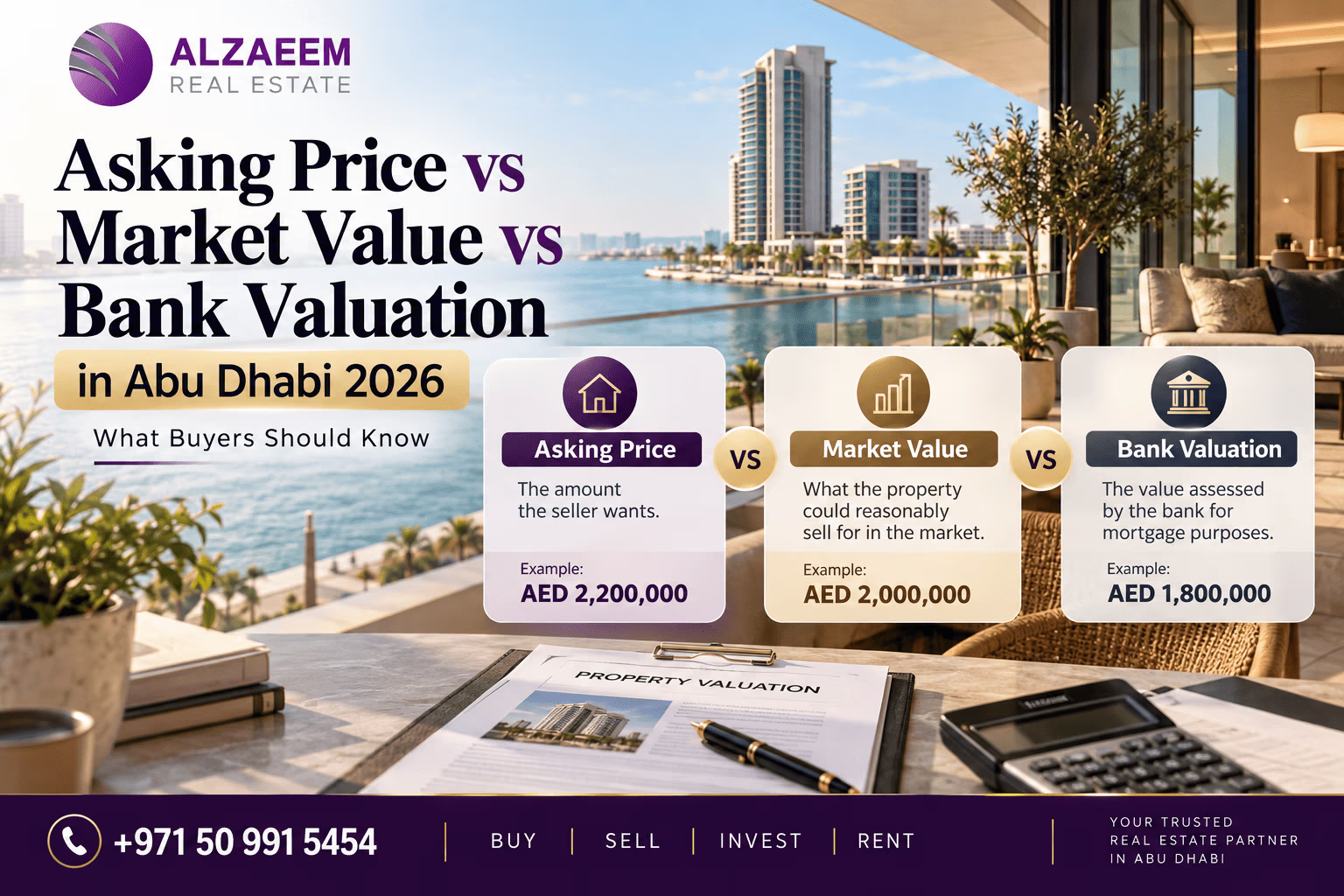
A property can have three different numbers attached to it at the same time:
AED 2.0 million asking price
AED 1.9 million estimated market value
AED 1.8 million bank valuation
All three numbers may be legitimate.
But they do not mean the same thing.
For buyers and investors in Abu Dhabi, understanding this distinction is critical because it can affect:
- negotiation,
- mortgage approval,
- down payment,
- buyer cash requirement,
- investment return,
- resale potential,
- and whether the transaction remains financially sensible.
This matters even more in a fast-moving market.
Abu Dhabi recorded AED 117 billion in total real-estate transactions in H1 2026, with sales accounting for AED 86.1 billion across 16,838 transactions. Residential unit sales alone reached AED 70.4 billion, while repeat-sale prices increased 20% year-on-year for apartments and 12% for villas. Adrec
When prices are moving quickly, the gap between:
seller expectations, market evidence and bank lending value
can become particularly important.
The Three Numbers Explained
1. Asking Price
The asking price is the amount the seller wants.
It may reflect:
- seller expectations,
- recent listings,
- original purchase price,
- desired profit,
- current market sentiment,
- unit quality,
- view,
- floor,
- furnishing,
- urgency,
- or simple negotiation strategy.
An asking price is not proof of value.
It is an offer to the market.
2. Market Value
Market value is an estimate of what the property could reasonably transact for under normal market conditions.
It should reflect evidence such as:
- comparable sales,
- recent transactions,
- project performance,
- unit size,
- floor,
- view,
- condition,
- layout,
- market direction,
- and competing supply.
Market value is therefore an analytical concept.
It is not necessarily the seller’s price.
And it is not necessarily the bank’s value.
3. Bank Valuation
A bank valuation is primarily used by the lender to determine the value of the property securing the mortgage.
This is important because mortgage lending depends on the property’s value as collateral.
CBUAE requires lenders to use prudent loan-to-value practices and take into account risks that may affect the value of the collateral. It also makes clear that regulatory LTV percentages are maximum limits, not guaranteed lending levels. Rulebook
A bank valuation can therefore be:
- equal to the purchase price,
- higher than the purchase price,
- or lower than the purchase price.
The third scenario is the one buyers need to understand most carefully.
Asking Price Is Not Market Value
Consider a seller advertising an apartment for:
AED 2,200,000
That does not mean the apartment is worth AED 2.2 million.
The seller may have:
- priced aggressively,
- included negotiation room,
- anchored against a premium listing,
- relied on outdated market information,
- or attached emotional value to the asset.
The buyer should ask:
What have comparable units actually sold for?
That is much more useful than asking:
What are other owners asking?
Listings and Transactions Are Different
Suppose five units are listed at:
AED 2.1M
AED 2.15M
AED 2.2M
AED 2.25M
AED 2.3M
A buyer may conclude:
“The market value is about AED 2.2M.”
Not necessarily.
If actual comparable transactions have recently closed at:
AED 1.95M
AED 2.0M
AED 2.03M
then the transactional evidence may suggest a substantially lower value.
Listings measure seller expectations.
Completed transactions measure what buyers actually paid.
Market Value Is Not One Perfect Number
Market value should often be thought of as a reasonable range, not an exact point.
For example:
Estimated market value: AED 1.95M–2.05M
Why a range?
Because two units in the same tower can still differ based on:
- view,
- floor,
- orientation,
- balcony,
- layout,
- condition,
- tenancy,
- furnishing,
- parking,
- and seller urgency.
A single exact number can create false precision.
Bank Valuation Has a Different Purpose
The seller wants the strongest possible price.
The buyer wants value.
The bank wants to understand its collateral.
These are different objectives.
A bank valuation is therefore not designed to answer:
“What is the absolute best price this seller could achieve?”
It is used within the lender’s risk and mortgage process.
CBUAE’s mortgage framework specifically requires prudent LTV assessment and notes that collateral value should be appropriately considered against current or emerging risks. Rulebook
That is why the bank can arrive at a more conservative number than the seller.
The Most Important Mortgage Problem: Valuation Shortfall
Suppose:
Purchase price: AED 2,000,000
You expect an 80% mortgage.
You assume:
Mortgage = AED 1,600,000
Cash down payment = AED 400,000
Then the bank values the property at:
AED 1,800,000
If the bank calculates its financing against AED 1.8M rather than your AED 2M purchase price:
80% of AED 1.8M =
AED 1,440,000
Your cash requirement becomes:
AED 560,000
instead of:
AED 400,000
That is an additional:
AED 160,000
before transaction fees.
This is the valuation gap.
Why Buyers Get Caught by Valuation Gaps
Many buyers think:
“The bank gives me 80%, so I only need 20%.”
That is incomplete.
The actual structure depends on:
- the applicable LTV category,
- the bank’s valuation,
- the bank’s credit approval,
- and the purchase price.
CBUAE regulations establish maximum LTVs, including up to 80% for qualifying expatriate first owner-occupied properties at or below AED 5 million, but actual lending remains subject to lender assessment. Rulebook
The buyer should therefore never assume that the maximum regulatory LTV will automatically apply to the agreed purchase price.
A Bigger Valuation Gap Example
Suppose:
Purchase price:
AED 3,000,000
Bank valuation:
AED 2,700,000
Maximum applicable LTV:
80%
Loan based on valuation:
AED 2,160,000
Buyer cash for purchase price:
AED 840,000
If the buyer had expected:
20% of AED 3M = AED 600,000
the shortfall is:
AED 240,000
Again, this is before registration, brokerage, mortgage and other costs.
Why Can Bank Valuation Be Lower?
Several reasons.
1. Recent Comparable Transactions Are Lower
The seller may be asking AED 2.3M.
But recent registered comparable sales may be closer to AED 2.0M.
The bank’s valuer may therefore conclude that the purchase price is aggressive.
2. The Unit Has a High Premium
Perhaps the seller is charging for:
- a high floor,
- premium view,
- corner layout,
- upgraded interior,
- or furnishing.
The bank may not value every premium at the same amount as the seller.
3. Market Prices Have Moved Too Quickly
Abu Dhabi saw strong price movement in H1 2026. ADREC reported repeat-sale price growth of 20% for apartments and 12% for villas year-on-year. Adrec
In fast-moving markets, seller expectations can sometimes move ahead of the transaction evidence available to valuers.
4. Comparables Are Limited
A unique unit may have few directly comparable transactions.
Examples:
- penthouse,
- very high floor,
- rare villa type,
- unusual layout,
- exceptional sea view,
- upgraded unit.
The valuation may then rely on imperfect comparable evidence.
5. Condition Is Different
Two identical layouts can have different values because one may be:
- newly renovated,
- poorly maintained,
- vacant,
- tenanted,
- furnished,
- or heavily worn.
Can Bank Valuation Be Higher Than Purchase Price?
Yes.
Suppose:
Purchase price:
AED 1,700,000
Bank valuation:
AED 1,800,000
This may appear attractive.
But buyers should not automatically assume that the higher valuation means they can borrow against AED 1.8M and extract extra cash.
Mortgage structure depends on bank policy, applicable LTV rules, purchase documentation and credit approval.
The transaction should be modelled using the lender’s actual approved finance amount.
Market Value vs Bank Valuation
These two can be close.
But they do not have to match exactly.
Market Value
Primarily asks:
What is the property reasonably worth in the market?
Bank Valuation
Primarily asks:
What value should the lender use for collateral and mortgage purposes?
A bank’s risk framework may lead to more conservative treatment.
Asking Price vs Market Value
This is primarily a negotiation issue.
If:
Asking price = AED 2.2M
Market evidence = AED 2.0M
the buyer may have a basis to negotiate.
But that does not guarantee the seller will accept.
The seller may:
- wait,
- reject,
- counter,
- or have another buyer.
Market value does not force a seller to sell.
Asking Price vs Bank Valuation
This becomes especially important for financed buyers.
A cash buyer can choose to overpay if they understand and accept the risk.
A mortgage buyer may be constrained by the bank.
If the seller refuses to reduce the price and the bank values the unit lower, the buyer may need to fund the difference with cash.
The Cash Buyer Has More Freedom — But Still Needs Discipline
A cash buyer does not face bank valuation as a financing constraint.
But that does not mean valuation becomes irrelevant.
If a cash buyer pays:
AED 2.3M
for a property reasonably worth:
AED 2.0M
they have effectively started with a:
AED 300,000 value deficit
The market would need to appreciate simply for the buyer to reach the original economic entry point.
Paying Above Market Value Hurts Yield
Suppose annual rent is:
AED 120,000
Buy at AED 2.0M
Gross yield:
6.0%
Buy at AED 2.2M
Gross yield:
5.45%
Buy at AED 2.4M
Gross yield:
5.0%
The property is identical.
Only the entry price changed.
That is why purchase-price discipline matters.
Entry Price Also Affects Capital Appreciation
Assume the property becomes worth:
AED 2.4M after several years.
Buyer A paid AED 2.0M
Gain:
AED 400K
Buyer B paid AED 2.3M
Gain:
AED 100K
Same exit value.
Very different investment outcome.
Negotiation Should Be Evidence-Based
Instead of saying:
“Your price is too high.”
A stronger buyer approach is:
- comparable transaction A,
- comparable transaction B,
- comparable unit currently available,
- price per sq ft comparison,
- floor/view differences,
- condition adjustments,
- current lease status.
This creates a rational negotiation framework.
Price per Sq Ft Can Help — But It Is Not Enough
Suppose:
Unit A:
1,000 sq ft
AED 2,000,000
= AED 2,000 PSF
Unit B:
1,100 sq ft
AED 2,090,000
= AED 1,900 PSF
Unit B looks cheaper.
But perhaps Unit A has:
- full sea view,
- superior layout,
- high floor,
- better balcony,
- premium orientation.
PSF is useful.
It is not the entire valuation.
This is why our future article on Abu Dhabi Property Price per Sq Ft will treat PSF as an analytical tool rather than a standalone answer.
Comparable Sales Need to Be Truly Comparable
A common mistake is comparing:
- 1BR with 2BR,
- low floor with penthouse,
- canal view with internal view,
- renovated with original condition,
- vacant with tenanted,
- new building with older stock.
Good valuation analysis should adjust for meaningful differences.
Same Building Does Not Mean Same Value
Imagine two identical 2BR units.
Unit A
5th floor
road view
tenanted below market
original condition
Unit B
25th floor
sea view
vacant
upgraded interior
Their values can be materially different even though:
- same tower,
- same bedroom count,
- similar BUA.
View Premium Can Be Real
In Abu Dhabi, waterfront and landmark views can carry meaningful premiums.
But the buyer should distinguish between:
a genuine scarce view
and
a seller claiming a premium view
A partial water glimpse may not justify the same premium as an uninterrupted sea view.
Floor Premium Can Be Overpaid
Higher floors can be attractive.
But the premium should still make economic sense.
Suppose:
15th floor = AED 1.8M
35th floor = AED 2.1M
The extra cost is:
AED 300,000
Does the higher floor generate:
- higher rent,
- stronger resale demand,
- better liquidity,
- or enough lifestyle value?
If not, the buyer may be overpaying.
Renovation Cost Is Not Automatically Market Value
A seller may say:
“I spent AED 250,000 renovating this unit.”
That does not mean market value increased by AED 250,000.
Some upgrades generate strong buyer value.
Others are personal taste.
The market decides how much of the renovation cost is recoverable.
Furniture Is Even More Difficult to Value
Furniture depreciates.
A seller may include:
AED 80,000 original furniture cost.
But the buyer may value it at:
AED 30,000
AED 15,000
or zero.
The bank may also treat movable furniture differently from the real-estate asset itself.
This is another reason furnished asking prices need careful decomposition.
Tenancy Can Affect Value
A property rented at a strong market rent can appeal to investors.
A property rented far below market may have weaker investor economics.
In 2026, this is especially relevant because Abu Dhabi temporarily moved tenancy renewals to a 0% annual increase for the duration of the measure. Buyers of tenanted properties therefore need to understand the current registered rent and applicable regulatory position rather than assuming immediate repricing. Adrec
Vacant Possession Can Affect Buyer Demand
A vacant property may appeal to:
- end users,
- investors,
- renovators,
- relocating buyers.
A tenanted unit may appeal more specifically to investors.
This can affect market value depending on the property type and target buyer pool.
Market Momentum Can Distort Asking Prices
Strong markets create optimism.
ADREC reported that residential sales reached AED 70.4 billion in H1 2026, compared with AED 25.3 billion in H1 2025. Off-plan accounted for 89% of sales value and 82% of residential deals. Adrec
In a rapidly rising environment, sellers may anchor to:
- the newest launch price,
- a record transaction,
- a neighbour’s asking price,
- or an aggressive future expectation.
But buyers should still separate:
market momentum
from
unit-specific value.
Off-Plan Pricing Adds Another Layer
Off-plan property often has:
- developer list price,
- launch price,
- current developer price,
- investor resale price,
- future instalment obligations.
This makes value comparison more complicated.
A developer may sell a new unit at AED 2.2M while an earlier investor resells a similar unit at AED 2.05M.
The lower resale price may still require substantially more cash upfront because the original buyer has already paid part of the payment plan.
Therefore:
price
and
cash required today
must be analysed separately.
Developer Price Is Not Automatically Market Value
A developer sets a commercial price.
That price may include:
- launch premium,
- payment-plan value,
- brand premium,
- incentives,
- furnishing,
- post-handover structure.
A secondary buyer should compare the effective economics.
Payment Plan Can Justify Some Price Difference
Consider:
Property A
AED 2.0M cash / ready
Property B
AED 2.15M off-plan with a long post-handover plan
The AED 150,000 price difference may partly represent financing flexibility.
The buyer should compare:
- present cash requirement,
- future instalments,
- financing cost,
- delivery risk,
- and opportunity cost.
Bank Valuation Matters Most for Ready Mortgage Purchases
In ready-property transactions, the bank valuation can directly affect the mortgage amount.
This makes valuation risk particularly important when the buyer has limited spare liquidity.
Before signing a binding commitment, a financed buyer should know:
What happens if the valuation is 5% below the agreed price?
The 5% Valuation Stress Test
Purchase price:
AED 2,000,000
5% lower valuation:
AED 1,900,000
At 80% LTV:
Mortgage:
AED 1,520,000
Buyer purchase equity:
AED 480,000
Expected equity based on AED 2M:
AED 400,000
Additional cash:
AED 80,000
Can you fund it?
If not, valuation risk is material.
The 10% Valuation Stress Test
Purchase price:
AED 2,000,000
10% lower valuation:
AED 1,800,000
80% loan:
AED 1,440,000
Buyer cash:
AED 560,000
Additional requirement:
AED 160,000
This should be modelled before the transaction becomes emotionally or contractually difficult to unwind.
Investment Properties Can Be Even More Sensitive
CBUAE maximum LTV for expatriate investment/subsequent properties is 60%, while the maximum for UAE nationals in that category is 65%. Rulebook
Suppose an expatriate investor buys for:
AED 2M
Bank valuation:
AED 1.8M
At 60% LTV:
Mortgage:
AED 1.08M
Buyer cash toward price:
AED 920K
The investor may have expected:
40% of AED 2M = AED 800K
Valuation shortfall creates another:
AED 120K
cash requirement.
A High Asking Price Can Damage Cash-on-Cash Return
Suppose two investors buy the same type of unit.
Investor A
Purchase price: AED 1.8M
Cash deployed: AED 800K
Annual cash flow: AED 70K
Cash-on-cash return:
8.75%
Investor B
Purchase price: AED 2.0M
Cash deployed: AED 1.0M
Annual cash flow: AED 70K
Cash-on-cash return:
7.0%
Same property economics.
Different acquisition discipline.
How Should Buyers Estimate Market Value?
A practical framework is:
Step 1: Start With Recent Transactions
Look at recent comparable sales.
Prefer:
- same project,
- same building,
- same unit type,
- similar floor,
- similar view,
- recent date.
Step 2: Compare Current Competition
Review competing listings.
But remember:
listings = asking evidence
not transaction evidence.
Step 3: Adjust for Unit Differences
Consider:
- BUA,
- floor,
- view,
- layout,
- balcony,
- parking,
- condition,
- furnishing,
- tenancy,
- upgrades.
Step 4: Analyse PSF
Calculate:
Price ÷ BUA
Use this as a comparison tool.
Do not use it blindly.
Step 5: Check Rental Economics
Ask:
- what is realistic rent?
- what is net yield?
- how much service charge?
- how does price compare with income?
Step 6: Consider Future Supply
ADREC reported approximately 409,000 residential units in Abu Dhabi in H1 2026, with around 71,000 additional units projected through 2030. Adrec
If substantial competing supply is approaching a district, aggressive current asking prices deserve closer scrutiny.
Market Value Should Be Tested Against Rental Value
Suppose:
Price = AED 2.0M
Rent = AED 100K
Gross yield:
5.0%
Comparable properties:
Price = AED 1.7M
Rent = AED 100K
Gross yield:
5.88%
Why is the first unit more expensive?
Possible valid reasons:
- better view,
- newer building,
- stronger resale market,
- better service quality.
Or perhaps it is simply overpriced.
The buyer must investigate.
Price Premium Must Have a Reason
A premium should ideally buy something.
For example:
- superior view,
- superior floor,
- larger BUA,
- better layout,
- rare unit,
- stronger developer,
- exceptional condition,
- better community.
If a unit is 15% more expensive but offers no meaningful advantage, that is a warning sign.
Bank Valuation Is Not an Investment Recommendation
A common mistake is thinking:
“The bank valued it at AED 2M, therefore it is a good investment.”
No.
The bank valuation does not answer:
- whether rental yield is attractive,
- whether service charges are excessive,
- whether future supply is risky,
- whether the buyer overpaid relative to another project,
- whether the exit market is liquid.
It is one data point.
Likewise, a Low Bank Valuation Does Not Automatically Mean a Bad Property
A unique unit may have features that are difficult to capture in comparable data.
The buyer should investigate the reason.
Do not simply assume either:
bank is wrong
or
seller is wrong.
Understand the evidence.
Ask for the Valuation Logic
Where possible through the lender or transaction process, understand:
- comparable evidence,
- valuation date,
- unit details,
- BUA,
- view,
- floor,
- condition.
A factual mistake can materially affect value.
For example:
wrong unit size
wrong bedroom count
wrong project
wrong view classification
should be corrected.
Can a Buyer Challenge a Bank Valuation?
Banks have their own processes.
Depending on lender policy, there may be options such as:
- review,
- reconsideration,
- revised evidence,
- or another valuation.
But buyers should not assume that a bank will change its valuation simply because the agreed purchase price is higher.
Do Not Build the Deal Around a Hopeful Valuation
This is critical.
The wrong approach:
“We’ll agree AED 2.4M and hopefully the bank values it at AED 2.4M.”
The stronger approach:
“If the bank values it at AED 2.2M, can I still complete?”
Stress-test first.
Seller Motivation Can Matter More Than Asking Price
A seller asking AED 2.2M may accept AED 2.0M because they need liquidity.
Another seller asking AED 2.05M may refuse anything below AED 2.04M.
Therefore asking price alone tells you little about the real negotiation range.
Time on Market Is Useful Context
A property listed for many months may indicate:
- price resistance,
- weak demand,
- unusual unit,
- unrealistic seller,
- or poor marketing.
But it can also create negotiation opportunity.
Repeated Price Reductions Are Informative
If a unit moved from:
AED 2.5M
to AED 2.35M
to AED 2.2M
that may reveal the seller’s expectations are adjusting toward the market.
Price history can therefore be useful when available.
Do Not Chase One Record Transaction
Suppose one exceptional unit sold for:
AED 2,500 PSF
That does not automatically mean every unit in the building is worth AED 2,500 PSF.
The sale could have involved:
- penthouse,
- rare corner unit,
- premium view,
- exceptional upgrade.
Use a range of evidence.
Median Can Be More Useful Than Maximum
A buyer should generally understand:
- low end,
- median,
- upper end
of comparable transactions.
One outlier should not control the valuation.
Asking Price Premium Example
Comparable market evidence:
AED 1.9M–2.0M
Seller asks:
AED 2.2M
Premium above upper comparable range:
AED 200K
or approximately:
10%
Buyer should ask:
What specifically justifies that AED 200K?
If there is no compelling answer, negotiate.
Market Value Can Change Quickly
Valuation is time-sensitive.
A transaction from 18 months ago may be less relevant in a rapidly moving market.
Abu Dhabi’s H1 2026 data shows significant year-on-year growth in both transaction activity and prices, meaning recent evidence deserves greater weight than stale comparables. Adrec
Off-Plan Comparables Can Distort Ready-Market Analysis
A new launch at AED 2,300 PSF may include:
- long payment plan,
- new amenities,
- future masterplan premium.
A ready unit at AED 2,000 PSF provides:
- immediate possession,
- immediate rent,
- lower delivery risk.
These are not identical products.
Ready vs Off-Plan Value Should Be Compared Economically
Do not ask only:
Which has lower PSF?
Compare:
- total price,
- payment timing,
- financing,
- rental start date,
- service charges,
- delivery risk,
- capital appreciation potential,
- resale liquidity.
Three Numbers, Three Different Decisions
Asking Price Helps You Understand:
seller expectation
Market Value Helps You Understand:
economic purchase discipline
Bank Valuation Helps You Understand:
financing and collateral
This is the simplest framework to remember.
Practical Example: AED 2.2M Asking Property
Seller asks:
AED 2,200,000
Comparable market range:
AED 2,000,000–2,100,000
Buyer negotiates:
AED 2,080,000
Bank valuation:
AED 2,000,000
Assume qualifying 80% LTV.
Bank loan:
AED 1,600,000
Buyer purchase equity:
AED 480,000
The buyer has negotiated AED 120K below asking.
But still needs more cash than the simple 20% of the agreed price because the bank valuation is lower.
This is exactly why all three numbers matter.
Practical Example: Cash Investor
Asking price:
AED 1.8M
Estimated market value:
AED 1.65M–1.7M
Seller accepts:
AED 1.72M
Cash investor has no bank valuation constraint.
But investor should still decide:
Is paying AED 20K above estimated upper market value justified by:
- rare view,
- tenant income,
- condition,
- strategic location?
If yes, paying slightly above a modelled value may be rational.
Valuation is not an automatic refusal mechanism.
It is decision support.
When Paying Above Market Can Make Sense
Sometimes a buyer knowingly pays a premium.
Possible reasons:
- exact preferred unit,
- rare layout,
- unique waterfront view,
- adjoining property,
- owner-occupier emotional value,
- very long holding period,
- strategic portfolio reason.
But the premium should be conscious.
The worst situation is overpaying without knowing that you are overpaying.
Investor vs End-User Valuation
An investor may focus heavily on:
- yield,
- rent,
- exit liquidity,
- service charges.
An end user may value:
- exact view,
- school proximity,
- floor,
- layout,
- lifestyle.
Therefore two rational buyers can place different values on the same property.
Market value is influenced by both financial and utility demand.
A Property Can Be Fairly Priced but Still Be a Poor Investment
Example:
Market value:
AED 3M
Purchase price:
AED 3M
But rent:
AED 100K
Service charges:
AED 35K
The property may be fairly valued in the market but produce weak income economics for a rental investor.
Fair price does not equal suitable investment.
A Discounted Property Can Still Be Bad
Asking price:
AED 2M
Buyer negotiates to:
AED 1.75M
Sounds excellent.
But what if:
Market value = AED 1.6M?
The buyer received a 12.5% discount from asking and still overpaid.
Always compare with value, not discount percentage.
The “Discount From Asking” Trap
Marketing often highlights:
“AED 300K below asking price.”
That means almost nothing without knowing whether the original asking price was realistic.
A seller can ask AED 2.5M for a AED 2M property and then “discount” AED 300K.
It is still expensive at AED 2.2M.
The Better Metric: Discount or Premium to Market Evidence
Instead calculate:
Agreed Price − Estimated Market Value
If negative:
possible discount.
If positive:
possible premium.
Then understand why.
Buyer Due-Diligence Checklist
Before making an offer, check:
- current asking price,
- seller’s price history,
- recent comparable sales,
- same-building transactions,
- unit PSF,
- comparable PSF,
- BUA,
- floor,
- view,
- layout,
- condition,
- tenancy,
- current rent,
- service charges,
- estimated net yield,
- future supply,
- likely bank valuation,
- financing category,
- available cash,
- valuation shortfall contingency.
Mortgage Buyer Checklist
Before committing:
- Get mortgage pre-approval.
- Understand applicable LTV.
- Estimate conservative bank valuation.
- Stress-test 5% lower valuation.
- Stress-test 10% lower valuation.
- Calculate extra cash required.
- Add transaction fees.
- Keep reserve liquidity.
- Do not assume maximum LTV is guaranteed.
Seller Checklist
Sellers can also benefit from understanding valuation.
Before pricing:
- review recent transactions,
- assess comparable listings,
- understand your unit’s genuine premium,
- consider condition,
- understand tenancy impact,
- price relative to buyer financing realities.
An asking price far above bank valuation ranges can reduce the pool of mortgage buyers.
Abu Dhabi’s 2026 Market Makes Valuation Discipline More Important
Abu Dhabi’s market has experienced strong activity.
H1 2026 total real-estate transactions reached AED 117 billion, while residential sales reached AED 70.4 billion. Repeat-sale apartment prices increased 20% year-on-year and villa prices rose 12%. Adrec
Strong markets can create opportunity.
They can also create:
- optimistic pricing,
- aggressive seller expectations,
- overbidding,
- and financing gaps.
The stronger the market becomes, the more important disciplined valuation can be.
Final Takeaway
The three numbers serve three different purposes:
Asking Price
What the seller wants.
Market Value
What the available evidence suggests the property may reasonably be worth.
Bank Valuation
What the lender is prepared to use within its collateral and mortgage assessment.
A buyer should understand all three before signing.
The most dangerous assumption is:
“If I agree the price, the bank will finance its normal percentage of that price.”
That may not happen.
If the bank valuation comes in lower, the buyer may need significantly more cash.
For investors, the consequences go further.
Overpaying can reduce:
- rental yield,
- cash-on-cash return,
- capital appreciation,
- and exit flexibility.
The objective should therefore be to buy based on evidence, economics and financing reality, not simply on the advertised asking price.
How Al Zaeem Real Estate Can Help
A strong property negotiation requires more than finding a listing.
At Al Zaeem Real Estate, buyers and investors can evaluate Abu Dhabi opportunities by looking at:
- asking price,
- recent comparable evidence,
- property characteristics,
- price per sq ft,
- rental economics,
- financing implications,
- and resale potential.
The aim is not simply to negotiate the biggest nominal discount.
It is to understand whether the final agreed price makes sense for the property, the market and the buyer’s strategy.
Al Zaeem Real Estate
Abu Dhabi, UAE
+971 50 991 5454
BUY | SELL | INVEST | RENT