


A AED 100 billion masterplan can make almost any property inside it sound like a good investment.
That is exactly why investors need to be careful.
Marsa Al Saadiyat has almost every feature capable of generating excitement around premium Abu Dhabi real estate:
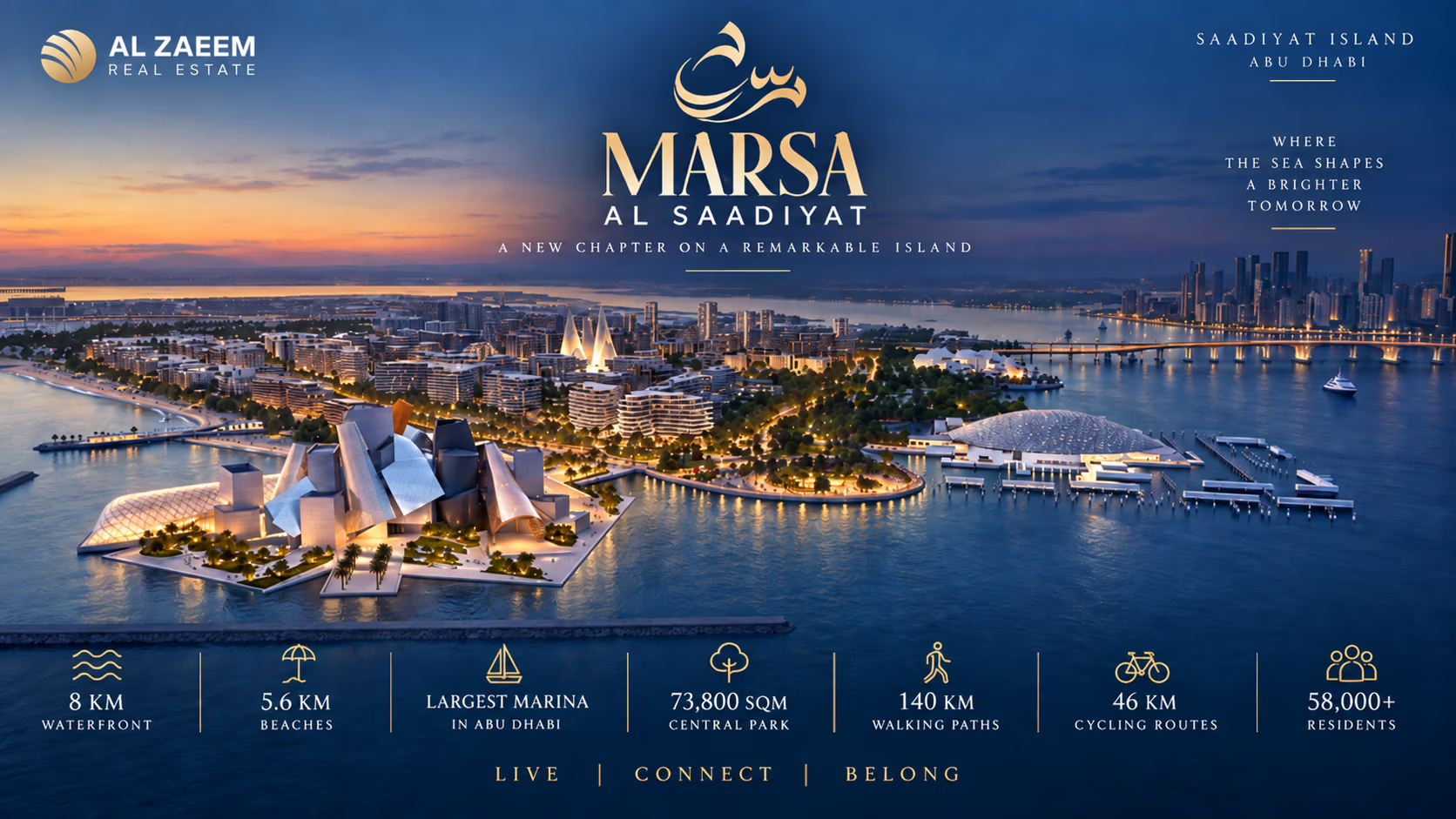
8 kilometres of waterfront.
5.6 kilometres of beaches.
Abu Dhabi’s largest marina.
Luxury villas and mansions.
Waterfront apartments.
Branded residences.
Hotels and restaurants.
Schools and healthcare.
Parks and active-mobility infrastructure.
And a planned underground Etihad Rail high-speed station.
The complete development spans approximately 6.4 million square metres and is planned for more than 58,000 residents. Aldar is the master developer and says it expects to develop AED 60 billion of the AED 100 billion overall pipeline.
Those are impressive fundamentals.
But none of them answers the investor’s most important question:
At the price I am being asked to pay, will my specific Marsa Al Saadiyat property generate an attractive risk-adjusted return?
That distinction is crucial.
Marsa can become one of Abu Dhabi’s most desirable waterfront districts while some individual buyers still overpay.
A villa can be exceptional real estate and still deliver mediocre investment performance.
A waterfront apartment can have a spectacular view and still produce a weak yield if the entry price is too high.
And an early investor can benefit enormously from destination growth—or end up paying today for most of the growth that has not happened yet.
So, is Marsa Al Saadiyat a good investment in 2026?
The answer is:
Potentially very strong — but only if the individual property, price and holding strategy are right.
Quick Answer: Should You Invest in Marsa Al Saadiyat?
At masterplan level, Marsa Al Saadiyat has a compelling long-term investment case.
Its strongest fundamentals are:
- an established premium Saadiyat Island location;
- 8 km of waterfront;
- 5.6 km of beaches;
- a major marina;
- Aldar as master developer;
- direct connection to Saadiyat Cultural District;
- extensive planned family infrastructure;
- strong international buyer appeal;
- significant future transport investment;
- and a large enough population to support a functioning mixed-use district rather than a seasonal luxury enclave.
The investment risks are equally important:
- individual launch pricing is not yet known across much of the masterplan;
- Saadiyat is one of Abu Dhabi’s principal future supply districts;
- Marsa will take years to mature;
- many infrastructure benefits are still planned rather than operational;
- luxury waterfront property can carry substantial launch premiums;
- and later Marsa releases could compete directly with earlier buyers.
The best investor is therefore unlikely to be the person who simply says:
“Marsa will be huge, so I’ll buy anything.”
The better strategy is:
Buy the property within Marsa whose location, scarcity and future demand justify its exact price.
Marsa Al Saadiyat Investment Case at a Glance
| Investment Factor | Assessment |
|---|---|
| Location | Very strong |
| Master developer | Strong — Aldar |
| Scale | Exceptional — AED 100B GDV |
| Waterfront scarcity | Strong |
| Family infrastructure | Strong |
| International appeal | Strong |
| Existing Saadiyat market depth | Strong |
| Current project-level pricing visibility | Limited |
| Immediate rental income | Depends on individual future launches |
| Future supply risk | Material |
| Infrastructure delivery risk | Moderate / long-term |
| Resale potential | Potentially strong for prime units |
| Best investment horizon | Medium to long term |
| Main risk | Overpaying for the masterplan story |
Why Marsa’s Location Is So Powerful
Marsa is not creating a premium property market from nothing.
It is being built on Saadiyat Island, one of Abu Dhabi’s most established luxury, cultural and residential destinations.
That matters enormously.
A completely new masterplan typically needs years to establish:
brand recognition;
resident demand;
schools;
hospitality;
retail;
transport connections;
and international buyer confidence.
Marsa already sits alongside an island ecosystem containing major cultural institutions, high-end residential communities, beaches, hotels, schools and universities.
ADREC reported that Saadiyat Island recorded AED 13.3 billion of residential sales during H1 2026, making it one of Abu Dhabi’s largest residential transaction districts.
This gives Marsa a fundamental advantage:
the destination already has demand before Marsa is fully built.
Saadiyat Is Already an International Property Brand
Many overseas investors may not know every Abu Dhabi community.
But Saadiyat is increasingly easy to understand internationally.
Its identity is associated with:
Louvre Abu Dhabi;
Zayed National Museum;
Natural History Museum Abu Dhabi;
teamLab Phenomena;
Guggenheim Abu Dhabi;
premium beaches;
luxury resorts;
education;
and high-end residential property.
Abu Dhabi’s Cultural District already functions as a major cultural destination rather than merely a future masterplan promise.
That international recognition can help future Marsa owners because property liquidity ultimately depends on:
how many future buyers understand why your location matters.
Abu Dhabi’s Foreign-Buyer Market Is Expanding Rapidly
The wider emirate is also becoming increasingly international.
ADREC reported AED 117 billion in total real-estate transactions during H1 2026, with foreign direct investment reaching AED 13.8 billion from non-resident investors representing 116 nationalities.
In the residential market specifically, resident expatriates and non-resident foreign buyers together accounted for 70% of sales value in H1 2026.
This matters for Marsa because premium waterfront real estate often depends on a larger buyer universe than:
local end users alone.
A globally understandable combination of:
beach;
marina;
culture;
luxury hospitality;
and modern infrastructure
can attract buyers across different nationalities and investment motivations.
Waterfront Scarcity Is the Core Investment Thesis
Marsa’s strongest physical investment feature is probably its:
8 kilometres of waterfront.
The masterplan includes approximately:
5.6 kilometres of beaches
along with Abu Dhabi’s largest marina and substantial waterfront residential frontage.
Waterfront property has several characteristics investors value.
It is:
visually desirable;
physically limited;
internationally understandable;
difficult to replicate;
and often attractive to both tenants and owner-occupiers.
But investors should be precise.
Marsa has:
8 kilometres of waterfront.
That does not mean:
every Marsa residence is waterfront.
Over time, a hierarchy will almost certainly develop between:
direct beach;
marina frontage;
promenade;
park frontage;
elevated villas;
and internal residential streets.
That hierarchy will affect:
price;
rent;
resale;
and appreciation.
The Best Marsa Properties May Be Defined by Permanent Scarcity
Consider two future Marsa apartments.
Apartment A overlooks:
the marina directly.
Apartment B overlooks:
another residential building.
Both belong to:
Marsa Al Saadiyat.
The project name is identical.
The investment may not be.
Similarly, one villa may sit:
directly against beach frontage.
Another could be:
several streets inland.
The strongest investment assets are likely to possess physical features that cannot easily be reproduced later.
Examples may include:
protected waterfront exposure;
large plots;
corner plots;
park frontage;
elevation;
exceptional orientation;
or rare architecture.
Those are:
permanent advantages.
Pay for Scarcity — But Calculate the Premium
Waterfront buyers often make one mistake:
they correctly identify a scarce asset,
then:
pay too much for it.
Suppose a marina-facing apartment eventually launches at:
20% more
than a comparable internal residence.
That premium could be completely reasonable.
Now suppose the premium is:
50%.
The investment analysis changes.
Ask:
Can the marina-facing unit realistically command enough:
additional rent;
resale premium;
or owner-use value
to justify the extra capital?
This is the same principle applied in our broader Abu Dhabi Property Price per Sq Ft analysis:
a better property can justify a premium, but the premium itself still needs to be valued.
Abu Dhabi’s Largest Marina Could Become a Major Value Anchor
The official masterplan includes a marina capable of accommodating up to 350 boats and luxury yachts.
A successful marina can do much more than serve boat owners.
It can support:
restaurants;
hospitality;
waterfront retail;
evening activity;
tourism;
events;
and a premium public realm.
From an investment perspective, that matters because residents may value:
living near the marina
even if they never own a yacht.
This is how waterfront infrastructure can influence a wider residential market.
Marina Property Is Usually Highly Visual
Real estate is partly analytical.
It is also emotional.
When someone walks into a residence and sees:
water;
yachts;
sunset;
promenade;
or beach,
that emotional reaction can influence:
rent;
resale;
and the speed at which a property attracts buyers.
This can give the best Marsa properties a strong advantage over homes whose investment story depends mostly on:
spreadsheet metrics.
But investors should remember:
the strongest emotional assets frequently attract:
the highest launch prices.
The 5.6 km Beach Network Adds Another Demand Layer
The planned 5.6 kilometres of beaches gives Marsa a lifestyle proposition beyond the marina itself.
This matters because different buyers value waterfront differently.
One buyer wants:
marina activity.
Another wants:
quiet beach.
Another wants:
family recreation.
Another wants:
open sea views.
By combining several waterfront experiences, Marsa can potentially broaden its buyer and tenant pool.
That diversity can strengthen long-term demand.
Marsa Is Designed for 58,000+ Residents
The masterplan is planned to accommodate more than:
58,000 residents.
This is important for investment analysis.
Marsa is not being designed as:
a small exclusive resort with a few hundred homes.
It is essentially:
a new urban district.
A population of that scale can support:
retail;
restaurants;
schools;
healthcare;
services;
hospitality;
and employment-related activity.
That helps create a year-round economy around the residences.
But 58,000 Residents Also Mean a Lot of Housing
The same statistic creates a risk.
A district designed for 58,000 people necessarily requires:
significant residential inventory.
So the Marsa investment thesis should not be:
“There will be hardly any property.”
There will eventually be:
substantial property.
The scarcity will exist at a more detailed level.
Scarcity may attach to:
front-row plots;
signature views;
particular architecture;
specific buildings;
branded residences;
or rare villa categories.
The masterplan itself will be large.
Marsa Is Part of Abu Dhabi’s Future Supply Pipeline
This is one of the most important investor considerations.
ADREC projects around 71,000 additional residential units across Abu Dhabi through 2030, with deliveries expected to peak at approximately 21,800 units in 2028.
Six key districts are expected to account for 77% of projected incremental supply, and Saadiyat Island is one of them.
This means Marsa’s investment story includes two forces working simultaneously:
Force 1 — Destination growth
More:
residents;
infrastructure;
hotels;
retail;
culture;
schools;
and transport.
Force 2 — Property competition
More:
apartments;
villas;
branded residences;
and alternatives
for future tenants and buyers.
The investor needs to benefit from the first without becoming vulnerable to the second.
Supply Is Not Automatically a Negative
A large property pipeline is sometimes treated as automatically bearish.
That is too simplistic.
Imagine Marsa today with:
almost no residents;
few shops;
no marina activity;
limited schools;
and no internal hospitality.
Now imagine it after tens of thousands of residents arrive.
The destination becomes:
more useful;
more active;
more recognisable;
and potentially more valuable.
Supply creates:
community maturity.
The problem only appears when:
supply materially exceeds demand
or:
too many similar units compete for the same buyer.
That is why individual property selection matters.
Buy Something Future Supply Cannot Easily Replace
This may be the strongest Marsa investment principle.
If thousands of homes will eventually be built, your property should ideally have something:
the next phase cannot easily copy.
For example:
a direct marina view;
beach frontage;
unique elevation;
a large private plot;
a distinctive branded position;
or an exceptional location beside a major park.
The more generic the property:
the more directly it competes with later releases.
The Aldar Factor
Aldar is not a small developer entering Saadiyat for the first time.
It is the master developer of Marsa and one of the dominant real-estate companies in Abu Dhabi.
Aldar confirmed that it expects to develop AED 60 billion of the AED 100 billion Marsa pipeline.
The company also reported AED 37.1 billion of liquidity during H1 2026, including AED 16.8 billion of unrestricted cash and AED 20.3 billion of committed undrawn bank facilities.
For an investor buying into a multi-year masterplan, developer capability matters because execution depends on far more than constructing individual homes.
It includes:
infrastructure;
public realm;
roads;
landscaping;
retail;
community assets;
and coordination between phases.
Masterplan Execution Matters More Than the First Villa
Imagine the first residential development is excellent.
But:
roads are delayed;
retail is missing;
public spaces are unfinished;
and surrounding plots remain construction sites for years.
The property may still perform.
But the investor is not yet receiving the full value of:
Marsa.
The long-term return therefore depends partly on:
Aldar successfully building the destination around the property.
This is one reason master developer quality matters.
The Long Development Horizon Is Both Risk and Opportunity
Marsa will not mature overnight.
Official site enabling and infrastructure work was scheduled to begin from Q3 2026, with initial residential launches commencing during H2 2026.
That means early investors may experience:
years of construction;
progressive amenity delivery;
new project launches;
and changing neighbourhood conditions.
For a buyer expecting:
immediate mature-community living,
that can be a disadvantage.
For a patient investor:
it can create the opportunity to enter before the destination reaches full maturity.
Early Entry Only Works if Early Pricing Is Sensible
“Buy early” is common property advice.
It is incomplete.
You should buy early when:
the early price adequately compensates you for waiting.
If developers already price Phase 1 as though:
the marina;
rail;
parks;
hotels;
retail;
and entire waterfront
are fully mature,
the investor may be paying for future benefits before receiving them.
The ideal early investment offers:
some discount
for accepting:
construction and maturity risk.
The Masterplan Premium
Marsa will naturally carry a premium because of:
the scale;
Saadiyat branding;
waterfront;
Aldar;
and future infrastructure.
The investor should therefore calculate a masterplan premium.
Compare future Marsa launches with:
existing Saadiyat Island property;
other waterfront Abu Dhabi communities;
ready villas;
ready apartments;
and other new off-plan projects.
Then ask:
How much extra am I paying specifically because this is Marsa?
Once that number becomes visible, you can decide whether:
the premium is justified.
Marsa vs Existing Saadiyat Property
Existing Saadiyat property has several advantages.
You can often evaluate:
actual building;
actual view;
actual service charges;
actual tenant demand;
current resale market;
and current rental income.
Marsa offers something different:
newer property;
future infrastructure;
new waterfront communities;
and the possibility of capital appreciation as the destination develops.
This is essentially:
certainty versus future potential.
Neither automatically wins.
A Ready Saadiyat Property Can Produce Income Today
Suppose two properties eventually cost:
AED 5 million.
Ready Saadiyat property
Can potentially produce:
rent now.
Marsa off-plan property
May produce:
no ordinary residential rent until completion.
The Marsa investor therefore needs:
future appreciation;
strong eventual rental economics;
or substantial lifestyle value
to compensate for the waiting period.
This is why the distinction between off-plan and ready property matters.
Do Not Ignore Opportunity Cost
Suppose you deploy:
AED 2 million
into construction payments over several years.
That capital could alternatively be used in:
another property;
business;
financial assets;
or income-producing real estate.
Therefore, the investment return from Marsa should eventually be compared against:
what your capital could have earned elsewhere.
A property can appreciate and still underperform an alternative.
The Payment Plan Will Be Critical
Marsa is a masterplan, not one sales release.
There is no universal payment plan that should be assumed for all future:
apartments;
villas;
mansions;
or branded residences.
Each launch needs to be assessed independently.
A payment plan can materially change the economics.
For example:
a 40/60 structure;
50/50 structure;
or 70/30 structure
all produce different capital timing.
The methodology in our Abu Dhabi Off-Plan Payment Plans Guide becomes particularly useful here.
Good Payment Plan Does Not Mean Good Investment
Suppose Project A offers:
10% down
and a very attractive post-handover structure.
Project B requires:
more capital upfront.
Investors may automatically prefer:
Project A.
But if Project A is:
20% overpriced,
the payment convenience may not compensate.
Always separate:
price
from:
payment timing.
Both matter.
Villa Investment at Marsa
Villas could become one of Marsa’s strongest residential asset classes.
Why?
Because family-focused villa communities can benefit from:
long holding periods;
owner occupation;
larger household demand;
school proximity;
and limited comparable plots.
Talay, announced as the first residential address at Marsa, already signals a strong family-villa component to the masterplan.
For villa buyers, the most important variables will likely include:
plot;
privacy;
orientation;
park/beach access;
bedroom configuration;
parking;
and future neighbouring development.
Plot Quality May Matter More Than Built-Up Area
Villa investors often focus on:
square feet.
But a slightly smaller villa on:
a superior plot
can outperform a larger home with:
poor orientation;
limited privacy;
or awkward road exposure.
In a premium waterfront masterplan, analyse:
distance from water;
corner positioning;
open space;
plot depth;
sun exposure;
and future obstruction.
Land cannot be renovated later.
Family Infrastructure Supports Villa Demand
Marsa is planned with:
three schools;
healthcare;
parks;
play areas;
community clubs;
walking routes;
and cycling infrastructure.
Those features matter enormously to:
full-time families.
A villa district becomes more investable when buyers can realistically:
live there
rather than merely:
own a beautiful house there.
Apartment Investment at Marsa
Future Marsa apartments may attract a different investor profile.
They could appeal to:
international investors;
professional residents;
second-home buyers;
couples;
and tenants seeking marina or waterfront living.
Compared with villas, apartments may offer:
lower absolute entry;
simpler maintenance;
greater rental turnover;
and potentially deeper investor liquidity.
But the investment will depend heavily on:
service charges.
Service Charges Could Be a Major Variable
Waterfront apartment communities often include:
pools;
gyms;
landscaping;
concierge;
security;
marina infrastructure;
and elaborate common areas.
These amenities can justify:
premium rent.
They also cost money to maintain.
A future Marsa apartment with:
AED 250,000 annual rent
can produce very different net returns depending on whether annual ownership expenses are:
AED 30,000
or:
AED 80,000.
This is why our Abu Dhabi Property ROI Calculator 2026 focuses on net economics rather than headline rent.
Branded Residences Could Be Highly Desirable — and Expensive
The official masterplan includes branded residences.
Branded property can attract:
international buyers;
wealth preservation;
prestige buyers;
second-home owners;
and luxury end users.
But branded residences often come with:
a substantial acquisition premium.
An investor should therefore ask:
Is the brand creating enough additional value to justify its premium?
That value might appear through:
resale;
services;
quality;
or global buyer recognition.
But it should be calculated.
Mansion Investment Is a Different Asset Class
Private mansions are also planned within Marsa.
These properties should not be analysed primarily through:
rental yield.
The investment thesis may revolve around:
land scarcity;
privacy;
trophy ownership;
wealth preservation;
and ultra-high-net-worth buyer demand.
A mansion yielding:
3%
could still perform strongly through:
land appreciation.
An apartment yielding:
3%
might be relatively unattractive.
Asset class matters.
The Planned Elevated Villa District Could Be Interesting
The Marsa masterplan includes elevated residential areas rather than only flat waterfront development.
Elevation in Abu Dhabi can create:
longer sightlines;
privacy;
and broader water views.
A villa without direct beachfront may therefore still have:
an exceptional visual position.
Investors should avoid assuming:
front-row water is always best.
A superior elevated view at a materially lower price could produce:
better value.
The Central Park Could Create Another Premium Zone
Water receives most attention in waterfront marketing.
But Marsa is also designed with major landscaped public spaces.
For families, a property overlooking:
green space
can sometimes be more practical than direct marina frontage.
Park-side living may provide:
quiet;
walking access;
children’s recreation;
and daily usability.
If future Marsa park-front units launch at a meaningful discount to waterfront equivalents, they could deserve serious investor attention.
Walkability Can Support Rental Demand
The masterplan includes roughly 140 kilometres of interconnected walking paths and a 46-kilometre cycling network.
These are not merely lifestyle statistics.
A genuinely walkable community can:
reduce car dependence;
increase public-space activity;
support retail;
and make the district more attractive to international residents accustomed to pedestrian environments.
Long-term rental demand often depends on:
how enjoyable daily life actually is.
The Etihad Rail Station Could Become a Major Long-Term Catalyst
Marsa is planned to include an underground Etihad Rail high-speed station connecting it more effectively with the wider UAE.
If delivered as planned, this could strengthen:
business travel;
tourism;
commuting;
and connectivity.
From an investment perspective, infrastructure of this scale can materially improve a location’s accessibility.
However:
planned is not operating.
Investors should not treat future infrastructure as though its full value is already available today.
Buy the Existing Fundamentals; Treat Future Rail as Upside
This is the safer framework.
Would you still buy Marsa if:
the rail station takes longer than expected?
If yes:
good.
Then rail is:
additional upside.
If your entire investment case collapses without the station:
the position is too dependent on one future assumption.
The same applies to:
hotels;
retail;
and later phases.
Road and Tunnel Connectivity Also Matter
The official masterplan includes new integrated roads and tunnels linking Marsa more effectively toward Reem Island and Umm Yifeenah Island.
For a premium island destination, road connectivity matters almost as much as the lifestyle itself.
A beautiful community with:
poor daily access
can lose tenant and end-user appeal.
Infrastructure that reduces travel friction can deepen:
full-time residential demand.
Marsa’s Investment Story Is Bigger Than Tourism
It would be a mistake to analyse Marsa only as:
a holiday or leisure destination.
The masterplan is being designed for:
tens of thousands of permanent residents.
That is why it includes:
schools;
healthcare;
parks;
family facilities;
and transport.
The strongest long-term investment story is therefore not:
“tourists will come.”
It is:
people will actually live there.
Full-time resident demand is usually much more durable than seasonal visitor demand.
Tourism Still Adds Another Layer
At the same time, Marsa’s proximity to:
beaches;
marina;
hotels;
Cultural District;
and major attractions
can strengthen tourism-related demand.
That can support:
hospitality;
retail;
restaurants;
and potentially some segments of short-term accommodation if legally permitted under the applicable framework.
This diversified demand base can improve the destination’s economic depth.
Rental Demand Could Be Strong — But Yield Is Unknown
It is far too early to responsibly claim:
“Marsa will yield 7%.”
There is no single Marsa property product.
There are no mature rental histories across the future neighbourhood.
And exact future purchase prices are not yet available across the masterplan.
The correct approach is scenario analysis.
Example: Future Apartment Yield Scenarios
Suppose, purely for illustration, a future Marsa apartment costs:
AED 4 million.
Potential future rents:
| Annual Rent | Gross Yield |
|---|---|
| AED 180,000 | 4.5% |
| AED 200,000 | 5.0% |
| AED 240,000 | 6.0% |
| AED 280,000 | 7.0% |
These are not Marsa rental forecasts.
They simply show the rent required to generate different yields at that purchase price.
Then deduct:
service charges;
maintenance;
vacancy;
management;
and financing.
The net yield will be lower.
Example: Waterfront Premium
Imagine:
internal apartment:
AED 4M.
Marina-facing apartment:
AED 4.8M.
Premium:
AED 800,000
or:
20%.
Now suppose annual rent is:
AED 220,000 internally
and:
AED 250,000 marina-facing.
Rent premium:
approximately:
13.6%.
The marina unit earns more rent.
But the internal apartment could produce the stronger yield.
The marina unit may still win through:
capital appreciation;
resale;
or personal value.
This is why:
best property and best yield are not necessarily the same property.
Capital Appreciation Is Likely to Be Central to the Marsa Thesis
Many early buyers will probably expect appreciation as:
infrastructure develops;
residential phases launch;
population grows;
and Marsa becomes operational.
That expectation is logical.
It is not guaranteed.
ADREC’s current market data is strong: Abu Dhabi repeat-sale apartment prices increased 20% year-on-year, while villas rose 12% in H1 2026.
But today’s growth should not simply be extrapolated into:
2030;
2035;
or Marsa-specific future performance.
Strong Markets Can Produce Weak Entry Prices
This is worth repeating.
Abu Dhabi residential sales surged to:
AED 70.4 billion in H1 2026
from:
AED 25.3 billion in H1 2025.
Off-plan represented:
89% of residential sales value.
That is extraordinary momentum.
But investment markets often become most dangerous when buyers assume:
recent growth
means:
automatic future growth.
The stronger the launch demand:
the more carefully price should be scrutinised.
The Flat-Market Test
When Marsa launches a property you like, ask:
Would I still want this property if it is worth roughly what I paid at handover?
If yes because:
you can hold;
rent it;
use it;
and believe in its long-term fundamentals,
the investment is more resilient.
If no because your entire plan requires:
selling at +20% before handover,
you are taking a much more speculative position.
The 10% Decline Test
Now go further.
Suppose your future Marsa property is worth:
10% less
than the purchase price at handover.
Can you:
complete?
hold?
rent?
avoid distressed selling?
If yes:
you have resilience.
If no:
the property may be too large relative to your balance sheet.
Mortgage Buyers Need Even More Caution
An investor may plan:
“I’m paying instalments now and I’ll mortgage the balance later.”
That can be reasonable.
But future mortgage approval depends on:
income;
debt;
bank policy;
interest rates;
and property valuation.
No buyer should assume:
the bank will fund exactly the amount required.
Bank Valuation Risk
Suppose a future Marsa property costs:
AED 5M.
At handover:
the bank values it at AED 4.5M.
If the mortgage is calculated using the lower valuation:
the buyer may need:
more equity.
This is why the principles in our Abu Dhabi Property Cash vs Mortgage Guide 2026 become important.
A mortgage preserves capital.
It also introduces:
valuation and financing risk.
International Investors Need Currency Planning
Marsa may attract buyers whose wealth is held in:
GBP;
EUR;
USD;
INR;
PKR;
RMB;
or other currencies.
The purchase is denominated in:
AED.
Changes in exchange rates can alter the buyer’s effective acquisition cost.
An investor funding a multi-year payment schedule should therefore consider:
currency exposure
rather than assuming today’s exchange relationship remains constant throughout construction.
Marsa Could Work Well in a Diversified Abu Dhabi Portfolio
For an investor who already owns:
a ready apartment on Reem;
a villa on Yas;
or an income property elsewhere,
Marsa can potentially provide:
premium waterfront growth exposure.
That can be useful.
But for an investor whose entire portfolio already consists of:
Saadiyat;
premium off-plan;
and luxury residential property,
another Marsa purchase may increase concentration.
Our Abu Dhabi Property Portfolio Strategy 2026 explains why multiple properties can still represent the same underlying risk.
Do Not Confuse Multiple Properties With Diversification
Imagine you own:
a Saadiyat Cultural District apartment;
another Saadiyat apartment;
a Marsa villa;
and a Marsa branded residence.
Four properties.
But all depend heavily on:
Saadiyat premium demand;
wealthy buyers;
Abu Dhabi luxury cycles;
and international investor activity.
That is:
asset diversification.
It may not be:
risk diversification.
Which Investor Is Marsa Best For?
Marsa may be especially attractive to someone who:
has a medium- or long-term investment horizon;
can comfortably meet future payments;
does not require immediate rental income;
wants premium Abu Dhabi waterfront exposure;
understands off-plan risk;
and can be selective about the individual property.
It may also suit:
end users
who value lifestyle highly enough that financial return is only one part of the decision.
Who Should Be More Cautious?
Be more careful if:
you need immediate income;
you are stretching financially to secure the initial payment;
you plan to fund later instalments by selling the property;
your strategy depends on rapid appreciation;
you already have heavy Saadiyat concentration;
or:
you are buying only because Marsa is “the next big thing.”
A good property should survive:
less exciting assumptions.
The First-Mover Advantage Is Not Guaranteed
Early phases can benefit from:
lower prices;
better selection;
and future destination maturity.
Later phases can benefit from:
better infrastructure;
greater certainty;
and lessons learned from earlier developments.
So there is no universal rule that:
Phase 1 always wins.
The investor needs to compare:
early discount versus early uncertainty.
Later Buyers May Pay More — But Know More
Suppose a buyer enters Marsa in:
They accept:
construction risk;
masterplan maturity risk;
and uncertain future comparables.
A buyer entering in:
2030
may pay more.
But they may be able to see:
marina;
roads;
retail;
schools;
actual views;
and transaction evidence.
That information has value.
Early buyers should ideally be compensated for the uncertainty through:
better pricing.
The Marsa Investment Scorecard
Before buying any future Marsa property, score it from 1 to 5.
| Factor | Score 1–5 |
|---|---|
| Exact masterplan position | |
| Waterfront / park / marina exposure | |
| View protection | |
| Purchase price | |
| Price vs existing Saadiyat | |
| Price vs competing Marsa releases | |
| Unit / villa / plot quality | |
| Scarcity | |
| Payment-plan strength | |
| Handover timing | |
| Future rental potential | |
| Service-charge risk | |
| Future competing supply | |
| Family/end-user demand | |
| International buyer appeal | |
| Connectivity | |
| Infrastructure dependence | |
| Portfolio fit | |
| Holding-period resilience | |
| Overall investment conviction |
This is an Al Zaeem analytical framework, not an Aldar or ADREC methodology.
The point is to stop the buyer from scoring:
the masterplan
instead of:
the property.
20 Questions Before Investing in Marsa Al Saadiyat
- Which exact Marsa project am I buying?
- What is the exact price?
- What is the relevant price per square foot?
- If it is a villa, what is the plot size?
- What exactly does the property overlook?
- Can that view be obstructed?
- How far is it from the marina or beach?
- Is it near or far from future commercial activity?
- What is the complete payment schedule?
- When is handover?
- What surrounding construction may still remain at handover?
- What future Marsa projects will compete with it?
- What current Saadiyat property can I buy for similar money?
- What rent would be required to produce my target yield?
- What service charges or operating costs should I model?
- Who is the likely tenant?
- Who is the likely resale buyer?
- How long can I comfortably hold?
- Can I complete if the market is flat or weaker?
- Would I still buy this exact property without assuming appreciation?
If you cannot answer number 20:
your investment case may depend too heavily on:
future price growth.
Frequently Asked Questions
Is Marsa Al Saadiyat a good investment?
Potentially. The masterplan has strong fundamentals including premium waterfront, Aldar development, major infrastructure, an established Saadiyat buyer market and significant international appeal. Individual investment quality will depend on the exact property and purchase price.
How much is Marsa Al Saadiyat worth as a development?
The complete masterplan has an announced gross development value of AED 100 billion.
How large is Marsa Al Saadiyat?
Approximately 6.4 million square metres.
How much waterfront does it have?
Approximately 8 kilometres, including around 5.6 kilometres of beaches.
Will Marsa have a marina?
Yes. The masterplan includes Abu Dhabi’s largest marina, planned for up to 350 boats and luxury yachts.
How many residents are planned?
More than 58,000 residents.
Who is developing Marsa Al Saadiyat?
Aldar is the master developer. It has stated that it expects to develop AED 60 billion of the AED 100 billion overall pipeline.
Is Marsa the final phase of Saadiyat Island?
Aldar describes Marsa as activating the final phase of the Saadiyat Island masterplan.
What property types will be available?
Official plans include apartments, luxury villas, private mansions, branded residences and elevated villa communities.
Will Marsa have schools?
Yes. The official masterplan includes three schools as well as other family infrastructure.
Will Marsa connect to Etihad Rail?
A planned underground Etihad Rail high-speed station forms part of the masterplan.
Is the rail station already operating?
No. It is planned future infrastructure.
Is waterfront property always the best Marsa investment?
No. Waterfront can justify a premium, but the price of that premium must be compared with rent, resale potential and alternative properties.
Will Marsa property appreciate?
It may, particularly if the destination matures successfully, but no specific appreciation rate can be guaranteed.
What rental yield will Marsa provide?
It is too early to state a project-wide yield. Marsa will contain several property types with different purchase prices, operating costs and tenant markets.
Is Marsa better for villas or apartments?
Neither is automatically better. Villas may benefit more from family and land scarcity; apartments may offer lower ticket sizes and broader rental liquidity.
Is Marsa better than existing Saadiyat property?
Marsa offers future masterplan growth and new inventory. Existing Saadiyat property offers more immediate certainty, physical inspection and potential current rental income.
Is future supply a risk?
Yes. Saadiyat is one of the principal districts driving Abu Dhabi’s residential supply expansion through 2030.
Does that mean Saadiyat will be oversupplied?
Not necessarily. Supply needs to be evaluated against population, international demand, employment, tourism and destination growth.
What is Marsa’s strongest investment advantage?
Probably the combination of waterfront scarcity, established Saadiyat demand and large-scale future infrastructure.
What is the biggest investment risk?
Paying too much today because the completed AED 100 billion masterplan looks compelling tomorrow.
Final Takeaway
Marsa Al Saadiyat has a powerful investment story.
It combines:
an AED 100 billion masterplan;
6.4 million square metres;
8 kilometres of waterfront;
5.6 kilometres of beaches;
Abu Dhabi’s largest marina;
58,000+ future residents;
parks and active-mobility infrastructure;
schools and healthcare;
luxury hotels and dining;
Saadiyat Cultural District connectivity;
and:
future high-speed rail infrastructure.
It also enters an exceptionally active property market.
Abu Dhabi recorded AED 117 billion in total real-estate transactions in H1 2026. Residential unit sales reached AED 70.4 billion, while Saadiyat Island alone accounted for AED 13.3 billion. International and expatriate buyers are now responsible for a substantial majority of residential sales value.
Those are strong foundations.
But Marsa is also being launched during a period of intense optimism.
That creates the possibility of:
premium pricing.
The masterplan can succeed brilliantly while an individual buyer still achieves an average return because they paid too much.
That is why the investment decision needs to move from:
Marsa Al Saadiyat
to:
exact property.
You need to know:
where it sits;
what it overlooks;
what cannot be built in front of it;
how scarce it is;
what future properties compete with it;
what the payment plan costs your liquidity;
what rent would be required;
who will eventually buy it;
and how long you can comfortably hold.
If those fundamentals work:
Marsa could become an excellent long-term Abu Dhabi investment.
If they do not:
a AED 100 billion masterplan cannot fix a poor entry price.
So the real answer to:
“Is Marsa Al Saadiyat a good investment?”
is:
Marsa is a strong investment destination. The individual property still has to earn the right to be called a good investment.
Al Zaeem Real Estate — Buy Marsa for the Property, Not Just the Masterplan
Marsa Al Saadiyat is likely to produce very different opportunities across:
villas;
apartments;
waterfront residences;
branded homes;
and premium land positions.
Al Zaeem Real Estate helps investors compare those opportunities through:
entry price;
masterplan position;
waterfront exposure;
plot or unit efficiency;
future supply;
rental economics;
payment structure;
resale demand;
and long-term portfolio fit.
Explore the wider Saadiyat Island property market, current Abu Dhabi off-plan properties, villas for sale and apartments for sale.
The goal is not simply:
“Buy Marsa early.”
It is:
buy the Marsa property whose advantages should still matter after the masterplan is no longer new.
Al Zaeem Real Estate
+971 (50) 991 5454
azcb.co
Primary Official Sources
The Marsa Al Saadiyat masterplan figures used in this analysis—including the AED 100 billion GDV, 6.4 million sq m area, 8 km waterfront, 5.6 km beaches, 58,000+ planned residents, marina, walking and cycling infrastructure, residential mix, road connections and planned Etihad Rail station—are based on the official Abu Dhabi Government launch announcement.
Aldar’s H1 2026 financial results confirm that Marsa activates the final phase of Saadiyat Island’s masterplan, that Aldar expects to develop AED 60 billion of the AED 100 billion pipeline, and that the company had AED 37.1 billion of liquidity at the end of the reporting period.
ADREC’s H1 2026 market report provides the wider investment context, including AED 70.4 billion in residential sales, Saadiyat’s AED 13.3 billion sales value, foreign-buyer participation, off-plan market share and the projected residential supply pipeline through 2030.
ADREC’s H1 transaction report confirms AED 117 billion in total real-estate transactions, AED 13.8 billion in foreign direct investment and participation by non-resident investors from 116 nationalities.
Disclaimer
This article is provided for general educational and real-estate research purposes only. It does not constitute financial, investment, legal, mortgage, tax, valuation, contractual or immigration advice.
Marsa Al Saadiyat is a large multi-phase masterplan. Individual future developments within Marsa will have their own prices, payment plans, property types, delivery schedules, service charges and contractual terms.
The AED 100 billion figure refers to the announced gross development value of the complete Marsa Al Saadiyat masterplan and is not the value or starting price of an individual residence.
Any rental-yield figures, waterfront-premium examples, price scenarios or investment calculations in this article are hypothetical illustrations rather than Marsa price or rent forecasts.
Future capital appreciation, rental income, resale liquidity, mortgage approval and property valuation cannot be guaranteed.
Planned infrastructure—including the Etihad Rail station, transport connections, future hospitality, education, retail and other community facilities—should not be treated as existing infrastructure until delivered and operational.
Property buyers should confirm the latest official developer documentation, exact unit or plot information, payment schedule, applicable fees and contractual terms before committing funds.
Last reviewed: 13 September 2026.