


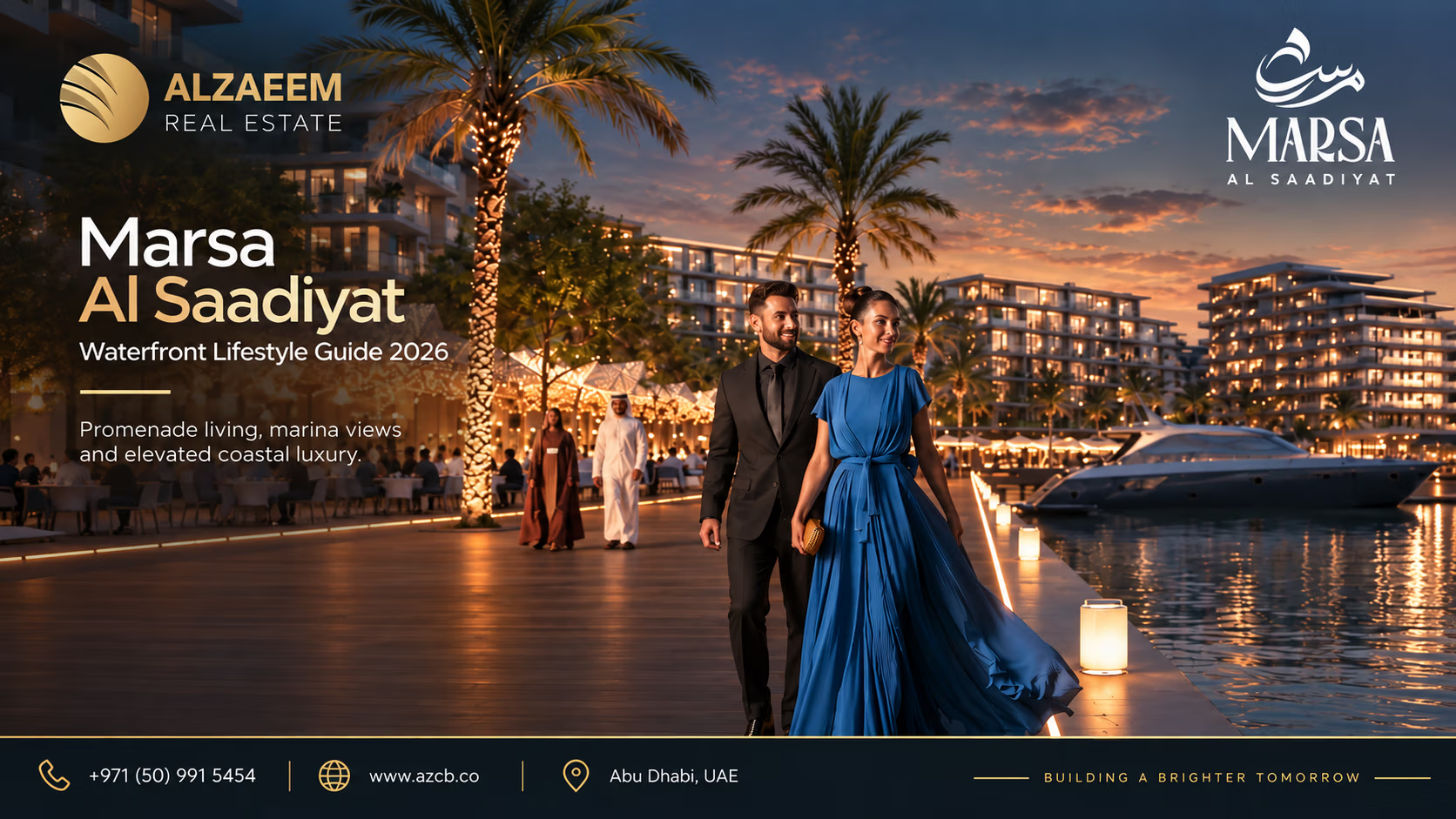
One is being built around the water.
The other around culture.
Both sit on Saadiyat Island. Both benefit from one of Abu Dhabi’s strongest premium property markets. Both can attract international investors, high-net-worth buyers, professionals and long-term residents.
But Marsa Al Saadiyat and Saadiyat Cultural District are not the same investment proposition.
Marsa Al Saadiyat is a AED 100 billion, 6.4 million sq m waterfront masterplan built around approximately 8 km of coastline, 5.6 km of beaches, Abu Dhabi’s largest marina, family neighbourhoods, villas, mansions, waterfront apartments, branded residences and major future infrastructure. More than 58,000 residents are ultimately planned.
Saadiyat Cultural District, by contrast, is already becoming one of the world’s most concentrated cultural destinations. Louvre Abu Dhabi is operating, Zayed National Museum opened in December 2025, and Guggenheim Abu Dhabi is scheduled to open on 11 December 2026. The district is increasingly surrounded by premium residential projects designed around museum access, architecture, walkability and an urban cultural lifestyle.
For an investor, this creates a fascinating choice.
Do you buy into:
the established cultural heart of Saadiyat?
Or:
the emerging waterfront expansion that may define its next chapter?
The answer depends less on which destination looks more impressive and more on what type of return, tenant, buyer and holding period you want.
Quick Answer: Marsa or Cultural District?
For investors prioritising waterfront scarcity, villas, marina living, family demand and long-term masterplan growth, Marsa Al Saadiyat may offer the stronger future-facing proposition.
For investors prioritising apartments, cultural-landmark proximity, professional and international tenant appeal, established destination infrastructure and easier comparison with existing transaction evidence, Saadiyat Cultural District may currently offer the clearer investment framework.
Neither area is automatically better.
The difference can be summarised like this:
| Factor | Marsa Al Saadiyat | Saadiyat Cultural District |
|---|---|---|
| Core identity | Marina, waterfront, beach | Culture, architecture, urban lifestyle |
| Development stage | Emerging masterplan | More established and actively operating |
| Scale | Very large | More concentrated |
| Property mix | Apartments, villas, mansions, branded residences | Predominantly premium apartments and residences |
| Family orientation | Very strong | Strong, but more urban |
| Professional tenant appeal | Strong | Very strong |
| Waterfront exposure | Exceptional | Selective |
| Cultural access | Direct connection planned | Immediate |
| Marina lifestyle | Core feature | Secondary |
| Existing pricing evidence | Limited for Marsa-specific launches | Considerably stronger |
| Future infrastructure upside | Very high | High but more mature |
| Future supply exposure | High | High |
| Best horizon | Medium/long term | Medium/long term |
| Key risk | Paying today for future masterplan value | Paying premium Cultural District pricing |
| Main advantage | Future waterfront scarcity | Existing global cultural ecosystem |
Two Different Investment Theses
The simplest way to understand the comparison is to stop thinking about both areas merely as:
Saadiyat property.
Their value propositions are different.
Marsa Al Saadiyat says:
Live by the water inside a complete new waterfront district.
Saadiyat Cultural District says:
Live among globally significant architecture and cultural institutions.
The first thesis depends heavily on:
waterfront;
marina;
family infrastructure;
future transport;
beaches;
and destination growth.
The second depends heavily on:
culture;
international recognition;
architecture;
urban placemaking;
museum proximity;
and premium apartment living.
Both are powerful.
But they create different buyer pools.
Saadiyat Cultural District Has the Maturity Advantage
This is one of the biggest differences in 2026.
Cultural District is no longer primarily a future promise.
Louvre Abu Dhabi is established and operating. Zayed National Museum officially opened on 3 December 2025. Guggenheim Abu Dhabi has an announced opening date of 11 December 2026.
The district already has:
recognisable landmarks;
visitors;
public programming;
restaurants;
residential development;
and international visibility.
That means an investor can increasingly evaluate Cultural District property based on:
an existing destination.
Marsa remains more dependent on:
what will be delivered.
That distinction should affect the price an investor is prepared to pay.
Marsa Has the Masterplan-Upside Advantage
Marsa’s advantage is almost the reverse.
Much of its future value is still ahead.
The official plan includes approximately 8 km of waterfront, 5.6 km of beaches, a marina for up to 350 boats and yachts, 140 km of walking paths, a 46 km cycling network, schools, healthcare, hotels, retail, parks and an underground Etihad Rail high-speed station.
Aldar also highlights a 73,800 sq m Central Park, a one-kilometre promenade and a mix of mansions, villas, apartments and branded residences.
If the destination develops successfully, an early buyer may benefit from:
infrastructure delivery;
community maturation;
population growth;
destination recognition;
and increasing commercial activity.
That creates potentially greater:
development upside.
It also creates greater:
execution and timing risk.
The Core Trade-Off: Existing Value vs Future Value
This comparison can therefore be reduced to one important concept.
Cultural District
You are paying more for:
value that is increasingly visible today.
Marsa
You may be paying for:
value that should become visible tomorrow.
Neither is inherently better.
But early-stage property should ideally compensate buyers for accepting:
construction;
infrastructure;
and community-maturity risk.
If Marsa property launches at pricing that already assumes every future benefit is complete, some of the early-investor advantage may disappear.
Saadiyat’s Underlying Market Is Already Exceptionally Strong
Both locations benefit from the wider island.
ADREC reported that Saadiyat Island recorded AED 13.3 billion in residential sales during H1 2026, making it one of Abu Dhabi’s largest residential transaction districts.
Across Abu Dhabi, residential sales reached AED 70.4 billion, compared with AED 25.3 billion during H1 2025. Off-plan represented 89% of residential sales value and 82% of deals. Resident expatriates and non-resident foreign buyers together accounted for 70% of residential sales value.
This is important.
Neither Marsa nor Cultural District needs to create international demand for Saadiyat from zero.
The island already attracts substantial capital.
Explore the broader Saadiyat Island property market before comparing specific projects.
Foreign Buyers Are Particularly Important to Both Locations
ADREC separately reported AED 13.8 billion of foreign direct investment in Abu Dhabi real estate during H1 2026, involving non-resident investors from 116 nationalities.
Both Marsa and Cultural District communicate easily to international buyers.
Cultural District offers:
Louvre;
Guggenheim;
Zayed National Museum;
international architecture;
and globally recognisable cultural positioning.
Marsa offers:
beach;
marina;
waterfront;
luxury hospitality;
and premium residential property.
These are different narratives.
But neither requires a complicated explanation.
That is valuable at resale.
Cultural District’s Greatest Asset: Global Recognition
Imagine marketing a Cultural District residence to a buyer in:
London;
Paris;
Singapore;
Mumbai;
or New York.
The location can be explained through:
Louvre Abu Dhabi;
Guggenheim Abu Dhabi;
Zayed National Museum;
and Saadiyat Island.
That creates immediate context.
Aldar describes The Row Saadiyat, for example, as a walkable Cultural District quarter framed by Zayed National Museum, Louvre Abu Dhabi, Guggenheim Abu Dhabi and Natural History Museum Abu Dhabi.
This recognisability can strengthen:
international marketing;
second-home demand;
resale appeal;
and premium perception.
Marsa’s Greatest Asset: Physical Waterfront Scarcity
Marsa has something equally powerful but more physical:
water.
Eight kilometres of waterfront cannot simply be manufactured inside the Cultural District.
Approximately 5.6 km of beaches and a large marina create different types of premium residential frontage.
Future Marsa buyers may eventually differentiate between:
beachfront;
marina-facing;
promenade;
park-facing;
elevated;
and internal neighbourhood property.
The strongest of these can create genuine physical scarcity.
And physical scarcity can be very durable.
Culture vs Water: Which Premium Is More Defensible?
This is an excellent investor question.
A cultural premium is supported by:
location beside major institutions;
urban identity;
global recognition;
architecture;
and destination activity.
A waterfront premium is supported by:
view;
coastline;
beach;
marina;
and a physically limited amount of front-row land.
Both can be defensible.
But investors should always calculate:
how much premium they are paying.
A wonderful view bought 40% above fair value can still underperform.
A spectacular museum-facing apartment bought too aggressively can do the same.
Premium does not mean:
unlimited price.
Property Types Are Fundamentally Different
This may be one of the clearest reasons to choose one area over the other.
Marsa’s official masterplan includes:
private mansions;
luxury villas;
waterfront apartments;
branded residences;
and standalone villas in an elevated hillside community.
Cultural District’s current residential story is more heavily:
apartment-led.
For example, Sei Saadiyat includes 1- and 2-bedroom apartments, 3-bedroom Kanso Residences and 2-bedroom Kanso Lofts. Aldar currently lists Sei from AED 2.95 million, with a 50/50 payment plan and Q4 2030 estimated handover.
The Row launched with 315 one-, two- and three-bedroom apartments across its first three buildings.
So if your goal is:
a large family villa or mansion
Marsa becomes considerably more relevant.
If your goal is:
a premium Cultural District apartment
the Cultural District already provides a deeper comparison set.
Family Buyers: Marsa May Have the Structural Advantage
Marsa is deliberately being planned for:
full-time family life.
The official masterplan includes three schools, healthcare facilities, community clubhouses, children’s areas, sports infrastructure, parks and extensive walking and cycling networks. More than 58,000 residents are ultimately planned.
Aldar’s current Marsa page further identifies two private schools, one public school and six nurseries.
That makes Marsa particularly compelling for buyers seeking:
larger homes;
villa living;
children’s infrastructure;
beach access;
and long-term owner occupation.
This could eventually produce a strong family resale market.
Professional Buyers: Cultural District May Have the Edge
For a professional or executive wanting:
apartment living;
restaurants;
culture;
walkability;
architecture;
and proximity to major urban experiences,
Cultural District may feel more natural.
The Row is explicitly designed around urban placemaking, premium dining, retail, leisure and pedestrian connections.
Sei provides a quieter wellness-led alternative while remaining directly inside Cultural District.
That gives the district multiple variations of:
premium urban apartment living.
A professional tenant pool can be particularly attractive to investors seeking:
modern apartments
rather than:
large villas.
Marsa Could Eventually Compete for the Same Professionals
This advantage is not permanent.
As Marsa’s waterfront apartments, retail, hospitality, marina and transport infrastructure develop, it may also become highly attractive to:
executives;
international residents;
couples;
and professionals.
The future Etihad Rail station could strengthen this significantly if delivered as planned.
So Cultural District has:
the professional-lifestyle advantage today.
Marsa may gain:
a powerful competing professional market later.
Rental Demand: Cultural District Has More Current Visibility
Cultural District investors can already use a growing set of:
existing buildings;
ready property;
active neighbourhoods;
and comparable Saadiyat rentals
to build assumptions.
Marsa currently has much less direct operating evidence because its residential story is still beginning.
That means Cultural District rental modelling generally has:
less uncertainty.
Marsa rental modelling currently has:
greater future potential but greater assumption risk.
No responsible investor should claim a precise Marsa rental yield for a property that does not yet have a real rental market.
Marsa Could Eventually Attract Several Tenant Markets
Marsa’s scale creates the possibility of multiple rental segments.
Waterfront apartments could appeal to:
professionals;
international tenants;
couples;
and executives.
Family villas could serve:
long-term households;
senior executives;
and high-income residents.
Branded residences may appeal to:
corporate;
international;
or high-net-worth tenants.
The marina and hospitality environment could attract another premium segment.
This diversification may ultimately strengthen rental depth.
But it has to be:
delivered first.
Cultural District Tenants Are Buying Proximity to Experience
A Cultural District tenant may pay a premium not simply for:
the apartment.
They are paying to live near:
architecture;
museums;
public programming;
restaurants;
walkability;
and a globally recognisable destination.
Zayed National Museum is already open, while Guggenheim Abu Dhabi’s opening is scheduled for December 2026.
This makes the cultural lifestyle increasingly tangible.
That matters when a landlord is trying to explain why:
this apartment
should rent for more than:
an otherwise similar apartment elsewhere.
Marsa Tenants May Pay for Lifestyle in a Different Way
The Marsa tenant may instead value:
sea;
beach;
marina;
parks;
large pedestrian networks;
schools;
family facilities;
and waterfront dining.
The emotional proposition is:
less museum district
and more:
waterfront city living.
For investors, this means future Marsa and Cultural District properties may not always compete directly.
They may appeal to:
different people.
Capital Appreciation: Marsa Has More Development-Uplift Potential
Marsa’s early investment argument relies partly on the idea that:
the destination of 2030+
should be significantly more developed than the destination of 2026.
That creates potential appreciation through:
masterplan maturity.
As:
marina;
parks;
roads;
retail;
schools;
hotels;
cultural facilities;
and homes
are progressively delivered, the location itself may become more valuable.
This is one of the classic reasons investors buy early in major masterplans.
But appreciation is not guaranteed.
Cultural District Has More Proven Destination Value
Cultural District’s upside comes from something different.
Much of its cultural infrastructure already exists or is reaching operation.
Zayed National Museum opened in December 2025 and Guggenheim Abu Dhabi has a confirmed December 2026 opening date.
This reduces part of the destination-development uncertainty.
The investor is not waiting for:
culture
to appear.
The primary uncertainty becomes:
property pricing;
future supply;
and individual project performance.
Which Has Greater Appreciation Potential?
There is no responsible universal answer.
Marsa potentially has:
more destination transformation ahead.
Cultural District potentially has:
more established scarcity and recognition.
If Marsa property is priced attractively relative to future delivered value:
it could provide substantial upside.
If Cultural District property has:
rare view;
strong architecture;
excellent layout;
and limited substitutes,
it may outperform despite being in a more mature destination.
The correct comparison remains:
exact property vs exact property.
Supply Risk Applies to Both
Neither location should be analysed under an assumption of:
limited future housing.
ADREC expects approximately 71,000 additional residential units across Abu Dhabi through 2030, with deliveries peaking at around 21,800 units in 2028. Saadiyat Island is one of six key districts expected to account for 77% of projected incremental supply.
That affects:
Marsa
and:
Cultural District.
The island is growing.
This can strengthen:
community maturity
while increasing:
property competition.
Future Supply Makes Differentiation More Important
By 2030, a buyer may have multiple choices across:
Marsa;
Sei;
The Row;
existing Cultural District property;
other Saadiyat apartment projects;
villa communities;
and future launches.
Saying:
“My property is on Saadiyat.”
may become less persuasive.
The market will increasingly ask:
Which project?
Which building?
Which view?
Which plot?
Which architecture?
Which service charge?
Which lifestyle?
This is healthy market maturation.
But it means generic properties can face more competition.
Marsa’s Size Makes Internal Competition Important
Marsa itself is enormous.
More than 58,000 residents imply a large residential population.
That means future Marsa property will compete not only with:
Cultural District.
It will compete with:
other Marsa property.
A generic waterfront apartment could eventually face many substitutes.
A truly rare:
front-row marina unit;
beachfront villa;
elevated plot;
or signature branded residence
may face fewer.
This is why investors should search for:
scarcity inside the masterplan.
Cultural District Has the Same Problem at Building Level
A Cultural District apartment can also become generic.
If several developments offer:
similar 2BR;
similar view;
similar size;
similar handover;
and similar amenities,
the buyer gains negotiating power.
Projects such as Sei and The Row therefore need their design and lifestyle differentiation to remain meaningful after delivery. Sei’s Kanso Lofts and The Row’s BIG-designed urban identity are examples of developers attempting to create that differentiation.
Again:
destination alone is not enough.
Which Area Has Better Liquidity?
Today, Cultural District arguably has the advantage in:
market legibility.
Buyers understand:
premium apartments;
cultural proximity;
specific projects;
and existing Saadiyat comparables.
Marsa’s future liquidity may ultimately be very strong, but until individual products establish:
pricing;
transactions;
rent;
and resale history,
more assumptions are required.
Over time, Marsa’s larger variety may create several separate liquidity markets:
apartments;
villas;
branded residences;
mansions;
and waterfront homes.
Smaller Apartments May Have Broader Resale Pools
This generally favours Cultural District property at lower ticket levels.
An apartment may be affordable to:
more investors;
more mortgage buyers;
more professionals;
and more international purchasers
than:
a large waterfront villa.
That does not mean apartments are better investments.
It means they often have:
broader buyer depth.
A Marsa mansion may have an exceptionally wealthy buyer pool but a much smaller one.
Large Marsa Villas May Trade More Like Wealth Assets
Ultra-premium villas and mansions can behave differently.
Buyers may focus less on:
rental yield
and more on:
plot;
waterfront;
privacy;
architecture;
scarcity;
and wealth preservation.
A lower percentage yield does not necessarily make such a property unattractive.
It simply means it belongs to a different investment category.
This is why comparing:
a Cultural District 1BR
with:
a Marsa mansion
through one ROI metric would make little sense.
Ready vs Off-Plan Exposure
Cultural District gives buyers a broader opportunity to compare:
ready;
recently completed;
and off-plan property.
Marsa is currently much more heavily a:
future-development proposition.
That distinction affects risk.
With ready property, you can usually inspect:
the actual view;
layout;
building;
common areas;
service charge;
and current rental market.
With off-plan property, you rely more heavily on:
developer delivery;
contractual documentation;
future market conditions;
and construction progress.
Buyers seeking current inventory can compare both established and future opportunities through Abu Dhabi properties for sale and Abu Dhabi off-plan property.
Infrastructure: Marsa Has the Bigger Transformation Story
Marsa’s infrastructure programme is one of its strongest investment arguments.
The government announcement includes new road and tunnel connections toward Reem Island and Umm Yifeenah Island, as well as the planned underground Etihad Rail high-speed station.
If delivered successfully, these improvements could reduce the perception of Saadiyat as:
an island one simply drives to
and strengthen its connection with:
central Abu Dhabi
and potentially the wider UAE.
That can broaden permanent-resident demand.
Cultural District Has the Immediate Walkability Story
Cultural District’s strength is different.
The Row, for example, has been designed around pedestrian connections to:
cultural institutions;
Saadiyat Grove;
Mamsha Beach;
restaurants;
and retail.
This creates an urban environment where the key destinations are:
already concentrated.
The Cultural District buyer is therefore paying more for:
proximity between experiences.
The Marsa buyer is paying more for:
scale and future integration.
Which Is Better for an Investor With AED 3–4 Million?
At this capital level, Cultural District currently provides clearer residential options.
Sei Saadiyat, for example, officially starts from AED 2.95 million.
Because Marsa’s complete unit-level residential pricing is not yet publicly established across the masterplan, it would be premature to claim that Marsa offers a better or worse AED 3–4 million investment.
If future waterfront Marsa apartments enter this range:
the comparison becomes very interesting.
Until then:
Cultural District has:
the clearer current benchmark.
Which Is Better for a Villa Buyer?
Marsa.
At least structurally.
Its masterplan specifically includes:
luxury villas;
private mansions;
and an elevated 22.5-metre hillside community of standalone villas.
A buyer seeking a long-term family villa within a major new Saadiyat waterfront district should therefore pay serious attention to Marsa.
Explore current wider options through villas for sale in Abu Dhabi.
Which Is Better for an Apartment Investor?
Today:
Cultural District has the stronger evidence base.
There are multiple premium residential developments to compare and a clearer current apartment-market identity.
Marsa may eventually offer compelling marina and waterfront apartments, perhaps with strong international appeal.
But the exact answer needs:
actual pricing.
For current opportunities, see apartments for sale in Abu Dhabi.
Which Is Better for an End User?
This may be easier than the investment question.
Choose Marsa if you imagine daily life around:
beach;
marina;
parks;
cycling;
larger family homes;
schools;
and a broader waterfront community.
Choose Cultural District if you imagine daily life around:
museums;
architecture;
restaurants;
walkability;
premium apartments;
and cultural activity.
The correct choice is not:
better.
It is:
better aligned.
Which Is Better for a Second Home?
Both are compelling.
A Cultural District residence may be particularly convenient for someone who wants:
an apartment;
cultural access;
restaurants;
and a highly recognisable international destination.
A Marsa waterfront residence may appeal more to someone seeking:
beach;
yacht;
marina;
and resort-like residential living.
The decision may become emotional.
That is normal for second-home property.
Which Is Better for Rental Yield?
There is not enough evidence to declare one winner.
Cultural District has more useful current rental comparisons.
Marsa’s future rental economics will depend on:
purchase price;
property type;
service charges;
tenant demand;
and exact completion timing.
A cheaper Cultural District apartment may outperform an expensive marina property on percentage yield.
A Marsa waterfront apartment may produce stronger rent but still lower yield if its purchase price is significantly higher.
Always distinguish:
rent
from:
return on capital.
Which Is Better for Long-Term Capital Preservation?
Potentially both.
Cultural District has:
global cultural identity;
premium architecture;
and increasing destination maturity.
Marsa has:
physically scarce waterfront;
major infrastructure;
and enormous long-term masterplan investment.
For capital preservation, I would place more emphasis on:
property scarcity
than:
district label.
An exceptional Cultural District residence can be a stronger wealth asset than an average Marsa property.
An exceptional waterfront Marsa villa can be stronger than a generic Cultural District apartment.
A Useful Investor Framework
Think about the decision through five variables:
| Question | Marsa Favour | Cultural District Favour |
|---|---|---|
| Want villa/mansion? | ✓ | |
| Want premium apartment? | ✓ eventually | ✓ |
| Want water/marina? | ✓✓ | Selective |
| Want culture/walkability? | ✓ | ✓✓ |
| Want family infrastructure? | ✓✓ | ✓ |
| Want current comparables? | ✓✓ | |
| Want early masterplan upside? | ✓✓ | ✓ |
| Want mature destination? | ✓✓ | |
| Want future transport upside? | ✓✓ | ✓ |
| Want architectural landmarks? | ✓ | ✓✓ |
| Want immediate rent evidence? | ✓ | |
| Want physical land scarcity? | ✓✓ | Selective |
The Five-Year Investor
A buyer with a five-year horizon needs particular caution with Marsa.
Five years may not be enough time for every part of an enormous 6.4 million sq m masterplan to mature.
Cultural District may provide more certainty because:
major institutions are already active
and:
additional projects will progressively complete.
For a relatively short property horizon:
certainty becomes valuable.
The Ten-Year Investor
A ten-year investor may see the comparison differently.
Ten years gives Marsa substantially more time for:
roads;
parks;
marina;
hotels;
residential communities;
schools;
retail;
and transport
to mature.
That allows the investor to potentially capture:
masterplan transformation.
For patient capital:
Marsa becomes significantly more compelling.
The Most Important Marsa Question
Ask:
Am I buying at a price that leaves room for the masterplan to create value for me?
If a property is priced as though:
every road;
school;
hotel;
marina;
rail connection;
and neighbourhood
already exists,
future development may simply justify today’s price.
It may not create:
exceptional appreciation.
The Most Important Cultural District Question
Ask:
What makes this exact residence difficult to replace when more Cultural District property completes?
The answer might be:
protected museum view;
unique architecture;
exceptional layout;
scarcity;
low service-charge structure;
or highly desirable floor position.
If the answer is simply:
“it is in Cultural District,”
that may become less persuasive as supply grows.
Do Not Buy Marsa Because Cultural District Became Expensive
This is another important point.
Sometimes investors miss an earlier market and then move to:
the next masterplan
because they believe:
“I missed Cultural District, so Marsa must be next.”
That is not sufficient investment logic.
Marsa needs to be evaluated based on:
its own price;
its own supply;
its own payment plan;
its own property;
and its own future demand.
Previous appreciation elsewhere does not guarantee:
future appreciation here.
Do Not Buy Cultural District Just Because It Is More Mature
Likewise, maturity does not automatically create value.
A mature destination can still contain:
overpriced property.
If a Cultural District unit is priced significantly above comparable alternatives and offers:
no exceptional view;
no scarcity;
and weak rental economics,
its mature location cannot automatically rescue the investment.
Entry price remains fundamental.
20 Questions Before Choosing Marsa or Cultural District
- Am I buying primarily for income, growth, personal use or wealth preservation?
- Do I want an apartment, villa, mansion or branded residence?
- What is my maximum total investment—not merely the down payment?
- Do I need rental income before completion?
- How long can I comfortably hold?
- Would I prefer marina and beach or museums and urban culture?
- What is the exact purchase price?
- What comparable property can I buy elsewhere on Saadiyat for the same amount?
- What permanent feature makes the property scarce?
- Is the view genuinely protected?
- How much future supply directly resembles my property?
- Who is the likely tenant?
- Who is the likely future buyer?
- What service charges should I model?
- How much capital remains due at handover?
- Do I depend on future mortgage approval?
- What future infrastructure must be delivered for my thesis to work?
- Would I still buy if prices are flat at handover?
- Can I comfortably hold if the property temporarily falls 10% in value?
- Would I buy this exact property if the words “Marsa” and “Cultural District” were removed from the brochure?
Question 20 strips away:
branding;
FOMO;
and location prestige.
What remains is:
the property itself.
Marsa vs Cultural District Investment Scorecard
This is an Al Zaeem analytical framework, not an Aldar or ADREC valuation methodology.
| Investment Factor | Marsa | Cultural District |
|---|---|---|
| Long-term destination potential | ★★★★★ | ★★★★★ |
| Current destination maturity | ★★★ | ★★★★★ |
| Waterfront scarcity | ★★★★★ | ★★★ |
| Cultural positioning | ★★★★ | ★★★★★ |
| Family-community infrastructure | ★★★★★ | ★★★★ |
| Apartment investment depth | ★★★ | ★★★★★ |
| Villa opportunity | ★★★★★ | ★★ |
| Current pricing transparency | ★★★ | ★★★★ |
| Existing rental evidence | ★★ | ★★★★ |
| International recognition | ★★★★ | ★★★★★ |
| Future infrastructure upside | ★★★★★ | ★★★★ |
| Execution risk | Higher | Lower |
| Future supply exposure | High | High |
| Long-hold suitability | Very strong | Very strong |
These scores describe the 2026 strategic positioning of the two zones, not the investment quality of every individual property within them.
Frequently Asked Questions
Is Marsa Al Saadiyat better than Saadiyat Cultural District?
Not universally. Marsa is stronger for waterfront, marina, family and villa-led living, while Cultural District is stronger for cultural proximity, premium apartments, urban lifestyle and current destination maturity.
Which area is newer?
Marsa Al Saadiyat was officially launched in July 2026. Cultural District has been developing for many years and already contains operating cultural institutions.
How large is Marsa Al Saadiyat?
Approximately 6.4 million square metres with around 8 km of waterfront.
How many people are expected to live in Marsa?
More than 58,000 residents are planned.
What property types will Marsa offer?
The official masterplan includes private mansions, luxury villas, waterfront apartments, branded residences and standalone hillside villas.
What property types are common in Cultural District?
Premium apartments and residences are currently prominent. New projects include Sei Saadiyat and The Row, alongside other existing and future Cultural District developments.
What does Sei Saadiyat start from?
Aldar currently lists Sei Saadiyat from AED 2.95 million, with a 5% down payment, 50/50 payment plan and estimated Q4 2030 handover.
Is Marsa pricing available across the entire masterplan?
No. Marsa is a multi-phase masterplan, so individual projects will have their own prices and terms.
Which area is better for apartments?
Cultural District currently provides the deeper and more established apartment comparison market. Future Marsa waterfront apartments may create a strong alternative.
Which is better for villas?
Marsa has the clearer structural advantage because villas, mansions and an elevated standalone-villa community form part of the masterplan.
Which is better for rental yield?
There is no evidence supporting a universal winner. Yield will depend on purchase price, rent, operating costs, service charges and financing.
Which location is better for families?
Marsa may eventually have the advantage because of its villa neighbourhoods, schools, nurseries, healthcare, parks and community facilities.
Which is better for professionals?
Cultural District currently has a strong proposition through apartments, walkability, cultural attractions and urban amenities. Marsa may compete strongly once its waterfront and transport infrastructure mature.
Which has greater appreciation potential?
Neither can be guaranteed to outperform. Marsa has more masterplan transformation ahead; Cultural District has more current destination maturity.
Which has more future supply risk?
Both are exposed because Saadiyat is one of Abu Dhabi’s main future residential supply districts.
Is Marsa connected to Cultural District?
Yes. The official Marsa masterplan includes a scenic pedestrian connection to Saadiyat Cultural District.
Will Marsa have an Etihad Rail station?
A future underground high-speed Etihad Rail station forms part of the announced masterplan.
Is the station operational?
No. It remains planned future infrastructure.
Is Guggenheim Abu Dhabi open?
As of 13 September 2026, its announced public opening date is 11 December 2026.
Is Zayed National Museum open?
Yes. It opened to the public on 3 December 2025.
What is the biggest mistake when choosing between Marsa and Cultural District?
Choosing the district first and the property second.
Final Takeaway
Marsa Al Saadiyat and Saadiyat Cultural District represent two different chapters of the same island.
Cultural District represents:
Saadiyat’s established global identity.
It brings together internationally significant cultural institutions, landmark architecture and increasingly sophisticated premium residential communities.
Zayed National Museum is already operating.
Louvre Abu Dhabi is established.
Guggenheim Abu Dhabi is scheduled to open in December 2026.
Marsa represents:
Saadiyat’s next phase of physical expansion.
Its numbers are enormous:
AED 100 billion development value;
6.4 million sq m;
8 km waterfront;
5.6 km beaches;
marina for up to 350 yachts and boats;
58,000+ residents;
140 km walking network;
46 km cycling network;
plus schools, healthcare, hotels, parks, residences and future rail connectivity.
So where should investors buy?
Marsa may be stronger if you want:
waterfront;
marina;
villas;
family demand;
future infrastructure;
and long-term masterplan transformation.
Cultural District may be stronger if you want:
premium apartments;
urban living;
culture;
international recognition;
existing destination maturity;
and stronger current market comparability.
But there is a better answer than simply choosing:
Marsa
or:
Cultural District.
Buy the stronger individual property.
A weak Marsa apartment does not become exceptional because it sits inside a AED 100 billion masterplan.
A weak Cultural District apartment does not become exceptional because Guggenheim is nearby.
Likewise, an exceptional marina-facing Marsa residence may eventually become extraordinarily scarce.
An exceptional Cultural District apartment with an irreplaceable landmark view may do the same.
The district creates:
the opportunity.
The property determines:
how much of that opportunity you actually own.
And because Saadiyat recorded AED 13.3 billion of residential sales during H1 2026, investors are making this decision inside an already deep and increasingly international market—not a theoretical future market.
The strongest question is therefore not:
“Should I buy Marsa or Cultural District?”
It is:
“At the capital I have available today, which exact Saadiyat residence gives me the best combination of scarcity, price, demand, holding power and future resale appeal?”
That is the comparison that matters.
Al Zaeem Real Estate — Compare Saadiyat at Property Level
Marsa Al Saadiyat and Saadiyat Cultural District can both form part of a strong long-term Abu Dhabi property strategy, but they serve different buyers and different investment objectives.
Al Zaeem Real Estate helps buyers compare opportunities through:
exact property price, location, waterfront or landmark exposure, floor plan, plot position, future supply, payment structure, tenant profile, holding period and resale demand.
Explore the wider Saadiyat Island property market, Abu Dhabi properties for sale, off-plan opportunities, apartments for sale and villas for sale.
The objective is not to buy the district with the biggest headline.
It is to own:
the property future Saadiyat buyers will still specifically want when both districts are fully established.
Al Zaeem Real Estate
+971 (50) 991 5454
azcb.co
Primary Official Sources
The Abu Dhabi Government’s Marsa Al Saadiyat announcement provides the masterplan’s core facts, including its AED 100 billion gross development value, 6.4 million sq m area, waterfront and beaches, marina capacity, planned population, residential mix, walking and cycling networks, Cultural District connection, transport infrastructure and initial development programme.
Aldar’s current Marsa Al Saadiyat masterplan page provides additional detail on the Central Park, schools and nurseries, Cultural District positioning, Dar al Funoon, future Etihad Rail connectivity, sustainability target and wider lifestyle strategy.
The Abu Dhabi Media Office’s Saadiyat Cultural District information and museum announcements provide the current cultural context, including Zayed National Museum’s December 2025 opening and Guggenheim Abu Dhabi’s announced 11 December 2026 opening.
ADREC’s H1 2026 Abu Dhabi Real Estate Market Report provides the residential sales, Saadiyat transaction value, buyer composition, price movement and future supply figures used in this comparison.
Disclaimer
This article is provided for general educational and real-estate research purposes only. It does not constitute investment, financial, legal, mortgage, tax, valuation, contractual or immigration advice.
Marsa Al Saadiyat is a large multi-phase masterplan. Individual developments within Marsa will have their own prices, payment plans, handover schedules, property types, service charges and contractual terms.
Saadiyat Cultural District also contains multiple developments at different stages of completion and with materially different pricing, unit types and investment characteristics.
The comparison in this article addresses the broader investment positioning of the two districts and should not be interpreted as a statement that every Marsa property will outperform every Cultural District property, or vice versa.
Future capital appreciation, rental yields, mortgage approval, resale liquidity and infrastructure completion cannot be guaranteed.
Planned Marsa infrastructure, including the underground Etihad Rail station and future roads, tunnels, schools, hotels, retail and community facilities, should not be treated as existing infrastructure until delivered and operational.
Guggenheim Abu Dhabi is scheduled to open on 11 December 2026 based on the current official announcement; future schedules may be updated.
Buyers should compare current official project documentation, exact property location, payment schedules, registered market evidence and applicable fees before committing capital.
Last reviewed: 13 September 2026.