


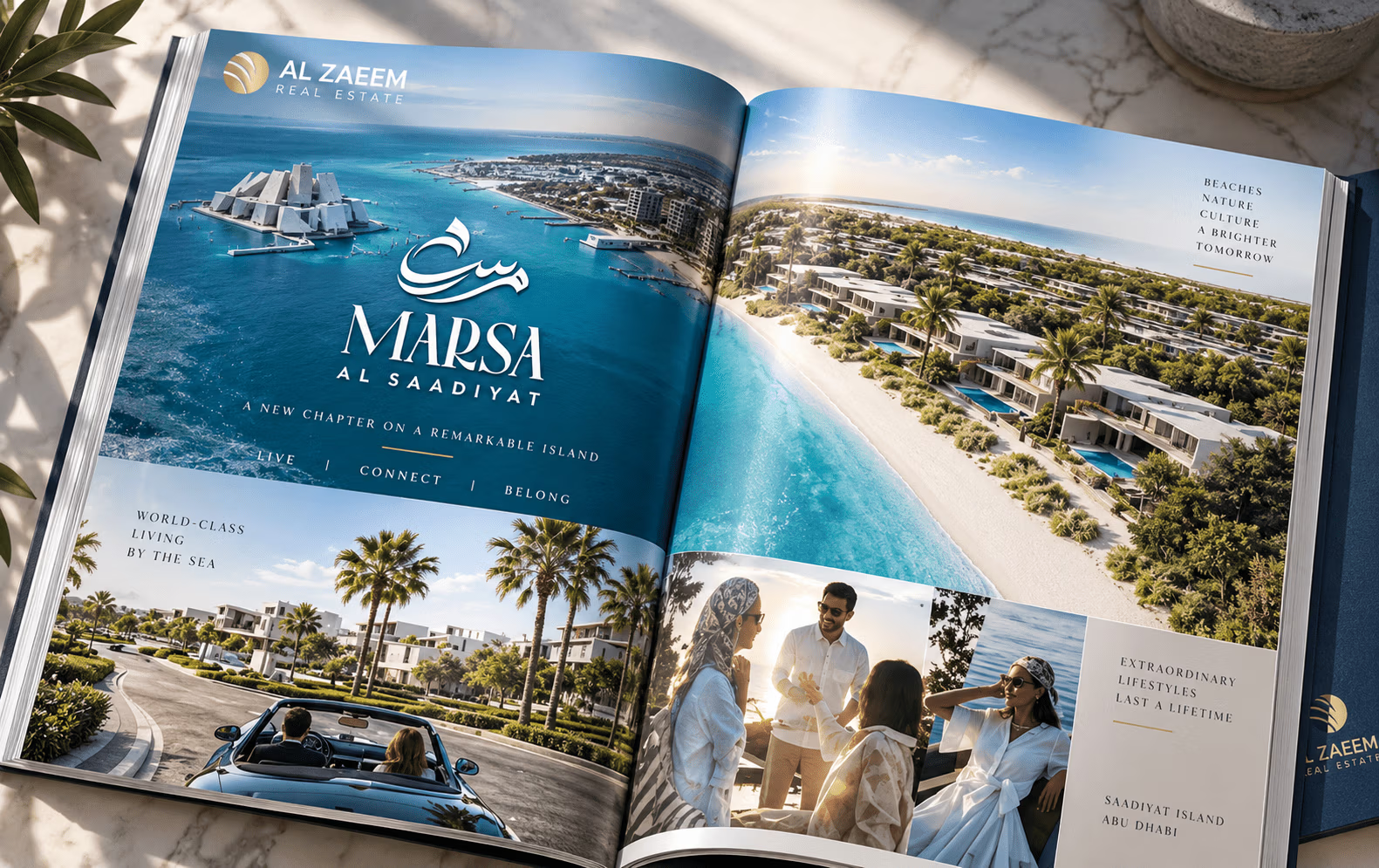
The most important question about a masterplan as large as Marsa Al Saadiyat is not how impressive it looks from the air.
It is:
What will everyday life actually feel like when tens of thousands of people live there?
A AED 100 billion development can contain spectacular villas, waterfront apartments and luxury hotels. But a successful long-term residential district also needs something less glamorous and far more important:
movement, schools, healthcare, parks, daily retail, family infrastructure, comfortable public spaces and reliable connections to the rest of the city.
That is where the Marsa Al Saadiyat masterplan becomes particularly interesting.
Officially launched in July 2026, the development spans approximately 6.4 million square metres, covers around 8 kilometres of waterfront, includes 5.6 kilometres of beaches, and is planned as a permanent home for more than 58,000 residents. The Abu Dhabi Government says the community will incorporate approximately 140 kilometres of interconnected walking paths, a 46-kilometre cycling network, Abu Dhabi’s largest marina, schools, healthcare, hotels, parks, retail, cultural infrastructure and a future underground Etihad Rail high-speed station.
Those figures suggest Marsa is being designed not as a collection of luxury compounds but as:
a new waterfront urban district within Saadiyat Island.
And that difference matters to both residents and property investors.
Quick Answer: What Will Living in Marsa Al Saadiyat Be Like?
Marsa Al Saadiyat is planned around four interconnected lifestyle ideas:
waterfront living, active mobility, family infrastructure and access to culture.
Residents are expected to live among beaches, marina promenades, parks, walking and cycling routes, community clubhouses, education, healthcare, retail and dining rather than relying on a car for every activity.
Aldar’s current masterplan also identifies two private schools, one public school, six nurseries, a 73,800 sq m Central Park, a one-kilometre promenade, future Etihad Rail connectivity, and Dar al Funoon Abu Dhabi as a major performing-arts destination scheduled to open in 2030.
The masterplan is ambitious.
But buyers should distinguish carefully between:
what exists around Saadiyat today
and:
what Marsa plans to deliver in future.
That distinction should remain clear throughout any property decision.
Marsa Al Saadiyat Infrastructure at a Glance
| Feature | Officially Announced |
|---|---|
| Masterplan area | 6.4 million sq m |
| Gross development value | AED 100B |
| Waterfront | 8 km |
| Beaches | 5.6 km |
| Planned population | 58,000+ |
| Marina | Up to 350 boats and yachts |
| Waterfront promenade | 1 km |
| Walking paths | Approx. 140 km |
| Cycling routes | 46 km |
| Central Park | 73,800 sq m |
| Private schools | 2 |
| Public schools | 1 |
| Nurseries | 6 |
| Luxury hotels | 2 planned |
| Cultural anchor | Dar al Funoon Abu Dhabi |
| Rail | Future underground Etihad Rail station |
| Sustainability target | Estidama 2 Pearl Community Rating |
These are masterplan-level commitments and targets rather than a statement that every element is currently operational.
Marsa Is Designed Around Daily Life, Not Only Luxury Real Estate
Many premium developments are designed backwards.
First come the villas.
Then apartments.
Then perhaps a retail strip, gym and swimming pool.
Marsa’s official planning language is different.
The Abu Dhabi Government says the community has been designed so that daily life can unfold within the development rather than outside it, supported by parks, children’s areas, community clubs, healthcare and schools positioned within convenient reach of residences.
This is important because a truly successful residential district must answer ordinary questions:
Where does a family take children to school?
Where do residents walk after dinner?
Can someone buy groceries without driving across the island?
Can a professional work nearby?
Can children cycle safely?
Can elderly residents access healthcare?
Can a resident spend an entire weekend within the neighbourhood without feeling isolated?
These questions determine whether a development becomes:
a real community
or:
a collection of investment properties.
The 8-Kilometre Waterfront Shapes the Entire Lifestyle
Marsa’s approximately 8 kilometres of waterfront is not simply scenery.
It is one of the main organising features of the community.
Around 5.6 kilometres are planned as beaches, while the waterfront also accommodates marina infrastructure, residential areas, promenades, hospitality and public spaces.
This gives future residents potentially several different ways to experience the water:
beach living;
marina activity;
waterfront walking;
yacht access;
promenade dining;
and homes positioned around different coastal environments.
That is more sophisticated than building one row of waterfront towers and calling the development:
“waterfront living.”
Beach Living and Marina Living Are Different Experiences
Future Marsa buyers should distinguish between them.
A beach-oriented property may offer:
greater openness;
recreation;
family appeal;
and potentially direct access to sand and sea.
A marina-oriented property may provide:
greater activity;
yacht views;
restaurants;
night-time atmosphere;
and closer proximity to commercial uses.
One is not necessarily better.
The better choice depends on the resident.
A family may value quiet beach access more than marina nightlife.
A professional couple may prefer restaurants and promenade activity.
An international second-home buyer may prioritise visual marina appeal.
This will eventually create several distinct residential micro-markets inside Marsa.
Abu Dhabi’s Largest Marina
The Marsa masterplan includes what the Abu Dhabi Government describes as the emirate’s largest marina, accommodating up to 350 sailing boats and luxury yachts.
The significance extends beyond yacht owners.
A well-designed marina can function as a district’s public heart.
It can support:
dining;
events;
hospitality;
water activities;
retail;
walking;
and evening activity.
This can make waterfront property appealing even to people who never intend to own a boat.
The marina could therefore become one of Marsa’s most important:
placemaking assets.
The One-Kilometre Promenade
The masterplan includes approximately one kilometre of waterfront retail and dining, together with a yacht club and two planned luxury hotels.
For residents, this could provide the type of daily environment that makes a neighbourhood feel active beyond:
home;
car;
office;
home.
A successful promenade can allow residents to:
walk to dinner;
meet friends;
sit beside the marina;
use local cafés;
and spend time outdoors
without leaving the community.
This is exactly the type of lifestyle infrastructure that can eventually support:
tenant retention;
owner satisfaction;
and long-term residential demand.
But Living Directly Above the Action Is Not for Everyone
Property buyers should also understand the trade-off.
Being very close to:
restaurants;
hotels;
promenade activity;
and marina entertainment
can mean stronger convenience.
It can also mean:
noise;
traffic;
delivery activity;
and more people.
The strongest premium property is not always the residence nearest every amenity.
Sometimes it is:
close enough to walk
but:
far enough to remain quiet.
Future Marsa unit selection should therefore consider:
amenity proximity versus residential privacy.
Central Park: The Non-Waterfront Anchor
Water receives most of the attention.
But Marsa’s 73,800 sq m Central Park may become equally important to residents. Aldar highlights it as a major landscaped element within the district.
Large parks can provide something waterfront promenades cannot:
shade;
green space;
children’s play;
exercise;
family recreation;
community gatherings;
and respite from busy commercial areas.
This may also create a second premium property category.
Instead of asking only:
“Does the property have a water view?”
future buyers may ask:
“Does it face the park?”
For families, a park-front residence may ultimately be more useful than a marina-facing property.
Linear Parks Are Designed to Connect the Community
The masterplan also describes a wider network of green linear parks connecting different parts of Marsa.
This is a particularly important planning decision.
A large community can become fragmented if every neighbourhood operates like:
an isolated compound.
Continuous green corridors can help connect:
homes;
schools;
parks;
beach;
marina;
retail;
and community facilities.
That contributes to:
walkability;
cycling;
and overall neighbourhood cohesion.
140 Kilometres of Walking Paths
One of Marsa’s most unusual statistics is its planned:
approximately 140 km of interconnected walking paths.
That is substantial for a residential masterplan.
The number itself matters less than the design philosophy behind it.
Walkability can fundamentally change daily behaviour.
A neighbourhood designed mainly around cars tends to produce:
parking;
traffic;
short vehicle journeys;
and disconnected public spaces.
A community designed around walking can create:
more interaction;
greater retail activity;
healthier daily routines;
and a stronger sense of place.
Abu Dhabi’s Climate Makes Walkability More Complicated
Of course, Abu Dhabi is not a mild-climate European city.
Summer heat changes how outdoor infrastructure is used.
So the real test will not simply be:
how many kilometres of pathways are delivered.
It will be:
how comfortable those paths are.
Future residents should pay attention to:
shade;
landscaping;
building orientation;
rest areas;
water features;
night-time lighting;
and the distance between destinations.
Walkability in Abu Dhabi is created through:
design quality
rather than:
path length alone.
The 46-Kilometre Cycling Network
Marsa also plans approximately 46 kilometres of cycling routes.
This gives cycling a potentially meaningful role in community mobility rather than treating it simply as:
a recreational track.
For residents, cycling infrastructure may make it easier to move between:
residential neighbourhoods;
schools;
parks;
beaches;
the marina;
and commercial areas.
For families, safe cycling can also give older children greater independence within the community.
That contributes to:
real liveability.
Active Mobility Can Increase Property Appeal
A buyer does not necessarily pay more because a development has:
46 km of cycle routes.
But the effect can emerge indirectly.
A neighbourhood that feels:
easy to move through;
safe;
pleasant;
green;
and connected
can retain residents longer.
Longer tenant and owner retention can support:
stable demand;
reduced vacancy;
and stronger resale perception.
That is why infrastructure which looks non-financial can ultimately influence:
financial performance.
Three Schools Inside Marsa
Marsa is planned with two private schools and one public school, according to Aldar’s current masterplan information. Six nurseries are also planned.
This is critical to Marsa’s ambition of becoming:
a permanent family community.
A district designed for 58,000+ people cannot depend indefinitely on parents driving children elsewhere every morning.
Schools help create:
full-time residency;
long holding periods;
family retention;
and predictable daily activity.
This is particularly important for future villa communities.
Six Nurseries Matter More Than They Sound
Nurseries are often overlooked in property marketing.
But young families make property decisions around:
convenience.
A nursery within:
walking distance
or:
a short drive
can influence whether a family views a community as practical.
Six planned nurseries suggest that Marsa is being designed to serve multiple residential clusters rather than concentrating early-years education in one distant location.
For family buyers:
that can be an important lifestyle advantage.
Marsa Also Benefits From Saadiyat’s Existing Education Ecosystem
The island already contains or is close to established education institutions, including NYU Abu Dhabi, and Marsa’s official masterplan specifically highlights NYU Abu Dhabi’s proximity.
The wider Saadiyat ecosystem also includes established schools and educational institutions.
This reduces one of the biggest risks faced by entirely new residential areas:
waiting for basic family infrastructure to catch up with home construction.
Marsa enters:
an established island.
Healthcare Is Planned Within the Community
The Abu Dhabi Government masterplan identifies premium healthcare facilities as part of Marsa’s daily infrastructure.
That matters for:
families;
older residents;
and long-term owner-occupiers.
A genuine residential district needs more than:
restaurants;
pools;
and gyms.
Healthcare accessibility helps transform a luxury destination into somewhere residents can realistically:
live for years.
Community Clubs, Pools and Sports Courts
The masterplan also includes community clubhouses with:
outdoor pools;
sports courts;
children’s areas;
and other recreational infrastructure.
These local facilities are important because not every resident wants to travel to:
the main marina;
a hotel;
or the Cultural District
for routine recreation.
A large masterplan works better when each residential neighbourhood has:
its own everyday amenities
while also accessing:
district-wide destinations.
Marsa Will Be Connected to Saadiyat Cultural District
A scenic pedestrian link is planned between Marsa and Saadiyat Cultural District.
This may become one of Marsa’s defining lifestyle advantages.
Residents could potentially combine:
waterfront living;
marina;
beach;
and family infrastructure
with direct access to:
Louvre Abu Dhabi;
Zayed National Museum;
Natural History Museum Abu Dhabi;
teamLab Phenomena;
Guggenheim Abu Dhabi;
restaurants;
and hospitality.
This is difficult to replicate elsewhere.
For buyers who want a broader understanding of the island, see Al Zaeem’s Saadiyat Island property guide.
Marsa and Cultural District Serve Different Daily Lifestyles
Although connected, they are not identical residential propositions.
Cultural District living is more:
urban;
museum-oriented;
apartment-led;
and closely tied to major cultural institutions.
Marsa is more:
waterfront;
marina;
beach;
family-oriented;
and mixed between villas, mansions, apartments and branded residences.
That diversity is positive for the island.
Instead of offering one luxury lifestyle, Saadiyat can offer:
several distinct ways to live.
Dar al Funoon Adds Culture Inside Marsa Itself
Marsa will not rely only on Cultural District attractions.
Aldar identifies Dar al Funoon Abu Dhabi as a major future performing-arts destination within Marsa, scheduled to open in 2030.
Designed by the late Frank Gehry, it is planned with more than 6,000 seats across venues for opera, ballet, theatre, music and live performance.
This creates a significant cultural anchor within:
the waterfront district itself.
It also means Marsa’s evening economy may eventually extend beyond:
marina dining.
Culture Can Support Residential Demand
Cultural infrastructure does not automatically increase property prices.
But it can contribute to:
destination recognition;
international tourism;
restaurants;
events;
hospitality;
and a richer local lifestyle.
For full-time residents, it creates more:
reasons to remain within the area.
For investors, that can support a deeper future tenant and buyer pool.
Two Luxury Hotels Are Planned
The Marsa social and commercial core includes two luxury hotels.
Hotels can increase:
restaurants;
events;
spa facilities;
business activity;
visitor traffic;
and international destination visibility.
They can also contribute to:
night-time activity.
For nearby residential owners, that may be positive if properly planned.
Again, exact location matters.
A residence overlooking:
a beautifully managed hotel landscape
can be attractive.
A residence directly exposed to:
service traffic;
event noise;
or busy access roads
may feel different.
Retail and Dining Are Essential to Making Marsa Work
A community housing more than 58,000 people needs a functioning local economy.
The one-kilometre waterfront promenade is therefore more important than a decorative retail strip.
Marsa will need daily services capable of supporting:
permanent residents;
families;
workers;
hotel guests;
and visitors.
If successful, this can reduce the need to leave the island for:
routine lifestyle needs.
That increases:
residential self-sufficiency.
The Future Etihad Rail Station Could Change Connectivity
Among Marsa’s most ambitious infrastructure elements is a planned underground Etihad Rail high-speed station.
Aldar also lists the future station as part of its “seamless connectivity” strategy.
If delivered and integrated effectively, rail could significantly change how residents experience Saadiyat.
Instead of seeing the island as:
a beautiful but primarily road-accessed destination,
future buyers may increasingly see it as:
part of a wider regional mobility network.
But the Rail Station Is Future Infrastructure
This needs to remain explicit.
The station is planned.
It is not currently operational.
The available Marsa masterplan information reviewed for this article does not establish a final operating date.
Therefore buyers should not purchase a residence today on the assumption that:
the full rail benefit is already guaranteed.
A better investment framework is:
Would I still want the property if rail takes longer than expected?
If yes:
the station becomes:
valuable upside.
Road and Tunnel Connections Also Matter
The Marsa masterplan includes a future network of roads and tunnels intended to improve connections toward Reem Island and Umm Yifeenah Island.
For a large community, this is essential.
58,000+ residents cannot rely on:
one constrained route.
Transport infrastructure will affect:
rush-hour experience;
school traffic;
delivery logistics;
hotel access;
and the attractiveness of Marsa to full-time working residents.
The roads may therefore matter more to everyday life than:
almost any single luxury amenity.
Connectivity Determines Whether Marsa Works for Professionals
Imagine a senior executive choosing between two homes.
Property A has:
slightly better beach access
but:
difficult daily commuting.
Property B provides:
excellent lifestyle plus efficient access to work.
For a permanent resident:
Property B may be far more useful.
This is why Marsa’s road, tunnel and future rail strategy is central to:
full-time residential demand.
Marsa’s Location Already Benefits From Abu Dhabi’s Wider Transport Investment
Abu Dhabi continues investing in connections between Saadiyat, Reem and surrounding areas.
For example, DMT opened two new marine bridges in March 2026 connecting Reem Island to Sheikh Khalifa Bin Zayed Highway, designed to reduce peak travel times on the affected route. This is separate from the Marsa project itself, but it demonstrates continued transport investment in the surrounding urban network.
As Marsa develops, wider-city infrastructure will matter alongside infrastructure inside the masterplan.
Sustainability: Estidama 2 Pearl Community Target
Aldar says Marsa is targeting an Estidama 2 Pearl Community Rating.
This is a community-level target rather than a guarantee that every individual future building will automatically carry the same certification.
The sustainability strategy is also visible through:
active mobility;
green space;
landscaping;
coastal planning;
and reduced dependence on cars for internal movement.
For buyers planning to hold property for:
10 or 20 years,
building and community sustainability may become increasingly important to:
operating cost;
resident expectations;
and future marketability.
Engineered Façades and Acoustic Barriers
Aldar also says Marsa will use engineered façades and acoustic barriers to reduce ambient noise.
This is particularly relevant in a mixed-use waterfront destination.
Marina activity, hotels, roads, restaurants and public destinations can make a community:
energetic.
Residential buyers still expect:
quiet.
The ability to balance:
activity outside
with:
comfort inside
could materially influence Marsa’s long-term reputation.
Noise Should Be Part of Unit Selection
Once individual Marsa projects launch, buyers should investigate more than:
view.
Ask what sits below the balcony.
Is it:
park?
road?
promenade?
restaurant terrace?
marina entrance?
hotel?
school?
Each creates a different residential experience.
A premium waterfront view may be less attractive if:
night-time noise is constant.
Infrastructure Can Create Different Property Premiums
Marsa will eventually develop several micro-locations.
A future property may command a premium because it is close to:
the marina.
Another because it faces:
Central Park.
Another because it is near:
schools.
Another because it is:
quietly positioned away from commercial activity.
Another because it is close to:
future transport.
This means investors should stop thinking of Marsa as:
one location.
The complete masterplan is:
6.4 million square metres.
Location within Marsa will matter enormously.
A Marina-Facing Apartment and Family Villa Have Different Infrastructure Needs
The apartment buyer may prioritise:
promenade;
restaurants;
marina views;
rail;
and hospitality.
The villa buyer may prioritise:
school;
nursery;
park;
beach;
traffic;
privacy;
and neighbourhood club.
Both may belong to Marsa.
Their definition of:
“best location”
can be completely different.
Families Could Be One of Marsa’s Most Important Buyer Segments
The infrastructure plan suggests Aldar expects substantial:
family occupation.
Schools.
Nurseries.
Healthcare.
Villas.
Parks.
Play areas.
Sports courts.
Cycling.
Beaches.
These are not designed purely for:
short-term investors.
They indicate an attempt to create:
long-duration residential demand.
That can be strategically important for property-market stability.
Permanent Residents Create a Different Market From Investors
A development dominated entirely by investors can have:
higher tenant turnover;
more simultaneous resale listings;
and weaker emotional attachment.
A development with a significant owner-occupier population can behave differently.
Families often:
hold longer;
invest more in their homes;
participate in schools and community;
and care deeply about neighbourhood quality.
Marsa’s infrastructure appears designed to attract:
both investors
and:
long-term residents.
The Planned Population Gives Retail a Better Chance to Succeed
More than 58,000 residents creates a substantial local customer base.
That matters because luxury retail and restaurants cannot depend forever on:
weekend visitors.
A dense permanent population can support:
weekday activity;
grocery;
daily dining;
services;
fitness;
education;
and commercial operations.
That makes the destination more economically resilient.
Infrastructure Can Matter More Than Apartment Finishes
A buyer can renovate:
floors;
lighting;
kitchen;
furniture.
A buyer cannot personally fix:
poor road access;
lack of schools;
a badly designed public realm;
or absence of nearby healthcare.
This creates a useful property rule:
Buy the infrastructure first. Then choose the residence inside it.
Interior specifications matter.
The neighbourhood ultimately matters more.
Marsa’s Infrastructure Could Benefit Wider Saadiyat
Not every benefit will stop at the development boundary.
New:
restaurants;
marina;
parks;
cultural facilities;
transport connections;
and hotels
could also be used by residents of existing Saadiyat communities.
That means Marsa potentially improves:
the entire island.
This broader effect is particularly relevant to existing owners and future buyers comparing Marsa against other Saadiyat Island properties.
But New Infrastructure Also Brings New Supply
The story is not entirely bullish.
ADREC currently projects approximately 71,000 additional residential units across Abu Dhabi through 2030, and Saadiyat is among six districts expected to account for 77% of incremental supply.
Therefore Marsa will improve:
infrastructure;
destination quality;
and lifestyle
while also creating:
more competing homes.
This is why property selection remains important.
A strong masterplan can improve demand.
It does not guarantee every unit will outperform.
Abu Dhabi’s Market Gives Marsa a Strong Starting Point
Marsa is also arriving during an exceptionally active Abu Dhabi residential market.
ADREC reported AED 70.4 billion in residential sales during H1 2026, compared with AED 25.3 billion during H1 2025. Off-plan represented 89% of residential sales value, while Saadiyat Island itself recorded AED 13.3 billion of residential sales.
Resident expatriates and non-resident foreign buyers together accounted for 70% of residential sales value.
That gives a global waterfront masterplan a potentially deep buyer market.
But strong demand can also increase:
launch pricing.
Lifestyle Quality Still Has to Justify the Price
A buyer should never say:
“Marsa has amazing infrastructure, therefore any price is acceptable.”
Infrastructure adds value.
That value still has to be:
priced.
Suppose future Marsa property commands a huge premium over established Saadiyat alternatives.
The buyer should ask whether:
new infrastructure;
waterfront;
marina;
and modern community design
justify the premium.
Excellent lifestyle does not eliminate:
investment mathematics.
The Mature Marsa Test
The best way to evaluate the lifestyle story is to imagine Marsa after the launch marketing disappears.
Imagine:
The roads are busy with residents.
Children attend school.
People cycle to parks.
Restaurants operate daily.
Boats enter the marina.
Hotels host guests.
Residents walk the promenade.
Some buildings are already several years old.
What still matters?
Not the render.
Not the launch event.
Not the sales brochure.
What matters is:
how well the district actually works.
That is the real test of a masterplan.
What Buyers Should Examine When Residential Projects Launch
Before buying, the exact property’s infrastructure relationship should be studied.
| Question | Why It Matters |
|---|---|
| Distance to beach | Lifestyle and resale appeal |
| Distance to marina | Convenience vs activity/noise |
| Distance to school | Family usability |
| Park frontage | Green-space premium |
| Road position | Traffic and noise |
| Promenade proximity | Walkability and F&B access |
| Future rail access | Long-term connectivity |
| Nearby undeveloped plots | Construction and view risk |
| Future commercial plots | Convenience vs disturbance |
| Walking route quality | Daily liveability |
| Cycling connectivity | Family and active lifestyle |
| Healthcare proximity | Long-term resident utility |
The correct Marsa unit should align with:
the buyer’s actual lifestyle.
Not simply:
the most expensive view.
Lifestyle Buyer vs Investment Buyer
The same infrastructure can be valued differently.
An end user may willingly pay more for:
school access;
quiet park frontage;
beach proximity;
or walking distance to restaurants.
A yield investor may focus more heavily on:
tenant demand;
purchase price;
service charges;
and resale liquidity.
Both approaches are legitimate.
Problems arise when:
an investor pays an end-user lifestyle premium
while expecting:
maximum yield.
Frequently Asked Questions
What lifestyle will Marsa Al Saadiyat offer?
The masterplan combines beaches, marina living, parks, walking and cycling routes, schools, nurseries, healthcare, retail, restaurants, hotels, cultural venues and different residential neighbourhoods.
How much waterfront does Marsa Al Saadiyat have?
Approximately 8 kilometres, including around 5.6 kilometres of beaches.
Will Marsa have a marina?
Yes. The masterplan includes Abu Dhabi’s largest marina, designed for up to approximately 350 boats and luxury yachts.
How long is the waterfront promenade?
Approximately one kilometre, with dining and retail planned around the waterfront social core.
Does Marsa have a major park?
Yes. Aldar identifies a 73,800 sq m Central Park.
How many walking paths are planned?
Approximately 140 kilometres of interconnected walking routes.
How much cycling infrastructure is planned?
Approximately 46 kilometres of cycling routes.
Will Marsa have schools?
Yes. Aldar currently identifies two private schools, one public school and six nurseries.
Will Marsa have healthcare?
Premium healthcare facilities form part of the official masterplan.
Will Marsa have hotels?
Two luxury hotels are planned within the destination’s commercial and social core.
Will Marsa connect to Saadiyat Cultural District?
Yes. The official masterplan describes a scenic pedestrian connection linking Marsa directly with Saadiyat Cultural District.
What is Dar al Funoon?
Dar al Funoon Abu Dhabi is a future performing-arts destination within Marsa designed by the late Frank Gehry. Aldar says it is planned to open in 2030 with more than 6,000 seats across multiple performance venues.
Will Marsa have an Etihad Rail station?
A future underground Etihad Rail high-speed station forms part of the official masterplan.
Is the rail station open now?
No. It is planned future infrastructure.
Will Marsa connect to Reem Island?
The masterplan includes future road and tunnel connectivity toward Reem Island and Umm Yifeenah Island.
How many people will eventually live at Marsa?
More than 58,000 residents are planned.
Is Marsa only for luxury second homes?
No. The scale of schools, healthcare, family facilities, parks and transport indicates that the masterplan is designed for substantial permanent residential use.
Is Marsa walkable?
Walkability is a major masterplan objective, supported by approximately 140 km of planned walking routes. Actual comfort will ultimately depend on execution, shade, landscaping and connectivity between destinations.
Is Marsa sustainable?
Aldar says the development is targeting an Estidama 2 Pearl Community Rating.
Will every Marsa residence have beach access?
The masterplan contains substantial waterfront and beach infrastructure, but access and proximity will vary by individual residential project and location.
Is the best Marsa property necessarily closest to the marina?
No. Some buyers may prefer marina proximity, while families may prefer quieter park, beach or school-oriented locations.
Final Takeaway
Marsa Al Saadiyat’s biggest ambition is not simply to build:
expensive property beside the sea.
It is to create:
a complete waterfront district where people can actually live.
The infrastructure plan is unusually broad.
Approximately:
8 km of waterfront;
5.6 km of beaches;
140 km of walking routes;
46 km of cycling routes;
a marina for up to 350 boats and yachts;
a 73,800 sq m Central Park;
three schools;
six nurseries;
healthcare;
two luxury hotels;
a one-kilometre promenade;
a major performing-arts destination;
and:
future high-speed rail connectivity.
Those features could eventually transform Marsa from:
a property development
into:
a functioning piece of Abu Dhabi.
That distinction matters tremendously to long-term real-estate value.
Buildings can age.
Launch campaigns disappear.
Interior trends change.
But well-designed:
transport;
parks;
schools;
coastline;
public spaces;
and connectivity
can remain valuable for decades.
For buyers, however, the next step is more precise.
Do not simply ask:
“Is Marsa well planned?”
Ask:
“Where inside Marsa should I live or invest to benefit from that infrastructure without paying for disadvantages I do not need?”
The family buyer may want:
schools and parks.
The international investor may prefer:
marina and waterfront.
The lifestyle owner may prioritise:
beach.
The professional may prioritise:
connectivity and dining.
And the investor should always consider:
the price required to access each advantage.
That is how a masterplan becomes:
a property decision.
Al Zaeem Real Estate — Find the Right Position Inside Marsa
Marsa Al Saadiyat will not offer one residential lifestyle.
Its scale means future buyers will choose between:
waterfront apartments;
family villa communities;
park-facing homes;
marina positions;
branded residences;
and other premium neighbourhoods.
Al Zaeem Real Estate helps buyers evaluate these opportunities through:
exact masterplan position, infrastructure access, view, lifestyle fit, future supply, payment structure and long-term resale potential.
Explore the wider Saadiyat Island property market, current Abu Dhabi off-plan opportunities, apartments for sale and villas for sale.
The goal is not simply to buy:
Marsa Al Saadiyat.
It is to buy:
the part of Marsa that best fits how you expect people to live there.
Al Zaeem Real Estate
+971 (50) 991 5454
azcb.co
Primary Official Sources
The Abu Dhabi Media Office provides the primary masterplan data used throughout this guide, including Marsa’s AED 100 billion development value, 6.4 million sq m scale, 8 km waterfront, 5.6 km beaches, 140 km walking network, 46 km cycling network, planned population, marina, schools, healthcare, promenade, hotels, Cultural District connection and future Etihad Rail station.
Aldar’s official Marsa Al Saadiyat page confirms current masterplan features including the Central Park, education provision, Dar al Funoon, future Etihad Rail connectivity, Estidama target and engineered acoustic design.
ADREC’s H1 2026 market report provides the wider Abu Dhabi and Saadiyat housing context, including AED 70.4 billion in residential sales, AED 13.3 billion of Saadiyat residential sales, foreign-buyer participation and projected supply through 2030.
Disclaimer
This article is provided for general educational and real-estate research purposes only. It does not constitute investment, financial, legal, mortgage, valuation, contractual or planning advice.
Marsa Al Saadiyat is a large multi-phase masterplan. Many infrastructure elements discussed in this article are planned or under future development rather than currently operational.
Distances, access arrangements, views, beach access, school proximity, rail access and amenity availability will vary by individual Marsa project, building, villa community and phase.
The Etihad Rail station, future transport connections, Dar al Funoon, schools, hotels, healthcare, commercial facilities and other future infrastructure remain subject to implementation schedules and relevant approvals.
The Estidama 2 Pearl designation is described by Aldar as a community-level target and should not be interpreted as confirmation that every individual future property will receive the same certification.
Lifestyle quality, infrastructure delivery and amenity availability do not guarantee property appreciation, rental yield or investment returns.
Buyers should review the latest official developer masterplan, sales documentation, individual project details and contractual terms before purchasing.
Last reviewed: 13 September 2026.