


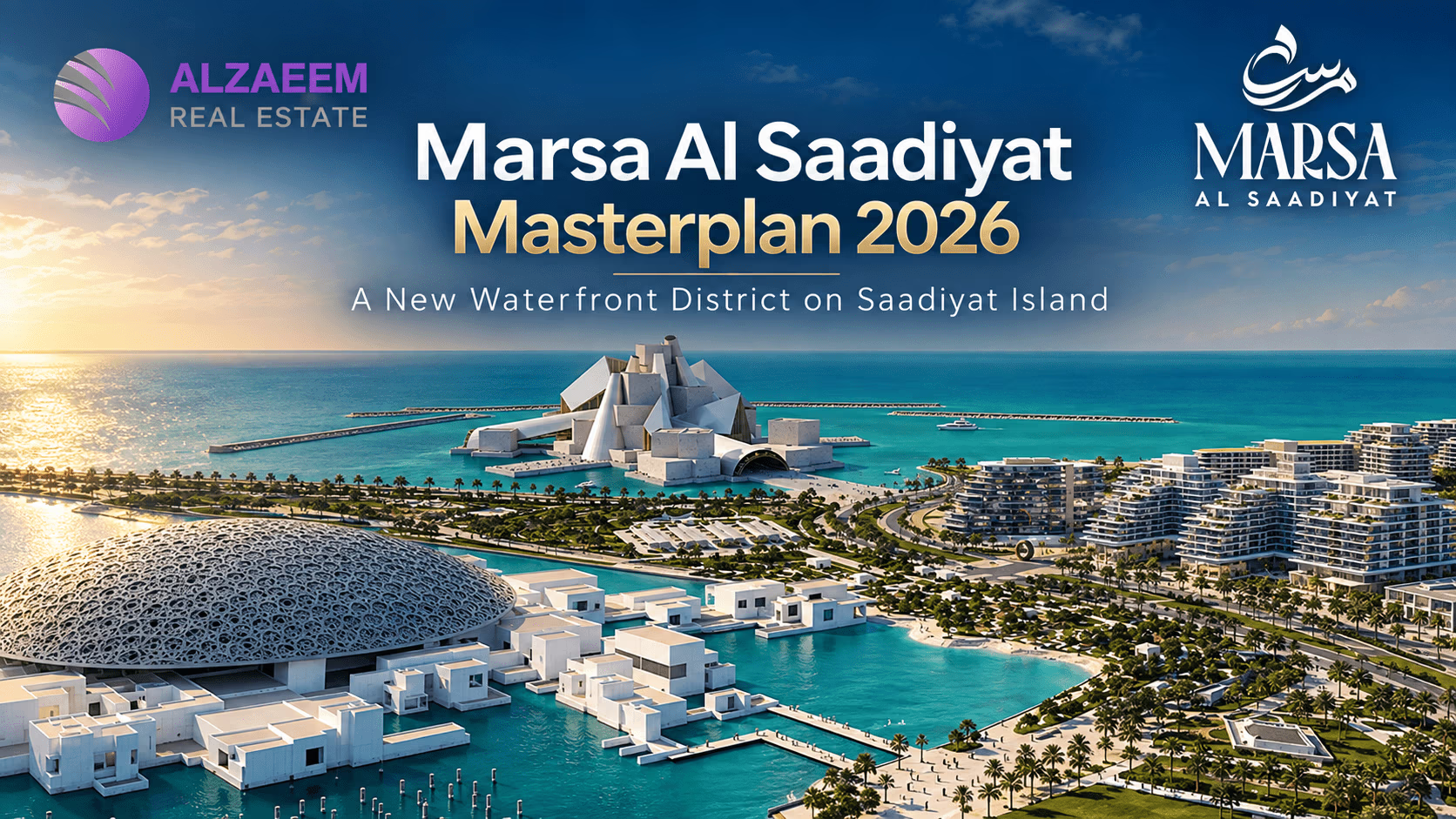
A AED 100 billion development does not arrive on an established luxury island without changing the property market around it.
But the change is unlikely to be simple.
Marsa Al Saadiyat could strengthen Saadiyat Island property values by adding infrastructure, waterfront amenities, transport connections, population, retail, hospitality and a major marina.
At the same time, it will introduce a substantial new generation of:
apartments;
villas;
mansions;
and branded residences
that will compete with existing Saadiyat homes for the same premium buyers and tenants.
So Marsa creates two opposing forces.
Destination uplift
and:
new supply.
Which one ultimately dominates will vary by project, property type and exact unit.
That is why the correct question is not:
“Will Marsa make all Saadiyat property more expensive?”
It is:
“Which existing Saadiyat properties are most likely to benefit from Marsa — and which could face greater competition?”
That distinction matters enormously for existing owners and new investors.
Quick Answer
Marsa Al Saadiyat is likely to increase the strategic value of Saadiyat Island as a complete destination, but it should not be expected to raise every property price equally.
Its AED 100 billion masterplan adds approximately 6.4 million sq m of development, 8 km of waterfront, 5.6 km of beaches, Abu Dhabi’s largest marina, a major park system, retail and hospitality, new transport connections and a planned underground high-speed rail station. More than 58,000 residents are ultimately planned.
Those improvements can increase the island’s overall attractiveness.
But Saadiyat is also one of six districts expected to account for 77% of Abu Dhabi’s incremental residential supply through 2030.
Therefore:
the strongest existing properties may become more valuable because Marsa makes the island better;
while:
generic or highly substitutable properties may face stronger competition because Marsa gives buyers newer alternatives.
Saadiyat Is Already a High-Value Market Before Marsa
Marsa is not rescuing an undeveloped or weak property market.
Saadiyat was already one of Abu Dhabi’s strongest residential districts before Marsa was announced.
ADREC reported AED 13.3 billion of residential sales on Saadiyat Island during H1 2026, second only to Hudayriyat among the districts highlighted in its residential sales breakdown. Across Abu Dhabi, residential sales reached AED 70.4 billion in the same period.
This matters because Marsa’s effect starts from:
an already valuable base.
The development is more likely to deepen and broaden Saadiyat’s market than create it from scratch.
For the wider residential context, buyers can also review Al Zaeem’s Saadiyat Island property guide.
Saadiyat Is Not One Property Market
One of the biggest mistakes investors make is talking about:
“the Saadiyat price”
as though the entire island has one valuation.
It does not.
Different projects already command dramatically different pricing because they provide different:
locations;
views;
brands;
building quality;
beach access;
unit formats;
and buyer profiles.
ADREC’s official 2025 Saadiyat project-level snapshot illustrates this clearly. Its published average sales-price-per-square-metre figures included approximately AED 42,000/sq m for The Row Saadiyat, AED 47,000–52,000/sq m for Mamsha Al Saadiyat and AED 93,000/sq m for Four Seasons Private Residences. These are 2025 project-level benchmarks rather than current 2026 quotations, but the dispersion demonstrates how strongly Saadiyat values already vary by product.
Marsa will probably increase this segmentation rather than eliminate it.
Marsa Could Create a New Price Anchor for Saadiyat
This may be one of its most important effects.
When a major premium masterplan launches new homes at:
AED X per square metre,
existing buyers immediately begin comparing.
If Marsa launches substantially above existing Saadiyat projects, owners may say:
“If a new Marsa residence costs AED X, perhaps my completed waterfront residence should be worth more.”
This creates a price-anchor effect.
New-development pricing can influence expectations around older properties even before many transactions occur.
But price anchoring cuts both ways.
If Marsa offers:
newer construction;
better amenities;
more flexible payment plans;
and stronger views
at pricing close to existing property, older projects may need to compete more aggressively.
New Launch Prices Can Re-Rate Existing Property
Imagine, purely as an example, that a future premium Marsa apartment launches significantly above comparable completed Saadiyat apartments.
Existing owners may benefit because:
their homes suddenly appear relatively affordable.
A completed residence has additional advantages:
physical inspection;
immediate occupancy;
existing rental evidence;
known service charges;
and no construction wait.
That can produce a relative-value trade.
Some buyers who cannot justify Marsa’s launch premium may move toward:
existing Saadiyat inventory.
In that situation:
Marsa indirectly increases demand for ready property.
But Marsa Could Also Make Older Property Look Dated
The opposite can happen.
A buyer compares an older apartment with:
a newly built Marsa residence;
modern lobby;
current interiors;
new technology;
better landscaping;
new waterfront amenities;
and the latest wellness facilities.
Suddenly the existing property looks:
older.
That does not necessarily cause its price to fall.
But it may limit how quickly its value rises unless the older property possesses another advantage such as:
better beach access;
larger floor plan;
lower service charges;
stronger view;
or materially lower price.
This is why Marsa is likely to reward differentiated existing property and pressure generic stock.
Marsa Can Increase the Value of the Saadiyat Brand
A property receives value from:
the residence itself
and:
the destination around it.
Marsa adds considerable destination infrastructure.
The government-announced masterplan includes more than 58,000 future residents, three schools, healthcare facilities, approximately 140 km of walking routes, a 46 km cycling network, a major marina, beaches, hotels, dining, retail and cultural infrastructure.
Aldar also highlights a 73,800 sq m Central Park and a waterfront-oriented lifestyle built around the marina, promenade and Cultural District access.
If delivered successfully, those features make:
Saadiyat Island itself more useful.
That can support property values beyond Marsa’s boundaries.
The Population Effect
More than 58,000 residents represent:
tens of thousands of potential customers;
school families;
employees;
restaurant users;
shoppers;
and participants in the island’s daily economy.
A location containing:
expensive property
but:
limited everyday activity
can remain dependent on destination visitors and occasional residents.
A location with a large permanent population creates:
economic depth.
Retail becomes more viable.
Restaurants gain year-round customers.
Services improve.
Transport demand increases.
Schools become sustainable.
More businesses have reason to operate nearby.
That can improve Saadiyat’s overall residential appeal.
The Marina Effect
Marsa’s planned marina is expected to accommodate up to 350 boats and luxury yachts and is described by the Abu Dhabi Government as the emirate’s largest marina.
A successful marina can become an island-wide amenity rather than something used only by Marsa residents.
Existing Saadiyat owners could gain access to:
new restaurants;
waterfront activity;
hospitality;
yacht facilities;
public spaces;
and another lifestyle destination.
This creates what real-estate investors might call:
amenity spillover.
You do not necessarily need to own the marina-front apartment to benefit from the marina being nearby.
Marsa Could Make Saadiyat More Comparable to Global Waterfront Districts
The combination of:
major culture;
luxury hotels;
beaches;
marina;
high-end residential property;
education;
and transport
makes Saadiyat easier for international investors to benchmark against established luxury waterfront districts elsewhere.
That matters because the future buyer pool is increasingly global.
ADREC reported that resident expatriates and non-resident foreign buyers together accounted for 70% of Abu Dhabi residential sales value during H1 2026.
Foreign direct investment in Abu Dhabi real estate reached AED 13.8 billion during H1 2026, with non-resident investors from 116 nationalities.
Marsa may make the Saadiyat proposition even simpler to communicate internationally:
culture + beach + marina + luxury residence.
That can broaden demand.
International Demand Can Support Existing Property Too
An international buyer attracted to Marsa may arrive in Abu Dhabi intending to buy:
Marsa.
Then discover:
Mamsha;
Cultural District;
Hidd;
Saadiyat Beach;
or other existing communities.
This is common in property markets.
A flagship development generates:
attention.
Attention creates:
search.
Search creates:
comparison.
Comparison can direct capital into adjacent or existing inventory.
Marsa therefore has the potential to function partly as:
a marketing engine for the entire island.
Infrastructure May Be the Most Powerful Long-Term Value Driver
Luxury property advertising focuses heavily on:
views;
pools;
marinas;
and architecture.
But infrastructure often has the deeper economic effect.
Marsa is planned to connect with Reem Island and Umm Yifeenah Island through a new network of roads and tunnels, while a future underground Etihad Rail high-speed station forms part of the masterplan.
Separately, Abu Dhabi has continued expanding transport infrastructure around Saadiyat and Reem. In March 2026, DMT opened two new marine bridges linking Reem Island to Sheikh Khalifa Bin Zayed Highway, designed to reduce peak travel time by around 15 minutes on the affected route.
Better connectivity changes the island’s relationship with:
central Abu Dhabi;
Reem Island;
employment;
and potentially the wider UAE.
Accessibility Can Expand the Buyer Pool
Imagine two identical luxury residences.
Property A requires a difficult daily commute.
Property B offers:
similar lifestyle
with:
much easier access to employment and the wider city.
Property B can appeal to more:
full-time residents.
That matters because an island relying mostly on:
second-home buyers
has a narrower market than one appealing to:
permanent professionals and families.
If Marsa’s infrastructure improves Saadiyat-wide accessibility, existing projects may benefit through:
greater full-time residential demand.
The Planned Rail Station Could Change the Island’s Perception
The underground high-speed station is particularly important conceptually.
Saadiyat has historically been perceived primarily as:
an island destination.
Rail connectivity could eventually make it part of a broader inter-emirate mobility network.
But investors must remain disciplined.
The station is:
planned infrastructure.
Its final timetable and realised property-value effect are not yet known from the Marsa masterplan announcement.
Therefore, it should be treated as:
future upside
rather than:
current value already delivered.
The Construction Period Could Temporarily Work Against Values
Large masterplans create disruption before they create maturity.
Construction may introduce:
noise;
traffic;
temporary visual disruption;
construction vehicles;
unfinished roads;
and nearby building activity.
Existing property close to major works may therefore experience:
a period when the Marsa effect is not entirely positive.
This is normal.
The value curve can look something like:
announcement excitement → construction disruption → infrastructure delivery → community activation → mature destination.
Investors should not assume the property-value impact will be linear.
2026–2030 May Be a Transition Period
The Marsa announcement gives investors a useful framework for thinking about time.
In the early period, values may be influenced mainly by:
expectations;
new-launch pricing;
and investor sentiment.
As infrastructure becomes visible, the market can begin pricing:
actual progress.
Later, when residents move in and amenities operate, buyers can judge:
real usage;
traffic;
retail quality;
views;
rental demand;
and community experience.
That makes post-delivery evidence much more important than marketing expectations.
New Supply Is the Counterweight to Everything Positive
Marsa’s strongest value risk is simple:
it creates a lot more property.
ADREC expects Abu Dhabi’s residential stock of roughly 409,000 units to increase by around 71,000 units through 2030. Saadiyat is one of six districts driving 77% of this incremental supply.
That means existing Saadiyat owners should not automatically assume:
more infrastructure = less competition.
They will receive:
better destination quality
and:
more competing homes.
Both are true.
Supply Competition Will Not Affect Every Property Equally
Imagine an existing apartment that is:
small;
internally facing;
poorly maintained;
and similar to hundreds of future units.
Marsa may create strong competition.
Now imagine a completed property with:
direct beach;
rare protected view;
large floor plan;
excellent building reputation;
and limited substitutes.
Marsa could actually strengthen its value because:
the island becomes better
without creating an exact replacement.
This creates a powerful rule:
the more replaceable your property is, the greater the competitive risk from Marsa.
Existing Waterfront Property May Benefit From “Completed Scarcity”
Future Marsa waterfront residences may be extremely desirable.
But they may require:
years of construction;
large future instalments;
and development risk.
An existing waterfront Saadiyat home offers:
water today.
A buyer can inspect:
the view today;
the beach today;
the building today;
and potentially collect:
rent today.
That can create a premium for:
completed scarcity.
Marsa may therefore strengthen rather than weaken demand for certain ready waterfront assets.
Mamsha and Established Prime Beachfront Property
Established premium projects near Saadiyat’s beach and Cultural District may benefit from a stronger island destination because Marsa adds:
population;
restaurants;
transport;
and global visibility.
At the same time, future buyers will compare these existing homes with brand-new Marsa waterfront residences.
Therefore, the effect is likely to depend on:
price difference;
service charges;
view;
beach access;
and the quality of the existing building.
An older premium asset does not automatically lose.
It needs to demonstrate:
why it remains worth buying.
Cultural District Apartments Could Experience a Different Effect
Saadiyat Cultural District is more:
museum- and urban-lifestyle-led.
Marsa is more:
marina- and waterfront-led.
These are complementary propositions rather than perfect substitutes.
A buyer wanting immediate adjacency to:
Louvre Abu Dhabi;
Zayed National Museum;
Guggenheim Abu Dhabi;
and Cultural District urban life
may still prefer a Cultural District apartment.
A buyer prioritising:
marina;
beach;
waterfront;
and family masterplan living
may choose Marsa.
That means Marsa can broaden Saadiyat’s product range rather than simply cannibalise the Cultural District.
Villa Communities May Face Directer Competition
Existing Saadiyat villa owners should watch Marsa carefully.
The masterplan includes:
private mansions;
luxury villas;
and an elevated hillside community of standalone villas.
Future villa launches could therefore compete directly with existing family-oriented Saadiyat homes.
A buyer comparing two villas will examine:
plot size;
age;
privacy;
community maturity;
school access;
beach access;
architecture;
and price.
New Marsa villas may win on:
modernity.
Existing communities may win on:
maturity;
larger plots;
or immediate use.
New Villas Could Raise the Island’s Price Ceiling
Competition is not the only possible effect.
Suppose Marsa introduces villas at substantially higher prices than existing Saadiyat communities.
This could establish a new luxury benchmark.
Owners of existing high-quality villas may then find that:
their property appears inexpensive
relative to:
new inventory.
That can support repricing.
This is another reason large luxury launches can simultaneously create:
competition
and:
valuation uplift.
Branded Residences Could Raise the Ultra-Prime Ceiling Further
Marsa’s planned mix includes branded residences.
Luxury branded property often sells at a premium because buyers are paying for:
name;
service;
design;
hospitality;
and international recognition.
If future Marsa branded residences transact at very high prices, they could expand the perceived upper end of the Saadiyat market.
But those prices should not automatically be applied to:
unbranded existing property.
A new benchmark influences expectations.
It does not erase product differences.
Marsa Could Create More Price Segmentation, Not Less
The likely outcome is not:
“All Saadiyat rises by 15%.”
Real markets rarely work that way.
Instead, Marsa could make Saadiyat increasingly segmented into categories such as:
ultra-prime branded;
prime marina;
prime beachfront;
Cultural District urban;
family villa;
park-front;
and more conventional residential property.
Each category may develop:
different PSF;
rental yield;
buyer depth;
and appreciation patterns.
The island becomes more sophisticated.
Rental Values Could Also Be Affected
Property values are partly supported by:
rental economics.
Marsa could influence rents through both:
demand creation
and:
new rental supply.
The positive case is that more:
business activity;
hospitality;
culture;
restaurants;
schools;
and residents
draw more people who want to live on Saadiyat.
The negative case is that thousands of new homes eventually provide tenants with:
more alternatives.
The outcome will depend on:
tenant demand growth relative to completed supply.
Existing Rental Properties May Benefit Before Marsa Is Fully Delivered
During construction, employees, contractors, professionals and people attracted to Saadiyat may create additional rental demand.
At the same time:
new Marsa units are not yet available to rent.
This can create an interim period where:
demand increases
before:
full competing supply arrives.
If that occurs, existing ready properties could enjoy:
stronger occupancy;
rent;
or tenant selection.
It is a plausible mechanism rather than a guaranteed outcome.
After Handover, Rental Competition May Intensify
When large numbers of new apartments begin completing, tenants can compare:
new Marsa;
existing Saadiyat;
Cultural District;
and other island communities.
The newest properties may initially attract tenants through:
launch incentives;
fresh interiors;
or newer amenities.
Existing landlords may need to compete through:
price;
maintenance;
furnishing;
view;
and tenant service.
This is where high-quality management becomes part of investment performance.
Service Charges Could Influence Which Properties Win
A new Marsa apartment may offer:
spectacular facilities.
But premium facilities cost money.
If service charges are materially higher than older Saadiyat alternatives, some investors may prefer:
existing property.
If the Marsa amenities generate significantly stronger rent and resale demand, the additional costs may be justified.
The eventual comparison should always use:
net return
rather than:
brochure quality.
Marsa May Shift Saadiyat From Destination to City District
This is perhaps the biggest conceptual change.
Saadiyat has long been known as:
a cultural and luxury island.
Marsa’s scale moves it further toward:
a complete city district.
More than 58,000 residents, internal education, healthcare, parks, marina, retail, hotels, roads and rail create something much broader than:
a collection of luxury developments.
That can alter how buyers perceive the entire island.
Instead of asking:
“Would I live on Saadiyat?”
more people may begin asking:
“Which part of Saadiyat should I live in?”
That is a very different stage of market maturity.
Market Maturity Usually Creates More Comparisons
As destinations mature, property buyers become:
more selective.
Early in a location’s development, simply owning:
“Saadiyat property”
may be enough to attract attention.
In a mature market, buyers ask:
Which neighbourhood?
Which building?
Which developer?
Which view?
Which floor?
Which service charge?
Which school?
Which beach?
Which marina?
Which transport connection?
Marsa can therefore increase total Saadiyat value while making:
weak individual assets easier to identify.
Which Existing Properties May Benefit Most?
The most likely beneficiaries are properties possessing advantages Marsa cannot easily commoditise.
That could include completed homes with exceptional protected views, genuine direct beach frontage, large or efficient layouts, scarce plots, established building reputation, strong service-charge economics or prime Cultural District positioning.
This is an analytical framework rather than a prediction that any specific project must appreciate.
Which Properties Could Face More Pressure?
Properties may be more exposed where they are:
highly replaceable;
poorly maintained;
priced close to much newer alternatives;
dependent mainly on the Saadiyat name rather than unit quality;
or lack strong permanent advantages.
In those cases, Marsa gives buyers:
more choices.
More choice generally increases the need for:
competitive pricing.
The “Marsa Premium” May Eventually Spill Into Existing Saadiyat
Suppose future Marsa releases establish very high pricing.
Existing sellers may attempt to raise asking prices in response.
Some will succeed.
Some will not.
The difference will depend on whether buyers view the properties as:
genuine substitutes.
An owner should not say:
“Marsa costs AED X, therefore my property is worth AED Y.”
The correct comparison adjusts for:
age;
view;
floor plan;
facilities;
location;
completion status;
service charges;
and property condition.
Asking Prices Are Not Transaction Prices
Another important warning.
A Marsa launch price or an owner’s listing price does not automatically prove:
market value.
The strongest evidence comes from:
registered transactions.
ADREC’s market reports are particularly useful because their findings are derived from registered transaction data with filtering and geographic methodology.
As Marsa transactions accumulate, investors will eventually be able to evaluate:
actual resale;
not merely:
marketing prices.
The Development Could Change Saadiyat’s Investment Narrative
Before Marsa, an investor might summarise Saadiyat as:
culture + beach + luxury.
After Marsa matures, the thesis may become:
culture + beach + luxury + marina + large resident population + stronger transport + integrated daily life.
That is a broader demand proposition.
Broader demand can reduce reliance on:
one buyer segment.
This could support long-term resilience.
Marsa Could Also Increase Saadiyat’s Exposure to Luxury Cycles
There is another side.
A larger inventory of:
luxury villas;
mansions;
premium apartments;
and branded residences
means more capital concentrated in:
premium housing.
Luxury markets can be sensitive to:
wealth cycles;
international investment;
financing conditions;
and global sentiment.
Marsa therefore potentially strengthens Saadiyat’s luxury identity while also increasing the island’s sensitivity to luxury-market competition.
What Happens If Abu Dhabi’s Market Slows?
This is an important stress test.
H1 2026 was exceptionally strong.
Residential sales reached AED 70.4 billion, repeat-sale apartment prices increased 20% year-on-year and villas 12%.
Suppose that momentum slows.
Which Saadiyat properties remain desirable?
Probably those with:
genuine scarcity;
quality;
usable layouts;
strong location;
and realistic pricing.
Large masterplans tend to expose the difference between:
good property
and:
good market conditions.
Investors should own the former.
A Three-Phase Marsa Effect
A useful way to think about the impact is through three broad stages.
| Stage | Likely Market Effect |
|---|---|
| 2026–Early Development | Announcement effect, new price anchors, investor attention |
| Construction & Infrastructure | Growing visibility, temporary disruption, evolving comparisons |
| Mature Marsa | Actual marina, retail, residents, transport and delivered supply determine long-term effect |
The dates will vary by project and infrastructure delivery, so this is an analytical framework rather than an official timetable.
Phase 1: The Announcement Effect
This is where we are now.
Buyers see:
AED 100B.
8 km waterfront.
marina.
rail.
beaches.
The result is increased:
attention.
Existing Saadiyat owners may become more optimistic.
Developers may achieve stronger pricing.
International investors may investigate the island.
But very little of Marsa’s physical value has been delivered yet.
This phase is driven heavily by:
expectations.
Phase 2: The Construction Effect
As roads, landscaping, buildings and marina infrastructure become visible, expectations turn into:
evidence.
Buyers can judge whether:
execution matches ambition.
Some existing properties may benefit from:
visible infrastructure.
Others may experience:
construction inconvenience.
This is likely to be the most uneven part of the value cycle.
Phase 3: The Operational Effect
Eventually the market will judge:
actual Marsa.
Are the restaurants busy?
Are schools attractive?
Is the marina active?
Are the beaches well maintained?
Does transport work?
Do people want to live there full time?
Are apartments renting?
Are villas reselling?
This is the point when:
marketing narrative
becomes:
real-estate performance.
How Existing Owners Should Respond
Existing Saadiyat owners do not necessarily need to sell simply because Marsa creates new competition.
Instead, they should understand what differentiates their property.
Ask whether your home offers something the future Marsa supply may not easily replicate.
Then monitor:
registered transaction values;
new launch pricing;
new rental competition;
infrastructure progress;
and comparable resale stock.
Marsa should trigger:
analysis.
Not panic.
How New Buyers Should Respond
A new buyer considering Saadiyat now has a more complicated decision.
You can choose:
ready existing property;
Cultural District off-plan;
Marsa;
villa;
apartment;
or future branded residence.
That is positive.
More choice allows better matching between:
property
and:
investment objective.
Buyers can compare current opportunities through Al Zaeem’s Abu Dhabi properties for sale and off-plan properties.
The Most Important Question for an Existing Property
Ask:
What does my property have that Marsa cannot easily replace?
Possible answers might include:
completed beachfront;
specific Cultural District location;
rare layout;
larger established plot;
mature landscaping;
known service charges;
immediate rental income;
or a protected view.
If the answer is:
“nothing except Saadiyat Island,”
future competition deserves more attention.
The Most Important Question for a Marsa Buyer
Ask:
Am I paying a sensible price for Marsa’s future — or paying today as though all of that future has already been delivered?
That is the other side of the same equation.
Existing property has:
maturity risk largely behind it.
Marsa has:
development upside ahead of it.
The price should reflect the difference.
Marsa Impact Scorecard for Existing Saadiyat Owners
| Factor | Positive for Existing Property | Competitive Risk |
|---|---|---|
| New marina | Better island amenities | New marina-front homes |
| Beaches | Destination strengthening | More beachfront alternatives |
| Roads/tunnels | Better connectivity | May make Marsa easier to access |
| Rail station | Wider buyer pool | Premium shifts toward Marsa |
| Retail/hotels | More lifestyle depth | New mixed-use competition |
| 58,000+ residents | Stronger island economy | Large housing supply |
| New luxury launches | Higher price anchors | Newer specifications |
| Branded residences | Raises prestige ceiling | Competes for HNW buyers |
| Schools/healthcare | Supports families | Strengthens new family districts |
| Cultural connectivity | Reinforces Saadiyat | More choices around culture |
The effect is clearly:
two-sided.
Frequently Asked Questions
Will Marsa Al Saadiyat increase Saadiyat Island property prices?
It could support island-wide values by improving infrastructure, amenities, population depth and international recognition, but it will also introduce significant new residential supply. The effect should vary by individual property.
How much is Marsa Al Saadiyat worth as a development?
The announced gross development value is AED 100 billion.
How large is Marsa Al Saadiyat?
Approximately 6.4 million square metres.
Does Saadiyat already have strong property demand?
Yes. ADREC recorded AED 13.3 billion in Saadiyat residential sales during H1 2026.
Are Abu Dhabi property prices currently rising?
ADREC reported H1 2026 repeat-sale apartment prices up 20% year-on-year and villas up 12% across Abu Dhabi.
Does that mean Saadiyat will rise 20%?
No. Those are emirate-wide repeat-sale statistics, not a forecast for an individual Saadiyat project.
Can new Marsa prices push existing property prices higher?
Potentially. High new-build prices can create new market anchors and make existing completed property appear relatively attractive.
Can Marsa reduce values of older properties?
It could increase competition for older or less differentiated stock, especially where new Marsa properties offer better quality at similar pricing.
Which existing properties may benefit most?
Properties with scarce permanent advantages such as strong waterfront, beach, protected views, large plots, efficient layouts or exceptional Cultural District positioning may be better placed.
Will Marsa create too much supply?
That cannot be concluded today. Saadiyat is a major future supply district, but supply must be evaluated relative to demand growth. ADREC expects six districts including Saadiyat to account for 77% of projected incremental supply through 2030.
Could the marina improve existing Saadiyat values?
Potentially, because it adds another major lifestyle and hospitality destination available to the wider island.
Could the Etihad Rail station affect property values?
Potentially, if delivered and well integrated, but the station remains planned infrastructure and its exact property-value effect cannot currently be quantified.
Will Cultural District property compete directly with Marsa?
Partially. Cultural District is more culture- and urban-apartment-led, while Marsa is more waterfront-, marina- and family-community-led.
Will existing villas face competition?
Yes. Marsa includes new villas, mansions and hillside residences, creating alternatives for premium family buyers.
Could existing villas still appreciate?
Yes. Mature communities, large plots, immediate use and scarcity can remain valuable even as new supply arrives.
Should an existing Saadiyat owner sell before Marsa launches?
There is no general reason to do so. The decision depends on the individual asset, price, holding strategy and alternatives.
Is ready property safer than Marsa off-plan?
Ready property provides greater current certainty. Marsa offers more future-development upside but greater delivery and maturity risk.
Will Marsa affect rents?
Likely, but in two directions: stronger island activity may increase rental demand, while new completed units will eventually increase tenant choice.
When will Marsa’s full property-value impact become clear?
Probably progressively as infrastructure and residential phases are delivered. The full effect cannot be judged from the 2026 announcement alone.
What should investors monitor most closely?
Registered transaction prices, new-launch pricing, handover supply, rental absorption, infrastructure delivery and the price gap between new Marsa inventory and established Saadiyat property.
What is the biggest mistake?
Assuming:
Marsa is good for Saadiyat, therefore every Saadiyat property must rise.
Final Takeaway
Marsa Al Saadiyat has the potential to change the economics of Saadiyat Island substantially.
It adds:
AED 100 billion of development;
6.4 million sq m;
8 km of waterfront;
5.6 km of beaches;
Abu Dhabi’s largest marina;
58,000+ future residents;
major parks;
schools and healthcare;
retail and hospitality;
new road connectivity;
and:
a planned high-speed rail station.
That can make Saadiyat:
more connected;
more populated;
more useful;
more internationally recognisable;
and more economically complete.
Those are powerful foundations for property values.
But Marsa also creates:
more villas;
more apartments;
more branded residences;
more waterfront homes;
and more choices.
That creates competition.
So the most likely outcome is not:
every Saadiyat property rises equally.
It is:
Saadiyat becomes more valuable as a destination while becoming more selective as a property market.
The best existing properties may benefit significantly because Marsa strengthens the island without perfectly replacing their scarcity.
Generic property may face tougher comparisons.
And the best Marsa homes themselves could establish entirely new value benchmarks.
That leaves investors with one core principle:
The Marsa effect will reward differentiation.
Existing owner?
Know what makes your property difficult to replace.
New Marsa buyer?
Make sure the feature you are paying a premium for will still be scarce after thousands of new homes have been built.
Because in a mature Saadiyat market, the question will no longer be:
“Is it on Saadiyat?”
It will be:
“Why should I buy this particular Saadiyat property instead of all the others?”
That is where future value will be decided.
Al Zaeem Real Estate — Position for the Next Phase of Saadiyat
Marsa Al Saadiyat changes the investment map of the island, but it does not make every property decision obvious.
Al Zaeem Real Estate helps buyers and owners compare:
existing Saadiyat property;
new Cultural District projects;
future Marsa opportunities;
ready vs off-plan;
waterfront premiums;
villa and apartment supply;
and long-term resale positioning.
Explore the wider Saadiyat Island market, Abu Dhabi properties for sale, off-plan opportunities, apartments for sale and villas for sale.
The objective is not simply to invest:
before Marsa grows.
It is to own the property that should remain desirable:
because Marsa grew.
Al Zaeem Real Estate
+971 (50) 991 5454
azcb.co
Primary Official Sources
The Marsa masterplan facts—including AED 100 billion GDV, 6.4 million sq m, 8 km waterfront, beaches, 58,000+ residents, marina, residential mix and transport connections—come from the official Abu Dhabi Government launch announcement.
Aldar’s official Marsa masterplan page provides current detail on the Central Park, waterfront positioning and wider lifestyle concept.
ADREC’s H1 2026 market report provides the residential-sales figures, Saadiyat sales value, price trends and forward supply data used throughout this analysis.
ADREC’s 2025 official market report provides the historical project-level Saadiyat price benchmarks used to demonstrate how widely values already differ across the island.
Disclaimer
This article is provided for general educational and real-estate research purposes only. It does not constitute investment, financial, legal, mortgage, valuation, contractual or tax advice.
The analysis describes potential mechanisms through which Marsa Al Saadiyat could influence existing Saadiyat property values. It is not a prediction that any individual project, villa or apartment will rise or fall by a specific amount.
The AED 100 billion figure refers to the announced gross development value of the complete Marsa Al Saadiyat masterplan.
Project-level Saadiyat price figures cited from ADREC’s 2025 report are historical benchmarks and should not be treated as current September 2026 asking prices or valuations.
Current or future Marsa launch pricing, rental performance, capital appreciation and resale liquidity will vary by individual development and property.
Planned infrastructure, including the Etihad Rail station and future transport connections, should not be treated as completed infrastructure until operational.
Past Abu Dhabi and Saadiyat market performance does not guarantee future returns.
Last reviewed: 13 September 2026.