


One of the easiest ways to make an expensive property look affordable is to advertise the first payment instead of the total financial obligation.
A buyer sees:
5% down payment
and thinks:
“I only need AED 100,000 to buy this AED 2 million property.”
Technically, that may be true at reservation.
Financially, it can be dangerously incomplete.
The same AED 2 million property might require another:
AED 700,000 during construction;
AED 1.2 million at handover;
or a combination of instalments spread over several years.
That is why experienced off-plan buyers do not ask only:
“What is the down payment?”
They ask:
“When exactly does every dirham become due?”
In Abu Dhabi in 2026, developers are using a wide range of payment structures, including:
- 55/45
- 40/60
- 50/50
- 60/40
- 70/30
- 35/65
- post-handover plans
- multiple alternative plans for the same development
The percentages look simple.
The financial consequences are not.
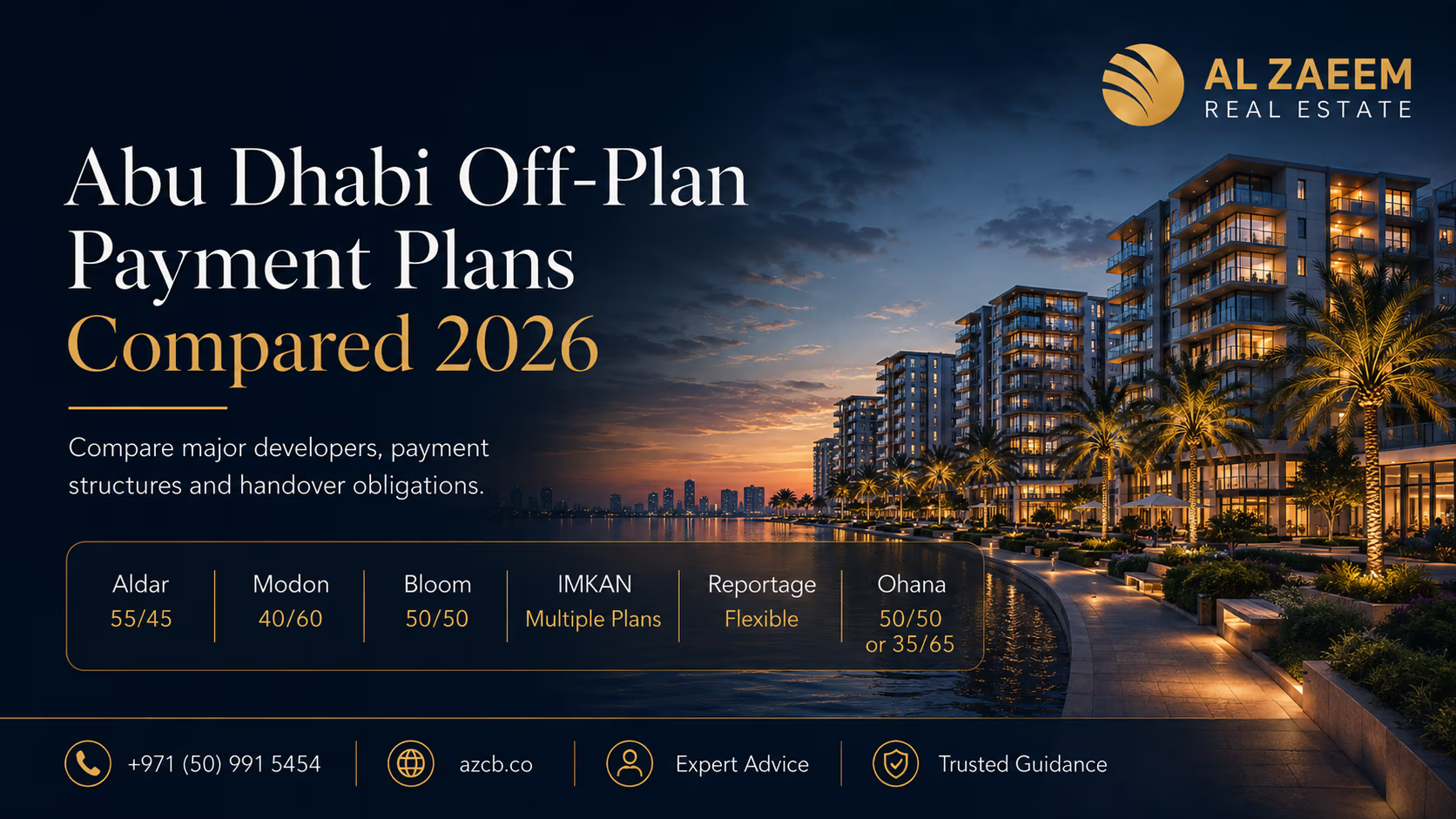
This guide compares current publicly available payment-plan examples from Aldar, Modon, Bloom, IMKAN, Reportage and Ohana, and explains how buyers should evaluate them before reserving an off-plan property.
Quick Answer
Current official 2026 project pages demonstrate substantial differences between Abu Dhabi developers.
| Developer | Current Example | Structure |
|---|---|---|
| Aldar | The Canopies / Al Ghadeer Parks | 55/45, 5% down |
| Modon | Tara Park | 40/60, 5% booking |
| Bloom | Granada II | 5% down + 45% construction + 50% handover |
| Bloom | Granada alternative | 5% + 35% construction + 40% handover + 20% over 2 years |
| IMKAN | Naseem AlJurf | 60/40, 40/60, 50/50, 70/30 or full payment |
| Ohana | Manchester City Yas Residences | 50/50 or 35/65 |
| Reportage | Varies by project/campaign | Verify unit-specific current offer |
Aldar currently lists a 55/45 structure with a 5% down payment at both The Canopies and Al Ghadeer Parks.
Modon’s Tara Park currently uses a 40/60 structure consisting of 5% booking, 35% staggered payments and 60% on completion.
Bloom’s Granada II currently displays 5% down, 45% during construction and 50% at handover, while another current Granada page shows an alternative plan that pushes 20% into two years after handover.
IMKAN currently offers several different structures at Naseem AlJurf rather than forcing every buyer into one payment plan.
Ohana’s Manchester City Yas Residences currently displays both 50/50 and 35/65 options.
The key lesson is therefore:
there is no universal Abu Dhabi off-plan payment plan.
And even within the same developer, there may be no universal structure.
What Does 40/60 Actually Mean?
A 40/60 payment plan normally means:
40% before completion
and
60% at completion or handover.
But the 40% itself may be divided into several instalments.
For example, Tara Park currently states:
5% on booking;
35% staggered;
60% on completion.
For an AED 2 million apartment:
| Stage | Percentage | Amount |
|---|---|---|
| Booking | 5% | AED 100,000 |
| Construction instalments | 35% | AED 700,000 |
| Completion | 60% | AED 1,200,000 |
| Total | 100% | AED 2,000,000 |
The marketing headline may be:
“Only 5% to book.”
The more important number is:
AED 1.2 million due at completion.
That is the amount the buyer needs to plan around.
What Does 55/45 Mean?
Aldar currently uses a 55/45 structure at selected developments including The Canopies at Yas Point and Al Ghadeer Parks.
Both current official project pages also state a 5% down payment.
For a hypothetical AED 2 million property:
55% before handover = AED 1.1 million
45% around handover = AED 900,000
The advantage compared with a 40/60 structure is that the final balloon is smaller.
The disadvantage is obvious:
you must fund more money during the construction period.
Neither structure is inherently better.
The question is:
Which cash-flow pattern suits you?
What Does 50/50 Mean?
A 50/50 plan splits the price approximately equally between construction and handover.
This is currently one of the structures available at Manchester City Yas Residences.
Ohana’s official project site shows a 50/50 option built around:
5% booking;
5% on signing the SPA;
multiple 5% instalments;
and 50% on delivery.
For an AED 4 million residence:
50% before delivery = AED 2 million
50% on delivery = AED 2 million
Again, “5% booking” is not the real affordability question.
The buyer needs to know whether AED 2 million will be available when the property completes.
The Handover Balloon Is the Number Buyers Underestimate
Consider three AED 2 million properties.
Property A — 55/45
Final payment:
AED 900,000
Property B — 50/50
Final payment:
AED 1,000,000
Property C — 40/60
Final payment:
AED 1,200,000
Same property price.
Very different handover liquidity requirement.
This is why payment plans influence investor behaviour.
A buyer with strong income but limited current cash may prefer a larger final payment.
A cash-rich buyer may prefer to pay more earlier and reduce completion risk.
Aldar Payment Plans in 2026
Aldar does not use one universal structure across every development.
However, two important current official examples share the same payment profile.
The Canopies at Yas Point
Current official terms include:
55/45 payment plan
5% down payment
estimated handover in 2030.
Al Ghadeer Parks
Current official terms include:
55/45 payment plan
5% down payment
expected Q2 2031 handover.
Buyer interpretation
Aldar’s current 55/45 examples create a relatively balanced structure.
The buyer pays slightly more than half before completion while keeping 45% for the final stage.
That may suit investors who:
want staged construction exposure;
do not want a 60–70% completion balloon;
and expect to have financing or cash available by handover.
But the specific instalment dates still matter.
A percentage split is only the summary.
The actual schedule in the SPA determines cash flow.
Modon Payment Plans in 2026
Modon commonly uses 40/60 and 50/50 structures across its current portfolio.
Its own FAQ describes these as common Modon payment-plan formats.
Examples currently listed on Hudayriyat include:
| Project | Payment Plan |
|---|---|
| Hudayriyat Golf Estates | 40/60 |
| Bashayer | 50/50 |
| Al Naseem | 40/60 |
| Nawayef Village | 50/50 |
| Nawayef Park Views | 60/40 |
| Nawayef East | 40/60 |
That is useful because Modon gives buyers several different financial profiles even within Hudayriyat.
Tara Park: A Clear 40/60 Example
Modon currently gives unusually clear detail for Tara Park.
The official structure is:
5% booking
35% staggered
60% completion
with no alternative payment structure currently offered.
This is exactly the kind of disclosure buyers should look for.
It tells you not merely the headline split but where the money is due.
Hudayriyat Golf Estates
Hudayriyat Golf Estates currently uses a 40/60 payment plan across its various residential formats, including townhomes, villas and mansions, with current project material showing Q3 2030 handover.
The percentage is the same whether the asset is an approximately AED 4–5 million home or a much more expensive mansion.
But the absolute completion liability is dramatically different.
For example:
AED 5 million home
60% final payment:
AED 3 million
AED 25 million property
60% final payment:
AED 15 million
This is why percentage-based marketing can be misleading psychologically.
Your bank account operates in dirhams.
Not percentages.
Bloom Payment Plans in 2026
Bloom is particularly interesting because its current official material demonstrates both conventional and post-handover structures.
Granada II
Current Bloom pages show:
5% down
45% during construction
50% at handover.
That creates a straightforward 50/50 economic split after the initial booking is included within the pre-handover portion.
Granada Post-Handover Option
A current Granada page also displays:
5% down
35% during construction
40% at handover
20% over two years after handover.
This is materially different.
For a AED 2 million property:
| Stage | Amount |
|---|---|
| 5% initial | AED 100,000 |
| 35% construction | AED 700,000 |
| 40% handover | AED 800,000 |
| 20% post-handover | AED 400,000 |
The final AED 400,000 is deferred beyond completion.
That can be extremely useful to some buyers.
Why Post-Handover Plans Are Attractive
A post-handover structure can allow the property to begin generating rent while the buyer is still paying part of the purchase price.
Suppose the apartment hands over and earns:
AED 100,000 per year.
If AED 400,000 remains payable over two years, some rental income can help support those future instalments.
But there is an important warning:
rental income is not guaranteed.
The buyer still owes the instalment even if:
the unit is vacant;
rent is lower than expected;
the tenant pays late;
or maintenance costs arise.
So rental income should be treated as support.
Not as the only repayment strategy.
IMKAN Payment Plans in 2026
IMKAN currently offers perhaps the clearest example of buyer choice.
At Naseem AlJurf, its official site currently lists:
60/40
10% on signing
50% construction
40% completion
40/60
10% on signing
30% construction
60% completion
50/50
10% on signing
40% construction
50% completion
70/30
10% on signing
60% construction
30% completion
Full Payment
100% on signing, with IMKAN stating that a special rate applies.
This is one of the strongest examples of how the same development can suit several buyer liquidity profiles.
Which IMKAN Plan Is Better?
There is no universal winner.
70/30
Best suited to a buyer who:
has substantial current liquidity;
wants a smaller completion obligation;
and may receive a better commercial offer for earlier payment.
40/60
Better suited to someone who:
wants to preserve cash today;
expects higher future liquidity;
or plans to finance near completion.
50/50 or 60/40
More balanced.
The right choice depends on:
cash;
income;
expected investment returns elsewhere;
mortgage plans;
and risk tolerance.
IMKAN Also Uses Long Post-Completion Structures
Selected AlJurf villa pages currently advertise extended plans.
For example, Rawya displays options including:
10% signing;
30% through construction/completion;
with 60% paid through post-completion instalments under four- or five-year structures.
Other AlJurf villa products also display post-completion options.
That can materially reduce the handover cash burden.
But longer payment periods should be evaluated against:
purchase price;
any premium attached to the plan;
rental potential;
opportunity cost;
and whether ownership/transfer conditions are affected.
Ohana Payment Plans in 2026
Manchester City Yas Residences provides two current official options.
Option One — 50/50
The published schedule includes:
5% booking;
5% SPA down payment;
a sequence of 5% instalments;
50% on delivery.
Option Two — 35/65
The published schedule includes:
5% booking;
30% upon signing the SPA;
65% on delivery.
These two plans produce dramatically different cash-flow behaviour.
50/50 vs 35/65 at AED 4 Million
50/50
Paid before delivery:
AED 2 million
Delivery balance:
AED 2 million
35/65
Paid before delivery:
AED 1.4 million
Delivery balance:
AED 2.6 million
The 35/65 structure preserves AED 600,000 more liquidity during construction.
But it increases completion exposure by the same amount.
That can be advantageous if you have a clear financing plan.
Dangerous if you do not.
Reportage Payment Plans
Reportage has historically built a strong market reputation around flexible payment arrangements.
Older official campaigns have included structures such as monthly instalment offers.
However, current official project brochures for developments such as Selina Bay and Royal Park primarily publish project specifications rather than one universal current 2026 payment structure.
For that reason, it would be inaccurate to write:
“Reportage’s 2026 payment plan is X.”
There is no reliable universal figure.
A Reportage buyer should request the current dated:
- price list;
- sales offer;
- reservation form;
- payment schedule;
- and SPA terms
for the specific unit.
This is good practice with every developer, but particularly important when promotional campaigns change frequently.
Never Compare Payment Plans Without Comparing Prices
This mistake is extremely common.
Imagine:
Property A
AED 2.0 million
40/60
Property B
AED 2.3 million
60/40
Someone may prefer Property B because the completion payment is smaller.
But Property B costs:
AED 300,000 more.
Payment flexibility should never distract from price.
The better question is:
How much am I paying for the property itself?
Then:
How conveniently am I allowed to pay it?
In that order.
A Payment Plan Is Not a Discount
This distinction matters enormously.
Suppose:
Property value = AED 2 million.
Developer allows five years to pay it.
You have not necessarily saved money.
You have received payment flexibility.
If another comparable property costs AED 1.8 million but needs faster payment, the cheaper property may still be financially superior.
A long payment plan can have real economic value.
But that value must be calculated rather than assumed.
How Much Is a Payment Plan Worth?
Money available today is generally more valuable than the same amount due several years later because the buyer can:
invest it;
earn interest or returns;
maintain liquidity;
or deploy it elsewhere.
Therefore, a deferred payment has an economic benefit.
For sophisticated investors, two properties should sometimes be compared using the present value of the instalment schedule, not simply headline purchase price.
For most retail buyers, you do not need a complicated financial model.
But you should at least recognise:
AED 1 million due today is not financially identical to AED 1 million due in four years.
What Happens If You Need a Mortgage at Handover?
This is one of the biggest off-plan risks.
A buyer may purchase today assuming:
“I will finance the final 60%.”
But the mortgage is normally assessed later.
By handover:
your income may change;
bank lending criteria may change;
interest/profit rates may change;
your credit profile may change;
the property’s valuation may differ from purchase price.
Suppose you owe:
AED 1.2 million.
But the bank valuation supports less financing than expected.
The shortfall becomes your responsibility.
This is why buyers should maintain a contingency reserve.
The Valuation Gap Risk
Imagine:
Purchase price:
AED 2.5 million
Final payment:
AED 1.5 million
At completion, the bank values the property at only:
AED 2.3 million
If financing is calculated on the lower valuation, the buyer may receive less financing than originally expected.
The buyer must cover the gap.
This risk is often ignored during launch excitement.
What If Property Prices Rise Before Handover?
This is the attractive side of off-plan leverage.
Suppose you buy for:
AED 2 million.
You have paid only:
AED 800,000.
By completion, comparable value reaches:
AED 2.4 million.
You have gained exposure to AED 400,000 of appreciation without having paid the full price throughout construction.
That is one reason investors like off-plan property.
But leverage works in both directions.
If values fall, the remaining payment is still contractually due.
Can You Sell Before Handover?
Possibly.
But this depends on the project and SPA.
Developers may require:
a certain percentage of the purchase price to be paid;
an NOC;
administrative charges;
assignment approval;
or other conditions.
This matters enormously when comparing payment plans.
If you intend to exit before handover, ask before buying:
At what payment percentage can I assign this unit?
If the answer is 40%, and your payment schedule reaches 40% only after two years, you may have less flexibility than expected.
Post-Handover Plans vs Mortgages
Both spread the financial obligation over time, but they are not the same.
Developer post-handover plan
Paid directly according to the developer schedule.
Potential advantages:
simpler structure;
may avoid immediate mortgage process;
can provide payment flexibility.
Potential disadvantages:
shorter repayment period;
large instalments;
may carry a higher property price;
limited refinancing flexibility.
Mortgage
Usually extends over many years.
Potential advantages:
lower monthly burden;
longer amortisation;
greater capital efficiency.
Potential disadvantages:
financing cost;
bank approval;
valuation risk;
eligibility requirements;
mortgage registration expenses.
The best structure depends on the buyer.
Which Payment Plan Is Best for Investors?
70/30
Useful when:
you have substantial liquidity;
you want lower completion exposure;
you may receive an attractive early-payment price.
60/40 or 55/45
Useful for:
balanced cash flow;
buyers who want moderate leverage;
lower final balloon.
50/50
Simple and balanced.
40/60 or 35/65
Useful when:
you want to preserve capital during construction;
you expect mortgage or liquidity later.
Higher risk if future financing is uncertain.
Post-handover
Useful when:
cash-flow flexibility is important;
the property can potentially begin producing rent before all instalments finish.
Which Plan Is Best for an End User?
An owner-occupier often has a different objective.
They may already own another property and plan to:
sell it near handover;
release savings gradually;
or arrange a mortgage.
For them, a larger handover payment can sometimes make sense because they do not need to deploy the entire purchase capital several years before moving in.
But certainty is more important than maximum leverage.
A family should avoid creating a handover obligation that depends on an optimistic future event.
Comparing AED 2 Million Across Common Plans
| Plan | Pre-Handover | Handover |
|---|---|---|
| 70/30 | AED 1.4M | AED 600K |
| 60/40 | AED 1.2M | AED 800K |
| 55/45 | AED 1.1M | AED 900K |
| 50/50 | AED 1.0M | AED 1.0M |
| 40/60 | AED 800K | AED 1.2M |
| 35/65 | AED 700K | AED 1.3M |
This table reveals the issue immediately.
The property price does not change.
The timing of financial pressure does.
Payment Plans and Opportunity Cost
Imagine you have AED 1 million.
Developer A requires you to pay all of it relatively early.
Developer B lets you retain AED 500,000 for three additional years.
That AED 500,000 can potentially remain:
in savings;
invested;
inside your business;
or available as emergency liquidity.
That flexibility has value.
But only if the second property is otherwise competitively priced.
Do not pay AED 300,000 extra merely to avoid paying AED 500,000 earlier unless the economics support it.
The Cheapest Payment Plan May Hide the Most Expensive Property
Marketing teams understand buyer psychology.
These headlines are powerful:
1% monthly
only 5% down
pay 60% on handover
three-year post-handover plan
But the investor must ignore the headline long enough to calculate:
Total Price ÷ Area
and then compare that with:
ready property;
resale property;
competing developer launches;
and expected rental income.
Payment terms should optimise a good deal.
They should not justify a bad deal.
Questions to Ask Before Accepting Any Payment Plan
Before signing, ask:
- What is the exact total purchase price?
- How much is due today?
- When is the SPA payment due?
- What are every subsequent instalment date and amount?
- Are instalments linked to construction milestones or calendar dates?
- What percentage is due before handover?
- What exact amount is due at handover?
- Is there a post-handover plan?
- Does the post-handover option change the purchase price?
- Is there a discount for full or accelerated payment?
- Can I mortgage the handover balance?
- Is mortgage approval guaranteed?
Usually not. - When can I assign or resell?
- What minimum payment is required before assignment?
- What transfer/NOC fees apply?
- What happens if an instalment is late?
- What happens if handover is delayed?
- Can the payment plan be changed later?
- Are there administrative fees outside the advertised purchase price?
- What is my backup plan if financing is unavailable?
A payment plan should be understood before the reservation is paid.
Not afterwards.
Developer Payment Plans Compared
Aldar
Current selected examples:
55/45 with 5% down.
Best fit: buyers wanting a relatively balanced construction/handover split.
Modon
Current examples span:
40/60, 50/50 and 60/40, depending on project.
Best fit: buyers wanting different payment structures across Hudayriyat/Reem inventory.
Bloom
Current examples include:
5/45/50
and
a plan with 20% post-handover over two years.
Best fit: family/community buyers and investors seeking selected post-handover flexibility.
IMKAN
Current Naseem AlJurf choices include:
60/40, 40/60, 50/50, 70/30 and 100%, with other AlJurf pages also offering multi-year post-completion schedules.
Best fit: buyers wanting maximum flexibility in how capital is deployed.
Reportage
Current payment terms vary materially by project, stock and sales campaign, and current official project brochures do not support one universal 2026 plan.
Best fit: buyers should request a current unit-specific dated offer and compare it against the total price.
Ohana
Manchester City Yas currently offers:
50/50 or 35/65.
Best fit: buyers comfortable with significant delivery-stage capital requirements.
Frequently Asked Questions
What is the most common Abu Dhabi off-plan payment plan?
There is no single standard. Current major projects use structures including 40/60, 50/50, 55/45, 60/40 and other variations.
What does 40/60 mean?
Usually 40% is paid before completion and 60% around handover, although exact instalment timing varies by developer.
What does 50/50 mean?
Approximately half the purchase price is paid before handover and half at completion.
Is 5% down payment good?
It reduces initial cash required, but it tells you almost nothing about the total affordability of the property.
Which Aldar projects currently offer 55/45?
Current official examples include The Canopies at Yas Point and Al Ghadeer Parks, both also listing 5% down payments.
What payment plan does Modon offer?
It varies. Current Modon projects include 40/60, 50/50 and 60/40 examples.
Does Bloom offer post-handover plans?
Current Granada information includes an option with 20% payable over two years after handover.
Does IMKAN offer multiple payment plans?
Yes. Naseem AlJurf currently lists several alternatives from 40/60 through 70/30 plus full payment.
What is Ohana’s Manchester City Yas payment plan?
The current official site lists 50/50 and 35/65 options.
Does Reportage have a 1% monthly plan?
Reportage has historically marketed flexible monthly-payment offers, but buyers should not assume an older promotion applies to current 2026 inventory. Obtain the exact current plan for the specific unit.
Is a post-handover plan better than a mortgage?
Not automatically. Developer post-handover schedules and mortgages have different durations, costs and eligibility requirements.
Can I finance the final payment with a mortgage?
Potentially, subject to bank eligibility, valuation, project eligibility and lending conditions at the time.
What happens if the bank valuation is lower than my purchase price?
You may need to contribute additional cash because financing may be calculated from the bank’s accepted valuation rather than your original purchase price.
Can I resell an off-plan unit before paying 100%?
Often yes, but developer assignment conditions vary. Some require a minimum percentage to be paid first.
Which payment plan is best?
The best plan is the one that fits your cash flow without causing you to overpay for the property itself.
Final Takeaway
A payment plan can make an off-plan purchase easier.
It can improve liquidity.
It can reduce the amount of capital tied up during construction.
It can even allow a property to begin generating income while some instalments remain outstanding.
But it does not change the most important financial fact:
you still have to pay 100% of the purchase price.
The real questions are:
How much?
When?
From where will that money come?
A 5% booking payment may be easy.
The 60% handover instalment may not be.
A post-handover plan may look attractive.
But rent may not cover it.
A 70/30 plan may reduce future risk.
But it may tie up more capital today.
There is therefore no universally best payment plan.
The strongest payment structure is the one that:
fits your current liquidity;
matches your expected future cash flow;
leaves a realistic contingency reserve;
supports your investment strategy;
and sits behind a property that is already worth buying at its actual price.
Choose the property first.
Then optimise how you pay for it.
Speak With Al Zaeem Before Choosing a Payment Plan
Al Zaeem Real Estate can compare Abu Dhabi off-plan inventory across Aldar, Modon, Bloom, IMKAN, Reportage, Ohana and other developers — including both the property economics and the payment schedule.
A buyer should know not only:
“How much do I need today?”
but also:
“How much will I need every year until I own the property completely?”
Al Zaeem Real Estate: +971 (50) 991 5454
Disclaimer
Payment plans, booking percentages, instalment schedules, project prices and financing eligibility can change and may differ between units within the same project.
Examples in this guide are based on publicly available developer information reviewed in September 2026. Current official pages show the stated structures at the time of review, but buyers should rely on the dated reservation form, SPA and payment schedule issued for the specific property they intend to purchase.
This article is for general educational and property-research purposes only and does not constitute financial, legal, mortgage, tax or investment advice.