



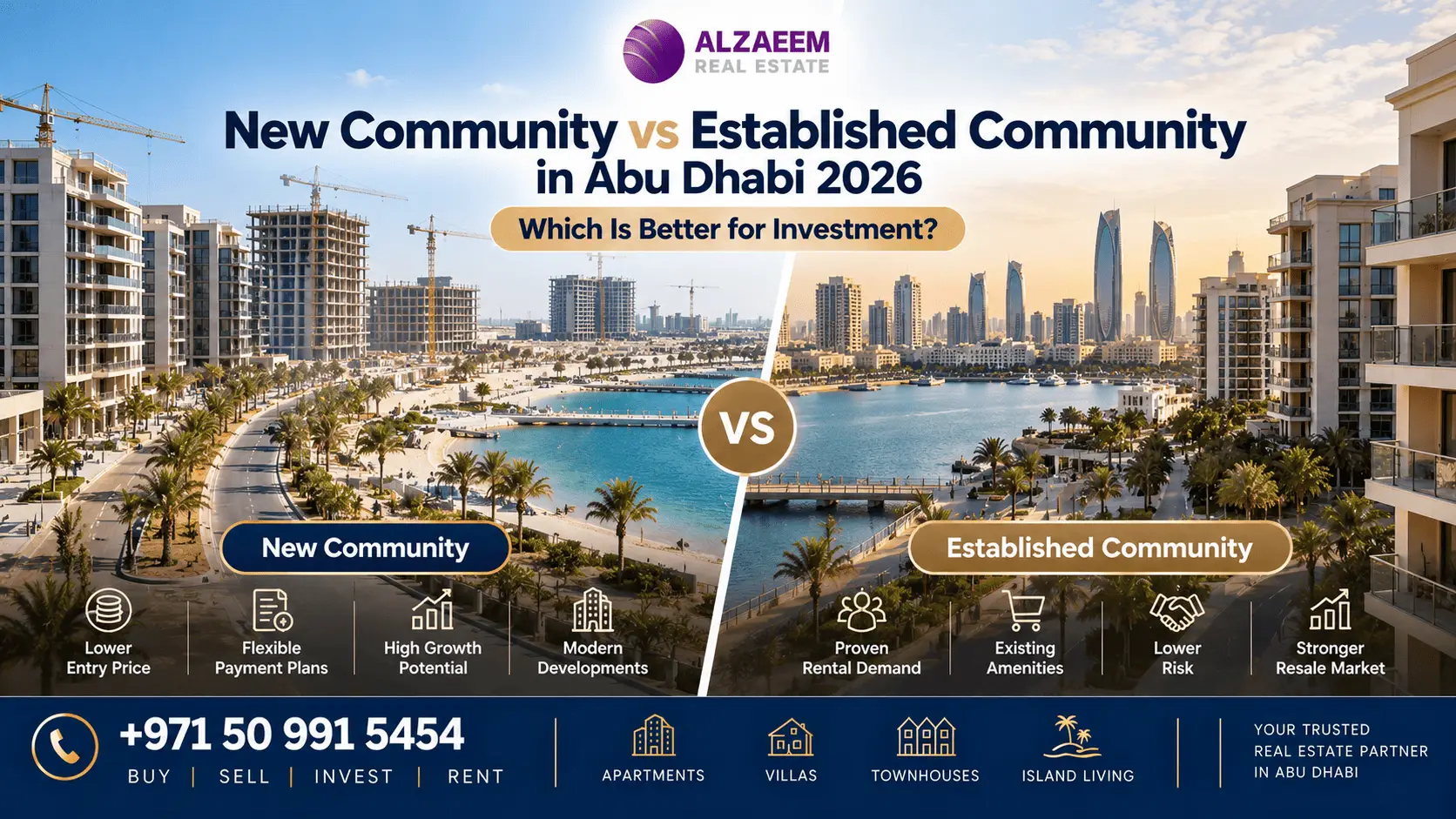
Abu Dhabi investors frequently face a fundamental choice.
Do you buy into a new or emerging community where much of the future value still has to be created?
Or do you buy into an established community where the roads, residents, amenities, rental market and transaction history already exist?
Both strategies can work.
But they generate returns in very different ways.
A new community may offer:
- earlier entry pricing;
- modern product;
- attractive payment plans;
- future infrastructure;
- stronger long-term transformation potential.
An established community may offer:
- visible rental demand;
- completed amenities;
- real transaction comparables;
- immediate occupancy;
- lower development uncertainty.
The correct question is therefore not:
Is new better than established?
It is:
Which type of community better matches your investment objective, holding period and tolerance for uncertainty?
This distinction matters because location maturity is one of the most important variables in Abu Dhabi property investment.
Our broader Abu Dhabi Property Buying Guide 2026 explains why investors should evaluate not only the property itself, but also the maturity, infrastructure, demand profile and future supply of the surrounding location.
What Is a New or Emerging Community?
A new community is generally a destination where a substantial portion of the masterplan is:
- recently launched;
- under construction;
- still being delivered;
- or not yet fully occupied.
The area may eventually contain:
- schools;
- retail;
- parks;
- hotels;
- restaurants;
- waterfront promenades;
- transport infrastructure;
- community facilities.
But at the time of purchase, some of these may still exist primarily on:
- masterplans;
- developer timelines;
- construction schedules.
That creates both opportunity and uncertainty.
What Is an Established Community?
An established community already has a functioning residential ecosystem.
Typically, investors can physically evaluate:
- roads;
- landscaping;
- buildings;
- supermarkets;
- schools;
- restaurants;
- parks;
- traffic patterns;
- tenant demand;
- rental prices;
- resale transactions.
Examples of more mature Abu Dhabi residential markets include parts of:
- Yas Island;
- Al Reem Island;
- Al Raha Beach;
- established Saadiyat communities.
An established market offers something extremely valuable:
Evidence.
Instead of asking what the community might become, investors can observe what it already is.
Why New Communities Attract Investors
New communities are usually purchased around a future-value thesis.
The investor is effectively saying:
I am buying before the destination reaches full maturity.
If the community successfully develops, several things may improve over time:
- population;
- retail;
- road connectivity;
- public realm;
- schools;
- community reputation;
- tenant demand;
- buyer confidence.
That process can create capital appreciation.
But it does not happen automatically.
Advantages of Buying in a New Community
1. Earlier Entry Into the Growth Cycle
One of the strongest arguments for emerging communities is entry timing.
Suppose an area currently has:
- limited completed housing;
- major infrastructure under development;
- several future amenities planned.
The investor may enter before the destination becomes widely established.
If the masterplan succeeds, later buyers may be willing to pay more once the community becomes:
- visible;
- occupied;
- landscaped;
- connected;
- socially established.
This is the classic:
buy before maturity
strategy.
2. Newer Product
Emerging communities often offer recently designed property.
That may mean:
- modern layouts;
- better amenities;
- contemporary façades;
- newer technology;
- newer kitchens and bathrooms;
- stronger sustainability standards;
- better community planning.
Newness itself can improve leasing and resale appeal.
But investors should still analyse individual layouts carefully.
A new apartment with an inefficient floor plan can still underperform an older but better-designed unit.
Our Abu Dhabi Property Floor Plan Efficiency Guide 2026 explains how to evaluate usable space instead of being impressed by total square footage alone.
3. Developer Payment Plans
Many new communities are sold off-plan.
That means buyers may receive staged payment structures.
Instead of paying 100% immediately, the investor may pay across:
- booking;
- construction milestones;
- handover;
- sometimes post-handover periods.
This can reduce the initial cash requirement.
But a payment plan should not be confused with affordability.
The future balance still has to be funded.
Our Abu Dhabi Off-Plan Payment Plans Explained 2026 explains why investors must evaluate the full commitment rather than focusing only on the booking amount.
4. Potential Community-Maturity Appreciation
A property can increase in desirability simply because its surrounding environment becomes better.
At launch, a community may have:
- construction traffic;
- incomplete landscaping;
- little retail;
- few residents.
Several years later, the same area may contain:
- mature landscaping;
- schools;
- cafés;
- supermarkets;
- occupied buildings;
- functioning parks;
- established transport links.
That transition can create value.
Our Abu Dhabi Property Holding Period Guide 2026 discusses community maturity as an important long-term investment catalyst. azcb.co
5. Wider Choice During Early Launches
Early-stage buyers may have access to:
- more floors;
- more layouts;
- better views;
- better orientations;
- corner units;
- premium villa plots.
That allows strategic unit selection.
Later buyers may have to choose from remaining stock.
But early choice is valuable only if the investor knows how to identify the stronger unit.
Our How to Choose the Best Off-Plan Unit in Abu Dhabi provides a framework for evaluating:
project → building → stack → floor → layout → view → price → exit liquidity.
Risks of Buying in a New Community
The opportunity comes with uncertainty.
1. Masterplan Execution Risk
A masterplan may look exceptional.
But investors must distinguish between:
- completed amenities;
- under-construction amenities;
- planned amenities.
These are not the same thing.
A brochure is not an operating community.
2. Construction Environment
Early residents may live near:
- active construction;
- unfinished roads;
- temporary access routes;
- dust;
- noise;
- undeveloped neighbouring plots.
This can temporarily affect rental attractiveness.
3. Rental Demand Is Less Proven
A new project can sell extremely well without yet proving its long-term leasing market.
Sales demand and rental demand are different.
Our Abu Dhabi Property Demand Drivers 2026 explains why strong off-plan sales should not automatically be interpreted as future occupancy or rental absorption. azcb.co
4. Many Units May Complete Together
This is a major risk.
Suppose a new development contains:
1,500 apartments.
If hundreds complete during the same period, many owners may immediately attempt to:
- rent;
- resell.
That can create competition.
Even an excellent project can experience short-term pressure if supply arrives faster than tenant demand.
5. Less Reliable Transaction History
In a mature market, investors may have years of:
- sale transactions;
- rental comparables;
- vacancy data;
- service-charge history.
In a new community, much of that evidence may not yet exist.
Valuation becomes more dependent on assumptions.
Advantages of an Established Community
Established locations operate differently.
The investor is buying evidence rather than primarily buying future expectation.
1. Proven Rental Market
You can often inspect:
- current asking rents;
- signed lease comparables;
- vacancy;
- tenant profile;
- renewal behaviour.
That makes rental underwriting more reliable.
For income-oriented investors, this can be extremely important.
2. Immediate Rental Income
A ready property in an established community can potentially begin generating income immediately after:
- acquisition;
- preparation;
- tenant placement.
There may be no multi-year construction wait.
That improves cash-flow visibility.
3. Existing Infrastructure
Established communities allow buyers to physically inspect:
- roads;
- parks;
- supermarkets;
- schools;
- beaches;
- restaurants;
- community facilities.
You are not relying entirely on future delivery.
This significantly reduces one form of investment uncertainty.
4. Real Resale Evidence
Perhaps the biggest advantage is transaction history.
You may be able to compare:
- similar buildings;
- similar unit sizes;
- previous sales;
- asking prices;
- achieved rents.
This helps investors estimate fair market value more accurately.
It also reduces dependence on launch marketing.
5. Established Community Reputation
Mature destinations develop a market identity.
Tenants and buyers may already understand what living there means.
That supports:
- search demand;
- leasing;
- resale familiarity.
Al Raha Beach is a useful example of an established waterfront market with mature residential stock and an operating rental ecosystem, which we analyse separately in our Al Raha Beach Property Investment Guide 2026. azcb.co
Disadvantages of Established Communities
Established does not automatically mean better.
1. Maturity May Already Be Priced In
If the area is already:
- completed;
- popular;
- highly occupied;
- proven,
the market may already understand its value.
That can reduce some speculative upside.
2. Older Buildings
Some established areas contain ageing stock.
Investors may need to evaluate:
- façade condition;
- mechanical systems;
- elevators;
- common areas;
- kitchens;
- bathrooms;
- maintenance history.
An older unit at the right price can still be excellent.
But age matters.
3. Competition From Newer Developments
New projects may offer:
- better gyms;
- newer pools;
- smart-home systems;
- improved layouts;
- hotel-style amenities.
An older building must compete through:
- price;
- space;
- location;
- view;
- lower cost;
- mature community advantages.
4. Less Flexible Payment Structure
Ready property normally requires substantially more capital upfront.
Buyers may need:
- cash;
- mortgage approval;
- transfer fees;
- immediate completion funding.
That can make ready property less accessible than staged off-plan purchases.
New Community vs Established Community — Quick Comparison
| Factor | New / Emerging Community | Established Community |
|---|---|---|
| Entry stage | Earlier | Mature |
| Product age | Usually new | Mixed |
| Payment plans | Often available | Less common |
| Rental evidence | Limited initially | Stronger |
| Immediate income | Usually delayed | Often possible |
| Amenities | May be incomplete | Mostly visible |
| Transaction history | Limited | Stronger |
| Development uncertainty | Higher | Lower |
| Capital-growth potential | Can be stronger | More measured |
| Resale predictability | Lower initially | Usually stronger |
| Construction exposure | Higher | Lower |
| Community reputation | Developing | Established |
Neither column automatically wins.
The Investment Difference: Certainty vs Future Upside
This is probably the simplest way to understand the decision.
Emerging Community
You are buying:
future potential.
Established Community
You are buying:
current evidence.
The stronger investor knows which one they need.
New Communities Can Produce Higher Growth — But Not Automatically
Investors frequently assume:
New area = higher appreciation.
That is too simplistic.
For appreciation to occur, something meaningful must improve.
That may include:
- infrastructure;
- population;
- amenities;
- connectivity;
- scarcity;
- destination reputation.
If the investor already pays a very high launch price reflecting all future expectations, the upside may be limited.
Established Communities Can Still Appreciate
Maturity does not mean zero growth.
An established area can continue benefiting from:
- broader Abu Dhabi market growth;
- limited supply;
- infrastructure improvements;
- new attractions;
- increasing rents;
- population growth.
Yas Island is particularly interesting because it combines an existing residential and lifestyle ecosystem with continued new development.
That means an area can be:
established + still growing.
Our Best Abu Dhabi Areas for Rental Income vs Capital Growth 2026 examines this distinction in more detail. azcb.co
Illustrative Investment Example
Consider two 2-bedroom properties.
Property A — Emerging Community
Purchase price:
AED 2,000,000
Current annual rent at completion estimate:
AED 120,000
Gross yield:
6.0%
The investor expects future value creation from:
- new amenities;
- community maturity;
- improving infrastructure.
Property B — Established Community
Purchase price:
AED 2,100,000
Current annual rent:
AED 140,000
Gross yield:
6.67%
Property B costs:
AED 100,000 more
but generates:
AED 20,000 more annual rent.
On current income alone, the established property appears stronger.
But Property A may offer greater capital upside if the new community develops successfully.
This demonstrates why investors should separate:
income return
from
future appreciation thesis.
Illustrative figures only.
Income Investors May Prefer Established Communities
If your primary objective is:
- stable rent;
- predictable occupancy;
- immediate cash flow,
a mature location often offers better evidence.
You can inspect:
- actual rent;
- vacancy;
- service charges;
- tenant demand.
That reduces reliance on forecasts.
Growth Investors May Prefer Emerging Communities
A longer-term investor may deliberately accept uncertainty.
Their thesis might be:
I am willing to wait five to seven years because I believe the destination will mature substantially.
That can make sense.
But the investor needs sufficient holding capacity.
If they need to sell quickly, an immature community can be more difficult.
Holding Period Is Critical
Community strategy should match holding period.
Short Holding Period
If you intend to exit in:
2–3 years
you are more dependent on:
- market sentiment;
- launch pricing;
- resale liquidity;
- construction progress.
Long Holding Period
If you intend to hold:
5–10 years
you have more time for:
- infrastructure;
- leasing;
- population growth;
- community maturity.
This is why holding period should be decided before purchasing, not after. See our Abu Dhabi Property Holding Period Guide 2026 for the full framework.
Service Charges Matter in Both Strategies
New does not automatically mean cheap to own.
A new project may include:
- resort pools;
- gyms;
- concierge;
- landscaped podiums;
- beach facilities.
These cost money to operate.
Established buildings may have known service-charge histories, making ownership costs easier to estimate.
Investors should calculate:
net yield
rather than comparing gross rent alone.
Do Not Confuse New Community With New Building
This distinction matters.
You can buy a:
New Building in an Established Community
This can offer:
- modern property;
- existing infrastructure;
- proven location.
That can be a very strong combination.
Alternatively:
New Building in a New Community
Here both the:
- property;
- destination
are unproven.
That may create greater upside — and greater uncertainty.
The Hybrid Strategy
Some of the strongest opportunities can sit between the two extremes.
Consider a new phase inside an established destination.
You may gain:
- modern product;
- new payment plan;
- established infrastructure;
- existing community reputation;
- known demand.
A current example of this broader concept can be seen in new launches inside established Yas communities. Our Best Aldar Projects in Abu Dhabi 2026 discusses how projects such as The Orchids can combine new-build housing with an already functioning destination. azcb.co
Developer Quality Matters More in New Communities
In an established community, investors can inspect what already exists.
In a new destination, more of the investment depends on future execution.
That makes developer evaluation particularly important.
Review:
- delivery history;
- previous projects;
- construction progress;
- masterplan execution;
- financial credibility;
- after-sales reputation.
Our How to Evaluate an Abu Dhabi Property Developer Before Buying Off-Plan explains the due-diligence process in more detail.
Infrastructure Should Be Categorised Properly
When reviewing a new community, divide infrastructure into three categories.
Existing
Already completed.
Under Construction
Physically being built.
Planned
Announced but not yet under construction.
Do not assign equal investment value to all three.
This distinction prevents buyers from paying today for amenities that may take years to become relevant.
Schools Matter for Family Communities
Family-oriented areas often become substantially more attractive once schools and nurseries operate nearby.
That can support:
- longer tenancies;
- owner-occupier demand;
- community stability.
If your target tenant is a family, investigate education infrastructure carefully.
Retail Changes Daily Livability
A new community without:
- supermarkets;
- cafés;
- pharmacies;
- restaurants
may initially feel inconvenient.
As retail opens, tenant willingness to live there can improve.
This is one way community maturity turns into rental value.
Landscaping Takes Time
Masterplan images often show:
- mature trees;
- dense greenery;
- fully landscaped parks.
Real communities need time to reach that appearance.
Early investors should understand that the actual experience at handover may look different from a mature marketing render.
Construction Phasing Matters
Ask:
If my building completes in 2028, how much of the surrounding masterplan will still be under construction?
A property can be completed while the wider area remains a work site.
This does not necessarily make it a poor investment.
But it affects:
- tenant experience;
- noise;
- access;
- short-term leasing.
Supply Pipeline Matters
Suppose a community will ultimately contain:
10,000 units.
Your building may be excellent.
But if thousands of competing apartments are scheduled for delivery shortly after handover, investors must consider:
- rental competition;
- incentives;
- resale supply.
Scarcity matters.
Existing Community Does Not Mean No Supply Risk
Even established locations can receive major new inventory.
For example, Abu Dhabi’s mature destinations continue to add new projects.
That means investors should never assume:
Established = fixed supply.
Analyse both:
existing stock + future pipeline.
Off-Plan Sales Are Not the Same as End-User Demand
A new project may sell out rapidly.
That proves:
buyer demand at launch.
It does not automatically prove:
- future tenant demand;
- long-term occupancy;
- secondary resale demand.
An investor needs to understand who is actually buying:
- residents;
- landlords;
- short-term investors;
- speculators.
Established Markets Offer Better Comparables
This is a major valuation advantage.
Suppose you are evaluating a 2BR apartment.
In a mature area, you may have:
- 20 recent transactions;
- multiple rental listings;
- years of price history.
In a brand-new community, comparable evidence may be far thinner.
That difference affects confidence in your valuation.
Price per Square Foot Needs Context
Emerging communities are sometimes marketed at a lower PSF than prime mature areas.
But lower PSF does not automatically mean undervalued.
Ask:
- What infrastructure exists?
- What view does the property have?
- What is the service-charge expectation?
- How much future supply is coming?
- How established is rental demand?
Our Abu Dhabi Property Price per Sq Ft Explained 2026 explains why PSF must always be interpreted in context.
Which Strategy Is Better for First-Time Investors?
For many first-time investors, established markets can be easier to understand.
Why?
Because more evidence exists.
They can compare:
- rent;
- resale;
- buildings;
- tenant demand.
However, this does not mean first-time buyers should automatically avoid new communities.
It means they should demand more due diligence.
Which Strategy Is Better for Experienced Investors?
More experienced investors may deliberately take development-stage risk when they believe:
- entry price is compelling;
- developer is strong;
- masterplan is credible;
- infrastructure catalyst is real;
- holding period is long enough.
They may be comfortable underwriting uncertainty.
New Community vs Established Community for Overseas Buyers
Overseas investors may find established areas easier to assess remotely because:
- comparable transactions exist;
- property is visible;
- tenant demand can be measured;
- community amenities are operating.
With emerging communities, the overseas investor relies more heavily on:
- official masterplans;
- developer documentation;
- professional due diligence.
Our Buying Abu Dhabi Property From Overseas guide covers the broader acquisition process.
Common Mistakes When Buying in a New Community
Mistake 1: Treating the Masterplan as Completed Reality
It is a future plan.
Mistake 2: Assuming Every New Area Will Appreciate
Growth requires real value creation.
Mistake 3: Ignoring Competing Supply
Hundreds of landlords may enter simultaneously.
Mistake 4: Buying Only Because the Payment Plan Is Easy
Payment structure does not determine investment quality.
Mistake 5: Planning a Short Exit From a Long-Term Story
Community maturity takes time.
Common Mistakes When Buying in an Established Community
Mistake 1: Assuming Mature Means Safe at Any Price
Overpaying remains overpaying.
Mistake 2: Ignoring Building Age
Community strength does not eliminate asset-level maintenance risk.
Mistake 3: Ignoring New Competition
New projects can pull tenants away.
Mistake 4: Focusing Only on Historic Performance
Past appreciation does not guarantee future appreciation.
Al Zaeem Community Investment Checklist
Before choosing a new or established community, evaluate:
Development Stage
How much is actually completed?
Developer
Who controls delivery?
Infrastructure
What exists today?
Future Infrastructure
What is under construction?
Supply
How many competing units are coming?
Rental Demand
Is it proven or forecast?
Tenant Profile
Who will actually live there?
Entry Price
Am I paying for future growth already?
Payment Plan
Can I fund all future obligations?
Holding Period
Can I wait for community maturity?
Resale Market
Who will buy from me later?
Service Charges
What will ownership cost?
Unit Quality
Is this specific property genuinely strong?
Which Is Better for Rental Income?
Generally, established communities provide greater rental visibility because:
- tenants already live there;
- leases already exist;
- amenities operate.
That does not mean they always offer higher yields.
But underwriting is easier.
Which Is Better for Capital Appreciation?
Emerging communities can have stronger appreciation potential if:
- purchased at a sensible entry price;
- infrastructure is delivered;
- demand grows;
- supply remains controlled.
But that upside is less certain.
Which Is Better for Resale Liquidity?
Established communities often have stronger immediate resale liquidity because buyers already understand them.
Emerging communities may become highly liquid later, but early-stage resale can depend heavily on:
- construction progress;
- developer inventory;
- market sentiment.
Which Is Better for End Users?
Owner-occupiers often prefer established communities when they need:
- schools now;
- supermarkets now;
- parks now;
- commuting certainty now.
Other buyers may deliberately purchase early because they want:
- new property;
- future lifestyle;
- long-term community growth.
Which Is Better for Investors?
There is no universal answer.
Choose an emerging community when:
- you have a longer holding period;
- you accept development-stage uncertainty;
- entry price is attractive;
- future infrastructure is credible;
- you believe community maturity will create value.
Choose an established community when:
- you prioritise income;
- you want immediate use;
- you value real transaction evidence;
- you prefer lower development uncertainty;
- you need stronger near-term liquidity.
Final Verdict
The difference between a new and an established Abu Dhabi community is fundamentally a difference between:
future potential and current proof.
A new community asks the investor to believe that:
- infrastructure will arrive;
- demand will grow;
- amenities will mature;
- perception will improve.
An established community allows the investor to examine:
- actual rent;
- actual roads;
- actual amenities;
- actual transactions;
- actual resident demand.
Neither strategy is automatically superior.
A strong emerging community bought too expensively can be a poor investment.
A mature community bought at the right price can still deliver excellent returns.
Likewise, an early investment in a well-executed new destination can outperform a mature market if community transformation creates genuine value.
The most important question is not:
Is this community new or established?
It is:
What am I being compensated for taking — or avoiding — community development risk?
That is the question sophisticated Abu Dhabi property investors should answer before buying.