


An investor finds two Abu Dhabi off-plan properties.
Both cost approximately:
AED 2 million.
Both offer:
modern architecture,
attractive payment plans,
premium amenities,
and a strong location.
One project comes from a developer with:
multiple completed communities,
a visible delivery record,
established after-sales systems,
and operating buildings that buyers can physically inspect.
The other comes from a newer developer with:
limited completed inventory,
an impressive presentation,
and an attractive launch price.
Which one should the investor choose?
The answer is not automatically:
“Buy from the bigger developer.”
A newer developer can deliver an excellent project.
And a well-known developer can still launch an individual project that is:
aggressively priced,
less attractive than its previous developments,
or unsuitable for your investment strategy.
The correct approach is therefore not simply to ask:
“Is this a good developer?”
Ask instead:
“Is this developer properly registered, is this specific project properly structured, what evidence exists that they can deliver what they are selling, and am I being compensated for the remaining uncertainty?”
That is developer due diligence.
And it should happen before you reserve an off-plan property.
Abu Dhabi now provides buyers with significantly more official project-level information than many investors realise. ADREC’s current framework requires developers to be registered, projects to be registered before off-plan sales, a project escrow structure to be established, and a Madhmoun licence to be obtained before the project is marketed and sold off-plan.
That regulatory framework is the starting point.
It is not the end of the analysis.
The Developer Due-Diligence Framework
Before buying from any Abu Dhabi developer, evaluate the opportunity across eight separate layers:
- Developer registration
- Project registration
- Madhmoun marketing verification
- Escrow structure
- Delivery and construction record
- Completed-project quality
- After-sales and community performance
- Commercial value of the specific project
A buyer who checks only the developer’s brand name is skipping seven of the eight.
First Rule: Evaluate the Project and the Developer Separately
This distinction is extremely important.
A strong developer can launch:
an excellent project,
an average project,
and a project that is excellent but simply too expensive at launch.
Likewise, a newer developer may offer:
a compelling location,
lower entry price,
good payment structure,
and high-quality product.
Therefore:
Developer quality does not automatically equal investment quality.
The developer helps you assess:
execution risk.
The project determines:
investment potential.
You need both.
Step 1: Verify That the Developer Is Properly Registered
Before analysing renderings, payment plans or projected ROI, confirm that the developer operates within Abu Dhabi’s official regulatory system.
ADREC’s current Developer Journey requires a real-estate developer first to hold the appropriate commercial licence and then register with ADREC. Registered developers receive a Developer ID, which is linked to their registered projects. ADREC says the registration application is reviewed for financial and compliance requirements.
That immediately gives buyers a useful principle:
A developer’s marketing presence is not the same thing as regulatory registration.
A professional website,
luxury launch event,
social-media advertising
or international sales office
should not substitute for official verification.
Main Developer vs Sub-Developer
Abu Dhabi regulations distinguish between:
main developers
and
sub-developers.
A main developer is licensed to carry out development, sale, management and leasing activities for a main development project.
A sub-developer carries out development within part of a larger master development under an agreement with the main developer or another authorised developer.
This matters because a buyer should understand:
Who owns or controls the development rights?
Who is legally selling your unit?
Who is responsible for delivering your building?
Who manages the wider master community?
Those entities may not always be the same company.
Ask for the Exact Legal Developer Name
Property marketing often uses a group or brand name.
The SPA may use a more specific legal entity.
For example, a large development group may have:
a parent brand,
a master-development company,
and individual project entities.
That is normal.
But the buyer should know exactly who the counterparty is.
Check:
legal developer name
licence number
project name
project number
and
SPA seller entity.
Do not rely only on the logo at the top of the brochure.
Step 2: Verify the Specific Project With ADREC
A registered developer does not mean every project automatically has permission to sell.
The project itself also needs to be registered.
ADREC’s current framework requires the developer to submit project information including:
unit types,
floor plans,
projected handover dates,
and pricing.
Once registered, the project receives an official Project ID, published through ADREC’s project register.
This is one of the most useful checks a buyer can perform.
ADREC’s Project Directory Is More Useful Than Many Buyers Realise
ADREC’s public directory allows users to search projects by criteria including:
project name,
project number,
municipality,
district,
community,
project type
and developer name.
Individual project records can contain information such as:
registered date
project number
project type
building use
developer name
developer licence number
completion percentage
escrow bank
and
escrow account information.
Current ADREC project records demonstrate these fields in practice.
That means a buyer can perform a meaningful regulatory check before transferring millions of dirhams.
Example of What Official Project Records Can Show
A current ADREC project record may show:
Developer:
the exact registered legal company.
Project number:
the official identifier.
Completion:
for example, 0%, 37%, 84% or 100%, depending on the registered project.
Escrow:
the bank trustee and account details where published.
Community:
the exact district and community.
This is very different from relying solely on:
“Construction is progressing well.”
Official project information gives you a concrete reference point.
Step 3: Verify the Madhmoun Permit
Before an Abu Dhabi project is marketed off-plan, the developer must obtain the relevant Madhmoun authorisation.
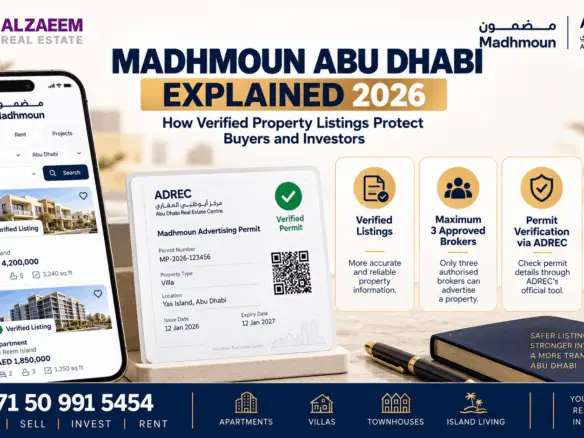
ADREC describes Madhmoun as Abu Dhabi’s verified MLS system. Under the current framework, registered off-plan projects must obtain the Madhmoun licence before marketing and sales activity begins, and licensed brokers can then advertise the project through the regulated ecosystem.
ADREC also provides a public document-verification service where a user can verify a Madhmoun Permit by permit number.
This gives buyers another simple due-diligence tool.
Why Madhmoun Verification Matters
A property advertisement can be:
beautiful,
professionally filmed,
widely shared,
and still require verification.
Madhmoun is designed to make listings:
traceable,
verified
and tied to approved property information. ADREC describes the platform as offering verified listings and authentic advertising, with real-time property information.
So if someone is aggressively selling an Abu Dhabi off-plan project, ask:
What is the Madhmoun permit or official listing reference?
A professional salesperson should not find that question unusual.
Step 4: Verify the Escrow Account
This is one of the most important financial protections in an off-plan purchase.
Abu Dhabi’s regulatory framework requires a developer wishing to sell off-plan property to establish a project escrow account.
The law defines the project escrow account as the bank account into which buyer payments for units sold off-plan and relevant project financing funds are deposited.
ADREC’s current project-development guidance states that buyer payments for off-plan units are deposited into an ADREC-approved escrow account held with an approved bank.
One Project, One Escrow Structure
Abu Dhabi’s legislation provides that an escrow account is established for the relevant development project and that the funds are allocated for the project’s construction and financing according to the regulatory framework.
Where a larger real-estate development contains projects completed in separate stages, the legislation provides for separate escrow-account treatment for those individual projects.
This means the correct question is not:
“Does the developer have an escrow account?”
It is:
“What is the escrow account for this exact project?”
Never Send Off-Plan Money Based Only on a WhatsApp Message
Before transferring money, verify:
beneficiary,
bank,
account,
project,
and payment instructions
against official developer documentation and the regulated project information.
A buyer transferring a large amount should be able to explain exactly:
where the money is going
and
why that account is authorised to receive it.
ADREC’s legal framework states that an off-plan unit should not be sold unless the required project escrow account has been opened.
Step 5: Check the Developer’s Delivery Record
Regulation tells you whether the developer and project operate within the official framework.
The next question is:
What has this developer actually delivered?
This is where brand reputation becomes evidence-based rather than emotional.
Build a simple table.
| Previous Project | Original / Announced Delivery | Actual Status | Quality | Resale / Rental Demand |
|---|---|---|---|---|
| Project A | ||||
| Project B | ||||
| Project C |
You are trying to identify a pattern.
Not one isolated success or complaint.
What Should You Look for in Delivery History?
Check:
- number of completed developments;
- size and complexity of those projects;
- whether projects were completed broadly within expected timelines;
- whether the delivered product resembles what was marketed;
- how common areas aged;
- how landscaping matured;
- whether amenities became operational;
- whether owners report persistent post-handover defects.
A developer who has delivered:
hundreds of apartments in a single small building
has a different execution record from one that has delivered:
large multi-phase communities,
infrastructure,
schools,
retail,
and thousands of homes.
That does not make one automatically better.
But project complexity should be matched to proven capability.
Use the ADREC Directory to Track Current Progress Too
ADREC project pages can display the current completion percentage for registered developments.
For example, current records in the directory show projects at a variety of stages—from newly registered projects at or near 0%, to projects showing substantial progress, to completed projects at 100%.
That provides a useful independent reference alongside:
developer construction updates,
site photographs,
and broker marketing.
Do Not Judge Delay From One Number Alone
A project being at:
40% construction
does not tell you whether it is delayed.
To evaluate timing properly, compare:
registered / contractual handover expectation
with
current construction stage
and
time remaining.
A 40%-complete development two years before expected delivery may be entirely different from one showing 40% shortly before contractual completion.
Context matters.
Step 6: Inspect the Developer’s Completed Projects
If the developer already has completed projects in Abu Dhabi:
go and see them.
This is one of the highest-value forms of due diligence.
A brochure shows:
what the developer intends to build.
A five-year-old completed building shows:
how the developer’s product actually ages.
Look at more than the lobby.
What to Inspect in a Completed Building
Check:
Façade
Does it still look premium?
Lobby
Are finishes ageing well?
Corridors
Do they feel durable or worn?
Lifts
Are there enough for the building density?
Parking
Is access sensible?
Landscaping
Did the green environment actually materialise?
Pool / gym / amenities
Are they maintained properly?
Common-area cleanliness
How does management perform?
Apartment layouts
Do completed units feel like the floorplans suggested?
Five Years Later Is More Informative Than Handover Day
Almost every new property looks attractive at completion.
The stronger test is:
What does the developer’s product look like after several years of actual occupancy?
Luxury finishes that require constant repair,
poorly planned service areas,
weak waterproofing,
or badly managed landscaping
can become visible only with time.
This is why a developer’s older communities can be a better due-diligence source than its newest show apartment.
Speak to Existing Owners and Tenants
Official information verifies the regulatory structure.
Existing residents tell you about:
operational experience.
Ask about:
defects,
maintenance response,
customer service,
handover communication,
community management,
service charges,
and building quality.
Do not rely on one review.
Look for repeated patterns.
One angry owner can exist in any large development.
Fifty owners describing the same problem deserves attention.
Developer Reputation Should Be Evidence, Not Internet Noise
Online reviews have value.
But they also contain:
sales complaints,
individual disputes,
competitor commentary,
and emotionally charged experiences.
Use them as:
leads for investigation
rather than final proof.
If several owners complain about:
AC,
water leakage,
handover delays
or after-sales service,
investigate the issue.
Do not automatically conclude that every project by the company will suffer the same outcome.
Step 7: Compare Announced Product With Contracted Product
The most beautiful brochure is not the legal agreement.
Before purchasing, distinguish between:
Marketing
Renderings
Lifestyle imagery
Brochure copy
Sales presentations
and
Contractual documentation
SPA
Approved plans
Unit schedule
Specifications
Payment schedule
Handover provisions
Your legal rights arise primarily from the transaction documents and applicable law.
Not from your emotional reaction to the launch event.
Ask What Is Actually Included
If the marketing mentions:
premium kitchen,
smart-home system,
branded appliances,
private beach access,
club membership,
or landscaped facilities,
verify which items are:
contractually included,
community facilities,
optional,
or subject to separate fees.
A developer’s reputation does not eliminate the need to read the SPA.
Step 8: Evaluate the Payment Plan — Not Just the Developer
A strong developer can still offer an investment structure that is unsuitable for you.
Suppose:
Developer A:
excellent reputation.
Payment:
10/90.
Your handover obligation:
AED 1.8 million.
Developer B:
less established.
Payment:
60/40.
Your handover obligation:
AED 800,000.
The developer-risk profile differs.
So does your personal financing risk.
The best developer cannot make an unaffordable payment schedule affordable.
Payment Flexibility Can Hide an Expensive Property
Imagine two similar projects.
Developer A
AED 2.0M
60/40.
Developer B
AED 2.3M
10/90.
The second looks easier because only a small amount is required early.
But you are agreeing to pay:
AED 300,000 more.
The right question is:
Is the developer, project and payment flexibility worth the premium?
Do not buy the payment plan instead of the property.
Step 9: Assess the Developer’s Financial Capacity Indirectly
Private developers may not publish the same detailed financial information as listed companies.
So buyers often need to assess capacity indirectly.
Look at:
existing project pipeline,
number of simultaneous developments,
construction partners,
financing arrangements where publicly disclosed,
land bank,
completed-project scale,
and evidence of construction continuing across existing projects.
You are not trying to conduct a corporate credit-rating exercise.
You are asking:
Does the developer appear operationally capable of executing this project at this scale?
Regulatory Requirements Provide Another Layer of Protection
Under ADREC’s current Developer Journey, sub-developers are required to provide a bank guarantee equivalent to 20% of total construction cost before project-registration completion.
That is useful regulatory context.
But buyers should still assess execution quality separately.
A regulatory guarantee does not tell you:
whether the layout is excellent,
whether the price is attractive,
or whether the building will become a strong resale asset.
Step 10: Investigate Construction Partners
The developer is not the only entity responsible for physical execution.
Large projects also involve:
main contractor,
consultants,
architects,
engineers,
project managers,
and specialist subcontractors.
Where publicly available, check:
who is actually building the project.
A contractor with relevant experience in:
high-rise towers,
waterfront construction,
luxury villas,
or large master communities
can add confidence.
But avoid assuming a prestigious architect automatically guarantees construction quality.
Design and execution are different functions.
Step 11: Evaluate Handover and After-Sales Systems
The relationship with the developer does not end when the building is completed.
Handover can involve:
home orientation,
snagging,
de-snagging,
final payments,
ownership registration,
key collection,
and defect reporting.
A developer with a clear, documented handover process can make this transition significantly easier.
Ask existing buyers:
How quickly were snagging issues addressed?
How organised was key collection?
Was communication clear?
Did the developer remain responsive after full payment?
Those questions matter.
A Developer Can Be Excellent at Sales and Weak at After-Sales
Launch teams are designed to:
sell.
After-sales teams are designed to:
manage the reality of ownership.
Do not confuse the two.
A polished salesperson cannot tell you how effectively the company will respond to:
a waterproofing problem
six months after handover.
Look at existing owner experience.
Step 12: Review Service-Charge History in Completed Projects
A developer can deliver beautiful amenities.
But those amenities have operating costs.
Before buying a project with:
multiple pools,
large landscaped gardens,
private beach,
concierge,
spa,
cinema,
clubhouse,
and large podium facilities,
ask:
What might it cost owners to operate all of this?
For an established developer, previous communities can provide useful context.
Not because the new project will necessarily have the same charges.
But because you can see how the developer’s design choices translate into ownership costs.
We’ll cover service charges in detail in the next article.
Step 13: Study Resale Performance of Previous Projects
This is especially important for investors.
Ask:
Do buyers still want the developer’s completed properties?
Do resale units remain liquid?
Do certain projects trade at premiums?
How quickly do units sell?
How many identical listings compete?
A developer’s strongest evidence is not:
how successfully they launch new projects.
It is:
whether buyers still value their older projects after the marketing campaign ends.
Launch Sales vs Secondary Demand
A project can sell rapidly because of:
small booking amount,
broker incentives,
international marketing,
or a powerful launch campaign.
That demonstrates primary-market demand.
But long-term investment quality is better tested by:
resale,
rent,
occupancy,
and end-user demand.
The true property market begins after the developer’s sales office is no longer the only seller.
Step 14: Examine Rental Performance
If the developer already has similar completed inventory, compare:
rent levels,
occupancy,
tenant profile,
and turnover.
A premium developer does not automatically generate premium rental yield.
High purchase prices can actually reduce yield even when rent is excellent.
You should calculate:
actual rent ÷ actual acquisition cost
rather than assigning a higher ROI merely because the developer is famous.
Step 15: Check How Much Competition the Developer Is Creating
This is an underrated risk.
Suppose you buy:
a one-bedroom apartment.
The same developer has:
four additional buildings,
another phase,
and 2,000 similar one-bedroom units coming nearby.
The developer may be excellent.
But you could still face significant:
rental competition
and
resale competition.
So ask:
How many similar units will this developer deliver before I want to sell?
How many competing developers are building nearby?
Your biggest competitor at resale may be:
the developer itself.
Developer Inventory Can Compete With Your Resale
Imagine you want to sell your unit for:
AED 2.3M.
But the developer still offers a similar new unit for:
AED 2.4M
with:
10% booking
and
three years of instalments.
Your buyer compares:
your resale
against
developer payment flexibility.
That can reduce your resale liquidity.
Therefore, the developer pipeline matters even when the developer itself is strong.
Step 16: Understand the Master Developer
Sometimes your building is delivered by one developer while the wider island or district has another master developer.
Your investment can therefore depend on two execution stories:
Building developer
Delivers your property.
Master developer
Delivers the broader destination:
roads,
parks,
waterfront,
retail,
schools,
infrastructure,
public realm.
A great building inside a poorly executed masterplan can underperform.
Likewise, a strong masterplan can significantly support individual property value.
Step 17: Compare the Developer’s Pricing Against the Market
This may be the most important commercial step.
After all the regulatory and quality checks, ask:
Is the property actually worth the price?
Suppose a prestigious developer launches:
AED 2.5M.
Comparable ready units nearby:
AED 2.0M.
The AED 500,000 premium needs to buy something.
Perhaps:
better architecture,
waterfront,
new masterplan,
superior amenities,
strong payment flexibility,
or significant scarcity.
If you cannot explain the premium, the brand name may be doing too much work.
Brand Premium Is Real — But It Must Be Quantified
Buyers may rationally pay more for a developer with:
strong execution record,
high buyer confidence,
quality perception,
better resale liquidity.
That brand premium has economic value.
But there is a limit.
A famous developer does not justify:
any price.
Investment returns are still heavily determined by the price you pay.
New Developer Does Not Automatically Mean “Avoid”
This is equally important.
A new developer can be attractive if:
the project is properly registered,
escrow is verified,
development team is credible,
contractor is experienced,
pricing compensates for uncertainty,
and the unit itself is excellent.
The correct reaction to a new developer is:
higher due diligence
—not automatic rejection.
What Risk Premium Should a New Developer Offer?
There is no universal percentage.
But conceptually, if two otherwise comparable properties cost exactly the same:
Project A
Long-established developer.
Multiple successful deliveries.
Project B
First major project.
The buyer should ask:
Why would I accept greater execution uncertainty without receiving:
better price,
better payment plan,
better unit,
or stronger location?
Investment risk should normally have some potential reward.
The 20-Question Developer Due-Diligence Checklist
Before buying an Abu Dhabi off-plan property, answer these:
- What is the exact legal developer name?
- Is the developer registered with ADREC?
- What is the developer’s licence number?
- Is this exact project registered?
- What is the official Project ID?
- Is the Madhmoun marketing permit verifiable?
- What is the official project escrow account?
- Which bank acts as escrow trustee?
- Who owns or controls the development rights?
- Is the seller a main developer or sub-developer?
- What has this developer completed before?
- How did those projects perform at handover?
- How do completed projects look several years later?
- What do existing owners say about after-sales service?
- What service-charge patterns exist in comparable completed projects?
- What contractor is building the project?
- How many competing units is the developer delivering?
- Does the new project trade at a justified premium to ready alternatives?
- Can you fund the entire payment schedule even if resale does not happen?
- Would you still buy this exact unit if the developer’s logo were removed from the brochure?
Question 20 is deliberately difficult.
The “Remove the Logo” Test
Imagine the same project without the brand name.
You only see:
location,
unit,
view,
layout,
price,
payment plan,
service-charge expectation,
future supply.
Would you still consider it attractive?
If yes:
the property may have strong independent fundamentals.
If no:
you may be buying the logo more than the asset.
Brand matters.
But property fundamentals should survive without it.
The “Completed Project” Test
Now imagine the opposite.
Forget the new launch.
Visit one completed development from the same company.
Ask:
Would I be happy if my new property looked and operated like this five years after handover?
If yes:
that is meaningful evidence.
If no:
the new project’s renderings should not erase what you have already observed.
The “Handover Stress” Test
Ask:
If:
the project is delayed,
the resale market slows,
and I cannot flip,
can I still fund the remaining purchase price?
A strong developer does not remove your personal financing risk.
This is especially important for highly deferred structures such as:
10/90
or
large handover payments.
Red Flag 1: You Cannot Find the Project in Official Records
Do not immediately assume wrongdoing—names can differ, records can be updated, and spelling matters.
But pause.
Obtain:
official project name,
project number,
developer legal name
and Madhmoun information.
Resolve the mismatch before transferring funds.
Red Flag 2: Payment Instructions Do Not Match the Project Escrow Information
Pause immediately.
Verify the instructions through:
official developer channels
and
the relevant project documentation.
Off-plan payments should follow the regulated escrow framework.
Red Flag 3: The Sales Pitch Avoids Specific Dates and Numbers
Statements such as:
“Handover very soon.”
“Prices will definitely rise.”
“Guaranteed resale.”
are not due diligence.
Ask for:
contractual timeline,
actual payment schedule,
current construction status,
and evidence behind financial claims.
Red Flag 4: The Investment Only Works Using the Developer’s Future Price
Suppose:
You buy for AED 2M.
Salesperson says:
“Developer will increase the next phase to AED 2.4M.”
That does not automatically mean you have:
AED 400,000 profit.
Your ROI depends on:
what a resale buyer will actually pay for your unit.
Developer pricing is a useful reference.
It is not guaranteed secondary-market value.
Red Flag 5: You Are Pressured to Transfer Before Verification
A genuinely high-demand launch can move quickly.
That is real.
But urgency should not eliminate verification.
A multimillion-dirham purchase deserves at least confirmation of:
developer,
project,
permit,
escrow,
unit,
price
and payment schedule.
If the opportunity disappears because you needed to verify those basics, another property will exist.
Red Flag 6: The Seller Cannot Explain Who Is Delivering the Wider Masterplan
If the sales team discusses:
future marina,
shopping district,
school,
park,
or infrastructure,
ask:
Who is delivering it?
Is it:
the same developer?
master developer?
government entity?
third party?
And is it:
approved,
announced,
under construction,
or simply conceptual?
Future infrastructure can create major property value.
But only if it actually materialises.
Red Flag 7: Premium Pricing With Generic Product
A developer can have an excellent reputation.
But if your specific unit offers:
generic view,
high density,
average layout,
large future supply
and an aggressive price,
the investment can still be weak.
Developer due diligence should protect you from execution risk.
It should not stop you from negotiating on value.
Abu Dhabi’s 2026 Regulatory Environment
Abu Dhabi continued strengthening its real-estate governance framework in 2026.
In March 2026, DMT announced administrative decisions implementing the amended real-estate legislation, covering areas including escrow-account disbursement, jointly owned property governance and buyer compensation/refund mechanisms for certain cancelled-unit scenarios.
That provides buyers with an increasingly structured regulatory environment.
But regulation and investment analysis remain different things.
A property can be:
perfectly legitimate
and
still be overpriced.
Regulation Protects the Transaction — It Does Not Guarantee Your Return
This distinction should be remembered.
ADREC registration can help establish that:
the developer is registered,
the project is registered,
escrow exists,
and marketing is authorised.
It does not guarantee:
capital appreciation,
rental yield,
on-time resale,
or that you chose the best unit.
Regulatory due diligence answers:
“Can this transaction legitimately proceed?”
Investment due diligence answers:
“Should I buy it?”
You need both.
A Practical Developer Scorecard
You can evaluate developers without pretending the result is a scientific rating.
Use the scorecard as a checklist rather than a public ranking.
| Area | Questions |
|---|---|
| Regulatory | Developer and project registered? |
| Escrow | Account and trustee verified? |
| Delivery | Evidence of completed projects? |
| Quality | How have older projects aged? |
| After-Sales | How are snagging and defects handled? |
| Community | Are completed communities functioning well? |
| Resale | Is secondary demand healthy? |
| Rental | Do completed properties attract tenants? |
| Pipeline | Is future competing inventory manageable? |
| Pricing | Is the brand premium justified? |
Do not necessarily total this into a number.
Use it to identify the questions that still need answers.
What Matters Most for a First-Time Buyer?
If you have never purchased off-plan property before, prioritise:
regulatory verification
developer delivery history
manageable payment plan
clear SPA
and
strong specific unit.
Do not let:
high launch energy
replace analysis.
A first purchase should not require perfect market timing.
It should require strong fundamentals.
What Matters Most for an Experienced Investor?
An experienced investor may be willing to accept:
newer developer,
earlier construction,
or greater project uncertainty
if they receive:
better entry price,
better unit,
or stronger payment leverage.
Their due diligence does not disappear.
It becomes more sophisticated.
They are consciously being compensated for risk.
What Matters Most for an End User?
End users should place additional emphasis on:
actual build quality,
community management,
school and transport access,
privacy,
amenity delivery,
parking,
and how previous communities function after occupancy.
A 2% better investment return means little if you dislike living there.
What Matters Most for an Overseas Investor?
Overseas buyers should be especially careful because they may never have:
visited the site,
inspected the developer’s old projects,
or independently understood the micro-location.
For them, the due-diligence sequence should include:
official verification,
independent market comparison,
video/site inspection,
clear escrow confirmation,
SPA review,
and an after-handover management plan.
Do not rely entirely on the same person who earns a commission from the sale for every layer of the research.
FAQs — Evaluating Abu Dhabi Property Developers
How can I verify an Abu Dhabi property developer?
ADREC registers developers and issues a Developer ID after reviewing applicable company, licensing, financial and compliance requirements. Buyers can also search registered projects through ADREC’s directory.
How do I check whether an off-plan project is registered?
Use ADREC’s project directory and search by project name, number, location or developer. Registered project pages can include the official project number, developer details, completion information and escrow details.
What is Madhmoun?
Madhmoun is Abu Dhabi’s verified MLS ecosystem designed to provide verified property listings and traceable advertising. Off-plan projects require the relevant Madhmoun authorisation before marketing and sale.
Can I verify a Madhmoun permit?
Yes. ADREC’s document-verification service includes an option to verify a Madhmoun Permit using the permit number.
Do Abu Dhabi off-plan projects require escrow accounts?
Yes. ADREC states that registered off-plan buyer payments must go into the approved project escrow structure. Abu Dhabi legislation provides the legal framework governing those accounts.
Can I see escrow information online?
Some ADREC project-directory records publicly display the escrow bank, account information and trustee contact details alongside developer and project information.
Does ADREC registration guarantee that the project is a good investment?
No. Registration and escrow verification address regulatory legitimacy and buyer protections. Investment performance still depends on price, unit quality, supply, demand, rent, resale liquidity and market conditions.
Is a large developer always safer than a small developer?
Scale and delivery experience can reduce some execution uncertainty, but a developer should still be assessed project by project. A smaller or newer developer can offer a strong project if its regulatory structure, delivery team, product and pricing are sound.
Should I avoid a developer with no completed projects?
Not automatically. But the absence of a delivery history means the buyer has less evidence and should conduct deeper due diligence on the project team, contractor, regulatory structure, pricing and risk compensation.
What should I inspect in a developer’s old projects?
Building condition, common areas, lifts, landscaping, parking, amenities, maintenance standards, unit layouts and resident experience are useful indicators.
How important is the contractor?
Very. The developer controls the project commercially, but construction execution also depends on the main contractor, consultants and specialist teams. Relevant experience should be considered where information is available.
Why should I check the developer’s future pipeline?
Because future phases or similar inventory can compete with your unit when you eventually rent or resell.
Should I trust the developer’s latest launch price as my resale value?
No. The latest developer price is useful market information, but your actual resale value depends on what another buyer is prepared to pay for your specific unit.
What should I verify before paying a booking amount?
At minimum: the developer, project registration, exact unit, purchase price, payment schedule, applicable permit and official payment destination.
What if the project cannot be found in ADREC’s directory?
Confirm the exact registered project name and project number with the seller or developer and resolve the discrepancy before transferring money.
Final Takeaway — Do Not Buy a Developer. Buy Evidence.
A respected developer can reduce uncertainty.
A long delivery record matters.
Completed communities matter.
Good after-sales systems matter.
But the strongest off-plan decision does not come from asking:
“Which developer has the biggest name?”
It comes from asking:
“What evidence supports my confidence in this developer and this specific project?”
Start with the regulatory foundation:
Developer registration
Project registration
Madhmoun authorisation
Escrow verification
Then move to execution evidence:
previous deliveries
construction quality
completed-community performance
after-sales service
resale demand
rental performance
Finally, evaluate the investment itself:
price
unit
view
layout
payment plan
future supply
exit liquidity
A project can pass every regulatory check and still be a poor investment at the wrong price.
And a newer developer can represent a strong opportunity when:
the regulatory structure is correct,
the execution team is credible,
and the buyer receives sufficient value for taking additional uncertainty.
The objective is therefore not to eliminate every possible risk.
That is impossible.
The objective is to understand:
which risks are already controlled, which remain, and whether the price rewards you for accepting them.
For buyers comparing developers and new off-plan projects across Abu Dhabi, Al Zaeem Real Estate can help evaluate registered project information, comparable ready property, unit positioning, payment structures and current market evidence before purchase.
Call: +971 50 991 5454
Abu Dhabi, UAE
Useful Al Zaeem Resources
Abu Dhabi Off-Plan Propertieshttps://azcb.co/status/off-plan
Best Time to Buy Off-Plan Property in Abu Dhabi/special-post/best-time-buy-off-plan-property-abu-dhabi/
How to Choose the Best Off-Plan Unit in Abu Dhabi/special-post/how-to-choose-best-off-plan-unit-abu-dhabi/
Abu Dhabi Off-Plan Payment Plans Explained/special-post/abu-dhabi-off-plan-payment-plans-explained/
Off-Plan vs Ready Property in Abu Dhabi 2026/special-post/off-plan-vs-ready-property-abu-dhabi-2026/
Abu Dhabi Property Handover Checklist/special-post/abu-dhabi-property-handover-checklist/
Primary Official Sources
ADREC — Developer Journey: current process covering developer registration, Project IDs, project registration, Madhmoun licensing, escrow and SPA registration.
ADREC — Project Development: current regulatory framework requiring registered off-plan projects, licensed escrow arrangements and verified Madhmoun listings.
ADREC — Projects & Professions Directory: official searchable register for projects, developers, project numbers, locations and project-level information.
ADREC — Document Verification: official tool for checking Madhmoun permits and other supported property documents.
Abu Dhabi Real Estate Legislation: legal framework governing project escrow accounts, development and off-plan transactions.
Disclaimer
This article is for general real-estate research and educational purposes only and does not constitute legal, financial or investment advice. Developer registrations, project records, construction percentages, permits, escrow details, timelines and commercial terms can change. Buyers should verify current information directly through ADREC and the developer’s official documentation, review the SPA and payment instructions for the specific transaction, and obtain qualified professional advice where appropriate.