


Buying an apartment means you own your unit.
But you do not individually own or personally manage:
- the lobby;
- lifts;
- corridors;
- swimming pool;
- gym;
- landscaping;
- shared mechanical systems;
- common parking areas;
- building security;
- other common facilities.
Those parts of the development require a separate governance and management structure.
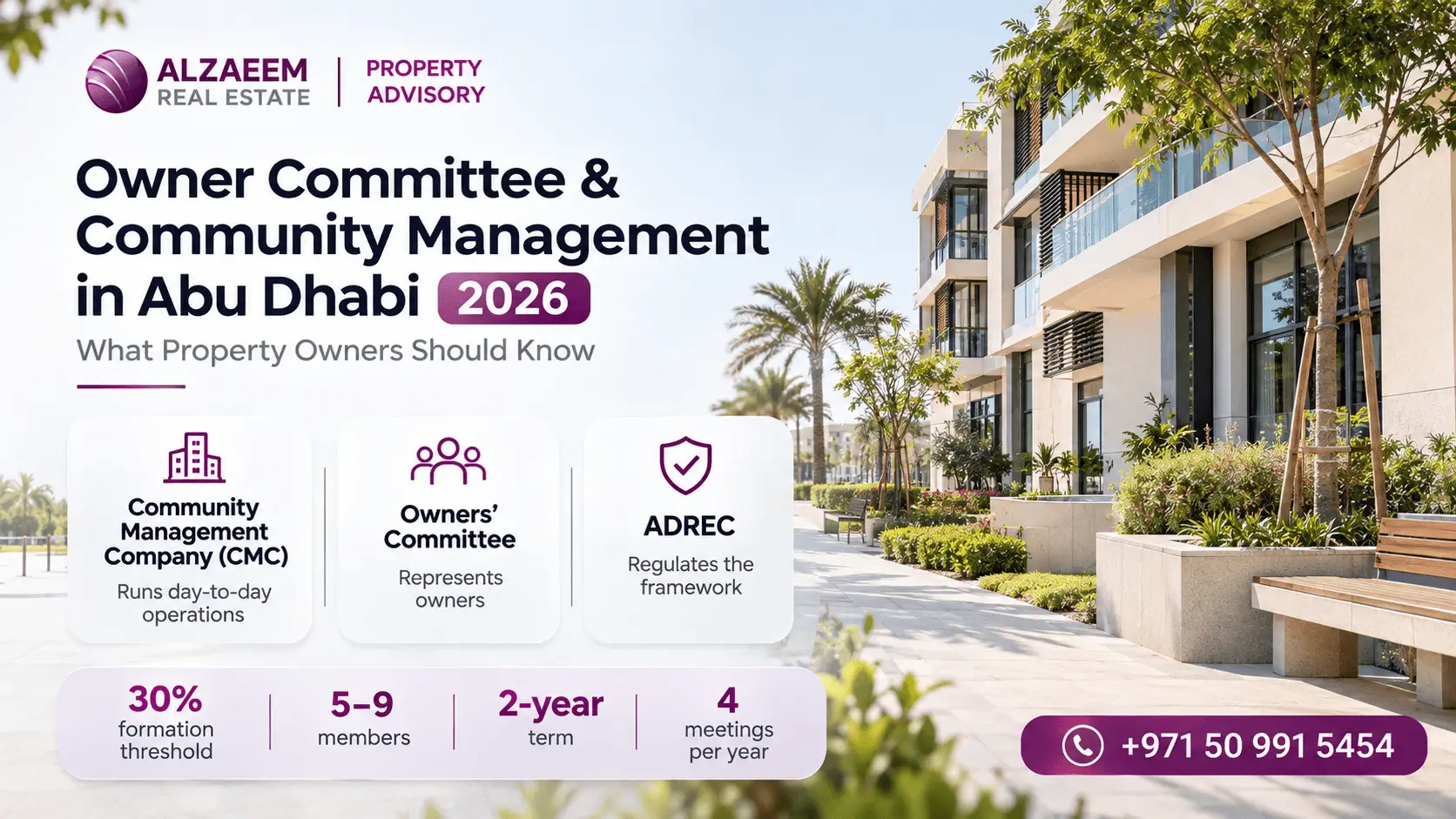
In Abu Dhabi, that structure involves three important parties:
Community Management Company
Owners’ Committee
Abu Dhabi Real Estate Centre — ADREC
ADREC’s current Community Affairs framework describes the division clearly:
- Operational matters: Community Management Company
- Owner representation and oversight: Owners’ Committee
- Regulatory oversight: ADREC
Understanding the difference is important because many owners incorrectly assume that:
“The Owners’ Committee runs the building.”
It does not run everyday operations.
And the opposite assumption is also wrong:
“The management company can do whatever it wants.”
It operates within an ADREC-regulated framework, approved budgets, community rules and owner oversight.
What Is a Jointly Owned Property?
A jointly owned property generally contains:
- individually owned units;
- common areas used collectively by owners and occupants.
Examples include:
- apartment buildings;
- residential towers;
- multi-building communities;
- certain villa or townhouse developments with shared facilities.
The individual owner controls their unit subject to applicable rules.
The common areas require coordinated management.
What Is an Owners’ Committee?
Abu Dhabi’s current legal framework defines the Owners’ Committee as the committee established under the real-estate law to perform functions relating to the management and operation of common parts, including maintenance and proper utilisation.
Operationally, ADREC describes the committee as the link between owners and the Community Management Company. Its members review service-charge budgets, monitor service delivery and coordinate with the CMC on unresolved or long-standing issues, but they do not interfere in day-to-day management operations.
That distinction is fundamental.
The Committee represents owners.
The CMC operates the community.
What Is a Community Management Company?
The Community Management Company — CMC — is responsible for the daily management of the jointly owned property.
According to ADREC, its responsibilities include:
- managing common property;
- operating shared facilities;
- maintaining and repairing common parts;
- collecting service charges;
- applying approved building or community management rules;
- appointing appropriate service providers.
Examples of CMC-managed services may include:
- security;
- cleaning;
- landscaping;
- lift maintenance;
- pool maintenance;
- common-area AC;
- common lighting;
- pest control;
- facility contractors.
Owner Committee vs Community Management Company
Think of the structure like this:
Community Management Company
Runs the community.
Responsible for operations.
Owners’ Committee
Represents and oversees owners’ interests.
Reviews, monitors and raises recommendations.
ADREC
Regulates the system.
Approves and supervises the applicable framework.
This prevents the Owners’ Committee from becoming an informal facilities-management team.
Abu Dhabi’s Community Management System Is Significant
ADREC’s current Community Affairs portal reports:
- 256 communities
- 56 Owners’ Committees
- 15 Community Management Companies
- approximately AED 560.97 million in annual service charges
within its current community-management ecosystem.
That shows how material community governance has become within Abu Dhabi’s property market.
For investors, it is no longer a secondary administrative issue.
It directly affects:
- operating costs;
- property condition;
- tenant experience;
- resale appeal.
When Is an Owners’ Committee Formed?
Under the 2025 Owners’ Committee bylaws, a committee is formed once at least:
30% of the total units
within the development have been registered in the Real Estate Register in the names of multiple owners.
The committee must contain:
5 to 9 members
including:
- Chair;
- Vice-Chair.
Owners Elect the Committee
Committee members are selected through voting by the unit owners.
The process is electronic and managed through a platform made available to unit owners.
ADREC then approves:
- committee formation;
- members;
- Chair;
- Vice-Chair.
The developer cannot simply appoint its own Owners’ Committee.
Who Can Become a Committee Member?
Under the current bylaws, a candidate must satisfy ADREC eligibility requirements.
These include being:
- an owner residing in the jointly owned property;
- legally capable;
- of good conduct;
- fully settled on service and community charges;
- holder of a valid UAE residence visa;
- approved by ADREC and any other relevant entity.
This means an overseas investor who does not reside in the property will not automatically qualify for Committee membership merely because they own a unit.
The Developer Cannot Join the Owners’ Committee
The current bylaws specifically state that the developer is not eligible for membership in the Owners’ Committee, even if it still owns unsold units in the jointly owned property.
That helps maintain the committee as an owner-representation mechanism rather than an extension of the developer.
Committee Membership Is Unpaid
Owners’ Committee membership is:
voluntary and unpaid.
Members do not receive remuneration or monetary compensation for serving.
So membership should be viewed as:
- governance;
- oversight;
- owner representation.
Not as employment.
How Long Does a Committee Serve?
The current bylaws provide a committee term of:
2 years
from approval of its formation.
The ADREC Director General may extend the term by an additional period not exceeding:
1 year.
Owners’ Committee Meetings
The Committee must hold regular meetings:
every 3 months
for a total of:
4 regular meetings each year.
The first meeting must take place within 15 days of approval of the Committee’s formation.
Extraordinary meetings may also be held where necessary, subject to the applicable ADREC notification requirements.
Meetings Can Be Held Online
The current bylaws allow Owners’ Committee meetings to be conducted through electronic visual communication where participants can:
- be identified;
- participate fully;
- interact.
Online attendance can count as actual attendance for quorum and voting purposes.
That makes participation more practical for owners with travel or work commitments.
How Voting Works
One interesting feature of the current framework is:
one owner = one vote
regardless of:
- how many units they own;
- the total area of those units.
If a unit is owned by multiple people, those co-owners collectively have one vote for that unit-owner position.
So a portfolio owner does not automatically receive ten votes because they own ten apartments.
Owners With Unpaid Service Charges Cannot Vote
The current Owners’ Committee bylaws state that an owner in arrears on:
- service charges;
- community charges
cannot participate in the Committee election vote.
Service-charge compliance therefore affects not only ownership costs but also governance participation.
What Does the Owners’ Committee Actually Do?
ADREC identifies several core functions.
The Committee acts as the connection between owners and the management company.
It may:
- review service-charge budgets;
- monitor service quality;
- raise recommendations;
- coordinate resolution of urgent issues;
- address long-standing service failures;
- advise on candidate management companies;
- request relevant financial reports.
But it does not directly run:
- security teams;
- cleaners;
- maintenance technicians;
- contractors.
That remains operational management.
Committee Can Review the Annual Budget
The Owners’ Committee can examine annual budgets relating to the maintenance and management of the jointly owned property.
It may:
- request financial reports;
- review expenditure;
- make recommendations to ADREC.
However, the Committee does not directly prepare, approve or audit the service-charge budget.
That prevents owner oversight from becoming uncontrolled financial administration.
ADREC Approves Service-Charge Budgets
This is extremely important.
The Community Management Company submits the annual service-charge budget for review.
Once ADREC evaluates and approves the budget, the CMC may issue service-charge invoices to owners based on those approved amounts.
So service charges are not simply:
“Whatever the management company decides to invoice.”
They operate within an ADREC approval framework.
What Do Service Charges Pay For?
Service charges generally fund:
- operation;
- management;
- maintenance
of common parts and shared facilities.
Depending on the development, that may include:
- security;
- cleaning;
- landscaping;
- lift maintenance;
- pool maintenance;
- common utilities;
- facility management;
- insurance;
- management administration.
Our Abu Dhabi Property Service Charges Explained 2026 guide covers the cost side in greater detail.
Owner Remains Responsible Even if the Unit Is Rented
This catches some landlords by surprise.
ADREC’s current Community Affairs guidance says:
the unit owner remains responsible for service charges at all times
even if the property is leased to a tenant.
A landlord may commercially recover certain costs through rent or another contractual arrangement where lawful.
But from the community’s perspective, the owner remains responsible.
Service-Charge Clearance Is Required Before Sale
Before completing a sale or transfer, outstanding service charges must be settled.
ADREC confirms that a service-charge clearance certificate is required before the unit transfer can be completed.
For sellers:
unresolved service charges can become a transaction problem.
For buyers:
verify the service-charge position during due diligence.
What Happens if Service Charges Are Not Paid?
ADREC states that legal action may be taken against owners who fail to pay service charges in accordance with applicable laws.
Non-payment may also affect:
- voting rights;
- Committee eligibility;
- property transfer.
So ignoring service-charge invoices is not a viable ownership strategy.
Owners Can Challenge or Question Service Charges
Owners are not expected to pay blindly.
ADREC confirms that owners may raise service-charge queries or concerns through:
- Community Management Company;
- Owners’ Committee;
- ADREC
using the applicable procedures.
The correct approach is:
ask for evidence.
Not:
refuse payment without process.
What Is a Reserve Fund?
A well-managed community must plan beyond routine daily expenses.
Major components eventually require replacement.
Examples:
- lifts;
- pumps;
- major mechanical equipment;
- common infrastructure.
Long-term financial planning helps avoid a situation where owners suddenly face extremely large unplanned costs.
The Community Management Plan and annual budgeting cycle are therefore central to sustainable management. ADREC specifically describes long-term community planning, budgeting and Owners’ Committee cycles as part of the regulated management framework.
Additional Capital Can Be Required
ADREC notes that additional capital may sometimes be required for new projects or major works, with those amounts incorporated into the following year’s service-charge budget.
Owners should therefore understand:
- why the expenditure is needed;
- whether it is part of an approved budget;
- what asset or project it supports.
Common Areas Matter to Property Value
Investors often analyse only the apartment.
But imagine two identical apartments.
Building A
- clean lobby;
- reliable lifts;
- well-maintained pool;
- strong security;
- good landscaping.
Building B
- damaged common areas;
- unreliable lifts;
- poor cleanliness;
- weak maintenance.
Even if the apartments are identical, the market may value them differently.
Community management therefore affects:
- rent;
- tenant retention;
- vacancy;
- resale value.
Common Areas Also Affect Tenant Experience
A landlord can maintain the inside of their apartment perfectly.
But if:
- lifts regularly fail;
- common corridors smell;
- security is poor;
- pool is closed;
the tenant may still decide not to renew.
That means community management can indirectly affect landlord ROI.
Our How to Reduce Rental Vacancy in Abu Dhabi 2026 guide explains why tenant experience and building quality can influence vacancy.
Who Maintains Common Parts?
ADREC states that the Community Management Company is responsible for maintaining common parts and facilities using approved service-charge funds.
It must also appoint reputable and suitable:
- contractors;
- consultants;
- suppliers;
- service providers.
Examples may include:
- lift contractor;
- cleaning company;
- landscaping contractor;
- pool company.
What If Common-Area Maintenance Is Poor?
Suppose:
- lifts repeatedly fail;
- pool maintenance is poor;
- corridor cleaning is inconsistent.
The owner should first raise the issue with:
Community Management Company
through the approved communication channel.
If unresolved:
Owners’ Committee
can become involved.
If still unresolved or regulatory escalation is required:
ADREC
may be approached through applicable procedures.
This creates a clear escalation ladder.
Complaint Escalation Route
A practical process is:
Step 1 — Community Management Company
Submit formal complaint.
Step 2 — Owners’ Committee
Escalate unresolved or recurring issue.
Step 3 — ADREC
Escalate where necessary under the applicable regulatory procedure.
Do not begin with social media complaints if a formal process exists.
Document Complaints Properly
Weak complaint:
“The building maintenance is terrible.”
Better:
“Lift 2 has been out of service on 7, 12 and 18 October. Attached are previous ticket references 2214, 2241 and 2298.”
Specific evidence is easier to address.
Community Rules
Community rules govern the use of:
- units;
- common areas.
ADREC gives examples such as:
- noise;
- parking;
- pets;
- balconies;
- façades;
- shared facilities.
These are not merely optional etiquette guidelines.
Owners and tenants must comply with approved community management regulations.
Tenants Must Follow Community Rules Too
An owner cannot say:
“I rented the apartment, so community rules are now the tenant’s problem.”
Both:
- owners;
- tenants
must comply with community and master-community regulations.
The landlord should therefore communicate relevant rules during tenancy setup.
Who Handles Rule Violations?
The Community Management Company handles violations according to approved regulations and procedures.
Repeated or serious violations may be escalated.
Examples may involve:
- unauthorized parking;
- noise;
- misuse of facilities;
- façade changes.
Owners Need Approval for Certain Alterations
ADREC states that owners or occupants must obtain prior written approval from the developer or management company for changes affecting:
- structure;
- external appearance;
- common parts;
unless expressly allowed under applicable management regulations.
This is particularly relevant when renovating.
Our Renovation ROI Abu Dhabi 2026 guide explains why investors should confirm approvals before substantial works.
Balcony Alterations Can Be a Community Issue
An owner may think:
“It is my balcony.”
But modifications affecting:
- façade;
- external appearance;
- shared design
can still fall under community-management controls.
Examples may include:
- permanent enclosures;
- external structures;
- visible façade modifications.
Check before installing.
Community Insurance
ADREC states that the Community Management Company arranges and renews insurance for:
- building;
- common parts.
Insurance costs are included within approved service charges.
But this does not automatically insure everything inside the owner’s apartment.
Owners May Still Need Their Own Insurance
ADREC encourages owners to consider separate:
- home insurance;
- contents insurance.
Community insurance and individual-owner insurance serve different purposes.
Our Property Insurance Abu Dhabi 2026 guide explains that distinction in detail.
Developer Defect vs Common-Area Maintenance
This distinction becomes particularly important after handover.
Suppose a common-area leak appears.
Possible categories:
Original Developer Defect
Potential defects-liability issue.
Normal Wear
Community-maintenance issue.
Contractor Failure
Operational management issue.
Do not simply classify every common-area issue as:
“service-charge maintenance.”
Our Property Defects Liability Period Abu Dhabi 2026 guide explains when developer responsibility may continue after handover.
Owners’ Committee Cannot Replace Technical Experts
Committee members may raise concerns.
But they are not automatically:
- engineers;
- accountants;
- lawyers;
- facility managers.
Technical issues should still be assessed by qualified professionals.
The Committee’s role is oversight and representation.
Owners’ Committee and Management Company Selection
Current bylaws allow the Owners’ Committee to propose or advise the developer regarding candidate companies for management of the jointly owned property and common areas, from among management companies approved by ADREC.
That gives owner representatives an input into management quality without making the Committee itself the management company.
Financial Transparency Matters
Owners should care about:
- service-charge budget;
- recurring contracts;
- maintenance expenditure;
- reserve planning.
But good oversight does not mean:
“Every owner personally approves every contractor invoice.”
The system would become impossible to operate.
Governance must balance:
- accountability;
- operational efficiency.
Community Management Quality Is an Investment Metric
Before buying, investors often compare:
- price per sq ft;
- rent;
- view;
- floor.
They should also ask:
Who manages the community?
What are the service charges?
How are common areas maintained?
Is there a functional Owners’ Committee?
Are owners satisfied with communication?
These factors affect long-term performance.
Example: Same Rent, Different Community
Two apartments each rent for:
AED 120,000
Property A
Annual service charges:
AED 15,000
Excellent community management.
Tenant retention:
High.
Property B
Annual service charges:
AED 13,000
But:
- frequent maintenance issues;
- poor common areas;
- higher tenant turnover.
Property B looks cheaper.
But if poor management causes one month vacancy:
AED 10,000 lost rent
the lower service charge becomes irrelevant.
Lowest Service Charge Is Not Automatically Best
An investor may prefer:
AED 12/sq ft
over:
AED 16/sq ft
But ask:
What services are being delivered?
Extremely low charges combined with inadequate:
- preventive maintenance;
- reserve planning
can create future problems.
The objective should be:
efficient service charge.
Not simply:
cheapest service charge.
Excessive Service Charges Are Also a Problem
The opposite is equally true.
High charges can reduce:
- net rental yield;
- resale attractiveness.
That is why ADREC approval and owner oversight matter.
Our Property Service Charges Abu Dhabi 2026 guide explains how service charges affect investment returns.
Overseas Owners
An overseas investor may not attend community events or inspect the building regularly.
That makes:
- digital communication;
- Owners’ Committee updates;
- property-management reporting
more important.
A professional local property manager can monitor:
- common-area concerns;
- service-charge notices;
- maintenance;
- tenant feedback.
Al Zaeem Property Management
Through Al Zaeem Property Management, an owner can manage unit-level matters such as:
- tenancy;
- rent collection;
- inspections;
- maintenance;
- tenant communication.
But the property’s CMC remains responsible for the development’s common-area operations.
The two roles should not be confused.
Unit Property Manager vs Community Manager
Al Zaeem Property Management / Owner-Appointed Property Manager
Manages the owner’s individual property and tenancy.
Community Management Company
Manages shared community/common assets.
Example:
AC inside the apartment
May be unit-level management.
Lift
Community-management issue.
Tenant rent
Property-manager issue.
Pool maintenance
Community-management issue.
Understanding this distinction prevents owners from contacting the wrong party.
Tenant Complaint vs Owner Complaint
A tenant might complain:
“The swimming pool has been closed for two weeks.”
Tenant should normally report the issue through:
- building/community communication;
- landlord/property manager where appropriate.
The owner or property manager may escalate where necessary.
The Community Management Company still operates the shared facility.
15-Point Abu Dhabi Owner Community Checklist
Before buying or during ownership, review:
1. Community Management Company
Who manages the building?
2. Owners’ Committee
Has one been formed?
3. Service Charges
Current annual amount?
4. Outstanding Charges
Any arrears on your unit?
5. Approved Budget
Is the current budget approved?
6. Common Areas
Condition?
7. Lifts
Reliable?
8. Pool / Gym
Operational?
9. Security
Adequate?
10. Cleaning
Consistent?
11. Landscaping
Maintained?
12. Major Planned Works
Anything upcoming?
13. Community Rules
Any important restrictions?
14. Insurance
Common property covered?
15. Complaints
Any recurring unresolved issues?
Owner Committee Participation Checklist
If you want to nominate yourself, check:
Are you a unit owner?
Do you reside in the jointly owned property?
Are all service/community charges settled?
Do you hold a valid UAE residence visa?
Do you satisfy the remaining ADREC eligibility conditions?
If yes, you may be eligible to participate in the nomination process under the current bylaws.
Common Owner Mistakes
Mistake 1: Treating the Committee as the Building Manager
It provides owner oversight, not daily operations.
Mistake 2: Refusing Service Charges Because You Disagree
Use the formal query and escalation process.
Mistake 3: Ignoring Community Rules
Owners and tenants must comply.
Mistake 4: Making External Alterations Without Approval
Written approval may be required.
Mistake 5: Ignoring Common Areas When Evaluating Property
They materially affect investment quality.
Mistake 6: Assuming Community Insurance Covers Personal Contents
It may not.
Mistake 7: Waiting Until Sale to Check Service-Charge Arrears
Outstanding charges must be settled before transfer.
Common Investor Mistakes
Mistake 1: Buying Solely on Gross Yield
Service charges reduce net return.
Mistake 2: Comparing Only Service-Charge Rates
Quality matters.
Mistake 3: Ignoring Community Governance
Poor management can reduce rental and resale performance.
Mistake 4: Assuming New Building Means Good Management
Developer quality and ongoing community management are different issues.
Community Governance Can Affect Resale
When buyers inspect a property, they also see:
- entrance;
- common areas;
- lifts;
- amenities.
A poorly maintained building can reduce buyer enthusiasm before they even reach the apartment.
That can affect:
- viewing conversion;
- negotiation;
- resale liquidity.
Community Governance Can Affect Rental Yield
Good community management can support:
- tenant satisfaction;
- retention;
- lower vacancy.
Poor management may produce:
- complaints;
- non-renewal;
- leasing resistance.
So although community governance looks administrative, it has a direct financial dimension.
The Correct Governance Chain
The cleanest way to understand Abu Dhabi jointly owned property management is:
Owners
elect and communicate through:
Owners’ Committee
while:
Community Management Company
handles operations,
and:
ADREC
provides regulatory oversight.
That creates separation between:
- ownership;
- oversight;
- operations;
- regulation.
Final Verdict
Owning an apartment in Abu Dhabi does not mean managing only the four walls of the unit.
A large part of the property’s long-term value depends on how the wider:
- building;
- community;
- common facilities
are managed.
Under the current Abu Dhabi framework:
- the Community Management Company handles daily operations and maintenance;
- the Owners’ Committee represents owners and provides oversight;
- ADREC regulates the system.
An Owners’ Committee is formed once at least 30% of units are registered to multiple owners, and consists of 5 to 9 members approved by ADREC. Eligible Committee members must be resident owners who meet the applicable requirements, including having settled service and community charges.
The Committee meets regularly, reviews budgets and service delivery, raises owner concerns and provides recommendations — but it does not replace professional community management.
For investors, the practical lesson is simple:
Do not assess only the apartment. Assess the community operating around it.
Strong community management can support:
- property condition;
- tenant retention;
- rental performance;
- resale liquidity.
Weak community management can undermine all four.
The best ownership approach is therefore:
understand the budget → monitor service quality → follow community rules → document concerns → use the Owners’ Committee → escalate properly when needed.
Official Sources
Abu Dhabi Real Estate Centre — Community Affairs
Current guidance covering Owners’ Committees, Community Management Companies, service charges, community rules, complaints and common-area management.
Administrative Decision No. 26 of 2025 — Owners’ Committee Bylaws
Current framework covering Committee formation, eligibility, voting, meetings and duties.
Disclaimer
This article is for general real-estate education and property-management information only. It does not constitute legal, accounting, community-management or investment advice.
Owners should verify the current ADREC regulations, approved community-management rules and service-charge documentation applicable to their individual property before making decisions or initiating formal disputes.
Last reviewed: November 2026.