


Marsa Al Saadiyat is not simply another property launch.
It is the final major phase of the Saadiyat Island masterplan and a AED 100 billion attempt to create an entirely new waterfront district around one of Abu Dhabi’s most valuable cultural, residential and beachfront destinations.
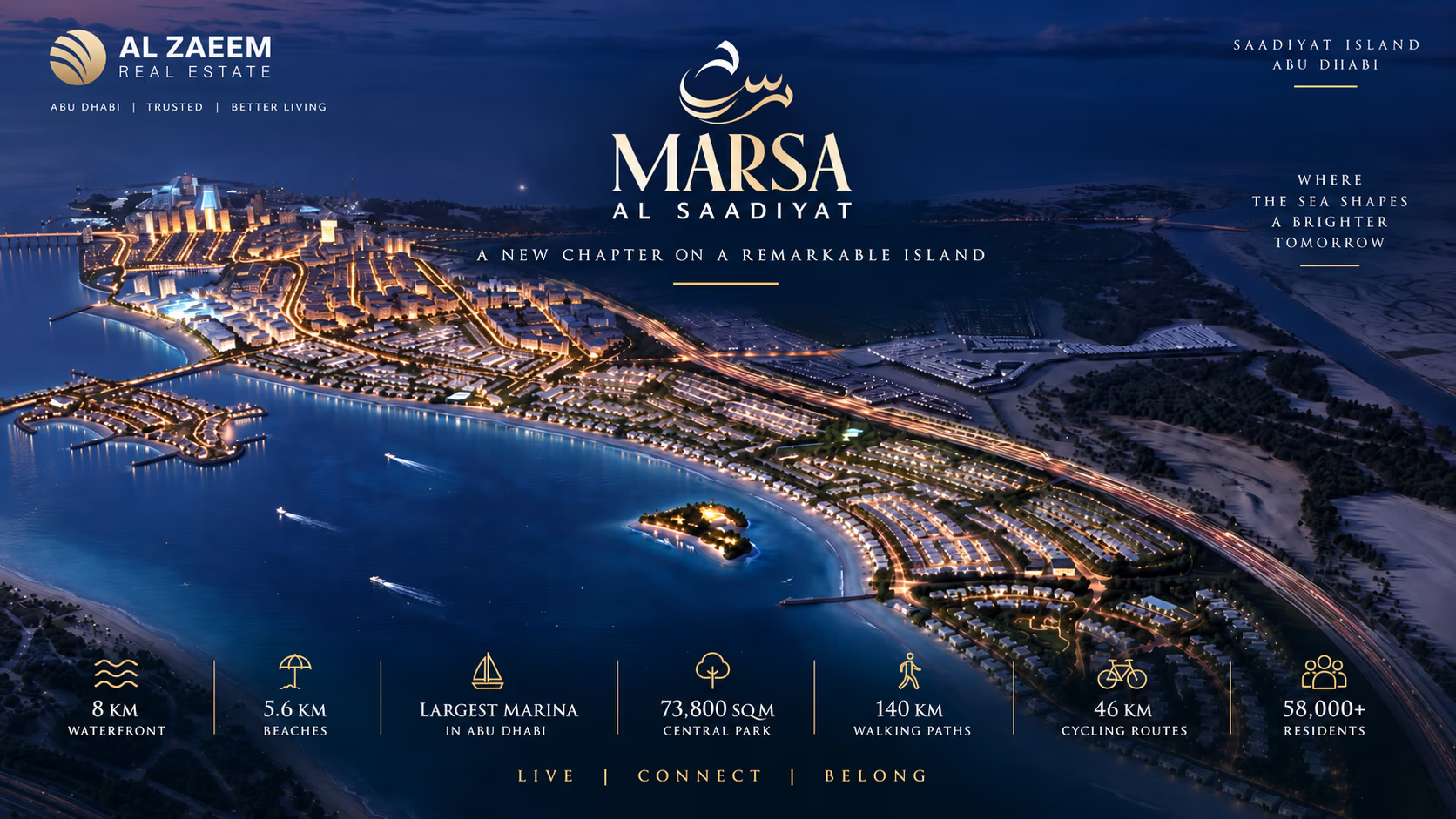
Officially launched on 22 July 2026, Marsa Al Saadiyat covers approximately 6.4 million square metres and extends across 8 kilometres of waterfront. Aldar is the master developer, responsible for the overall design and delivery of the primary infrastructure. The masterplan is expected to accommodate more than 58,000 residents across private mansions, luxury villas, waterfront apartments, branded residences and an elevated hillside villa community.
Its scale is difficult to capture through the AED 100 billion figure alone.
The destination is planned with 5.6 kilometres of beaches, Abu Dhabi’s largest marina with capacity for up to 350 boats and yachts, a one-kilometre waterfront promenade, approximately 140 kilometres of interconnected walking paths, 46 kilometres of cycling routes, a major central park, schools, healthcare, luxury hotels, retail, dining, cultural venues and a future underground Etihad Rail high-speed station.
And there is now an important new development for property buyers.
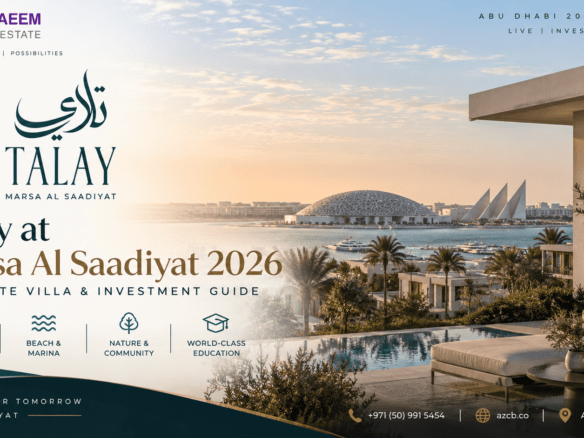
Talay has been announced by Aldar as the first residential address at Marsa Al Saadiyat, positioned as a family villa community close to the marina and beach. Aldar currently describes it as “coming soon.” Detailed public pricing, floor plans and payment terms have not yet been published on Aldar’s current property pages as of 13 September 2026.
That makes this an unusual moment for investors.
The masterplan is known.
The investment thesis can be analysed.
But much of the unit-level pricing required to determine whether the first homes represent good value is still to come.
So the important question is not:
“Is Marsa Al Saadiyat impressive?”
It clearly is.
The more useful question is:
“Will the individual homes released inside this AED 100 billion destination be priced attractively enough for investors to benefit from the masterplan rather than simply pay for it upfront?”
Quick Answer: What Is Marsa Al Saadiyat?
Marsa Al Saadiyat is Aldar’s major new waterfront masterplan on Saadiyat Island, Abu Dhabi, activating the final phase of the wider island masterplan.
The destination was previously referred to as Saadiyat Marina District before being officially renamed Marsa Al Saadiyat at its July 2026 launch. The new name reflects the project’s strong maritime identity and the central role of the marina and waterfront.
| Marsa Al Saadiyat | Officially Announced |
|---|---|
| Gross development value | AED 100 billion |
| Master developer | Aldar |
| Masterplan area | 6.4 million sq m |
| Waterfront | 8 km |
| Beaches | 5.6 km |
| Planned population | 58,000+ residents |
| Marina | Up to 350 berths |
| Waterfront promenade | 1 km |
| Walking paths | Approx. 140 km |
| Cycling network | 46 km |
| Major central park | 73,800 sq m |
| Schools | 2 private + 1 public |
| Nurseries | 6 |
| Luxury hotels | 2 |
| Planned homes | Mansions, villas, apartments, branded residences |
| High-speed rail | Planned underground Etihad Rail station |
| Sustainability | Targeting Estidama 2 Pearl Community Rating |
| First announced address | Talay |
| First residential sales | H2 2026 programme |
The scale and infrastructure figures are from Aldar and Abu Dhabi Government announcements.
AED 100 Billion: What Does the Number Actually Mean?
The AED 100 billion figure is the gross development value of the complete Marsa Al Saadiyat destination.
It is not:
a property starting price;
the value of one residential development;
the cost of the infrastructure alone;
or a forecast of investor profit.
It represents the scale of the overall masterplan.
Aldar’s H1 2026 results state that Marsa activates the final phase of the Saadiyat Island masterplan and that Aldar itself expects to develop AED 60 billion of the AED 100 billion pipeline, with launches commencing during H2 2026.
This distinction matters because Marsa will not function as one single residential project.
It will contain multiple:
residential neighbourhoods;
villa communities;
apartment projects;
branded residences;
hospitality assets;
commercial areas;
cultural destinations;
and supporting infrastructure.
Investors will therefore eventually need to evaluate each Marsa release separately.
Marsa Al Saadiyat Is a Masterplan, Not One Property Project
This may be the single most important point for future buyers.
Buying property in Marsa will not simply mean:
“I bought Marsa Al Saadiyat.”
One buyer may eventually own:
a waterfront apartment overlooking the marina.
Another may own:
a family villa.
Another:
a private mansion.
Another:
a branded residence.
Another:
a standalone home within the elevated hillside district.
All may share the same masterplan.
Their investment characteristics could be completely different.
A waterfront apartment may appeal strongly to:
international investors;
executives;
second-home buyers;
and tenants.
A large villa may depend much more heavily on:
family demand;
wealth preservation;
long holding periods;
and high-net-worth end users.
The masterplan creates the destination.
The individual property determines the investment.
Why the “Final Phase of Saadiyat Island” Matters
Official announcements describe Marsa Al Saadiyat as activating the final phase of the Saadiyat Island masterplan.
That is strategically important.
Saadiyat has already developed several distinct residential identities around:
beaches;
culture;
mangroves;
education;
premium apartments;
and villa communities.
Marsa adds a major:
marina and integrated waterfront-city dimension.
But investors should not turn the phrase “final phase” into:
“prices can only rise because there will never be more supply.”
That would be an unjustified conclusion.
The stronger interpretation is that Marsa is designed to complete a major part of the island’s long-term urban structure while introducing a substantial new volume of residential property itself.
That creates:
scarcity of location
and simultaneously:
new supply.
Both effects must be analysed.
An 8-Kilometre Waterfront Is a Major Structural Feature
Marsa is planned around approximately 8 kilometres of waterfront, including 5.6 kilometres of beaches.
That is not simply an amenity.
It fundamentally determines the geography of the development.
Waterfront property can support value through:
views;
walkability;
leisure;
lifestyle;
hospitality;
marina access;
and emotional buyer appeal.
But not every Marsa property will be:
front row.
This will eventually create significant differences between:
direct waterfront;
marina-facing;
park-facing;
internal-community;
elevated;
and secondary-location homes.
The strongest investment analysis will therefore need to go much deeper than the word:
Marsa.
Abu Dhabi’s Largest Marina
The destination will include what the Abu Dhabi Government describes as Abu Dhabi’s largest marina, with capacity for up to 350 berths for sailing boats and luxury yachts.
That can create several layers of demand.
A marina is not merely somewhere to park boats.
When successfully integrated into a premium district, it can become:
a visual centre;
a leisure destination;
a hospitality anchor;
a dining location;
a pedestrian destination;
and a premium residential frontage.
This is important because a successful marina can influence the desirability of property even for owners who do not own a yacht.
Marina View Does Not Automatically Mean Best Investment
Future buyers should nevertheless be careful.
A marina-facing unit may command a significant price premium.
The correct question will be:
How much premium am I paying for that marina exposure?
Suppose a comparable internal apartment eventually costs:
AED X.
A marina-facing version costs:
20% more.
The buyer needs to determine whether the view and location can reasonably support:
higher rent;
stronger resale;
or enough personal-use value
to justify the additional capital.
A great view bought too expensively can still produce a weak investment return.
The One-Kilometre Waterfront Promenade
Marsa will include approximately one kilometre of waterfront retail and dining, supported by a yacht club and two luxury hotels.
This is strategically important because Marsa is not intended to operate as a residential dormitory.
The masterplan is designed so that residents can access much of daily life:
within the destination.
Retail and hospitality can improve:
walkability;
night-time activity;
tenant appeal;
international tourism;
and the overall perception of the community.
But the strongest properties may be those close enough to benefit from these amenities without suffering from:
traffic;
noise;
or excessive commercial activity.
The “Culinary Mile”
Aldar now describes the waterfront retail-and-dining environment as The Culinary Mile, emphasising local and international dining experiences as part of Marsa’s identity.
For investment property, this may matter more than it initially appears.
Premium residents increasingly evaluate a community based not simply on:
their apartment
but:
what happens when they leave the building.
Dining, cafés, walking routes, hotels, marina activity and public space can help convert a residential development into:
a destination.
Destination value can deepen both tenant and buyer demand.
A 73,800-Square-Metre Central Park
Aldar’s current Marsa masterplan page identifies a 73,800 sq m Central Park as one of the development’s major features.
The wider government masterplan also describes landscaped linear parks connecting the community and a major park extending toward the waterfront.
This gives Marsa another source of residential differentiation.
Some future units may sell primarily on:
marina exposure.
Others could eventually benefit from:
park frontage.
For families, a strong park-facing property may even be more useful than a marina-facing unit.
That is why investors should avoid assuming:
water is always the only premium view.
140 Kilometres of Walking Paths
The development is planned with approximately 140 kilometres of interconnected walking routes.
At first glance, that may sound like a brochure statistic.
It has real urban implications.
Walkability affects whether residents can comfortably move between:
homes;
parks;
schools;
waterfront;
retail;
cultural venues;
and community amenities
without making every journey by car.
In a premium community, this can materially affect:
quality of life;
family usability;
and long-term residential satisfaction.
A 46-Kilometre Cycling Network
Marsa will also incorporate approximately 46 kilometres of cycling infrastructure.
Together with the walking network and parks, this suggests Aldar is treating mobility within the community as a fundamental design layer rather than simply adding isolated jogging tracks around buildings.
For long-term investors, this matters because large masterplans can feel:
integrated
or:
fragmented.
The quality of movement between districts can determine which result Marsa ultimately achieves.
More Than 58,000 Future Residents
Marsa is planned to become home to more than 58,000 residents.
That number immediately establishes the development as:
far more than a luxury enclave.
At full scale, this will be a substantial urban community.
The future population can support:
retail;
schools;
healthcare;
hospitality;
services;
and year-round commercial activity.
That can reduce one common risk of luxury developments:
beautiful properties surrounded by limited everyday infrastructure.
But 58,000 residents also imply:
significant residential supply.
The investment thesis therefore relies on Marsa becoming a deep demand market—not simply a scarce collection of homes.
The Residential Mix Is Broad
The official masterplan confirms a future residential mix including:
private mansions, luxury villas, waterfront apartments, branded residences and standalone villas within an elevated hillside community.
That breadth is important.
It means Marsa will potentially attract several different wealth segments rather than relying on one property category.
A waterfront apartment buyer may have:
AED 3–6M
or another future budget depending on the release.
A large villa or mansion buyer may operate at:
a completely different capital level.
Branded residences could create an entirely separate luxury pricing structure.
Because official unit pricing for these future collections is not yet publicly available across the masterplan, any current specific price claims should be treated cautiously.
Talay: The First Residential Address at Marsa
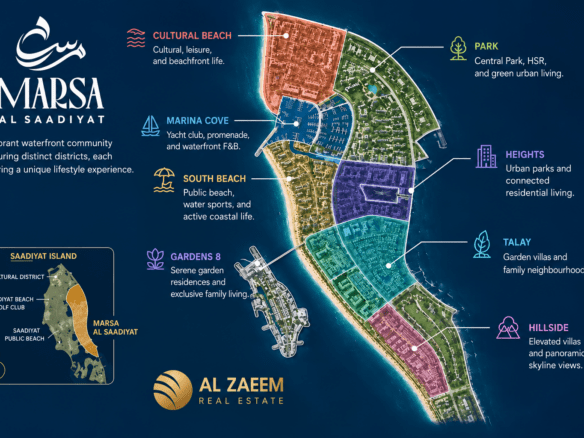
Since the July masterplan announcement, Aldar has now introduced Talay as the first residential address at Marsa Al Saadiyat.
Aldar’s current property listing describes Talay as:
“The first address at Marsa Al Saadiyat”
and positions it as a villa community close to the marina and beach, designed for long-term family living. It remains marked “Coming soon” as of this review.
This is important because Marsa is now moving from:
masterplan announcement
toward:
actual residential product.
However, Al Zaeem buyers should separate officially confirmed information from numbers circulating through third-party launch pages.
Until Aldar publishes the relevant Talay sales documentation, we should not treat unofficial:
starting prices;
villa counts;
payment plans;
floor plans;
or handover dates
as confirmed project facts.
Why Talay Matters Even Before Pricing
Talay already tells us something about Marsa’s initial positioning.
The first announced address is:
family-focused;
villa-led;
and tied strongly to:
beach;
marina;
education;
and generational living.
That indicates Aldar is not beginning Marsa solely with investor-oriented waterfront apartments.
It is beginning the residential story with:
long-term family ownership.
This is strategically interesting.
Family communities can create:
longer holding periods;
deeper owner occupation;
more stable community formation;
and less dependence on short-term investor turnover.
Schools Will Be Built Into the Community
Aldar’s current masterplan states that Marsa is planned with:
two private schools, one public school and six nurseries.
The Abu Dhabi Government announcement similarly confirms three schools as part of the community infrastructure.
This is an important investment factor.
A development designed for 58,000+ residents cannot rely permanently on parents driving off-island for every educational need.
Schools create:
family retention;
daily convenience;
community depth;
and long-term residential demand.
They can also help broaden the buyer market beyond:
second-home purchasers
toward:
full-time households.
Saadiyat Already Has a Strong Education Ecosystem
Marsa also benefits from wider Saadiyat institutions.
Official government material highlights access to education ranging from nurseries through university level, including NYU Abu Dhabi, Berklee Abu Dhabi, Cranleigh Abu Dhabi, American Community School of Abu Dhabi and Harrow International School Abu Dhabi.
This matters because Marsa does not need to wait until every internal school is operational before being connected to a functioning educational destination.
It enters an established island.
That significantly changes the risk profile compared with building a family community in a completely new district.
Premium Healthcare Is Planned Inside Marsa
The masterplan includes premium healthcare facilities as part of the community infrastructure.
For investors, this reinforces the idea that Marsa is intended to support:
full-time life.
The most resilient masterplanned communities usually provide reasons to remain in the area through:
education;
healthcare;
retail;
recreation;
and employment connectivity.
Not only:
beautiful houses.
Marsa Will Connect Directly to Saadiyat Cultural District
A scenic pedestrian connection is planned between Marsa and Saadiyat Cultural District.
This is arguably one of Marsa’s biggest competitive advantages.
Residents will potentially combine:
marina and beach living
with:
direct access to one of the world’s increasingly significant cultural clusters.
The broader district includes institutions such as Louvre Abu Dhabi, Zayed National Museum, Natural History Museum Abu Dhabi, teamLab Phenomena Abu Dhabi and Guggenheim Abu Dhabi.
For buyers wanting the wider island context, Al Zaeem’s Saadiyat Island property guide provides the broader residential picture.
Marsa and Cultural District Are Complementary, Not Identical
This distinction will become important later in the investment cluster.
Saadiyat Cultural District is fundamentally:
culture-led urban living.
Marsa Al Saadiyat is fundamentally:
marina-led waterfront living.
The two connect physically and reinforce each other.
But they serve different lifestyle preferences.
A buyer who wants:
museum adjacency;
urban apartments;
and direct cultural immersion
may prefer Cultural District property.
A buyer who prioritises:
beaches;
marina;
villas;
waterfront living;
and a larger family environment
may prefer Marsa.
This distinction will eventually affect:
tenant demand;
resale buyer profiles;
and price-per-square-foot behaviour.
Dar al Funoon Adds a Cultural Anchor Inside Marsa
Marsa will not depend exclusively on Cultural District institutions.
Its own theatre district will be anchored by Dar al Funoon Abu Dhabi, which Aldar says is planned to open in 2030.
The performing-arts destination is designed by the late Frank Gehry and is expected to offer more than 6,000 seats across venues for opera, ballet, theatre, music and other live performance.
This matters because Marsa is not intended merely to sit next to culture.
It is planned to add:
new cultural infrastructure of its own.
Two Luxury Hotels Will Support the Destination
Two luxury hotels are planned within Marsa’s social and commercial core.
Hotels can contribute to residential value through:
restaurants;
events;
spa and hospitality activity;
international awareness;
and destination traffic.
If future branded residences are associated with high-profile hospitality brands, they may create another premium property category.
However, branded property must still be analysed carefully.
A brand can increase:
price
faster than it increases:
investment return.
Future Branded Residences Could Create a New Luxury Benchmark
The masterplan explicitly includes branded residences.
These may eventually become some of Marsa’s most expensive residential assets.
For investors, branded property often presents a specific trade-off.
It can provide:
international recognition;
service;
design;
prestige;
and resale differentiation.
But it can also introduce:
higher acquisition premiums;
management fees;
service costs;
and lower percentage rental yields.
When specific branded projects are announced, they should be evaluated separately rather than assuming all Marsa property belongs to one pricing class.
Connectivity Could Fundamentally Change Saadiyat’s Position
One of the most ambitious parts of Marsa is not residential at all.
It is:
transport.
The masterplan is planned to connect with Reem Island and Umm Yifeenah Island through a new network of roads and tunnels. It will also connect to another future Aldar island through a bridge.
This can strengthen Saadiyat’s integration with central Abu Dhabi.
A premium island becomes more valuable when its lifestyle advantages do not require:
poor connectivity.
The Planned Underground Etihad Rail Station
Marsa will also feature a planned underground Etihad Rail high-speed station designed to connect the destination with the wider UAE rail network.
From an investment perspective, this has obvious potential.
High-quality regional rail could strengthen:
commuting;
tourism;
business connectivity;
and access between Abu Dhabi and other emirates.
But investors need to use careful language.
The station is:
planned.
It is not currently operating.
The Marsa masterplan pages reviewed do not provide a final operational date for the station.
Therefore, buyers should not capitalise the entire expected benefit of future rail infrastructure into today’s purchase price as though delivery timing were guaranteed.
Planned Infrastructure Is Upside, Not Current Utility
This is an important investment principle.
If you buy property today because:
a station may exist in future,
you are purchasing partly on infrastructure expectations.
That can produce excellent returns when infrastructure is delivered successfully.
But the stronger purchase is one that already makes sense:
without needing every future infrastructure project to arrive exactly on schedule.
The planned station should strengthen the investment thesis.
It should not be the only reason for it.
Estidama 2 Pearl Community Target
Aldar currently states that Marsa is targeting an Estidama 2 Pearl Community Rating.
This applies at masterplan/community level rather than being a statement that every future residential project will automatically have the same building-level certification.
The development also incorporates environmental and mobility planning designed around:
walking;
cycling;
green space;
and Saadiyat’s natural environment.
Long-term buyers should eventually examine both:
community-level sustainability
and:
the building or villa-specific sustainability specification of the exact property they purchase.
Engineered Façades and Acoustic Barriers
Aldar’s current project information states that engineered façades and acoustic barriers are planned to reduce ambient noise.
This detail is more significant than it appears.
Large mixed-use destinations can create competing priorities.
Residents want:
activity;
restaurants;
marina;
entertainment;
and transport.
They also want:
quiet homes.
If Marsa successfully separates active public areas from comfortable residential environments, that can materially improve long-term liveability.
Why Marsa Is Not Starting From Zero
New masterplans often face a difficult challenge:
they need to create both:
property
and:
destination.
Marsa has an unusual advantage.
Saadiyat already exists as a globally recognisable:
residential;
cultural;
education;
beach;
and hospitality
destination.
Marsa therefore begins with access to:
existing demand.
That lowers one form of masterplan risk.
Residents do not need to wait twenty years for the name:
“Saadiyat”
to mean something.
Saadiyat Recorded AED 13.3 Billion in H1 2026 Residential Sales
ADREC reported that Saadiyat Island recorded AED 13.3 billion in residential sales during the first half of 2026, making it one of Abu Dhabi’s strongest residential sales districts.
This is one of the most important pieces of investment evidence behind Marsa.
The masterplan is not entering a weak island market.
It is adding substantial supply to a location already attracting:
major capital.
Abu Dhabi’s Overall Market Is Also Extremely Active
Abu Dhabi residential sales reached AED 70.4 billion during H1 2026, up from AED 25.3 billion in H1 2025.
Off-plan transactions accounted for 89% of residential sales value and 82% of deals, while resident expatriates and non-resident foreign buyers together accounted for 70% of residential sales value.
Separately, ADREC reported total real-estate transactions of AED 117 billion, with foreign direct investment reaching AED 13.8 billion from non-resident investors representing 116 nationalities.
That creates a powerful environment for a large luxury waterfront launch.
But it also creates:
pricing risk.
Strong markets can encourage buyers to pay aggressive premiums.
Strong Demand Does Not Make Every Launch Price Good Value
This distinction will be essential when Talay and later Marsa projects release their prices.
Imagine the market is exceptionally strong.
Buyers compete for:
waterfront;
first release;
best plots;
marina views.
That can produce:
rapid sales.
Rapid sales prove:
strong demand at launch.
They do not automatically prove:
strong investment value.
The buyer still needs to compare:
purchase price;
plot or unit size;
view;
payment schedule;
future supply;
resale alternatives;
and likely end-user demand.
Marsa Is Also Part of Abu Dhabi’s Future Supply Story
ADREC projects approximately 71,000 additional residential units across Abu Dhabi by 2030, with six districts accounting for 77% of incremental supply.
Saadiyat Island is one of those six districts.
For Marsa, this creates a double effect.
More supply can help complete:
communities;
schools;
retail;
parks;
restaurants;
and destination activity.
But it also creates more competition.
The wider implications are covered in Al Zaeem’s Abu Dhabi property supply analysis.
Supply Is Not Automatically Bearish
A development designed for more than 58,000 residents obviously requires:
thousands of homes over time.
If supply were the only variable affecting property values, no successful large city district could exist.
The question is whether:
demand grows fast enough to absorb supply.
Marsa has several potential demand sources:
existing Abu Dhabi residents;
international investors;
families;
high-net-worth buyers;
corporate executives;
branded-residence buyers;
second-home purchasers;
and future tenants.
Its challenge will be matching each residential release with a sufficiently deep buyer segment.
Marsa Could Create Its Own Internal Property Hierarchy
As the masterplan develops, not all addresses are likely to command equal prices.
A future hierarchy might differentiate between:
direct beach frontage;
marina frontage;
promenade;
central park;
elevated hillside;
internal villa neighbourhoods;
branded residences;
and secondary apartment positions.
This is normal in successful masterplans.
It means early buyers should think beyond:
project name.
Front Row Usually Carries a Premium
Direct waterfront property is physically limited.
That can create scarcity.
But scarcity alone is not enough.
Suppose front-row property launches at an enormous premium to:
second-row property.
Future appreciation may simply bring the cheaper property closer to fair value while the premium property remains expensive.
A disciplined buyer should calculate:
the price of the view.
Hilltop or Elevated Property Could Be Equally Interesting
The official Marsa masterplan includes a 22.5-metre elevated hillside community of standalone villas.
In Abu Dhabi’s generally flat coastal geography, elevation can create:
longer sightlines;
privacy;
and different views.
This could eventually produce a residential submarket separate from:
beachfront villas.
Whether elevated villas outperform waterfront villas will depend on:
pricing;
plot size;
view protection;
architecture;
and buyer preferences.
Mansions Will Operate in a Different Investment Market
Private mansions are also part of the planned residential mix.
This is not simply a larger version of an apartment investment.
Mansion pricing is often driven by:
wealth;
scarcity;
plot size;
privacy;
architecture;
waterfront;
and international luxury-buyer behaviour.
Rental yield may be secondary.
Capital preservation and:
trophy-asset status
may matter more.
This is why Al Zaeem should eventually treat Marsa mansion content as a separate luxury-investment category.
Apartments May Become the More Liquid Investment Product
Future waterfront apartments could potentially attract a broader market because they may offer:
lower absolute ticket sizes;
managed living;
marina access;
and easier rental operation.
That could make them more liquid than:
very large villas or mansions.
But this will depend entirely on:
pricing.
A premium apartment launched too aggressively can still produce:
low yield
and:
limited upside.
Villas Could Benefit From Family Demand
The first announced residential address, Talay, already indicates that family villas will play an important role in Marsa’s identity.
For villa buyers, the strongest investment factors may include:
plot;
privacy;
bedroom configuration;
school proximity;
beach access;
park access;
orientation;
and long-term family usability.
Villa buyers should not judge property only through:
price per square foot.
Land and:
position within the masterplan
can be more important.
Marsa Could Have Strong International Appeal
International buyers often understand waterfront property quickly.
You do not need to explain:
why someone wants a beach;
marina;
culture;
luxury hotel;
or waterfront promenade.
That gives Marsa a simple international story.
Combine that with the existing Saadiyat brand and Abu Dhabi’s rapidly growing foreign-buyer market, and the development has a credible global audience. ADREC says expatriate and non-resident foreign buyers represented 70% of Abu Dhabi residential sales value in H1 2026.
That can support future resale.
But international appeal generally concentrates most heavily in:
the strongest individual properties.
Is Marsa Al Saadiyat a Good Investment?
At masterplan level:
the fundamentals are compelling.
The location is strong.
The developer is established.
The island already attracts substantial transaction volume.
The infrastructure programme is unusually ambitious.
The residential mix is broad.
The marina, beaches, Cultural District and future transport links create multiple demand drivers.
But a masterplan cannot be declared a good investment before:
the exact property;
price;
payment schedule;
handover;
service charges;
and future supply within that property category
are known.
So the most accurate current answer is:
Marsa Al Saadiyat is a highly credible investment destination, but the investability of each residential launch must be assessed separately.
The Biggest Bull Case
The strongest investment argument is that Marsa may complete Saadiyat’s evolution from:
premium island
into:
a full global waterfront city district.
The island already has:
culture;
beaches;
education;
hospitality;
and premium residential property.
Marsa adds:
major marina infrastructure;
new waterfront;
greater family housing;
more retail;
transport connections;
parks;
rail;
performing arts;
and substantial additional population.
If this ecosystem works as intended, Marsa can benefit from more than simply:
new construction.
It can benefit from:
destination maturation.
The Biggest Bear Case
The primary risk is:
paying tomorrow’s value today.
A AED 100 billion masterplan will attract significant excitement.
Waterfront.
Marina.
Rail.
Culture.
Saadiyat.
Aldar.
All of these can become embedded in launch pricing.
If a buyer pays such a high premium that years of future growth are already reflected in the purchase price, the property can be excellent while the investment return remains average.
This distinction matters enormously.
Infrastructure Risk
Several major elements of Marsa are:
future infrastructure.
Roads.
Tunnels.
Rail.
Hotels.
Cultural venues.
Schools.
Retail.
Individual residential districts.
These are officially planned, but they will develop over time.
Investors should therefore avoid comparing:
a completed mature Marsa
with:
the capital they are committing today
without accounting for:
delivery risk and time.
Construction-Phase Risk
Site enabling and infrastructure works were scheduled to begin in Q3 2026, while residential sales are planned across H2 2026.
Marsa will be developed in phases.
That means some early residents may live amid:
ongoing construction.
Future tenants may experience:
partial community maturity.
Certain amenities may open before others.
That is normal for major masterplans, but buyers should include it in:
rental;
personal-use;
and resale planning.
Payment Plans Will Need Release-Specific Analysis
There is no single Marsa payment plan applying to every future residence currently displayed on Aldar’s masterplan page.
Individual launches will establish their own:
price;
payment schedule;
and completion timetable.
This is why buyers should not assume future Marsa apartments, villas and branded residences will all have:
the same payment terms.
Al Zaeem’s Abu Dhabi off-plan properties inventory can eventually be used to compare individual Marsa launches with other current opportunities.
Do Not Assume Talay Pricing Before Aldar Publishes It
This is particularly important right now.
Multiple websites are already publishing different alleged:
villa counts;
starting prices;
payment plans;
and launch dates.
Aldar’s own current public listing identifies Talay as the first Marsa address and says it is coming soon, but the public material reviewed here does not yet provide a full official sales matrix.
Until the developer issues those details:
we should not present third-party numbers as confirmed facts.
This protects both:
buyer decisions
and:
Al Zaeem’s credibility.
What Investors Should Analyse When Each Marsa Launch Arrives
The first question should be the exact purchase price, followed by price per square foot where meaningful, total area or plot size, view, masterplan position, payment timing, handover date, likely service charges, scarcity, competing future inventory and the likely eventual buyer.
A buyer should also assess whether the property’s investment thesis relies primarily on:
rent;
capital appreciation;
personal use;
or wealth preservation.
A waterfront apartment and a private mansion should not be evaluated using the same return model.
The “Masterplan Premium” Test
When the first property launches arrive, compare Marsa with relevant existing Saadiyat property.
Suppose a future Marsa villa launches:
25% above
a strong existing alternative.
Ask:
What exactly does the extra 25% buy?
Newer construction?
Better beach?
Larger plot?
Marina?
Better community plan?
Future rail?
Scarcity?
Or simply:
launch hype?
A premium becomes investable when the underlying advantages can reasonably defend it.
The 2030 Test
Imagine Marsa in 2030.
Some infrastructure is complete.
Other phases are still developing.
Dar al Funoon is expected to open.
The Cultural District is substantially mature.
More residential property has been delivered across Saadiyat.
Would you still want:
your exact villa;
apartment;
or residence?
That is a stronger test than asking:
“Will somebody pay me more next year?”
The 10-Year Test
Now imagine:
At that point, the launch excitement is irrelevant.
What remains?
Waterfront.
Marina.
Beach.
Plot.
View.
Walkability.
Park.
Architecture.
School access.
Transport.
Those are durable property fundamentals.
The strongest Marsa purchases should make sense on:
permanent physical advantages.
Not only:
marketing.
Marsa Al Saadiyat Investment Scorecard
This is an Al Zaeem analytical framework, not an Aldar or ADREC methodology.
| Factor | Score 1–5 |
|---|---|
| Exact location within Marsa | |
| Waterfront/view quality | |
| View protection | |
| Developer/project quality | |
| Entry price | |
| Price vs Saadiyat alternatives | |
| Plot/floor-plan efficiency | |
| Scarcity | |
| Payment-plan affordability | |
| Handover timing | |
| Rental potential | |
| Service-charge risk | |
| Future competing supply | |
| Marina/park/beach access | |
| School/family usability | |
| Transport connectivity | |
| Future buyer depth | |
| Portfolio fit | |
| Holding-period resilience | |
| Overall investment conviction |
The objective is not to score:
“Marsa”
out of 100.
It is to score:
the exact property you are actually being asked to buy.
Marsa Al Saadiyat Strengths vs Risks
| Strength | Investment Relevance |
|---|---|
| AED 100B masterplan | Destination-scale investment |
| Final Saadiyat masterplan phase | Important strategic location |
| 8km waterfront | Significant waterfront exposure |
| 5.6km beaches | Lifestyle and scarcity driver |
| Abu Dhabi’s largest marina | Marina-led destination identity |
| 58,000+ planned residents | Deep future community |
| Cultural District connection | Global destination appeal |
| Aldar master developer | Strong development credentials |
| Schools and healthcare | Supports full-time family living |
| Hotels, dining and retail | Destination maturity |
| Parks and active mobility | Long-term liveability |
| Planned Etihad Rail station | Future connectivity upside |
| Broad residential mix | Multiple buyer segments |
| Risk | Why It Matters |
|---|---|
| Unit pricing still release-specific | Value cannot be judged from masterplan alone |
| Large future supply | Competition across Saadiyat |
| Long development horizon | Community will mature in stages |
| Future infrastructure dependency | Not every benefit exists today |
| Luxury pricing | Smaller affordability pool |
| Waterfront premiums | Easy to overpay for view |
| Service-charge uncertainty | Important for apartment/branded ROI |
| Launch excitement | Can push entry prices above fair value |
| Multiple future releases | Later projects may compete with early buyers |
| Rail/tunnel timelines | Should not be treated as current infrastructure |
Frequently Asked Questions
What is Marsa Al Saadiyat?
Marsa Al Saadiyat is a major waterfront masterplan by Aldar on Saadiyat Island, Abu Dhabi, with an announced gross development value of AED 100 billion. It activates the final phase of the wider Saadiyat Island masterplan.
Was Marsa Al Saadiyat previously called Saadiyat Marina District?
Yes. The destination was renamed from Saadiyat Marina District to Marsa Al Saadiyat at its official July 2026 launch.
Who is developing Marsa Al Saadiyat?
Aldar is the master developer and is responsible for the overall masterplanning and primary infrastructure. Aldar says it expects to develop AED 60 billion of the AED 100 billion overall pipeline.
How large is Marsa Al Saadiyat?
Approximately 6.4 million square metres.
How much waterfront will Marsa have?
Approximately 8 kilometres.
How much beach will there be?
Approximately 5.6 kilometres of beaches are planned.
Will Marsa have a marina?
Yes. The masterplan includes Abu Dhabi’s largest marina, with capacity for up to 350 sailing boats and luxury yachts.
How many people will live at Marsa Al Saadiyat?
The destination is planned to accommodate more than 58,000 residents.
What property types will Marsa Al Saadiyat have?
Official plans include private mansions, luxury villas, waterfront apartments, branded residences and standalone villas within an elevated hillside community.
What is Talay?
Talay is the first residential address announced at Marsa Al Saadiyat. Aldar currently presents it as a family villa community and lists it as coming soon.
What is the starting price of Talay?
Aldar’s current public property pages reviewed for this article do not yet display a complete official Talay price list. Buyers should therefore verify pricing from Aldar’s formal sales release rather than relying on unconfirmed third-party figures.
When will Marsa Al Saadiyat property sales begin?
The original official masterplan announcement said the first residential sales would commence during H2 2026. Talay has since been announced as the first address and is currently marked coming soon.
Will Marsa have an Etihad Rail station?
Yes, a future underground Etihad Rail high-speed station is part of the masterplan.
When will the Etihad Rail station open?
The current Marsa masterplan information reviewed here does not provide a final operating date. It should therefore be treated as planned infrastructure rather than current connectivity.
Will Marsa connect to Reem Island?
The masterplan includes new road and tunnel connections toward Reem Island and Umm Yifeenah Island.
Does Marsa have schools?
The current Aldar masterplan identifies two private schools, one public school and six nurseries.
What is Dar al Funoon?
Dar al Funoon is the planned performing-arts anchor within Marsa’s theatre district. Aldar states that it is designed by Frank Gehry, planned for 2030 and expected to offer more than 6,000 seats across multiple performance venues.
Is Marsa Al Saadiyat a good investment?
The masterplan has strong location and infrastructure fundamentals, but the investment quality of any individual property cannot be determined until its exact price, configuration, payment terms, delivery schedule and competitive position are known.
Is Marsa better than Saadiyat Cultural District?
Neither is universally better. Marsa is primarily a marina and waterfront proposition; Cultural District property is more strongly tied to museums, culture and urban apartment living.
Can foreigners buy property at Marsa?
Saadiyat Island is an established Abu Dhabi investment-zone location open to foreign property ownership, but buyers should verify the ownership classification and sales documentation applicable to each specific Marsa release.
What is the biggest investment risk?
The biggest risk may be paying too much for a property simply because the wider AED 100 billion masterplan is impressive.
Final Takeaway
Marsa Al Saadiyat is one of the most ambitious residential and lifestyle masterplans currently emerging in Abu Dhabi.
The headline numbers alone are extraordinary:
AED 100 billion in gross development value.
6.4 million square metres.
8 kilometres of waterfront.
5.6 kilometres of beaches.
Abu Dhabi’s largest marina.
58,000+ future residents.
140 kilometres of walking paths.
46 kilometres of cycling routes.
A 73,800 sq m central park.
Three schools and six nurseries.
Two luxury hotels.
A one-kilometre waterfront promenade.
A major performing-arts district.
And:
a planned underground high-speed rail station.
But the scale of the masterplan is not itself the investment return.
Marsa’s long-term success will depend on whether Aldar can convert those numbers into:
a genuinely walkable community;
strong infrastructure;
high-quality residential design;
successful retail and hospitality;
family retention;
international buyer demand;
and a waterfront environment people still want to live in decades after launch.
The external market backdrop is strong.
Saadiyat Island recorded AED 13.3 billion in residential sales during H1 2026, while Abu Dhabi residential sales reached AED 70.4 billion and expatriate plus non-resident foreign buyers accounted for 70% of residential sales value.
That gives Marsa a powerful foundation.
But it also means buyers are entering during a period of exceptionally strong demand.
That is precisely when pricing discipline matters most.
The best Marsa property will not necessarily be:
the first property released;
the most expensive property;
the property closest to the water;
or:
the property with the most dramatic render.
It will be the property where:
location, scarcity, design, buyer demand and future infrastructure justify the exact price being asked.
Talay now marks the beginning of that residential story.
More Marsa launches will follow.
And every one should be analysed independently.
The right question is therefore not:
“Should I invest in Marsa Al Saadiyat?”
It is:
“Which property within Marsa gives me the strongest exposure to this AED 100 billion masterplan without making me pay too much for the future before it arrives?”
That is the investment question that matters.
Al Zaeem Real Estate — Invest in Marsa at Property Level
Marsa Al Saadiyat has the potential to become one of Abu Dhabi’s defining waterfront destinations.
But a destination this large will contain very different investment opportunities.
Al Zaeem Real Estate helps buyers evaluate new Marsa releases through:
the exact location within the masterplan;
waterfront or park positioning;
unit or plot size;
view;
price;
payment structure;
future supply;
rental potential;
resale buyer profile;
and long-term portfolio fit.
Buyers can explore the broader Saadiyat Island property market, current Abu Dhabi off-plan opportunities, villas for sale and apartments for sale.
The goal is not simply to say:
“I bought in Marsa Al Saadiyat.”
It is to own:
the Marsa property that future buyers specifically want.
Al Zaeem Real Estate
+971 (50) 991 5454
azcb.co
Primary Official Sources
The primary masterplan data in this guide comes from the Abu Dhabi Media Office announcement of Marsa Al Saadiyat, including the AED 100 billion development value, 6.4 million sq m area, 8 km waterfront, 5.6 km beaches, marina capacity, 58,000+ residents, residential mix, parks, schools, promenade, hotels, transport links and H2 2026 sales programme.
Aldar’s current official Marsa Al Saadiyat project page provides additional detail on the 73,800 sq m central park, education provision, walking and cycling networks, Estidama target, waterfront positioning and Dar al Funoon.
Aldar’s H1 2026 financial results confirm that Marsa activates the final phase of the Saadiyat Island masterplan and that Aldar expects to develop AED 60 billion of the overall AED 100 billion pipeline.
ADREC’s H1 2026 Real Estate Market Report provides the wider market context, including AED 13.3 billion in Saadiyat residential sales, AED 70.4 billion of Abu Dhabi residential sales, foreign-buyer participation, off-plan activity and supply projections through 2030.
Aldar’s current residential listings identify Talay as the first announced address at Marsa Al Saadiyat and currently describe it as coming soon.
Disclaimer
This article is provided for general educational and real-estate research purposes only. It does not constitute investment, financial, legal, mortgage, tax, valuation or contractual advice.
Masterplan information reflects official public information reviewed on 13 September 2026.
The AED 100 billion figure refers to the announced gross development value of the complete Marsa Al Saadiyat masterplan and is not a property starting price.
Marsa Al Saadiyat will comprise multiple future residential projects. Individual prices, payment plans, handover dates, floor plans, service charges and availability will vary by project and phase.
Talay has been announced by Aldar as the first residential address at Marsa Al Saadiyat and is currently presented as coming soon. Specific third-party figures circulating for Talay should not be treated as official unless confirmed in Aldar sales documentation.
The Etihad Rail station, road and tunnel connections, future hotels, schools, cultural venues and other planned infrastructure discussed in this article remain subject to project implementation and relevant schedules.
Any analysis of future rental demand, appreciation, scarcity, liquidity or buyer behaviour is analytical and does not constitute a guaranteed investment outcome.
Past performance of Saadiyat Island or the Abu Dhabi property market does not guarantee future returns.
Last reviewed: 13 September 2026.