


AED 2.95 million.
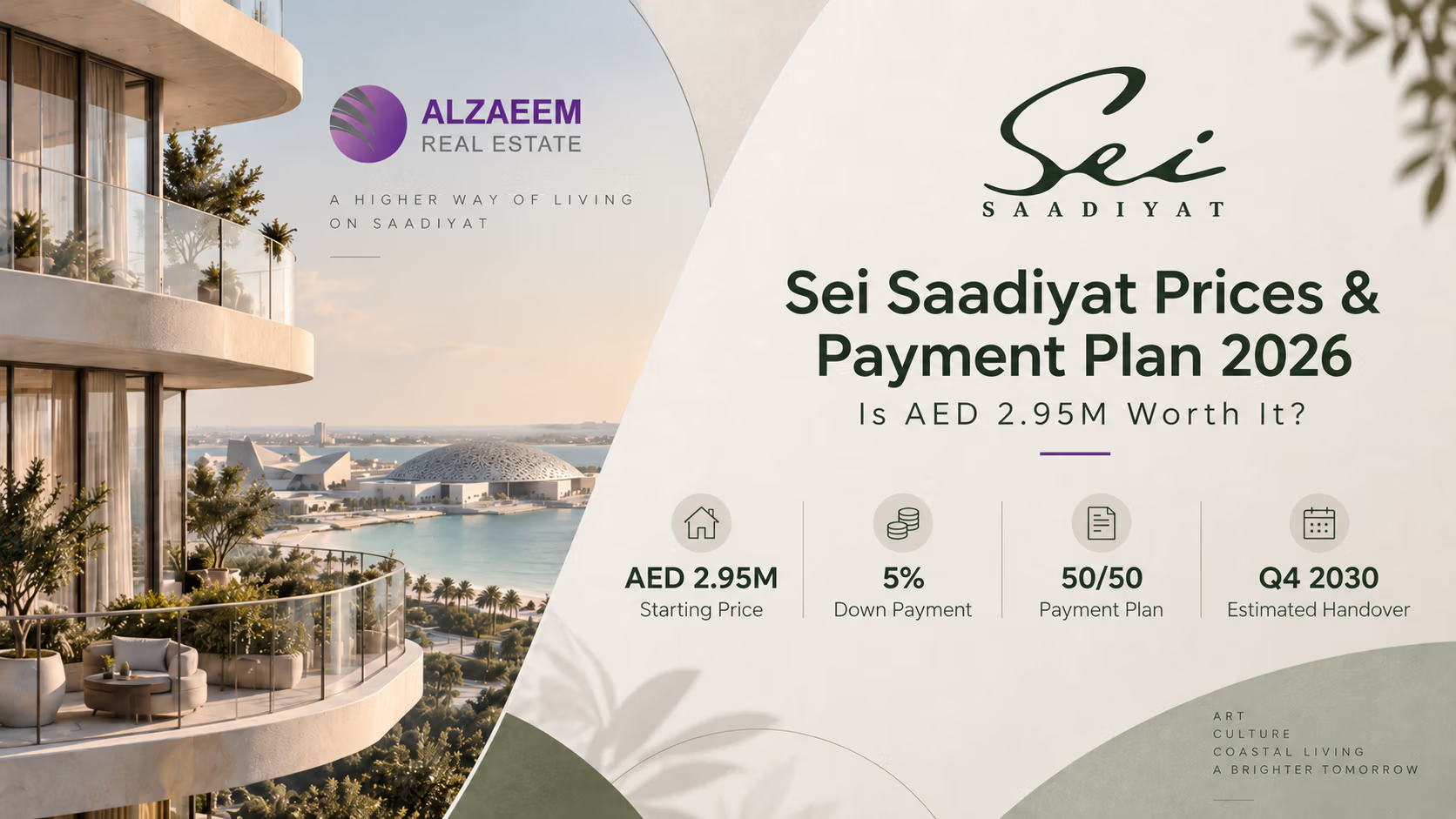
That is currently the official starting price for Sei Saadiyat, Aldar’s newly announced residential development in Saadiyat Cultural District.
The number immediately attracts attention.
But it tells a buyer surprisingly little on its own.
A AED 2.95 million apartment can be:
excellent value;
fair value;
or:
expensive.
The answer depends on what that AED 2.95 million actually buys.
How large is the residence?
Which building?
Which floor?
What view?
How efficient is the layout?
How much is due before handover?
What happens to the buyer’s capital between 2026 and 2030?
And what will competing property on Saadiyat look like when Sei is delivered?
Aldar currently confirms that Sei Saadiyat will contain 778 residences across six buildings, with prices starting from AED 2.95 million, a 5% down payment, a 50/50 payment plan, and estimated completion in Q4 2030. The project includes 1- and 2-bedroom apartments, 3-bedroom Kanso Residences and 2-bedroom Kanso Lofts.
The first phase contains 265 homes across two buildings, with sales scheduled to begin on 16 September 2026.
So this article is not simply about whether AED 2.95 million sounds high.
It is about:
whether the price, payment schedule and future value justify committing capital to Sei Saadiyat today.
Quick Answer: What Does Sei Saadiyat Cost?
As of 13 September 2026, Aldar officially publishes:
| Detail | Sei Saadiyat |
|---|---|
| Starting price | AED 2.95M |
| Down payment | 5% |
| Payment plan | 50/50 |
| Estimated handover | Q4 2030 |
| Published size range | 70–208 sq m |
| Total residences | 778 |
| Phase 1 | 265 homes |
| Residential buildings | 6 |
| Sales launch | 16 September 2026 |
Aldar has not publicly published a complete unit-by-unit Phase 1 price list or the full dated instalment schedule on its project page as of this review.
That distinction matters.
We know the overall structure.
We should not invent the missing instalments.
What Does “Prices Start From AED 2.95M” Actually Mean?
It means exactly that:
the lowest published entry price starts at AED 2.95 million.
It does not mean:
every 1BR costs AED 2.95M;
the average apartment costs AED 2.95M;
a high-floor Cultural District view costs AED 2.95M;
or:
a Kanso Loft costs AED 2.95M.
Starting prices are useful for understanding the minimum entry point.
They are not enough to value an individual property.
Once sales open, investors should compare the actual unit price against:
area;
floor;
orientation;
view;
layout;
balcony;
building;
and competing units.
The First Calculation: 5% Down Payment
At the published AED 2.95 million starting price:
5% × AED 2,950,000
=
AED 147,500
So, mathematically, 5% of the starting price is:
AED 147,500
But this is where buyers need discipline.
AED 147,500 is not:
“the cost of buying Sei.”
It is merely:
the initial 5% of a AED 2.95 million commitment.
The difference is enormous.
Do Not Ask: “Can I Afford AED 147,500?”
Ask:
“Can I afford AED 2.95 million under the complete payment schedule?”
Off-plan marketing naturally emphasises:
the down payment.
Investment analysis should emphasise:
the full obligation.
A buyer can comfortably afford the booking payment and still struggle later.
That is particularly relevant where:
50% remains associated with the later portion of the payment structure.
Aldar officially describes Sei’s plan as 50/50 with 5% down, but the buyer should obtain the final dated instalment schedule before signing.
What Does a 50/50 Payment Plan Mean?
At its broadest level, a 50/50 structure divides the purchase consideration into:
50% before or through the construction period
and:
50% associated with completion/handover, subject to the actual contract schedule.
For a AED 2.95M property:
50% is:
AED 1,475,000
and the other 50% is:
AED 1,475,000.
That immediately reveals the real financial issue.
The buyer is not mainly deciding whether to spend:
AED 147,500 today.
The buyer is committing to eventually fund:
AED 2.95 million plus applicable transaction and ownership costs.
A Simplified AED 2.95M Payment Illustration
This is not Aldar’s official dated instalment schedule.
It simply illustrates the mathematics of the published 50/50 structure.
| Component | Percentage | Amount |
|---|---|---|
| Initial 5% | 5% | AED 147,500 |
| Remaining portion within first 50% | 45% | AED 1,327,500 |
| Remaining 50% | 50% | AED 1,475,000 |
| Total | 100% | AED 2,950,000 |
The exact timing of the 45% should be taken from:
the reservation agreement;
official payment schedule;
and SPA.
Do not treat the table above as the developer’s instalment calendar.
Why the Handover Amount Deserves More Attention Than the Booking Amount
A small initial payment can make an expensive property feel accessible.
But the handover obligation may be the financially demanding part.
Imagine a buyer thinks:
“I have the 5%. I’ll worry about the rest later.”
That is not a strategy.
Between now and Q4 2030, the buyer may experience:
changes in income;
business conditions;
interest rates;
mortgage policy;
currency;
portfolio value;
or personal circumstances.
The stronger approach is to ask:
How will I fund the property if the financial environment in 2030 is worse than I expect today?
Three Ways Buyers May Plan for the Final Balance
A buyer could ultimately rely on:
cash;
mortgage financing;
or:
a combination of the two.
Each strategy creates different risks.
Option 1: Cash Buyer
Suppose the investor intends to pay the entire balance using personal capital.
Advantages include:
no mortgage approval dependency;
no interest expense;
lower financing complexity;
and no bank valuation shortfall.
But the disadvantage is:
capital concentration.
A AED 2.95M cash purchase ties up substantial equity in one property.
The investor should compare that with alternative uses of capital.
Option 2: Mortgage at Handover
Some buyers may plan to finance part of the final amount once the property is completed.
That can preserve liquidity.
But a mortgage in:
2030
is not the same thing as a mortgage approval in:
2026.
Future lending depends on:
income;
debt burden;
property valuation;
bank policy;
interest rates;
and lending rules at that time.
Never treat future mortgage approval as guaranteed.
Option 3: Sell Before Handover
Some off-plan investors plan to:
buy;
hold during construction;
then resell before completion.
This can work in certain circumstances.
But the strategy depends on:
resale permission;
developer requirements;
amount already paid;
market liquidity;
buyer demand;
and future pricing.
A buyer should not commit to Sei assuming:
“I can always flip it later.”
Liquidity must be earned by the market.
It is not guaranteed by the brochure.
Price vs Payment Plan: Two Different Questions
Investors sometimes confuse:
good payment plan
with:
good price.
They are not the same.
A property can be overpriced but offer an attractive payment plan.
Another can be well-priced but require a demanding payment schedule.
You need to analyse both.
Our Abu Dhabi Off-Plan Payment Plans Compared 2026 explains why payment timing changes cash-flow efficiency even when two properties have the same purchase price.
The Payment Plan Does Not Reduce the Purchase Price
This sounds obvious.
It is often forgotten.
AED 2.95M paid gradually is still:
AED 2.95M.
A flexible schedule may improve:
cash management;
liquidity;
and capital efficiency.
It does not transform an expensive property into a cheap property.
Therefore, always separate:
affordability
from:
value.
Is AED 2.95M Expensive for a 1BR?
Potentially.
But the word “expensive” needs a reference point.
A AED 2.95M 1BR should not be compared casually with:
a mass-market 1BR on another island;
an older apartment;
an inland building;
or:
a project with different completion timing and amenities.
Sei sits in:
Saadiyat Cultural District.
That carries a location premium.
The real question is:
How much of the AED 2.95M represents justified location and project value—and how much represents launch premium?
Saadiyat Already Commands Serious Buyer Demand
ADREC recorded AED 13.3 billion in residential sales on Saadiyat Island during H1 2026, making it one of the strongest residential sales districts in Abu Dhabi.
This is relevant because Sei is not attempting to create premium demand in an unproven market.
Saadiyat already attracts:
local buyers;
resident expatriates;
and international investors.
Across Abu Dhabi as a whole, resident expatriates and non-resident foreign buyers represented 70% of residential sales value in H1 2026.
That supports a credible future buyer pool.
It does not tell you what any specific Sei unit is worth.
Why Price per Square Foot Will Matter
Once the complete Phase 1 inventory is available, buyers should calculate:
Purchase Price ÷ Saleable Area
for every unit under serious consideration.
Then compare:
unit against unit;
Sei against other Cultural District projects;
and Sei against relevant Saadiyat alternatives.
Do not compare only:
total price.
A AED 4M property can be cheaper on a PSF basis than a AED 3M property if it provides substantially more area.
Our Abu Dhabi Property Price per Sq Ft Guide 2026 explains why PSF is useful—but still needs adjustment for view, floor, layout and quality.
Do Not Calculate Sei PSF From the Published Range Alone
Aldar currently publishes:
prices from AED 2.95M
and:
a project-wide size range of 70–208 sq m.
It would be incorrect to automatically divide:
AED 2.95M
by:
70 sq m
and claim that this is the official project starting rate per square metre.
Why?
Because the public page does not establish that:
the AED 2.95M unit is exactly 70 sq m.
It may be.
It may not be.
Accurate PSF analysis should use:
the price and area of the same exact unit.
Project Price Is Not Unit Value
Two buyers can both say:
“I bought Sei Saadiyat.”
One may have purchased:
a lower-floor 1BR with a secondary outlook.
Another:
a premium 2BR with open Cultural District views.
Their investment quality can be completely different.
When Phase 1 pricing is available, the analysis should move from:
project level
to:
unit level.
Which Features May Justify a Higher Sei Price?
A higher price can potentially be justified by:
superior Cultural District view;
open sea view;
higher floor;
greater privacy;
efficient layout;
corner position;
larger balcony;
scarce Kanso format;
maid’s room;
better orientation;
or:
stronger future resale differentiation.
The feature should have a reason to matter to:
the next buyer.
Pay Premiums for Scarcity, Not Marketing Labels
Suppose two 2BR units differ by:
AED 400,000.
One has:
a genuinely unobstructed signature view.
The other does not.
That premium may prove valuable because:
the better view cannot easily be manufactured later.
Now suppose the AED 400,000 premium exists only because the unit is described using:
a fashionable marketing label.
That is weaker.
The best premium is attached to something:
physically scarce.
Sei’s Kanso Lofts May Create Different Pricing Economics
Aldar says the Kanso Lofts introduce a new loft-style residential format to its portfolio with double-height open living spaces.
That distinction may justify a premium because the product is:
architecturally different;
scarcer;
and more visually distinctive.
But investors still need to calculate:
price per usable area;
service charges;
rental-market depth;
and resale buyer pool.
A beautiful loft can be excellent for:
end-user desirability.
That does not automatically mean:
highest rental yield.
Kanso Residences May Appeal to a Different Buyer
The 3BR Kanso Residences sit in a different market from:
a standard 1BR.
Potential buyers may include:
families;
senior executives;
international owner-occupiers;
and high-net-worth buyers seeking a larger Cultural District home.
That can support long holding periods and scarcity.
But larger units also require:
much more capital.
The question becomes:
Does the larger unit create enough additional value per dirham invested?
The Investor Should Calculate Incremental Price
Suppose, purely for illustration:
1BR option:
AED 3M.
2BR option:
AED 4.4M.
Additional capital:
AED 1.4M
Now ask:
What does AED 1.4M buy?
Additional bedroom?
Larger living room?
Better view?
Parking?
Maid’s room?
More balcony?
Stronger tenant pool?
Higher rent?
If the investor cannot explain what the extra capital is buying:
the larger unit may not be the better investment.
Opportunity Cost of the Payment Plan
Capital committed to Sei cannot simultaneously be used elsewhere.
Suppose you allocate:
AED 1M
to instalments during construction.
That AED 1M could otherwise remain:
in cash;
business;
financial investments;
another property;
or:
income-producing ready real estate.
This is called opportunity cost.
A payment plan is therefore not only:
“When do I pay?”
It is also:
“When does my money stop being available for something else?”
Off-Plan Property Produces No Ordinary Rent During Construction
Sei’s estimated handover is:
Q4 2030.
Until handover, the property does not operate as a normal completed rental residence.
That means the investment thesis during construction is mainly based on:
future asset value;
capital appreciation;
project progression;
and positioning.
A ready apartment can potentially produce:
rent today.
This is a major difference.
For buyers choosing between an immediate-income asset and Sei, our Abu Dhabi Off-Plan vs Ready Property Guide 2026 provides the broader framework.
The Four-Year Question
From September 2026 to Q4 2030 is a substantial holding period.
The buyer should ask:
What does my capital earn while construction continues?
If the property rises in value:
excellent.
If the property remains near its launch price:
what was the opportunity cost?
If it falls:
can I comfortably hold through the cycle?
The strongest buyers do not need:
immediate appreciation.
They can wait.
Why Long Payment Plans Can Be Powerful
There is also a positive side.
Staged payments can allow investors to:
retain part of their capital for longer;
plan cash flow;
avoid deploying the full amount immediately;
and gain exposure to an asset before completion.
If the property appreciates during construction, the investor may benefit from price movement on a property whose full purchase amount has not yet been deployed.
This creates a form of:
capital efficiency.
But it should not be confused with:
risk-free leverage.
Simplified Example of Capital Efficiency
Imagine a property priced at:
AED 3M.
Suppose the buyer has paid:
AED 1.5M
before completion.
If the market value rises to:
AED 3.3M,
the gross property-value increase is:
AED 300,000.
Relative to the AED 1.5M deployed capital, that appears significant.
But this simplified example ignores:
fees;
remaining contractual liability;
resale restrictions;
selling costs;
tax considerations;
and market liquidity.
It demonstrates the principle—not a guaranteed return.
Leverage Works Both Ways
If a property rises:
partial capital deployment can magnify the return on cash invested.
If a property falls:
the buyer still owes the contractual purchase price.
Suppose the market becomes weaker while the buyer still has:
a large handover payment due.
That is exactly why off-plan stress testing matters.
The Handover Stress Test
Before buying, model at least three scenarios.
Scenario A — Strong
Property has appreciated by handover.
Mortgage availability is good.
Buyer income is strong.
Rental outlook is strong.
Scenario B — Flat
Property value is around the original purchase price.
Buyer still needs to fund the remaining balance.
Scenario C — Weak
Property value is below the original price.
Mortgage valuation is conservative.
Rent is weaker than expected.
The investment should ideally remain manageable under:
Scenario C.
If the strategy only works in Scenario A:
the position is fragile.
Bank Valuation Risk at Handover
Suppose the purchase price is:
AED 3M.
At handover, the bank values the property at:
AED 2.7M.
A lender normally applies its financing rules to:
its accepted valuation and lending criteria,
not simply:
what the buyer originally agreed to pay.
This can increase the amount of cash the buyer needs.
That is why mortgage-dependent off-plan buyers should maintain:
a liquidity buffer.
Do Not Spend Your Entire Cash Reserve on Instalments
Suppose a buyer has:
AED 1.5M.
The temptation may be to commit almost everything to property instalments.
But property ownership eventually requires:
registration and transaction costs;
furniture;
service charges;
maintenance;
insurance where relevant;
and potentially mortgage-related costs.
A strong investment plan includes:
reserves after handover.
Transaction Costs Matter Too
AED 2.95M is not necessarily the complete all-in ownership cost.
Property buyers need to account for the relevant:
registration;
administrative;
financing;
brokerage where applicable;
and other transaction-related costs.
Our Abu Dhabi Property Fees & Closing Costs 2026 explains the wider acquisition-cost structure.
Investment return should use:
all-in capital.
Not only:
developer price.
What About Golden Visa Eligibility?
A Sei property starting above AED 2M may appear to satisfy the headline Golden Visa threshold.
But there is an important off-plan distinction.
Abu Dhabi Residents Office currently states that a real-estate investor needs at least AED 2 million of qualifying investment capital.
For off-plan property, the applicant must provide a purchase agreement from an approved developer and evidence that at least AED 2 million has already been paid to the developer.
So buying a:
AED 2.95M
Sei property
with:
AED 147,500 as the initial 5%
does not mean the buyer immediately satisfies that off-plan payment condition.
How Much of AED 2.95M Is AED 2M?
For reference:
AED 2M is approximately:
67.8%
of AED 2.95M.
Therefore, under the current off-plan Golden Visa payment requirement, the buyer would need to have paid a substantial portion of the purchase consideration before reaching AED 2M.
The actual timing depends on:
the official instalment schedule.
Golden Visa regulations should always be reconfirmed at the time of application.
Sei Saadiyat vs Buying a Ready AED 2.95M Property
This is a useful investment comparison.
With Sei:
you obtain:
new-build Cultural District exposure;
Aldar project positioning;
future delivery;
and staged payment.
With a ready property:
you may obtain:
immediate occupancy;
immediate rent;
known service charges;
physical inspection;
and current market evidence.
The trade-off is:
future potential vs immediate certainty.
Neither is inherently superior.
Why Saadiyat’s Future Supply Matters to Sei Pricing
ADREC projects approximately 71,000 additional residential units across Abu Dhabi through 2030, with six major districts—including Saadiyat Island—accounting for 77% of incremental supply.
This creates two opposing effects.
More development can make Saadiyat:
more mature;
more vibrant;
better serviced;
and more internationally recognised.
But additional residential inventory also creates:
competition.
By 2030, a Sei seller or landlord may compete against:
other new Saadiyat projects;
recently completed Cultural District apartments;
premium branded residences;
and future launches not even available today.
Entry Price Becomes More Important When Supply Is Growing
Imagine two investors buy premium Saadiyat properties.
Investor A enters at a sensible price.
Investor B pays a large launch premium.
By 2030, both own excellent property.
But Investor A has:
more margin for error.
This is why future supply makes the entry basis important.
A great market can hide:
bad pricing
for a while.
Eventually, investors compare alternatives.
Abu Dhabi’s Current Market Is Very Strong
ADREC reported AED 70.4 billion in residential sales in H1 2026, versus AED 25.3 billion during H1 2025.
Off-plan accounted for:
89% of sales value
and:
82% of transactions.
Repeat-sale apartment prices were also up 20% year-on-year at the emirate level.
These are strong conditions.
And that creates another risk:
buying at peak optimism.
Strong Markets Require More Pricing Discipline, Not Less
When everyone is optimistic:
buyers compete;
launches sell rapidly;
and fear of missing out increases.
That is precisely when an investor should ask:
What is the fair value?
What is the alternative?
What happens if the market cools?
Can I hold through 2030?
The best investment decisions are not made by:
FOMO.
Should You Buy on Launch Day?
Buying early may provide access to:
broader inventory;
better views;
better floors;
more layout choice;
and potentially first-release pricing.
But launch day can also create:
urgency.
The buyer should arrive with:
budget;
preferred unit category;
maximum acceptable price;
view priorities;
and payment capacity
already defined.
Your Maximum Price Should Be Decided Before the Sales Event
Suppose you decide:
“My preferred 2BR is attractive up to AED X.”
If the available unit exceeds:
AED X,
walk away.
That is investment discipline.
Do not increase your budget simply because:
another buyer is waiting.
The Best Unit May Not Be the Cheapest Unit
A cheaper apartment with:
poor orientation;
weak view;
inefficient floor plan;
or future obstruction
may eventually underperform a more expensive but clearly superior unit.
The correct goal is not:
lowest price.
It is:
best value.
But the Most Expensive Unit Is Not Automatically Best Either
Paying more for:
top floor;
larger terrace;
signature view;
or corner position
can make sense.
But every premium needs to be compared with:
the value it creates.
Suppose a better floor costs:
AED 300,000 more.
Will it produce:
additional rent;
stronger resale;
or enough owner enjoyment
to justify AED 300,000?
That is the correct analysis.
Calculate Premium Percentage, Not Just Premium Amount
Example:
Base unit:
AED 3M.
Better-view unit:
AED 3.3M.
Premium:
AED 300k.
Percentage premium:
10%
Now ask:
Would future buyers plausibly pay around 10% more for that advantage?
This makes the decision easier to frame.
What If Sei Appreciates Before Handover?
That is the upside scenario.
Suppose a AED 2.95M unit later has a market value of:
AED 3.4M.
Gross value increase:
AED 450,000
or roughly:
15.3%
on original purchase price.
That sounds attractive.
But realised return would still depend on:
amount paid;
transaction costs;
resale rules;
selling expenses;
and whether there is an actual buyer at AED 3.4M.
A paper valuation is not:
cash.
What If It Stays Flat?
Suppose the property is still worth around:
AED 2.95M
in 2030.
The buyer may still have acquired:
an excellent long-term home;
a Cultural District asset;
and future rental property.
But as a pure capital-growth investment, the buyer also needs to consider:
four years of opportunity cost.
Flat price does not necessarily mean:
bad asset.
It can mean:
weak return during the construction period.
What If It Falls 10%?
A 10% decline from:
AED 2.95M
would imply a theoretical market value around:
AED 2.655M
Difference:
AED 295,000
The buyer still owes the contractual amount subject to the SPA.
This is why off-plan property should be purchased with:
holding capacity.
Is Sei Better for Cash Buyers?
Not automatically.
A cash-rich buyer may have:
greater resilience;
less mortgage dependency;
and stronger ability to absorb handover risk.
But tying up substantial capital may reduce portfolio flexibility.
A mortgage buyer may preserve capital.
But increases:
interest;
valuation;
approval;
and debt-service risk.
The broader decision is covered in our published Abu Dhabi Property Cash vs Mortgage Guide 2026.
Rental Yield Cannot Yet Be Known
Sei will not hand over until 2030.
Therefore, statements such as:
“Sei will generate 7% rental yield”
should be treated cautiously unless they are clearly labelled:
assumptions.
No actual Sei tenancy market exists yet.
Investors should model several future rent scenarios.
Example Rental Stress Test
Assume, purely for education, a unit is purchased for:
AED 2.95M.
Future annual rent scenarios:
Conservative
AED 150,000
Gross yield:
approximately 5.08%
Base
AED 180,000
Gross yield:
approximately 6.10%
Strong
AED 210,000
Gross yield:
approximately 7.12%
These are not Sei rent forecasts.
They simply demonstrate how sensitive future yield is to rental assumptions.
Now Include Ownership Costs
Suppose the hypothetical property rents at:
AED 180,000.
Then deduct:
service charges;
maintenance;
vacancy;
management;
and other ownership costs.
Net operating income could be materially lower.
That is why our Abu Dhabi Property ROI Calculator 2026 distinguishes:
gross yield
from:
real investment return.
Service Charges Could Change the Investment Case
Sei includes:
rooftop pools;
wellness facilities;
hot and cold pools;
gardens;
fitness areas;
spa facilities;
co-working;
cinema rooms;
and multiple shared amenities.
These can strengthen:
lifestyle;
rental desirability;
and resale appeal.
They also need to be:
operated;
cleaned;
staffed;
and maintained.
Until approved service charges are available, investors should avoid inserting an invented figure into the model.
Instead:
stress-test a range.
Service Charge Stress Test
Imagine, purely for analysis:
Scenario A ownership costs:
AED 25,000/year.
Scenario B:
AED 40,000.
Scenario C:
AED 60,000.
The same rent produces very different net yields.
When official figures become available:
replace assumptions with:
actual project data.
Can AED 2.95M Be Better Value Than AED 2.5M Elsewhere?
Absolutely.
Price alone does not define value.
Suppose Property A:
AED 2.95M;
excellent Cultural District location;
strong floor plan;
scarce view;
Aldar development;
good resale depth.
Property B:
AED 2.5M;
inferior location;
weak layout;
large future competing supply;
poor resale differentiation.
Property A could be:
more expensive
and:
better value.
Can AED 2.95M Also Be Too Expensive?
Absolutely.
If the exact Sei unit has:
weak orientation;
average layout;
limited view;
and many identical competitors,
while an alternative offers stronger fundamentals at lower capital:
then branding and location alone may not justify the premium.
The answer is always:
unit-specific.
The Value Triangle
A useful Sei framework is:
1. Property
What exactly are you buying?
2. Price
What are you paying relative to alternatives?
3. Payment Plan
When does the money leave your hands?
A strong investment needs:
all three
to work together.
Sei Saadiyat Price Scorecard
Use this framework once the exact Phase 1 unit list is available.
| Factor | Score 1–5 |
|---|---|
| Price per sq ft | |
| View premium | |
| Floor premium | |
| Layout efficiency | |
| Balcony efficiency | |
| Unit scarcity | |
| 5% initial affordability | |
| Construction instalment affordability | |
| 50% later-payment resilience | |
| Mortgage fallback | |
| Future rental potential | |
| Resale buyer depth | |
| Future supply risk | |
| Portfolio fit | |
| Overall value |
This is an Al Zaeem analytical framework—not an Aldar or ADREC valuation method.
20 Questions Before Paying the 5%
- What is the exact unit price?
- What is the exact saleable area?
- What is the true price per square foot?
- Which building is it in?
- Which floor?
- What is the orientation?
- What will the view actually be?
- Can future construction obstruct it?
- How much of the area is balcony?
- Is the floor plan efficient?
- What is the complete dated payment schedule?
- When is each instalment due?
- What happens if a payment is late?
- Can the property be resold before handover?
- What conditions apply to resale?
- How will I fund the final balance?
- What if the bank values the property below my purchase price?
- How much cash reserve will remain after payments?
- What comparable Saadiyat properties could I buy instead?
- Would I still buy this exact unit if nobody expected prices to rise before 2030?
Question 20 is powerful.
If the answer is:
yes,
the investment thesis is probably based on:
the underlying property.
If the answer is:
no,
you may primarily be buying:
an appreciation expectation.
Frequently Asked Questions
What is the starting price of Sei Saadiyat?
Aldar currently lists Sei Saadiyat prices from AED 2.95 million.
What is the down payment?
The official project page states a 5% down payment.
How much is 5% of AED 2.95 million?
AED 147,500.
What is the payment plan?
Aldar describes Sei as having a 50/50 payment plan.
Does 5% mean I only pay 5% before handover?
No. Aldar describes the overall structure as 50/50 with 5% down. Buyers need the complete official instalment schedule to understand when the remaining payments are due.
Has Aldar published every Sei instalment date?
The public project page reviewed on 13 September 2026 states 50/50 and 5% down but does not provide the complete dated instalment schedule.
When do Sei Saadiyat sales begin?
Phase 1 is scheduled for sale from 16 September 2026.
How many Phase 1 homes are there?
The first release comprises 265 homes across two buildings.
How many homes will Sei have in total?
The complete development comprises 778 homes across six residential buildings.
When is handover?
Aldar currently estimates Q4 2030.
What are the apartment sizes?
Aldar publishes a project-wide size range of 70–208 sq m.
Can I calculate the exact starting PSF from the public page?
Not reliably unless the exact AED 2.95M unit’s corresponding area is confirmed.
Is AED 2.95M good value?
It depends on the exact unit, area, view, floor, layout, payment schedule and relevant Saadiyat comparables.
Is Sei suitable for investors?
Potentially. It offers Cultural District exposure and staged payment, but investors must consider entry price, future supply, 2030 handover, service charges and rental/resale assumptions.
Is Sei better for end users?
It may be particularly compelling for buyers who value Saadiyat Cultural District, wellness facilities, design and long-term lifestyle use. But value remains unit-specific.
Can I finance the final payment with a mortgage?
Potentially, subject to bank lending criteria, buyer eligibility, valuation and rules applicable at the time. Future mortgage approval should not be assumed.
Can I resell before handover?
Off-plan resale depends on developer and regulatory requirements and the specific SPA. Buyers should verify the actual conditions before purchasing.
Does a Sei property automatically qualify for Golden Visa?
No. Current Abu Dhabi guidance for off-plan real estate requires evidence that at least AED 2 million has been paid to the approved developer, in addition to other eligibility requirements.
Is the price likely to increase after launch?
No future price movement can be guaranteed.
What is the biggest financial risk?
For many buyers, it is not the 5% down payment.
It is:
committing to a premium property today without a robust plan for funding the remaining purchase price through 2030.
Final Takeaway
Sei Saadiyat begins from:
AED 2.95 million.
The down payment begins from:
5%.
The payment structure is:
50/50.
And estimated handover is:
Q4 2030.
Those four numbers make the project look simple.
The actual investment decision is more complex.
A 5% down payment lowers the immediate capital barrier.
It does not lower the purchase price.
A 50/50 payment plan can improve cash-flow flexibility.
It also creates a substantial later funding obligation.
A 2030 handover provides time for:
Saadiyat Cultural District;
Abu Dhabi;
and the property itself
to mature.
It also means the buyer waits years before ordinary residential rental income can begin.
And AED 2.95M may prove to be:
excellent;
fair;
or expensive
depending on the exact unit received for that capital.
The current market backdrop is unquestionably strong.
Abu Dhabi residential sales reached AED 70.4 billion in H1 2026, with off-plan accounting for 89% of sales value. Saadiyat Island alone recorded AED 13.3 billion in residential sales.
But strong markets should not reduce investment discipline.
They should increase it.
The buyer should not ask:
“Can I book Sei with 5%?”
The buyer should ask:
“Is this exact Sei residence worth the full price—and can I comfortably complete the entire investment even if the market becomes less favourable before 2030?”
That is the real payment-plan question.
Al Zaeem Real Estate — Analyse the Full Price Before Paying the 5%
Sei Saadiyat’s first release is scheduled for 16 September 2026, with 265 homes across the initial two buildings.
Before choosing a unit, Al Zaeem Real Estate can help buyers compare:
exact price;
unit size;
price per square foot;
floor;
view;
layout;
payment timing;
handover exposure;
and alternative Saadiyat opportunities.
Explore the wider Saadiyat Island property market, Abu Dhabi off-plan properties, and apartments for sale in Abu Dhabi.
For the financial framework, also review our Off-Plan Payment Plans Guide and Abu Dhabi Property ROI Calculator 2026.
The goal is not merely to reserve early.
It is:
to enter at a price and payment structure you can defend all the way to handover.
Al Zaeem Real Estate
+971 (50) 991 5454
azcb.co
Primary Official Sources
Aldar’s official Sei Saadiyat page confirms the AED 2.95M starting price, 5% down payment, 50/50 payment plan, Q4 2030 estimated handover, size range and residential formats.
Aldar’s official launch announcement confirms the six-building, 778-home project, 265-home first phase and introduction of the new double-height Kanso Loft format.
Emirates News Agency confirms that Phase 1 is scheduled to go on sale from 16 September 2026.
ADREC’s H1 2026 market report provides the wider market context, including AED 70.4B residential sales, 89% off-plan share, AED 13.3B Saadiyat residential sales and future supply projections through 2030.
Abu Dhabi Residents Office provides the current Golden Visa criteria applicable to real-estate investors, including the treatment of off-plan purchases.
Disclaimer
This article is provided for general educational and real-estate research purposes only. It does not constitute financial, investment, legal, mortgage, tax, immigration, valuation or contractual advice.
Project information reflects publicly available official information reviewed on 13 September 2026, before Sei Saadiyat Phase 1’s scheduled 16 September sales opening.
The AED 2.95 million price is Aldar’s published starting price. It does not represent the price of every residence.
The 5% down payment and 50/50 structure are officially published; however, buyers should obtain the complete dated developer payment schedule and contractual documents before committing funds.
Any payment examples in this article other than Aldar’s published percentages are mathematical illustrations and are not a substitute for the official payment schedule.
Rental figures, price-growth examples, valuation scenarios, service-charge assumptions and future market values used for explanation are hypothetical and are not forecasts.
Future mortgage approval, bank valuation, off-plan resale, Golden Visa eligibility, rental income and capital appreciation are not guaranteed.
Last reviewed: 13 September 2026.