


A property is advertised for:
AED 2,000,000.
The buyer assumes:
“My property costs AED 2 million.”
That number is important.
But it is not necessarily the amount of capital required to complete, hold and eventually sell the investment.
Real property ownership can involve several additional cost layers:
registration
brokerage
mortgage
handover
service charges
furnishing
insurance
maintenance
and eventually:
resale expenses.
Some are regulatory.
Some are optional.
Some apply only to financed purchases.
Others do not become visible until the building is completed.
That distinction matters because two properties advertised at exactly AED 2 million can have very different total ownership costs.
Abu Dhabi’s market is particularly active in 2026. Residential sales reached AED 70.4 billion in H1 2026, with off-plan sales representing 89% of residential sales value.
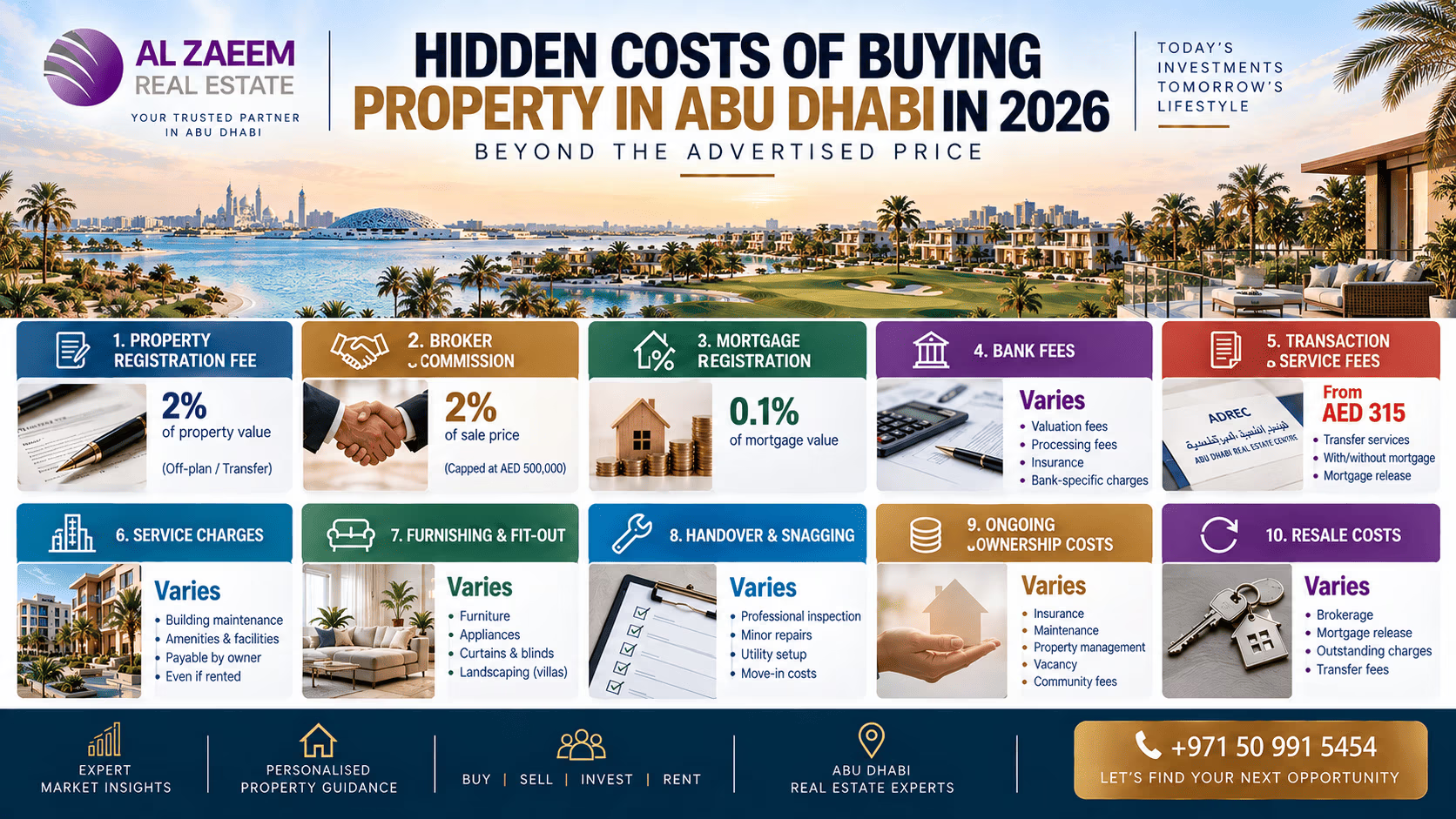
With so much capital entering under-construction property, buyers need to understand something that launch brochures rarely make prominent:
The purchase price is the beginning of the financial calculation—not the end.
This guide breaks down the costs Abu Dhabi buyers should consider before committing to a property.
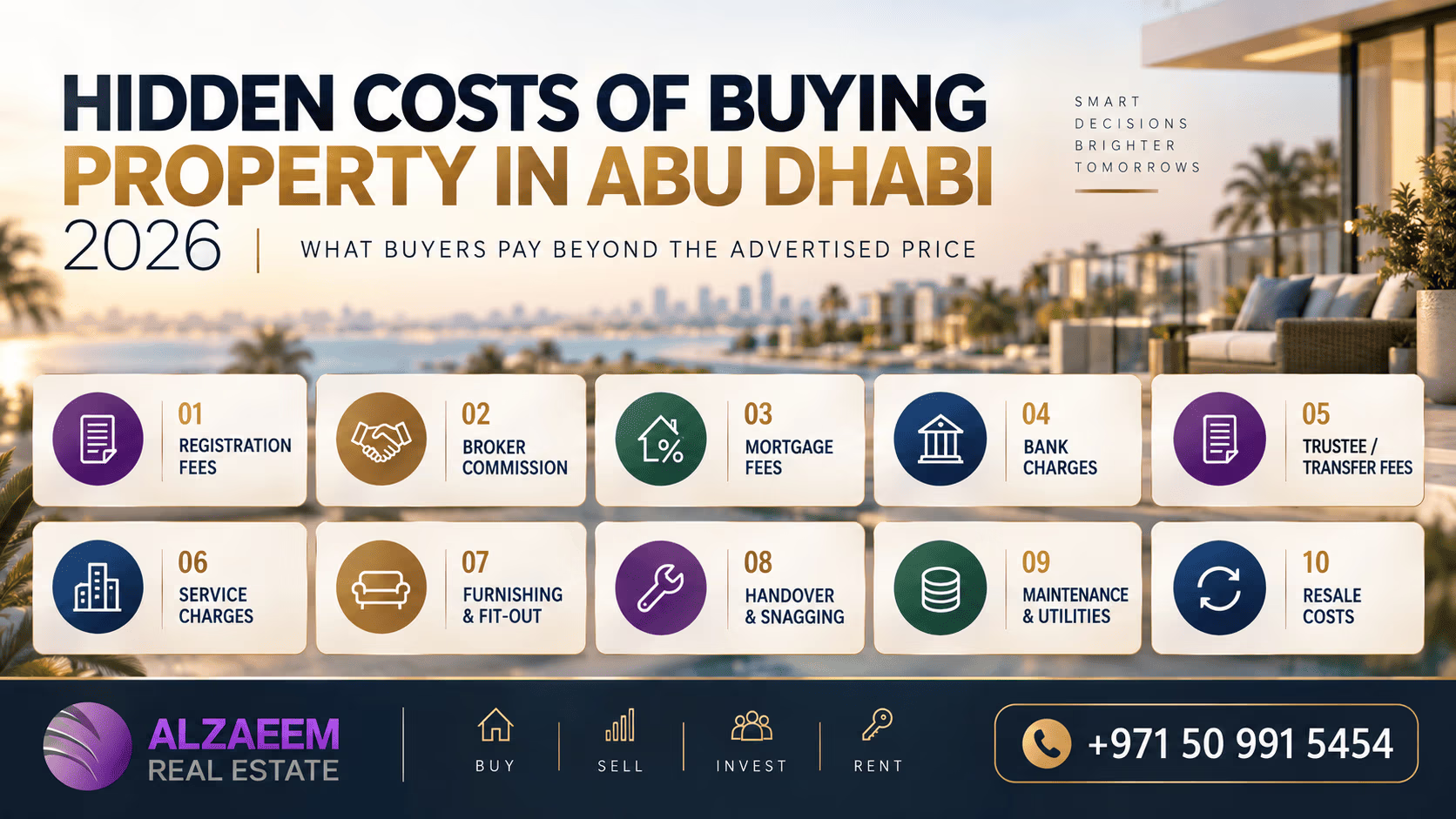
Abu Dhabi Property Costs — Quick Overview
| Cost | When It May Apply | Fixed or Variable? |
|---|---|---|
| Property registration | Purchase / off-plan registration | Regulatory |
| Broker commission | Where brokerage is payable | Percentage |
| Mortgage registration | Financed property | Percentage |
| Bank valuation | Mortgage buyers | Bank-specific |
| Mortgage processing | Mortgage buyers | Bank-specific |
| Trustee / transaction service | Certain transaction channels | Service-specific |
| Service charges | After completion / ownership | Community-specific |
| Community charges | Some master communities | Community-specific |
| Furnishing | Rental / personal use | Optional |
| Snagging | Handover | Optional but advisable |
| Home / contents insurance | Ownership | Optional / lender-dependent |
| Repairs and maintenance | Ready property / post-handover | Variable |
| Property management | Landlords | Optional |
| Resale brokerage | Exit | Transaction-specific |
| Mortgage release | Financed resale | If applicable |
The actual cost depends on whether you are buying:
off-plan
ready
cash
mortgage
apartment
or
villa.
So avoid using one universal percentage for every Abu Dhabi purchase.
Cost 1: Off-Plan Registration Fee
This is one of the first costs buyers should understand.
Abu Dhabi’s current regulatory framework requires off-plan sales to be registered through the official system.
ADREC’s current developer process states that every off-plan sale is registered through a Sale and Purchase Agreement and lists the registration fee at 2% of the unit sale price.
The regulatory fee schedule also states that registration of an off-plan sale is charged at 2% of the real-estate value, normally divided equally between seller and buyer unless otherwise structured.
That distinction is important.
Do not automatically assume:
“The buyer always pays exactly 2%.”
Instead, check:
- SPA;
- developer payment schedule;
- reservation form;
- official transaction breakdown.
Developers can structure commercial arrangements differently.
Example — AED 2 Million Off-Plan Property
Property value:
AED 2,000,000
Total 2% regulatory registration amount:
AED 40,000
Under the regulatory schedule’s equal division:
Buyer portion would ordinarily be:
AED 20,000
Seller/developer portion:
AED 20,000
But the contractual allocation should be checked before reservation.
This is precisely why buyers should request a complete cost sheet, not merely the payment plan.
Cost 2: Broker Commission
Broker commission is another cost that buyers sometimes forget because many primary off-plan launches are marketed through developer-appointed agents under different commercial arrangements.
For ordinary real-estate sale and purchase brokerage, Abu Dhabi’s published regulations state that broker commission is 2% of the sale and purchase contract, capped at AED 500,000.
Whether you personally owe that commission depends on:
- the transaction;
- broker agreement;
- developer arrangement;
- primary vs secondary purchase.
Never assume that because one transaction involved no buyer-side commission, every Abu Dhabi transaction will be the same.
Example
Property:
AED 3,000,000
2% brokerage:
AED 60,000
That amount alone can materially change the economics of a resale investment.
This becomes especially important when investors calculate:
launch price vs resale price.
If your property rises AED 150,000 but your selling costs consume AED 70,000–100,000, your real profit may be far smaller than the headline appreciation suggests.
Cost 3: Mortgage Registration
Cash buyers avoid many financing costs.
Mortgage buyers do not.
ADREC’s published fee framework lists mortgage registration at:
1 per thousand of the mortgage value
which equals:
0.1%
subject to the applicable maximum under the published schedule.
Example
Mortgage:
AED 1,500,000
0.1% registration:
AED 1,500
This is not usually the largest mortgage expense.
The bigger costs can come from the bank itself.
Cost 4: Bank Mortgage Fees
Mortgage purchasers can also encounter:
- property valuation;
- loan arrangement / processing;
- insurance;
- account requirements;
- mortgage-related administration.
These are bank-specific, not universal Abu Dhabi property charges.
Therefore, do not calculate affordability using only:
down payment + monthly mortgage.
Ask the lender for an all-in mortgage cost illustration.
A slightly lower interest rate does not automatically mean a cheaper mortgage if the financing structure includes materially higher upfront charges.
Cost 5: Transaction / Trustee Service Fees
Another easy source of confusion is the difference between:
registration fees
and
transaction-service fees.
ADREC’s Trustee Office currently lists service charges including:
- AED 1,050 for transfer of ownership;
- AED 1,575 for transfer of ownership with mortgage;
- AED 1,050 for mortgage services;
- AED 315 for mortgage release.
The listed amounts are inclusive of VAT.
These should not be confused with the percentage-based property registration charges.
They relate to the transaction service channel.
ADREC also offers an optional At Your Place service, which currently lists AED 1,000 for services such as buy-and-sell transactions or off-plan sale registration.
Again:
do not double-count these automatically.
Ask which services actually apply to your transaction.
Cost 6: Service Charges
For apartment investors, this can become one of the most important recurring expenses.
Service charges fund the management, operation, repair and maintenance of common areas.
ADREC confirms that these budgets are subject to regulatory approval and that the unit owner remains responsible for service charges even when the property is rented to a tenant.
That means:
Rent does not eliminate the owner’s service-charge obligation.
Common service-charge expenses can support:
- security;
- cleaning;
- pools;
- gyms;
- landscaping;
- elevators;
- common-area electricity;
- maintenance;
- management;
- building insurance;
- shared infrastructure.
Luxury developments with:
multiple pools,
beach clubs,
concierge,
spa,
private cinema,
extensive landscaping
may naturally require a larger operating budget than a simpler residential building.
Why Service Charges Matter So Much to Yield
Imagine two apartments.
Apartment A
Price:
AED 2,000,000
Annual rent:
AED 150,000
Annual service charge:
AED 18,000
Apartment B
Price:
AED 2,000,000
Annual rent:
AED 150,000
Annual service charge:
AED 35,000
Headline gross yield for both:
7.5%
But before any other expenses:
Apartment A retains:
AED 132,000
Apartment B retains:
AED 115,000
Same purchase price.
Same rent.
Very different ownership economics.
This is why investors should never calculate yield from:
rent ÷ purchase price
and stop there.
New Service-Charge Transparency From 2027
This is especially relevant for properties handing over in 2027.
ADREC announced changes to the way service-charge budgets will be presented from 2027 onward.
Annual charges will be separated into:
- Community Service Charges
- Master Community Fees
- Surplus / Deficits
and owners will receive clearer invoices and financial reporting.
This should improve transparency.
But it also reminds buyers that some developments can contain more than one recurring community-level cost.
Cost 7: Master Community or Compound Charges
A building can exist inside a larger master development.
For example:
an apartment tower may have its own common-area expenses,
while the wider district also maintains:
- roads;
- landscaping;
- parks;
- community infrastructure;
- security;
- waterfront areas.
Abu Dhabi’s regulatory framework recognises both service fees and compound fees within real-estate developments.
Therefore, when buying inside a large community, ask:
Are there building charges only, or building charges plus master-community charges?
This is particularly important for long-term investors because small annual differences compound over many years.
Cost 8: Service-Charge Clearance When You Sell
Service charges are not merely an annual operating expense.
They can also affect your exit.
ADREC states that outstanding service charges must be settled before completing a property sale or transfer.
So an owner cannot simply ignore accumulated charges and assume the buyer will deal with them later.
Before resale, check:
outstanding balance
current invoice
clearance requirements
any community-management process
This becomes particularly important for absentee overseas investors.
Cost 9: Handover Payment
Technically, this is not a hidden fee.
It is part of the purchase price.
But it often behaves like a hidden cost because buyers concentrate on the attractive early-stage payment plan and underestimate the final capital requirement.
Example:
Property:
AED 2,000,000
Paid during construction:
60% = AED 1.2 million
Handover payment:
40% = AED 800,000
That AED 800,000 can become very real very quickly.
If you intended to:
flip before handover
but the resale market is weak,
you may suddenly need to fund the final AED 800,000.
This is why the final instalment should be treated as a financial obligation from Day One.
Not as a future problem.
Cost 10: Snagging
At handover, a new property needs inspection.
Typical issues might involve:
- paint;
- doors;
- cabinetry;
- plumbing;
- tiling;
- electrical fittings;
- air-conditioning;
- balconies;
- seals;
- finishes.
Owners can inspect personally.
Many also use professional snagging specialists.
The cost varies with:
- property size;
- inspection depth;
- villa vs apartment;
- specialist.
It is optional.
But on a multimillion-dirham property, professional inspection can be relatively small compared with the value of defects that might otherwise be missed.
Cost 11: Furnishing
A new apartment may be technically ready for ownership but not ready for a tenant.
A landlord may still need:
bed
sofa
dining furniture
curtains
TV
kitchen equipment
washing machine
lighting
decor
linen
The difference between:
handover
and
rent-ready
can therefore be substantial.
This is particularly relevant to furnished studios and one-bedroom investment properties.
An investor may calculate an attractive projected rent but forget that several months of rent could be consumed simply by furnishing the property.
Furnishing Luxury Property Is Different
The issue becomes larger at the upper end.
A AED 10 million villa furnished inconsistently with its market position can harm both:
rental appeal
and
resale presentation.
Luxury buyers and tenants often expect:
- coordinated furniture;
- premium appliances;
- outdoor furniture;
- window treatments;
- landscaping;
- lighting;
- decorative finishes.
Therefore the property’s capital expenditure after handover should match its target market.
Cost 12: Curtains, Blinds and Window Treatments
This sounds minor.
In some properties it is not.
Large modern Abu Dhabi homes can include:
floor-to-ceiling glazing,
double-height living rooms,
large bedrooms,
sliding glass walls.
Quality window treatments across a large villa can become a meaningful expense.
The same applies to premium apartments with extensive glazing.
It rarely appears in the advertised property price.
Cost 13: Landscaping
For villas, landscaping deserves its own budget.
Depending on what the developer provides at handover, an owner may want:
- lawn;
- trees;
- planting;
- irrigation;
- outdoor lighting;
- seating;
- barbecue area;
- pool enhancement;
- shading.
A villa can therefore be delivered yet still require additional capital before it looks like the lifestyle property shown in marketing material.
Before purchase ask:
Exactly what exterior landscaping is included in the delivered specification?
Do not assume the rendering represents the delivered garden.
Cost 14: Utility Setup and Deposits
Ready property also needs functioning services.
Depending on the development and utility structure, owners may need to arrange:
- electricity;
- water;
- cooling;
- gas;
- internet;
- community access;
- move-in permissions.
Some systems involve deposits or activation costs.
These charges are provider- and property-specific, so they should be confirmed during handover rather than estimated blindly.
They are normally small relative to the property price.
But they belong in the cash-flow plan.
Cost 15: Cooling
This deserves special attention for apartment buyers.
Some buildings have central or district-cooling structures.
Depending on the property and leasing arrangement, cooling costs may involve:
- consumption;
- capacity;
- account charges.
The commercial structure varies by building.
Investors should understand whether:
landlord pays
tenant pays
or
some charges remain owner-related.
A unit with attractive rent but unusually high occupancy costs may be less competitive with tenants.
Cost 16: Insurance
ADREC notes that community-management arrangements provide building/common-area insurance through the service-charge structure, while individual owners are encouraged to arrange separate home and contents insurance where appropriate.
Mortgage lenders may also impose insurance-related requirements.
Again, this is not usually the largest expense.
But buyers should distinguish between:
building/common-area insurance
and
insurance protecting their own unit, contents or financing obligations.
Cost 17: Maintenance Inside the Unit
Service charges do not mean:
“Everything inside my apartment is maintained for free.”
They primarily cover common areas and approved shared facilities.
Inside your own property you may remain responsible for items such as:
- appliances;
- plumbing fixtures;
- internal AC components depending on system;
- cabinetry;
- electrical issues;
- flooring;
- repainting.
Ready-property investors should therefore keep a maintenance reserve.
The older the asset becomes, the more important that reserve becomes.
Cost 18: Property Management
Overseas investors may not want to manage:
tenant inquiries,
contracts,
maintenance,
renewals,
inspections,
rent collection,
move-in/out.
Professional property management can solve that.
But it is another cost.
The fee structure varies.
Therefore, when an overseas investor hears:
“This apartment produces 7% rental yield,”
the correct question is:
Before or after professional management?
Cost 19: Vacancy
Vacancy is not an invoice.
But economically it is a cost.
Suppose expected annual rent is:
AED 120,000
If the property remains empty for one month:
lost rent is approximately:
AED 10,000.
Two months:
AED 20,000.
This is why investors should calculate:
effective annual income
rather than assuming 100% occupancy forever.
Cost 20: Tenant Turnover
A property can also generate costs every time a tenant changes.
Potential expenses include:
- repainting;
- cleaning;
- repairs;
- brokerage;
- vacancy;
- furniture replacement.
A long-term tenant paying slightly below the maximum theoretical market rent can sometimes be financially better than aggressively replacing tenants every year.
Cost 21: Mortgage Exit Costs
A mortgage matters when you sell too.
If the property is mortgaged, the financing may need to be:
- settled;
- released;
- replaced;
- coordinated with the buyer’s financing.
ADREC Trustee Office currently lists AED 315 for mortgage release service and AED 1,575 for certain transfer-with-mortgage transaction services.
These service fees are relatively small compared with the loan itself.
The more important issue may be your lender’s:
early-settlement conditions.
That is bank-specific and should be checked directly.
Cost 22: Resale Brokerage
Buying costs are only half of the ownership cycle.
Eventually you may sell.
If a broker earns commission on the transaction, that cost reduces your net proceeds.
Example:
Original purchase:
AED 2,000,000
Resale:
AED 2,300,000
Headline appreciation:
AED 300,000
Then deduct:
- sale-related brokerage where applicable;
- transfer/registration costs allocated to you;
- mortgage release;
- outstanding service charges;
- other transaction expenses.
Your realised gain is not AED 300,000.
This links directly to the principle from our Launch Price vs Resale Before Handover analysis:
Paper appreciation and actual profit are not the same number.
Cost 23: Currency Risk for International Buyers
A buyer earning:
GBP,
EUR,
PKR,
INR,
USD or another currency
may think primarily in dirhams when buying.
But capital enters and eventually exits through currency conversion.
Exchange-rate movements can affect the investor’s return measured in their home currency.
This is not an Abu Dhabi property fee.
But it is an investment cost/risk that international buyers should recognise.
Cost 24: Opportunity Cost
This is the least visible cost of all.
Suppose you place:
AED 800,000
into staged off-plan payments for three years.
During construction:
- you receive no rent;
- that money cannot easily be deployed elsewhere;
- liquidity depends on resale eligibility.
Even if the project performs well, capital has been tied up.
That is the opportunity cost of the investment.
It should be considered when comparing:
off-plan property
against
ready rental property.
Off-Plan vs Ready — Where Costs Differ
Off-Plan
Often involves:
- staged payments;
- off-plan registration;
- long wait before rent;
- possible assignment costs;
- handover expenses;
- furnishing at completion.
But may offer:
- payment flexibility;
- lower initial capital requirement;
- first-owner condition.
Ready
Often involves:
- immediate transfer;
- possible brokerage;
- mortgage;
- valuation;
- immediate service charges;
- possible renovation.
But can provide:
- immediate rent;
- physical inspection;
- known community;
- established service charges.
Neither is automatically cheaper.
A AED 2 Million Example — The Real Budget
Consider a hypothetical AED 2 million off-plan apartment.
Purchase price:
AED 2,000,000
Potential buyer-side share of 2% off-plan registration under the standard equal split:
approximately AED 20,000, unless the transaction allocates it differently.
Now add, depending on the property:
furnishing
snagging
utility setup
first service-charge invoices
insurance
Potentially:
mortgage costs
Your actual cash requirement can therefore exceed the advertised AED 2 million purchase price even without any surprise or wrongdoing.
Those are simply ownership economics.
A AED 5 Million Villa Example
Now imagine:
Villa price:
AED 5,000,000
Additional potential expenditures could include:
- registration allocation;
- mortgage-related expenses;
- snagging;
- landscaping;
- curtains;
- outdoor furniture;
- maintenance;
- community charges;
- insurance.
A buyer who has exactly AED 5 million available should therefore not automatically purchase a AED 5 million property.
Liquidity matters.
How Much Extra Should a Buyer Budget?
There is no responsible single percentage that works for every Abu Dhabi purchase.
The answer depends on:
- off-plan vs ready;
- mortgage vs cash;
- broker involvement;
- developer terms;
- property size;
- building service charges;
- furnishing strategy;
- villa landscaping;
- intended resale timeline.
The correct method is to create an individual acquisition budget before signing.
The Five-Bucket Budget Method
Before buying, divide the capital into five buckets.
1. Purchase
Contract price.
2. Transaction
Registration, brokerage and transaction services.
3. Financing
Valuation, mortgage registration, bank costs and insurance.
4. Handover
Snagging, utilities, furnishing, curtains, landscaping.
5. Ownership
Service charges, maintenance, vacancy, management and insurance.
If your financial plan contains only Bucket 1, it is incomplete.
Which Cost Hurts Investors the Most?
Usually not the small administrative fees.
The most damaging costs tend to be:
overpaying at purchase
high recurring service charges
vacancy
expensive financing
or
buying an asset with poor resale liquidity.
A AED 1,000 administrative service fee is visible.
Overpaying AED 300,000 for a property is not.
That is why acquisition price remains the most important cost.
Service Charges Can Affect Resale Value Too
Buyers often treat service charges only as a rental-yield issue.
They also affect resale.
Suppose two similar AED 3 million apartments.
Building A:
reasonable operating costs.
Building B:
materially higher annual charges.
A future investor may capitalise those additional costs into the price they are willing to pay.
So high service charges can potentially reduce:
yield
and
future buyer demand.
Luxury Amenities Are Not Free
Pools.
Spa.
Concierge.
Cinema.
Residents’ lounge.
Private beach.
Valet.
Landscaping.
These amenities can improve:
tenant demand,
quality of life,
and resale appeal.
But someone must pay to:
operate,
clean,
staff,
repair,
replace
and insure them.
Therefore:
More amenities are not automatically better investment economics.
Ask whether the target tenant or future buyer will pay enough of a premium to justify the cost.
Do Developers Pay Service Charges on Unsold Units?
Yes.
Abu Dhabi’s regulatory framework requires developers to contribute their share of approved service fees for unsold units.
That is an important consumer protection because existing owners should not automatically be expected to fund operating costs attributable to units still held by the developer.
Can You Avoid Service Charges by Not Using the Amenities?
No.
Ownership of a unit carries its applicable contribution toward approved common-area costs.
The regulations specifically prevent owners from simply giving up their interest in common areas to avoid paying service charges.
So:
“I don’t use the pool”
is not a service-charge exemption.
Questions to Ask Before Reserving Any Property
Ask the agent or developer for:
- Exact unit purchase price.
- Off-plan/transfer registration costs.
- Who pays each registration component?
- Is buyer brokerage payable?
- Estimated/approved service charges if available.
- Master-community fees.
- Handover payment.
- Furnishing included or excluded.
- Appliances included.
- Landscaping specification.
- Cooling structure.
- Mortgage eligibility.
- Resale/assignment costs.
- NOC or developer administration requirements.
- What costs begin immediately at handover?
This is far more useful than asking only:
“What’s the payment plan?”
FAQs — Abu Dhabi Property Buying Costs
Is the advertised price the total cost of buying property in Abu Dhabi?
Not necessarily. Buyers may also encounter registration, brokerage, mortgage, service, furnishing, handover and recurring ownership costs depending on the transaction.
What is the Abu Dhabi off-plan registration fee?
ADREC’s current project-development framework lists 2% of the unit sale price for off-plan sale registration. The published regulatory schedule states this amount is normally divided equally between seller and buyer unless otherwise agreed.
What is Abu Dhabi broker commission?
The published regulatory framework sets real-estate broker commission for sale and purchase contracts at 2%, subject to a maximum of AED 500,000. The actual party responsible depends on the brokerage/transaction arrangement.
Are there mortgage registration fees?
Yes. ADREC’s published fee schedule lists mortgage registration at 0.1% of the mortgage value, subject to the applicable maximum.
Are ADREC Trustee Office fees separate?
ADREC currently lists transaction-service charges such as AED 1,050 for transfers and AED 1,575 for certain transfer-with-mortgage services. These are service-channel charges rather than simply the percentage property-registration fee.
Who pays service charges in a rented Abu Dhabi property?
The owner remains responsible for the property’s service charges.
Are Abu Dhabi service charges regulated?
Yes. Service-charge budgets for jointly owned properties are subject to ADREC approval.
Can I sell a property if service charges are outstanding?
Outstanding service charges need to be settled before completing the sale or transfer process.
Does buying off-plan avoid service charges?
Service charges generally become relevant when the property becomes part of an operating jointly owned/community structure. Off-plan investors should still budget for them from ownership/handover onward.
Does a villa have no community charges?
Not necessarily. Villas within managed master communities can still carry community or compound charges.
Should I furnish an investment apartment?
That depends on tenant demand, location and strategy. Furnishing can improve marketability in some segments but adds upfront capital and replacement costs.
Final Takeaway — Calculate the Property, Not the Advertised Price
A AED 2 million property does not necessarily cost exactly AED 2 million to:
buy
prepare
own
and
sell.
That does not mean Abu Dhabi property contains mysterious or unreasonable charges.
Most costs are understandable once the transaction is properly analysed.
The problem appears when investors budget only for the number written at the top of the brochure.
Before purchasing, calculate four separate numbers:
Purchase Price
Total Acquisition Cost
Annual Ownership Cost
Net Exit Cost
Those four numbers provide a far better picture of the investment than the advertised price alone.
A professional investor should therefore ask:
What will this property actually cost me from reservation to eventual resale?
Once you know that answer, you can calculate:
real yield
real profit
and
real affordability.
For buyers comparing ready and off-plan properties across Abu Dhabi, Al Zaeem Real Estate can help assess the complete purchase structure—including developer pricing, comparable properties, recurring costs and exit considerations—before you commit.
Call: +971 50 991 5454
Abu Dhabi, UAE
Primary Official Sources
ADREC — Project Development / Developer Journey
Current off-plan registration, SPA, escrow and project-sale framework.
ADREC — Abu Dhabi Real Estate Regulations
Official framework covering off-plan registration, brokerage commission, mortgage registration, service charges and property transactions.
ADREC — Community Affairs
Current service-charge approval, owner responsibility, clearance requirements and 2027 budgeting reforms.
ADREC Trustee Office
Current transaction-service charges for ownership transfers, mortgages and mortgage releases.
ADREC at Your Place
Current optional mobile transaction-service pricing.
Disclaimer
This article is for general real-estate research and educational purposes only. It is not financial, legal, tax or mortgage advice. Regulatory fees, developer allocations, bank fees, service charges, brokerage arrangements and transaction procedures can vary or change. Buyers should request a current transaction cost sheet and verify applicable fees through ADREC, the relevant developer, lender and SPA before purchasing property.