


Two investors can buy equally good properties in Abu Dhabi and still need completely different locations.
One investor wants:
cash flow now.
The other wants:
the property to become substantially more valuable over time.
Those objectives are related, but they are not identical.
An established apartment in a mature rental district may generate income immediately but have less dramatic masterplan upside.
A newly launched villa in an emerging destination may offer a stronger long-term appreciation story but produce no rental income for years while construction continues.
That creates one of the most important decisions in Abu Dhabi property investment:
Are you primarily buying for rental income, capital appreciation, or a balance of both?
The distinction has become especially important in 2026.
Abu Dhabi recorded 233,000 active residential lease contracts worth AED 9.3 billion during H1 2026. New-lease prices increased 17% for apartments and 9% for villas; inside investment zones, the increases were even higher at 21% and 16% respectively.
At the same time, residential sales reached AED 70.4 billion, repeat-sale apartment prices increased 20% year-on-year, villa repeat-sale prices rose 12%, and off-plan represented 89% of residential sales value.
So both sides of the investment equation are currently active:
rents are rising
and
property values are rising.
But not every district offers the same balance.
Abu Dhabi Investment Areas — Quick Comparison
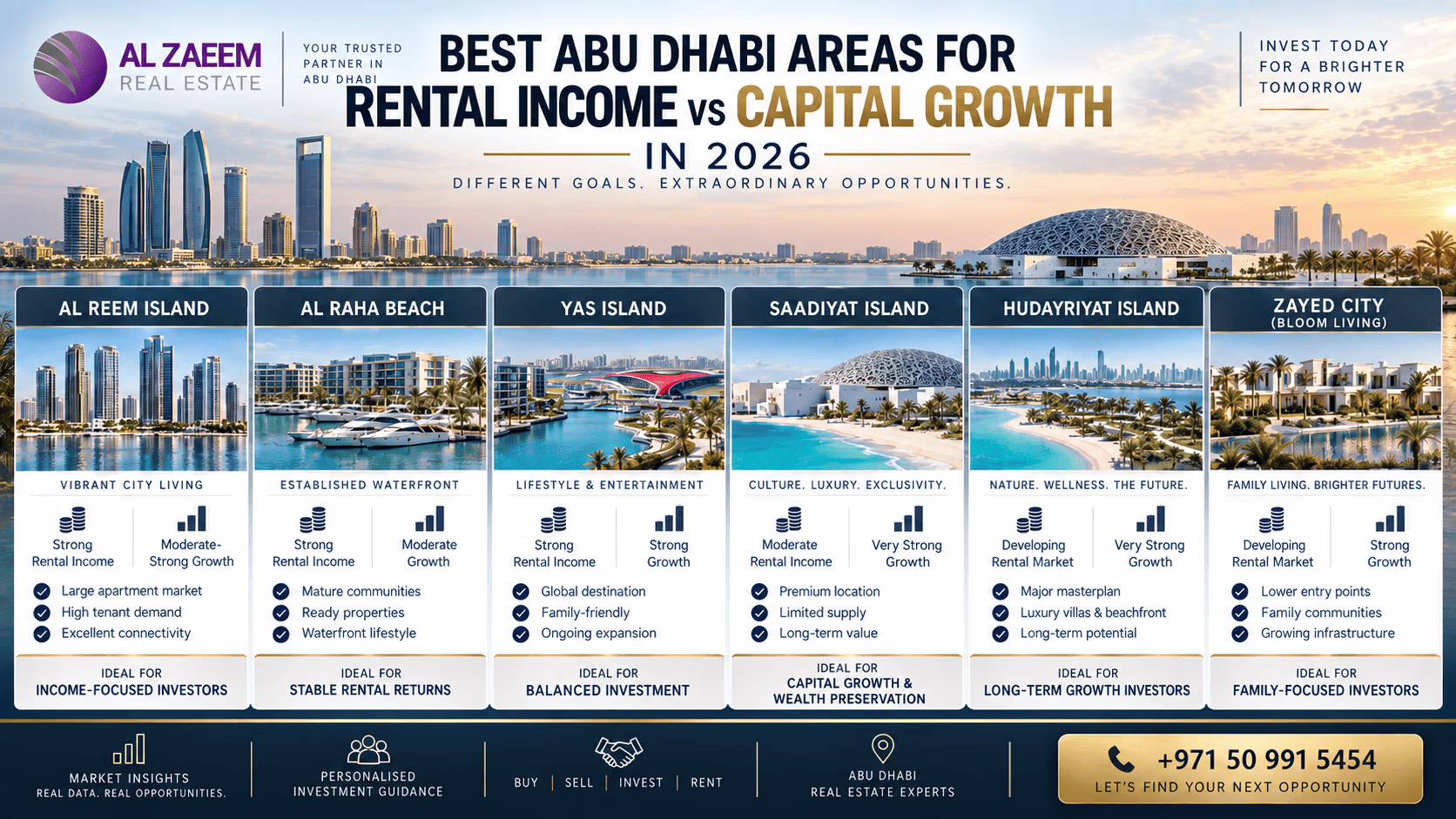
| Area | Rental-Income Profile | Capital-Growth Profile | Main Investment Character | Main Risk |
|---|---|---|---|---|
| Al Reem Island | Strong | Moderate–Strong | Deep apartment rental & resale market | Large existing and future supply |
| Al Raha Beach | Strong | Moderate | Mature waterfront communities | Older stock competes with new launches |
| Yas Island | Strong | Strong | Balanced lifestyle, tourism & family market | Large development pipeline |
| Saadiyat Island | Moderate | Very Strong | Premium scarcity, culture & luxury | High entry price |
| Hudayriyat Island | Developing | Very Strong | New luxury masterplan & villa-led growth | Limited mature rental history |
| Zayed City / Bloom Living | Developing | Strong | Family communities at lower entry points | Community still maturing |
This is not a ranking of guaranteed returns.
It is a way of understanding how each market currently behaves.
First: Rental Yield and Capital Appreciation Are Different
Suppose you buy a property for:
AED 2 million.
It rents for:
AED 140,000 per year.
Gross rental yield:
7%.
Now suppose another AED 2 million property rents for:
AED 100,000.
Gross yield:
5%.
From an income perspective, Property A looks stronger.
But imagine five years later:
Property A becomes worth AED 2.3 million.
Property B becomes worth AED 3 million.
Property B generated less rental income but substantially more capital appreciation.
Neither result is automatically better.
It depends on what the investor needed.
This is why asking:
“Which area gives the best ROI?”
is often too simplistic.
ROI can come from:
income + appreciation.
Al Reem Island — Strong Case for Rental-Income Investors
If the objective is to own an apartment in a deep, functioning residential market, Al Reem Island deserves serious attention.
ADREC estimates Reem currently contains approximately 27,500 residential units, making it the largest residential stock concentration among Abu Dhabi’s investment zones.
That is important for rental investors because Reem is not dependent on a future masterplan eventually attracting residents.
It already has a substantial residential population and established apartment inventory.
During Q1 2026, Reem Island recorded approximately AED 9.45 billion in real-estate transactions, placing it among Abu Dhabi’s most active districts.
For H1 2026, ADREC grouped Reem and Al Maryah at approximately AED 10.5 billion in residential sales.
Those figures demonstrate substantial market depth.
Why Reem Can Work for Rental Income
The investment case is relatively straightforward.
There is already extensive:
ready inventory
tenant demand
secondary-market evidence
apartment choice
and
transaction activity.
For landlords, those characteristics make analysis easier.
You can compare:
actual buildings,
actual rents,
actual service charges,
actual views,
and actual resale competition.
You are not relying entirely on forecasts.
That is valuable.
But Reem’s Greatest Strength Is Also Its Main Risk
There are many properties.
Approximately 27,500 homes already exist there, and Reem is also one of the six districts expected to drive the majority of Abu Dhabi’s incremental residential supply through 2030.
So saying:
“Reem Island is good”
is not enough.
The investor needs to identify a property that can compete within a very large market.
The strongest units may have:
waterfront position,
permanent views,
efficient layouts,
reasonable service charges,
strong building management,
or boutique scarcity.
A generic apartment can face significant competition.
Investment positioning
Reem makes particular sense for income-focused investors who value an established rental market and are prepared to choose the building carefully.
Al Raha Beach — Mature Waterfront Income Without Needing a Future Story
Al Raha Beach is another established investment-zone market.
ADREC identifies Al Raha as the second-largest investment-zone residential stock concentration after Reem.
Unlike a newly launched masterplan, much of Al Raha can already be inspected physically.
Communities such as Al Zeina and Al Muneera include apartments, townhouses and villas alongside waterfront amenities and established residential infrastructure. Aldar describes Al Zeina as including private beach access, pools, gyms and landscaped residential areas, while Al Muneera combines apartments, townhouses and villas in a completed waterfront environment.
This matters for rental investors.
The product already exists.
Why Al Raha Can Be Attractive to Income Buyers
An investor can analyse:
how the community is maintained,
what the view really looks like,
how tenants use the area,
and how much competing stock exists.
There is less uncertainty than with a project that completes in 2029 or 2030.
For some investors, that certainty is worth more than speculative upside.
Al Raha can therefore fit the investor who wants:
waterfront property + established community + immediate leasing potential.
The Al Raha Trade-Off
Older communities compete with brand-new product.
Abu Dhabi is launching newer apartments with:
modern amenities,
newer layouts,
long payment plans,
and heavily marketed lifestyle concepts.
An established Al Raha property therefore needs to compete on:
price
space
waterfront position
community maturity
or
rental value.
This is a different investment thesis from buying the newest launch.
Investment positioning
Al Raha is more naturally suited to income and mature-value investing than to speculative early-masterplan appreciation.
Yas Island — Probably the Most Balanced Investment Story
Yas is different because it already has an operating residential and lifestyle ecosystem but continues to receive substantial new development.
ADREC recorded approximately AED 7.3 billion in Yas Island residential sales during H1 2026.
The island combines:
residential communities,
tourism,
entertainment,
retail,
hotels,
waterfront,
schools,
golf,
and large-scale future development.
Aldar is also continuing to expand Yas.
In July 2026, it announced Yas Point, a new AED 6 billion waterfront destination, and launched The Canopies, a 592-unit mid-rise residential community within it.
The Canopies itself is planned around parks, a waterfront promenade, beach, retail and F&B and is currently scheduled for 2030 handover.
That combination of established destination plus new investment is why Yas sits between income and appreciation strategies.
Yas for Rental Income
Unlike a completely new island destination, Yas already has multiple tenant-demand drivers.
Some tenants want access to established residential communities.
Others value:
island lifestyle,
leisure,
retail,
waterfront,
or employment connectivity.
That broadens the potential rental market.
For the landlord, ready Yas apartments and townhouses can therefore produce immediate income while the surrounding destination continues developing.
Yas for Capital Appreciation
The appreciation argument comes from continued destination expansion.
Yas is not finished.
New waterfront communities, additional residential phases and future entertainment concepts continue adding investment to the island.
That can create value.
But it creates competing inventory too.
This is the trade-off.
The same future development that improves Yas can also increase the number of homes available for buyers and tenants.
Investment positioning
Yas is one of the strongest fits for investors who want a balance between current rental utility and longer-term masterplan growth.
Saadiyat Island — More Capital-Growth Oriented
Saadiyat sits at a different price and investment level.
ADREC recorded approximately AED 13.3 billion in residential sales on Saadiyat during H1 2026, making it Abu Dhabi’s second-largest residential sales market by value after Hudayriyat during the period.
The island’s investment thesis increasingly revolves around:
culture,
beachfront property,
luxury hospitality,
premium schools,
branded residences,
scarce villas,
and international demand.
And the destination continues developing.
Aldar announced the AED 100 billion Marsa Al Saadiyat masterplan in July 2026, with approximately AED 60 billion expected to be developed directly by Aldar.
More recently, Aldar confirmed that Saadiyat Grove is expected to open in Q4 2026, adding luxury retail and fine dining within the Cultural District.
These investments strengthen the destination proposition.
Why Saadiyat Is Different From Reem
A Reem investor may ask:
What rent can I achieve relative to my purchase price?
A Saadiyat luxury investor may care more about:
scarcity
prestige
view
land
brand
culture
and
long-term global buyer demand.
That difference matters.
A very expensive Saadiyat residence may generate respectable rent but still produce a lower percentage yield than a smaller mid-market apartment elsewhere.
That does not automatically make it a weaker investment.
Its return thesis can depend more heavily on:
capital appreciation and wealth preservation.
Saadiyat’s Main Risk: Paying Too Much for the Story
Premium destinations can attract premium pricing.
A buyer therefore needs to separate:
real scarcity
from
marketing scarcity.
A permanent sea-view apartment overlooking an important cultural landmark may be difficult to replicate.
A standard unit inside a large development may be less rare.
Aldar’s continuing Saadiyat pipeline—including new branded and Cultural District products—means investors should compare future supply carefully.
Investment positioning
Saadiyat is particularly compelling for capital-growth, premium-lifestyle and wealth-preservation strategies rather than purely yield-maximising investment.
Hudayriyat Island — The Strongest New Growth Story, but With More Execution Risk
Hudayriyat has emerged very quickly as one of Abu Dhabi’s largest residential investment stories.
ADREC reported AED 19 billion in residential sales on Hudayriyat during H1 2026, representing approximately 27% of Abu Dhabi residential sales value during the period.
It also led Abu Dhabi areas during Q1 2026 with approximately AED 11.97 billion in transactions.
That is exceptional activity for an emerging residential destination.
The attraction is understandable.
Hudayriyat’s new communities include premium apartments, townhouses and large villas, with future handovers extending through 2028 and 2029. Modon’s current schedule includes Nawayef Parkviews in Q1 2028, Bashayer in Q3 2028 and Nawayef Village in Q1 2029.
This gives investors exposure to a masterplan that is still being built.
Hudayriyat Is Not Primarily a Rental-Income Play Yet
That distinction is important.
An investor purchasing a project that completes in 2028 or 2029 does not receive normal rental income during construction.
The investment thesis is therefore heavily dependent on:
masterplan execution,
future demand,
scarcity,
developer delivery,
and entry price.
This makes Hudayriyat fundamentally different from buying a ready Reem apartment.
Why Investors Are Paying Attention Anyway
New luxury destinations can create large value changes as the physical environment becomes real.
At launch, buyers are purchasing:
plans,
renderings,
future amenities,
and location potential.
Later, they may have:
completed landscaping,
restaurants,
schools,
beaches,
golf,
residents,
and established resale evidence.
That maturation can drive appreciation.
But it is not guaranteed.
Investment positioning
Hudayriyat is better understood as a capital-growth and masterplan-investment market than as a mature rental-income market in 2026.
Hudayriyat’s Main Risk: Expectations Are Already High
AED 19 billion of residential sales in six months tells us demand is powerful.
It also means significant investor enthusiasm is already embedded in the market.
A buyer should therefore ask:
How much future success is already included in today’s price?
That question becomes critical in a fast-rising new destination.
Strong demand can produce exceptional investments.
It can also produce aggressive entry prices.
Zayed City and Bloom Living — Family-Led Long-Term Growth
Zayed City provides a different investment profile.
It does not currently have the luxury positioning of Saadiyat or Hudayriyat.
That can actually be part of the opportunity.
Bloom Living is a 2.2 million sqm community with more than 4,500 planned homes, spanning apartments, townhouses and villas.
The community is designed around parks, a lake, clubhouse, retail, healthcare, schools and family-oriented amenities.
Importantly, it is beginning to move from off-plan concept toward functioning neighbourhood.
Bloom began handover of Toledo, the second Bloom Living phase, in July 2026, while later phases remain under development.
ADREC also identifies Zayed City among the six districts expected to drive 77% of Abu Dhabi’s incremental residential supply through 2030.
Why Zayed City Can Appeal to Growth Investors
The entry price can be significantly below Abu Dhabi’s premium islands.
That allows investors to acquire:
more bedrooms,
townhouses,
or villas
without deploying Saadiyat-level capital.
The investment thesis then relies on the community becoming progressively more established.
As schools, retail, landscaping and additional homes complete, the area may become increasingly attractive to families.
This is a classic masterplan-maturation investment thesis.
Why It Is Not Yet the Same Rental Story as Reem
Mature rental markets develop over time.
Reem has tens of thousands of homes.
Bloom Living is still progressing through phased delivery.
That means current rental evidence is naturally less mature.
The investor may therefore be accepting:
less current market evidence
in exchange for
greater future-community growth potential.
Investment positioning
Zayed City can suit investors seeking family-oriented growth at a more accessible capital level, but it should not be analysed as though the rental market is already as deep as Reem or Al Raha.
So Which Area Is Better for Rental Income?
There is no responsible answer based only on the area name.
But the strongest rental-income characteristics generally appear where the market already has:
ready inventory,
large tenant populations,
established amenities,
deep lease activity,
and measurable resale transactions.
That naturally gives mature locations such as:
Reem Island
and
Al Raha Beach
an analytical advantage for income-focused buyers.
Yas can also fit strongly because it combines ready residential communities with an established lifestyle destination.
The exact building still matters more than the postcode.
Which Areas Have the Strongest Capital-Growth Narrative?
In 2026, the clearest growth-oriented stories are increasingly:
Saadiyat
Hudayriyat
and selected parts of
Yas and Zayed City.
But they represent very different types of appreciation.
Saadiyat:
premium scarcity and global destination development.
Hudayriyat:
new masterplan creation and luxury land development.
Yas:
continued expansion of an already established destination.
Zayed City:
family-community maturation from a lower entry base.
The mechanisms are different.
Rental Income vs Capital Appreciation — A Simple Example
Imagine two investors with AED 3 million.
Investor A buys a ready apartment.
The property produces rental income immediately.
After five years, it has generated:
five years of rent
plus
some capital appreciation.
Investor B purchases an off-plan villa completing in three years.
During the first three years:
no rent.
But if the destination matures and the property appreciates significantly, the capital gain may eventually compensate for the missing income.
The correct comparison is therefore:
Total return over the entire holding period.
Not just year-one rental yield.
The Hidden Value of Immediate Income
Rental income does something appreciation does not:
it pays you while you wait.
That cash can cover:
mortgage payments,
service charges,
maintenance,
or provide distributable income.
It can also reduce investment risk.
A property that generates income does not depend entirely on future resale appreciation to create return.
This is one reason mature rental markets remain attractive even during strong off-plan cycles.
The Hidden Value of Land
On the appreciation side, villas and townhouses increasingly introduce another factor:
land.
Buildings can be reproduced.
Prime land cannot.
A waterfront or golf-front villa in a low-density community may therefore behave very differently from a high-rise apartment surrounded by future development parcels.
This is particularly relevant in:
Hudayriyat,
Saadiyat,
Jubail,
and premium Yas villa communities.
Why Investors Should Not Chase the Highest Rental Yield
A very high advertised yield can signal opportunity.
It can also signal risk.
Perhaps:
the building is older,
maintenance costs are high,
resale demand is weak,
or the unit is located in an oversupplied market.
Similarly, a low yield does not automatically mean poor investment.
An exceptional scarce property may attract strong capital growth.
The correct question is:
What am I being compensated for?
A Balanced Strategy May Be Better Than Choosing One Side
Some investors deliberately combine both strategies.
For example:
Property 1: ready Reem or Al Raha apartment generating rent.
Property 2: emerging Hudayriyat or Zayed City property targeting future appreciation.
The income-producing asset creates cash flow.
The off-plan asset creates growth exposure.
This can reduce reliance on a single investment outcome.
Supply Is the Counterargument Across Almost Every Area
Abu Dhabi currently has approximately 409,000 residential units.
Another 71,000 are projected through 2030, with deliveries expected to peak at approximately 21,800 units in 2028.
Six areas are expected to account for 77% of incremental supply:
Saadiyat,
Reem,
Yas,
Zayed City,
Khalifa City,
and Hudayriyat.
Notice something important.
Many of Abu Dhabi’s strongest investment areas are also receiving the most new supply.
That is not necessarily negative.
It means capital and population growth are concentrating there.
But it makes unit selection increasingly important.
The Property Can Matter More Than the Area
Consider two Yas apartments.
One has:
permanent waterfront view,
efficient layout,
large balcony,
low internal competition.
The other faces:
parking,
road,
or a future development plot.
They should not be valued identically.
Likewise, two Reem apartments can have dramatically different:
service charges,
building quality,
views,
tenant demand,
and resale liquidity.
The phrase:
“Buy in Yas.”
is not an investment strategy.
The real strategy is:
Buy the right property in Yas at the right price.
What Income Investors Should Prioritise
An income-focused buyer should spend less time asking whether the brochure looks premium and more time studying the operating asset.
The most important factors are usually the realistic achieved rent, total acquisition cost, service charges, vacancy risk, tenant profile, competing inventory and actual building quality.
A beautiful project can still be a mediocre rental investment if the purchase price is too high.
What Capital-Growth Investors Should Prioritise
Growth investors need a different lens.
They should focus more heavily on:
future infrastructure,
masterplan progression,
scarcity,
entry price,
land,
views,
future supply,
and the likely resale buyer.
The question is not:
“What can I rent it for today?”
It is:
“Why should somebody pay materially more for this property five years from now?”
FAQs — Rental Income vs Capital Appreciation in Abu Dhabi
Which Abu Dhabi area has the deepest apartment market?
ADREC reports that Al Reem Island currently leads Abu Dhabi investment zones with approximately 27,500 residential units.
Is Reem Island good for rental investment?
It has many characteristics associated with an established rental market, including substantial residential stock and strong transaction activity. Individual building economics still determine actual yield.
Is Yas Island better for rent or appreciation?
Yas has characteristics of both. It already has established communities and lifestyle infrastructure while also receiving substantial new investment, including Yas Point.
Is Saadiyat primarily a rental investment?
Saadiyat has rental demand, but its premium pricing, luxury positioning, cultural development and scarcity mean many investors approach it primarily through capital appreciation and wealth-preservation considerations.
Is Hudayriyat a good rental market?
Hudayriyat’s residential communities are still relatively new, with several major handovers scheduled for 2028–2029. Its current investment case is therefore more dependent on future masterplan growth than mature rental evidence.
How much residential property was sold on Hudayriyat in H1 2026?
ADREC recorded approximately AED 19 billion in residential sales, representing 27% of Abu Dhabi residential sales value during the period.
How much was sold on Saadiyat?
Approximately AED 13.3 billion in residential sales during H1 2026.
How much was sold on Yas Island?
Approximately AED 7.3 billion during H1 2026.
Are Abu Dhabi rents still rising?
ADREC reported H1 2026 new-lease price increases of 17% for apartments and 9% for villas, rising to 21% and 16% respectively within investment zones.
Are Abu Dhabi property prices still increasing?
ADREC reported repeat-sale prices up 20% year-on-year for apartments and 12% for villas during H1 2026. These are emirate-level figures and should not be assumed to represent every district or unit.
Final Takeaway — Income or Growth?
Abu Dhabi’s property market now provides credible opportunities for both strategies.
For investors prioritising immediate rental income and market evidence, mature areas such as Reem Island and Al Raha Beach deserve close analysis.
For investors looking for a balance of income and appreciation, Yas Island offers one of the clearest combinations of established demand and continued destination investment.
For investors prioritising premium capital growth and long-term wealth preservation, Saadiyat Island has an increasingly powerful case.
For buyers seeking masterplan-driven upside, Hudayriyat represents one of Abu Dhabi’s strongest emerging growth stories—but with greater reliance on future delivery.
And for investors seeking family-community growth at a more accessible entry point, Zayed City and Bloom Living provide a different type of long-term opportunity.
The key is not deciding which Abu Dhabi area is universally “best.”
The key is matching the location to the investment objective.
Rental investor: buy established demand.
Growth investor: buy future scarcity at a defensible price.
Balanced investor: look for a property capable of doing both.
And in every case, the final investment decision should come down to the actual asset:
price + unit + view + land + service charges + future supply + tenant demand + resale liquidity.
For buyers comparing Abu Dhabi rental and capital-growth opportunities, Al Zaeem Real Estate can help evaluate ready properties, off-plan launches, rental evidence and competing inventory before purchase.
Call: +971 50 991 5454
Abu Dhabi, UAE
Useful Al Zaeem resources:
Abu Dhabi Off-Plan Propertieshttps://azcb.co/status/off-plan
Abu Dhabi Villas for Salehttps://azcb.co/buy-a-villa
Best Areas to Invest in Abu Dhabihttps://azcb.co/special-post/best-areas-invest-abu-dhabi
Abu Dhabi Property Investor Insightshttps://azcb.co/special-post/abu-dhabi-property-investor-insights
Primary Official Sources
ADREC — Abu Dhabi Real Estate Market Report H1 2026: current rental activity, price movements, residential supply, district sales and future supply.
ADREC — H1 2026 Transaction Report: current foreign-investment and transaction activity across Abu Dhabi.
Aldar — Yas Point / The Canopies: current expansion of Yas Island’s residential and waterfront offering.
Aldar — H1 2026 Results: current Marsa Al Saadiyat and wider Abu Dhabi development pipeline.
Aldar — Saadiyat Grove: current Cultural District retail and lifestyle expansion.
Bloom Holding — Bloom Living: current Zayed City masterplan, inventory and community development information.
Modon — Hudayriyat: current residential delivery schedules across major Hudayriyat communities.
Disclaimer
This article is intended for general real-estate research and does not constitute investment, financial, tax, legal or mortgage advice. Rental yields vary significantly by purchase price, unit, building, service charges, vacancy and achieved rent. Capital appreciation is not guaranteed. District-level transaction and price trends should not be treated as predictions for an individual property. Buyers should compare current transaction evidence, official developer information, ADREC records and total ownership costs before investing.