


Buying a brand-new property does not mean receiving a perfect property.
A newly completed apartment or villa can still contain:
- damaged finishes;
- misaligned doors;
- cracked tiles;
- poor sealant;
- paint defects;
- drainage problems;
- AC issues;
- electrical faults;
- plumbing problems;
- unfinished joinery;
- balcony defects.
That is why property snagging exists.
Snagging is the process of identifying defects, unfinished items or poor workmanship before or around formal property handover so that they can be documented and presented to the developer for review and rectification.
In Abu Dhabi, snagging is not merely an informal buyer practice.
ADREC’s current developer journey specifically includes snagging with buyers as part of the official project-handover stage, after the Certificate of Completion is issued and before the development moves fully into post-completion operation.
For buyers, that means handover should not be treated as:
Collect keys → take photos → celebrate.
The better sequence is:
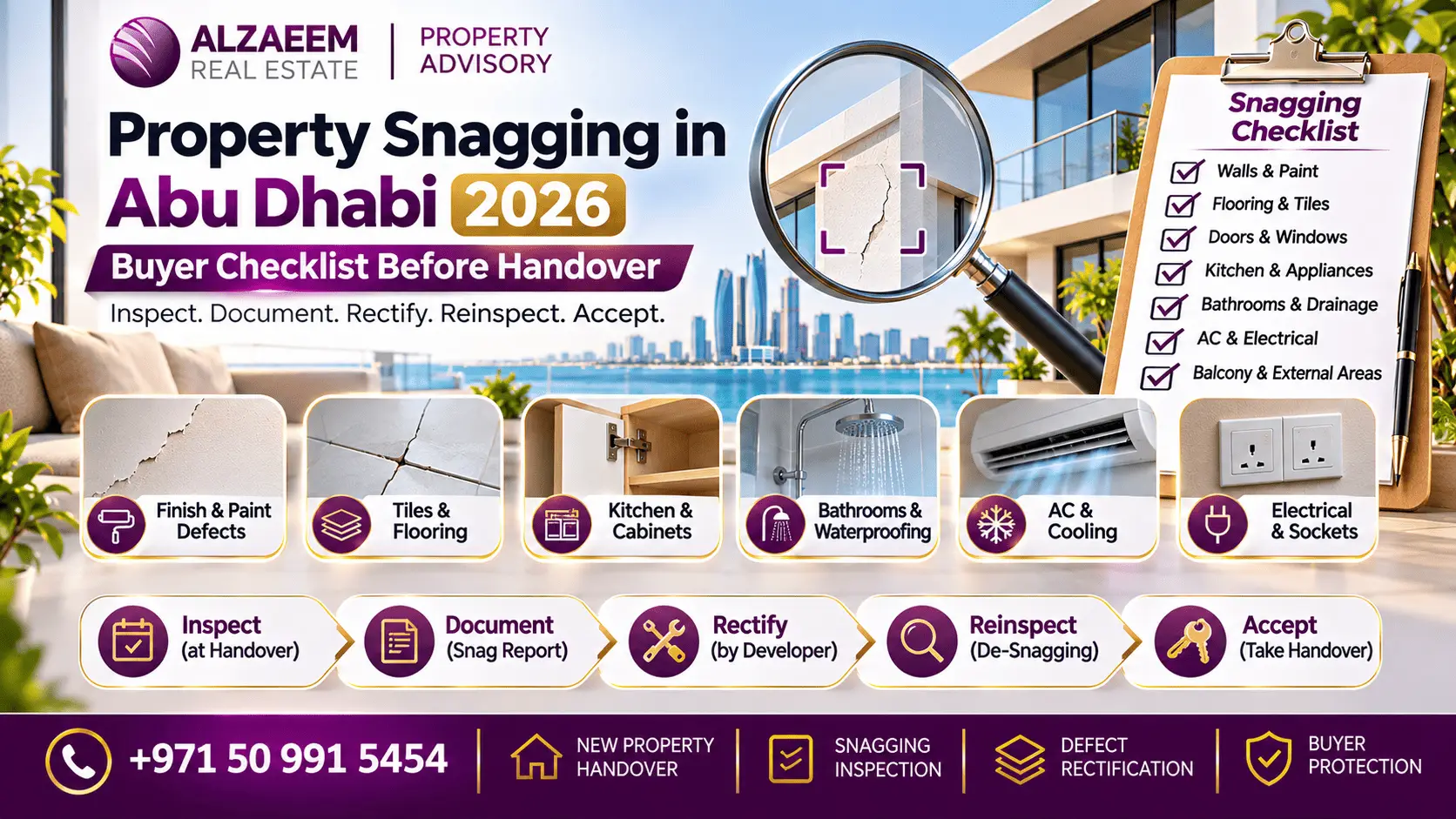
inspect → document → submit → rectify → reinspect → accept
What Is Property Snagging?
Property snagging is a detailed inspection of a newly completed property to identify defects or incomplete work.
Typical snags may include:
- scratched doors;
- cracked tiles;
- damaged kitchen cabinets;
- poorly finished paint;
- leaking taps;
- defective sockets;
- loose handles;
- poor drainage;
- AC performance issues;
- damaged windows;
- incomplete sealant.
Snagging is primarily concerned with:
condition and workmanship.
It is not the same as redesigning the property.
For example:
Potential snag
Bedroom door does not close correctly.
Not a snag
Buyer no longer likes the bedroom layout.
Aldar’s current handover guidance makes the same distinction: snagging covers finish and condition issues such as scratches or peeling wood, while design or structural changes requested by the buyer are not part of ordinary snagging.
Snagging vs General Property Inspection
These two terms are related but not identical.
Property Inspection
Can apply to:
- resale property;
- older property;
- tenanted investment;
- villa;
- apartment.
The objective is to understand the property’s physical condition before buying or during ownership.
Snagging
Is most commonly associated with:
- new property;
- off-plan completion;
- developer handover.
The objective is to identify defects or unfinished work around delivery.
Our existing Abu Dhabi Property Inspection Checklist makes the same distinction and notes that ADREC includes buyer snagging within the project-handover process.
Why Snagging Matters
A buyer may be purchasing:
AED 1 million apartment
or:
AED 10 million villa
but still accept the property after a 20-minute walkthrough.
That is disproportionate.
The handover inspection may be one of the few opportunities where the buyer can methodically document the property’s delivered condition before:
- furniture;
- tenants;
- contractors;
- move-in activity
begin changing that condition.
Snagging creates a baseline.
New Does Not Mean Defect-Free
Construction involves:
- multiple subcontractors;
- hundreds of components;
- finishing trades;
- installation work;
- testing;
- cleaning.
Small defects can remain even in high-quality projects.
The objective of snagging is not necessarily to prove the developer built a bad property.
It is to identify what still requires attention.
When Should You Snag the Property?
Ideally, snagging should happen during the developer’s formal:
- home orientation;
- pre-handover inspection;
- handover inspection;
depending on the project’s process.
Aldar currently allows buyers to inspect the completed home during home orientation and raise snags before final key collection. Agreed defects are then addressed and reflected in a de-snagging report.
Other developers may use different terminology and procedures.
Always check the individual project.
Do Not Wait Until After Moving In
Once you:
- move furniture;
- install curtains;
- mount televisions;
- drill walls;
- bring contractors;
it becomes harder to establish whether a defect existed before occupation.
The cleanest evidence is created:
before use.
Start With the SPA and Specifications
Before inspection, review what you actually purchased.
Check:
- unit type;
- stated layout;
- included fixtures;
- finishes;
- appliances where applicable;
- parking;
- storage;
- other stated inclusions.
Snagging should compare the delivered property against the applicable contractual and project specifications, not against assumptions.
Bring the Right Tools
A basic snagging kit may include:
- phone or camera;
- charger/power bank;
- flashlight;
- notepad;
- measuring tape;
- tissue/paper for airflow or moisture observation;
- phone charger or simple device for accessible socket tests where appropriate;
- spirit level if competent to use it.
Professional inspectors may use additional equipment depending on their scope.
The purpose is documentation and practical checking, not destructive testing.
Should You Hire a Professional Snagging Company?
For many buyers, particularly:
- overseas investors;
- high-value buyers;
- villa buyers;
- technically complex properties;
professional snagging can be worthwhile.
A professional inspector may be more likely to systematically check:
- cooling;
- drainage;
- plumbing;
- electrical points;
- moisture;
- windows;
- doors;
- cabinetry;
- finishes.
Aldar explicitly confirms that buyers may bring a third-party snagging company to home orientation.
Other developers should be checked separately.
Professional Snagging Is Due Diligence
Professional inspection is sometimes treated as:
“Another unnecessary buying fee.”
That is the wrong way to think about it.
Our Abu Dhabi Property Fees & Closing Costs 2026 guide classifies inspection and snagging as optional but potentially valuable due-diligence spending and notes that Abu Dhabi does not have one fixed government snagging fee; pricing depends on property size, inspection company and scope.
For a multimillion-dirham property, a competent inspection can be a small relative cost.
Start Outside the Unit
Before focusing on interiors, check the immediate access area.
Look at:
- entrance;
- door frame;
- unit number;
- corridor interface;
- threshold.
Confirm you are inspecting:
the correct unit.
It sounds obvious.
Still verify.
Main Entrance Door
Check:
- scratches;
- dents;
- alignment;
- lock;
- handle;
- frame;
- door closer.
Open and close it repeatedly.
A door that technically closes but requires force may need adjustment.
Walls
Inspect walls in natural and artificial light.
Look for:
- uneven paint;
- stains;
- cracks;
- dents;
- patching;
- poorly finished corners;
- marks.
Do not inspect only from the centre of the room.
Look along the wall at an angle.
Light can reveal finishing defects.
Ceiling
Check for:
- paint defects;
- cracks;
- stains;
- visible moisture;
- unfinished service access.
Water staining deserves particular attention.
Do not simply write:
“Ceiling stain.”
Ask whether the cause has been identified.
Flooring
Inspect:
- tiles;
- marble;
- wood;
- laminate.
Look for:
- cracks;
- chips;
- scratches;
- hollow or loose areas;
- uneven transitions;
- damaged grout.
A visual defect and a functional defect are different.
Document both.
Tile Alignment
Check:
- spacing;
- grout;
- level;
- edge damage.
Bathroom and balcony tiles deserve particular attention because poor installation can interact with:
- drainage;
- waterproofing.
Doors
Open and close every internal door.
Check:
- alignment;
- handle;
- latch;
- lock;
- frame;
- paint;
- surface damage.
Do not simply look at them.
Operate them.
Windows
Check:
- opening;
- closing;
- locks;
- handles;
- seals;
- glass condition;
- frame damage.
A window that does not close properly can affect:
- dust;
- noise;
- energy efficiency.
Sliding Doors
For balcony or terrace doors, test:
- track;
- rollers;
- lock;
- alignment;
- seal.
Large sliding systems can appear visually perfect but still operate poorly.
Balcony
Check:
- tiles;
- drainage;
- slope;
- railing;
- door seal;
- paint;
- external lights where applicable.
Balcony drainage deserves serious attention.
Water should not simply collect because the surface has inadequate fall.
Kitchen Cabinets
Open:
- every cupboard;
- every drawer.
Check:
- hinges;
- alignment;
- handles;
- damage;
- soft-close function where specified;
- interior surfaces.
Do not assume the kitchen is complete because the doors look aligned from outside.
Countertops
Check:
- chips;
- stains;
- edge damage;
- joints;
- sealant.
Look especially around:
- sink;
- backsplash.
Kitchen Sink
Test:
- tap;
- hot/cold water;
- drainage;
- under-sink plumbing.
Open the cabinet underneath while water is running.
Look for:
- dripping;
- moisture;
- poor connections.
Appliances
Where appliances are included, test what can reasonably be tested.
Examples:
- refrigerator;
- oven;
- hob;
- hood;
- dishwasher;
- washing machine.
Check:
- visible damage;
- installation;
- operation where possible.
Record model/serial information for higher-value included equipment where useful.
Bathrooms
Bathrooms deserve more time than most buyers give them.
Check:
- taps;
- basin;
- toilet;
- shower;
- bathtub if applicable;
- drainage;
- sealant;
- grout;
- vanity;
- mirrors;
- exhaust.
Test Drainage
Run water.
Observe whether it drains properly.
Look for:
- slow drainage;
- pooling;
- leakage.
A beautiful bathroom with bad drainage is not properly finished.
Shower Area
Check:
- shower screen;
- door;
- seals;
- slope;
- drain.
Water should move toward the drain rather than escape into the bathroom.
Toilet
Check:
- flushing;
- stability;
- visible leakage.
A loose toilet should be documented.
Sealant and Grout
Small defects here can become future moisture issues.
Look for:
- gaps;
- cracks;
- incomplete sealant.
These are often simple rectification items but should still be recorded.
Water Pressure
Test pressure at:
- kitchen;
- basin;
- shower.
Extremely weak or inconsistent pressure should be noted.
Hot Water
Where systems are active and handover process permits testing, confirm hot water availability.
Check visible water-heater areas for:
- leakage;
- installation issues.
Air Conditioning
AC is one of the most important systems in Abu Dhabi property.
Check:
- cooling;
- thermostat;
- airflow;
- noise;
- vibration;
- visible condensation;
- leakage.
A newly delivered apartment should not be accepted on the assumption:
“AC will probably work once we move in.”
Test what the handover process allows.
AC Drainage
Look around:
- ceiling access;
- vents;
- nearby walls.
Water staining can indicate drainage or condensation issues.
Electrical Sockets
Check accessible sockets where practical.
Look for:
- loose plates;
- visible damage;
- poor finishing.
A professional inspector may conduct more systematic testing within their scope.
Switches and Lighting
Operate:
- switches;
- installed lights.
Check:
- loose switches;
- incorrect switching;
- missing fittings;
- flickering.
Distribution Board
A technically competent inspector may review:
- labelling;
- obvious installation issues.
Buyers without technical knowledge should not dismantle or interfere with electrical systems.
Smoke and Safety Systems
Where applicable, visually confirm installed safety devices and discuss any testing process with the developer or inspector.
Safety-critical systems should be handled by qualified professionals.
Built-In Wardrobes
Check:
- doors;
- hinges;
- drawers;
- shelves;
- finish.
Open everything.
Look inside.
Maid’s Room
If included, inspect it exactly like any other room.
Check:
- AC;
- electrical;
- bathroom;
- flooring;
- storage.
It is part of the property.
Do not skip it.
Laundry / Utility Area
Check:
- drainage;
- appliance connections;
- electrical points;
- water connections.
A laundry-area leak can create expensive damage after occupation.
Joinery
Inspect:
- cabinetry;
- skirting;
- wall panels;
- doors.
Look for:
- chips;
- peeling;
- uneven joints;
- gaps.
Cosmetic vs Functional Defects
Not every defect has the same severity.
A useful snag report can classify problems.
Cosmetic
Examples:
- scratch;
- paint mark;
- small chip.
Functional
Examples:
- door does not lock;
- tap leaks;
- socket not working;
- AC not cooling.
Potentially Serious / Technical
Examples:
- significant water ingress;
- safety concern;
- substantial electrical issue;
- major unfinished installation.
This helps prioritise rectification.
Do Not Confuse a Snag With a Design Preference
This distinction protects the credibility of the report.
For example:
Snag
Kitchen cabinet door is damaged.
Preference
Buyer wants different cabinet colour.
Snag
Balcony door does not lock.
Preference
Buyer wants a larger balcony door.
The snag report should focus on delivered condition.
Document Every Snag Clearly
Do not write:
“Bathroom problem.”
Write:
Master Bathroom — Shower screen lower seal incomplete; water escapes onto bathroom floor during test.
The second description is actionable.
Give Every Snag a Reference Number
For example:
S001 — Living Room — Paint defect
S002 — Kitchen — Cabinet hinge misaligned
S003 — Bathroom 1 — Basin tap leaks
S004 — Balcony — Drainage pooling
Then use the same reference during reinspection.
Photograph Each Defect
Ideally include:
Context Photo
Shows where the problem is.
Close-Up
Shows the defect.
This reduces ambiguity.
Include Scale Where Useful
For:
- crack;
- chip;
- gap;
use an object or measuring scale where practical to indicate size.
Keep the Report Structured
A useful snag report can include:
| Ref | Location | Defect | Severity | Photo | Status |
|---|---|---|---|---|---|
| S001 | Living Room | Paint damage | Cosmetic | Attached | Open |
| S002 | Kitchen | Tap leaking | Functional | Attached | Open |
| S003 | Balcony | Water pooling | Functional | Attached | Open |
Simple.
Clear.
Trackable.
Do Not Submit Hundreds of Meaningless Photos
More photos do not automatically mean a better inspection.
Every image should answer:
- where;
- what;
- why it matters.
A professional report should be easy for:
- developer;
- contractor;
- buyer
to use.
Submit the Snagging List Through the Correct Process
Different developers may use:
- app;
- digital portal;
- handover agent;
- formal report.
Follow the project process.
Aldar’s current system records buyer-raised snags and then shows agreed rectification through the de-snagging process.
Do not rely only on verbal promises.
Developer Review
A buyer may report an issue.
The developer may then:
- accept it;
- reject it;
- request clarification;
- classify it differently.
Keep:
- original report;
- responses;
- updated status.
Reinspection Is Essential
Do not assume:
“The system says completed, therefore it is fixed.”
Reinspect.
Our existing Abu Dhabi Property Handover Guide recommends bringing the original snagging list back, checking each item individually, photographing incomplete items again and recording any new damage.
De-Snagging
A de-snagging inspection is essentially the verification stage.
The objective is to confirm:
- original snag addressed;
- repair quality acceptable;
- no new damage created.
Aldar’s current handover process specifically provides before-and-after evidence of agreed rectification in the de-snagging report.
Example
Original snag:
S015 — Bedroom 2 — Door does not latch.
Developer marks:
Completed
Reinspection:
Door now closes.
But handle becomes loose after repair.
That should be documented.
Rectification should not create another defect.
What If the Unit Is Not Reasonably Ready?
There is a major difference between:
Minor snagging
and
A materially incomplete or unsafe property.
Potentially serious concerns can include:
- significant unfinished construction;
- essential systems not functioning;
- major water ingress;
- serious safety issues;
- inaccessible areas;
- incomplete critical installations.
Document the condition carefully.
Where necessary, obtain independent technical or legal advice.
Do Not Sign Blindly
Read any document presented at handover.
Understand whether you are acknowledging:
- inspection;
- receipt;
- completion;
- keys;
- acceptance.
Do not sign merely because:
“Everyone signs this.”
If unclear, ask.
Handover Is Bigger Than Snagging
After snagging, also verify:
- ownership documentation;
- final payment;
- parking;
- storage;
- keys;
- access cards;
- remotes;
- utilities;
- community access;
- service charges.
Our Abu Dhabi Property Handover Guide covers the full handover process separately.
Parking
Confirm:
- allocated parking bay;
- location;
- access method.
Do not assume the parking shown in marketing material is automatically the final allocated space.
Storage
If storage forms part of the property rights, confirm:
- location;
- access;
- condition.
Keys and Access Cards
Create a record of:
- keys;
- cards;
- remotes.
This later becomes useful for:
- property management;
- tenancy handover.
Title Deed
ADREC’s current project-handover journey places snagging and title-deed issuance together within the formal project-handover stage after completion certification.
Confirm the ownership-document process applicable to your transaction.
Defects Liability Period
Snagging does not necessarily represent the end of all defect responsibility.
ADREC’s current developer journey includes a Defects Liability Period after project completion. It states that developers must address defects reported by buyers during the liability period, with 5% of total construction cost retained from the Taking Over Certificate stage and released after issues are resolved and ADREC confirms completion. ADREC describes this stage as starting from 12 months.
This is separate from your initial snagging inspection.
Structural and Installation Defect Liability
Abu Dhabi’s real-estate legislation also provides specific developer liability periods for certain defects.
Article 73 states that developers remain liable for defects threatening the durability and safety of structural or common parts for 10 years from the final completion certificate, while defective building installations are subject to a one-year repair or replacement liability from final completion certification.
These legal protections are not a reason to skip snagging.
They are a reason to document defects properly.
Cosmetic Defect vs Latent Defect
A snagging inspection is strongest at identifying visible or testable issues.
Some defects may appear only later.
Examples:
- hidden leak;
- intermittent AC problem;
- waterproofing failure.
Keep all handover documents and defect records after moving in.
Apartment Snagging
For an apartment, pay particular attention to:
- AC;
- plumbing;
- drainage;
- balcony;
- doors;
- windows;
- kitchen;
- bathrooms;
- cabinetry.
Also consider the relationship between the unit and common building systems.
Villa Snagging
Villa snagging usually requires a broader inspection.
In addition to interiors, check:
- exterior walls;
- roof-accessible areas where safely inspectable;
- garden;
- irrigation;
- gates;
- external lighting;
- paving;
- pool;
- pool equipment;
- external drainage.
A large villa can contain significantly more systems than an apartment.
Private Pool
Where applicable, inspect:
- tiles;
- water condition;
- visible leakage;
- pumps;
- filters;
- surrounding paving.
Pool systems should be assessed by competent professionals where technical evaluation is required.
Garden
Check:
- irrigation;
- drainage;
- landscaping condition;
- external taps.
New landscaping should not distract from checking whether irrigation actually works.
Roof
Do not climb onto unsafe roofs yourself.
Where roof inspection is important, use competent professionals and proper access.
External Walls
Look for:
- cracks;
- poor paint;
- unfinished surfaces;
- visible water staining.
Gates and Garage Doors
Operate them.
Check:
- remote;
- alignment;
- locking;
- safety.
Overseas Buyers
Overseas ownership is not a reason to skip snagging.
Our guide on leaving or managing Abu Dhabi property from overseas recommends remote buyers arrange:
- professional snagging;
- written report;
- clear photographs;
- video;
- reinspection.
Remote buyers need:
better documentation.
Not less.
Power of Attorney / Representation
Depending on the transaction and developer process, an authorised representative may be able to assist with certain handover actions.
Verify:
- authority;
- developer requirements;
- current transaction procedure.
Investor Planning to Rent Immediately
If your property will become a rental investment, snagging should connect directly to leasing preparation.
Ideal sequence:
Snagging
↓
Rectification
↓
Reinspection
↓
Deep Cleaning
↓
Professional Photography
↓
Rental Pricing
↓
Tenant Marketing
↓
Move-In
Do not photograph and market a unit while avoidable defects remain visible.
Snagging Protects Rental Presentation
Imagine the property has:
- cabinet misalignment;
- damaged paint;
- weak bathroom sealant.
Each issue may seem minor.
Together they make a brand-new unit feel:
poorly finished.
That can affect:
- tenant confidence;
- viewing conversion;
- vacancy.
Snagging and Rental Property Inspection
Once the property becomes tenanted, switch from:
handover snagging
to:
rental condition management.
Our Rental Property Inspection Checklist Abu Dhabi 2026 explains how move-in, mid-tenancy and move-out inspections should then track the property’s condition throughout occupancy.
Snagging vs Renovation
Do not confuse developer rectification with an owner upgrade.
Developer snag
Cabinet door damaged.
Owner renovation
Replace entire kitchen with a different premium design.
Our Renovation ROI Abu Dhabi 2026 guide explains how optional improvements should be evaluated separately.
Common Buyer Snagging Mistakes
Mistake 1: Getting Distracted by the View
The view may be excellent.
Inspect the property.
Mistake 2: Assuming New Means Perfect
It does not.
Mistake 3: Checking Only Cosmetic Finishes
Test functionality.
Mistake 4: Writing Vague Defects
Be specific.
Mistake 5: No Photographs
Document every meaningful issue.
Mistake 6: No Reinspection
Completion status must be verified.
Mistake 7: Treating Design Preferences as Snags
Keep the report credible.
Mistake 8: Accepting Major Problems as “Minor Snags”
Understand severity.
Professional Snagging Company Checklist
Before appointing one, ask:
Scope
What exactly is inspected?
AC
Included?
Electrical
What level of testing?
Plumbing
What is tested?
Moisture
Any testing?
Balcony
Drainage checked?
Report
Photographs and references?
Reinspection
Included or separate?
Villa
Pool/external inspection included?
Timing
When is report delivered?
Do not choose only on the lowest fee.
30-Point Abu Dhabi Snagging Checklist
Structure / Finish
- Walls
- Ceilings
- Paint
- Flooring
- Tiles
- Grout
- Sealant
Doors / Windows
- Main door
- Internal doors
- Locks
- Windows
- Sliding doors
- Balcony doors
Kitchen
- Cabinets
- Drawers
- Countertops
- Sink
- Appliances
Bathrooms
- Toilets
- Basins
- Showers
- Drainage
- Water pressure
Systems
- AC
- Thermostats
- Lights
- Electrical points
- Water heater / visible plumbing
External / Handover
- Balcony / terrace
- Parking, storage, keys and access items
For villas, add:
- garden;
- irrigation;
- pool;
- external walls;
- gates;
- paving;
- external drainage.
Snag Report Template
A simple professional structure:
Reference
S021
Location
Master Bathroom
Defect
Shower-floor water pools beside glass screen instead of draining fully.
Category
Functional
Evidence
Photo 21A / Video 21B
Status
Open
Reinspection
Pending
That is much more useful than:
“Bathroom drainage bad.”
Buyer Handover Workflow
Step 1
Receive official handover communication.
Step 2
Review SPA and unit specification.
Step 3
Book orientation / inspection.
Step 4
Arrange professional snagging if required.
Step 5
Inspect systematically.
Step 6
Submit snag report.
Step 7
Developer reviews and rectifies agreed items.
Step 8
Reinspect.
Step 9
Verify documentation and final obligations.
Step 10
Receive keys/access and prepare move-in or leasing.
What Should You Prioritise?
If inspection time is limited, prioritise:
Safety
Electrical or serious physical concerns.
Water
Leaks, drainage and waterproofing indicators.
Cooling
AC functionality.
Operability
Doors, windows and locks.
Bathrooms / Kitchen
Plumbing and installations.
Major Finish Defects
Tiles, cabinetry and flooring.
Do not spend 20 minutes photographing a tiny paint mark while ignoring a leaking shower.
Is Every Snag a Reason to Delay Handover?
Not necessarily.
The answer depends on:
- severity;
- developer process;
- contract;
- whether rectification is agreed.
Minor paint touch-ups are not the same as:
- major water ingress;
- essential system failure.
Use proportional judgment.
Why Reinspection Matters More Than Report Size
A 150-item snag report is meaningless if nobody checks whether the items were fixed.
The real objective is:
rectification.
Not:
report thickness.
Snagging and Resale Value
Good snagging can help an investor receive a cleaner starting asset.
That can reduce:
- immediate repair;
- future maintenance;
- tenant complaints.
It does not guarantee future appreciation.
But it can reduce avoidable defects entering the ownership period.
Snagging and Property Management
For investors who will not occupy the unit themselves, handover is also the right time to prepare:
- maintenance file;
- key inventory;
- appliance records;
- property photographs.
Through Al Zaeem Property Management, owners can then move from:
handover
to:
rental preparation
to:
tenant management
within one coordinated operating process.
Facility Management After Handover
Once developer snag rectification is complete, future owner maintenance becomes a separate matter.
Al Zaeem Facility Management can support areas such as:
- AC;
- plumbing;
- electrical;
- painting;
- flooring;
- woodwork.
Keep developer defect responsibility and normal owner maintenance clearly separated.
Snagging Is Not a Guarantee
Even excellent snagging cannot identify every future problem.
Some defects may be:
- hidden;
- intermittent;
- inaccessible.
The objective is risk reduction and evidence.
Not perfection.
Keep Your Records
Retain:
- original snag report;
- photographs;
- developer responses;
- de-snagging report;
- warranties;
- handover documents;
- completion information;
- key records.
These documents may become useful years later.
Final Verdict
Property snagging is one of the most important steps between:
buying an off-plan property
and
accepting the completed asset.
ADREC’s current developer journey formally includes buyer snagging in the project-handover process, and major developers such as Aldar provide structured home orientation, snag-reporting and de-snagging workflows.
The strongest buyer process is:
inspect → document → submit → rectify → reinspect → accept.
Check:
- walls;
- flooring;
- doors;
- windows;
- kitchen;
- bathrooms;
- AC;
- plumbing;
- electrical points;
- balcony;
- appliances;
- parking;
- access items.
For villas, extend the inspection to:
- pool;
- garden;
- irrigation;
- gates;
- external areas.
The most important principle is simple:
Do not assume a brand-new property is defect-free merely because it is new.
And do not judge snagging by the number of defects you find.
Judge it by whether:
- material issues were identified;
- evidence was created;
- agreed defects were corrected;
- the property was properly verified before final use.
For investors, the ideal transition is:
snag → rectify → reinspect → handover → prepare → lease → manage.
That turns handover from a ceremonial moment into a disciplined property-acquisition process.
Internal Linking Suggestions
Add internal links from this article to:
- Abu Dhabi Property Handover Guide 2026
- Abu Dhabi Property Handover Checklist 2026–2027
- Abu Dhabi Property Inspection Checklist
- Rental Property Inspection Checklist Abu Dhabi 2026
- Renovation ROI Abu Dhabi 2026
- Abu Dhabi Property Fees & Closing Costs 2026
- What Happens After Buying Property in Abu Dhabi
- Buying Abu Dhabi Property From Overseas
Disclaimer
This article is for general real-estate education and property-buying guidance only. It does not constitute legal, engineering, structural, electrical or technical advice.
Snagging scope, developer procedures, handover timing, defect-liability rights and rectification processes can vary by project, contract and defect type. Buyers should review their SPA, developer handover instructions and current ADREC requirements, and obtain qualified technical or legal advice where appropriate.
Last reviewed: November 2026.