


A security deposit looks simple.
The tenant pays a sum at the beginning of the tenancy.
At the end:
- the landlord returns it;
- or legitimate deductions are made.
In practice, this is one of the most common areas where landlord-tenant relationships become difficult.
Why?
Because disagreements usually begin much earlier than move-out.
They begin when nobody properly documents:
- the property’s original condition;
- existing damage;
- furniture;
- appliances;
- keys;
- meter readings;
- maintenance issues.
Then, twelve months later, both sides remember the property differently.
For landlords, the security deposit is not just money being held.
It is part of a wider condition-control process.
For tenants, it is money that should not be deducted arbitrarily.
The best system is therefore:
document before move-in, inspect during the tenancy where appropriate, compare at move-out, and deduct only where there is a clear basis.
That approach is also consistent with the wider operational framework we recommend through Al Zaeem Property Management, where inspections, maintenance coordination, tenancy administration and owner reporting form part of the rental lifecycle.
What Is a Security Deposit?
A security deposit is money paid by the tenant at the beginning of the tenancy as financial protection against certain potential obligations.
Depending on the tenancy arrangement, it may relate to matters such as:
- tenant-caused damage;
- missing landlord-owned items;
- unpaid contractual obligations;
- restoration required after unauthorized changes.
It should not be confused with:
- advance rent;
- agency commission;
- utility deposits;
- service charges.
These are different payments.
Security Deposit Is Not Extra Rent
This is fundamental.
The deposit is not simply another payment the landlord earns at the beginning of the tenancy.
It is held against possible legitimate tenancy-related liabilities.
If no legitimate deduction applies, the deposit should not be treated as rental income.
For investors, that means the deposit should also not be included in:
- annual rent;
- gross yield;
- rental revenue.
Our Abu Dhabi Property ROI Guide 2026 explains why investment return should be based on actual recurring income, not refundable tenant funds.
The Deposit Amount Should Be Clearly Written
The tenancy agreement should state:
- amount paid;
- date paid;
- who received it;
- what it secures;
- refund process.
Avoid informal arrangements.
If the tenant later says:
“I paid AED 8,000.”
and the landlord says:
“No, it was AED 5,000.”
that is an unnecessary dispute.
Documentation solves it immediately.
The Move-In Inspection Is the Most Important Step
A deposit is difficult to administer fairly without a move-in record.
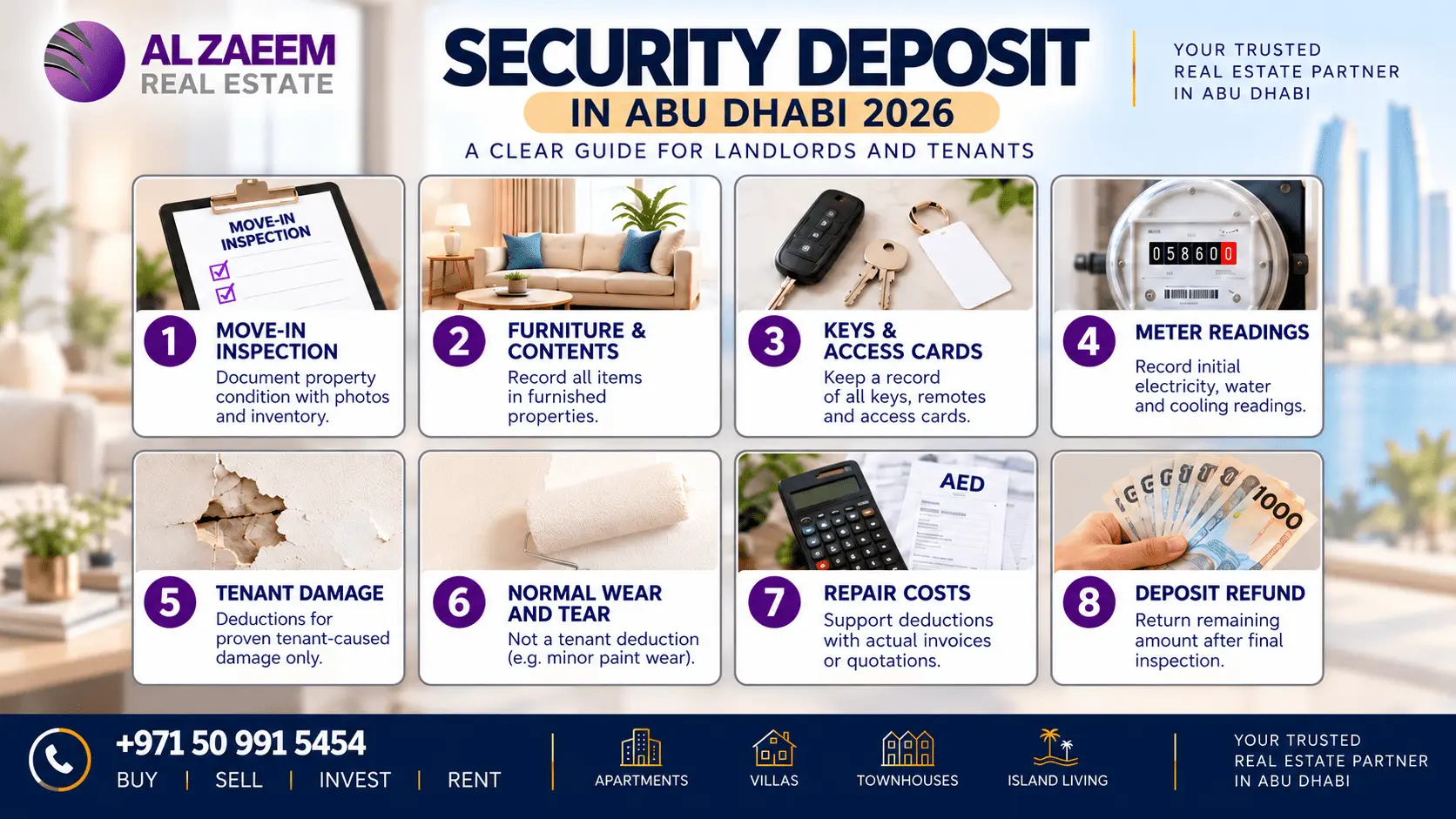
Before the tenant receives possession, document the condition of:
- walls;
- ceilings;
- flooring;
- doors;
- windows;
- kitchen;
- bathrooms;
- AC;
- electrical fittings;
- plumbing;
- appliances;
- furniture.
Take dated photographs.
Where appropriate, include video.
The goal is to establish:
what condition existed on Day 1.
Without this baseline, later damage becomes difficult to prove.
Existing Damage Should Be Recorded
Suppose the wall already has:
- scratches;
- small holes;
- chipped paint.
If that is not documented before move-in, the tenant may later be blamed for something they did not cause.
Likewise, if the landlord documents the existing defect clearly, both sides are protected.
A professional inspection is not about finding fault.
It is about creating evidence.
Furnished Properties Need a Full Inventory
For furnished apartments, the move-in record should be more detailed.
List items such as:
- sofa;
- dining table;
- chairs;
- beds;
- mattresses;
- television;
- refrigerator;
- washing machine;
- curtains;
- lamps;
- decorative items.
Where useful, record:
- quantity;
- condition;
- model;
- photographs.
Our Furnished vs Unfurnished Property in Abu Dhabi 2026 explains why furnished property requires stronger operational controls.
Keys and Access Cards Should Be Recorded
Do not forget small items.
Record:
- front-door keys;
- mailbox key;
- parking remote;
- access cards;
- gate remote.
At move-out, confirm they are returned.
Missing access items may create:
- replacement cost;
- security concerns.
Meter Readings Can Prevent Utility Disputes
Where relevant, record opening readings for:
- electricity;
- water;
- cooling.
This helps separate:
- prior consumption;
- tenant consumption.
The same process should be repeated at move-out.
What Can Legitimately Be Deducted?
The answer depends on the tenancy agreement and actual circumstances.
Potential deduction categories may include:
- tenant-caused damage;
- missing landlord-owned items;
- unauthorized alterations;
- required restoration;
- certain unpaid tenancy obligations.
But the key word is:
documented.
A landlord should be able to explain:
- what happened;
- why the tenant is responsible;
- how much the repair actually cost.
Normal Wear and Tear Is Different From Damage
This distinction is essential.
A property naturally deteriorates over time.
Examples may include:
- minor paint ageing;
- ordinary carpet wear;
- ageing sealant;
- normal appliance deterioration.
That is not the same as:
- broken door;
- damaged furniture;
- large wall damage;
- deliberate misuse.
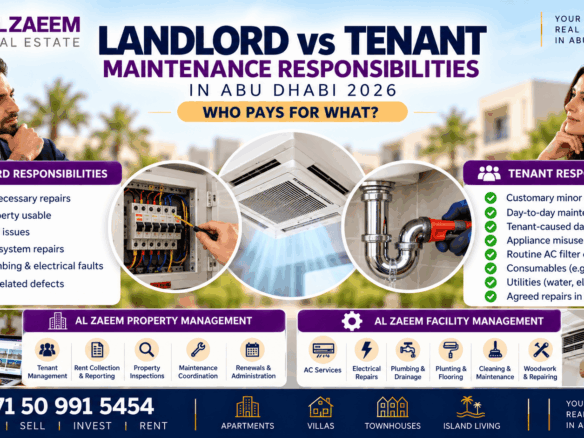
Our Landlord vs Tenant Maintenance Abu Dhabi 2026 explains this distinction in more detail.
Example: Wall Paint
Consider two scenarios.
Scenario A
Small marks after one year of normal occupancy.
Scenario B
Large holes, unauthorized repainting or significant wall damage.
These should not automatically be treated the same.
The condition report and tenancy terms matter.
Example: Appliance Damage
A washing machine fails after normal use.
That may simply be:
- equipment failure;
- age;
- maintenance.
But if the appliance is physically damaged through misuse, the analysis changes.
Cause matters.
Security Deposit Is Not a Maintenance Fund
A landlord should not use the deposit simply to refresh the property after every tenant.
Routine ownership costs may include:
- repainting due to age;
- preventive maintenance;
- appliance replacement;
- normal deterioration.
Those are different from tenant-caused loss.
This is why owners should maintain a proper maintenance reserve separately.
Move-Out Inspection
When the tenancy ends, inspect the property systematically.
Compare it against the original move-in record.
Check:
- walls;
- floors;
- appliances;
- furniture;
- fixtures;
- keys;
- access cards;
- cleanliness;
- alterations.
Then classify each issue.
Existing Before Tenancy
No tenant deduction.
Normal Wear
Generally ownership/maintenance issue.
Tenant Damage
Potential deduction depending on contract and evidence.
Take Move-Out Photographs
Do not rely on memory.
Take dated photographs showing the final condition.
This creates a direct:
before vs after
comparison.
That makes deposit decisions much easier to explain.
Get Repair Quotes or Invoices
If a deduction is necessary, the landlord should ideally support it with actual cost evidence.
For example:
Damaged door repair:
AED 650
Supporting contractor invoice:
AED 650
That is stronger than simply saying:
“I think this damage is worth AED 1,500.”
Professional documentation reduces disputes.
Do Not Inflate Repair Costs
A security deposit should compensate legitimate loss.
It should not create a profit opportunity.
If a damaged item costs:
AED 500
to repair, the landlord should have a defensible basis before deducting substantially more.
Old Items Should Be Considered Realistically
Suppose a ten-year-old appliance is damaged.
The landlord should consider:
- age;
- existing condition;
- realistic value.
Charging the tenant the full cost of a brand-new premium replacement may not always reflect the actual economic loss.
This is a practical fairness principle.
Tenant-Caused Damage Must Be Distinguished From Building Defects
Imagine water damage occurs.
Possible cause:
Tenant misuse
Potential tenant liability.
Hidden internal pipe defect
Potential landlord maintenance issue.
Common building pipe
Potential building/common-property issue.
Do not deduct from a deposit until the actual cause is understood.
Unauthorized Alterations
A tenant may:
- drill;
- repaint;
- modify fixtures;
- install items.
The tenancy agreement should state what requires written landlord approval.
If restoration is contractually required at move-out, that should be documented.
Cleaning
Cleaning is another common disagreement.
A landlord may expect the property to be returned in a reasonable condition.
But the standard should be clear.
For furnished or premium property, the tenancy agreement can specify:
- professional cleaning;
- deep cleaning;
- carpet cleaning where applicable.
Again:
clear expectations before move-in prevent arguments at move-out.
Security Deposit and Tenant Screening
The deposit should not replace proper tenant screening.
A security deposit can provide limited financial protection.
It cannot fully compensate for:
- prolonged non-payment;
- severe damage;
- vacancy;
- operational problems.
Our How to Screen a Tenant in Abu Dhabi 2026 explains why landlords should verify tenant suitability before signing.
Security Deposit and Property Management
Deposit administration becomes much easier when professional property management handles:
- move-in inspection;
- inventory;
- condition records;
- tenant communication;
- move-out inspection;
- repair coordination;
- reporting.
Through Al Zaeem Property Management, landlords can create a more structured tenancy process rather than relying on informal handovers.
Facility Management Can Support Repair Verification
Where damage or repair is identified, Al Zaeem Facility Management can support technical assessment and repair coordination across areas such as:
- AC;
- plumbing;
- electrical work;
- painting;
- flooring;
- woodwork.
This helps owners distinguish between:
- maintenance;
- damage;
- repair cost.
Example: Move-Out Comparison
Imagine a tenant paid:
AED 6,000 security deposit.
At move-out:
Missing access card
Replacement: AED 200
Tenant-damaged cabinet
Repair: AED 850
Normal wall wear
No deduction
Routine AC servicing
No tenant deduction unless clearly allocated under the contract
Total supported deduction:
AED 1,050
Refund:
AED 4,950
That is a transparent process.
Illustrative example only.
A Security Deposit Should Not Be Held Indefinitely
The tenancy process should clearly establish:
- when the inspection occurs;
- when repairs are assessed;
- when the refund is processed.
Leaving the tenant without information creates unnecessary conflict.
Good property management should provide a clear timeline.
Security Deposit When Selling a Tenanted Property
This is particularly important for investors.
If you purchase a property with an existing tenant, understand:
- deposit amount;
- who currently holds it;
- how the obligation transfers.
Our Tenanted vs Vacant Property in Abu Dhabi 2026 specifically identifies security-deposit treatment as an item that should be clear during the transaction. azcb.co
The buyer should not discover after transfer that the tenant expects a deposit refund that was never accounted for.
Example: Buying a Tenanted Property
Purchase price:
AED 1.8M
Existing tenant deposit:
AED 6,000
If the seller holds the deposit but the buyer becomes the new landlord, the transfer accounting should clearly address that amount.
Otherwise the buyer may eventually owe:
AED 6,000
without having received it.
Small administrative details can become real financial liabilities.
Overseas Landlords Need Stronger Documentation
An overseas owner may not personally attend:
- move-in;
- inspections;
- move-out.
That makes professional documentation even more important.
AZCB’s existing overseas-property-management guide specifically recommends documenting:
- photographs;
- inventory;
- meter readings;
- keys;
- existing damage;
- deposit amount;
- custody;
- deductions;
- refund process. azcb.co
This is exactly why remote investors should use a local management structure.
Security Deposit and Rent Are Separate Accounts
A tenant should not automatically assume:
“Use my deposit as the final month’s rent.”
Likewise, a landlord should not automatically treat the deposit as rent.
Unless the tenancy agreement and both parties clearly establish otherwise, these are separate obligations.
Keep the accounting clean.
Security Deposit and Unpaid Utilities
Where a tenant remains responsible for certain utilities, move-out administration should confirm:
- final bills;
- account closure;
- outstanding consumption.
The exact process depends on the utility and tenancy structure.
Do not make arbitrary deductions without supporting evidence.
Security Deposit and Chiller Charges
Cooling may create similar issues.
If the tenant is contractually responsible for separate cooling charges, ensure the final account position is clear.
Our District Cooling vs Chiller-Free Abu Dhabi 2026 explains why cooling obligations should be identified in advance.
Security Deposit for Villas
Villa deposits may need stronger condition documentation because the property can include:
- garden;
- pool;
- irrigation;
- gates;
- external areas;
- more appliances.
A move-in inspection should capture all relevant components.
Pool and Garden Damage
If the tenancy places certain routine responsibilities on the tenant, document the starting condition carefully.
At move-out, distinguish:
- routine wear;
- lack of agreed care;
- major damage.
Again, the contract matters.
Security Deposit for Furnished Villas
This is one of the highest-documentation cases.
You may need:
- room-by-room photographs;
- inventory;
- appliance records;
- furniture condition;
- outdoor furniture;
- pool equipment;
- garden items.
The more assets the landlord provides, the more important the inventory becomes.
Common Landlord Mistakes
Mistake 1: No Move-In Photos
Then damage is difficult to prove.
Mistake 2: Treating Normal Wear as Tenant Damage
This creates unnecessary disputes.
Mistake 3: No Repair Evidence
Provide invoices or quotations.
Mistake 4: Using the Deposit as Routine Maintenance Money
Different costs should remain separate.
Mistake 5: Forgetting the Deposit When Selling a Tenanted Unit
The liability still exists.
Common Tenant Mistakes
Mistake 1: Not Reviewing the Move-In Report
Confirm it accurately reflects the property.
Mistake 2: Making Unauthorized Changes
Get approval where required.
Mistake 3: Failing to Report Damage Early
Small problems can become larger.
Mistake 4: Losing Keys or Access Cards
These can create legitimate replacement costs.
Mistake 5: Assuming the Deposit Is Automatically Final Rent
Treat them separately unless clearly agreed.
Al Zaeem Security Deposit Checklist
Before move-in, document:
Deposit
Amount and receipt.
Property Condition
Photographs and written report.
Furniture
Full inventory where furnished.
Appliances
Condition and functionality.
Keys
Number issued.
Access Cards
Number issued.
Meters
Opening readings.
Existing Damage
Recorded clearly.
Maintenance
Any unresolved issue.
At move-out, repeat the same process and compare.
Best Practice for Landlords
The strongest workflow is:
Tenant Screening
↓
Tenancy Agreement
↓
Deposit Receipt
↓
Move-In Inspection
↓
Property Management
↓
Maintenance Records
↓
Move-Out Inspection
↓
Supported Deductions
↓
Deposit Refund
This removes most ambiguity.
Why Professional Property Management Is Better for Deposit Administration
The deposit itself is easy.
The evidence around it is what matters.
Through Al Zaeem Property Management, landlords can professionalise:
- inspections;
- tenant handover;
- inventories;
- maintenance coordination;
- move-out assessment.
This is particularly useful when the owner:
- lives overseas;
- has multiple properties;
- does not want to personally handle disputes.
Final Verdict
A security deposit should not become a source of conflict at the end of every tenancy.
The best landlord-tenant process begins before the tenant moves in.
Document:
- condition;
- furniture;
- appliances;
- keys;
- access cards;
- existing defects.
At move-out:
- inspect;
- compare;
- identify legitimate tenant-caused damage;
- support deductions with evidence;
- return the remaining deposit transparently.
The core rule is simple:
If you cannot show the difference between the move-in condition and the move-out condition, the deposit becomes much harder to administer fairly.
For landlords, the most professional model is not merely:
collect a deposit.
It is:
document → manage → inspect → reconcile.
That is why security-deposit administration works best as part of a broader professional tenancy system through Al Zaeem Property Management, supported where needed by Al Zaeem Facility Management for technical inspection and repair coordination.