



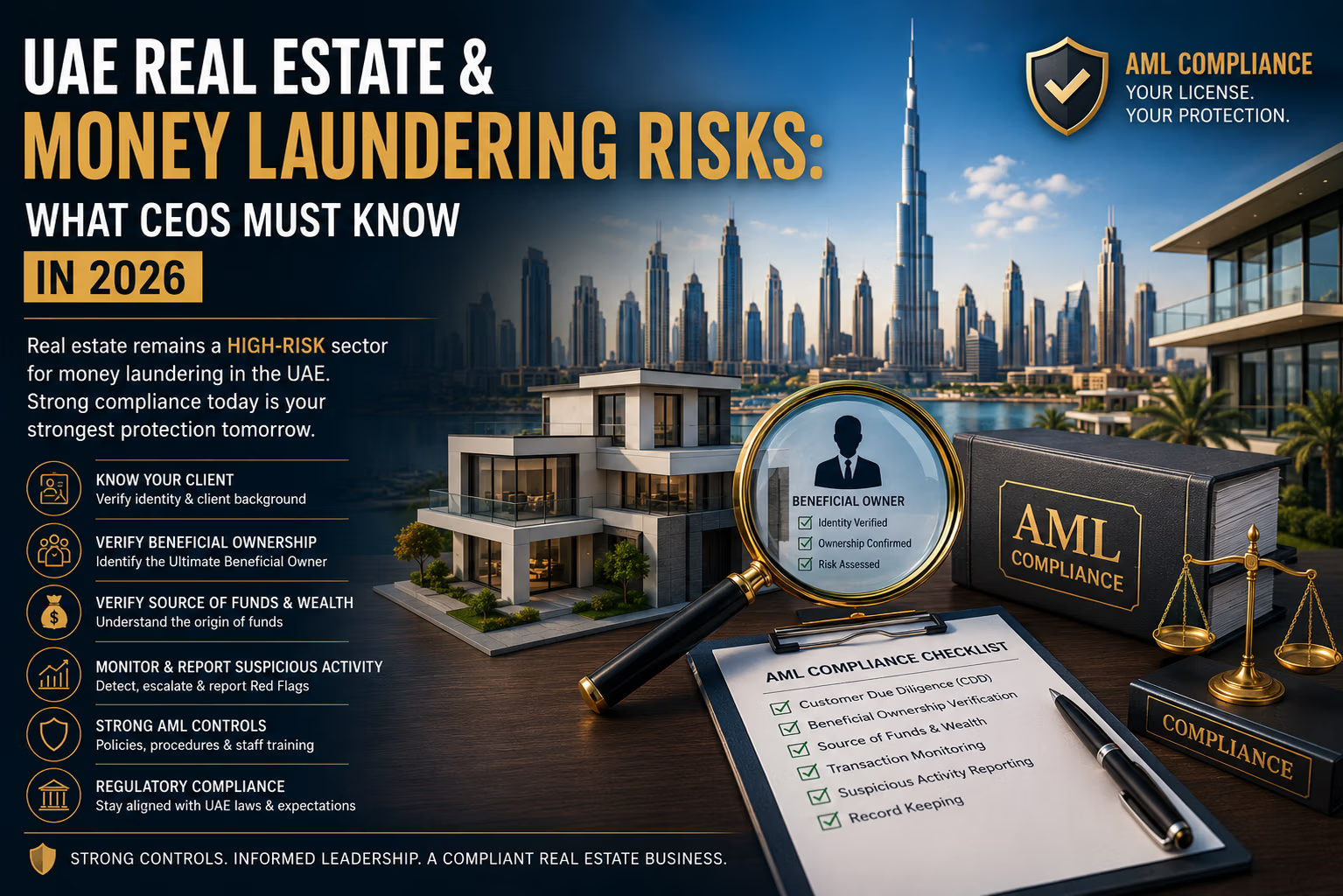
UAE Real Estate Is a High-Risk Sector for Money Laundering: What CEOs & Compliance Officers Must Know in 2025
The UAE real estate market continues to attract global investors, high-net-worth individuals, and institutional capital. However, alongside this growth comes increasing regulatory scrutiny.
According to the UAE’s latest National Risk Assessment (NRA), the real estate sector is officially classified as a high-risk industry for money laundering (ML). This classification is not speculative — it is based on documented vulnerabilities identified through national risk analysis and enforcement trends.
For CEOs, compliance officers, brokers, developers, and property management firms, the implications are significant. Real estate businesses are now operating at the frontline of Anti-Money Laundering (AML) enforcement in the UAE.
Whether you facilitate luxury property transactions or manage mid-market developments, your company is expected to maintain strong AML controls, verify ownership structures, monitor high-risk transactions, and report suspicious activity.
In this article, we break down the major money laundering threats identified in the UAE National Risk Assessment and explain what leadership teams in the real estate sector must do in 2025 to reduce risk and remain compliant.
Why Real Estate Is a Prime Target for Money Laundering
The UAE National Risk Assessment highlights several reasons why real estate remains attractive to criminals attempting to launder illicit funds.
Property transactions naturally involve high-value assets, making them ideal for storing and moving wealth. Real estate can also be used to conceal beneficial ownership, particularly when corporate structures, nominees, or offshore entities are involved.
Cross-border investments further increase exposure, especially when transactions involve foreign buyers, cash payments, or complex ownership arrangements.
The NRA identifies the following core vulnerabilities in the real estate sector:
- High-value transactions that enable large-scale movement of funds
- The ability to preserve and store wealth over time
- Limited transparency around beneficial ownership in some transactions
- Cross-border financing and foreign investment structures
- Cash-intensive transactions with weak fund verification
Importantly, money laundering risks are not limited to luxury mansions or multimillion-dirham penthouses. Even smaller residential units can become part of laundering schemes when due diligence procedures are weak or inconsistently applied.
The reality is simple: weak compliance controls create opportunities for abuse.
Top Money Laundering Threats in UAE Real Estate
The National Risk Assessment identifies several recurring vulnerabilities that continue to expose the UAE property sector to financial crime.
1. Obscured Beneficial Ownership
One of the biggest risks highlighted in the NRA is the concealment of the true property owner.
Criminals frequently use legal entities, shell companies, trusts, or proxy arrangements to purchase property while hiding the individual who actually controls or benefits from the asset.
According to the NRA:
“The use of legal persons and arrangements to obscure beneficial ownership continues to be a significant vulnerability in the real estate sector.”
When ownership is layered through multiple corporate structures, identifying the Ultimate Beneficial Owner (UBO) becomes significantly harder.
For real estate firms, this means enhanced due diligence is no longer optional. Compliance teams must be able to identify who ultimately owns, controls, or benefits from a transaction — not simply who signs the paperwork.
2. Use of Third Parties and Nominees
Another major vulnerability involves the use of family members, business associates, or nominees to purchase property on behalf of someone else.
The NRA notes:
“Transactions involving third parties or nominees are commonly used to disguise the true ownership of real estate assets.”
This structure creates distance between the real source of funds and the legal owner shown on documentation.
For example, a property may appear to be purchased by a spouse, sibling, employee, or associate while the true owner remains hidden behind informal arrangements.
Compliance teams should pay close attention to:
- Unclear buyer relationships
- Third-party payment sources
- Mismatched financial profiles
- Clients reluctant to explain ownership structures
When ownership explanations do not align with financial capacity or transaction logic, additional scrutiny is necessary.
3. Cash Transactions and Unexplained Sources of Funds
Cash-intensive transactions remain one of the strongest money laundering indicators in the real estate sector.
The NRA specifically highlights concerns around transactions involving partial or full cash payments, especially when the source of funds cannot be independently verified.
According to the report:
“High-value cash transactions in real estate remain a concern, particularly when the source of funds cannot be readily verified.”
In practice, this means businesses must carefully assess situations where clients:
- Avoid standard banking channels
- Insist on unusual payment arrangements
- Provide inconsistent financial documentation
- Cannot clearly explain their wealth accumulation
Repeated efforts to bypass bank transfers or reluctance to provide evidence of funds should immediately raise internal compliance concerns.
Source of Funds (SoF) and Source of Wealth (SoW) documentation must be treated as essential — not optional paperwork.
4. Unusual Transaction Structures
Money laundering activity often hides behind transactions that appear unusual, overly complex, or commercially irrational.
The NRA warns:
“Complex transaction structures, including rapid resales and price manipulation, are indicative of potential money laundering activities.”
Common red flags include:
- Payments from unrelated third-party bank accounts
- Property values that appear artificially inflated or undervalued
- Multiple back-to-back sales within short periods
- Sudden ownership transfers with limited commercial justification
Rapid flipping of assets can be used to disguise illicit money by creating a legitimate paper trail.
If a transaction appears unnecessarily complicated or financially illogical, firms should apply enhanced monitoring and document internal review decisions carefully.
5. High-Risk Foreign Buyers and Offshore Structures
The UAE real estate market attracts investors from around the world, which creates tremendous opportunities — but also additional compliance responsibilities.
The NRA highlights heightened risk when buyers originate from high-risk jurisdictions or purchase property through offshore structures.
The report states:
“The involvement of foreign buyers from high-risk jurisdictions, often using offshore entities, increases the vulnerability of the real estate sector.”
This does not mean all foreign buyers present elevated risk. However, enhanced due diligence becomes critical when transactions involve:
- Politically exposed persons (PEPs)
- High-risk jurisdictions
- Offshore companies
- Complex cross-border fund movements
- Sanctions exposure
Screening against sanctions lists and PEP databases should be standard practice for every real estate business.
6. Integration Through Renovation and Rental Income
Money laundering does not always end with the purchase of property.
In many cases, illicit funds are integrated into the legitimate economy through renovations, construction spending, rental income, or ownership transfers.
The NRA explains:
“Investment in property renovations and the generation of rental income are methods used to integrate illicit funds into the legitimate economy.”
Common methods include:
- Funding expensive renovations using illicit capital
- Generating rental income to legitimize funds
- Repeated ownership transfers between related parties
- Construction spending with limited financial transparency
At this stage, illegal proceeds begin to appear lawful, making detection significantly harder.
This is why monitoring should continue beyond onboarding and transaction completion.
What CEOs and Compliance Officers Must Do in 2025
AML compliance is no longer simply a regulatory obligation — it is a strategic business risk.
Regulators increasingly expect leadership teams to demonstrate active oversight of AML controls. If your business is inspected by the Ministry of Economy or Financial Intelligence Unit (FIU), gaps in compliance can quickly become violations.
Common weaknesses include:
- Inadequate verification of ownership structures
- Weak Source of Funds (SoF) documentation
- Poor transaction monitoring processes
- Lack of risk scoring mechanisms
- Weak internal suspicious activity reporting procedures
Leadership accountability is growing.
For CEOs
AML should be treated as a license protection issue, not an administrative task delegated entirely to compliance staff.
Senior management must ensure:
- Proper AML systems are implemented
- Staff receive ongoing training
- Compliance teams have sufficient authority and resources
- High-risk transactions receive executive oversight
Ignoring AML weaknesses can expose businesses to regulatory penalties, reputational damage, and operational disruption.
For Compliance Officers
Compliance functions should directly map internal controls to the threats identified in the UAE National Risk Assessment.
At a minimum, organizations should have systems capable of:
- Screening clients against sanctions and PEP databases
- Verifying beneficial ownership structures
- Documenting Source of Funds and Source of Wealth
- Monitoring high-risk clients and unusual transaction activity
- Maintaining audit-ready records for inspections
- Reporting suspicious activity efficiently
Strong documentation often determines whether a company passes or fails a regulatory review.
How the ALZAEEM Compliance Program Supports AML Readiness
To support real estate firms navigating UAE AML obligations, the ALZAEEM Compliance Program is designed to strengthen internal monitoring and regulatory readiness.
Key capabilities include:
Automated Risk Scoring
Clients and transactions are automatically assessed based on:
- Geographic exposure
- Client risk profile
- Transaction complexity
- Jurisdictional risks
Real-Time Sanctions & PEP Screening
Continuous screening against:
- UAE sanctions lists
- United Nations sanctions databases
- Politically Exposed Persons (PEP) records
- Custom internal watchlists
Flexible Beneficial Ownership Tracking
Rather than relying solely on static system fields, beneficial ownership can be documented through:
- Internal compliance notes
- Client-specific document folders
- Audit-ready ownership evidence
This provides flexibility while maintaining clear regulatory documentation.
goAML-Ready Suspicious Transaction Reporting
The program includes built-in red flag indicators and reporting support to help businesses prepare Suspicious Transaction Reports (STRs) aligned with goAML requirements.
Final Thoughts
The UAE National Risk Assessment has made one thing clear: real estate remains one of the country’s most scrutinized sectors under AML law.
Regulators already know where the risks exist. The question is whether real estate firms are actively addressing them.
For CEOs and compliance officers, the conversation can no longer be about whether AML matters. It is now about how prepared your business is for scrutiny.
The National Risk Assessment has spoken.
Are you listening?