

A beautiful project is not automatically a good investment.
A prestigious location is not automatically a good investment.
And a property launched by one of Abu Dhabi’s largest developers is still capable of being a poor investment if the wrong unit is purchased at the wrong price.
That is the correct starting point for analysing Sei Saadiyat.
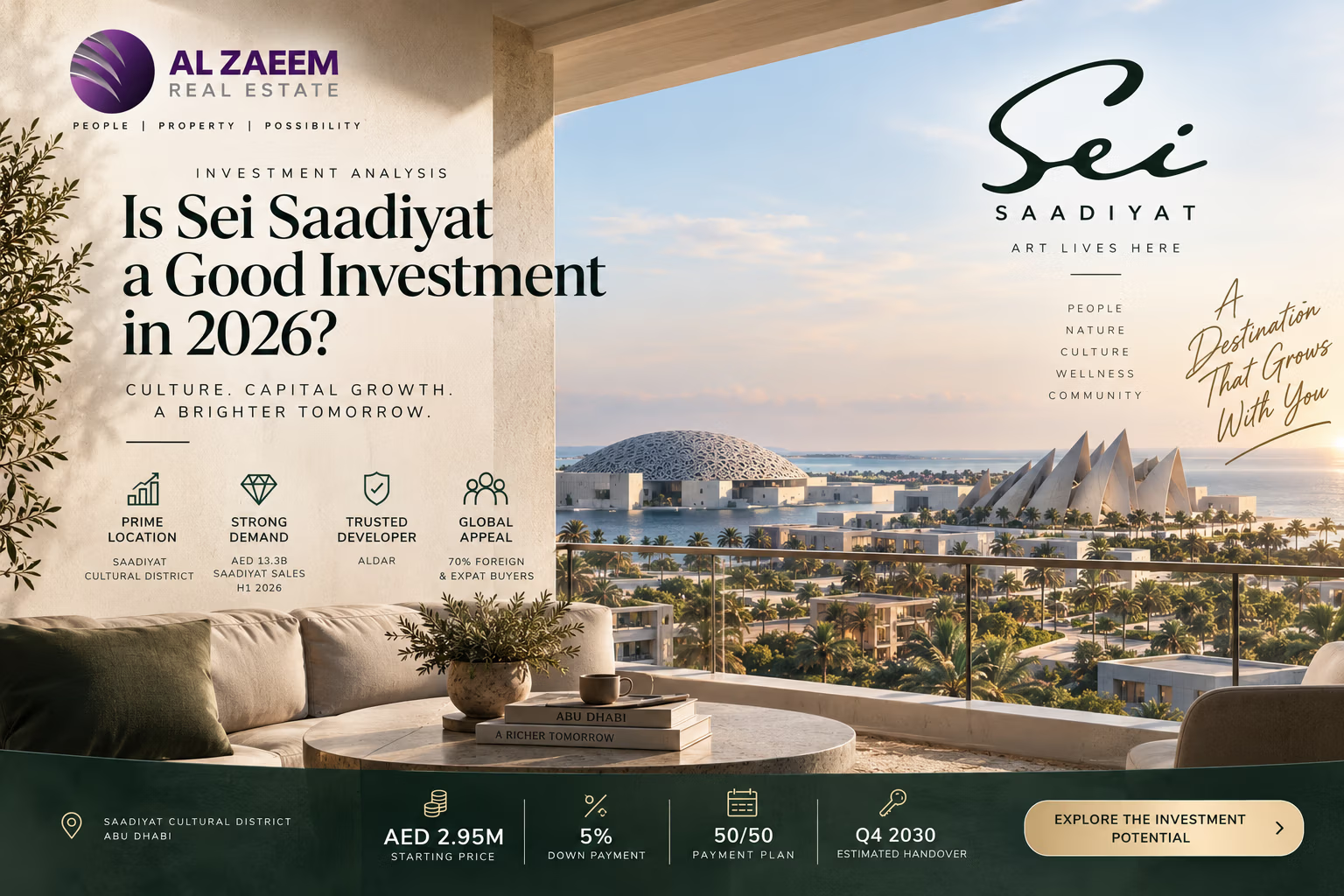
Aldar’s new development has several features that are immediately attractive: it sits inside Saadiyat Cultural District, comprises 778 homes across six residential buildings, includes distinctive Kanso Residences and Kanso Lofts, starts from AED 2.95 million, offers a 5% initial down payment under a 50/50 payment structure, and is currently scheduled for completion in Q4 2030.
Those characteristics give Sei a credible investment thesis.
They do not guarantee a return.
The investor still needs to answer a more demanding question:
Will the specific Sei Saadiyat residence I buy today remain desirable enough in 2030 and beyond to justify the price, holding period, future competition and capital committed?
That is what this analysis is designed to answer.
Quick Answer: Is Sei Saadiyat a Good Investment?
Potentially, yes — but selectively.
Sei Saadiyat has several strong investment fundamentals: a difficult-to-replicate Cultural District location, an established developer, a premium but differentiated residential product, substantial existing buyer demand for Saadiyat Island, and a long-term destination story that is increasingly supported by completed cultural infrastructure rather than only future promises. Abu Dhabi’s broader residential market is also exceptionally active, with ADREC reporting AED 70.4 billion of residential sales in H1 2026 and Saadiyat Island accounting for AED 13.3 billion of that value.
However, investors are entering at a premium starting price, waiting until Q4 2030 for completion, taking future service-charge and rental-market uncertainty, and buying into an island that is itself one of Abu Dhabi’s major future supply corridors. ADREC identifies Saadiyat among six districts expected to account for 77% of projected incremental residential supply through 2030.
So the conclusion is not:
“Sei is a good investment.”
It is:
“The right Sei unit, bought at a defensible price by an investor able to hold through 2030, can have a strong long-term investment case.”
The Investment Case in One Table
| Factor | Assessment |
|---|---|
| Location | Strong — Saadiyat Cultural District |
| Developer | Strong — Aldar |
| Current starting price | Premium — AED 2.95M |
| Initial payment | Accessible relative to ticket size — 5% |
| Payment structure | Investor-friendly if properly planned — 50/50 |
| Handover | Long-dated — Q4 2030 |
| Current rental income | None before completion |
| Cultural infrastructure | Strong and increasingly operational |
| Product differentiation | Good — Kanso Residences and Lofts |
| Foreign-buyer appeal | Strong |
| Future supply risk | Material |
| Service-charge visibility | Not yet fully known |
| Resale liquidity | Potentially strong for the right unit, not guaranteed |
| Best suited to | Medium/long-term investors and premium end users |
| Main risk | Paying a launch premium for an average unit |
Why Sei’s Location Is Its Strongest Investment Argument
Sei is not merely on Saadiyat Island.
It is specifically positioned in Saadiyat Cultural District.
That distinction matters because Cultural District property has a different demand thesis from generic island residential development. Sei residents will be close to Louvre Abu Dhabi, Zayed National Museum, Natural History Museum Abu Dhabi and teamLab Phenomena Abu Dhabi. Aldar and WAM both position the project around direct access to this cultural environment.
The district is also becoming increasingly complete. Zayed National Museum opened in December 2025, and the Natural History Museum Abu Dhabi opened in late 2025; Guggenheim Abu Dhabi is scheduled to open on 11 December 2026.
That changes the investment story.
Several years ago, a Cultural District buyer was purchasing partly on the basis of future destination promises.
A 2026 buyer is increasingly purchasing next to an operating cultural ecosystem.
That reduces one type of development risk.
Culture Does Not Guarantee Property Returns
Investors should still be careful with the phrase:
“Cultural District premium.”
A museum does not directly pay your mortgage.
A cultural institution does not guarantee your tenant.
And a famous neighbourhood cannot rescue an overpriced apartment.
The investment value of the Cultural District works indirectly through factors such as international recognition, destination traffic, urban quality, premium hospitality, prestige, visitor activity and the desirability of living close to one of Abu Dhabi’s most distinctive districts.
The location is therefore a powerful demand driver.
It is not a return guarantee.
Saadiyat Already Has Real Transaction Depth
One of the strongest points in Sei’s favour is that the island is not dependent on theoretical future demand.
ADREC recorded AED 13.3 billion in residential sales on Saadiyat Island during H1 2026. Only Hudayriyat Island recorded a larger district-level figure in the report.
That matters for a future Sei owner because resale liquidity is more credible when a location already attracts substantial buyer capital.
Across Abu Dhabi, H1 2026 residential sales reached AED 70.4 billion, compared with AED 25.3 billion in H1 2025. Off-plan transactions represented 89% of residential sales value and 82% of transactions.
Sei is therefore launching into a market where both:
premium Saadiyat demand
and:
off-plan buyer demand
are already substantial.
International Buyers Strengthen the Thesis
ADREC reported that resident expatriates and non-resident foreign buyers together accounted for 70% of Abu Dhabi residential sales value in H1 2026.
A globally recognisable location such as Saadiyat Cultural District can potentially benefit disproportionately from international demand.
An overseas buyer may not know every Abu Dhabi residential community.
They are much more likely to recognise a location associated with:
Louvre Abu Dhabi;
Guggenheim;
Zayed National Museum;
Saadiyat beaches;
and the wider cultural district.
That international recognisability can become useful at resale.
Developer Risk: Aldar Is a Major Positive
Developer quality matters particularly in a property not expected to complete until Q4 2030.
A buyer is effectively trusting the developer with:
construction;
quality execution;
project delivery;
common-area standards;
amenity delivery;
and the creation of the final residential environment.
Aldar’s scale is meaningful here.
The company reported AED 12.1 billion of development sales during H1 2026, a development backlog of AED 71.6 billion, and AED 37.1 billion of liquidity at the end of the period. Aldar also reported that overseas and expatriate resident buyers represented AED 7.6 billion, or 80%, of its H1 UAE sales.
Aldar separately reported in March 2026 that it remained on track to hand over more than 3,500 units during the year while construction activity was progressing across 141 sites.
None of this removes project-specific construction risk.
But developer strength is clearly an investment advantage.
The Product Is More Differentiated Than a Generic Apartment Launch
A development containing hundreds of near-identical apartments can create a resale problem.
When ten owners want to sell the same layout at the same time, the buyer can largely choose on:
price.
Sei has some protection against this because Aldar has introduced several different product categories: 1- and 2-bedroom apartments, 3-bedroom Kanso Residences and 2-bedroom Kanso Lofts. Selected residences also offer maid’s-room configurations.
The Kanso Loft category is especially relevant because double-height, loft-style residential space can create an architectural identity that cannot easily be reproduced by furnishing or renovation.
That gives investors another potential source of value:
scarcity within the development itself.
But Scarcity Must Be Bought at the Right Price
Imagine a conventional Sei 2BR costs AED X.
A Kanso Loft costs 25% more.
If future tenants pay only 5% more rent and future buyers value the loft only modestly more, the investor has paid too much for architectural scarcity.
If the loft remains genuinely rare, highly desirable and visually distinct, the premium may be maintained or even expand.
The principle is simple:
Scarcity creates value only when buyers care about what is scarce.
AED 2.95M Is a Serious Entry Price
Aldar currently lists Sei Saadiyat from AED 2.95 million.
This means the investment case needs to be stronger than:
“Saadiyat is a good area.”
At this price point, buyers should expect:
premium location;
premium construction;
premium design;
and a future tenant or buyer market capable of supporting the capital basis.
The AED 2.95M figure is also a starting price, not the average project price.
Larger units, better orientations, higher floors, stronger views and signature formats will require more capital.
The exact unit matters considerably more than the marketing entry price.
The 5% Down Payment Can Be Misleading Psychologically
At AED 2.95M:
5% equals:
AED 147,500.
That makes the initial commitment appear relatively manageable.
But the investor is not buying a AED 147,500 property.
They are entering a contractual commitment toward a property costing at least:
AED 2.95 million.
Aldar describes the structure as 50/50 with 5% down.
The investor therefore needs to evaluate the entire future payment obligation rather than allowing the small initial percentage to shape the affordability decision.
The 50/50 Plan Can Improve Capital Efficiency
The payment structure is also one of Sei’s genuine investment strengths.
A buyer does not need to deploy the full purchase price immediately.
If instalments are staggered during development and a meaningful balance remains toward completion, capital can remain available elsewhere for longer.
That can be useful for:
business owners;
portfolio investors;
international buyers;
and buyers managing several assets.
However, a payment plan improves timing.
It does not reduce:
price.
AED 2.95M paid over time remains AED 2.95M.
The Q4 2030 Handover Is Both an Opportunity and a Risk
A long construction horizon provides time for Saadiyat Cultural District to mature further.
By 2030, Guggenheim Abu Dhabi should be operating, the surrounding district should be more developed, and the overall Saadiyat residential environment may be substantially more mature than it is at launch.
That is the opportunity.
The risk is that the investor waits several years without ordinary rental income.
During that period, capital is committed to an asset that is still under construction.
The investor is primarily relying on:
development progress;
market value;
future demand;
and eventual completion.
This makes Sei more suitable for:
patient capital
than for an investor requiring immediate cash flow.
Sei Is Not an Income Investment Yet
A ready apartment can begin producing rent after purchase and tenant placement.
Sei cannot.
The investor should therefore distinguish between:
future income potential
and:
current income production.
This is especially important if the buyer is comparing Sei with a ready property of similar value on Saadiyat Island.
A ready property may deliver:
current rent;
known service charges;
physical inspection;
existing tenant evidence;
and immediate utility.
Sei may deliver:
new-build quality;
modern design;
Cultural District positioning;
and potential construction-period capital appreciation.
Different investment profile.
What Rental Yield Could Sei Produce?
Nobody can responsibly state Sei’s actual rental yield today.
There is no completed Sei rental market.
The residences are scheduled for Q4 2030 handover.
However, investors can model scenarios.
Using the current starting price of AED 2.95M purely for illustration:
| Future Annual Rent | Simplified Gross Yield |
|---|---|
| AED 140,000 | 4.75% |
| AED 150,000 | 5.08% |
| AED 180,000 | 6.10% |
| AED 200,000 | 6.78% |
| AED 210,000 | 7.12% |
These figures are not rental forecasts.
They demonstrate what future rent would need to look like to produce different gross yields on the current entry price.
The actual calculation must eventually include:
service charges;
maintenance;
vacancy;
management;
furnishing;
and financing where applicable.
The Service-Charge Question Is Important
Sei’s amenity offering includes rooftop pools, landscaped social gardens, hot and cold baths, fitness studios, yoga and aerial-yoga facilities, spa spaces, cinema rooms, co-working areas, a Zen Garden and Serenity Pool.
Those amenities can improve:
tenant attraction;
owner experience;
and resale appeal.
They also need to be operated and maintained.
At launch, investors should therefore avoid pretending they know the final long-term net yield before the approved service-charge structure is available.
The difference between:
AED 20,000;
AED 40,000;
and AED 60,000
of annual ownership costs can materially alter investment return.
Gross Yield Is Not the Investment
Suppose a future Sei unit rents for AED 180,000.
On AED 2.95M, that is approximately:
6.1% gross yield.
Now suppose annual ownership and operating costs amount to AED 40,000.
Net operating income becomes:
AED 140,000.
Simplified net yield:
approximately:
4.75%.
If costs are AED 60,000:
NOI becomes:
AED 120,000.
Net yield:
approximately:
4.07%.
This is why an investor should not decide:
“Sei will yield 6%”
simply because a future rental estimate looks attractive.
Capital Appreciation May Be the Bigger Investment Story
For many Sei buyers, the investment case will likely rely partly on:
capital appreciation.
That is understandable.
The property is being acquired years before completion in a district that is still maturing.
But investors should separate:
possible appreciation
from:
guaranteed appreciation.
ADREC reported that Abu Dhabi repeat-sale apartment prices increased 20% year-on-year in H1 2026.
That shows strong recent momentum.
It does not mean Sei will increase:
20% next year;
20% by handover;
or any particular amount.
Historical price growth is evidence of market strength.
It is not a forecast.
A Useful 2030 Value Stress Test
Consider a AED 2.95M purchase today.
These are hypothetical scenarios over roughly the period to Q4 2030:
| Illustrative Annual Price Change | Approx. 2030 Value |
|---|---|
| -3% p.a. | AED 2.59M |
| 0% p.a. | AED 2.95M |
| +3% p.a. | AED 3.34M |
| +5% p.a. | AED 3.63M |
| +7% p.a. | AED 3.93M |
These figures are mathematical illustrations, not forecasts.
Their purpose is to answer a more important question:
Would the investment still be financially comfortable if the property is worth approximately what you paid—or even somewhat less—at handover?
If the answer is no, the strategy depends too heavily on appreciation.
The Flat-Market Scenario Is More Important Than the Bull Case
Suppose Sei is worth approximately AED 2.95M in 2030.
The investor has not necessarily purchased a bad property.
They may still own:
a brand-new Cultural District residence;
in a mature Saadiyat location;
capable of generating future rent.
But the construction period itself has produced little capital growth.
The investor then needs to ask:
what was the opportunity cost of the capital committed from 2026 to 2030?
This is a more rigorous way of analysing off-plan property.
Future Supply Is Sei’s Most Important Market Risk
ADREC expects approximately 71,000 additional residential units across Abu Dhabi by 2030, with deliveries peaking at around 21,800 units in 2028.
Saadiyat Island is one of six key districts expected to account for 77% of incremental residential supply.
This does not mean Saadiyat will be oversupplied.
Growing supply can accompany:
population growth;
employment;
foreign investment;
tourism;
and destination development.
But it does mean a future Sei seller will not operate in a market with no alternatives.
Cultural District Competition Is Becoming Sophisticated
Sei is also not the only premium residential product in Saadiyat Cultural District.
Aldar’s The Row Saadiyat is a seven-building lifestyle quarter designed by BIG. Its first phase introduced 315 one-, two- and three-bedroom apartments.
Aldar also launched Baccarat Residences Saadiyat in February 2026 as an ultra-prime branded residential project in the Cultural District.
That is important for Sei investors.
By 2030, the question may not be:
“Do you want an apartment in Saadiyat Cultural District?”
The buyer may instead compare:
Sei;
The Row;
Baccarat;
existing Source inventory;
other Cultural District developments;
and future projects not yet launched.
Competition will increasingly occur at the level of:
quality, design, view, price and scarcity.
This Makes Unit Selection Critical
In a less competitive market, simply owning property in the right neighbourhood can be enough.
In a mature premium district, buyers become selective.
Within Sei itself, future buyers may distinguish between:
a high-floor Cultural District-facing unit;
a weaker-view unit;
a conventional apartment;
a Kanso Loft;
a large Kanso Residence;
and different building positions.
The phrase:
“I own Sei Saadiyat”
will not describe all properties equally.
The exact residence matters.
View Could Be One of the Biggest Long-Term Differentiators
Sei is positioned around one of Abu Dhabi’s most visually distinctive urban environments.
A genuinely open view toward:
cultural landmarks;
sea;
or a protected open space
can become difficult to reproduce.
That creates a potentially defensible premium.
But buyers should investigate:
orientation;
future plots;
building separation;
and whether the advertised view can eventually be obstructed.
A premium for a permanent view is easier to defend than a premium for a temporary view.
Floor-Plan Efficiency Will Matter at AED 2.95M+
At this price level, buyers should expect efficient space.
An expensive apartment containing:
long corridors;
awkward corners;
poor storage;
or oversized circulation
is still inefficient.
Two units with the same area can provide very different daily usability.
The strongest Sei investment may therefore not be:
the largest unit.
It may be:
the unit whose area is used most effectively.
Should Investors Prefer the 1BR?
Potentially, because the 1BR should require less absolute capital than larger formats and may appeal to:
professionals;
couples;
international investors;
and second-home buyers.
The lower ticket size may also support future resale liquidity.
However, the starting price is already premium.
The 1BR investment case therefore depends heavily on:
future rent;
unit size;
PSF;
service charges;
and how many competing 1BRs reach the Cultural District market.
Should Investors Prefer the 2BR?
The conventional 2BR may provide the best balance for many buyers.
It can serve:
couples;
small families;
professionals wanting a study;
investors;
and future owner-occupiers.
That wider buyer pool can support liquidity.
The weakness is that 2BR apartments are also likely to be common across competing projects.
A good 2BR therefore needs:
view;
layout;
price;
or positioning
to remain distinct.
What About Kanso Residences?
The 3BR Kanso Residences may appeal more strongly to:
families;
end users;
high-net-worth residents;
and buyers seeking larger Cultural District homes.
Their investment advantage could come from:
scarcity.
Their disadvantage is:
higher absolute capital
and a smaller affordability pool.
This may make them less liquid in transaction volume but potentially more defensible if larger premium residences remain limited.
What About Kanso Lofts?
The Kanso Loft thesis is different.
Its potential value comes from:
architecture.
Aldar separates the 2BR Kanso Loft from its conventional apartment offering. The project is designed around thoughtful architecture by Jacobs, while interiors are by Kettle Collective.
If the loft format creates genuine architectural scarcity, it may eventually be easier to market than another conventional 2BR.
But a loft should not be purchased simply because it is visually impressive.
Investors still need to assess:
privacy;
usable area;
furnishing;
tenant profile;
and the premium paid over a conventional 2BR.
Sei’s Sustainability Positioning Supports Long-Term Relevance
WAM reports that Sei is targeting Estidama Pearl 3, with smart-community features and EV provisions.
Sustainability certification does not directly guarantee appreciation.
But over a long holding period, buyers may increasingly value:
energy efficiency;
EV readiness;
building performance;
and modern community infrastructure.
For a project scheduled to complete in 2030, future relevance matters.
The Cultural District Should Be Even More Mature by Handover
One of the strongest elements of the Sei timing is that the area around it should continue evolving before residents receive their keys.
Guggenheim Abu Dhabi is currently scheduled to open on 11 December 2026, adding another major institution to a district that already includes Louvre Abu Dhabi, Zayed National Museum, Natural History Museum Abu Dhabi and teamLab Phenomena.
By the time Sei completes, these institutions will no longer simply be:
new openings.
They should be established elements of the district.
This could strengthen the area’s international profile and residential desirability.
But Marsa Al Saadiyat Changes the Wider Island Story Too
Aldar’s H1 2026 results highlighted Marsa Al Saadiyat, the AED 100 billion development activating the final phase of the Saadiyat masterplan, with Aldar itself expected to develop AED 60 billion of that pipeline.
For Sei owners, this is potentially positive because it signals:
continued infrastructure;
destination investment;
new waterfront amenities;
and greater island-wide maturity.
It is also another reminder that:
Saadiyat will continue receiving substantial new inventory.
Destination growth and supply growth happen simultaneously.
A sophisticated investor models both.
Is the 50/50 Payment Plan Better Than Buying Ready?
That depends on what you do with the capital not yet paid.
Suppose the buyer retains part of their funds in:
business;
financial investments;
cash reserves;
or another income-producing asset
during construction.
The staged plan can improve capital efficiency.
If the retained capital simply remains idle while the investor also waits years for rental income, the benefit is less significant.
The payment plan should therefore be considered as part of the buyer’s total portfolio strategy.
Mortgage-Dependent Buyers Need an Extra Stress Test
A buyer planning to finance the handover balance in 2030 should not assume:
future mortgage approval.
The bank will assess the buyer and the property based on circumstances at that time.
Income can change.
Mortgage regulations can change.
Interest rates can change.
And bank valuation may differ from the original purchase price.
This is where the principles in our published cash-vs-mortgage Abu Dhabi guide become relevant: a mortgage preserves capital, but it also adds financing and valuation risk.
The Bank-Valuation Scenario
Suppose you purchase a residence for:
AED 4M.
At handover, the bank values it at:
AED 3.7M.
If financing is calculated using the lower accepted valuation, the investor may need more cash than originally expected.
That does not mean this will happen.
It means the buyer should be able to complete without relying on:
a perfect valuation.
Who Is Sei Best Suited To?
Sei makes the strongest investment sense for a buyer who can comfortably fund the complete purchase, does not require rental income before 2030, wants medium- or long-term Saadiyat exposure, understands that premium property can have lower percentage yield than cheaper assets, and is willing to select the unit carefully rather than purchasing purely on launch excitement.
It is less suitable for a buyer whose entire financial strategy depends on rapid off-plan resale, aggressive appreciation assumptions or guaranteed mortgage availability at handover.
Sei as a Portfolio Asset
Imagine an investor already owns:
three premium Saadiyat apartments.
Adding Sei may improve:
project diversification.
But it does not necessarily improve:
geographic diversification.
All four properties may still depend heavily on:
Saadiyat luxury demand;
international buyer activity;
and similar supply conditions.
Another investor owning property on Reem, Yas and the mainland may use Sei as:
a premium-growth allocation.
Portfolio context changes the answer.
The Concentration Question
The strongest individual property can still be the wrong next purchase if it increases portfolio concentration excessively.
Before buying Sei, ask:
How much of my total property wealth is already in:
Abu Dhabi;
Saadiyat;
off-plan property;
luxury apartments;
and 2030-era handovers?
Owning different unit numbers is not the same thing as owning different risks.
The Holding-Period Question
A Sei buyer should ideally be comfortable with:
2030 handover
plus:
several years of ownership after completion.
Why?
Because transaction costs and market cycles can make very short holding periods less predictable.
A buyer entering with a 7- to 10-year perspective can allow more time for:
Cultural District maturity;
rental income;
community establishment;
and property-cycle movement.
That does not mean every buyer must hold for ten years.
It means the investment should not collapse if a quick resale opportunity fails to appear.
Five Investment Tests Before Buying Sei
| Test | Question |
|---|---|
| Price Test | Is this exact unit fairly priced against alternatives? |
| Unit Test | Does it have a reason to outperform other Sei inventory? |
| Funding Test | Can I comfortably meet every instalment and handover payment? |
| 2030 Test | Would I still want it if prices are flat at handover? |
| Exit Test | Who is most likely to buy this unit from me later? |
If a property passes all five, the investment thesis becomes much stronger.
The “No Appreciation” Test
This may be the most important question in the entire article:
Would you still buy Sei if you knew the property would be worth approximately your purchase price at handover?
If yes, perhaps because you value:
the property;
location;
future rental potential;
and long-term ownership,
then appreciation becomes:
upside.
If no, your thesis may depend primarily on:
selling to someone else at a higher price.
That is speculation rather than a complete real-estate investment strategy.
The “No Logo” Test
Now imagine the project were not called Sei.
Would you still buy:
this layout;
in this exact Cultural District location;
with this view;
at this price;
under this payment plan?
If yes:
the underlying real estate is doing the work.
That is positive.
The “Wrong Unit” Test
Now imagine Sei becomes highly successful.
Could your particular unit still underperform?
Yes.
If it has:
poor view;
inefficient layout;
high entry PSF;
future obstruction;
or too many identical competing units,
a great project cannot completely remove unit-level weaknesses.
Buy:
the project.
Then buy:
the unit.
Both decisions matter.
Sei Saadiyat Investment Scorecard
This is an Al Zaeem analytical framework, not an Aldar or ADREC methodology.
| Investment Factor | Score 1–5 |
|---|---|
| Saadiyat Cultural District location | |
| Developer strength | |
| Exact unit pricing | |
| Price per sq ft | |
| View quality | |
| View protection | |
| Layout efficiency | |
| Unit scarcity | |
| Payment-plan affordability | |
| 2030 handover resilience | |
| Future rental potential | |
| Service-charge risk | |
| Future supply resilience | |
| Resale buyer depth | |
| Portfolio diversification | |
| Long-term holding ability | |
| Overall investment conviction |
The purpose is not to produce a magic number.
It is to prevent the buyer from making a multi-million-dirham decision based only on:
a brochure;
a developer name;
or launch excitement.
Frequently Asked Questions
Is Sei Saadiyat a good investment?
It can have a strong investment case because of its Cultural District location, Aldar development, product differentiation and Saadiyat’s existing buyer demand. However, future return depends on the specific unit, entry price, service charges, supply, rental demand and market conditions at handover.
What does Sei Saadiyat start from?
Aldar currently lists prices from AED 2.95 million.
What is the payment plan?
Aldar currently publishes a 50/50 payment plan with 5% down payment.
When will Sei Saadiyat be completed?
The current estimated handover is Q4 2030.
How many homes are in the project?
The complete development comprises 778 homes across six residential buildings. Phase 1 contains 265 homes across two buildings.
Is Sei suitable for rental investment?
Potentially, but the project will not have an operating rental history until after completion. Any current rental estimate should therefore be treated as a projection.
What rental yield will Sei produce?
It is too early to state an actual yield. Investors should model several future rent and expense scenarios rather than relying on a guaranteed percentage.
Will Sei appreciate before handover?
It may, but no appreciation rate can be guaranteed.
Is Saadiyat Island performing well?
ADREC reported AED 13.3 billion in Saadiyat Island residential sales during H1 2026.
Is Abu Dhabi off-plan demand strong?
Yes. ADREC reported off-plan property accounted for 89% of residential sales value and 82% of transactions in H1 2026.
Is future Saadiyat supply a risk?
It is an important factor. ADREC identifies Saadiyat among six districts that will account for 77% of projected incremental supply through 2030.
Is a 1BR the best investment?
Not automatically. It may offer lower capital entry, but the exact price, size, view, rent and future competition determine its performance.
Are Kanso Lofts better investments?
They may benefit from architectural scarcity, but the premium paid must be justified by future rental, resale or lifestyle value.
Is the 3BR Kanso Residence better for appreciation?
No unit category can be guaranteed to appreciate faster. Larger signature residences may have scarcity advantages but require more capital and have a narrower buyer pool.
Is Sei better than buying a ready property?
Neither is universally better. Sei offers future new-build Cultural District exposure and staged payments, while a ready property can provide immediate rent and greater current certainty.
Should I buy Sei with cash or mortgage?
That depends on liquidity, investment return, risk tolerance and future financing capacity. A mortgage can preserve capital but creates interest, valuation and approval risk.
Is Aldar a positive factor?
Yes. Aldar is one of Abu Dhabi’s leading developers, with substantial sales, liquidity, development backlog and current delivery activity.
Does the Cultural District strengthen investment value?
It can support desirability and global recognition, but the Cultural District alone cannot guarantee returns.
Is the 5% down payment an advantage?
It reduces the immediate cash requirement but does not reduce the total purchase price. Buyers must assess the complete 50/50 schedule.
What is the biggest risk?
For many investors, the biggest risk is paying a premium price for an average unit while assuming Saadiyat’s reputation will automatically produce appreciation.
What is the strongest reason to buy?
The strongest reason is owning a carefully selected residence in a globally differentiated Cultural District with a long-term holding horizon and a price that remains defensible against future alternatives.
Final Takeaway
Sei Saadiyat has the ingredients of a strong premium property investment.
It has:
Saadiyat Cultural District;
Aldar;
a differentiated six-building residential collection;
778 homes;
premium conventional apartments;
Kanso Residences;
Kanso Lofts;
a 50/50 payment structure;
and:
a Q4 2030 completion horizon.
It is also entering a market with substantial momentum. Abu Dhabi recorded AED 70.4 billion in residential sales during H1 2026, Saadiyat alone accounted for AED 13.3 billion, and international and expatriate buyers represented 70% of residential sales value across the emirate.
But investors should not confuse:
strong market
with:
guaranteed investment.
Sei’s greatest opportunities are also connected to its main risks.
The Cultural District creates prestige and scarcity—but commands premium pricing.
The 50/50 structure improves capital timing—but leaves a meaningful future funding obligation.
The 2030 delivery date gives the district time to mature—but delays rental income.
Saadiyat’s growth can strengthen the destination—but also creates competing supply.
And distinctive Kanso products may create scarcity—but only if the market eventually values that scarcity enough to justify their premium.
So, is Sei Saadiyat a good investment?
The most accurate answer is:
Yes, potentially — but the investment quality will be determined much more by the exact unit and entry price than by the project name alone.
A good Sei investment should survive three scenarios:
prices rise;
prices remain flat;
and:
the market becomes temporarily weaker.
If you can comfortably complete the property, hold through the cycle, and still want the exact residence without assuming rapid appreciation, then the investment thesis is substantially stronger.
The question is not simply:
“Will Sei Saadiyat go up in value?”
It is:
“Am I buying a residence that should remain desirable even if the market does not behave exactly as I hope?”
That is the more useful investor question.
Al Zaeem Real Estate — Invest in the Unit, Not the Launch Hype
Sei Saadiyat deserves serious consideration, but a multi-million-dirham property should be selected on evidence rather than urgency.
Al Zaeem Real Estate helps buyers evaluate Sei through the exact residence rather than only the project brochure: price, floor, layout, view, payment obligations, future tenant profile, resale competition and portfolio fit.
You can also explore the wider Saadiyat Island property market, current Abu Dhabi properties for sale, apartments for sale, and available off-plan opportunities through Al Zaeem Real Estate.
The objective is not simply to own property in Sei Saadiyat.
It is to own:
a Sei Saadiyat residence that still makes financial sense when the keys arrive in 2030.
Al Zaeem Real Estate
+971 (50) 991 5454
azcb.co
Primary Official Sources
The project’s published price, payment plan, unit mix, size range, amenity programme and Q4 2030 estimated handover are based on Aldar’s official Sei Saadiyat project information.
The Phase 1 scale, total project size, sales-launch timing and Estidama Pearl 3 target are supported by Emirates News Agency’s official launch coverage.
Market analysis uses ADREC’s H1 2026 Abu Dhabi Real Estate Market Report, including residential sales, Saadiyat sales, foreign-buyer participation, off-plan share and future residential supply projections.
Aldar’s H1 2026 financial results and March 2026 delivery update provide context on the developer’s sales, backlog, liquidity and project-delivery activity.
The Cultural District context is supported by Abu Dhabi Media Office information on Zayed National Museum, Natural History Museum Abu Dhabi and Guggenheim Abu Dhabi.
Disclaimer
This article is provided for general educational and real-estate research purposes only. It does not constitute investment, financial, legal, mortgage, tax, valuation, immigration or contractual advice.
Project information reflects publicly available information reviewed on 13 September 2026, before the scheduled opening of Sei Saadiyat Phase 1 sales on 16 September 2026.
The AED 2.95 million starting price, 5% down payment, 50/50 payment plan and Q4 2030 estimated handover are current published project details and may be updated by the developer.
Rental-yield examples, future property-value scenarios, operating-cost illustrations and appreciation assumptions in this article are hypothetical analytical examples only. They are not forecasts or guaranteed returns.
No future rental income, resale liquidity, mortgage approval, bank valuation or capital appreciation can be guaranteed.
Future market supply can contribute both to destination growth and increased competition. The impact on an individual property will depend on its exact unit characteristics, price and future market conditions.
Buyers should review current developer documentation, SPA terms, payment schedules, applicable fees and professional advice before committing funds.
Last reviewed: 13 September 2026.