


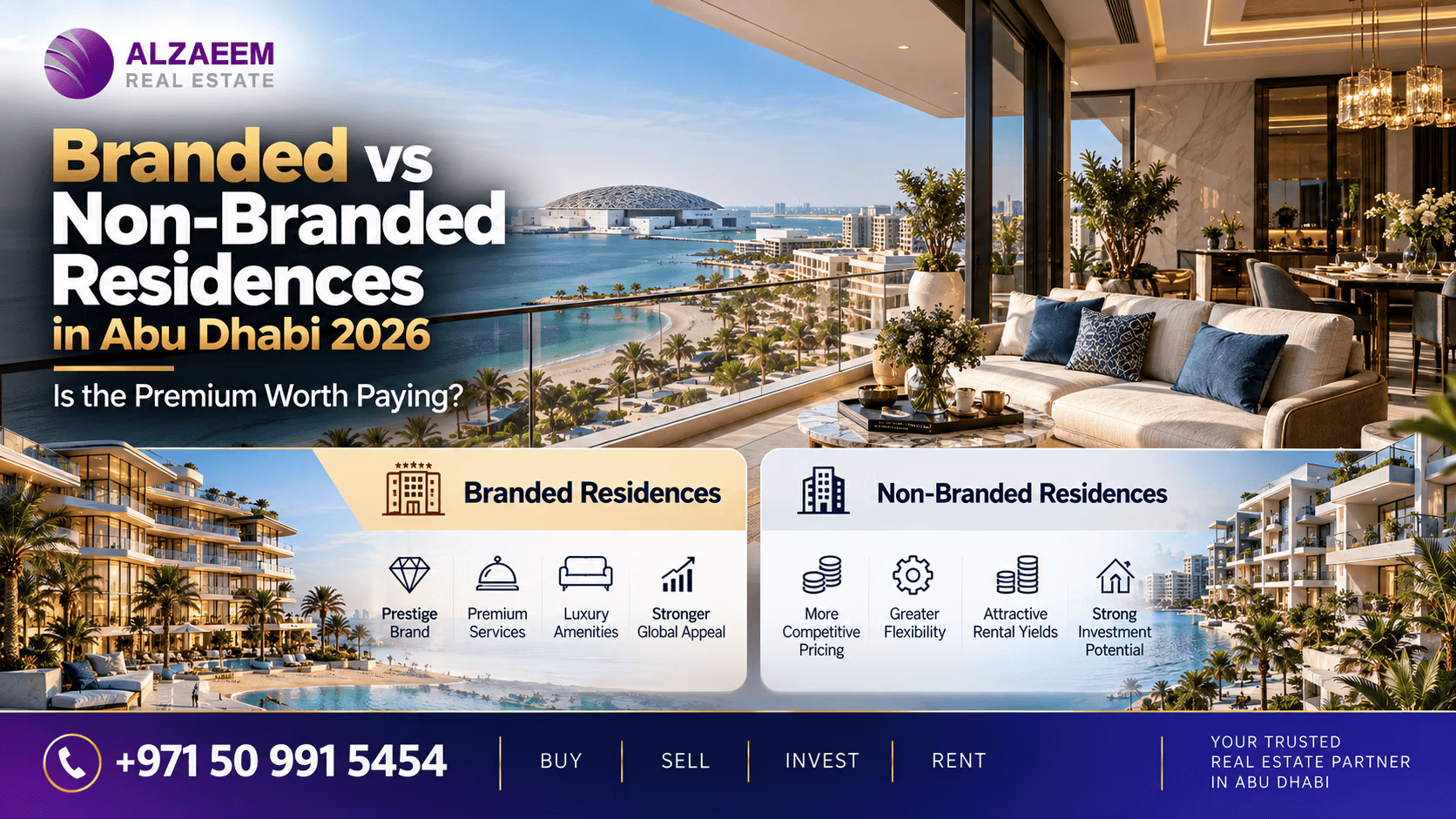
Abu Dhabi’s luxury residential market is moving into a new phase.
For years, investors mainly compared properties by:
- location,
- developer,
- view,
- layout,
- payment plan,
- rental yield,
- and price per square foot.
Increasingly, another question is entering the investment decision:
Should I pay more for a branded residence?
A branded residence typically combines residential ownership with a recognised hospitality, luxury, design or lifestyle brand.
The brand might influence:
- architecture,
- interiors,
- resident services,
- amenities,
- management,
- marketing,
- and the overall positioning of the property.
But branded real estate often comes with a premium.
That creates the real investment question:
Does the brand create enough additional rental demand, resale value, service quality and scarcity to justify the higher purchase price and potentially higher ongoing costs?
There is no universal answer.
In some properties, the brand can materially strengthen the asset.
In others, the investor may simply be paying a large premium for a name.
This distinction is becoming particularly relevant in Abu Dhabi. Knight Frank’s 2026/27 branded-residence research places Abu Dhabi among the world’s ten largest branded-residence markets, with 24 schemes identified and 19 still in the pipeline. That means much of Abu Dhabi’s branded-residence stock has yet to be delivered, so investors are evaluating a market that is expanding rapidly but remains less mature than Dubai’s. Knight Frank AE
What Is a Branded Residence?
A branded residence is a privately owned home connected to an established brand.
The brand could come from:
- luxury hospitality,
- fashion,
- design,
- automotive,
- jewellery,
- lifestyle,
- or another premium consumer sector.
The brand relationship may extend beyond simply using the name.
Depending on the development, it can influence:
- design standards,
- interior specification,
- amenities,
- concierge,
- housekeeping,
- wellness,
- resident services,
- property management,
- rental programmes,
- and operational standards.
The exact arrangement varies project by project.
That is important.
Two properties marketed as branded residences can have very different levels of genuine brand involvement.
Branded Does Not Automatically Mean Hotel Apartment
This distinction matters.
A branded residence may be:
- attached to a hotel,
- next to a hotel,
- managed by a hospitality brand,
- or completely residential while still carrying a recognised brand.
Likewise, owning a branded residence does not automatically mean the property is operated as a short-term hotel unit.
The investor should verify the actual operating model.
Abu Dhabi’s Branded-Residence Market Is Expanding
Knight Frank’s latest research says the Middle East now accounts for around 20% of live branded-residence schemes globally and 25% of the global pipeline. Abu Dhabi ranks eighth globally by scheme count, with 24 schemes, 19 of which are still in development. Knight Frank AE
That pipeline is important.
It means branded residences are becoming a meaningful segment of Abu Dhabi’s premium property market rather than an occasional specialist product.
Aldar’s 2026 launch of Baccarat Residences Saadiyat, for example, combines the Baccarat brand with residences in Saadiyat Cultural District, including apartments, sky villas and penthouses. Aldar
Aldar also announced Yas Point, a AED 6 billion waterfront destination on Yas Island that will include a five-star resort and branded residences alongside retail, leisure and other residential components. Aldar
Meanwhile, the recently unveiled Marsa Al Saadiyat masterplan is expected to include branded residences as part of a much larger luxury residential and lifestyle destination. Aldar
So the investment question is increasingly practical:
Should buyers pay the branded-residence premium, or can a high-quality non-branded property produce stronger economics?
What Is a Non-Branded Residence?
A non-branded residence is simply a residential property without a separate hospitality or lifestyle brand attached to it.
That does not mean it is lower quality.
A non-branded property can still offer:
- premium architecture,
- waterfront location,
- strong developer,
- luxury amenities,
- concierge,
- high-end interiors,
- excellent property management,
- and scarcity.
Some of Abu Dhabi’s strongest residential assets are not dependent on an external luxury brand.
The distinction is therefore not:
luxury vs ordinary
It is:
brand-associated luxury vs property-led luxury.
Why Branded Residences Usually Cost More
A branded residence often commands a premium because the buyer is paying for several layers of value.
These may include:
Brand Recognition
International buyers may recognise the brand even if they know little about the local property market.
Design and Specification
The brand may impose standards relating to interiors, architecture or material quality.
Services
Residents may receive:
- concierge,
- valet,
- housekeeping,
- wellness,
- private dining,
- resident lounges,
- hospitality-style support.
Scarcity
Some branded developments contain a limited number of residences.
Marketing Reach
A global brand can expose the property to international buyers beyond the normal local real-estate audience.
Lifestyle Value
Some buyers are willing to pay significantly more for association with the brand.
But these benefits only create investment value if future buyers and tenants are also willing to pay for them.
The Brand Premium Must Be Measured
Suppose two comparable residences are available in similar locations.
Non-Branded Residence
Purchase price: AED 3,000,000
Branded Residence
Purchase price: AED 3,750,000
The branded premium is:
AED 750,000
or:
25%
The investment question becomes:
What does the investor receive for that additional AED 750,000?
Possible answers might include:
- higher rent,
- stronger occupancy,
- premium service,
- better resale demand,
- superior architecture,
- greater international recognition,
- stronger capital appreciation.
If the investor cannot identify the economic justification, the premium may be too high.
Rental Premium vs Purchase Premium
This is one of the most important calculations.
Imagine:
Non-Branded
Purchase price: AED 3.0M
Annual rent: AED 180K
Gross yield:
6.0%
Branded
Purchase price: AED 3.75M
Annual rent: AED 210K
Gross yield:
5.6%
The branded unit generates:
AED 30K more annual rent
But costs:
AED 750K more
Incremental gross rent return on the additional capital:
AED 30K ÷ AED 750K = 4.0%
That does not mean the branded property is a bad investment.
But it shows that rental income alone may not justify the premium.
The investor may be relying more heavily on:
- resale premium,
- scarcity,
- capital appreciation,
- lifestyle demand.
Branded Residences Often Target a Different Buyer
A standard premium apartment may appeal to:
- local investors,
- expatriate professionals,
- families,
- regional buyers.
A high-end branded residence may attract:
- high-net-worth individuals,
- international second-home buyers,
- global investors,
- luxury lifestyle purchasers,
- brand-sensitive buyers.
This buyer pool can support higher pricing.
But it can also be narrower.
That means branded residences sometimes depend more heavily on international luxury demand.
Brand Recognition Can Improve International Liquidity
For an international buyer, an unfamiliar local project may require explanation.
A globally known brand can reduce that information gap.
A future buyer may instantly understand the positioning.
That can potentially help:
- marketing,
- resale,
- overseas demand,
- buyer trust.
However, brand recognition should not be confused with guaranteed liquidity.
If the property is overpriced, even a famous name may not produce a quick sale.
Service Charges Can Be Higher
Luxury services cost money.
A branded residence may involve more extensive:
- staffing,
- concierge,
- amenities,
- common areas,
- hospitality services,
- security,
- maintenance standards.
That can translate into higher annual operating charges.
Investors should therefore avoid calculating yield from rent and purchase price alone.
Use:
Net rental income after service charges and recurring costs
rather than:
rent ÷ purchase price
This becomes especially important in service-heavy luxury developments.
Example: Service Charges Can Reverse the Yield Comparison
Consider an illustrative comparison.
Non-Branded Unit
Purchase price: AED 3.0M
Rent: AED 180K
Service/community charges: AED 35K
Other operating allowance: AED 12K
Net operating income:
AED 133K
Operating yield:
4.43%
Branded Unit
Purchase price: AED 3.75M
Rent: AED 220K
Service/community charges: AED 65K
Other operating allowance: AED 15K
Net operating income:
AED 140K
Operating yield:
3.73%
The branded residence generates more rent and more net income in absolute dirhams.
But it delivers a lower yield on the capital invested.
That may still suit an investor seeking:
- premium capital preservation,
- appreciation,
- global resale appeal.
But it may not suit an investor primarily targeting income yield.
Not All Branded Residences Are Equally Strong
This is critical.
A famous name alone is not enough.
Investors should ask:
Who Owns the Brand?
Is it:
- hotel group,
- luxury house,
- design brand,
- licensing brand?
What Is the Brand Actually Responsible For?
Does it:
- manage the property,
- provide resident services,
- control design,
- operate amenities,
- simply license the name?
How Long Does the Brand Agreement Last?
Brand agreements are contractual.
Investors should understand what happens if:
- the relationship changes,
- management changes,
- branding rights expire.
Is the Brand Relevant to Residential Real Estate?
A brand may be famous globally but have little track record operating residences.
Hospitality Brands vs Lifestyle Brands
There can be an important difference.
Hospitality Brand
Often has operational experience in:
- guest service,
- concierge,
- property management,
- hospitality standards.
Potential advantage:
service delivery
Lifestyle / Luxury Brand
May contribute:
- design identity,
- prestige,
- aesthetic differentiation,
- brand association.
Potential advantage:
positioning and scarcity
These are different value propositions.
Investors should understand which one they are paying for.
Branded Residences Can Carry Stronger Emotional Demand
Luxury real estate is not purchased entirely through spreadsheet analysis.
Some buyers want:
- prestige,
- experience,
- identity,
- service,
- uniqueness.
That emotional demand can support pricing.
This is especially relevant in ultra-prime markets such as Saadiyat Island, where Knight Frank reported average apartment transaction prices of roughly AED 43,100 per square metre in the year to June 2026, making Saadiyat the emirate’s most premium apartment market in its tracked data. Knight Frank AE
In these markets, buyers may place more value on scarcity and identity than pure rental yield.
Premium Location Matters More Than the Brand Alone
A powerful brand cannot fully compensate for a weak location.
Investors should still analyse:
- waterfront quality,
- accessibility,
- surrounding development,
- views,
- future supply,
- masterplan,
- community.
A branded residence in a prime location is different from a branded residence relying mainly on the brand.
Saadiyat Is a Natural Branded-Residence Market
Saadiyat already combines:
- beaches,
- museums,
- cultural institutions,
- luxury hospitality,
- premium residences.
That ecosystem supports high-end branded products.
Aldar’s Baccarat Residences Saadiyat is being positioned in Saadiyat Cultural District, while Marsa Al Saadiyat is planned as a large-scale luxury waterfront destination containing branded residences alongside other premium residential types. Aldar
This matters because a brand works best when it reinforces the existing character of the destination.
Branded Residences on Yas Can Serve a Different Market
Yas Island’s appeal is built more around:
- lifestyle,
- entertainment,
- family living,
- tourism,
- airport connectivity.
Yas Point’s inclusion of branded residences alongside a resort, school, retail, dining and leisure components illustrates how branding can be integrated into a larger lifestyle destination. Aldar
The investment case therefore differs from Saadiyat.
Brand + location must be analysed together.
The Resale Question Is Crucial
Before paying a branded premium, ask:
Who will buy this from me later?
Potential resale buyers may include:
- brand enthusiasts,
- international investors,
- luxury end users,
- second-home buyers,
- wealthy residents.
That sounds attractive.
But if the future buyer pool is narrow, resale can still take time.
Branded Supply Is Growing
Knight Frank says Abu Dhabi has 24 branded-residence schemes, with 19 still in the pipeline. Knight Frank AE
That is important.
A product that is rare today may be less rare several years from now.
Investors should therefore distinguish between:
brand scarcity today
and
brand scarcity at exit.
If many competing branded projects deliver before resale, the premium may become harder to defend.
Future Supply Can Reduce Scarcity Premiums
Suppose you purchase a branded residence because there are only two comparable branded projects in the market.
By handover, there may be:
- six,
- ten,
- or more competing developments.
The investor should therefore research:
- current branded stock,
- announced pipeline,
- delivery timing,
- competing brands,
- competing price points.
Brand Strength Can Vary Over Time
Brands evolve.
A globally desirable brand today may:
- strengthen,
- weaken,
- reposition,
- become overused.
Real estate has a long holding period.
A buyer should consider whether the brand is likely to retain relevance over:
- five years,
- ten years,
- twenty years.
Building Quality Still Matters More Than Marketing
The residence needs to function as real estate.
Check:
- layout,
- light,
- storage,
- parking,
- lifts,
- balcony,
- finishing,
- acoustics,
- maintenance,
- common areas.
A strong logo cannot fix a poor floor plan.
Layout Efficiency Matters Even in Ultra-Luxury
Luxury buyers still value useful space.
A 2,000 sq ft branded residence with:
- oversized corridors,
- awkward rooms,
- unusable terraces
may offer worse functional value than a more efficient non-branded residence.
Do not allow branding to replace unit analysis.
PSF Premium Should Be Quantified
Suppose:
Non-branded comparable:
AED 2,500 PSF
Branded residence:
AED 3,250 PSF
Premium:
AED 750 PSF
Percentage premium:
30%
If the unit is 1,500 sq ft:
Total premium:
AED 1,125,000
That number deserves serious analysis.
What does the extra AED 1.125M buy?
The Premium Can Be Justified by Scarcity
Some branded residences may have genuinely limited inventory.
Examples:
- only a small number of penthouses,
- rare beachfront villas,
- limited branded sky residences.
Scarcity can strengthen resale.
But scarcity should be real.
Not simply marketing language.
“Limited Edition” Does Not Always Mean Limited Competition
A development may contain only 60 residences.
But if ten nearby branded projects also contain similar luxury stock, the wider market supply can still be substantial.
Always measure scarcity relative to the competitive market.
Branded Residences May Be Better for Capital Growth Than Yield
This is a common potential profile.
A premium branded residence may produce:
- lower percentage rental yield,
- stronger capital appreciation,
- stronger international buyer appeal.
That can suit a wealth-preservation or capital-growth strategy.
Non-Branded Residences May Be Better for Income
A strong non-branded premium property may offer:
- lower entry price,
- lower service charges,
- similar rent,
- better yield.
That can be attractive to income-focused investors.
Illustrative Comparison
The following figures are hypothetical.
| Metric | Non-Branded | Branded |
|---|---|---|
| Purchase Price | AED 3.0M | AED 3.9M |
| Size | 1,400 sq ft | 1,400 sq ft |
| PSF | AED 2,143 | AED 2,786 |
| Annual Rent | AED 185K | AED 225K |
| Gross Yield | 6.17% | 5.77% |
| Service Charges | AED 38K | AED 70K |
| Other Costs | AED 12K | AED 15K |
| Net Operating Income | AED 135K | AED 140K |
| Operating Yield | 4.50% | 3.59% |
The branded property produces:
AED 5K more net operating income
but requires:
AED 900K additional purchase capital.
If income is the main goal, the premium appears difficult to justify from rent alone.
The branded residence would need to create value elsewhere:
- appreciation,
- scarcity,
- resale,
- lifestyle.
The Incremental Brand Test
A useful analytical method is:
Additional Annual Economic Benefit ÷ Additional Purchase Premium
Suppose:
Branded premium:
AED 800K
Additional net annual income:
AED 20K
Incremental income return:
2.5%
This does not mean the total branded investment return is 2.5%.
It simply shows the income produced by the extra capital allocated to the brand premium.
Capital Appreciation Can Change the Result
Suppose after five years:
Non-Branded
AED 3.0M → AED 3.6M
Gain:
AED 600K
Branded
AED 3.9M → AED 5.0M
Gain:
AED 1.1M
The branded property produces more appreciation in absolute terms.
But percentage gains are:
Non-Branded:
20%
Branded:
28.2%
In that scenario, the branded premium created additional capital value.
But those appreciation figures are hypothetical.
Future appreciation should never be assumed.
Branded Residences Can Also Underperform
Suppose the buyer pays too much at launch.
Even if the development is excellent, the resale market may not support the original premium.
A branded property bought at:
AED 4.5M
may later compete against:
- new branded launches,
- investor resales,
- premium non-branded properties.
The quality can remain high while investor return remains weak.
Entry price matters.
Launch Pricing Needs Particular Attention
Luxury launches often create excitement.
Potential buyers may face:
- limited allocation,
- invitation-only releases,
- prestige marketing,
- scarcity claims.
That environment can reduce price discipline.
Do not buy because:
“Everyone wants it.”
Analyse:
price vs value
Compare Brand Premium Against Ready Luxury Stock
A strong method is to compare the branded launch with:
- premium ready properties,
- nearby non-branded luxury projects,
- branded resales,
- upcoming competitors.
This helps answer:
Is the buyer paying for genuine differentiation or simply launch hype?
Developer Quality Still Matters
The brand is one layer.
The developer is another.
Investors should still assess:
- delivery record,
- construction quality,
- financial strength,
- previous projects,
- after-sales,
- property management.
A strong brand partnered with a weak execution platform can still create problems.
Operator Quality Matters After Handover
If the branded experience depends on service, ask:
- Who operates the residence?
- Who employs staff?
- What service standards apply?
- How are charges controlled?
- What happens if service quality deteriorates?
The investment exists long after the launch brochure disappears.
Branded Residence Agreements Can Matter
Where accessible, buyers should understand:
- brand agreement,
- operator agreement,
- management structure,
- service obligations,
- termination provisions.
Professional legal advice can be useful for high-value branded transactions.
Rental Restrictions Should Be Checked
Some branded residences may have:
- specific rental programmes,
- approved operators,
- furnishing requirements,
- restrictions on short-term rental,
- management rules.
Do not assume unrestricted landlord control.
Furnishing Can Be Part of the Brand
Branded residences may include:
- fixed interior specification,
- furniture packages,
- design schemes.
This can improve consistency.
But investors should understand:
- replacement responsibilities,
- refurbishment standards,
- future upgrade requirements.
Brand Standards Can Create Future Capital Expenditure
A premium residence may eventually need refurbishment to maintain brand standards.
Potential costs could include:
- furniture replacement,
- finishes,
- appliances,
- decorative upgrades.
These costs should be considered for long holding periods.
Non-Branded Properties Offer More Flexibility
A non-branded owner may have greater freedom to:
- furnish independently,
- renovate,
- redesign,
- choose management,
- control operating expenses.
That flexibility has value.
Branded Properties Offer More Consistency
The advantage on the branded side can be:
- uniform quality,
- controlled aesthetics,
- service standards,
- management structure.
Some international buyers prefer this predictability.
Overseas Investors May Value Branding More
A buyer in:
- London,
- New York,
- Singapore,
- Hong Kong
may know the luxury brand but not understand every Abu Dhabi developer or tower.
The brand can reduce perceived unfamiliarity.
That can be particularly valuable when selling internationally.
Local Buyers May Value the Building More Than the Brand
A sophisticated Abu Dhabi buyer may prioritise:
- exact location,
- view,
- floor plan,
- developer,
- service charges.
This means brand premium can vary depending on the future buyer pool.
Branded Residences and Rental Demand
Premium tenants may value:
- concierge,
- security,
- hotel-level amenities,
- fully serviced living.
Corporate executives and high-net-worth tenants may accept a rental premium.
But again:
rental premium must be compared with purchase premium.
Branded Residences and Vacancy
A distinctive luxury property can potentially achieve:
- stronger tenant appeal,
- lower vacancy.
But the absolute rent may be high.
A very expensive rental can have a smaller tenant pool.
Therefore premium positioning can reduce or increase vacancy depending on the market.
Larger Luxury Units Can Have Lower Yield
High-end branded residences often include:
- large apartments,
- villas,
- penthouses.
These may have:
- very high total prices,
- lower percentage yields.
Investors should not compare them directly with studio or 1BR yield expectations.
Luxury Property Should Be Analysed on Total Return
For ultra-prime branded property, the investment thesis may be:
Income + Appreciation + Capital Preservation + Scarcity
rather than pure rent yield.
That requires a different analytical framework.
When a Branded Residence May Make Sense
A branded residence may be attractive when:
- location is genuinely prime,
- brand is globally respected,
- inventory is limited,
- service quality is strong,
- developer is reputable,
- resale buyer pool is international,
- premium is reasonable,
- long-term scarcity exists.
When Non-Branded May Be Better
A premium non-branded property may be stronger when:
- brand premium is excessive,
- service charges are materially higher,
- rents are only slightly higher,
- competing branded supply is increasing,
- investor prioritises yield,
- buyer wants management flexibility.
Branded Residence Warning Signs
Be cautious when:
- brand involvement is unclear,
- premium vs comparable property is extreme,
- service charges are unknown,
- project depends entirely on brand marketing,
- many similar branded projects are coming,
- resale thesis assumes guaranteed premium,
- layout or location is weak.
Stronger Signals
Potentially positive characteristics include:
- genuine prime location,
- proven hospitality operator,
- rare inventory,
- meaningful service differentiation,
- strong developer,
- global buyer recognition,
- controlled future supply.
Branded vs Non-Branded: A Practical Investor Framework
Before buying, compare:
Acquisition
- total price,
- PSF,
- transaction costs.
Income
- realistic rent,
- vacancy,
- service charges,
- management.
Brand
- reputation,
- role,
- longevity,
- operational involvement.
Property
- layout,
- view,
- floor,
- quality.
Market
- future branded supply,
- international demand,
- resale liquidity.
Exit
- future buyer pool,
- competing inventory,
- likely premium sustainability.
Abu Dhabi’s Current Luxury Context
Abu Dhabi’s overall residential market remained strong in H1 2026. ADREC reported around AED 70.4 billion of residential unit sales, while the emirate had roughly 409,000 residential units with another 71,000 projected through 2030. Adrec
Knight Frank also reported strong price growth across key premium markets, including approximately 18% year-on-year apartment-price growth on Yas and Reem and around 21% growth on Saadiyat apartments to June 2026. Knight Frank AE
This environment supports luxury development.
But it also means investors need to distinguish genuine scarcity from market-wide price momentum.
The Branded Pipeline Is the Key Risk to Watch
Abu Dhabi’s branded-residence market is still heavily weighted toward future supply: Knight Frank counts 24 schemes, with 19 yet to be delivered. Knight Frank AE
That does not mean prices will fall.
It does mean today’s scarcity assumptions need to be stress-tested.
A buyer should ask:
How unique will this property still be once the current branded pipeline is delivered?
That may be the most important branded-residence investment question of the next several years.
Final Investor Checklist
Before paying a branded premium, ask:
- What is the non-branded comparable price?
- What is the exact brand premium?
- What is the PSF premium?
- How much higher is realistic rent?
- What are annual service charges?
- What is net yield?
- Who manages the property?
- What does the brand actually provide?
- How long is the brand agreement?
- What competing branded supply is coming?
- Is the unit itself genuinely strong?
- Is the location prime without the brand?
- Is inventory truly scarce?
- Who is the future buyer?
- Can the premium survive at resale?
- Does the investment still work without aggressive appreciation assumptions?
If those answers are convincing, the branded premium may be justified.
If the investment only makes sense because:
“It has a famous name”
the analysis is incomplete.
How Al Zaeem Real Estate Can Help
Branded residences should not be evaluated on prestige alone.
At Al Zaeem Real Estate, investors can compare branded and non-branded Abu Dhabi opportunities based on:
- purchase price,
- PSF premium,
- unit quality,
- developer,
- brand involvement,
- service charges,
- rental economics,
- future supply,
- resale liquidity,
- and long-term investment objectives.
The objective is not to determine whether branded residences are universally better.
It is to identify whether the specific branded premium creates enough real economic and market value to justify the additional capital.
Al Zaeem Real Estate
Abu Dhabi, UAE
+971 50 991 5454
BUY | SELL | INVEST | RENT