

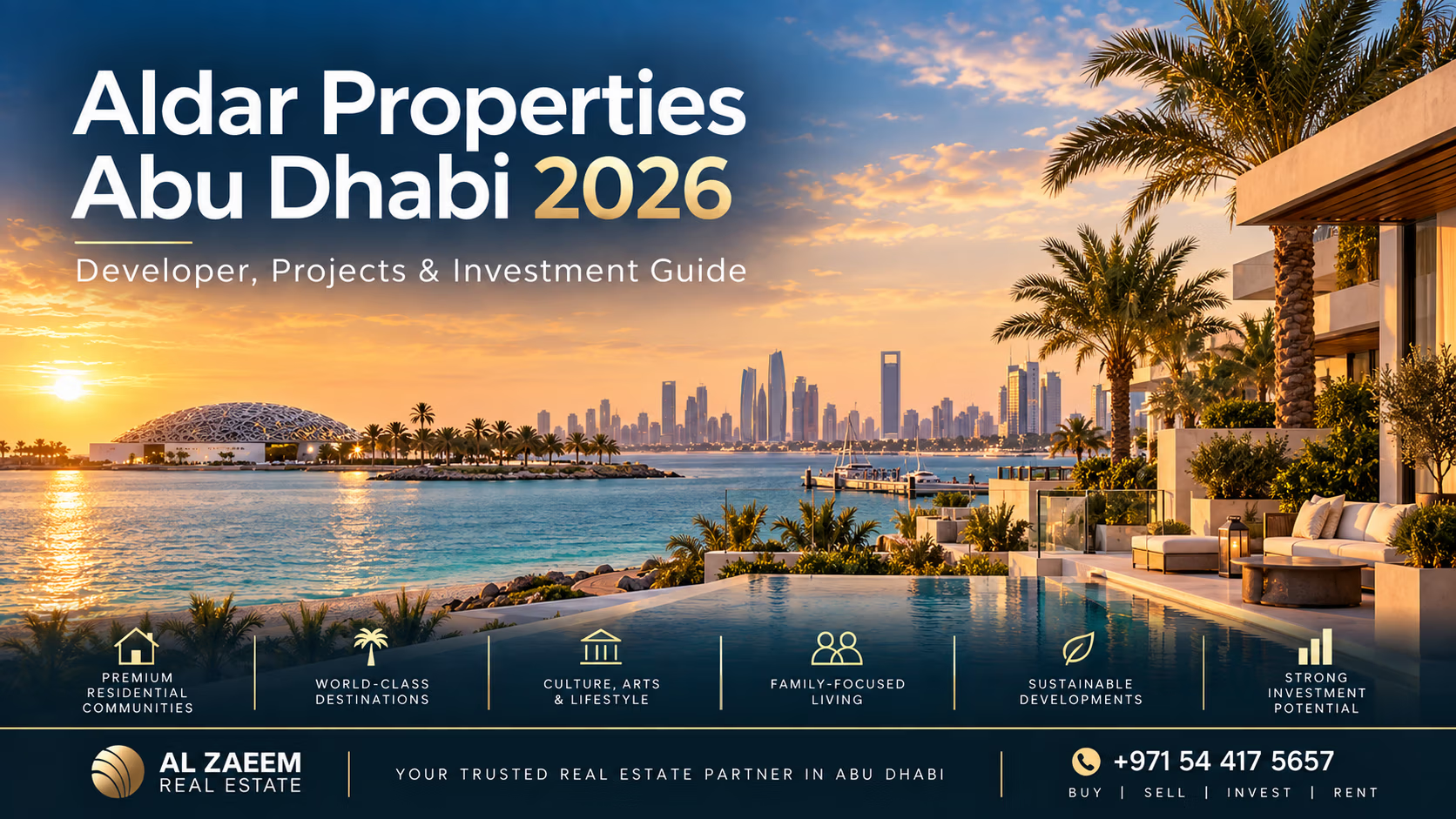
Few companies have influenced the physical shape of modern Abu Dhabi as extensively as Aldar Properties.
From Yas Island and Saadiyat Island to Al Raha, Reem Island and a rapidly expanding pipeline of new communities, Aldar operates at a scale that goes far beyond constructing individual apartment towers or villa compounds.
It is simultaneously a developer, master developer, asset owner, investment manager, project manager and community operator.
That distinction matters for property buyers.
When someone purchases an Aldar property, they may not simply be evaluating the architecture of one building. In many cases, they are also buying into a district where Aldar controls or influences the roads, parks, retail, schools, public realm, neighbouring phases and long-term development programme.
As of 2026, that model is becoming even more significant.
Aldar has launched the AED 100 billion Marsa Al Saadiyat masterplan, announced the AED 6 billion Yas Point waterfront destination, expanded its strategic Abu Dhabi land pipeline, continued launching premium and family-oriented residential communities, and maintained a substantial development backlog.
Its H1 2026 financial results also show the scale behind those projects: AED 16.8 billion in group revenue, AED 4.9 billion in net profit after tax and AED 71.6 billion of development revenue backlog at the end of June.
But size alone does not make every Aldar property a good investment.
This guide examines what Aldar is, how its business works, where it develops, what makes its properties attractive, what buyers should still scrutinise and how investors can judge an individual Aldar launch rather than simply buying the developer name.
Quick Answer: What Is Aldar Properties?
Aldar Properties PJSC is one of the UAE’s leading real-estate development and management groups, headquartered in Abu Dhabi and publicly traded on the Abu Dhabi Securities Exchange.
Aldar states that it was established in 2004 and operates through two principal businesses:
Aldar Development — responsible for property development, sales, project management and international development activities.
Aldar Investment — responsible for recurring-income real estate and operating businesses.
Historically, Aldar has been closely associated with the transformation of major Abu Dhabi destinations including:
- Yas Island;
- Saadiyat Island;
- Al Raha;
- Reem Island;
- and multiple government-backed housing and infrastructure programmes.
Its recognised Abu Dhabi developments and assets include projects such as Aldar HQ, Gate Towers, Yas Marina Circuit-related destinations, Yas hotels and major residential communities.
For a buyer, perhaps the most important point is this:
Aldar frequently develops not merely the property, but the destination surrounding it.
Aldar at a Glance — 2026
| Metric | Current Position |
|---|---|
| Headquarters | Abu Dhabi, UAE |
| Established | 2004 |
| Public company | Listed on Abu Dhabi Securities Exchange |
| Core businesses | Aldar Development + Aldar Investment |
| Major Abu Dhabi markets | Saadiyat, Yas, Reem, Al Raha and wider emirate |
| H1 2026 Group Revenue | AED 16.8 billion |
| H1 2026 Net Profit After Tax | AED 4.9 billion |
| H1 2026 Group Sales | AED 12.1 billion |
| UAE Development Backlog | AED 59.9 billion |
| Total Development Backlog | AED 71.6 billion |
| Aldar Investment AUM | AED 56 billion |
| H1 UAE sales to overseas + expat buyers | AED 7.6 billion |
| Overseas + expat share of UAE sales | 80% |
| Marsa Al Saadiyat GDV | AED 100 billion |
| Aldar share of Marsa pipeline | Approx. AED 60 billion |
| Yas Point GDV | AED 6 billion |
Financial and sales figures above are based on Aldar’s H1 2026 reporting.
How Aldar Became Central to Abu Dhabi Real Estate
Aldar’s importance is not based only on the number of homes it sells.
It comes from its position in Abu Dhabi’s urban-development ecosystem.
The company has been involved in large-scale destination creation, residential communities, commercial property, hospitality, retail, education and public-sector development programmes.
Its evolution also included the 2013 merger with Sorouh Real Estate, a major consolidation that expanded Aldar’s asset base and development platform.
Over time, Aldar’s operating model became increasingly diversified.
Rather than relying entirely on selling new homes, the group developed significant recurring-income businesses.
That matters because a developer dependent exclusively on launching and selling new properties is exposed more directly to property cycles.
Aldar’s model includes:
development sales + rental assets + commercial properties + retail + logistics + education + property management + hospitality + international development.
That diversification is one reason buyers and investors often treat Aldar differently from smaller project-by-project developers.
Aldar Development vs Aldar Investment
Understanding this structure helps explain the size of the group.
Aldar Development
Aldar Development covers property development and sales, project management services and international development.
Its role includes planning and delivering residential communities in some of Abu Dhabi’s most desirable locations.
In H1 2026, Aldar Development generated AED 12.4 billion in revenue, while its development backlog reached AED 71.6 billion.
For property buyers, this is the part of the business behind many of the homes and communities marketed under Aldar.
Aldar Investment
Aldar Investment focuses on recurring-income assets and operating businesses.
As of H1 2026, Aldar reported AED 56 billion of assets under management within the investment platform. Its portfolio benefited from strong occupancy and rental growth, while its develop-to-hold pipeline stood at AED 20 billion.
Why should a residential buyer care?
Because it shows that Aldar has a long-term economic interest in Abu Dhabi property beyond simply collecting sale proceeds from new launches.
It owns and operates income-generating assets and businesses across the same broader urban ecosystem.
Aldar’s Financial Position in 2026
A developer’s financial strength does not guarantee that every project will deliver perfectly.
But it is an important part of off-plan due diligence.
Aldar’s H1 2026 results reported:
- AED 16.8 billion revenue, up 8% year-on-year;
- AED 6.3 billion EBITDA, up 19%;
- AED 4.9 billion net profit after tax, up 18%;
- AED 71.6 billion development backlog;
- AED 59.9 billion UAE development backlog;
- and AED 37.1 billion liquidity, including AED 16.8 billion in unrestricted cash and AED 20.3 billion of committed undrawn facilities.
For context, FY2025 had already been a record year for the group.
Aldar reported AED 40.6 billion in group sales, AED 33.8 billion in revenue and AED 8.8 billion in net profit after tax for 2025.
These figures help explain why Aldar can simultaneously undertake multiple major masterplans.
Does Financial Strength Make Aldar Property Risk-Free?
No.
A financially strong developer reduces some categories of risk.
It does not eliminate:
- construction delays;
- market cycles;
- launch-price risk;
- interest-rate risk;
- oversupply;
- weak individual plots;
- poor unit selection;
- resale restrictions;
- service-charge concerns;
- or buying at an excessive valuation.
This is an important distinction.
Developer quality and investment quality are not the same question.
Aldar can be a strong developer while an individual property is overpriced.
A buyer still needs to evaluate each asset independently.
Why International Buyers Matter So Much to Aldar
One of the clearest changes in Abu Dhabi residential property has been the expansion of international demand.
Aldar reported AED 7.6 billion of H1 2026 UAE sales to overseas and expatriate resident buyers, representing 80% of its total UAE sales.
In Q1 alone, that share had reached 88%. Aldar has also expanded its international sales network, including World of Aldar experience centres in London and Hong Kong.
The wider Abu Dhabi market shows a similar pattern.
According to ADREC, resident expatriates and non-resident foreign buyers together represented 70% of Abu Dhabi residential sales value in H1 2026.
For investors, a geographically diverse buyer base can support resale liquidity.
A property is generally easier to exit when future demand does not depend on a single nationality or buyer segment.
Aldar and Saadiyat Island
Saadiyat has become one of the most important parts of Aldar’s premium development strategy.
The island combines:
- cultural institutions;
- beaches;
- championship golf;
- luxury hospitality;
- premium residences;
- education;
- museums;
- and increasingly high-end branded living.
Aldar describes Saadiyat as a combination of art, culture, nature and luxury, with major residential communities alongside institutions including Louvre Abu Dhabi and the wider Cultural District.
For Al Zaeem readers researching the wider destination, see our Saadiyat Island property guide. Explore Saadiyat Island properties
Important Aldar Projects on Saadiyat Island
Aldar’s Saadiyat portfolio spans multiple property types rather than a single housing model.
Notable projects and communities include:
Mamsha Al Saadiyat
A major beachfront residential community close to Saadiyat Cultural District.
Mamsha Palm
A premium design-led residential concept with Japanese-inspired architecture by Koichi Takada.
Louvre Abu Dhabi Residences
A culturally branded residential project connected to the identity of the museum district.
Saadiyat Lagoons
A large family villa community centred around sustainability, nature and recreation.
Saadiyat Reserve / The Dunes
Premium family villas in an established residential setting.
Jawaher Al Saadiyat
A low-density luxury villa and townhouse development.
The Row Saadiyat
A boutique lifestyle quarter designed in collaboration with BIG, positioned beside major Cultural District institutions. Aldar launched the first phase with 315 residences in 2025.
Baccarat Residences Saadiyat
Launched in February 2026 as an ultra-prime branded project designed by Sou Fujimoto Architects, featuring apartments, sky villas and penthouses overlooking Saadiyat Cultural District and the Arabian Sea.
Marsa Al Saadiyat and Talay
Marsa represents the next major chapter.
This is no longer simply an individual Saadiyat project.
It is a new district.
Marsa Al Saadiyat — Aldar’s AED 100 Billion Next Phase
In July 2026, Aldar unveiled Marsa Al Saadiyat, activating what the company calls the final phase of the Saadiyat Island masterplan.
The development spans approximately 6.4 million sq m and carries an estimated AED 100 billion gross development value.
Aldar expects to develop approximately AED 60 billion of that pipeline itself.
Official plans include:
- approximately 8 km of waterfront;
- 5.6 km of beaches;
- Abu Dhabi’s largest marina;
- around 350 marina berths;
- 140 km of walking routes;
- 46 km of cycling routes;
- parks;
- schools;
- healthcare;
- hotels;
- retail;
- culture;
- private mansions;
- villas;
- apartments;
- branded residences;
- and a future underground Etihad Rail high-speed station.
For investors, Marsa matters because it demonstrates Aldar’s role as a city-scale master developer, not merely a seller of buildings.
Talay is the first announced residential address within the new district.
Our detailed Talay content cluster analyses the project separately rather than treating every Marsa property as interchangeable.
Aldar and Yas Island
If Saadiyat represents culture, beaches and premium residential positioning, Yas Island represents another major part of Aldar’s Abu Dhabi identity.
Aldar has played a central role in Yas Island’s development.
The island is home to:
- Yas Marina Circuit;
- Yas Mall;
- Ferrari World;
- Yas Waterworld;
- Yas Links;
- hotels;
- residential districts;
- schools;
- and an expanding range of entertainment and hospitality assets.
Aldar has delivered or launched multiple residential communities on Yas, including:
- Yas Acres;
- Yas Park Gate;
- Yas Park Views;
- Yas Park Place;
- The Sustainable City – Yas Island;
- Yas Riva;
- Yas Golf Collection;
- Waters Edge;
- Ansam;
- Mayan;
- and other apartment, townhouse and villa products.
The diversity is important.
Aldar does not use one formula across the entire island.
Different projects target different budgets and buyer profiles.
Yas Point — Aldar’s New AED 6 Billion Waterfront Destination
In 2026, Aldar expanded Yas again with Yas Point, an AED 6 billion mixed-use waterfront destination on the island’s northern shore.
Its first residential project, The Canopies, launched in July 2026 with 592 apartments across six mid-rise buildings.
The wider Yas Point plan includes a waterfront promenade, dining, retail, public parks and a new beach on Yas Island’s northern side.
This is another example of Aldar’s development model:
create destination → launch first residential phase → build surrounding infrastructure → release subsequent phases.
That sequence can create opportunities for early buyers.
It can also create construction and future-supply risk.
Al Raha and Aldar’s Earlier Abu Dhabi Legacy
Long before today’s branded residences and cultural-district launches, Aldar had already played a major role in developments around Al Raha.
The distinctive Aldar HQ building became one of the company’s most recognisable architectural symbols.
Aldar’s broader Al Raha and Abu Dhabi portfolio also contributed to its reputation for masterplanning larger mixed-use environments rather than developing only isolated residential buildings.
That earlier track record matters because master development requires different capabilities from constructing a single tower.
It requires:
- infrastructure planning;
- roads;
- utilities;
- landscape;
- retail;
- schools;
- mobility;
- public realm;
- and long-term phasing.
Reem Island and Iconic Aldar Developments
Aldar has also played a significant role on Reem Island.
Its historic portfolio includes properties such as:
- Gate Towers;
- The Arc;
- Sun and Sky Towers;
- The Bridges;
- Reem Central Park;
- and associated retail and community assets.
Gate Towers in particular became one of Abu Dhabi’s recognisable residential architectural landmarks.
This reinforces another point:
Aldar’s track record spans both horizontal masterplanned communities and high-density urban residential projects.
Aldar’s New Abu Dhabi Land Pipeline
Aldar is still expanding its development capacity.
In February 2026, the company announced the addition of strategic Abu Dhabi land plots with approximately AED 23 billion of gross development value.
The plots span waterfront, island and mainland locations and are intended to support both luxury projects and family-oriented communities.
A few months later, Aldar and Abu Dhabi’s Department of Municipalities and Transport announced another major partnership covering more than 20 million sq m across five strategic locations.
The plan includes integrated communities with residential property, green public spaces, schools, retail and connectivity, while also activating a previously undeveloped Abu Dhabi island as a new waterfront destination.
For buyers, this makes one point very clear:
Aldar’s Abu Dhabi pipeline is far from finished.
Why Aldar’s Land Bank Matters to Investors
A large land bank gives a developer flexibility.
Aldar historically reported a land bank of approximately 65 million sq m in prime Abu Dhabi locations, while its current land portfolio materials highlight around 75 million sq m of Abu Dhabi land potential across various uses.
This gives Aldar the ability to:
- release projects according to market demand;
- diversify across price segments;
- create new districts;
- develop future phases around earlier buyers;
- and respond to changing buyer preferences.
But investors should recognise the other side:
A large land bank also means Aldar can create substantial future supply.
Buying an Aldar property does not automatically create scarcity.
Scarcity must be assessed within the specific segment and community.
Aldar’s International Expansion
Aldar is no longer purely an Abu Dhabi developer.
Its international development businesses include:
SODIC in Egypt
and
London Square in the United Kingdom.
In H1 2026, SODIC sales rose 171% year-on-year, while London Square sales increased 236%.
This international footprint helps diversify the business.
It also gives Aldar exposure to different markets, design standards and customer bases.
For an Abu Dhabi buyer, international expansion is not necessarily a direct reason to buy a villa.
But it is relevant when evaluating the institutional depth of the developer.
Aldar’s Sustainability Strategy
Sustainability is increasingly important in Abu Dhabi property, particularly for projects intended to remain competitive over decades.
Aldar states that it is targeting:
90% reduction in Scope 1 and Scope 2 emissions by 2030
and
45% reduction in Scope 3 emissions intensity by 2030, with a goal of reaching net-zero emissions across operations by 2050.
At project level, Aldar developments increasingly incorporate features such as:
- Estidama targets;
- energy-efficient building envelopes;
- solar infrastructure;
- water conservation;
- shaded pedestrian routes;
- extensive landscaping;
- cycling networks;
- and more walkable masterplans.
For buyers, the investment question is practical:
Will the property remain efficient, comfortable and attractive as future building standards rise?
That matters more than simply placing a sustainability label in the sales brochure.
Is Aldar a Luxury Developer?
Yes — but it is not only a luxury developer.
This distinction matters.
Aldar operates across multiple segments.
Its portfolio includes:
ultra-prime branded residences
such as Baccarat Residences Saadiyat;
premium cultural-district apartments;
large luxury villas;
family villas and townhouses;
mid-market housing;
land plots;
and increasingly value-oriented housing and rental communities.
For investors, this diversification means the Aldar name alone does not tell you the target buyer of a project.
The positioning of the individual development must still be understood.
How Aldar Creates Different Products for Different Buyers
Consider three simplified examples:
Saadiyat branded residence
Buyer motivation may include:
- prestige;
- architecture;
- cultural location;
- brand;
- international appeal;
- capital preservation.
Yas family villa
Buyer motivation may include:
- schools;
- community;
- outdoor space;
- attractions;
- family end use;
- long-term rental demand.
Al Ghadeer family property
Buyer motivation may focus more heavily on:
- relative affordability;
- Abu Dhabi-Dubai corridor access;
- practical family living;
- commute;
- price.
All may be Aldar.
But they should not be valued using the same investment assumptions.
Is Buying From Aldar Safer Than Buying From a Smaller Developer?
Generally, a large institutional developer may provide stronger:
- balance-sheet capacity;
- development infrastructure;
- project-management resources;
- access to capital;
- land pipeline;
- sales network;
- and long-term market presence.
Aldar’s current scale supports those advantages.
Its H1 2026 liquidity, backlog, recurring-income portfolio and project pipeline demonstrate substantial institutional capacity.
But “safer” should not become “no due diligence required.”
A buyer still needs to review:
- SPA;
- escrow and registration;
- payment plan;
- assignment terms;
- handover obligations;
- service charges;
- specifications;
- unit plan;
- development phasing;
- and exact plot or apartment position.
A strong developer reduces some risks.
It does not remove the buyer’s responsibility to analyse the transaction.
How Important Is Aldar’s Track Record?
Very important.
Off-plan property involves buying something that is not yet physically complete.
The buyer therefore relies partly on the developer’s:
- historical delivery;
- technical capacity;
- funding;
- reputation;
- and long-term commercial incentives.
Aldar has been developing Abu Dhabi property for more than two decades and has created more than 31,000 homes according to its corporate reporting.
That is a meaningful track record.
Yet investors should avoid a common mistake:
past delivery does not determine whether today’s launch price is attractive.
Developer track record answers:
“Can this organisation execute?”
Investment analysis asks:
“Am I buying the right asset at the right price?”
Those are separate questions.
The Abu Dhabi Market Aldar Is Selling Into in 2026
The market backdrop is exceptionally active.
ADREC reported that in H1 2026:
- residential sales reached AED 70.4 billion;
- repeat-sale apartment prices increased 20% year-on-year;
- villa repeat-sale prices increased 12%;
- off-plan accounted for 89% of residential sales value;
- and Saadiyat Island alone recorded AED 13.3 billion in residential sales.
Yas Island accounted for another AED 7.3 billion.
These are two destinations where Aldar has major exposure.
That alignment helps explain the scale of buyer demand for Aldar launches.
But Abu Dhabi Is Also Adding Significant Supply
Strong demand is only half of the market equation.
ADREC projects approximately 71,000 additional residential units across Abu Dhabi through 2030, with deliveries expected to peak in 2028.
Six major districts — including Saadiyat and Yas — are expected to account for 77% of projected incremental supply.
This means Aldar buyers should not simply assume:
“Saadiyat is strong, therefore every Saadiyat launch must appreciate.”
Or:
“Yas is popular, therefore every Yas property is scarce.”
Future supply must be considered carefully.
How to Judge an Aldar Off-Plan Project
A disciplined buyer should use a project-level framework.
1. Entry Price
Compare with:
- existing ready property;
- competing off-plan launches;
- neighbouring projects;
- and the expected future supply.
2. Price Per Square Foot
Headline price can be misleading.
Always compare effective area and land where relevant.
3. Unit or Plot Quality
A great project can contain average units.
The best apartment line or villa plot may perform very differently from the weakest.
4. Masterplan Position
Study what surrounds the property.
Ask:
- what is being built nearby?
- what could block the view?
- where are schools?
- where are hotels?
- where are roads?
- where are future phases?
5. Payment Plan
A flexible schedule can improve cash management.
It does not automatically make a property inexpensive.
6. Handover Timing
Longer construction periods create:
- opportunity cost;
- market risk;
- and delayed rental income.
7. Service Charges
Especially important for:
- branded residences;
- high-amenity projects;
- large apartments;
- and resort-style communities.
8. Resale Rules
Understand assignment restrictions and minimum payment requirements before assuming you can sell pre-handover.
9. End-User Demand
Ask whether people genuinely want to live there.
Properties with real end-user demand often have stronger long-term resilience.
10. Exit Buyer
Before buying, ask:
Who will buy this property from me later?
Aldar Apartments vs Aldar Villas — Which Is Better for Investment?
There is no universal answer.
Apartments
Potential advantages:
- lower entry ticket;
- broader tenant pool;
- easier diversification;
- potentially higher percentage yields;
- often easier short-term resale.
Potential disadvantages:
- more direct supply competition;
- service charges;
- less land value;
- many similar units.
Villas
Potential advantages:
- land component;
- family demand;
- privacy;
- lower-density supply;
- potential long-term scarcity.
Potential disadvantages:
- larger absolute ticket;
- smaller resale buyer pool at high price points;
- landscaping and maintenance;
- sometimes lower percentage yield.
Aldar offers both.
The correct choice depends on the investor’s objective.
Which Aldar Locations Should Buyers Study?
Saadiyat Island
Best known for:
- premium residential property;
- culture;
- beach lifestyle;
- branded residences;
- luxury villas;
- international buyers.
Explore Al Zaeem’s Saadiyat coverage. Saadiyat Island property guide
Yas Island
Best known for:
- entertainment;
- family communities;
- major attractions;
- apartments and villas;
- strong lifestyle demand;
- expanding waterfront development.
Al Raha
An established Abu Dhabi residential corridor associated strongly with Aldar’s earlier development legacy.
Reem Island
Urban high-density living, towers, parks, offices and close access to central Abu Dhabi.
Al Ghadeer
More value-oriented family housing positioned near the Abu Dhabi-Dubai corridor.
Different Aldar destinations serve very different buyer profiles.
Aldar for End Users
Aldar’s master-development capabilities can be particularly relevant to end users.
Families often value:
- integrated schools;
- parks;
- retail;
- landscaping;
- cycling;
- walking;
- community management;
- and access to daily services.
A well-planned community can therefore create value beyond the walls of the home.
This is why buyers should evaluate the entire masterplan rather than selecting a property solely from its internal finishes.
Aldar for Investors
Investors generally focus more heavily on:
- launch price;
- payment plan;
- supply;
- rental demand;
- resale restrictions;
- timing;
- and future competition.
Aldar’s brand can increase initial demand.
That can be useful.
But high demand can also allow a developer to charge a premium.
An investor must determine whether that premium is justified.
What Makes an Aldar Property Potentially Attractive?
Several structural characteristics can support demand:
Major destination exposure
Projects within Saadiyat and Yas benefit from established place brands.
Developer recognition
Aldar is well known locally and increasingly internationally.
Integrated masterplanning
Many projects gain from surrounding parks, schools, retail and public realm.
Broad buyer pool
Aldar has demonstrated substantial overseas and expatriate demand.
Institutional scale
Financial resources and large development backlogs provide execution capacity.
Long-term presence
Aldar remains involved in Abu Dhabi through development, investment and asset management.
What Are the Main Risks of Buying Aldar Property?
1. Paying Too Much for the Developer Name
Brand strength can create pricing power.
Do not assume a premium is automatically justified.
2. Future Supply
Aldar owns and controls significant land.
Later phases can both increase destination value and compete with earlier purchases.
3. Off-Plan Timing
Your money may be committed years before the asset can produce rent.
4. Masterplan Construction
Early buyers may experience construction around them for years.
5. View Risk
A temporary open view may later face another building.
6. Service Charges
Amenity-rich projects can carry significant annual costs.
7. Investor Concentration
A project purchased mainly by short-term investors can experience resale competition around handover.
8. Market Cycle
Even the best developer cannot eliminate broader property-market risk.
How to Identify the Best Aldar Units
For apartments, prioritise:
permanent view + efficient layout + sensible floor + natural light + manageable service charges + competitive entry price.
For villas:
plot + privacy + orientation + usable garden + road exposure + open outlook + practical layout + resale ticket size.
One of the most common mistakes is buying the project instead of buying the unit.
The two are not the same thing.
Should You Buy Aldar at Launch or Later?
There are advantages to both.
Buying at Launch
Potential benefits:
- first inventory selection;
- payment plan;
- launch-stage pricing;
- access to premium units.
Risks:
- less certainty;
- future supply;
- longer holding period before completion.
Buying Later Off-Plan
Potential benefits:
- more visible construction;
- clearer market comparables;
- shorter time to handover.
Risks:
- price may have increased;
- best inventory may be gone.
Buying Ready
Potential benefits:
- inspect the asset;
- rent immediately;
- use financing against a completed property;
- established community.
Risks:
- seller premium;
- wear and maintenance;
- less payment flexibility.
There is no rule that launch always provides the best value.
Is Aldar Good for Long-Term Property Investment?
Potentially, yes.
Aldar has characteristics long-term investors typically look for in a major developer:
- deep Abu Dhabi land exposure;
- strong financial resources;
- recognised masterplans;
- recurring-income businesses;
- established local brand;
- international demand;
- large-scale future pipeline;
- and government-linked urban-development partnerships.
However, the long-term return still comes from the individual property.
A poorly selected unit can underperform inside an excellent masterplan.
Aldar’s 2026 Position Looks Different From Five Years Ago
Aldar today is substantially broader than a conventional Abu Dhabi homebuilder.
The group is:
- developing new Abu Dhabi districts;
- expanding Yas and Saadiyat;
- operating major recurring-income portfolios;
- developing in Dubai;
- operating through SODIC in Egypt;
- operating through London Square in the UK;
- growing education;
- expanding logistics;
- and partnering with Abu Dhabi authorities on long-term urban development.
The company’s scale has become one of the defining features of the UAE property market.
Who Should Consider Buying an Aldar Property?
Aldar may particularly suit:
Long-term Abu Dhabi investors
Buyers seeking exposure to established or emerging masterplans.
International investors
Those who value a recognisable institutional developer and prime Abu Dhabi locations.
Families
Particularly buyers attracted to planned schools, parks, retail and community infrastructure.
Luxury buyers
Especially on Saadiyat, where Aldar increasingly operates in ultra-prime and branded segments.
Off-plan investors
Those comfortable with construction timelines and seeking new inventory.
Who Should Be More Selective?
Buyers should be especially careful if they:
- intend to flip quickly;
- are heavily leveraged;
- depend on immediate rental income;
- are buying solely because a launch is selling fast;
- have not compared ready-market alternatives;
- cannot comfortably meet future instalments;
- or are purchasing a compromised unit simply to gain access to a popular project.
FOMO is not an investment strategy.
Aldar Buyer Checklist
Before reserving any Aldar property, confirm:
- What is the total purchase price?
- What is the effective price per sq ft?
- What comparable ready property can I buy?
- What competing off-plan launches exist?
- What is the payment schedule?
- What is the contractual handover date?
- What exactly is included in the unit?
- What is excluded?
- What are expected service charges?
- Can the view be blocked?
- What future phases surround the property?
- What is the assignment policy?
- What are the expected closing costs?
- Who is the likely tenant?
- Who is the likely resale buyer?
- How much competing inventory exists?
- Is the unit itself genuinely premium?
- What happens if property prices remain flat for several years?
- Can you hold through completion if resale becomes difficult?
- Does the property still make sense without aggressive appreciation assumptions?
If the answer to the last question is yes, the investment case is usually much healthier.
FAQs About Aldar Properties
Is Aldar Properties a major Abu Dhabi developer?
Yes. Aldar describes itself as a leading UAE real-estate developer and manager and has developed major communities across Saadiyat, Yas, Al Raha and Reem Island.
When was Aldar founded?
Aldar’s corporate reporting states that Aldar Properties PJSC was established in 2004 and is headquartered in Abu Dhabi.
Is Aldar publicly listed?
Yes. Aldar Properties PJSC is publicly traded on the Abu Dhabi Securities Exchange under the ALDAR name.
Who leads Aldar?
Aldar’s current leadership page lists H.E. Mohamed Khalifa Al Mubarak among its board leadership and Talal Al Dhiyebi as part of executive management; Aldar’s 2026 results identify Al Mubarak as Chairman and Al Dhiyebi as Group CEO.
Is Aldar financially strong?
As of H1 2026, Aldar reported AED 16.8 billion in revenue, AED 4.9 billion net profit after tax, AED 71.6 billion of development backlog and AED 37.1 billion in liquidity.
Which Abu Dhabi islands is Aldar most associated with?
Saadiyat Island and Yas Island are among Aldar’s most important development markets, alongside Reem Island, Al Raha and other locations across the emirate.
Does Aldar develop villas?
Yes. Aldar develops villas, townhouses, apartments, branded residences and land products across multiple Abu Dhabi communities.
Does Aldar develop luxury property?
Yes. Its portfolio ranges from family housing to ultra-prime properties including Baccarat Residences Saadiyat and other premium projects.
What is Aldar’s biggest new Saadiyat development?
Marsa Al Saadiyat is one of Aldar’s most significant new projects. The wider masterplan carries an estimated AED 100 billion GDV, of which Aldar expects to develop approximately AED 60 billion.
What is Talay?
Talay is the first announced residential address within Marsa Al Saadiyat.
What is Yas Point?
Yas Point is a new AED 6 billion waterfront destination on Yas Island. Its first residential launch is The Canopies.
Do international buyers purchase Aldar property?
Yes. Aldar reported that overseas and expatriate resident buyers accounted for 80% of its UAE sales in H1 2026.
Is every Aldar launch a good investment?
No. Developer reputation is only one factor. Buyers still need to assess launch price, unit position, payment plan, future supply, rental demand and resale potential.
Is it better to buy Aldar off-plan or ready?
It depends on the buyer. Off-plan may offer first inventory access and staged payments, while ready property provides physical certainty and potential immediate rental income.
Does Aldar have projects outside Abu Dhabi?
Yes. Aldar’s development platform also includes activities in Dubai, Egypt through SODIC and the UK through London Square.
Is Aldar focused on sustainability?
Aldar has established 2030 emissions-reduction targets and a 2050 net-zero objective across operations.
Final Verdict: How Strong Is Aldar as a Developer in 2026?
From an institutional perspective, Aldar enters the second half of 2026 in a strong position.
It has:
scale.
capital.
land.
brand recognition.
major Abu Dhabi masterplans.
a substantial development backlog.
international buyer demand.
a recurring-income investment business.
and decades of Abu Dhabi development experience.
Its H1 2026 results demonstrate significant financial capacity, while Marsa Al Saadiyat, Yas Point, its expanding land bank and new public-private development programmes show that its Abu Dhabi pipeline remains substantial.
The broader Abu Dhabi market is also supportive.
Residential sales reached AED 70.4 billion in H1 2026, international participation is high, and Saadiyat and Yas are among the emirate’s largest residential transaction markets.
But buyers should resist turning these strengths into a shortcut.
Aldar being a strong developer does not make every Aldar unit a strong investment.
The best Aldar purchase is still the one where:
the location is strong,
the unit or plot is well selected,
the layout works,
the future supply is manageable,
the payment structure fits the buyer,
and the entry price leaves enough room for future value.
That is why investors should evaluate Aldar at two levels.
First:
Can the developer execute?
The evidence suggests Aldar has considerable institutional capacity to do so.
Second:
Is this particular property worth the price being asked?
That answer changes from project to project and sometimes from unit to unit within the same building.
For investors and end users comparing Aldar launches across Saadiyat, Yas and the wider Abu Dhabi market, Al Zaeem Real Estate can help assess current developer inventory against ready-market alternatives, plot positioning, pricing and long-term investment objectives.
Call: +971 (50) 991 5454
Abu Dhabi, UAE
Explore Al Zaeem’s wider property research resources:
Abu Dhabi Off-Plan Properties
Abu Dhabi Villas for Sale
Abu Dhabi Real Estate Knowledge Hub
Abu Dhabi Property Investor Insights
Best Areas to Invest in Abu Dhabi
Primary Official Sources
Aldar — About Aldar
Corporate structure, development model and major Abu Dhabi destinations. Aldar corporate overview
Aldar — H1 2026 Financial Results
Latest published financial performance, sales, international-buyer share, backlog, liquidity, Marsa and Yas Point information. Aldar H1 2026 results
Aldar — FY2025 Results
Full-year 2025 sales, revenue and profit figures. Aldar FY2025 results
Abu Dhabi Media Office — Marsa Al Saadiyat
Official information on the AED 100 billion masterplan, scale, beaches, marina, transport and public infrastructure. Marsa Al Saadiyat official announcement
Abu Dhabi Real Estate Centre — H1 2026 Market Report
Registered market data covering residential sales, prices, off-plan activity, Saadiyat and Yas performance and future supply. ADREC H1 2026 market report
Aldar — Sustainability
Official net-zero and 2030 emissions-reduction targets. Aldar sustainability strategy
Disclaimer
This article is provided for general property research and informational purposes only and does not constitute investment, financial, legal, tax or mortgage advice. Developer financial strength does not guarantee property appreciation, completion timing or investment returns. Project pricing, availability, specifications, payment plans, service charges, handover schedules and resale conditions may change. Buyers should verify current details through official developer documentation, registered Abu Dhabi property data, the applicable Sale and Purchase Agreement and independent professional advice before entering into a real-estate transaction.