


For an international buyer considering Abu Dhabi real estate, one of the first questions should not be:
Which project has the highest rental yield?
It should be:
Can I legally acquire the property rights being offered in this location?
Abu Dhabi’s real-estate market operates with designated investment zones, where non-UAE nationals can acquire property rights under the emirate’s legal framework.
This distinction is fundamental.
It affects:
- who can buy,
- what property rights can be registered,
- where international investors can participate,
- mortgage eligibility,
- resale liquidity,
- rental investment,
- and long-term ownership strategy.
The investment-zone market has also become increasingly important to Abu Dhabi’s property sector.
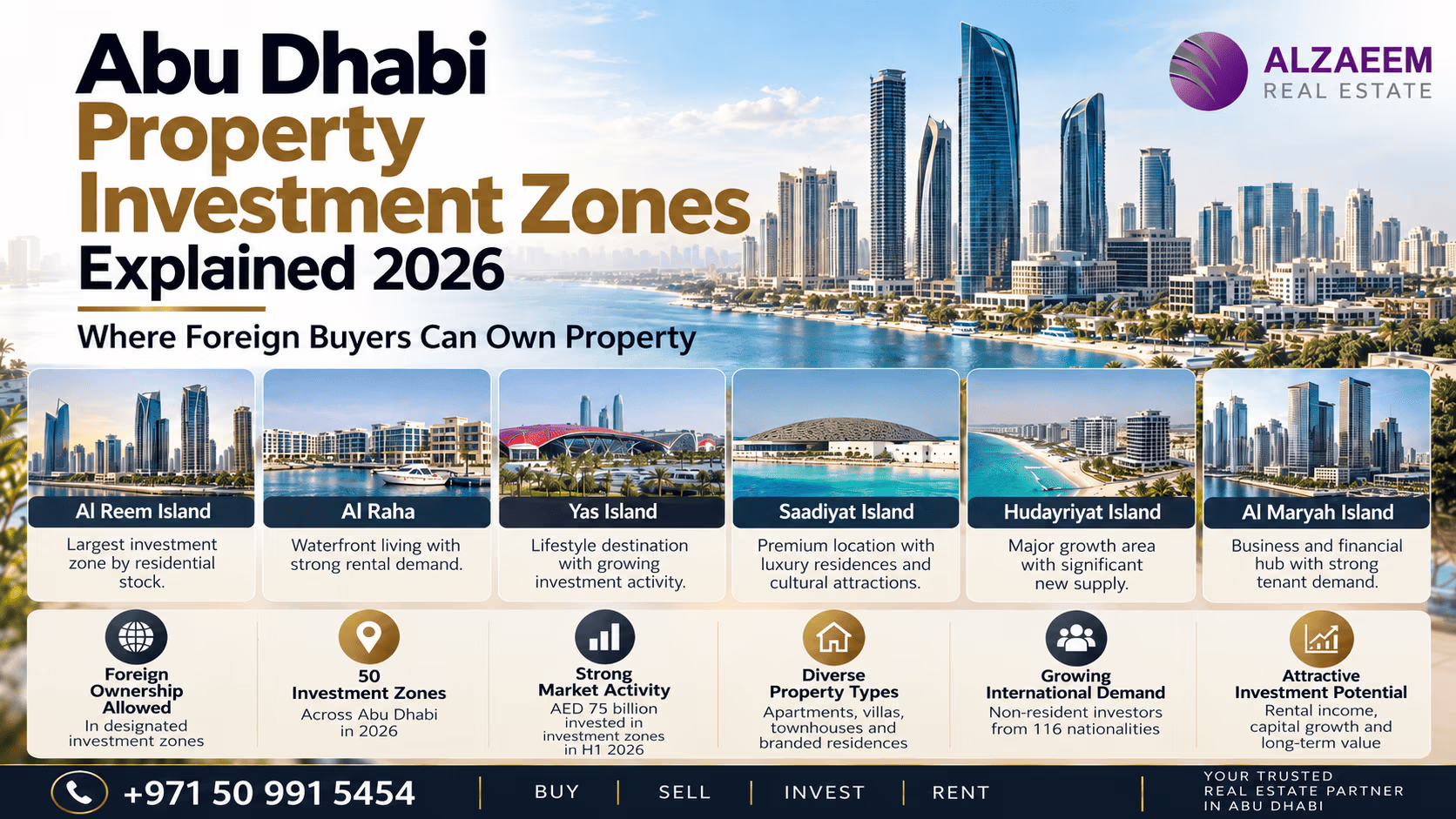
ADREC reported that eight new investment zones were approved during H1 2026, taking the total number of investment zones across Abu Dhabi to 50. Investment zones attracted approximately AED 75 billion of investment during H1 2026, an increase of 181% year-on-year. Adrec
For buyers, however, understanding investment zones requires more than memorising a list of neighbourhoods.
The investor needs to understand what the designation means and then analyse each location on its own fundamentals.
What Is an Abu Dhabi Investment Zone?
An investment zone is an area designated under Abu Dhabi’s real-estate legal framework in which non-UAE nationals can acquire property rights.
Abu Dhabi Law No. 13 of 2019 amended the emirate’s property ownership framework so that non-UAE natural and legal persons may acquire principal and ancillary real rights over properties situated within investment areas and dispose of those properties. Adrec
This legal distinction is important because property ownership rights outside designated investment areas can operate differently.
Therefore, foreign investors should always verify:
- whether the property lies within an approved investment zone,
- what exact ownership interest is being sold,
- how that interest will be registered,
- and what is stated on the property’s title documentation.
Can Foreigners Own Property in Abu Dhabi?
Yes — within Abu Dhabi’s designated investment zones, non-UAE nationals can acquire property rights under the current legal framework.
The 2019 amendment states that non-citizen natural and legal persons may acquire and dispose of principal and collateral real rights over real estate located within investment zones. Adrec
ADREC describes Abu Dhabi’s investment zones as open to investors of all nationalities, and non-resident investors from 116 nationalities participated in the Abu Dhabi real-estate market during H1 2026. Adrec
This has helped transform Abu Dhabi from a market focused primarily on domestic buyers into a substantially more international investment destination.
Investment Zone Does Not Mean Every Property Is Identical
This is one of the biggest misconceptions.
If two projects are both located inside investment zones, that does not mean they offer the same:
- ownership structure,
- price,
- rental demand,
- service charges,
- developer quality,
- payment plan,
- liquidity,
- future supply,
- or investment return.
The designation answers primarily a legal-access question.
It does not answer the investment question.
An investor still needs to perform normal real-estate due diligence.
Abu Dhabi Now Has 50 Investment Zones
According to ADREC, Abu Dhabi approved eight additional investment zones during the first half of 2026, bringing the emirate-wide total to 50 investment zones. Adrec
That expansion is significant because it increases the geographic range available to local and international investors.
The market is therefore no longer concentrated around only a small number of established locations.
However, from an investment perspective, this creates another challenge:
more choice requires more comparison.
Investors increasingly need to distinguish between:
- established investment districts,
- emerging districts,
- new master communities,
- apartment-led markets,
- villa-led markets,
- lifestyle destinations,
- and locations still dependent on future infrastructure.
Investment Zones Represent a Significant Part of Residential Supply
ADREC reported that investment zones accounted for more than 22% of Abu Dhabi’s total residential stock in H1 2026, representing approximately 72,000 residential units. Adrec
Among the largest established investment-zone residential markets, ADREC identified:
- Al Reem Island — approximately 27,500 units
- Al Raha
- Yas Island
- Saadiyat Island
These areas differ substantially in tenant demographics, pricing, property type and investment strategy.
Al Reem Island
Al Reem Island is one of Abu Dhabi’s largest established investment-area residential markets.
ADREC reported approximately 27,500 residential units on Al Reem Island in H1 2026, making it the largest investment-zone residential stock concentration cited in the report. Adrec
For investors, Al Reem Island can be relevant because of its:
- large apartment inventory,
- established residential population,
- proximity to central Abu Dhabi,
- broad range of unit sizes,
- active rental market,
- and substantial secondary-market stock.
But that size also creates competition.
An investor should compare:
- tower against tower,
- service charges,
- building age,
- maintenance,
- unit layout,
- views,
- parking,
- and competing listings.
Buying “on Reem Island” is not enough of an investment thesis.
Al Raha
Al Raha represents another established investment-area market with waterfront and residential components.
The area can attract:
- professionals,
- couples,
- families,
- airport-linked residents,
- and tenants seeking waterfront accommodation outside the most central parts of Abu Dhabi.
For investors, the important questions include:
- which sub-community,
- apartment vs villa,
- transport accessibility,
- proximity to Yas and the airport,
- service charges,
- and current tenant demand.
Properties within the broader Al Raha area can have very different economics.
Yas Island
Yas Island is one of Abu Dhabi’s most recognisable lifestyle and investment destinations.
Its appeal is supported by a combination of:
- residential development,
- entertainment,
- tourism,
- retail,
- leisure,
- airport accessibility,
- and expanding residential communities.
ADREC reported AED 7.3 billion of residential sales value on Yas Island in H1 2026. Adrec
For investors, Yas can serve several different strategies:
- long-term rental,
- lifestyle-oriented ownership,
- off-plan appreciation,
- family communities,
- apartment investment,
- villa investment.
The investor should not assume that the Yas brand itself guarantees returns.
Compare:
entry price vs achievable rent vs future supply.
Saadiyat Island
Saadiyat sits at the premium end of much of Abu Dhabi’s residential market.
The island combines:
- beaches,
- cultural institutions,
- luxury residences,
- villas,
- premium apartments,
- resorts,
- and lifestyle-driven demand.
ADREC reported residential sales worth approximately AED 13.3 billion on Saadiyat Island during H1 2026. Adrec
Saadiyat investment analysis should typically place greater emphasis on:
- scarcity,
- project quality,
- views,
- developer,
- end-user appeal,
- resale buyer depth,
- and capital appreciation
rather than focusing purely on maximum rental yield.
A lower-yield premium property can still make strategic sense if the investor’s objective is long-term asset quality and capital growth.
Hudayriyat Island
Hudayriyat has become increasingly important in Abu Dhabi’s new development landscape.
ADREC reported approximately AED 19 billion in residential sales value on Hudayriyat Island during H1 2026, representing around 27% of residential sales value during the period. Adrec
This illustrates how quickly emerging districts can become major transaction centres.
For investors, newer master communities like Hudayriyat should be analysed differently from mature areas.
Key questions include:
- how much has already been delivered?
- what infrastructure remains planned?
- how much future supply is coming?
- what is the expected buyer demographic?
- what is the expected rental market at completion?
- how dependent is current pricing on future expectations?
Al Maryah Island
Al Maryah Island forms part of Abu Dhabi’s major business and financial ecosystem and operates within the Abu Dhabi Global Market area.
ADREC grouped Al Reem Island and Al Maryah Island together at approximately AED 10.5 billion in H1 2026 residential sales value. Adrec
Properties in and around major commercial employment hubs can benefit from proximity-driven rental demand.
But premium acquisition prices must still be tested against realistic rents.
Investment Zone vs Freehold: Be Precise With Terminology
In property marketing, the word freehold is often used broadly.
Investors should rely on the actual legal and title documentation rather than a brochure label.
The key questions are:
- What real right is being acquired?
- Is the property inside an approved investment zone?
- What does the title deed record?
- Are there any project-specific restrictions?
The 2019 legal framework expanded the rights available to non-UAE nationals within designated investment areas. Adrec
But investors should still verify each property individually.
Investment Zones and Title Registration
A property investment is not complete simply because a reservation form has been signed.
The investor should understand the registration path.
Depending on whether the property is:
- ready,
- off-plan,
- mortgaged,
- resale,
- or developer inventory,
the registration process can differ.
The property should be properly recorded through the applicable Abu Dhabi registration framework.
For off-plan purchases, the investor should also verify:
- project registration,
- developer registration,
- project identification,
- escrow arrangements,
- and transaction documentation.
Investment Zones and Off-Plan Property
Investment zones contain a substantial share of Abu Dhabi’s new-development activity.
ADREC reported that 89% of residential sales value in H1 2026 came from off-plan transactions, representing 82% of deal volume. Adrec
This matters because many international buyers enter Abu Dhabi through off-plan property.
The benefits can include:
- phased payment structures,
- new inventory,
- access to emerging communities,
- potential appreciation before handover.
But the risks include:
- construction timeline,
- developer execution,
- future supply,
- resale restrictions,
- payment obligations,
- and uncertain rental conditions at handover.
Investment Zone Does Not Eliminate Developer Risk
Legal eligibility to buy in an area does not mean every project is equally safe.
Before buying off-plan, verify:
- developer registration,
- project registration,
- escrow structure,
- delivery history,
- contractor quality,
- previous communities,
- after-sales reputation,
- and pricing relative to competitors.
Investment-zone status should be the beginning of due diligence, not the end.
Established Zone vs Emerging Zone
One of the most useful ways to analyse investment zones is to divide them into:
Established Zones
These typically have:
- existing population,
- functioning infrastructure,
- actual rents,
- transaction history,
- established communities,
- secondary-market evidence.
Emerging Zones
These may rely more heavily on:
- future infrastructure,
- masterplan delivery,
- developer execution,
- future tenant demand,
- future retail and schools.
Emerging areas can provide greater upside.
They also contain more forecasting risk.
Established Market Advantage
A mature area allows investors to analyse actual data.
You can examine:
- existing rental listings,
- achieved rents,
- completed transactions,
- service charges,
- building performance,
- tenant demographics,
- vacancy,
- resale liquidity.
This reduces uncertainty.
Emerging Market Advantage
An emerging area may allow an investor to enter earlier in the development cycle.
Potential upside can come from:
- infrastructure completion,
- community maturation,
- increasing occupancy,
- future amenities,
- scarcity of early inventory.
But future value should not be assumed.
The investor is accepting more execution risk.
Investment Zones and Foreign Demand
International participation in Abu Dhabi real estate expanded materially in H1 2026.
ADREC reported:
- AED 13.8 billion in foreign direct real-estate investment
- growth of 309% year-on-year
- non-resident investors from 116 nationalities
- approximately AED 75 billion invested in investment zones overall. Adrec
This growing international participation can support:
- transaction liquidity,
- buyer diversity,
- resale markets,
- and developer activity.
However, strong foreign demand can also push entry prices higher.
Investors still need acquisition discipline.
Resident Expatriates and Foreign Buyers Are Major Participants
ADREC reported that resident expatriates and non-resident foreign buyers together represented approximately 70% of residential sales value during H1 2026. Adrec
This is significant.
It shows that international participation is not a marginal component of Abu Dhabi’s residential market.
For investors, it also means resale demand may increasingly extend beyond UAE nationals.
Investment Zone Does Not Mean High Rental Yield
This is critical.
A premium investment-zone property may offer:
- strong capital appreciation,
- high asset quality,
- international resale appeal,
but only moderate rental yield.
Another property may generate:
- stronger rental yield,
- lower entry price,
but less appreciation potential.
Therefore the investor must define the objective.
Income Strategy
Income investors should prioritise:
- achievable rent,
- vacancy,
- service charges,
- tenant demand,
- acquisition price,
- net yield.
Growth Strategy
Capital-growth investors may prioritise:
- future development,
- limited supply,
- masterplan quality,
- location,
- developer,
- buyer demand,
- infrastructure.
Balanced Strategy
Some investors want:
rental income + appreciation + resale liquidity.
That may favour established or rapidly maturing investment zones with both tenant and buyer depth.
Investment Zones and Rental Demand
ADREC reported that new apartment rents in Abu Dhabi’s investment zones increased 21% year-on-year in H1 2026, while villa new-lease prices in investment zones rose 16%. Adrec
This demonstrates strong recent rental momentum.
But investors should not assume those percentages apply uniformly to:
- every island,
- every building,
- every unit,
- or future years.
Rental analysis must remain property-specific.
Future Supply Is One of the Biggest Risks to Analyse
Abu Dhabi had approximately 409,000 residential units in H1 2026, with around 71,000 additional units projected through 2030. Deliveries are expected to peak at approximately 21,800 units in 2028. Adrec
Six areas are expected to account for 77% of incremental supply through 2030:
- Saadiyat Island
- Al Reem Island
- Yas Island
- Zayed City
- Khalifa City
- Hudayriyat Island. Adrec
This has direct implications for investors.
More Supply Is Not Automatically Bad
New supply can create competition.
But it can also bring:
- schools,
- retail,
- roads,
- restaurants,
- offices,
- entertainment,
- community services.
An area can become more valuable as it grows.
The real question is:
Will tenant and buyer demand grow fast enough to absorb the new inventory?
Compare Future Supply by Unit Type
Suppose an island will receive 5,000 new homes.
That number alone is not enough.
Ask:
- how many studios?
- how many 1BRs?
- how many 2BRs?
- how many villas?
- what price points?
- what handover dates?
If 3,000 competing one-bedroom apartments deliver around the same time as your property, rental competition can increase dramatically.
Investment Zone Pricing Can Vary Enormously
Two investment-zone apartments can both be legally available to foreign investors but have completely different price structures.
Example:
Property A
AED 1.2M
Rent AED 90K
Gross yield:
7.5%
Property B
AED 2.2M
Rent AED 125K
Gross yield:
5.68%
Property B may still offer better:
- location,
- appreciation,
- view,
- buyer liquidity.
The point is:
investment-zone status does not determine value.
Service Charges Can Change the Comparison
Suppose:
Property A
Rent AED 100K
Service charges AED 14K
Income before other costs:
AED 86K
Property B
Rent AED 115K
Service charges AED 32K
Income before other costs:
AED 83K
The property with higher rent generates lower income after service charges.
Always compare net economics.
Property Type Matters
Investment zones contain many different products:
- studios,
- apartments,
- penthouses,
- townhouses,
- villas,
- branded residences.
Different assets serve different investment objectives.
Apartments
Can offer:
- lower entry prices,
- larger tenant pool,
- potentially stronger percentage yields.
But may face:
- higher service charges,
- substantial competing stock.
Villas and Townhouses
Can offer:
- family demand,
- longer tenancy,
- greater end-user appeal,
- land-related scarcity in some communities.
But require:
- higher capital,
- maintenance,
- and more careful location analysis.
Premium and Branded Residences
May attract:
- wealthy international buyers,
- lifestyle purchasers,
- second-home demand.
But investors should examine:
- brand premium,
- service charges,
- realistic rents,
- resale buyer depth.
Premium does not automatically mean superior investment return.
Investment Zones and Mortgage Financing
Foreign buyers may be able to finance qualifying properties through UAE banks, subject to:
- residency,
- income,
- property type,
- credit profile,
- valuation,
- lender policy.
CBUAE maximum LTV rules establish regulatory ceilings, but a bank’s actual approved financing can be lower.
Investment-zone status does not guarantee mortgage approval.
Non-Resident Buyers
International buyers who do not live in the UAE may still participate in Abu Dhabi investment-zone property markets.
ADREC reported participation from non-resident investors representing 116 nationalities in H1 2026. Adrec
However, non-resident buyers should pay particular attention to:
- banking,
- source of funds,
- mortgage availability,
- currency exchange,
- property management,
- power of attorney,
- documentation,
- rental management.
Overseas Investors Need a Management Plan
Buying is only the first step.
An overseas landlord must manage:
- leasing,
- maintenance,
- renewals,
- inspections,
- service charges,
- tenant communication,
- repairs.
A strong investment zone does not remove management responsibilities.
Investment Zone and Golden Residency
Property ownership and residency are related but separate issues.
Investors should not purchase a property solely on the assumption that it will automatically produce a particular residency outcome.
Residency eligibility depends on the current UAE immigration framework and the investor’s circumstances.
Always verify applicable requirements through official UAE immigration channels before making a residency-driven property decision.
Investment Zones and Resale Liquidity
One potential advantage of internationally accessible areas is a broader buyer pool.
A property may potentially be resold to:
- UAE nationals,
- resident expatriates,
- overseas investors.
That can support liquidity.
But liquidity depends on:
- price,
- project quality,
- market cycle,
- completed supply,
- unit type.
Large Zones Can Have Strong Liquidity and Strong Competition
A mature zone with thousands of units can generate frequent transactions.
That is positive for price discovery.
But there may also be many competing sellers.
An investor should ask:
How many comparable units are currently for sale?
Smaller or Newer Zones Can Offer Scarcity
A newer or lower-supply investment area may offer scarcity.
But price discovery may be weaker because there are fewer:
- transactions,
- rentals,
- comparables.
That increases valuation uncertainty.
Do Not Choose an Investment Zone Based Only on Brand Recognition
A well-known island is not automatically the best investment.
Compare:
- price per sq ft,
- net yield,
- future supply,
- tenant demand,
- resale liquidity,
- project quality,
- unit scarcity.
A lesser-known project at the right price can outperform a famous location purchased too expensively.
Do Not Choose Only on Yield
Likewise, the highest-yield investment zone is not automatically the strongest investment.
High yield can sometimes reflect:
- lower asset quality,
- slower appreciation,
- weak resale demand,
- higher vacancy risk,
- ageing buildings.
Yield needs context.
Analyse the Zone at Three Levels
A useful framework is:
Level 1 — Zone
Is the wider investment area attractive?
Analyse:
- masterplan,
- accessibility,
- supply,
- infrastructure,
- demand.
Level 2 — Project / Building
Analyse:
- developer,
- quality,
- management,
- amenities,
- service charges.
Level 3 — Unit
Analyse:
- layout,
- floor,
- view,
- size,
- price,
- parking.
Do not skip any layer.
Illustrative Comparison
Consider three hypothetical investment-zone properties.
| Metric | Property A | Property B | Property C |
|---|---|---|---|
| Purchase Price | AED 1.2M | AED 1.7M | AED 2.4M |
| Annual Rent | AED 90K | AED 115K | AED 145K |
| Gross Yield | 7.50% | 6.76% | 6.04% |
| Service Charges | AED 14K | AED 20K | AED 32K |
| Future Supply Risk | Higher | Moderate | Lower |
| Resale Buyer Pool | Broad | Broad | Premium |
| Strategy | Income | Balanced | Growth/Premium |
These numbers are illustrative only.
No property is automatically superior.
They represent different strategies.
How to Compare Investment Zones Properly
Use the following framework.
1. Confirm Foreign Ownership Eligibility
Verify the property’s exact location and legal ownership structure.
2. Understand the Zone
Is it established, emerging or still dependent on future development?
3. Analyse Supply
How much competing inventory exists today and what is coming?
4. Analyse Rental Demand
Who will actually rent the property?
5. Compare Purchase Price
Is the investor paying a premium simply for location branding?
6. Calculate Net Yield
Deduct service charges, vacancy and operating costs.
7. Assess Capital Appreciation
What genuine demand drivers can support future value?
8. Examine Resale Liquidity
Who is likely to buy the unit later?
9. Assess Developer and Project
Investment-zone status cannot compensate for poor execution.
10. Stress-Test the Deal
What happens if rent falls or supply rises?
Investment Zone Warning Signs
Exercise extra caution when:
- price is far above comparable properties,
- future supply is extremely concentrated,
- rental demand is unproven,
- project information is incomplete,
- developer history is weak,
- payment plan disguises a high total price,
- service charges are unclear,
- resale depends entirely on future buyers paying higher prices.
Positive Signals
More constructive signals may include:
- clear ownership documentation,
- established rental demand,
- strong developer,
- sensible price,
- limited competing unit type,
- good infrastructure,
- realistic future supply,
- strong end-user appeal,
- broad resale market.
Abu Dhabi Investment Zones in 2026: The Bigger Picture
Abu Dhabi’s investment-zone model has expanded considerably.
By H1 2026:
- the emirate had 50 investment zones,
- investment-zone residential supply stood at roughly 72,000 units,
- international participation continued expanding,
- investment zones attracted approximately AED 75 billion in investment during the first half of 2026. Adrec
At the same time, significant new residential supply is expected through 2030.
The opportunity is therefore substantial.
But so is the need for disciplined selection.
Final Investor Checklist
Before buying property in an Abu Dhabi investment zone, ask:
- Is the property definitely inside an approved investment zone?
- What exact ownership right am I acquiring?
- How will it appear on the title documentation?
- Is the property ready or off-plan?
- Is the developer properly registered?
- Is the project properly registered?
- What is the purchase price per sq ft?
- What are comparable transactions?
- What is realistic rent?
- What is the gross yield?
- What is the net yield?
- What are the service charges?
- How much competing inventory exists?
- What supply is coming before or after handover?
- Who is the target tenant?
- What is the resale buyer pool?
- Is the location established or emerging?
- What infrastructure is still planned?
- How much of the property’s value depends on future expectations?
- What happens if rent is 10% lower than forecast?
If the property still makes sense after those questions, the investment thesis is much stronger.
How Al Zaeem Real Estate Can Help
Abu Dhabi now offers international property buyers a much wider choice of investment zones than in previous years.
But the right approach is not simply:
“Which areas can foreigners buy in?”
It is:
“Within the areas available to me, which property best matches my investment objective?”
At Al Zaeem Real Estate, buyers and investors can compare Abu Dhabi opportunities across established and emerging investment locations while assessing:
- ownership structure,
- purchase price,
- rental demand,
- unit type,
- developer,
- future supply,
- service charges,
- resale liquidity,
- and long-term investment potential.
The objective should be to combine legal ownership eligibility with sound property economics.
Al Zaeem Real Estate
Abu Dhabi, UAE
+971 50 991 5454
BUY | SELL | INVEST | RENT