


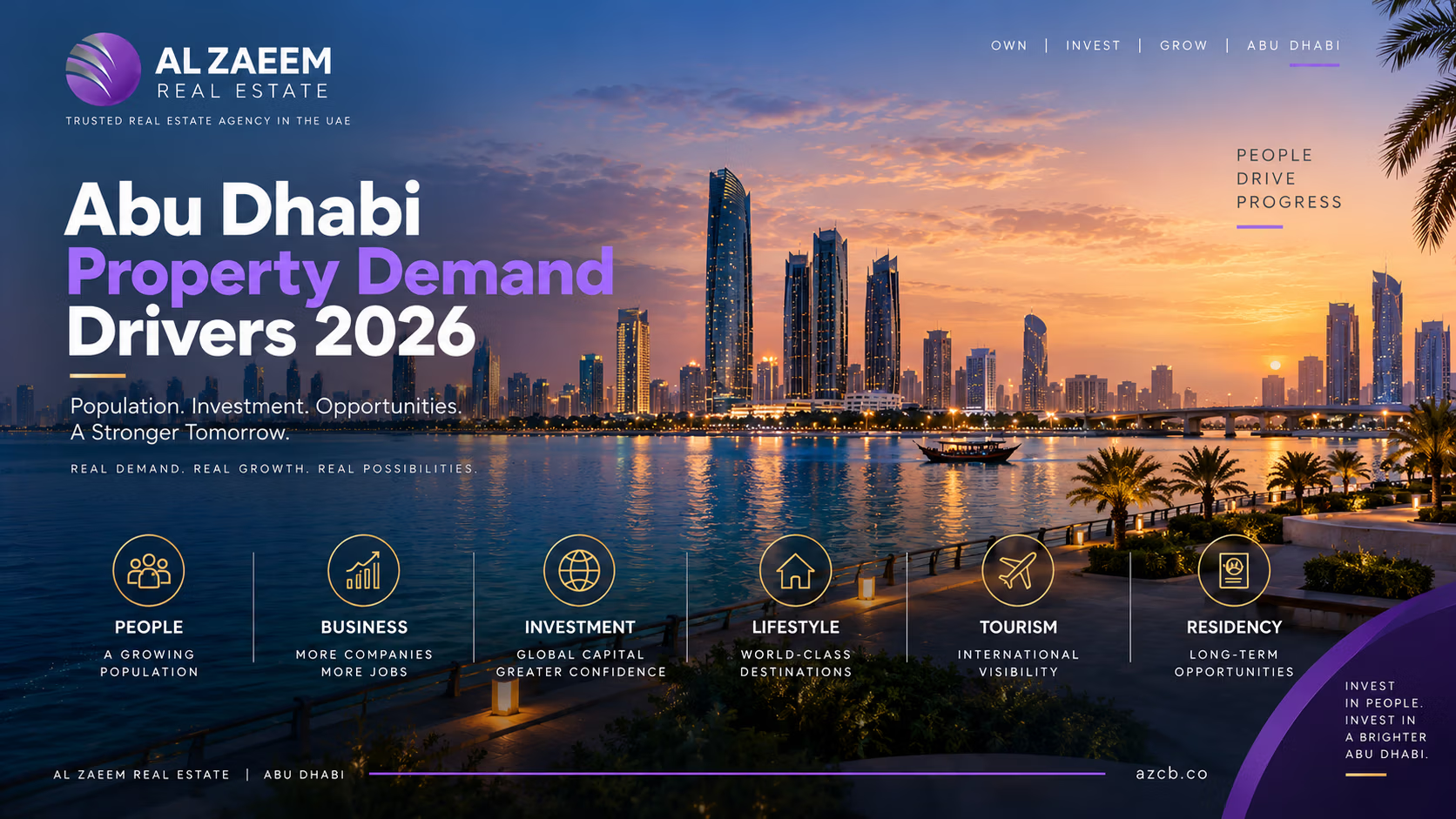
Abu Dhabi is preparing for approximately 71,000 additional residential units through 2030.
That immediately creates one of the most important questions for anyone buying property in 2026:
Who is going to buy, rent or occupy all of those homes?
The answer cannot be found in one statistic.
Property demand is created by several groups simultaneously:
residents who need homes;
new professionals moving to Abu Dhabi;
Emirati families;
expatriate end users;
local investors;
international investors;
business owners;
high-net-worth individuals;
and buyers entering the market through long-term investment and residency strategies.
The latest official data suggests that demand remains strong.
The Abu Dhabi Real Estate Centre recorded AED 70.4 billion of residential unit sales in H1 2026, up from AED 25.3 billion in the same period of 2025. Off-plan property represented 89% of residential sales value and 82% of transactions. Resident expatriates and non-resident foreign buyers together accounted for 70% of residential sales value.
Rental-market data also shows substantial housing demand.
Abu Dhabi had approximately 233,000 active residential lease contracts in H1 2026 with a combined value of AED 9.3 billion. New-lease prices increased 17% year-on-year for apartments and 9% for villas; within investment zones, the increases were 21% and 16%.
At the same time, supply is expanding.
Around 71,000 additional homes are projected through 2030, with deliveries currently expected to peak at approximately 21,800 units in 2028.
So the real investment question is not simply:
“Is Abu Dhabi demand strong?”
It is:
Will demand continue growing quickly enough, in the right locations and property segments, to absorb the supply being delivered?
This guide examines the evidence.
Quick Answer
The current Abu Dhabi property-demand story is supported by several measurable factors.
| Demand Indicator | Latest Relevant Data |
|---|---|
| Residential sales H1 2026 | AED 70.4B |
| Off-plan share of residential sales value | 89% |
| Resident expat + non-resident foreign buyer share | 70% of residential sales value |
| Emirati residential purchases | AED 21B |
| Active residential leases | 233,000 |
| Residential lease value | AED 9.3B |
| Apartment new-lease growth | +17% YoY |
| Villa new-lease growth | +9% YoY |
| Real-estate FDI H1 2026 | AED 13.8B |
| Nationalities investing as non-residents | 116 |
| Abu Dhabi population, latest published annual count | 4.136M in 2024 |
| Population growth in 2024 | +7.5% |
| New economic licences Q1 2026 | +21% YoY |
| 2025 visitors | 26.6M |
| Additional residential supply to 2030 | ~71,000 units |
Sources include ADREC, SCAD/Abu Dhabi Media Office, ADDED/ADRA and DCT Abu Dhabi.
The important conclusion is that Abu Dhabi currently has multiple demand engines operating at the same time.
But those demand engines do not affect every property equally.
What Does “Property Demand” Actually Mean?
Property demand is often discussed too loosely.
A project selling quickly at launch does not automatically prove long-term residential demand.
A better analysis separates demand into different categories.
End-User Demand
People buying a home to live in.
Rental Demand
Residents who need housing but do not want or cannot yet buy.
Investor Demand
Buyers purchasing property primarily for income or appreciation.
International Capital Demand
Non-resident investors deploying money into Abu Dhabi property.
Speculative Demand
Buyers primarily hoping to resell before or shortly after handover.
These categories matter because they behave differently.
End users may remain in a property for many years.
Tenants support rental income.
Long-term investors can support resale liquidity.
Speculative buyers can create strong launch sales but may later become simultaneous sellers.
A healthy market ideally contains more than one demand source.
Demand Driver 1: Population Growth
The most fundamental source of housing demand is people.
The latest annual population release from the Statistics Centre – Abu Dhabi showed that the emirate’s population reached 4,135,985 in 2024, increasing 7.5% in a single year.
Over the decade from 2014 to 2024, the population increased approximately 51%, from around 2.7 million to more than 4.1 million.
That is significant for real estate because more residents generally create demand for:
apartments;
villas;
family housing;
staff accommodation;
schools;
retail;
offices;
and community infrastructure.
But population growth should not be translated mechanically into property demand.
A population increase of 100,000 people does not mean demand for 100,000 additional homes.
Households contain multiple people.
Some residents share accommodation.
Some live in employer-provided housing.
Some remain tenants rather than buyers.
The meaningful variable is therefore:
Household Formation
not simply population.
Why Household Formation Matters
Imagine Abu Dhabi gains:
100,000 additional residents.
If the average household requiring independent residential accommodation contained four people, that could theoretically represent around:
25,000 households
rather than 100,000 homes.
If household size averages two people, the housing requirement could be larger.
If many arrivals live in shared or employer accommodation, conventional residential demand could be lower.
Therefore, population numbers are a powerful demand indicator but not a direct housing-unit forecast.
Population Growth Also Changes the Type of Housing Needed
A market attracting mostly single professionals may experience stronger demand for:
studios;
one-bedroom apartments;
centrally located units.
A market attracting families may require more:
two-bedroom apartments;
three-bedroom apartments;
townhouses;
villas;
schools;
parks.
Abu Dhabi investors should therefore ask not only:
“Is the population growing?”
but:
“Which population segment is growing, and what type of property will it need?”
Demand Driver 2: Resident Expatriates
One of the strongest current numbers in Abu Dhabi residential real estate is the share of sales coming from expatriate and international buyers.
ADREC reports that resident expatriates and non-resident foreign buyers together accounted for 70% of residential sales value in H1 2026.
That tells us something important.
Abu Dhabi residential property demand is not dependent exclusively on Emirati buyers.
The investment-zone model has created a much broader purchasing base.
For Al Zaeem clients, that means the future buyer pool for a well-positioned investment-zone property may include:
UAE-based professionals;
business owners;
international investors;
people planning future relocation;
and investors seeking property-linked residency eligibility where applicable.
Resident Expat Buyers Are Different From Non-Resident Investors
These two groups should not be combined when analysing a specific property.
Resident Expat Buyer
Already lives or works in the UAE.
May currently rent.
Understands local communities.
May purchase for personal use.
May use a mortgage.
Non-Resident Investor
May live overseas.
Could prioritise yield.
May buy without immediate occupancy.
May prefer property management.
May be more sensitive to currency, international economic conditions and remote-purchase processes.
A project heavily dependent on non-resident investors can behave differently from a community with strong local end-user demand.
Demand Driver 3: Foreign Direct Investment
ADREC recorded AED 13.8 billion in real-estate foreign direct investment during H1 2026, an increase of 309% year-on-year.
Importantly, the amount invested during only the first six months of 2026 exceeded the real-estate FDI recorded throughout the entire year of 2025.
Non-resident investors from 116 nationalities participated, compared with 82 nationalities during H1 2025.
Leading sources included:
the United Kingdom;
China;
Russia;
the United States;
Germany;
and France.
This diversification matters.
A market dependent on buyers from only one foreign country can be vulnerable to changes in that country’s:
currency;
capital controls;
economy;
or regulation.
A broader international investor base potentially reduces that concentration risk.
Investment Zones Are Central to Foreign Demand
Abu Dhabi now has 50 investment zones, after eight additional zones were approved during H1 2026.
Investment zones attracted approximately AED 75 billion of investment in H1 2026, up 181% from AED 26.7 billion a year earlier.
This expansion increases the geographic range available to foreign buyers.
It also changes competition between districts.
A foreign investor is no longer choosing from only a narrow selection of developments.
They can increasingly compare:
Saadiyat;
Yas;
Reem;
Hudayriyat;
Al Raha;
and emerging investment destinations.
That makes property differentiation more important.
More Foreign Buyers Does Not Mean Every Property Benefits
Foreign investment is a market-level demand driver.
It should not be used as a blanket sales argument.
A property still needs:
competitive pricing;
clear ownership eligibility;
credible developer;
rental demand;
usable layout;
reasonable ownership costs;
and resale appeal.
International capital can be substantial while a poorly selected unit still underperforms.
Demand Driver 4: Emirati Buyers
International demand is only part of the market.
ADREC reports that Emirati buyers purchased approximately AED 21 billion of residential property in H1 2026, up from AED 8.9 billion in H1 2025.
That is more than a doubling of residential purchase value.
This domestic demand matters because it provides another source of market activity alongside expatriate and foreign investors.
Different projects will have different buyer mixes.
Some communities may appeal strongly to:
Emirati family buyers;
while others may be dominated by international apartment investors.
Understanding the expected buyer pool is therefore essential before investing.
Demand Driver 5: Economic Growth
Housing demand ultimately needs an economic foundation.
People move to cities for:
jobs;
business;
investment;
education;
and quality of life.
Abu Dhabi’s recent economic data remains supportive.
SCAD reported that Abu Dhabi’s economy expanded 7.7% year-on-year in Q3 2025, while the non-oil economy grew 7.6%.
During the first nine months of 2025, overall GDP increased 5%, while non-oil GDP grew 6.8%.
The importance of the non-oil economy should not be underestimated.
A more diversified economy potentially supports housing demand from professionals working across:
finance;
technology;
manufacturing;
construction;
healthcare;
tourism;
professional services;
education;
and entrepreneurship.
Why Non-Oil Growth Matters for Property
If residential demand depended almost entirely on one economic sector, housing cycles could become more exposed to that industry’s volatility.
A broader economy can create different resident groups.
For example:
a banker may want an apartment close to Al Maryah;
a family working near the airport may consider Yas or Khalifa City;
an executive may prefer Saadiyat;
a new business owner may rent centrally before later purchasing.
Economic diversification therefore affects not only how much housing is required but where housing demand appears.
Demand Driver 6: New Businesses and Jobs
The Abu Dhabi Registration Authority reported a 21% year-on-year increase in new economic licences issued during Q1 2026.
A business licence does not automatically equal a new employee or a new home purchase.
But business formation can contribute to property demand through several channels:
company founders relocate;
companies recruit employees;
employees rent housing;
senior staff purchase homes;
business expansion supports offices and services.
The relationship is indirect but economically meaningful.
SMEs Are a Major Part of Abu Dhabi Employment
ADDED reports that SMEs account for approximately 98% of businesses in Abu Dhabi, employ around 46% of the workforce, and contribute 42.8% of non-oil GDP.
This reinforces a broader point:
Residential demand is not supported only by giant corporations and government institutions.
Thousands of smaller businesses also contribute to employment and housing requirements.
Commercial Real Estate Gives Another Demand Signal
ADREC’s H1 2026 market report recorded approximately 95% office occupancy, including the prime and Grade A segments.
New office lease prices increased approximately 13%.
Office demand and residential demand are not identical.
But strong office occupancy can be a useful signal of business activity.
Companies occupying offices require employees.
Employees require places to live.
The connection should be treated as an economic relationship — not as proof that one new office tenant creates one home buyer.
Demand Driver 7: Long-Term Residency
The UAE’s Golden Residency framework can add another dimension to property ownership.
Current Federal Authority for Identity, Citizenship, Customs & Port Security guidance lists a five-year Golden Residency route for qualifying real-estate investors, based on property investment of at least AED 2 million and applicable requirements.
This can make property ownership more attractive to certain international buyers who want:
a long-term UAE connection;
family residency;
investment diversification;
or potential future relocation.
However, property should not be purchased purely because someone assumes every AED 2 million transaction automatically qualifies.
Eligibility conditions and required documentation should be confirmed through ICP or the relevant authority before purchase.
Residency Is a Demand Support — Not an Investment Return
Golden Residency can improve the practical value proposition of qualifying property ownership.
It does not guarantee:
capital appreciation;
rental income;
resale liquidity;
or investment profit.
A weak property does not become a strong investment simply because it may contribute to residency eligibility.
The property economics still need to work.
Demand Driver 8: Tourism and Global Visibility
Tourism is not the same as residential demand.
A tourist visiting Abu Dhabi for three nights does not automatically become a tenant or property buyer.
However, tourism can indirectly support real estate through:
hospitality employment;
international awareness;
holiday-home demand;
business events;
repeat visitors;
future relocation;
and international investment interest.
Abu Dhabi recorded 26.6 million visitors in 2025, its strongest culture and tourism performance on record.
The emirate welcomed 5.9 million hotel guests, while international guests from key markets increased 10%.
Hotel occupancy reached approximately 81%.
MICE and Business Tourism Matter Too
Abu Dhabi recorded approximately 2.2 million MICE delegates in 2025, an increase of 40% year-on-year.
MICE means:
Meetings;
Incentives;
Conferences;
Exhibitions.
This type of visitor can be particularly relevant to Abu Dhabi’s global-business positioning.
An international executive may first experience Abu Dhabi through:
a conference;
corporate meeting;
investment event;
or exhibition.
Some eventually establish business or personal ties with the emirate.
Again, this is an indirect demand pathway, not a one-to-one housing conversion.
Culture Can Strengthen Residential Locations
Major cultural investment can also change the long-term appeal of specific districts.
For example, the continued development of Saadiyat Cultural District contributes to the global identity of Saadiyat.
During 2025, Abu Dhabi recorded openings including the Natural History Museum Abu Dhabi and Zayed National Museum, while cultural sites and libraries attracted more than 8.6 million visits.
For property investors, the relevant question is not:
“Does a museum guarantee higher house prices?”
It does not.
The useful question is:
Does the development make the area more distinctive, desirable and internationally recognised over time?
That can influence demand.
Demand Driver 9: Rental-Market Depth
Perhaps the strongest evidence of real housing demand is not a property launch.
It is someone actually paying to live in the property.
Abu Dhabi had approximately 233,000 active residential lease contracts in H1 2026, worth AED 9.3 billion.
ADREC also states that rental units represent approximately 69% of occupied units in Abu Dhabi Region.
That demonstrates a deep rental market.
For property investors, this matters because tenants are the economic engine behind rental yield.
Rental Price Growth Shows Current Competition for Homes
New-lease prices increased:
Apartments
+17% year-on-year
Villas
+9%
Within investment zones:
Apartments
+21%
Villas
+16%
These figures indicate strong recent conditions for landlords.
But investors should not build a five-year financial model assuming rents rise at 17–21% every year.
Recent growth is historical evidence.
It is not a permanent future growth rate.
Rent Growth Can Attract More Investors
Higher rents can create a feedback mechanism.
Suppose an apartment previously rented for:
AED 80,000.
It now rents for:
AED 100,000.
If purchase pricing has not risen equally fast, its rental yield may become more attractive.
Investors enter.
More investor demand can then support purchase prices.
Eventually, property prices may rise sufficiently that the yield compresses again.
This relationship between:
rent
and
capital value
is one reason rental-market data is important for purchase analysis.
Demand Driver 10: Off-Plan Payment Structures
Abu Dhabi’s sales demand in 2026 is heavily concentrated in off-plan property.
Off-plan accounted for:
89% of residential sales value
and
82% of residential transactions
in H1 2026.
Part of that demand is supported by the structure of off-plan buying.
Instead of paying the entire property price immediately, buyers may access:
staged construction payments;
handover balances;
or project-specific payment structures.
This can lower the immediate capital requirement compared with a ready-property cash purchase.
Payment Flexibility Can Expand Buyer Demand
Consider a hypothetical AED 2 million property.
A ready cash buyer might require roughly:
AED 2 million plus acquisition costs.
An off-plan buyer may initially commit only a portion of the total contractual value.
This can make a higher-value property accessible to investors who have:
strong future income;
but limited immediate liquidity.
However, payment-plan-driven demand has an important risk.
The future balance still becomes due.
A buyer who can afford 10% today does not necessarily have the financial capacity to complete 100% later.
That is why off-plan sales volume should not automatically be interpreted as future occupancy.
Primary-Sale Concentration Matters
ADREC reports that the ten largest developers accounted for 90% of primary off-plan residential sales, worth AED 51 billion in H1 2026.
Just ten projects accounted for 43% of all residential unit sales, worth around AED 30 billion.
This is important.
Abu Dhabi demand is strong — but a substantial portion of sales demand is concentrated in major projects and developers.
Therefore, the market should not be treated as uniformly hot.
Some projects may be attracting extraordinary demand while others experience much slower absorption.
Demand Driver 11: Ready-Property Buyers
Ready property has a different demand base.
In H1 2026, 61% of ready residential purchases were completed in cash.
Ready buyers may prioritise:
immediate occupancy;
existing tenant income;
known service charges;
visible property condition;
established community;
and lower construction uncertainty.
This can create demand even when the off-plan market dominates headlines.
A strong ready-property market is particularly important because it gives off-plan investors an eventual secondary-market reference.
Off-Plan Demand vs End-User Demand
A project can sell out without being full of future residents.
Imagine 1,000 units are sold.
Perhaps:
250 buyers intend to live there.
500 intend to rent.
250 intend to resell.
The development has 1,000 sales but only 250 immediate end-user households.
That is why off-plan transaction volume should be analysed separately from:
future rental demand;
occupancy;
and secondary resale demand.
Investor Demand Can Become Future Rental Supply
This is one of the most important relationships in Abu Dhabi’s 2026 market.
Investor buys off-plan property today.
Project hands over in 2028.
Investor lists it for rent.
Today’s purchase demand becomes tomorrow’s rental supply.
If enough new residents arrive to rent those units, absorption is strong.
If too many investor-owned units reach the rental market simultaneously, landlords may compete.
This is exactly why our previous Abu Dhabi Property Supply Pipeline 2026 analysis matters.
Demand Driver 12: Infrastructure and Destination Development
People do not simply buy square metres.
They buy access to:
work;
schools;
roads;
retail;
beaches;
airports;
parks;
culture;
entertainment;
and lifestyle.
As infrastructure develops, the potential buyer or tenant pool for a community can expand.
For example, major destinations such as:
Yas;
Saadiyat;
Hudayriyat;
Reem;
and emerging master communities
are not purely residential projects.
They form part of wider urban destinations.
Investors should therefore analyse how the surrounding area is expected to function when the property is completed.
Where Is Residential Buyer Demand Concentrated?
ADREC’s H1 2026 sales data shows significant residential capital concentrated in several districts:
| District | H1 2026 Residential Sales Value |
|---|---|
| Hudayriyat Island | AED 19.0B |
| Saadiyat Island | AED 13.3B |
| Al Reem + Al Maryah | AED 10.5B |
| Yas Island | AED 7.3B |
Hudayriyat alone represented approximately 27% of residential sales value during the period.
These numbers show where substantial capital is currently flowing.
They do not necessarily show which area has:
the most end users;
the strongest yield;
or the highest future appreciation.
Hudayriyat: High Sales Demand and High Future Supply
Hudayriyat is particularly interesting because it appears on both sides of the market equation.
It recorded approximately:
AED 19 billion of residential sales in H1 2026
while also being one of the six districts expected to account for most future residential supply through 2030.
This creates a useful investment question:
Is future supply following demand, or will future supply eventually outrun demand?
The answer will depend on:
community delivery;
buyer profile;
price;
product scarcity;
occupancy;
and broader destination development.
Saadiyat: International Lifestyle Demand
Saadiyat recorded approximately AED 13.3 billion in H1 2026 residential sales.
Its demand proposition includes several characteristics that are difficult to replicate everywhere:
cultural institutions;
beaches;
luxury hospitality;
premium residential stock;
and international recognition.
But the island is also one of the six largest future supply-growth districts.
That means investors should distinguish between:
general Saadiyat demand
and
demand for their exact property segment.
A rare beachfront villa and a high-density apartment do not necessarily share the same demand curve.
Reem and Al Maryah: Residential + Employment Connection
Al Reem and Al Maryah recorded approximately AED 10.5 billion in residential sales value during H1 2026.
The area has a particularly interesting demand profile because it combines:
existing residential stock;
employment and financial activity;
established rentals;
and proximity to central Abu Dhabi.
Al Reem already contains approximately 27,500 residential units, making it the largest investment-zone residential stock identified in ADREC’s H1 report.
For investors, the question here is often less about creating a destination from zero and more about how new projects compete against an established market.
Yas: Tourism, Employment and Family Demand
Yas recorded around AED 7.3 billion of residential sales in H1 2026.
Its demand base can potentially draw from multiple segments:
families;
investors;
tourism-linked workers;
professionals;
leisure-oriented residents;
international buyers.
But Yas is also one of the major future supply districts.
Therefore, buying “on Yas” is not enough of an investment thesis.
The buyer still needs to analyse:
which side of Yas;
property format;
community maturity;
price;
future competition.
Apartments vs Villas: Demand Is Not the Same
The latest lease-price data shows different growth rates.
Apartments:
+17% new leases
Villas:
+9%
Meanwhile repeat-sale prices increased:
20% for apartments
and
12% for villas year-on-year.
This does not prove apartments are permanently better investments.
It demonstrates that the current market cycle is not affecting both property types identically.
Demand needs to be analysed by segment.
What Drives Apartment Demand?
Potential apartment demand drivers include:
professionals;
single residents;
couples;
smaller families;
investors;
lower ticket prices;
central locations;
ease of management.
The strongest apartment-demand markets often combine:
employment accessibility;
amenities;
transport;
reasonable service charges;
competitive rents.
What Drives Villa Demand?
Villa demand may be more closely connected with:
family formation;
schools;
privacy;
space;
gardens;
long-term residence;
community facilities.
Villa supply can also be more physically constrained in prime locations.
But villas generally involve:
higher purchase prices;
more maintenance;
larger household budgets.
So the buyer pool differs.
Demand vs the 71,000-Unit Supply Pipeline
This is where all the analysis comes together.
Current residential supply is approximately:
409,000 units.
Additional projected supply through 2030:
71,000 units.
Current projection for peak delivery:
21,800 units in 2028.
The question is whether:
population growth;
household growth;
tenant formation;
local purchases;
foreign investment;
and investor demand
will remain strong enough to absorb the new homes.
71,000 Units Is Not 71,000 Identical Homes
This point is essential.
The new pipeline will contain:
apartments;
villas;
townhouses;
luxury properties;
mid-market properties;
different bedroom sizes;
different locations;
different handover years.
So demand needs to be matched to the actual supply.
A luxury Saadiyat property does not compete directly with every new home in Zayed City.
A Yas one-bedroom does not necessarily compete with a Hudayriyat villa.
This is why:
Segment-Level Demand
is more useful than citywide demand.
The Absorption Question
Property analysts often talk about absorption.
In simple terms:
How quickly can new supply be occupied, rented or purchased by genuine users?
Suppose a district receives:
5,000 new apartments.
If 6,000 new households want similar apartments, the market may remain tight.
If only 2,500 additional households want them, competition increases.
Investors should therefore watch:
vacancy;
rental incentives;
days on market;
achieved rents;
resale discounts;
and developer inventory.
These indicators can reveal whether supply is being absorbed.
2028 Is the Critical Test
ADREC expects residential deliveries to peak at approximately 21,800 units in 2028.
That makes 2028 particularly important for projects being purchased in 2026.
By then, investors will learn whether:
population growth continues;
employment expansion remains strong;
foreign investment persists;
rents remain resilient;
and new residents absorb the delivery wave.
The important point is not to predict failure or success.
It is to prepare for both.
Three Demand Scenarios Through 2030
A sensible investor should model more than one future.
Scenario 1 — Strong Demand
Population and employment continue expanding.
International investment remains strong.
Rental demand absorbs new handovers.
Rents continue growing moderately.
Resale liquidity remains healthy.
Potential effect
Much of the new supply is absorbed without major pressure.
Scenario 2 — Balanced Market
Demand continues growing but slower than 2024–2026.
New units provide tenants and buyers with more choice.
Rent growth moderates.
Resale takes longer.
Potential effect
Good properties continue performing, while weaker projects need more competitive pricing.
Scenario 3 — Demand Weakens
Economic or international conditions reduce new buyer inflows.
Population growth slows.
Large handovers arrive simultaneously.
Investor-owned units compete for tenants.
Potential effect
Vacancy increases, rental incentives return and weaker secondary properties may face pricing pressure.
A responsible investment should not require Scenario 1 to survive.
Strong Demand Can Hide Bad Investments
When markets rise quickly, almost every decision can temporarily look intelligent.
Suppose:
rents rise;
prices rise;
foreign investment rises;
launches sell rapidly.
A buyer may stop asking whether:
the unit is overpriced;
service charges are high;
layout is weak;
future supply is large;
or resale demand is narrow.
That is dangerous.
Strong market demand should improve the opportunity set.
It should not eliminate due diligence.
Weak Property, Strong Market
Consider:
poor layout;
high service charge;
weak view;
thousands of competing units.
If the overall Abu Dhabi market rises 15%, that property may still rise.
But a stronger property might rise more.
If the market later slows, the weak property’s disadvantages become more visible.
Investors should therefore choose properties capable of competing even in a more normal demand environment.
What Makes Demand “High Quality”?
Not all demand is equally durable.
Stronger Demand
End users.
Stable long-term tenants.
Buyers using sustainable financing.
Investors holding for income.
Companies creating genuine employment.
More Fragile Demand
Highly leveraged short-term flipping.
Buyers dependent on continued rapid price growth.
Large numbers of investors planning identical exits.
Demand driven almost entirely by launch incentives.
A market can contain both simultaneously.
How Do We Know Demand Is Becoming Weaker?
Investors should monitor warning signals.
One indicator alone may mean little.
Several moving together become more important.
Watch for:
rising vacancy;
longer listing times;
landlords offering larger incentives;
rent reductions;
developer discounts;
increased payment-plan generosity;
secondary sellers undercutting launch prices;
greater assignment supply;
bank valuations below asking prices;
ready-property transaction volumes weakening;
foreign-investment slowdown.
These are often more useful than social-media sentiment.
What Would Confirm Continued Strong Demand?
Positive indicators could include:
continued population growth;
stable or increasing active leases;
moderate rental growth;
healthy ready-market transaction activity;
strong mortgage volumes;
business formation;
office occupancy;
continued diversified foreign investment;
new supply being occupied quickly.
Again, no one signal is enough.
Investor Demand Score
Before buying, rate a property from 1 to 5 on these factors.
| Demand Factor | Strong | Weak |
|---|---|---|
| Current tenant demand | 1 | 5 |
| End-user appeal | 1 | 5 |
| International buyer appeal | 1 | 5 |
| Local buyer appeal | 1 | 5 |
| Employment accessibility | 1 | 5 |
| Community maturity | 1 | 5 |
| Rental affordability | 1 | 5 |
| Unit differentiation | 1 | 5 |
| Buyer pool size | 1 | 5 |
| Future competing supply | 1 | 5 |
A low score does not guarantee success.
A high score does not automatically mean avoid.
The exercise simply forces the buyer to think about who actually wants the property.
The Most Important Question Before Buying
Many investors ask:
“How many units are left?”
A better question is:
“Who will want my unit after I buy it?”
If you want to rent:
Who is your tenant?
If you want to resell:
Who is your buyer?
If you want to live there:
Will families like yours still value the community?
If you cannot answer those questions clearly, the investment thesis may be incomplete.
20 Questions to Test Property Demand
Before buying, ask:
- Who currently lives in this area?
- Who is moving into the area?
- What is the typical tenant profile?
- What are actual achieved rents?
- Are rents increasing because of genuine scarcity?
- How many similar units are vacant?
- How long do comparable properties take to lease?
- Who buys similar resale properties?
- Are buyers mostly residents or overseas investors?
- Is the project heavily investor-owned?
- What percentage of owners may list at handover?
- How much directly competing supply is coming?
- Will the developer still be selling new units when I resell?
- Is the community connected to employment centres?
- Are schools and family amenities available?
- What makes my unit different?
- Is the price affordable to the likely future buyer?
- Would the investment work if rent fell 10%?
- Would I hold the property if prices stayed flat for three years?
- Who is the most likely person to buy this property from me?
The twentieth question may be the most important.
Frequently Asked Questions
Is Abu Dhabi property demand strong in 2026?
Current official indicators show strong demand. Residential unit sales reached AED 70.4 billion in H1 2026, active residential leases reached 233,000, and ADREC states that demand continues to outpace supply.
How much of Abu Dhabi residential sales comes from foreign buyers?
Resident expatriates and non-resident foreign buyers together accounted for approximately 70% of residential sales value in H1 2026.
How much foreign direct investment entered Abu Dhabi real estate?
Real-estate FDI reached approximately AED 13.8 billion in H1 2026, an increase of 309% year-on-year.
How many nationalities invested in Abu Dhabi property?
ADREC recorded non-resident investors from 116 nationalities in H1 2026.
How much did Emiratis spend on residential property?
Emirati buyers committed approximately AED 21 billion in H1 2026, up from AED 8.9 billion a year earlier.
Is Abu Dhabi’s population growing?
The latest official annual population figure shows Abu Dhabi reaching approximately 4.136 million residents in 2024, up 7.5% year-on-year and 51% over the preceding decade.
Does population growth guarantee property-price growth?
No. Population supports housing demand, but prices also depend on household formation, supply, affordability, finance and buyer preferences.
Are Abu Dhabi rents rising?
ADREC reported H1 2026 year-on-year new-lease increases of 17% for apartments and 9% for villas.
Are investment-zone rents rising faster?
In H1 2026, new-lease prices within investment zones rose 21% for apartments and 16% for villas year-on-year.
How many residential leases are active in Abu Dhabi?
Approximately 233,000 active residential lease contracts were recorded in H1 2026.
Why is off-plan demand so high?
Payment-plan flexibility, new project launches, investor demand and major master-community development can all contribute. Off-plan represented 89% of residential sales value in H1 2026.
Is off-plan sales demand the same as housing demand?
No. An off-plan buyer may be an end user, landlord or investor planning to resell. Sale demand should therefore be separated from future occupancy demand.
Is ready property still in demand?
Yes. ADREC reports that 61% of ready-market purchases in H1 2026 were completed in cash.
Does Golden Residency increase property demand?
It can improve Abu Dhabi’s attractiveness to qualifying investors. ICP currently lists a five-year Golden Residency route for eligible real-estate investors meeting the applicable AED 2 million threshold and other requirements.
Does tourism create residential demand?
Tourism affects residential property indirectly through employment, international visibility, hospitality, business events and repeat visitors. It should not be treated as equivalent to permanent housing demand.
How many visitors came to Abu Dhabi in 2025?
DCT Abu Dhabi reported 26.6 million visitors in 2025.
Is Abu Dhabi creating more businesses?
ADRA reported a 21% increase in new economic licences issued in Q1 2026 compared with Q1 2025.
Will demand absorb the 71,000 new homes coming by 2030?
No one can guarantee this. Current demand indicators are strong, but absorption will depend on future population, employment, rents, investment, affordability and the distribution of new supply.
Which Abu Dhabi areas currently attract the most residential investment?
In H1 2026, Hudayriyat, Saadiyat, Reem/Maryah and Yas recorded some of the highest residential sales values.
Can Al Zaeem guarantee future buyer or rental demand?
No responsible agency can guarantee future demand, occupancy, rental income or resale value. Investment decisions should be based on current evidence and conservative scenarios.
Final Takeaway
Abu Dhabi’s property-demand story in 2026 is supported by more than one trend.
The emirate’s latest published population data shows more than 4.1 million residents, following 7.5% annual growth in 2024.
Residential sales reached:
AED 70.4 billion in H1 2026
with resident expatriates and non-resident foreign buyers accounting for:
70% of residential sales value.
Foreign direct investment reached:
AED 13.8 billion
from investors representing:
116 nationalities.
The rental market contained:
233,000 active residential leases
while new rents continued to rise.
Business formation is expanding, the non-oil economy continues to grow, tourism reached record levels, and Abu Dhabi is increasing its international economic reach.
At the same time:
71,000 additional residential units are projected through 2030.
And:
2028 is expected to be the largest delivery year.
That creates the central question for the next phase of Abu Dhabi real estate:
Can demand continue expanding fast enough to absorb new supply without undermining rents and prices?
At the market level, the current evidence is encouraging.
At the property level, investors still need to be selective.
Do not buy simply because:
“Abu Dhabi is growing.”
Ask:
Who will live here?
Who will rent this unit?
Who will buy it from me later?
How many alternatives will they have?
And:
What happens if demand is merely normal instead of exceptional?
When those questions have strong answers, the investment thesis becomes much more defensible.
Al Zaeem Real Estate — Follow the Demand, Not the Hype
Al Zaeem Real Estate can help buyers evaluate Abu Dhabi opportunities using more than project launch momentum.
A strong investment analysis should consider:
current buyer demand;
tenant demand;
population and employment trends;
foreign investment;
future competing supply;
rental affordability;
ready-market liquidity;
and
who the future buyer is likely to be.
This guide should connect naturally with:
Abu Dhabi Property Supply Pipeline 2026
Abu Dhabi Property Appreciation 2026
Abu Dhabi Property ROI Calculator 2026
Abu Dhabi Off-Plan vs Ready Property 2026
Abu Dhabi Off-Plan Payment Plans Compared 2026
Best Areas to Invest in Abu Dhabi 2026
Property Research & Investor Insights
and the Abu Dhabi Real Estate Knowledge Hub.
Confirmed internal pages include:
Abu Dhabi Real Estate Knowledge Hub
Al Zaeem Real Estate: +971 (50) 991 5454
Disclaimer
This article is for general educational and real-estate research purposes only and does not constitute investment, financial, mortgage, immigration, tax or legal advice.
Population growth, foreign investment, transaction values, rental increases, tourism activity and economic expansion are historical or currently reported indicators and do not guarantee future residential demand, rental income or property appreciation.
The approximately 71,000 residential units projected through 2030 and the expected 2028 delivery peak are forward-looking supply projections and may change.
Golden Residency requirements can change and depend on individual circumstances. Buyers should verify current eligibility directly with the relevant UAE authority.
No market-level demand statistic guarantees the performance of an individual property.
Buyers should evaluate the specific location, property type, purchase price, developer, current rents, future competing supply, buyer profile and personal financial circumstances before making a significant investment decision.
Last reviewed: September 2026.