



A property generating:
AED 120,000 annual rent
does not generate:
AED 120,000 annual profit.
That distinction sounds obvious.
But many property-investment calculations still begin and end with:
annual rent ÷ property price.
That gives you a gross rental yield.
It does not tell you how much money actually remains in the landlord’s account.
Real cash flow can be affected by:
- service charges;
- private maintenance;
- vacancy;
- tenant turnover;
- property-management fees;
- insurance;
- furnishing replacement;
- mortgage payments;
- unexpected repairs.
A more useful landlord question is therefore:
“After everything has been paid, how much cash does this property actually produce?”
That is rental-property cash flow.
What Is Rental Property Cash Flow?
Cash flow is the amount of money left after cash coming into the property is compared with cash going out.
At the simplest level:
Rental Income – Property Cash Expenses = Property Cash Flow
If the result is positive:
positive cash flow.
If the result is negative:
negative cash flow.
But to calculate it properly, landlords need to separate several different financial concepts.
Gross Rent Is the Starting Point
Suppose the tenancy contract says:
AED 120,000 per year
That is your:
contracted gross rent.
It tells you the headline rental income.
It does not yet account for anything else.
Contracted Rent vs Collected Rent
These are not always identical.
Suppose contracted rent is:
AED 120,000
but the property was vacant for one month before the tenancy started.
Your annualised market rent may be AED 120,000.
But cash actually received during the relevant 12-month ownership period may be lower.
Therefore distinguish:
Contracted Rent
What the lease says.
Collected Rent
What actually reached the landlord.
Cash-flow analysis should focus on:
collected income.
Start With Effective Rental Income
A useful framework is:
Gross Potential Rent
minus
Vacancy / Collection Loss
=
Effective Rental Income
Example:
Potential annual rent:
AED 120,000
Vacancy loss:
AED 10,000
Effective income:
AED 110,000
Now you have a better starting point.
Vacancy Is a Real Expense Even When No Invoice Arrives
Vacancy is unusual because nobody sends you a bill for it.
But financially, it still costs money.
If annual market rent is:
AED 120,000
one month of vacancy represents approximately:
AED 10,000 in lost gross rent.
That lost opportunity should be reflected in investment analysis.
Our Tenant Turnover Cost Abu Dhabi 2026 and How to Reduce Rental Vacancy in Abu Dhabi 2026 guides explain vacancy in more detail.
Gross Yield Is Not Cash Flow
Formula:
Annual Rent ÷ Property Price × 100
Example:
Annual rent:
AED 120,000
Property price:
AED 2,000,000
Gross yield:
6%
That sounds attractive.
But 6% does not account for operating expenses.
Net Operating Income
A more useful property-performance figure is:
Net Operating Income — NOI
Conceptually:
Effective Rental Income – Operating Expenses = NOI
Operating expenses can include:
- service charges;
- maintenance allowance;
- property management;
- insurance;
- recurring operating expenses.
Mortgage payments are usually analysed separately because financing is not an operating property expense.
Service Charges
For jointly owned properties, service charges cover the cost of managing, operating, maintaining and repairing common parts.
ADREC states that the Community Management Company maintains common parts using approved service-charge funds, and current legislation requires owners to pay their share of approved common-property service fees.
So if your apartment produces:
AED 120,000 rent
and annual service charges are:
AED 18,000
you do not have AED 120,000 of operating income.
You have already reduced it to:
AED 102,000
before other expenses.
Service Charges Are an Owner Expense
ADREC’s current Community Affairs guidance states that the unit owner remains responsible for service charges even when the unit is rented.
Therefore landlords should include service charges in their cash-flow model rather than assuming:
“The tenant occupies the property, so this is no longer my cost.”
Private Maintenance Is Separate
Service charges generally relate to:
common property.
Your internal property may still require separate spending on:
- AC;
- plumbing;
- electrical;
- appliances;
- painting;
- doors;
- fixtures.
Abu Dhabi tenancy law generally requires the landlord to keep the leased premises fit for use and perform necessary repairs, while tenants handle customary rental repairs and damage they cause unless otherwise agreed.
That means a landlord needs a realistic private maintenance allowance.
Maintenance Should Be Budgeted Even in a “Good Year”
A common mistake is:
“I spent only AED 1,000 on maintenance this year, so my annual maintenance cost is AED 1,000.”
That may simply mean no major component failed yet.
A better investment model includes:
maintenance reserve
rather than only actual current-year invoices.
Our Landlord Maintenance Reserve Abu Dhabi 2026 guide explains this in detail.
Property Management Fee
If a professional property manager handles:
- tenant communication;
- rent collection;
- inspections;
- maintenance coordination;
- renewals;
that fee should be included as an operating expense.
Do not compare:
self-managed property
against
professionally managed property
without accounting for the management cost.
But Management Cost Must Be Compared Against Management Value
A property-management fee can also help reduce:
- missed rent;
- maintenance delays;
- unnecessary vacancy;
- administrative friction.
So the correct question is not:
“Is there a management fee?”
It is:
“Does the management structure improve the property’s net operating performance enough to justify the fee?”
Insurance
ADREC’s Community Affairs framework distinguishes common-property insurance from individual owner insurance.
Community management arranges insurance for the building/common parts, while owners may arrange their own home or contents insurance separately.
If you maintain private insurance:
include the premium in your cash-flow model.
Furnished Property Replacement Allowance
A furnished property contains assets that wear out.
Examples:
- sofa;
- bed;
- refrigerator;
- washing machine;
- television;
- curtains.
You may not replace them every year.
But financially, they still have a useful life.
A realistic cash-flow model should therefore include some allowance for future replacement.
Tenant Turnover Cost
When a tenant leaves, the landlord may face:
- vacancy;
- cleaning;
- paint;
- repairs;
- marketing;
- leasing;
- administration.
If your property turns over frequently, these costs materially reduce long-term net income.
Do not calculate cash flow as though every tenant remains forever.
A Simple Operating Statement
Suppose:
Gross annual rent
AED 120,000
Vacancy allowance
AED 6,000
Effective rental income
AED 114,000
Then subtract:
Service charges
AED 18,000
Maintenance reserve
AED 8,000
Property management
AED 6,000
Insurance / miscellaneous
AED 2,000
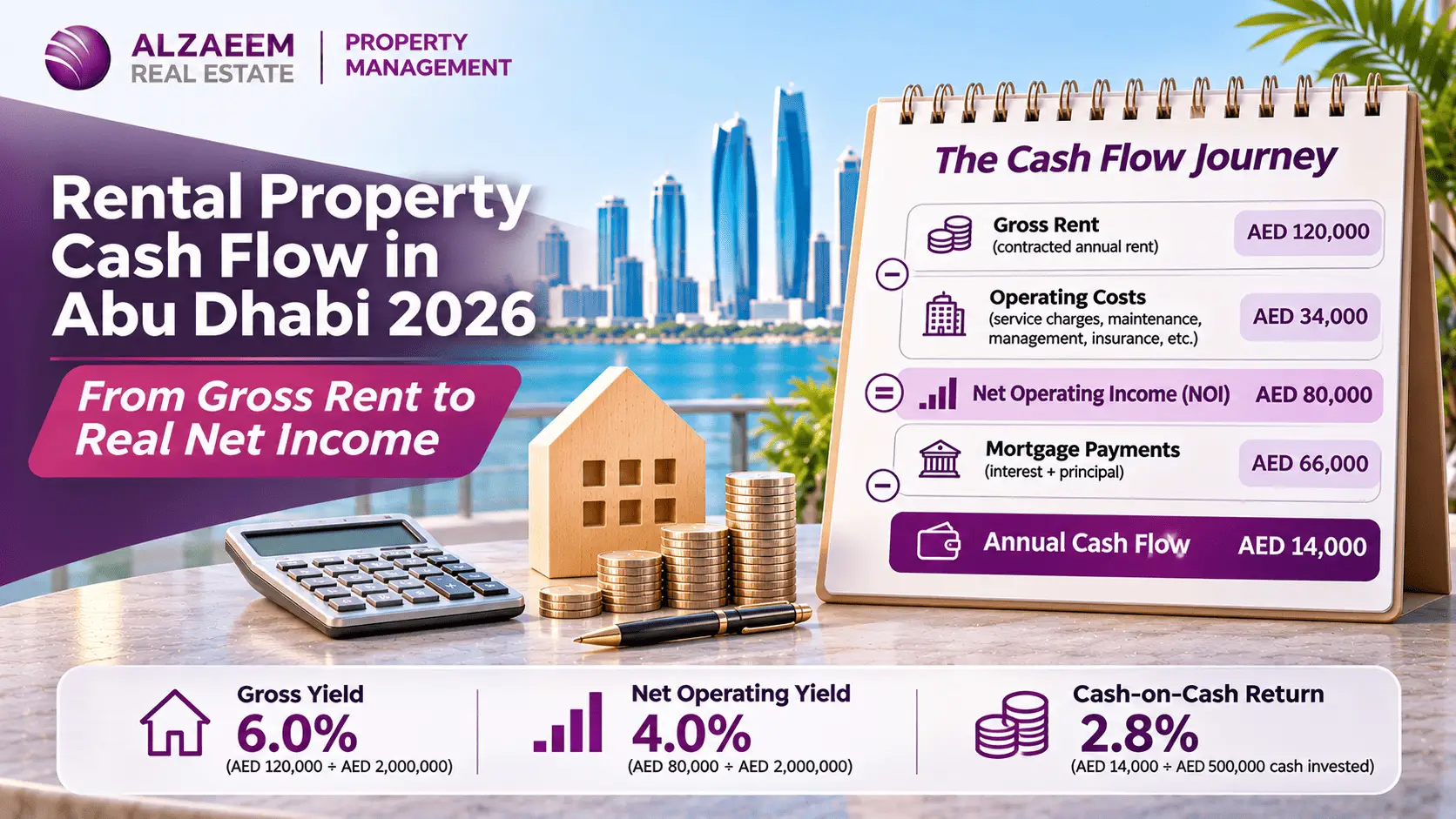
Net operating income:
AED 80,000
That is very different from AED 120,000.
Gross Yield vs Net Yield
Using the same AED 2,000,000 property:
Gross rent:
AED 120,000
Gross yield:
6%
But NOI:
AED 80,000
Net operating yield:
4%
That 2-percentage-point difference is economically significant.
The Formula for Net Operating Yield
A practical version:
NOI ÷ Total Property Investment × 100
If:
NOI = AED 80,000
Total investment = AED 2,000,000
Net operating yield:
4%
This is more informative than gross yield alone.
But Net Operating Yield Still Does Not Equal Cash Flow
Why?
Because financing may still need to be paid.
If the property has a mortgage:
you must next account for:
debt service.
Mortgage Payment Changes the Cash Picture
Suppose NOI:
AED 80,000
Annual mortgage payments:
AED 66,000
Cash remaining after debt service:
AED 14,000
That is the property’s annual pre-tax cash flow.
So the landlord may own a 6% gross-yield property but receive only:
AED 14,000 of annual cash surplus
after operating expenses and mortgage payments.
Cash Buyer vs Mortgage Buyer
Two investors can buy identical apartments and experience completely different cash flow.
Cash Buyer
No mortgage payment.
NOI may largely remain as cash return.
Mortgage Buyer
NOI must also support:
- principal;
- interest.
This can materially reduce monthly cash flow.
Mortgage Payment Is Not All “Expense”
This distinction matters.
A typical mortgage payment contains:
Interest
Cost of borrowing.
Principal
Reduction in loan balance.
Principal reduces immediate cash flow but also increases owner equity.
Therefore:
cash flow
and
wealth accumulation
are not identical.
Example: Mortgage Property
Suppose:
NOI:
AED 90,000
Annual mortgage payment:
AED 84,000
Annual cash flow:
AED 6,000
At first glance, return looks weak.
But suppose AED 30,000 of those mortgage payments reduced principal.
The landlord’s cash account gained only AED 6,000.
But owner equity may also have increased by:
AED 30,000
before any property-price change.
Negative Cash Flow Does Not Automatically Mean Bad Investment
Suppose annual cash flow:
–AED 12,000
But annual principal reduction:
AED 40,000
And the investor intentionally chose a highly leveraged property for long-term equity accumulation.
That can still fit a specific strategy.
However:
negative cash flow creates liquidity risk.
The investor must be capable of funding the deficit.
Positive Cash Flow Does Not Automatically Mean Great Investment
A very cheap property may produce:
- positive cash flow;
- weak capital appreciation;
- high maintenance;
- poor resale liquidity.
Investment quality still requires broader analysis.
Cash-on-Cash Return
Cash-on-cash return measures annual pre-tax cash flow relative to the investor’s actual cash invested.
Formula:
Annual Pre-Tax Cash Flow ÷ Cash Invested × 100
This can be useful for mortgage investors.
Example: Cash-on-Cash Return
Buyer cash invested:
AED 500,000
Annual cash flow after operating expenses and mortgage:
AED 30,000
Cash-on-cash return:
6%
This tells the investor how efficiently their deployed cash is producing annual cash surplus.
Cash-on-Cash Is Different From Gross Yield
Gross yield uses:
property value.
Cash-on-cash uses:
investor cash invested.
They answer different questions.
Monthly Cash Flow
Annual analysis is useful.
But landlords should also understand monthly liquidity.
Formula:
Monthly Rent Collected – Monthly Average Expenses – Mortgage = Monthly Cash Flow
Example:
Rent:
AED 10,000/month equivalent
Average operating expenses:
AED 3,000
Mortgage:
AED 5,500
Monthly cash flow:
AED 1,500
But Rent May Not Be Collected Monthly
Abu Dhabi leases may use:
- one payment;
- multiple payments.
So monthly cash-flow analysis should not be confused with actual bank-account timing.
A landlord receiving rent in four cheques may experience large inflows followed by several months of expenses.
Cash Timing Matters
Suppose annual rent:
AED 120,000
paid in:
2 payments.
The landlord may receive:
AED 60,000
then nothing for several months.
But expenses such as:
- mortgage;
- maintenance;
- service charges
continue.
Cash management therefore requires:
liquidity planning.
Keep Property Cash Separate
A good landlord practice is to maintain a dedicated property ledger or account structure.
When rent arrives:
do not treat the entire amount as disposable personal income.
Allocate for:
Service charges
Maintenance
Vacancy
Mortgage
Management
Future turnover
Then determine what is genuinely distributable.
Illustrative Example: Cash Buyer
Property value:
AED 1,500,000
Annual rent:
AED 105,000
Vacancy allowance:
AED 5,000
Effective rental income:
AED 100,000
Expenses:
- Service charges: AED 14,000
- Maintenance reserve: AED 7,000
- Management: AED 5,000
- Insurance / miscellaneous: AED 2,000
NOI:
AED 72,000
Net operating yield:
4.8%
Annual pre-tax cash flow:
AED 72,000
because there is no mortgage.
Illustrative Example: Mortgage Buyer
Same property:
AED 1,500,000
NOI:
AED 72,000
Annual mortgage payments:
AED 60,000
Annual cash flow:
AED 12,000
Monthly equivalent:
AED 1,000
Same property.
Same rent.
Very different investor cash return.
Illustrative Example: Furnished Property
Purchase price:
AED 2,000,000
Annual rent:
AED 150,000
Vacancy allowance:
AED 7,500
Effective income:
AED 142,500
Operating expenses:
- Service charges: AED 20,000
- Maintenance: AED 9,000
- Management: AED 7,500
- Furniture replacement allowance: AED 5,000
- Insurance / miscellaneous: AED 2,500
NOI:
AED 98,500
Net operating yield:
4.93%
Gross yield was:
7.5%
The difference is substantial.
A 7.5% Gross Yield Can Become Under 5% Net
This is why investors should be cautious when marketing says:
“High yield 7.5%.”
Ask:
Before service charges?
Before vacancy?
Before maintenance?
Before management?
Before mortgage?
Gross yield is useful.
But it is only the first layer.
Mortgage Costs Should Be Modelled Separately
ADREC’s mortgage calculator itself separates transaction costs, annual service charges and monthly mortgage payment when illustrating property-financing economics.
That is consistent with proper investment analysis:
operating property costs
and
financing costs
should not be blended blindly.
Mortgage Interest Rate Risk
If the mortgage rate changes after a fixed period, monthly debt service may change.
A property that currently produces positive cash flow could become:
cash-flow neutral
or
negative.
Stress-testing is useful.
Stress Test Your Property
Instead of only modelling the best case, test:
Rent falls 5%.
Vacancy reaches 30 days.
Maintenance is AED 10,000 higher.
Mortgage payment rises.
Then ask:
Does the property still remain financially manageable?
Example Stress Test
Normal annual cash flow:
AED 30,000
Then:
- rent decreases AED 6,000;
- vacancy costs AED 8,000;
- repairs increase AED 5,000.
Revised cash flow:
AED 11,000
Still positive.
That is a more resilient property.
Another Property May Become Negative
Normal cash flow:
AED 12,000
Unexpected costs:
AED 20,000
Result:
–AED 8,000
The landlord needs external cash.
This is why reserves matter.
High Yield Can Hide High Operating Cost
A property might offer:
8% gross yield
because:
- purchase price is low;
- rent looks high.
But it may also have:
- high service charges;
- maintenance problems;
- high tenant turnover.
The real net cash return may be weaker than a lower-yield property.
Low Service Charges Can Improve Cash Flow
If two identical AED 2 million apartments both rent at AED 130,000:
Property A
Service charges:
AED 15,000
Property B
Service charges:
AED 27,000
Difference:
AED 12,000 every year
That difference directly affects NOI.
But Cheapest Service Charges Are Not Automatically Best
Poor community maintenance can contribute to:
- tenant dissatisfaction;
- vacancy;
- weaker resale appeal.
The right target is:
efficient service charges
rather than simply:
minimum service charges.
Vacancy Must Be Modelled Even in a Strong Market
No landlord should assume:
100% occupancy forever.
Even a good property can become vacant because of:
- tenant relocation;
- lease timing;
- maintenance;
- market conditions.
Include a realistic vacancy allowance.
Tenant Retention Improves Cash Flow
A stable tenant can reduce:
- lost rent;
- cleaning;
- repainting;
- leasing costs;
- administration.
Our Tenant Turnover Cost Abu Dhabi 2026 article explains why retaining a reliable tenant can sometimes outperform chasing a higher headline rent.
Capital Expenditure vs Operating Expense
Not all spending should be treated identically.
Operating Expense
Routine cost of running the property.
Examples:
- normal maintenance;
- management;
- service charges.
Capital Expenditure
Larger improvement or asset replacement.
Examples:
- major renovation;
- full kitchen replacement.
For long-term modelling, both matter.
But they represent different types of spending.
Cash Flow vs Accounting Profit
This article focuses on:
practical landlord cash movement.
Formal accounting, depreciation and tax treatment may differ depending on:
- investor structure;
- jurisdiction;
- ownership vehicle.
Do not confuse a landlord cash-flow worksheet with audited accounting profit.
Rental Income Is Not Spendable Until Obligations Are Funded
A disciplined landlord receiving AED 120,000 rent should mentally divide it into buckets.
For example:
Service charges
Maintenance reserve
Mortgage
Property management
Vacancy / turnover reserve
What remains after these allocations is far closer to real distributable income.
12-Month Landlord Cash-Flow Worksheet
Track:
| Item | Annual Amount |
|---|---|
| Gross contracted rent | AED ___ |
| Less vacancy/collection loss | AED ___ |
| Effective rental income | AED ___ |
| Service charges | AED ___ |
| Maintenance reserve | AED ___ |
| Property management | AED ___ |
| Insurance | AED ___ |
| Furniture/appliance allowance | AED ___ |
| Other operating costs | AED ___ |
| Net Operating Income | AED ___ |
| Mortgage payments | AED ___ |
| Pre-Tax Cash Flow | AED ___ |
This simple statement can transform the way a landlord evaluates performance.
Add Principal Reduction Separately
For financed properties, add:
| Equity Item | Annual Amount |
|---|---|
| Mortgage principal repaid | AED ___ |
This helps distinguish:
cash generated
from
equity accumulated.
Example Full Landlord Dashboard
Property price:
AED 2,000,000
Gross rent:
AED 140,000
Effective income:
AED 133,000
NOI:
AED 92,000
Mortgage payments:
AED 72,000
Cash flow:
AED 20,000
Principal repaid:
AED 28,000
Then the investor can see:
Cash generated:
AED 20,000
Debt reduced:
AED 28,000
before any capital appreciation.
That is much more useful than simply saying:
“My yield is 7%.”
Cash Flow and Capital Appreciation Are Separate
Total property return can come from:
- rental cash flow;
- mortgage principal reduction;
- capital appreciation.
A low-cash-flow property may perform well through appreciation.
A high-cash-flow property may appreciate slowly.
Investors should know which strategy they are pursuing.
Cash Flow for Overseas Landlords
Overseas owners should be even more disciplined because they may face:
- currency transfers;
- remote maintenance;
- management costs;
- delayed approvals.
Keeping a local operating reserve can prevent disruption.
Property Management Can Improve Cash Visibility
A professional property-management system should provide clear reporting on:
- rent collected;
- outstanding payments;
- repairs;
- maintenance;
- tenancy status.
That allows the landlord to measure real operating performance rather than rely on memory.
Al Zaeem Property Management
Through Al Zaeem Property Management, landlords can coordinate:
- rent collection;
- tenant communication;
- inspections;
- maintenance;
- renewals;
- operating reporting.
The objective is not only to collect rent.
It is to manage the property as an:
operating asset.
Al Zaeem Facility Management
Private-unit maintenance can materially affect cash flow.
Where repairs are required, Al Zaeem Facility Management can coordinate areas such as:
- AC;
- plumbing;
- electrical;
- painting;
- flooring;
- woodwork.
Good repair coordination can reduce both:
- maintenance disruption;
- avoidable vacancy.
Ten Cash-Flow Mistakes Landlords Make
Mistake 1 — Calling gross rent profit
It is only revenue.
Mistake 2 — Ignoring vacancy
Empty days have a cost.
Mistake 3 — Ignoring service charges
They reduce NOI.
Mistake 4 — Budgeting zero maintenance
Repairs eventually occur.
Mistake 5 — Forgetting tenant turnover
Re-leasing costs money.
Mistake 6 — Ignoring management fees
Include all operating costs.
Mistake 7 — Treating entire mortgage payment as pure loss
Principal builds equity.
Mistake 8 — Using gross yield as cash-on-cash return
They are different metrics.
Mistake 9 — Spending every rent payment immediately
Fund reserves first.
Mistake 10 — Never stress-testing the property
Good years do not last forever.
The Better Property Investment Formula
Instead of asking only:
What rent will I get?
Ask:
What will I collect?
Then:
What will I spend operating it?
Then:
What will financing cost?
Then:
How much cash remains?
That is real investment analysis.
Final Verdict
Rental-property cash flow in Abu Dhabi should be calculated from:
actual income
not headline rent.
The correct sequence is:
Gross Potential Rent
minus
Vacancy / Collection Loss
=
Effective Rental Income
minus
Operating Expenses
=
Net Operating Income
minus
Mortgage Debt Service
=
Pre-Tax Cash Flow
Service charges are a real owner operating cost within Abu Dhabi’s regulated community-management framework, and private-unit maintenance remains a separate landlord risk.
That is why:
AED 120,000 annual rent is not AED 120,000 annual profit.
A property advertised at:
6% gross yield
may deliver:
- 4% net operating yield;
- lower cash-on-cash return after financing;
- or even temporary negative cash flow.
None of those figures is automatically “wrong.”
They simply measure different things.
The disciplined landlord tracks:
- rent collected;
- vacancy;
- service charges;
- maintenance;
- turnover;
- management;
- financing.
That transforms a rental property from:
a rent cheque
into:
a measurable operating business.
Official Sources
Abu Dhabi Real Estate Centre — Community Affairs
Current guidance on service charges and common-property maintenance.
Abu Dhabi Tenancy Law
Current framework concerning landlord necessary repairs and tenant repair responsibilities.
ADREC Mortgage Calculator
Current illustrative financing framework separating transaction costs, annual service charges and mortgage payments.
Disclaimer
This article provides general real-estate and financial modelling information only. It does not constitute accounting, tax, mortgage, legal or investment advice.
All financial examples are illustrative. Actual rental income, vacancy, service charges, maintenance costs, financing rates, management fees and property performance vary by property and investor.
Investors should calculate returns using their own verified costs, financing terms and risk assumptions.
Last reviewed: November 2026.