


A rental property can generate income.
It can also generate:
- AC failures;
- plumbing repairs;
- appliance replacements;
- repainting;
- tenant-turnover costs;
- emergency call-outs;
- unexpected vacancy.
That is why serious landlords should maintain a:
maintenance reserve.
A maintenance reserve is money deliberately kept aside for property-related expenses that are expected eventually, but not necessarily in a predictable month.
The mistake is to think:
“Nothing has broken yet, so I do not need a reserve.”
A better question is:
“If something breaks tomorrow, can I pay for it immediately without disrupting my cash flow?”
There Is No Universal “Correct Percentage”
You will often hear rules such as:
“Save 1% of the property value every year.”
That can be too simplistic.
Consider two properties both worth:
AED 2 million
Property A
New 1-bedroom apartment.
Unfurnished.
New AC system.
Few private maintenance obligations.
Property B
Older furnished villa.
Private garden.
Private pool.
Multiple AC units.
More plumbing.
More external maintenance.
The market value is identical.
The maintenance risk is not.
That is why a better Abu Dhabi landlord framework is:
asset-based budgeting.
The Maintenance Reserve Formula
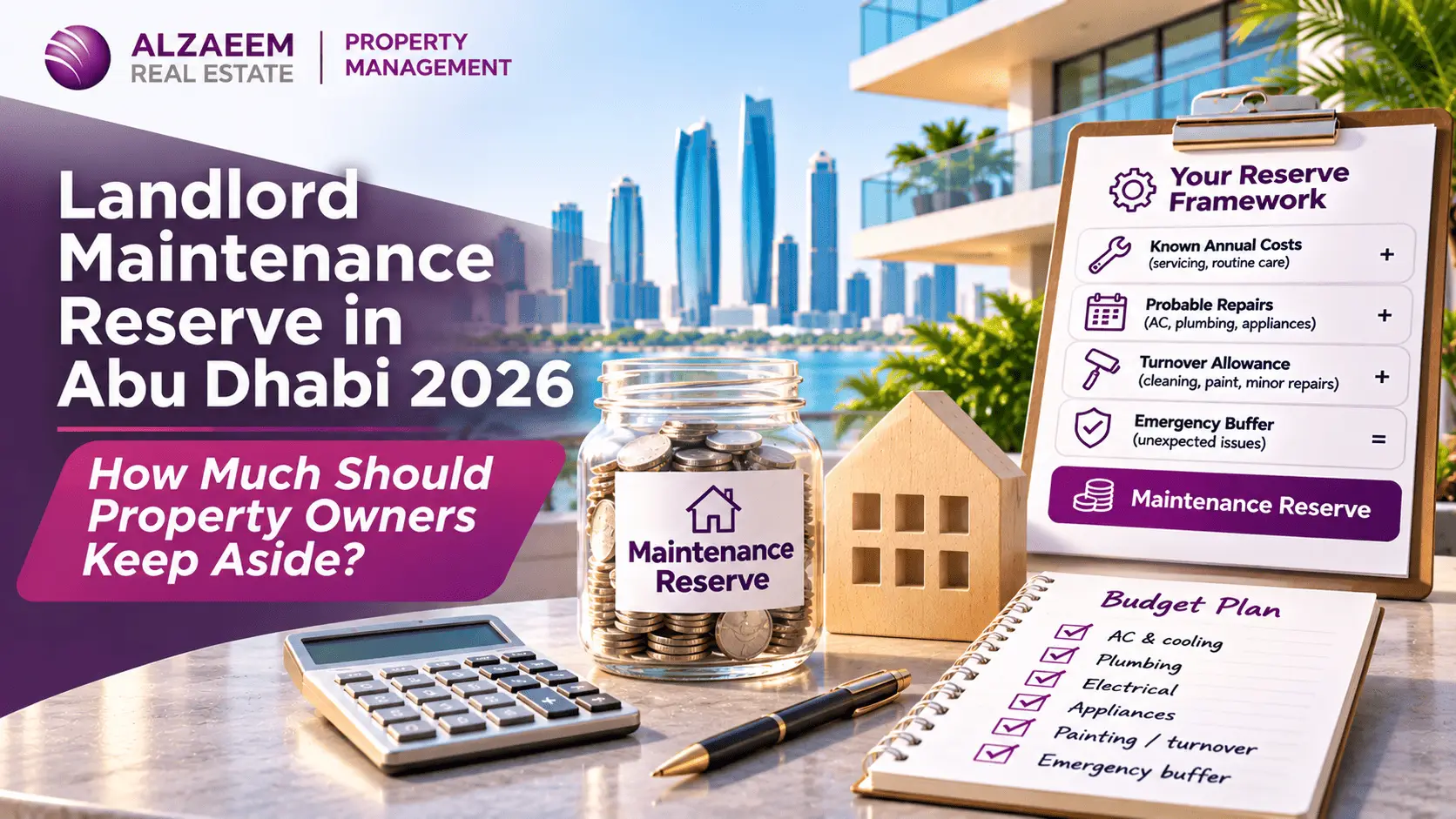
A practical reserve can be built from four components:
Known Annual Costs
Probable Repairs
Turnover Allowance
Emergency Buffer
=
Landlord Maintenance Reserve
Vacancy can then either be:
- included separately;
- or added as an additional liquidity reserve.
For most landlords, keeping vacancy and maintenance conceptually separate gives a clearer picture.
Maintenance Reserve Is Not the Same as Service Charges
This distinction is essential.
ADREC defines service charges as amounts paid by owners for the:
- management;
- operation;
- maintenance;
- repair
of common parts and facilities. Service-charge budgets require ADREC approval.
Examples may include:
- lifts;
- lobby;
- common pool;
- security;
- landscaping;
- shared building systems.
Your private-unit maintenance reserve is different.
What Your Private Maintenance Reserve Covers
Depending on the property, your reserve may be needed for:
- internal AC;
- plumbing;
- electrical work;
- appliances;
- painting;
- doors and locks;
- cabinetry;
- sealant;
- flooring;
- private pool;
- private garden systems;
- tenant-turnover preparation.
These are not automatically covered by building service charges.
Service Charges Remain the Owner’s Responsibility
ADREC states that the unit owner remains responsible for service charges even where the property is leased.
So a landlord budget should normally contain two separate lines:
Service Charges
Common-property operating cost.
Private Maintenance Reserve
Unit-level repair and replacement buffer.
Do not merge them mentally.
Maintenance Reserve Is Not the Security Deposit
A tenant security deposit should not become your landlord maintenance fund.
The deposit exists to address tenant-related obligations subject to the tenancy terms and applicable rules.
It should not be relied upon to replace:
- an ageing AC;
- a failed water heater;
- normal landlord maintenance;
- ordinary wear.
Maintenance Reserve Is Not the Same as an Emergency Fund
A maintenance reserve covers expected property risk.
An emergency liquidity reserve may cover broader events such as:
- prolonged vacancy;
- mortgage obligations;
- major unexpected expenditure.
A disciplined landlord can keep both.
Abu Dhabi Landlord Repair Responsibility
Under Abu Dhabi tenancy law, the landlord is generally responsible for maintaining the leased property so it remains fit for use and for carrying out necessary repairs, excluding customary rental repairs unless otherwise agreed.
The tenant is generally responsible for:
- customary or agreed rental repairs;
- damage caused by the tenant.
That means the landlord still needs liquidity available for genuine owner-side repairs.
Necessary Repair vs Minor Rental Repair
This distinction matters.
Necessary Repair
Something needed to keep the property fit for use.
Potential landlord responsibility.
Rental Repair
A minor repair customarily handled by the tenant or contractually allocated to the tenant.
Potential tenant responsibility.
The tenancy agreement can affect allocation.
But a reserve still gives the landlord the ability to respond first and determine responsibility properly afterward.
Why New Properties Still Need a Reserve
A new apartment can still experience:
- AC drainage issue;
- plumbing leak;
- faulty appliance;
- door adjustment;
- electrical problem.
Some issues may fall under:
- developer defects;
- manufacturer warranty.
But not every post-handover problem will.
Our Property Defects Liability Period Abu Dhabi 2026 guide explains when developer liability may still apply.
Do Not Pay for a Developer Defect From Your Reserve Without Checking
Suppose a newly handed-over unit develops:
- waterproofing failure;
- defective installation;
- original construction issue.
Before treating it as owner maintenance, ask:
Is this still under developer responsibility?
A maintenance reserve is for genuine landlord costs.
It should not be used automatically where another party is liable.
Apartment vs Villa Reserve
A villa generally has more privately controlled systems than an apartment.
Possible villa responsibilities include:
- several AC units;
- external plumbing;
- private landscaping;
- irrigation;
- private pool;
- gates;
- external lighting;
- roof or exterior elements depending on title structure.
An apartment may shift more shared infrastructure into common-property management.
Therefore:
villas generally justify a larger private maintenance buffer.
Furnished vs Unfurnished Reserve
Furniture increases replacement exposure.
A furnished property may contain:
- sofa;
- beds;
- dining set;
- TV;
- refrigerator;
- washing machine;
- dishwasher;
- curtains;
- decorative items.
Even where tenant-caused damage can be charged appropriately, normal ageing still belongs to ownership economics.
A furnished landlord therefore needs a larger replacement allowance.
AC Is One of the Biggest Budget Risks
In Abu Dhabi, AC is operationally critical.
A landlord may face:
- thermostat issue;
- fan coil problem;
- drainage blockage;
- motor failure;
- compressor issue;
- control-board failure.
Not every AC problem has the same cost.
But the key principle is:
do not operate with zero AC contingency.
One AC Failure Can Destroy a Thin Reserve
Suppose your reserve is:
AED 1,500
and a major repair costs more than that.
You then need to fund the difference from:
- rent income;
- personal cash;
- credit.
That means the reserve was not truly adequate.
Plumbing Risk
Common private-unit plumbing issues may include:
- leaking tap;
- toilet mechanism;
- water heater;
- flexible hose;
- drainage;
- sealant failure.
Small leaks can become expensive if ignored.
Fast response protects:
- your unit;
- neighbouring property;
- tenant relationship.
Electrical Risk
Possible private-unit issues include:
- sockets;
- switches;
- breakers;
- lighting circuits;
- appliance electrical faults.
Again, classify the issue before paying.
A shared building-system fault may belong to the Community Management Company rather than your unit reserve.
Appliance Replacement
A furnished or appliance-equipped rental can eventually require replacement of:
- refrigerator;
- washing machine;
- dishwasher;
- cooker;
- microwave;
- water heater.
The reserve should account for:
replacement cycles,
not just emergency repairs.
Painting and Turnover
Even a well-maintained tenant may leave behind normal wear.
Between tenancies, landlords may need:
- touch-up paint;
- deep cleaning;
- minor repairs;
- silicone/sealant;
- lock adjustments;
- small fixture replacements.
This is why turnover allowance should be separate from emergency maintenance.
Vacancy Reserve Should Usually Be Separate
Maintenance reserve covers:
the property.
Vacancy reserve covers:
the income gap.
For example, if annual rent is:
AED 120,000
one month of gross rent equals:
AED 10,000
That is a different risk from an AED 3,000 plumbing repair.
Separate planning makes both visible.
A Simple Vacancy Reserve
A landlord might maintain:
- 1 month;
- 2 months;
- or more
of expected rent as a vacancy buffer depending on:
- demand;
- mortgage exposure;
- property type;
- leasing history.
There is no universal legal requirement.
This is financial risk management.
Mortgage Owners Need More Liquidity
If the property has a mortgage, the landlord may need to pay:
- mortgage instalment;
- service charges;
- repair bill
even while the property is vacant.
That increases the importance of liquidity.
A cash-bought property and heavily financed property should not necessarily hold identical reserves.
Do Not Budget Only From Property Value
Property value can be misleading.
A AED 3 million new apartment may need less private maintenance than a AED 2 million older villa.
Better variables include:
- age;
- property type;
- number of AC units;
- furnishing;
- private facilities;
- tenant turnover;
- known equipment condition.
Use an Asset Register
Create a simple list.
| Asset | Approximate Age | Condition | Likely Future Cost |
|---|---|---|---|
| AC Unit 1 | 5 years | Good | Monitor |
| Water Heater | 4 years | Fair | Replacement reserve |
| Refrigerator | 6 years | Fair | Replacement likely |
| Washing Machine | 2 years | Good | Low near-term risk |
This converts maintenance from guesswork into planning.
Known Annual Costs
Start with predictable private-unit items.
Examples may include:
- AC servicing;
- deep cleaning between tenants;
- pest control where owner-funded;
- private pool servicing;
- garden servicing.
These are not “emergencies.”
Budget them normally.
Probable Repairs
Then identify items that may realistically fail over the next 12–24 months.
Examples:
- older AC component;
- water heater;
- ageing refrigerator;
- worn seals;
- plumbing fixtures.
Assign a reasonable contingency.
Emergency Buffer
Finally, add an unallocated amount for events you cannot predict precisely.
This buffer prevents every unexpected issue from becoming a financial problem.
Illustrative Example: New 1BR Apartment
This example is illustrative only.
Property:
- new;
- unfurnished;
- no private pool;
- one main AC system;
- modern appliances limited.
Possible annual planning:
Known servicing/turnover
AED 2,500
Probable repair allowance
AED 2,000
Emergency buffer
AED 3,500
Illustrative maintenance reserve:
AED 8,000
This is not a universal recommended figure.
It demonstrates the methodology.
Illustrative Example: Furnished 2BR Apartment
Possible planning:
Routine maintenance and turnover
AED 4,000
Appliance/furniture replacement allowance
AED 4,000
AC/plumbing contingency
AED 4,000
Emergency buffer
AED 4,000
Illustrative annual reserve:
AED 16,000
Again, this is an example, not a market rule.
Illustrative Example: Villa
Villa with:
- multiple AC systems;
- private landscaping;
- private pool;
- older equipment.
Possible planning:
Routine private maintenance
AED 8,000
Pool/garden contingency
AED 6,000
AC/plumbing/electrical reserve
AED 10,000
Emergency buffer
AED 8,000
Illustrative annual reserve:
AED 32,000
A villa can justify much more private liquidity than a small apartment.
Percentage of Rent Can Be a Secondary Check
Another useful sanity check is to compare reserve size with annual rent.
But do not let the percentage become the primary formula.
Example:
Annual rent:
AED 120,000
Maintenance reserve:
AED 10,000
That equals:
8.3% of annual rent
This can help assess whether the reserve is materially large or small.
But asset condition should still drive the number.
Percentage of Property Value Is Also Only a Cross-Check
Property value:
AED 1,500,000
Reserve:
AED 10,000
Equivalent to:
0.67% of property value
Again:
use this as context,
not as the rule.
Turnover Reserve
Every tenancy change can create costs.
Potential items:
- cleaning;
- paint;
- small repairs;
- photography refresh;
- lock/key work;
- minor replacement.
Landlords with high tenant turnover should budget more.
Long-Term Tenant Can Reduce Turnover Cost
A stable tenant who renews can reduce:
- vacancy;
- cleaning;
- repainting;
- marketing;
- re-leasing costs.
That means tenant retention has direct maintenance and operational value.
Reserve for Furnished Inventory
For furnished units, create an inventory-replacement schedule.
Example:
Short life
- linens;
- small kitchen items.
Medium life
- sofa;
- dining chairs;
- curtains.
Longer life
- major appliances;
- beds.
Replace strategically rather than all at once.
Do Not Replace Everything After Every Tenant
Normal wear does not automatically justify full replacement.
Assess:
- condition;
- market positioning;
- tenant expectations.
A functional mid-market rental does not need hotel-style refurbishment every year.
Luxury Properties Need Different Standards
A premium unit may require:
- faster repairs;
- higher-quality replacements;
- better presentation;
- more expensive finishes.
The reserve should reflect the expected tenant segment.
Overseas Landlords Need a Higher Operational Buffer
An overseas owner cannot easily:
- visit the property;
- pay a contractor in person;
- inspect the repair immediately.
That makes pre-approved liquidity especially useful.
A reserve can allow the property manager to act quickly without waiting for international coordination.
Maintenance Approval Thresholds
An owner and property manager should agree on:
- what can be approved automatically;
- what requires owner approval;
- what happens in emergencies.
For example:
Up to AED 500
Routine approval.
AED 500–2,000
Owner notification.
Above AED 2,000
Prior owner approval unless emergency.
These numbers are illustrative.
The actual threshold should be agreed contractually.
DARI Property Management Agreement
Abu Dhabi’s DARI system supports registered Property Management Agreements.
Current DARI guidance shows that PMAs can specify:
- permissions;
- agreement amount;
- agreement period.
Examples of permissions include rent collection and other authorised actions.
That makes the management agreement the right place to define operational authority clearly.
Active PMA Allows Property Manager to Initiate Tenancy Services
DARI confirms that where an active Property Management Agreement exists, the property-management company can initiate the tenancy contract process on the owner’s behalf.
For overseas landlords, this can make day-to-day management more efficient.
Maintenance Authority Should Be Clear
Even if a PMA does not itself prescribe a universal maintenance threshold, the owner’s management arrangement should clearly define:
- emergency authority;
- spending limits;
- approval channels;
- reporting.
Do not leave it vague.
Emergency Repairs Cannot Always Wait
Suppose:
- pipe bursts;
- AC stops during extreme heat;
- electrical fault creates safety risk.
Waiting two days for email approval can turn a small issue into a large loss.
A sensible management arrangement needs emergency authority.
But Unlimited Authority Is Also Poor Governance
The opposite extreme is:
“Repair anything at any cost.”
Owners still need control.
A good system balances:
speed
with
accountability.
Maintenance Reserve Account
A landlord can keep the reserve:
- in a separate account;
- in a dedicated ledger;
- as clearly earmarked cash.
The key principle is:
do not mentally spend it twice.
If the reserve also becomes your holiday fund, it is not a reserve.
Monthly Funding Method
Instead of depositing the whole annual reserve at once, an owner can build it monthly.
Example:
Target reserve:
AED 12,000
Monthly contribution:
AED 1,000
This creates smoother cash flow.
Rent-Based Funding
Another approach:
Every time rent arrives, allocate a fixed amount immediately to:
- maintenance reserve;
- vacancy reserve;
- service charges.
This prevents the full rent from appearing to be disposable income.
Gross Rent Is Not Profit
If annual rent is:
AED 120,000
the landlord still may pay:
- service charges;
- maintenance;
- management fee;
- insurance;
- mortgage interest;
- vacancy costs.
Gross rent should never be confused with net income.
Maintenance Reserve and Net Yield
Net rental yield is more meaningful when expected maintenance is included.
Illustrative formula:
Annual Rent – Operating Costs – Maintenance Allowance
÷
Total Property Investment
This creates a more realistic return estimate.
A Property With Higher Rent Can Still Be Worse
Property A:
Rent: AED 130,000
Maintenance: AED 20,000
Property B:
Rent: AED 120,000
Maintenance: AED 6,000
Property A has higher gross income.
But its net operating economics may not be as attractive as they first appear.
When Reserve Is Too Low
Warning signs include:
- every repair paid from personal salary;
- delayed repairs;
- credit-card dependence;
- arguing over every small maintenance invoice;
- tenant complaints waiting for funds.
This suggests the property is under-reserved.
Delayed Repairs Can Cost More
A small leak today may become:
- damaged cabinetry;
- damaged flooring;
- neighbour claim.
A functioning reserve allows early intervention.
When Reserve Is Too High
Holding excessive idle cash also has a cost.
If the landlord keeps:
AED 100,000
for a low-risk new studio with minimal private systems, that may be unnecessarily conservative.
The reserve should reflect actual risk.
Review Reserve Annually
At least once per year, review:
Property age
Repair history
AC condition
Appliances
Tenant turnover
Upcoming tenancy expiry
Known refurbishment needs
Then adjust the reserve.
Increase Reserve as Property Ages
A five-year-old property usually has a different risk profile from a brand-new one.
As systems age:
- failure probability rises;
- replacement becomes more likely.
Your reserve should evolve.
Repair History Is Useful Data
If the property has spent:
- AED 3,000;
- AED 4,500;
- AED 5,000
on private maintenance over three years,
that gives you actual property-specific history.
Use it.
Separate One-Off Renovation From Maintenance
Replacing an entire kitchen for design reasons is not ordinary annual maintenance.
Keep categories separate:
Maintenance
Preserves function.
Capital Improvement
Upgrades the asset.
This distinction helps with investment analysis.
Reserve for Tenant Turnover Refurbishment
After several years, a landlord may need:
- repainting;
- flooring refresh;
- cabinet repair;
- new curtains.
This is more substantial than routine maintenance but still predictable over time.
Create a sinking fund rather than being surprised.
Landlord Reserve Dashboard
A simple spreadsheet can track:
| Category | Annual Budget | Actual Spend | Remaining |
|---|---|---|---|
| AC | AED 3,000 | AED 1,200 | AED 1,800 |
| Plumbing | AED 2,000 | AED 600 | AED 1,400 |
| Appliances | AED 3,000 | AED 0 | AED 3,000 |
| Turnover | AED 2,000 | AED 0 | AED 2,000 |
| Emergency | AED 4,000 | AED 0 | AED 4,000 |
This makes management much more disciplined.
Maintain Repair Evidence
Keep:
- invoices;
- contractor reports;
- photographs;
- warranty documents.
This helps distinguish:
- recurring issue;
- tenant damage;
- developer defect;
- normal ageing.
Contractor Quality Matters
The cheapest maintenance invoice can become the most expensive if the repair fails repeatedly.
Consider:
- competence;
- warranty;
- response time;
- documentation.
A professional repair should solve the root problem.
Preventive Maintenance Can Protect the Reserve
Not all maintenance spending is bad.
Preventive servicing can reduce larger failures.
Examples:
- AC servicing;
- checking drainage;
- water-heater inspection;
- sealant checks.
The goal is not:
spend nothing.
The goal is:
spend intelligently.
Al Zaeem Property Management
Through Al Zaeem Property Management, landlords can structure the operational side of ownership around:
- tenant communication;
- maintenance coordination;
- inspections;
- rent collection;
- renewals;
- reporting.
A well-defined management arrangement can also establish clear approval pathways for routine and emergency maintenance.
Al Zaeem Facility Management
Where private-unit repairs are required, Al Zaeem Facility Management can coordinate services such as:
- AC;
- plumbing;
- electrical;
- painting;
- flooring;
- woodwork.
The advantage of combining maintenance planning with property management is:
problems can be identified, approved and resolved faster.
12-Month Maintenance Reserve Checklist
Review:
1. Annual service charges funded separately?
2. AC reserve adequate?
3. Plumbing contingency?
4. Electrical contingency?
5. Water-heater age?
6. Appliance replacement risk?
7. Furnished inventory condition?
8. Painting/turnover allowance?
9. Villa pool/garden risk if applicable?
10. Emergency buffer?
11. Vacancy reserve separate?
12. Property manager approval limits defined?
If several answers are “no,” the property is probably underprepared.
Simple Reserve Framework by Property Type
This is a planning framework, not a fixed recommendation.
New Unfurnished Apartment
Lower private-system complexity.
Reserve focus:
- AC;
- plumbing;
- minor repairs;
- turnover.
Furnished Apartment
Moderate complexity.
Add:
- appliance replacement;
- furniture wear.
Older Apartment
Increase:
- AC;
- plumbing;
- ageing fixtures.
Villa
Higher complexity.
Add:
- multiple AC systems;
- external systems;
- private pool;
- landscaping;
- gates;
- larger repair exposure.
The Better Rule
Instead of:
“Save 1%.”
Use:
List the assets → estimate likely failures → include turnover → add emergency liquidity → review annually.
That is far more defensible.
Final Verdict
Every Abu Dhabi landlord should maintain a maintenance reserve.
But the reserve should not be based on a lazy universal percentage.
The correct amount depends on:
- property type;
- age;
- private systems;
- furnishing;
- maintenance history;
- tenant turnover;
- financing;
- owner location.
Abu Dhabi tenancy law generally places necessary repairs required to keep the property fit for use on the landlord, while customary rental repairs and tenant-caused damage can fall to the tenant unless otherwise agreed.
At the same time, common-area management and maintenance are funded separately through ADREC-approved service charges, for which the unit owner remains responsible.
So the financially disciplined landlord should maintain separate planning for:
service charges
private maintenance
vacancy
major future replacement
The best reserve formula is:
known costs + probable repairs + turnover allowance + emergency buffer.
Then adjust it every year using actual property experience.
A landlord who does this can respond quickly to maintenance without:
- delaying repairs;
- disturbing personal finances;
- damaging the tenant relationship;
- compromising the property’s long-term condition.
Official Sources
Abu Dhabi Real Estate Centre — Tenancy Law
Current framework for landlord necessary repairs, tenant customary repairs and tenant-caused damage.
ADREC — Community Affairs
Current guidance on approved service charges, common-area maintenance and owner responsibility.
DARI — Property Management Agreement Services
Current digital framework for registered PMAs and management permissions.
Disclaimer
This article provides general real-estate, property-management and budgeting information only. It does not constitute legal, tax, accounting or financial advice.
There is no single official ADREC maintenance-reserve percentage applicable to all landlords. The figures used in this article are illustrative budgeting examples only and should not be treated as required or market-standard amounts.
Owners should calculate reserves according to their individual property condition, contractual obligations, tenancy arrangement and risk tolerance.
Last reviewed: November 2026.