


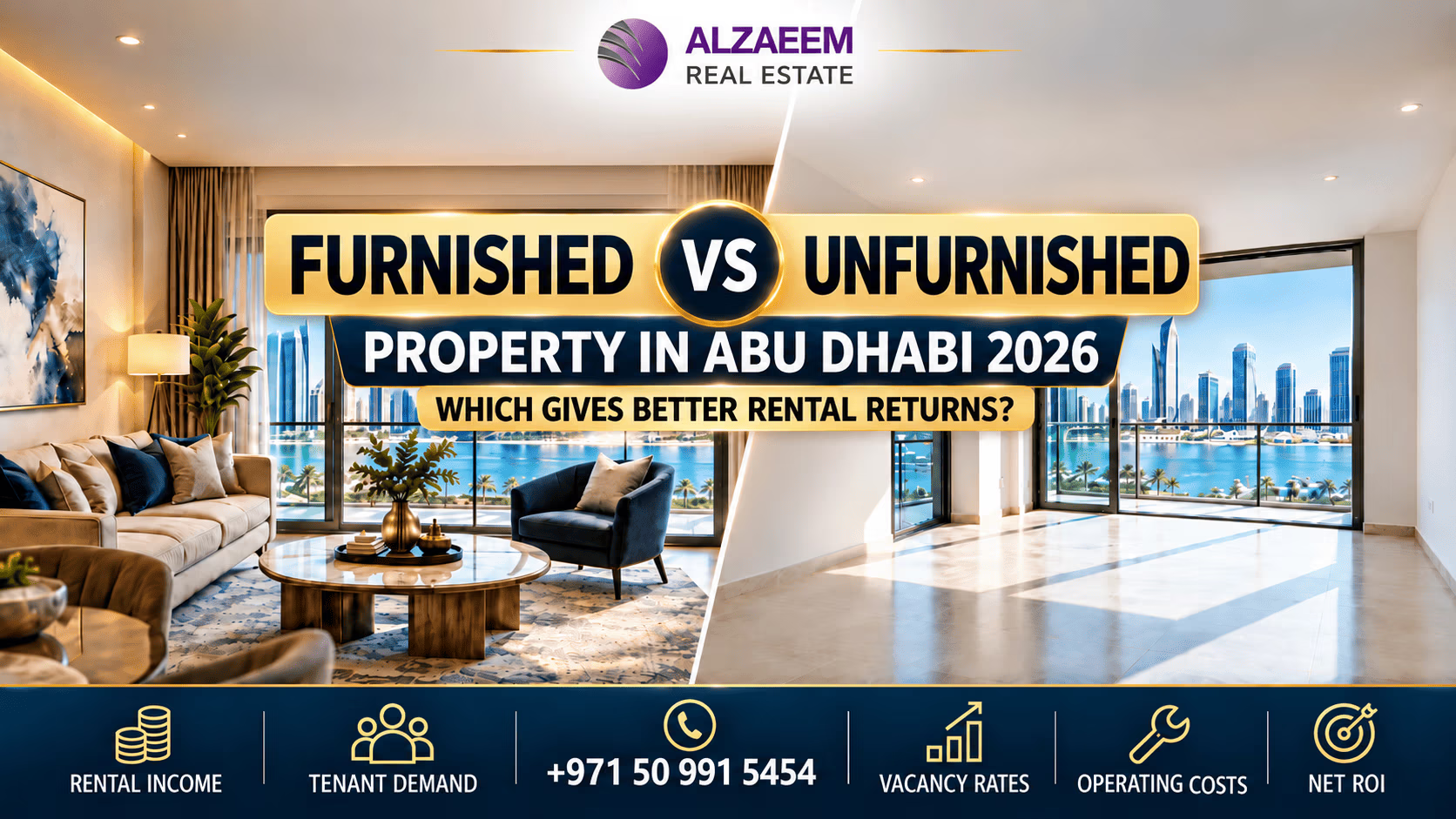
A furnished apartment can rent for more than an unfurnished apartment.
That does not automatically mean it is the better investment.
For property investors in Abu Dhabi, the real comparison is not simply:
Which unit can achieve the higher advertised rent?
The more useful question is:
Which furnishing strategy produces the stronger net return after furniture cost, maintenance, tenant turnover, vacancy, replacement expenses and management complexity are taken into account?
That distinction matters in Abu Dhabi’s current rental market.
The emirate recorded approximately 233,000 active residential lease contracts in the first half of 2026, with total lease values of around AED 9.3 billion. ADREC also reported that new apartment lease prices increased by 17% year-on-year, while new apartment rents within investment zones rose by 21%. Rental properties accounted for 69% of occupied residential units in the Abu Dhabi Region.
This is a substantial rental market, but tenant demand is not uniform.
A furnished studio on Yas Island may attract a completely different tenant profile from an unfurnished three-bedroom apartment designed for a family.
Likewise, a furnished one-bedroom investment on Al Reem Island may command a rental premium, but it may also require more frequent furniture replacement, cleaning, tenant turnover and management.
The objective should therefore be to match the furnishing strategy to:
- property type,
- location,
- target tenant,
- expected holding period,
- rental strategy,
- furnishing cost,
- likely rental premium,
- vacancy risk,
- and long-term net return.
This guide explains how investors should analyse the choice.
Furnished vs Unfurnished: The Basic Difference
A furnished property is generally offered with the main furniture and appliances necessary for a tenant to move in without purchasing the core household items themselves.
Depending on the property and market segment, this may include:
- beds and mattresses,
- sofas,
- dining furniture,
- wardrobes,
- curtains,
- televisions,
- kitchen appliances,
- washing machine,
- refrigerator,
- microwave,
- decorative lighting,
- desks,
- side tables,
- and other household items.
A premium furnished apartment may also include:
- artwork,
- premium furniture packages,
- kitchenware,
- linen,
- small appliances,
- decorative accessories,
- and integrated smart-home equipment.
An unfurnished property, by contrast, usually gives the tenant greater responsibility for furnishing the home.
However, investors should not assume that “unfurnished” means completely empty.
Properties may still contain:
- built-in wardrobes,
- fitted kitchens,
- integrated appliances,
- curtains,
- lighting,
- and other developer-installed fixtures.
The exact specification should always be verified before comparing competing properties.
Why Furnished Properties Often Achieve Higher Rent
The economic logic behind furnished accommodation is straightforward.
The tenant is paying not only for the property itself, but also for convenience.
A tenant can potentially arrive in Abu Dhabi, sign the lease, move in and immediately use the property without spending tens of thousands of dirhams furnishing it.
This can be especially valuable for:
- newly relocated professionals,
- executives,
- corporate employees,
- consultants,
- expatriates on limited-term assignments,
- people between permanent residences,
- and tenants who do not want to own furniture.
Property Finder currently describes furnished apartments as particularly attractive to expatriates and short-term corporate residents and indicates that furnished properties can command a monthly premium relative to comparable unfurnished units, although actual premiums vary materially by location, specification and property quality.
The premium therefore exists because the landlord is providing additional economic value.
But that additional value has a cost.
The Furnishing Premium Is Not Free Money
Suppose two identical one-bedroom apartments could rent for:
Unfurnished: AED 95,000 per year
Furnished: AED 108,000 per year
At first glance:
Additional annual rent = AED 13,000
An investor may therefore conclude that furnishing the property produces AED 13,000 of additional annual income.
That analysis is incomplete.
Imagine the furniture package costs:
AED 45,000
The investor must then consider:
- furniture depreciation,
- maintenance,
- damaged items,
- mattress replacement,
- sofa replacement,
- appliance failures,
- repainting,
- cleaning,
- inventory checks,
- and higher turnover.
If the furniture needs substantial renewal after four years, the economic cost might be far higher than it first appears.
The important calculation is not simply:
Furnished rent − unfurnished rent
It is:
Additional furnished rental income − incremental furnishing and operating costs
That determines whether the furnishing strategy is genuinely creating additional return.
Example: Does Furnishing Actually Improve the Return?
Consider an illustrative one-bedroom apartment.
These figures are hypothetical and are not intended to represent any specific Abu Dhabi development.
Unfurnished Strategy
Purchase price: AED 1,300,000
Annual rent: AED 95,000
Service charges: AED 15,000
Maintenance and vacancy allowance: AED 8,000
Net operating income:
AED 95,000 − AED 15,000 − AED 8,000 = AED 72,000
Illustrative operating yield:
AED 72,000 ÷ AED 1,300,000 = 5.54%
Furnished Strategy
Property price: AED 1,300,000
Furniture package: AED 45,000
Total capital basis:
AED 1,345,000
Annual rent: AED 108,000
Service charges: AED 15,000
Maintenance/vacancy allowance: AED 10,000
Furniture replacement reserve: AED 7,000
Net operating income:
AED 108,000 − AED 15,000 − AED 10,000 − AED 7,000 = AED 76,000
Illustrative operating yield:
AED 76,000 ÷ AED 1,345,000 = 5.65%
The furnished unit earns significantly more gross rent.
But after including the extra capital and costs, the difference in operating yield is relatively modest:
5.65% furnished vs 5.54% unfurnished
This illustrates an important investment principle:
A large rental premium does not necessarily translate into a large net-return premium.
The Furnishing Break-Even Test
Investors can analyse furniture using a simple break-even framework.
Suppose furnishing costs:
AED 40,000
And furnished rent is:
AED 12,000 higher per year
Before considering replacement costs:
AED 40,000 ÷ AED 12,000 = 3.33 years
The furniture would theoretically recover its initial cost through the additional rent after approximately 3.3 years.
But that is only the simple payback period.
Now assume furniture replacement and additional maintenance consume AED 4,000 annually.
Net incremental benefit becomes:
AED 12,000 − AED 4,000 = AED 8,000
Revised payback:
AED 40,000 ÷ AED 8,000 = 5 years
That is a very different investment.
The furnished strategy therefore becomes much less attractive if:
- the furniture package is expensive,
- the rental premium is small,
- turnover is high,
- or the furniture deteriorates quickly.
Furnished Properties Can Attract a Different Tenant Pool
Furnishing changes more than rent.
It changes the target customer.
Typical furnished-property tenants may include:
- professionals relocating to Abu Dhabi,
- airline or aviation staff,
- consultants,
- project-based employees,
- senior corporate personnel,
- individuals seeking move-in-ready accommodation,
- and tenants who expect to remain in the UAE for a relatively short period.
Unfurnished accommodation can appeal more strongly to:
- established residents,
- couples building a long-term home,
- families,
- tenants already owning furniture,
- and residents expecting longer occupancy.
Neither tenant pool is inherently superior.
They simply produce different economics.
Tenant Turnover Is One of the Most Important Variables
A landlord should pay close attention to tenant duration.
Imagine:
Property A
AED 105,000 annual rent
Tenant stays 3 years
Property B
AED 112,000 annual rent
Tenant changes every year
Property B appears stronger on headline rent.
However, each turnover could involve:
- several weeks of vacancy,
- deep cleaning,
- repainting,
- maintenance,
- agent fees,
- advertising,
- furniture damage,
- new tenancy administration,
- and management time.
One month of vacancy on AED 112,000 annual rent represents approximately:
AED 9,333 of lost gross rent
That alone could eliminate most of the furnished rental premium.
This is why occupancy stability can be more valuable than a high nominal rent.
Vacancy Must Be Analysed in Days, Not Just Percentages
Many investors speak about vacancy as a percentage.
Another useful approach is to convert vacancy into actual cost.
If annual rent is AED 120,000:
Daily economic rent is approximately:
AED 120,000 ÷ 365 = AED 329
Thirty vacant days therefore represent approximately:
AED 9,870 of lost rent
Sixty days:
AED 19,740
A unit that rents for AED 10,000 more annually but remains vacant an additional six weeks between tenants may generate worse economics than a lower-rent unit with strong tenancy continuity.
Abu Dhabi’s Rental Market Supports Strong Demand — But Strategy Still Matters
ADREC’s H1 2026 data indicates a deep rental market.
The emirate had approximately 233,000 active residential leases, while active lease values reached AED 9.3 billion. New apartment rents increased by 17%, with apartment rents inside investment zones rising 21% year-on-year.
Strong market-wide demand does not eliminate asset-level differences.
Rental performance can still vary significantly based on:
- island or district,
- project quality,
- building management,
- views,
- layout,
- floor,
- parking,
- furnishing quality,
- unit size,
- rental price,
- and competing supply.
Investors should therefore avoid treating Abu Dhabi’s strong rental market as proof that every furnished property will outperform.
Furnished Studios Can Behave Differently From Furnished Two-Bedroom Units
The optimal strategy often changes by apartment size.
Studios
Studios are frequently strong candidates for furnishing because the target tenant often values convenience and compact living.
Furniture cost is also lower in absolute terms.
A studio may require:
- one bed,
- one sofa or chair,
- smaller dining arrangement,
- fewer appliances,
- and fewer decorative elements.
As a result, the furnishing cost relative to achievable rent can sometimes be attractive.
However, studios may also experience:
- higher turnover,
- shorter tenancy periods,
- stronger competition,
- and tenants with greater price sensitivity.
One-Bedroom Apartments
One-bedroom apartments can offer one of the broadest furnished tenant pools.
Potential tenants include:
- professionals,
- couples,
- relocating executives,
- and corporate tenants.
The key question becomes whether the rental premium adequately compensates the investor for:
- furnishing,
- replacement,
- additional maintenance,
- and potentially higher turnover.
One-bedroom units are particularly suitable for comparing furnished and unfurnished economics because both strategies can attract meaningful demand.
Two-Bedroom Apartments
Two-bedroom apartments may have greater family appeal.
Families planning longer occupancy may prefer using their own furniture.
This can make unfurnished two-bedroom units attractive because they potentially support:
- longer tenancies,
- lower turnover,
- less furniture maintenance,
- and lower landlord capital expenditure.
However, furnished two-bedroom apartments may still perform strongly in:
- premium communities,
- corporate accommodation,
- executive housing,
- waterfront locations,
- and serviced-style residential environments.
Property size alone should therefore not determine furnishing strategy.
Furniture Quality Matters More Than Many Investors Expect
A low-cost furniture package can sometimes reduce rather than increase the attractiveness of a unit.
Tenants paying a premium for a furnished apartment are usually evaluating the quality of the overall living experience.
A property containing:
- mismatched furniture,
- low-quality mattresses,
- damaged sofas,
- cheap curtains,
- poor lighting,
- and dated decoration
may struggle to justify a meaningful rental premium.
Investors should therefore distinguish between:
furnished
and
well furnished
They are not the same.
Avoid Over-Furnishing
The opposite problem is also common.
An investor might spend AED 100,000 furnishing a unit when the tenant market only supports an additional AED 12,000 of annual rent.
Premium furniture may improve photographs and presentation, but investment-grade furnishing should be driven by return.
The investor should ask:
Will the tenant pay enough additional rent to compensate for this expenditure?
A AED 20,000 improvement that produces AED 2,000 of additional annual rent may be difficult to justify financially.
Furniture Should Be Treated as a Depreciating Asset
The apartment itself may appreciate.
Furniture generally does not.
A sofa eventually becomes worn.
Mattresses require replacement.
Televisions become outdated.
Dining chairs become damaged.
Appliances fail.
Curtains and rugs deteriorate.
This means the investment contains two fundamentally different assets:
Real estate
Potentially appreciating long-term asset.
Furniture
Generally depreciating operating asset.
Investors should therefore maintain a furniture replacement reserve rather than assuming furnishing is a one-time cost.
A Simple Furniture Reserve Method
Suppose the initial furniture package costs:
AED 50,000
If the investor expects the package to require major replacement or refurbishment after five years:
AED 50,000 ÷ 5 = AED 10,000 per year
That does not mean exactly AED 10,000 will be spent each year.
It simply creates an economic allowance.
Without that reserve, the apparent net yield may be overstated.
Furnished Properties Can Require More Active Management
An unfurnished apartment might require the landlord to maintain:
- property fixtures,
- plumbing,
- electrical systems,
- air-conditioning,
- built-in appliances,
- and structural or contractual responsibilities.
A furnished apartment adds another operational layer.
The landlord may also need to deal with:
- broken furniture,
- televisions,
- kitchen appliances,
- mattresses,
- lamps,
- tables,
- chairs,
- curtains,
- and other inventory.
More items create more potential service requests.
Investors who live outside Abu Dhabi should consider whether they have:
- a reliable property manager,
- local maintenance support,
- an inventory process,
- tenant check-in/check-out inspections,
- and replacement logistics.
Management friction has an economic cost even if it does not appear directly on the rent roll.
Inventory Documentation Is Important
A furnished lease should have a detailed inventory.
This may document:
- item,
- brand,
- approximate condition,
- quantity,
- photographs,
- serial number where relevant,
- and existing damage.
Why?
Because when the tenant leaves, both sides need to understand what existed at move-in and what condition it was in.
Without an inventory, disputes over:
- damage,
- missing items,
- normal wear,
- and deposit deductions
can become much harder to resolve.
Furnished Does Not Automatically Mean Short-Term Rental
This distinction is extremely important.
A property can be furnished and still operate under a normal residential tenancy.
Short-term and holiday-home operations are a separate regulatory and operating model.
ADREC states that short-term and holiday-home rentals within residential communities must align with the Department of Culture and Tourism’s Holiday Homes Guidelines. Third-party holiday-home operators must maintain the appropriate licences, and residential communities may establish operating rules consistent with the regulatory framework.
Therefore:
Furnished long-term residential lease
and
holiday-home / short-term rental
should never be treated as interchangeable strategies.
Short-term operation may involve:
- licensing,
- operator requirements,
- cleaning,
- booking platforms,
- guest management,
- utility costs,
- higher turnover,
- occupancy volatility,
- and community-specific rules.
Investors considering short-term rental should analyse it as a separate business model.
Unfurnished Properties Have Important Advantages
Furnished property often receives more marketing attention because the higher rent is easy to see.
But unfurnished property has several important investment advantages.
1. Lower Initial Capital Requirement
If the property is already ready for leasing, the investor may avoid spending:
AED 25,000
AED 50,000
AED 75,000
or more
on furniture and accessories.
That capital can remain available for:
- another investment,
- mortgage reserve,
- maintenance,
- transaction costs,
- or liquidity.
2. Lower Replacement Cost
The tenant typically supplies most furniture.
The landlord therefore carries less risk from:
- sofa damage,
- mattress wear,
- broken tables,
- television failure,
- furniture trends,
- and interior depreciation.
3. Potentially Longer Tenancy
A tenant who transports or purchases their own furniture may have a greater incentive to stay longer.
Longer tenancy can reduce:
- vacancy,
- marketing,
- leasing commission,
- repainting,
- cleaning,
- and administrative turnover.
4. Broader Family Appeal
Families often have their own furniture and household belongings.
For certain two-, three- and four-bedroom properties, offering the unit unfurnished may therefore better match the natural tenant demographic.
5. Simpler Management
There are fewer landlord-owned items to inspect, maintain and replace.
For a passive investor, that simplicity may be valuable.
The Hidden Cost of Tenant Turnover
Turnover is one of the easiest costs to underestimate.
Suppose a furnished unit earns:
AED 10,000 more rent annually
But every year the landlord incurs:
AED 3,500 cleaning/repainting
AED 3,000 furniture repair/replacement
AED 5,000 vacancy
AED 2,500 leasing/administration
Total:
AED 14,000
The apparent AED 10,000 premium has disappeared.
By contrast, an unfurnished tenant staying three years could produce less gross rent but higher cumulative net income.
Compare Total Tenancy Economics
Investors should therefore analyse each tenancy cycle.
Consider:
Strategy A — Furnished
Annual rent: AED 110,000
Average tenant stay: 1 year
Annual turnover cost: AED 10,000
Effective rent before other operating expenses:
AED 100,000
Strategy B — Unfurnished
Annual rent: AED 98,000
Average tenant stay: 3 years
If turnover costs AED 9,000 once every three years:
Annualised turnover cost:
AED 3,000
Effective rent:
AED 95,000
The headline difference was:
AED 12,000
But after turnover:
AED 5,000
Once furniture depreciation is included, the difference could narrow further.
Rental Premium Should Be Measured as a Percentage
Suppose:
Unfurnished rent = AED 100,000
Furnished rent = AED 112,000
Premium:
AED 12,000
Percentage premium:
AED 12,000 ÷ AED 100,000 = 12%
Now compare that 12% premium with:
- furniture cost,
- replacement cycle,
- vacancy,
- maintenance,
- and turnover.
This provides a more meaningful comparison than simply saying the furnished property rents for AED 12,000 more.
Furniture Cost as a Percentage of Property Value
Another useful measure:
Furniture package: AED 50,000
Property price: AED 1,250,000
Furniture cost:
4% of property value
If furnishing adds only 3% to annual rental income but requires continual replacement, the economics may be questionable.
If relatively modest furnishing expenditure materially increases rent and tenant demand, the strategy may be more attractive.
Furnishing Can Improve Marketability
Not every benefit needs to appear as higher rent.
Good furnishing may also improve:
- photography,
- listing quality,
- viewing conversion,
- perceived condition,
- tenant emotional response,
- and speed of leasing.
A well-designed apartment may lease faster than an empty competing unit.
Lower vacancy itself can improve return.
Therefore the investor should evaluate:
Rental premium + potential vacancy reduction
rather than rental premium alone.
But Poor Furnishing Can Hurt Marketability
Cheap or outdated furniture can narrow the tenant pool.
A tenant who dislikes the owner’s furniture may face a problem:
They cannot easily replace it with their own.
By contrast, an unfurnished apartment allows tenants to create their preferred interior.
This flexibility can be particularly valuable for longer-term residents.
Furnished Resale Value: Does Furniture Increase the Property Price?
Usually, investors should be conservative.
Furniture may improve presentation and help a property appear move-in ready.
But the resale market may not value the furniture at its original cost.
A buyer purchasing a AED 1.5 million apartment is primarily paying for:
- location,
- building,
- layout,
- floor,
- view,
- size,
- condition,
- community,
- and market value.
A AED 60,000 furniture package does not necessarily increase the resale value by AED 60,000.
Furniture should therefore primarily be evaluated as a rental-income tool, not as guaranteed capital appreciation.
Furnishing and Off-Plan Property
Off-plan investors should avoid making the furnishing decision too early.
The rental market at handover may be different from the market at launch.
An apartment purchased three years before completion may eventually face:
- different competing supply,
- different tenant demographics,
- different rents,
- and different furniture trends.
Abu Dhabi’s pipeline is significant.
ADREC reported approximately 409,000 existing residential units across the emirate in H1 2026 and projected roughly 71,000 additional units through 2030, with deliveries expected to peak around 2028.
This future supply means investors should review the competitive rental environment closer to handover rather than automatically ordering a furniture package years in advance.
Developer Furniture Packages Need Careful Analysis
Some off-plan developers offer optional or included furnishing packages.
Investors should compare:
- Package price
- Furniture quality
- Replacement practicality
- Warranty
- Appliances
- Interior suitability
- Expected rental premium
- Alternative third-party furnishing cost
A developer package may provide excellent convenience.
But convenience should not replace economic analysis.
Location Can Change the Furnished vs Unfurnished Decision
Abu Dhabi is not one uniform rental market.
Investment zones contain a large portion of the city’s investor-owned apartment stock.
ADREC reported roughly 72,000 residential units in investment zones during H1 2026, led by Al Reem Island, followed by Al Raha, Yas Island and Saadiyat Island.
Different districts attract different tenant profiles.
For example:
Al Reem Island
May appeal strongly to professionals, couples and residents seeking modern apartment living.
Yas Island
Can attract lifestyle-focused tenants, professionals and residents seeking proximity to entertainment and leisure destinations.
Saadiyat Island
Often competes in a more premium segment where furnishing quality and interior presentation can materially affect tenant perception.
Family-focused mainland or villa communities
May have stronger long-term demand from tenants bringing their own furniture.
These are strategic tendencies, not fixed rules.
The actual building and unit must still be analysed individually.
Furnished vs Unfurnished for Overseas Investors
An overseas investor may initially assume furnished property is easier because it is “ready to rent.”
Operationally, the opposite can sometimes be true.
A furnished property requires the owner or manager to maintain more physical assets.
An overseas investor should therefore assess:
- property management fees,
- maintenance response,
- inventory management,
- tenant inspections,
- furniture sourcing,
- replacement logistics,
- and local decision-making authority.
For some overseas investors, the lower-management nature of unfurnished long-term leasing may be attractive even if headline rent is lower.
Cash Buyers Should Include Furniture in Total Capital Deployed
Suppose:
Property = AED 1,200,000
Acquisition costs = AED 30,000
Furniture = AED 50,000
Actual capital deployed:
AED 1,280,000
Do not calculate investment return using only AED 1.2 million if the furniture and acquisition costs were necessary to generate the furnished rental income.
This is particularly important when calculating:
- net yield,
- cash-on-cash return,
- and total return.
Mortgage Buyers Should Also Count Furniture Cash
Furniture may not be financed on the same basis as the property.
If the investor obtains a mortgage but pays AED 50,000 cash for furniture, that furniture expenditure increases total cash invested.
For example:
Down payment: AED 300,000
Acquisition costs: AED 40,000
Furniture: AED 50,000
Total investor cash:
AED 390,000
Cash-on-cash return should therefore use the full relevant cash commitment rather than the down payment alone.
Furnished Property Can Be Attractive When…
A furnished strategy may make sense when:
- target tenants value move-in convenience,
- the apartment is small or medium sized,
- furnishing costs are controlled,
- achievable rental premium is meaningful,
- turnover is manageable,
- the building attracts corporate/professional tenants,
- furnishings materially improve leasing speed,
- and management infrastructure is strong.
Unfurnished Property Can Be Attractive When…
An unfurnished strategy may make sense when:
- long-term family tenants dominate,
- tenants commonly own furniture,
- furnishing premium is weak,
- initial furnishing cost is high,
- investor wants lower management complexity,
- unit is large,
- tenant retention is more important than maximum headline rent,
- or the owner wants to reduce furniture depreciation risk.
A Practical Investor Comparison
Before deciding, create two columns.
Furnished
Calculate:
Purchase price
- acquisition costs
- furniture cost
- annual service charge
- maintenance
- management
- vacancy
- furniture replacement reserve
- turnover costs
Then estimate:
Annual rent
− all operating costs
Unfurnished
Calculate:
Purchase price
- acquisition costs
- annual service charge
- maintenance
- management
- vacancy
- turnover costs
Then estimate:
Annual rent
− all operating costs
Now compare:
Net annual income
Net operating yield
Cash-on-cash return
Expected tenant duration
Management burden
Capital required
Only then can the investor determine which strategy is stronger.
Do Not Make the Decision From Listing Prices Alone
Online listings represent asking rents.
They do not necessarily show:
- final agreed rent,
- vacancy duration,
- incentives,
- renewal terms,
- landlord concessions,
- or actual net return.
A furnished property listed at AED 120,000 is not automatically more profitable than an unfurnished property listed at AED 105,000.
The important question is what the landlord actually receives and retains after the full tenancy cycle.
Abu Dhabi’s 2026 Rental Environment Requires Careful Pricing
Abu Dhabi entered 2026 with strong rental demand.
ADREC reported that active lease contracts continued growing during the year and that new-lease apartment prices were materially higher year-on-year.
However, investors should also remain aware of regulatory developments.
In June 2026, Abu Dhabi temporarily moved the annual increase percentage on residential, commercial and industrial tenancy renewals to 0% until further notice, replacing the previously applicable 5% increase during the measure. ADREC stated that renewals and new agreements would reference the property’s last registered Tawtheeq rental rate within the framework described by the measure.
Investors should therefore verify the current regulatory position before building future rent-growth assumptions into a financial model.
Furnished vs Unfurnished: Which Gives Better Rental Returns?
There is no universal winner.
Furnished can produce:
- higher gross rent,
- stronger move-in convenience,
- wider appeal to relocating professionals,
- better presentation,
- and potentially faster leasing.
But it can also produce:
- higher initial capital cost,
- furniture depreciation,
- higher maintenance,
- greater turnover,
- replacement expenses,
- and more active management.
Unfurnished can produce:
- lower upfront capital expenditure,
- simpler operations,
- less depreciation risk,
- potentially longer tenancy,
- and attractive family demand.
But it may also produce:
- lower headline rent,
- less appeal to relocation tenants,
- and slower leasing in some furnished-dominated submarkets.
The correct investment decision therefore depends on net economics, not presentation.
The Best Strategy Is Property-Specific
An investor should not ask:
Is furnished better than unfurnished?
A stronger question is:
For this specific apartment, in this specific building, serving this specific tenant demographic, does the additional furnished rent adequately compensate for the additional capital, depreciation, vacancy and management risk?
That is the question professional property analysis should answer.
Final Investor Checklist
Before furnishing an Abu Dhabi investment property, verify:
- What is the realistic unfurnished annual rent?
- What is the realistic furnished annual rent?
- What percentage premium does furnishing generate?
- What will the complete furniture package cost?
- What furniture replacement reserve is reasonable?
- How long are furnished tenants likely to stay?
- How long are unfurnished tenants likely to stay?
- What is the vacancy risk for each strategy?
- Which tenant demographic dominates the building?
- Is the property a studio, 1BR, 2BR or larger family unit?
- What will management cost?
- Is short-term operation being considered separately?
- Are any community or licensing restrictions relevant?
- How does furnishing affect total capital deployed?
- What is the net yield under each scenario?
- What is the cash-on-cash return?
- What happens if rent is 5% lower than expected?
- What happens if vacancy lasts one additional month?
- What happens if furniture requires replacement sooner than expected?
The investor who answers these questions is in a much stronger position than one simply comparing furnished and unfurnished listing prices.
How Al Zaeem Real Estate Can Help
The furnishing decision should be made as part of the wider investment strategy—not after purchasing the property.
At Al Zaeem Real Estate, investors can compare Abu Dhabi properties based on factors such as rental demand, unit type, location, tenant profile, operating costs, resale liquidity and investment objectives.
Whether the objective is stronger rental income, long-term capital appreciation, portfolio diversification or a balance of income and growth, the right property and rental strategy should be assessed together.
For investors considering off-plan or ready property in Abu Dhabi, professional market comparison can help identify whether a particular unit is better suited to furnished, unfurnished or another rental strategy.
Al Zaeem Real Estate
Abu Dhabi, UAE
+971 50 991 5454
BUY | SELL | INVEST | RENT