


Abu Dhabi’s off-plan property market has become one of the most active parts of the emirate’s real-estate sector.
During H1 2026, residential unit sales reached AED 70.4 billion, and off-plan transactions represented 89% of residential sales value. At the same time, Abu Dhabi’s residential pipeline continues to expand, with approximately 71,000 additional homes projected through 2030.
That level of activity creates opportunity.
It also creates urgency.
New launches can sell quickly. Buyers are presented with limited-release units, launch-day discounts, payment plans, preferred views, “last remaining” inventory and sales representatives encouraging immediate reservation.
But buying an off-plan property is fundamentally different from buying a completed home.
You are not purchasing only what exists today.
You are purchasing:
a contract, a future building, a future community, a future view and a future resale market.
That makes due diligence much more important.
Abu Dhabi now has a stronger regulatory framework than many buyers realise. ADREC requires off-plan projects to be registered, supported by an approved escrow account and authorised before being marketed. Registered projects and listings are increasingly tied into Madhmoun, Abu Dhabi’s verified MLS framework.
Those protections are valuable.
But regulation cannot decide whether you are buying the right unit at the right price.
That remains the buyer’s responsibility.
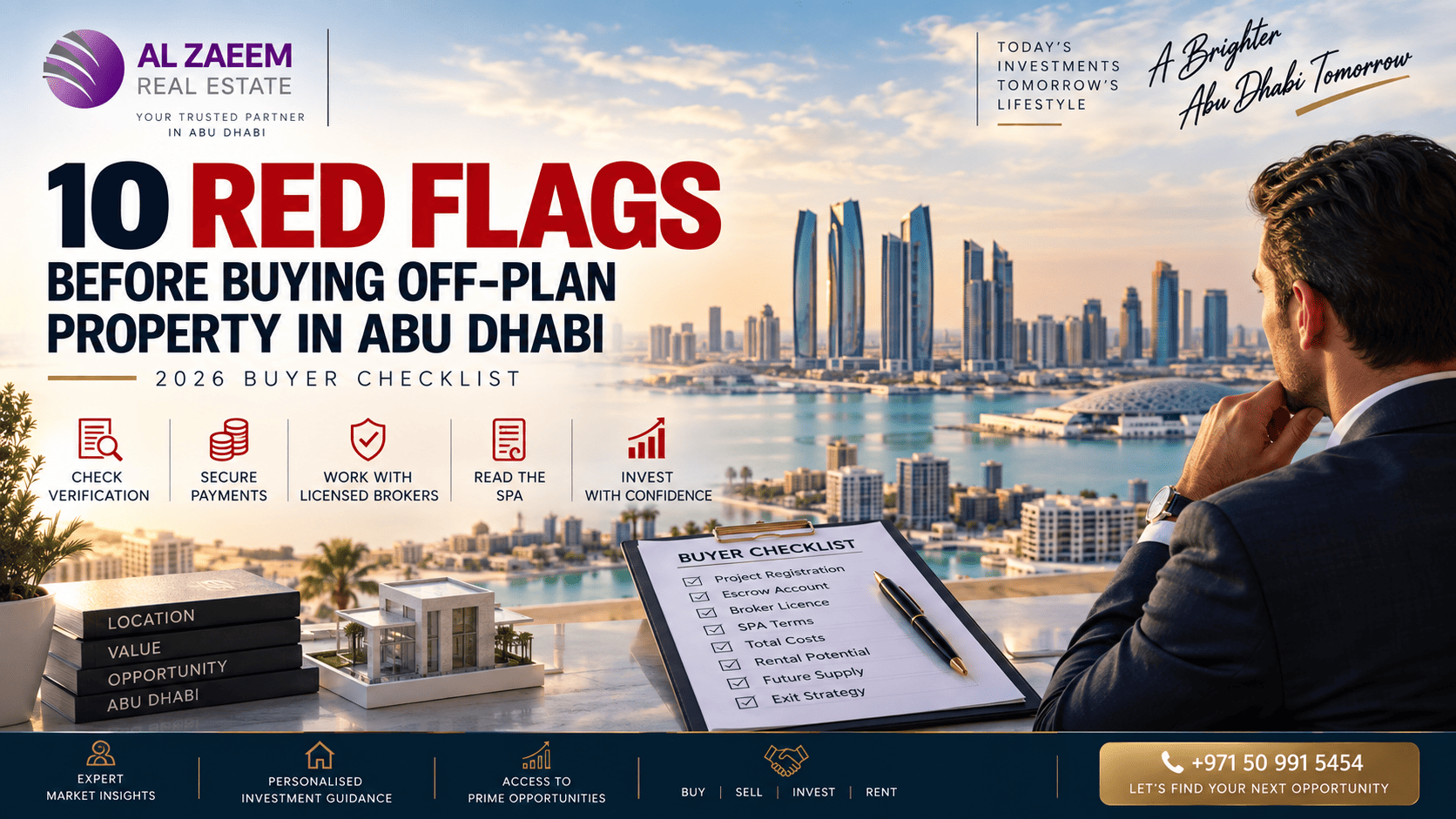
Here are ten warning signs that deserve attention before committing capital to any Abu Dhabi off-plan property.
Red Flag 1: You Cannot Verify the Project Through ADREC
This should be the first test.
Before discussing:
- view;
- layout;
- payment plan;
- ROI;
- handover;
- appreciation;
first establish that the project is properly registered.
ADREC states that every off-plan development must go through official project registration. Developers must submit project details including floor plans, unit types, prices and projected handover dates, and the project receives an official Project ID.
ADREC further states that off-plan projects must be registered, backed by a licensed escrow account and listed within the regulated framework before units can be marketed or sold.
That creates a straightforward question:
Can the person selling the property show you the official project registration and regulated listing trail?
If the answer becomes vague, slow or defensive, stop.
Statements such as:
“Registration is still processing.”
“It is a private pre-launch.”
“The developer is well known, so you do not need it.”
“The documents will come after the booking.”
should not replace regulatory verification.
A beautiful brochure is not a registration certificate.
A respected developer name is not a substitute for checking the exact project.
And a sales representative’s WhatsApp message is not legal documentation.
ADREC also provides document-verification services, including verification of Madhmoun permits.
What to verify
Before paying, identify:
Developer name
Project name
Project ID
Madhmoun permit where applicable
Exact unit
Official selling entity
The property should exist inside the regulated system, not merely inside a marketing presentation.
Red Flag 2: You Are Asked to Pay Into the Wrong Account
This is one of the most serious red flags.
Off-plan buyer funds are supposed to be protected through a project-specific escrow structure.
ADREC defines an escrow account as a regulated bank account dedicated to a particular development. Buyer funds are deposited into it and released according to verified construction milestones.
ADREC’s current developer framework explicitly states that buyer funds for registered off-plan sales are deposited into an ADREC-approved escrow account.
The underlying Abu Dhabi regulatory framework also requires developers selling off-plan to establish project escrow accounts and directs that amounts paid for off-plan units be deposited into the relevant project’s escrow account.
So be extremely cautious if you are instructed to transfer a substantial purchase payment to:
an individual’s personal account
a broker’s ordinary company account
an unrelated corporate entity
an overseas account with no clear project connection
or
a payment destination that cannot be matched to the official project documentation.
Reservation mechanics can differ between projects, so the exact payment procedure should always be checked against the developer’s official documents.
But you should know precisely:
who is receiving the money, why they are receiving it and how the payment is linked to your unit.
Do not let launch-day pressure override basic financial controls.
Red Flag 3: The Broker Cannot Produce a Valid Permit or Licence Trail
A professional-looking Instagram page does not make someone an authorised Abu Dhabi property broker.
Neither does:
a business card,
a luxury car,
a large WhatsApp group,
or thousands of social-media followers.
ADREC reported 3,302 licensed real-estate brokers in Abu Dhabi by H1 2026, while Madhmoun had already facilitated more than 41,200 regulated advertising permits.
ADREC says Madhmoun permits only licensed brokers holding valid credentials to advertise regulated listings.
Madhmoun was created specifically to improve reliability by providing verified listings, authentic advertising and real-time property information.
So if an agent tells you:
“Don’t worry about the permit.”
“We are getting the listing directly.”
“This one isn’t on the system yet.”
or
“Just send your passport and deposit first,”
you should become more cautious, not less.
The issue is not whether the broker seems trustworthy.
The issue is whether the transaction can be independently verified.
A better standard
Ask for the relevant:
broker licence details
listing permit
project information
and
official developer confirmation.
ADREC provides an online verification function for Madhmoun permits.
A legitimate transaction should become clearer when you ask for documentation.
Not more complicated.
Red Flag 4: The Sales Pitch Is Stronger Than the SPA
Off-plan buyers often spend hours examining:
renderings,
floor plans,
payment schedules,
views,
amenities,
pool decks,
beaches,
parks,
schools,
restaurants.
But the document that ultimately matters is the Sale and Purchase Agreement — SPA.
ADREC’s developer framework states that every off-plan sale is registered through an SPA and that the registered SPA becomes visible within the regulatory system.
Abu Dhabi regulations also require disclosures covering important property and project information, including estimated delivery dates and the buyer’s obligation to register the off-plan purchase.
The marketing team can promise:
“Amazing marina view.”
The SPA may say:
“View not guaranteed.”
The brochure can say:
“Luxury community.”
The contract may permit modifications to plans.
The salesperson can say:
“You can sell before handover.”
The SPA may impose assignment conditions.
The payment plan can look flexible.
The default clauses may be much less forgiving.
That is why a major red flag appears when a buyer is encouraged to:
sign first and read later.
Do not treat the SPA like a software terms-and-conditions page.
For a multimillion-dirham purchase, read it.
For larger transactions, consider having an independent UAE property lawyer review it.
Pay particular attention to
The SPA’s provisions on:
handover timing,
permitted delays,
unit-area adjustments,
plan changes,
payment defaults,
assignment or resale,
termination,
refunds,
service charges,
snagging,
force majeure,
and dispute procedures.
A glossy brochure sells the dream.
The SPA allocates the risk.
Red Flag 5: The Payment Plan Makes You Forget the Actual Property Price
Off-plan marketing frequently focuses on instalments.
For example:
“Only 5% now.”
“1% monthly.”
“60% during construction.”
“40% on handover.”
Those numbers can make an expensive property feel psychologically cheaper.
But a payment plan does not reduce the purchase price.
It only changes when you pay it.
Imagine Property A costs AED 2.0 million with a demanding payment schedule.
Property B costs AED 2.4 million with a very comfortable payment schedule.
Many buyers instinctively prefer Property B because the monthly cash requirement feels easier.
But you are still paying AED 400,000 more.
If the properties have similar:
size,
location,
quality,
rent potential,
and resale demand,
that extra AED 400,000 needs to be justified.
A payment plan should therefore be analysed as a financing characteristic, not as evidence of investment value.
Calculate the real exposure
You should know:
Total purchase price
Price per square foot
Cash required before handover
Amount due at handover
Financing requirement
Estimated registration costs
Service charges
Furnishing cost
Broker or administrative costs where applicable
Total capital invested before first rental income
The cheapest instalment is not always the cheapest property.
Red Flag 6: Everyone Talks About ROI, but Nobody Can Explain the Rent
One of the most common off-plan sales claims is:
“Expected ROI 8%.”
The immediate question should be:
8% based on what?
Projected rent?
Gross yield?
Net yield?
Today’s rents?
Future rents?
Developer guarantee?
Agent estimate?
Comparable ready property?
The Abu Dhabi rental market is currently strong. ADREC reported approximately 233,000 active residential leases during H1 2026, with new apartment leases rising 17% year-on-year and villa leases 9%; increases inside investment zones were even stronger.
But market strength does not validate every individual ROI forecast.
Suppose a property costs AED 2 million.
An agent forecasts AED 160,000 annual rent.
That looks like an 8% gross yield.
But then deduct:
service charges,
maintenance,
vacancy,
property management,
furnishing replacement,
and financing costs.
The return is different.
Now imagine that by handover several neighbouring projects deliver simultaneously.
Rent competition increases.
The projected AED 160,000 may become AED 140,000.
Again, the return changes.
Ask for evidence
A credible rental discussion should identify:
specific comparable buildings
actual unit sizes
achieved or registered rents where available
service-charge assumptions
tenant profile
and
future competing supply.
If someone can quote an 8% ROI but cannot name three comparable properties, treat the figure as marketing rather than analysis.
Red Flag 7: Nobody Discusses Future Supply
A strong market can hide supply risk.
Abu Dhabi had approximately 409,000 residential units in H1 2026, with another 71,000 projected through 2030. ADREC expects deliveries to peak in 2028.
That does not mean prices will fall.
Demand can grow too.
But it does mean investors should stop asking only:
“Is this area good?”
and start asking:
“How many similar homes will exist when I want to rent or sell?”
This is particularly important in large masterplans.
Imagine buying a two-bedroom apartment today.
By handover, the developer may launch:
Phase 2.
Phase 3.
A new neighbouring building.
A newer apartment with a better payment plan.
A competing community nearby.
Your future buyer may have many alternatives.
Supply risk is unit-specific
Not all units respond equally.
A common internal-facing apartment may face significant competition.
A permanent waterfront unit, rare corner layout, exceptional terrace, oversized plot or unusually low-density building may face much less.
This is why scarcity matters.
Not marketing scarcity.
Real scarcity.
Before buying, ask:
How many buildings are planned?
How many units have the same layout?
What undeveloped land surrounds the project?
Could the view be blocked?
What later phases will compete with me?
What major projects are handing over around the same time?
Our Abu Dhabi Off-Plan Handover Radar 2027 is useful precisely because future completions can materially change local rental and resale dynamics.
Red Flag 8: The View Exists Only in the Rendering
Few things sell premium real estate more effectively than a beautiful view.
Sea.
Marina.
Golf course.
Park.
Museum.
Mangroves.
Skyline.
But buyers often pay substantial premiums for views they have not independently verified.
A rendering is an illustration.
It is not a legal guarantee.
Before paying more for:
“full sea view”
“park view”
“museum view”
“marina view”
or
“open skyline,”
investigate what can actually be built nearby.
Ask for:
the masterplan,
plot map,
building orientation,
unit stack,
floor,
balcony direction,
nearby development parcels,
and any disclosure about future construction.
This becomes especially important when the project is early in a masterplan.
Today’s open desert may become tomorrow’s tower.
Today’s sea corridor may later be partially obstructed.
Today’s low-rise neighbourhood may gain additional construction.
The premium-view test
Ask yourself:
Would I still buy this unit at this price if the view becomes weaker than the rendering suggests?
If the answer is no, the view needs much deeper verification.
In luxury property, view permanence can be one of the largest determinants of resale value.
Red Flag 9: You Have No Exit Strategy
Many buyers know exactly how they will enter the investment.
Few know how they will exit.
They know:
reservation amount
monthly instalments
handover date
but have never decided whether they intend to:
resell before handover,
sell at completion,
rent long term,
use the property personally,
finance the final payment,
or hold for ten years.
That is a problem.
Abu Dhabi regulations provide for registration of off-plan assignments and recognise transfers of interests in units recorded in the initial real-estate register.
But actual resale mechanics also depend on the developer, SPA, payment progress and current project procedures.
Do not assume:
“I can always flip it.”
Some projects may require a specified percentage to be paid before assignment.
There may be administrative processes.
The future resale market may be weaker than launch demand.
And at handover, multiple investors may attempt to sell simultaneously.
Decide your Plan A and Plan B
A sensible investor should know:
Plan A: what I want to do.
Plan B: what I will do if prices do not rise.
For example:
Plan A — sell before handover.
Plan B — finance the balance and rent for five years.
If Plan B is financially impossible, the investment is more fragile than it appears.
Red Flag 10: You Are Buying Because Someone Says “Prices Will Go Up”
Abu Dhabi’s market is undeniably strong.
H1 2026 residential sales reached AED 70.4 billion. Foreign direct real-estate investment reached AED 13.8 billion, with investors from 116 nationalities participating.
That is impressive.
But market growth does not mean every property rises equally.
Apartment A can increase strongly.
Apartment B in the building next door can stagnate.
A rare villa can outperform.
A poorly positioned villa can struggle.
A launch can sell out and still provide mediocre resale returns.
“Abu Dhabi is booming” is not enough analysis for a specific purchase.
The correct question is:
Why should this exact property become more valuable?
A credible answer might include:
scarce waterfront position,
major infrastructure,
limited competing supply,
strong end-user demand,
large land component,
high-quality school access,
exceptional layout,
permanent view,
maturing masterplan,
or meaningful entry-price discount.
A weak answer sounds like:
“Everyone is buying.”
“Developer prices always rise.”
“This area is the next Saadiyat.”
“Launch sold out in one hour.”
“Prices can only go up.”
Real estate moves in cycles.
The objective is not to avoid every risk.
It is to understand which risk you are accepting and whether the price compensates you for taking it.
A Separate Red Flag: False Urgency
This one deserves special mention because it appears across many of the previous categories.
Good properties genuinely can sell quickly.
But urgency becomes dangerous when it prevents verification.
Phrases such as:
“Only five minutes to decide.”
“Send the booking amount now.”
“Someone else is taking your unit.”
“Price increases tonight.”
may sometimes reflect real launch dynamics.
But no property is worth bypassing fundamental checks.
If you do not yet know:
the project registration,
escrow details,
unit number,
official price,
payment schedule,
SPA terms,
or who is receiving your money,
you are not ready to transfer a large deposit.
A good investment should survive due diligence.
What Abu Dhabi’s Regulatory System Already Protects
The regulatory environment has strengthened materially.
ADREC states that:
- off-plan projects must be registered;
- developers need approved project escrow arrangements;
- buyer funds are deposited into regulated escrow accounts;
- registered SPAs form part of the official system;
- Madhmoun provides verified listings;
- licensed brokers and advertising permits improve traceability.
The underlying law also regulates developer licensing, project registration, escrow accounts, off-plan sales and purchaser disclosures.
In 2026, Abu Dhabi also introduced additional regulatory measures implementing the amended real-estate law, including measures relating to escrow disbursement, jointly owned properties and purchaser refunds in certain cancelled-unit scenarios.
That is encouraging.
But regulation protects the integrity of the market.
It does not guarantee your investment return.
ADREC cannot decide whether you overpaid for a third-floor internal unit with a weak layout.
That remains the investor’s job.
The Difference Between a Safe Transaction and a Good Investment
This distinction is essential.
A transaction can be legally compliant and still be a poor investment.
Imagine:
Registered developer.
Registered project.
Approved escrow.
Licensed broker.
Proper SPA.
Everything legally correct.
But you buy:
at a 25% premium,
in a weak location,
with a poor view,
inside a 2,000-unit project,
while three competing communities are about to complete.
The transaction may be completely legitimate.
The investment may still disappoint.
The best buyers therefore perform two types of due diligence.
Regulatory due diligence
Is the transaction properly structured?
Investment due diligence
Is the property actually worth buying?
You need both.
A Simple Off-Plan Decision Framework
Before reserving a property, reduce the decision to five questions.
1. Is it legitimate?
Verify the developer, project, broker, listing and payment destination through the official regulatory framework.
2. Is the price defensible?
Compare it with ready property and competing off-plan projects.
3. Is the unit strong?
Assess layout, floor, orientation, view, plot, privacy and scarcity.
4. Is future demand credible?
Identify the likely tenant and resale buyer.
5. Can I survive the downside?
Calculate what happens if prices remain flat, handover is delayed or resale takes longer than expected.
If the property still makes sense after those questions, the investment case is much stronger.
What Should You Verify Before Paying a Reservation?
At minimum, confirm the official project identity, developer, unit number, price, Madhmoun/ADREC verification trail where applicable, payment destination, escrow details, payment plan, handover schedule, unit plan, SPA conditions, assignment provisions, expected ownership costs and any premium being charged for view or positioning.
ADREC’s verification service allows users to authenticate certain documents and Madhmoun permits directly.
That is a better starting point than trusting screenshots forwarded through WhatsApp.
Abu Dhabi Registration Costs
Buyers should also budget for transaction costs beyond the advertised property price.
ADREC’s published regulatory framework lists a 2% fee for registering off-plan sale dispositions, split equally between seller and buyer under the cited schedule, subject to the applicable rules and limits.
Actual buyer costs can depend on the transaction and developer arrangement, so current charges should always be confirmed before purchase.
The broader lesson is simple:
Do not calculate affordability using only the advertised unit price.
Ask for a complete payment schedule.
FAQs — Buying Off-Plan Property in Abu Dhabi
Is buying off-plan property legal in Abu Dhabi?
Yes. Off-plan property is a major regulated segment of Abu Dhabi’s real-estate market. Developers and projects must satisfy ADREC’s registration and regulatory requirements before authorised off-plan marketing and sales.
What is an escrow account?
It is a regulated bank account dedicated to a particular real-estate development. Off-plan buyer funds are deposited into the account and released according to verified construction milestones.
How do I verify an Abu Dhabi property listing?
ADREC’s Madhmoun system provides verified property listings and advertising permits, and ADREC also offers a permit-verification service.
Should an off-plan SPA be registered?
Yes. ADREC states that off-plan sales are registered through the SPA process within its regulatory framework.
Can I sell an Abu Dhabi off-plan unit before handover?
Off-plan interests can be assigned within Abu Dhabi’s regulatory framework, but the applicable developer requirements, SPA terms, payment thresholds and registration procedures must be checked for the specific property.
Is off-plan safer when buying from a large developer?
Large developers may provide stronger delivery histories and financial visibility, but developer size does not eliminate unit-level investment risk. Price, location, supply, layout and future demand still matter.
Is a sold-out project automatically a good investment?
No. A sell-out proves strong launch demand, not future resale demand.
Are projected rental yields guaranteed?
Not unless a properly documented guarantee exists and you understand its conditions. Marketing yield estimates should otherwise be treated as projections.
Is the advertised handover date guaranteed?
Not necessarily. The SPA and official developer documentation should be reviewed for completion provisions, permitted delays and remedies.
Should I buy immediately if a launch is almost sold out?
Only after the key regulatory, contractual and investment checks have been completed. Scarcity should not eliminate due diligence.
Final Takeaway
Abu Dhabi’s off-plan market is larger, more international and more regulated than it has ever been.
That is positive for buyers.
But the rapid growth of the market also means investors need to become more sophisticated.
The biggest mistakes are rarely caused by failing to admire the project.
They come from failing to investigate:
the contract, the price, the unit, the future competition and the exit.
Remember the ten red flags:
- The project cannot be independently verified.
- Payment instructions are unclear or inconsistent with the regulated escrow structure.
- The broker or advertising permit cannot be verified.
- Marketing promises are stronger than the SPA.
- The payment plan distracts from the total price.
- ROI is quoted without defensible rental evidence.
- Future supply is ignored.
- The premium view exists only in the rendering.
- There is no realistic exit strategy.
- The entire investment thesis is simply “prices will rise.”
A strong off-plan purchase should withstand all ten tests.
For buyers comparing Abu Dhabi launches, resale alternatives and ready properties, Al Zaeem Real Estate can help assess the actual unit, pricing, location, competing supply and exit strategy before purchase.
Call: +971 50 991 5454
Abu Dhabi, UAE
Useful Al Zaeem resources: Abu Dhabi Off-Plan Properties · Abu Dhabi Real Estate Knowledge Hub · Abu Dhabi Property Investor Insights
Primary Official Sources
ADREC’s Project Development framework explains project registration, escrow, Madhmoun licensing and SPA registration.
ADREC’s FAQs explain how project escrow accounts protect off-plan buyers.
ADREC’s regulatory materials cover off-plan disclosures, assignments, registration and escrow obligations under Abu Dhabi’s real-estate framework.
ADREC’s H1 2026 market report provides current off-plan sales, rental and future-supply data.
Disclaimer
This article is general real-estate information, not legal, financial, mortgage or tax advice. Regulations, fees, project terms, payment plans and developer procedures can change. Buyers should verify current details through ADREC, official developer documentation, the applicable SPA and independent professional advice before committing funds.