



Abu Dhabi enters the next four years from an unusually strong starting point.
In H1 2026, residential sales reached AED 70.4 billion, repeat-sale apartment prices were 20% higher year-on-year, villa prices were 12% higher, and new residential lease prices rose 17% for apartments and 9% for villas. Off-plan transactions accounted for 89% of residential sales value.
Foreign capital has also expanded sharply. Abu Dhabi recorded AED 13.8 billion of real-estate foreign direct investment in H1 2026, with non-resident investors from 116 nationalities active in the market.
But the next phase will not simply be a continuation of 2026.
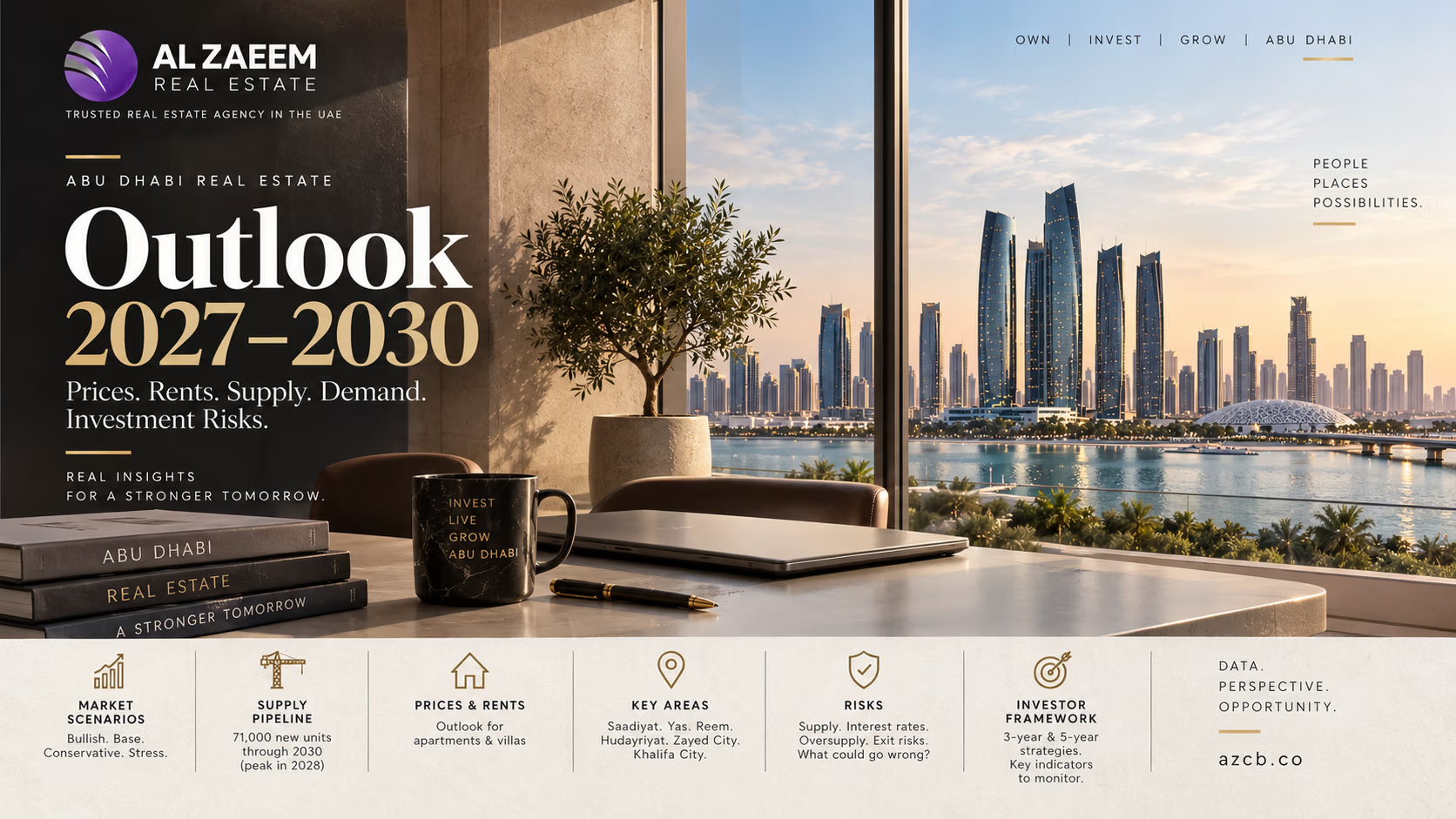
Approximately 71,000 additional residential units are currently projected through 2030, equivalent to roughly 17% of today’s approximately 409,000-unit residential stock. Deliveries are expected to peak at approximately 21,800 units in 2028.
That creates a more complicated investment environment.
The key questions for 2027–2030 are no longer only:
Will Abu Dhabi property continue growing?
They are:
How much of the 2026 price and rental growth can be sustained?
Will population, jobs and foreign investment absorb the new housing pipeline?
What happens when the 2028 handover wave reaches the rental and resale markets?
Which properties remain scarce when buyers have more choice?
And perhaps most importantly:
Can an investment still work if the market becomes normal rather than exceptional?
This guide does not attempt to predict exact future prices.
Instead, it builds a scenario-based outlook using the latest official market, supply, demand and economic data available in September 2026.
Quick Answer: Our 2027–2030 View
The evidence currently supports a constructive but increasingly selective outlook.
Abu Dhabi has strong demand foundations:
- population expansion;
- economic and business growth;
- deep rental demand;
- increasing foreign participation;
- strong domestic buying;
- international destination development.
At the same time, supply is accelerating substantially, especially around 2028.
The likely implication is not simply:
prices rise
or
prices fall.
A more realistic expectation is greater divergence between:
strong and weak locations;
scarce and interchangeable properties;
ready and speculative off-plan stock;
good and poor entry prices;
and
projects with genuine end-user demand versus projects driven primarily by investor launches.
Scenario Framework
| Scenario | 2027–2030 Environment | Likely Market Character |
|---|---|---|
| Strong | Demand continues to outpace new supply | Rents and prices remain resilient; prime assets outperform |
| Base | Demand grows, but supply catches up | Moderate growth, greater buyer choice, wider performance differences |
| Conservative | Supply arrives faster than demand | Rent pressure, slower resales, discounts in weaker projects |
| Stress | Demand weakens while deliveries remain high | Higher vacancy, price corrections in vulnerable segments |
These are analytical scenarios, not forecasts.
The 2026 Starting Point Matters
Future property-market analysis must begin with today’s valuation environment.
Abu Dhabi is not entering 2027 after a weak period.
It is entering from strong momentum.
ADREC reports that in H1 2026:
- apartment repeat-sale prices increased 20% year-on-year;
- villa repeat-sale prices increased 12%;
- residential sales reached AED 70.4 billion;
- off-plan represented 89% of residential sales value and 82% of transactions;
- 233,000 active residential leases were registered;
- new apartment lease prices increased 17%;
- new villa lease prices increased 9%.
This creates both an opportunity and a risk.
The opportunity is obvious:
demand is strong.
The risk is less obvious:
investors buying after a large price increase may have less margin for error than investors who entered before the increase.
Do Not Extrapolate 2026 Growth Into 2030
Suppose apartment values rose 20% every year for four more years.
A AED 2 million property would theoretically exceed AED 4.1 million.
That is not a sensible base-case assumption.
Likewise, assuming:
17% annual rent growth
every year because apartments recorded that increase recently would create unrealistic long-term models.
Strong historical growth should be treated as:
evidence of momentum
not
a guaranteed future growth rate.
The more strongly a market has already appreciated, the more important entry valuation becomes.
2027 Outlook — Transition From Momentum to Selectivity
2027 could be one of the most informative years in the current cycle.
By then, buyers will have more evidence on:
actual project handovers;
rent absorption;
secondary-market activity;
developer inventory;
mortgage conditions;
and whether current foreign-investment momentum continues.
ADREC’s H1 2026 data still indicates demand outpacing supply, but the supply pipeline is already expanding.
The key 2027 question may therefore be:
Does demand remain strong enough that new supply is absorbed without meaningful concessions?
If yes, that would strengthen the case for continued market resilience into 2028.
What Could Support Prices in 2027?
Several current fundamentals are supportive.
Abu Dhabi’s population reached approximately 4.136 million in 2024, after increasing 7.5% in one year and 51% over a decade.
The economy grew 7.7% year-on-year in Q3 2025, while the non-oil economy expanded 7.6%. Across the first nine months of 2025, non-oil GDP increased 6.8%.
Business creation also remains positive: new economic licences increased 21% year-on-year in Q1 2026, while active licences increased 12%.
Those factors can support:
employment;
household formation;
rental demand;
and eventual homeownership.
But the property market still needs to convert economic growth into actual housing demand.
2028 Outlook — The Handover Test
2028 is currently the most important year in the forward supply schedule.
ADREC expects approximately:
21,800 residential deliveries
during 2028.
That is the current projected peak through 2030.
This is where the Abu Dhabi investment story becomes much more property-specific.
What Happens When 21,800 Homes Arrive?
Three broad outcomes are possible.
Outcome 1 — Strong Absorption
Population and employment keep expanding.
International buying remains strong.
New communities attract end users.
Rental inventory is occupied relatively quickly.
In this case, the supply wave may moderate growth without creating serious market stress.
Outcome 2 — Competitive Absorption
Demand remains healthy, but tenants and buyers gain more choice.
Landlords compete on:
price;
quality;
furnishing;
maintenance;
payment flexibility.
Prices may continue rising in scarce locations while interchangeable units become flatter.
Outcome 3 — Supply Pressure
Too many similar investor-owned units complete simultaneously.
Landlords discount.
Secondary sellers compete.
Developers continue offering new units with attractive payment plans.
That could put specific projects or unit types under pressure even if Abu Dhabi as a whole remains healthy.
The 2028 Risk Is Concentrated, Not Uniform
Six districts are expected to account for 77% of incremental residential supply through 2030:
Saadiyat Island
Al Reem Island
Yas Island
Zayed City
Khalifa City
Hudayriyat Island.
This means the 2028 question cannot be answered from an Abu Dhabi-wide number alone.
A rare beachfront villa does not face the same competitive environment as:
a one-bedroom apartment;
in a high-density project;
where hundreds of similar units hand over simultaneously.
2029–2030 Outlook — The Market Starts Revealing the Winners
By 2029 and 2030, much of today’s off-plan pipeline will either:
be completed;
be occupied;
be on the rental market;
or be competing in the secondary market.
That could make these years particularly revealing.
Projects will increasingly be judged on:
actual maintenance;
actual rents;
actual service charges;
actual community life;
actual resale transactions;
rather than brochures.
For long-term investors, this transition matters.
From “Project Story” to “Asset Performance”
Off-plan property can initially be sold on expectations:
beautiful renderings;
future amenities;
launch prices;
payment plans.
After completion, the market becomes much less theoretical.
Buyers can compare:
Building A
against
Building B
in real life.
That tends to reward projects that actually deliver on:
quality;
location;
maintenance;
design;
amenities;
and community demand.
By 2029–2030, the difference between brand promise and operating reality may become a major determinant of resale performance.
Abu Dhabi Price Outlook 2027–2030
No responsible adviser should give buyers a guaranteed percentage forecast.
Instead, price behaviour should be understood through several forces.
Positive forces
Population growth
Economic expansion
Foreign capital
Limited truly prime locations
High rental demand
Strong international profile
Community development
Negative forces
Rising supply
High entry valuations
Investor resale concentration
Mortgage affordability
Competing developer inventory
Potential global economic weakness
The balance between these forces will determine pricing.
Base-Case Price Scenario
A reasonable analytical base case is not:
“prices keep rising 20%.”
It is:
Growth slows from exceptional 2026 levels and becomes increasingly differentiated.
Under this type of environment:
prime and scarce assets could remain resilient;
maturing communities could continue appreciating;
average projects may experience slower growth;
highly interchangeable units may remain flat for periods;
poorly priced units may correct.
Again, this is a scenario — not an Al Zaeem price forecast.
Strong Price Scenario
A stronger-than-base outcome could occur if:
population growth remains high;
new business formation continues;
foreign investment expands;
supply is delayed;
rents remain strong;
and investor confidence continues.
Under that scenario, the 2028 pipeline could be absorbed relatively smoothly.
Prime waterfront, villa and limited-stock segments might maintain stronger pricing power.
Conservative Price Scenario
A conservative scenario could include:
slower foreign inflows;
higher financing costs;
large simultaneous handovers;
more secondary listings;
weaker rental growth.
Under this environment:
headline Abu Dhabi values might remain relatively stable while weaker sub-markets experience declines.
This is why a market average can hide significant investment losses.
Apartment Outlook
Apartments recorded stronger recent price appreciation than villas:
20% versus 12% year-on-year in H1 2026 repeat-sale data.
That does not mean apartments should automatically outperform through 2030.
Apartment investors need to watch:
new tower deliveries;
one-bedroom and studio concentration;
service charges;
building age;
rental affordability;
investor-owned inventory.
Apartment demand can remain strong because of the emirate’s growing professional population, but supply can also expand faster than villa stock in certain districts.
Villa Outlook
Villas may benefit from:
family demand;
land scarcity;
privacy;
larger living space;
limited prime plots.
However, villa investment economics can be affected by:
higher entry prices;
maintenance;
community fees;
lower buyer liquidity in upper price brackets.
The most defensible villa investments are likely to be properties where the land/community proposition is difficult to replicate rather than villas bought simply because they are villas.
Rental Outlook 2027–2030
The rental market currently begins from strong conditions.
ADREC recorded:
233,000 active residential lease contracts
worth:
AED 9.3 billion
in H1 2026.
New lease prices were up 17% for apartments and 9% for villas. Within investment zones, increases were 21% and 16%.
But rent outlook requires an important 2026 regulatory caveat.
Abu Dhabi’s Temporary 0% Renewal Increase Measure
In June 2026, Abu Dhabi temporarily changed the annual rental increase percentage from 5% to 0% for tenancy contract renewals, until further notice. ADREC said the measure was introduced after several years in which demand had exceeded supply and occupancy reached record highs.
As of September 2026, this is still an important part of the market framework.
Because it is explicitly temporary, buyers should not assume the same rule will necessarily remain unchanged through 2027–2030.
But while it remains in place, it can create a distinction between:
existing lease economics
and
new-market rents.
Why This Matters for Landlords
Suppose market rent increases.
A vacant unit may potentially be exposed to a different leasing situation from an occupied unit subject to renewal restrictions.
This means investors should not blindly calculate future rental income using:
“current advertised rent × assumed annual growth.”
Instead, check:
current tenancy status;
Tawtheeq contract;
renewal rules;
market rent;
and the applicable regulation at the time.
Our Rental Base Case
A sensible 2027–2030 analytical assumption would be:
rental growth normalises from recent double-digit rates as new supply arrives.
That does not mean rents must fall.
If population and employment continue expanding, rents could continue increasing.
But expecting:
17%;
21%;
or similarly large annual increases
for several consecutive years would be aggressive.
What Could Keep Rents Strong?
Rental strength could continue if:
new households grow quickly;
employment expands;
occupancy remains high;
construction deliveries slip;
prime areas remain scarce;
new supply targets higher price brackets rather than mass affordability.
ADREC has already described demand as continuing to outpace supply in its H1 2026 market reporting.
What Could Pressure Rents?
Rental growth could weaken where:
many identical units hand over;
landlords rely heavily on investors rather than residents;
tenant affordability becomes stretched;
older buildings compete with newer stock;
large new communities deliver before population fully arrives.
The most exposed properties are often not necessarily the most expensive.
They are the most replaceable.
Supply Outlook Through 2030
Current residential stock:
~409,000 units
Projected additional stock:
~71,000 units
through 2030.
That pipeline equals approximately 17.4% of current stock.
But this does not mean Abu Dhabi has “17% oversupply coming.”
Demand will grow during the same period.
Some scheduled properties will also:
delay;
change phases;
or enter different segments.
The correct supply question remains:
How much comparable supply is coming?
Development Projects Will Dominate New Supply
ADREC estimates that development projects will account for 77% of Abu Dhabi Region supply growth between H2 2026 and 2030, compared with 23% arising from building permits.
That matters because large development projects can deliver:
many similar properties;
within defined phases;
over concentrated time periods.
This can create strong destination development — but also intense project-level competition.
Developer Concentration Matters
Nine major developers account for approximately 76% of the development-project pipeline, while the ten largest developers accounted for 90% of primary off-plan residential sales in H1 2026.
This means developers themselves can become competitors to secondary sellers.
Imagine selling a three-year-old off-plan contract while the developer still offers:
new phases;
newer specifications;
lower initial deposits;
longer payment plans.
A secondary unit needs a compelling advantage.
Demand Outlook Through 2030
The supply question cannot be answered without the demand side.
Current demand has several measurable foundations.
Population
Abu Dhabi’s population reached 4,135,985 in 2024, increasing 7.5% year-on-year.
Over ten years, population increased 51%.
If strong demographic growth continues, it would substantially improve the market’s ability to absorb new homes.
But the exact 2027–2030 population trajectory is not yet known.
Investors should therefore monitor actual annual releases instead of assuming 7.5% growth continues permanently.
Foreign Investment
Real-estate FDI reached:
AED 13.8 billion in H1 2026
up:
309% year-on-year.
Non-resident investors came from 116 nationalities.
Diversified international participation is a powerful demand signal.
But international investors can also be sensitive to:
global interest rates;
exchange rates;
geopolitical events;
alternative investment markets.
A property’s long-term case is stronger when it can appeal to local residents as well as international investors.
Expatriate and International Buyer Demand
Resident expatriates and non-resident foreign buyers together represented 70% of residential sales value in H1 2026. Emirati buyers separately committed AED 21 billion.
That means Abu Dhabi currently benefits from both:
domestic purchasing
and
international/expatriate capital.
This diversified buyer base is positive for liquidity.
Jobs and Business Expansion
New economic licences increased 21% in Q1 2026, while active licences increased 12%.
Abu Dhabi’s non-oil economy also recorded substantial recent growth.
For real estate, this matters because sustainable housing demand ultimately needs:
employment;
income;
and household formation.
A launch can generate buyers temporarily.
Jobs create residents.
Tourism and Destination Development
Abu Dhabi welcomed 26.6 million visitors in 2025, including 5.9 million hotel guests, while international hotel guests increased 10%. MICE delegates reached approximately 2.2 million.
Tourism should not be treated as equivalent to permanent residential demand.
However, international visibility can support:
employment;
business relocation;
holiday homes;
hospitality;
destination awareness;
and overseas investor interest.
Mortgage and Interest-Rate Risk
Property buyers sometimes analyse the property and ignore the financing environment.
That is a mistake.
Mortgage affordability can directly influence:
buyer demand;
bank valuations;
ready-market liquidity;
and investor cash flow.
Rather than predicting future mortgage rates, investors should test several possibilities.
Mortgage Sensitivity Example
Suppose:
Property price: AED 2,000,000
Mortgage: AED 1,200,000
Term: 25 years
For illustration:
| Mortgage Rate | Approx. Annual Debt Service |
|---|---|
| 4.0% | AED 76,000 |
| 4.5% | AED 80,000 |
| 5.5% | AED 88,400 |
| 6.5% | AED 97,200 |
These figures are mathematical illustrations only and exclude lender-specific fees, insurance and other finance costs.
A movement from 4% to 6.5% increases annual debt service by more than:
AED 21,000.
If the property’s NOI is only AED 100,000, that difference is substantial.
Financing Conditions Can Affect Prices Even for Cash Owners
A cash investor may say:
“Interest rates don’t affect me.”
Directly, perhaps not.
Indirectly, they can.
Your future buyer may need a mortgage.
If financing becomes more expensive, their purchasing power may fall.
That can reduce:
the number of buyers;
the price they can afford;
or the speed at which you can exit.
Mortgage conditions are therefore part of property liquidity even for cash investors.
Off-Plan Outlook 2027–2030
Off-plan dominates the current Abu Dhabi residential market.
That makes the next few years particularly important.
Today’s off-plan boom becomes:
tomorrow’s construction;
then tomorrow’s handover;
then tomorrow’s ready-market inventory.
What Could Support Off-Plan?
Strong developers
Destination development
Early-stage pricing
Payment flexibility
Scarce units
Community growth
Foreign demand
Off-plan can remain attractive where the buyer enters at a defensible price and the final product has genuine demand.
What Could Hurt Off-Plan?
Late-cycle buying
High launch premiums
Too many similar phases
Large handover balances
Weak mortgage valuations
Developer inventory competing at resale
Simultaneous investor exits
The key question is not:
“Is off-plan good?”
It is:
“Is this off-plan property’s future ready-market value defensible?”
Ready-Property Outlook
Ready property may become increasingly important as the market matures.
It offers measurable:
rent;
service charge;
condition;
occupancy;
resale evidence;
and community quality.
ADREC reports that 61% of ready-market residential purchases in H1 2026 were completed in cash, indicating substantial liquidity outside the off-plan market.
Ready Property Could Benefit From 2027–2028 Uncertainty
Some buyers may prefer:
immediate possession;
known costs;
actual rental income;
existing communities.
That can support quality ready properties while large numbers of off-plan projects remain under construction.
But after new stock completes, older buildings may face stronger competition.
Age Will Matter More by 2030
By 2030, an apartment that is already:
10;
15;
or 20 years old
may be competing against thousands of newer units.
Older properties will need advantages such as:
superior location;
lower service charges;
larger layouts;
better pricing;
established rental demand.
Otherwise, physical obsolescence can affect value.
Area Outlook: Saadiyat Island
Saadiyat recorded approximately AED 13.3 billion of residential sales in H1 2026 and is also one of the six districts expected to drive most incremental supply through 2030.
Positive factors
Cultural significance
Beaches
Premium positioning
Global recognition
Limited truly prime land
Risk factors
High entry prices
Future luxury supply
Large differences between prime and average units
Saadiyat’s outlook should therefore be property-specific rather than island-wide.
A rare beachfront asset can have a very different competitive position from a high-density apartment.
Area Outlook: Yas Island
Yas generated approximately AED 7.3 billion of residential sales in H1 2026 and is another major future-supply district.
Its demand base can potentially draw from:
families;
professionals;
tourism;
international investors;
leisure-driven residents.
The risk is that “Yas Island” becomes too broad a label.
Different Yas communities can have completely different:
tenant pools;
prices;
and supply dynamics.
Area Outlook: Al Reem Island
Reem already has approximately 27,500 residential units, making it the largest existing investment-zone stock cited by ADREC. It is also among the major future supply-growth districts.
This creates both:
competition
and
market depth.
The strongest Reem properties through 2030 may increasingly be those that distinguish themselves through:
maintenance;
location;
layout;
views;
pricing;
service-charge efficiency.
Area Outlook: Hudayriyat Island
Hudayriyat recorded approximately AED 19 billion of residential sales in H1 2026, representing 27% of residential sales value during the period, while also appearing among the key future-supply districts.
Hudayriyat is therefore a major test of whether:
large-scale supply
can be matched by
large-scale destination demand.
Its long-term outcome will depend heavily on execution, community maturity and differentiation.
Area Outlook: Zayed City and Khalifa City
Both are expected to contribute significantly to future residential supply.
These areas may benefit from:
population growth;
family demand;
relative affordability;
community expansion.
They also illustrate why supply can be constructive.
More residents can support:
schools;
retail;
services;
infrastructure.
The investor question is whether those amenities mature quickly enough to absorb the homes being delivered.
What Could Go Right Through 2030?
A strong Abu Dhabi outcome could look like this:
Population continues expanding.
Non-oil economic growth remains robust.
New businesses bring workers.
Foreign investment remains diversified.
Rent growth normalises but remains positive.
2028 deliveries are absorbed without major vacancy.
New communities become functional destinations.
Ready-market liquidity strengthens.
In this environment, supply expansion could actually help Abu Dhabi grow into a deeper and more mature residential market.
What Could Go Wrong?
A weaker scenario could look like:
Population growth slows.
Foreign investor activity drops.
Many 2028 properties are investor-owned.
New tenants cannot absorb them quickly.
Developers continue competing with resellers.
Rental incentives increase.
Older projects lose appeal.
Bank valuations become conservative.
Highly leveraged investors need to exit.
Under that scenario, specific property segments could correct meaningfully.
Biggest Investment Risks Through 2030
1. Buying Too Expensively
The property can perform well operationally but still generate poor return if entry price is excessive.
2. Handover Concentration
Especially around 2028.
3. Investor-to-Investor Resale
If your future buyer must also be another investor rather than an end user.
4. Developer Competition
New phases with superior payment plans can weaken secondary resale.
5. Rental Normalisation
Recent double-digit rent growth may slow.
6. Mortgage Affordability
Higher financing costs can reduce buyer purchasing power.
7. Building Obsolescence
Newer properties can pressure older buildings.
8. Service Charges
High operating costs weaken net returns.
9. Global Capital Reversal
Foreign investment can change quickly.
10. Assuming Appreciation
An investment that requires constant price growth is vulnerable.
Which Properties May Be More Defensive?
No property is guaranteed defensive, but stronger characteristics can include:
genuine scarcity;
prime waterfront;
limited plots;
efficient layouts;
broad buyer pool;
reasonable service charges;
strong tenant demand;
established community;
credible developer;
competitive entry price.
A property becomes vulnerable when the opposite characteristics accumulate.
2027–2030 Investor Timeline
| Year | Main Question |
|---|---|
| 2027 | Is demand absorbing the first expansion in supply? |
| 2028 | How does the market handle the projected 21,800-unit delivery peak? |
| 2029 | Which projects retain rents and resale liquidity after handover? |
| 2030 | Which communities have become durable residential markets rather than launch stories? |
This is a more useful timeline than trying to predict one percentage price increase for each year.
A Three-Year Investor Strategy
For someone planning a relatively short exit:
focus strongly on:
entry price;
handover timing;
assignment restrictions;
developer inventory;
comparable resale supply;
transaction costs.
Shorter holding periods leave less time for rental income or community maturity to recover an expensive purchase.
A Five-Year Investor Strategy
A five-year investor can evaluate:
rental income;
community development;
capital growth;
mortgage principal reduction;
longer-term population demand.
This reduces dependence on one specific market year.
But five-year investors still need to avoid overpaying.
Time does not automatically repair bad valuation.
The 0% Appreciation Test
One of the strongest investment tests is:
Would I still buy this property if its market value did not increase for three years?
Suppose the answer is yes because:
rental yield is strong;
location is excellent;
cash flow works;
you intend to live there;
or the asset serves a long-term wealth goal.
That is a more resilient investment.
If the investment makes sense only because:
“It should go up 20%,”
the thesis is much weaker.
The −10% Stress Test
Now ask:
What if the property falls 10%?
A AED 2 million property becomes:
AED 1.8 million.
If bought cash, the paper loss is AED 200,000.
If the investor originally contributed only AED 800,000 equity, the same AED 200,000 loss equals:
25% of initial equity
before costs.
This is why leverage changes risk.
20 Indicators Al Zaeem Investors Should Monitor Through 2030
- Population growth
- Active residential leases
- New-lease prices
- Vacancy
- Ready-market transaction volume
- Repeat-sale price growth
- Off-plan share
- New project launches
- Actual handovers
- 2028 delivery revisions
- Developer inventory
- Secondary listing volume
- Foreign investment
- Number of international buyer nationalities
- Mortgage transaction value
- Bank valuations
- New business licences
- Office occupancy
- Service-charge trends
- Days required to rent or resell comparable units
No one metric determines the market.
The trend across several metrics is what matters.
Frequently Asked Questions
Will Abu Dhabi property prices rise between 2027 and 2030?
They may, but no future appreciation rate can be guaranteed. Current demand is strong, while substantial new supply is also scheduled. Performance is likely to vary increasingly by property and district.
What is the biggest risk to Abu Dhabi property between 2027 and 2030?
One of the most important is the interaction between new supply and demand, particularly around the projected 2028 handover peak.
How many new homes are coming?
ADREC currently projects approximately 71,000 additional residential units through 2030.
When will supply peak?
Current projections indicate approximately 21,800 deliveries in 2028.
Does that mean Abu Dhabi will be oversupplied?
No. Oversupply depends on whether demand can absorb comparable new stock. ADREC’s latest reporting says demand currently continues to outpace supply.
Are Abu Dhabi property prices currently rising?
Yes. H1 2026 repeat-sale prices increased 20% year-on-year for apartments and 12% for villas.
Will prices continue rising at 20% per year?
That should not be assumed. The 20% figure is recent historical apartment repeat-sale growth, not a future forecast.
Are rents likely to keep rising?
They may remain supported by population and employment growth, but substantial new supply could moderate growth. Current double-digit rent increases should not automatically be extrapolated.
What is the current Abu Dhabi rental increase rule?
As of September 2026, Abu Dhabi has temporarily set annual rental increases on tenancy renewals at 0% until further notice. The measure may change in the future.
Is off-plan still attractive for 2027–2030?
Potentially, but buyers should analyse entry price, handover year, remaining phases, developer inventory and future ready-market competition.
Is ready property safer?
Ready property removes construction uncertainty and provides actual rental and operating data, but it still carries market, maintenance and valuation risk.
Are apartments or villas better positioned?
Neither universally. Recent apartments have shown stronger price and rent growth, but future performance will depend on location, scarcity and supply.
Which Abu Dhabi areas have the strongest outlook?
There is no single answer. Saadiyat, Yas, Reem/Maryah and Hudayriyat currently show substantial transaction activity, while several of these areas also have significant future supply.
Is Saadiyat likely to remain strong?
Saadiyat has strong scarcity, cultural and lifestyle characteristics, but future supply and entry pricing still matter.
What is the key risk on Yas Island?
Future supply and project-level competition need to be weighed against strong lifestyle, tourism and residential demand.
What should Reem investors watch?
New supply, building age, service charges, rental competitiveness and differentiation between existing and newer stock.
Why is Hudayriyat important?
It recorded AED 19 billion of residential sales in H1 2026 and is also a major future supply district, making it an important test of destination-led demand.
Will population growth support housing?
Population growth is a fundamental housing-demand driver. Abu Dhabi reached approximately 4.136 million residents in 2024 after 7.5% annual growth.
Is foreign investment still strong?
Real-estate FDI reached AED 13.8 billion in H1 2026, with investors from 116 nationalities.
Should I wait until 2028 before buying?
Not necessarily. Timing depends on the property, purchase price, holding period and investor objectives. A strong property at an attractive valuation may make sense before 2028; a weak property does not automatically become attractive simply because you wait.
Can Al Zaeem guarantee the 2027–2030 outlook?
No. Future property prices, rents, interest rates and supply absorption cannot be guaranteed. The purpose of an outlook is to understand possible scenarios and position an investment accordingly.
Final Takeaway
Abu Dhabi enters 2027 from a position of exceptional momentum.
H1 2026 residential sales reached:
AED 70.4 billion.
Apartment repeat-sale prices increased:
20%.
Villa prices increased:
12%.
Real-estate foreign direct investment reached:
AED 13.8 billion.
The emirate also has strong economic and demographic foundations.
Population reached more than:
4.1 million
in the latest annual official count, while recent economic and business-licensing data continues to show expansion.
But the next phase will be different.
Approximately:
71,000 new residential units
are projected through 2030.
And:
2028 is currently expected to bring approximately 21,800 deliveries.
That does not make the outlook bearish.
It makes it more selective.
From 2027 onward, investors should expect the market to increasingly distinguish between:
real scarcity and manufactured scarcity;
actual end-user demand and launch demand;
strong communities and interchangeable projects;
sensible valuations and momentum pricing.
The strongest investment question for 2027–2030 is therefore not:
“How much will Abu Dhabi go up?”
It is:
“If market growth slows, new supply arrives and buyers gain more choice, why will they still want my property?”
If the answer is:
strong location;
real scarcity;
deep tenant demand;
competitive costs;
credible developer;
broad resale buyer pool;
and a defensible entry price,
then the property has a much stronger chance of performing across different market conditions.
That is how investors should approach Abu Dhabi’s next real-estate cycle.
Al Zaeem Real Estate — Invest for the Next Market, Not the Last One
Al Zaeem Real Estate can help buyers analyse Abu Dhabi opportunities using:
current transaction evidence;
ready and off-plan comparisons;
future supply;
rental demand;
developer strength;
service charges;
payment plans;
resale liquidity;
and
property-specific risk scenarios.
This article should naturally connect with:
Abu Dhabi Property Demand Drivers 2026
Abu Dhabi Property Supply Pipeline 2026
Abu Dhabi Property Appreciation 2026
Abu Dhabi Property ROI Calculator 2026
Abu Dhabi Property Taxes & Annual Ownership Costs 2026
Abu Dhabi Property Fees & Closing Costs 2026
Abu Dhabi Off-Plan vs Ready Property 2026
Abu Dhabi Off-Plan Payment Plans Compared 2026
and Best Areas to Invest in Abu Dhabi 2026.
Confirmed internal pages:
Abu Dhabi Property Investor Insights
Abu Dhabi Real Estate Knowledge Hub
Al Zaeem Real Estate: +971 (50) 991 5454
Disclaimer
This article is provided for general educational and real-estate research purposes only and does not constitute financial, investment, mortgage, legal, tax or property-valuation advice.
The 2027–2030 strong, base, conservative and stress cases discussed in this guide are scenario frameworks created for analysis, not market forecasts or promises by Al Zaeem Real Estate.
Historical price, rental, transaction, population, economic and foreign-investment data does not guarantee future performance.
The approximately 71,000-unit residential supply projection through 2030 and the approximately 21,800-unit 2028 peak are current ADREC projections and may change because of new project launches, delays, phasing changes or other market developments.
The current 0% rental renewal increase measure is temporary and applies according to the prevailing Abu Dhabi regulatory framework; it may be amended or withdrawn after this article is published.
Mortgage calculations in this article are illustrative mathematical examples only and do not represent current or future bank quotations.
Property performance varies by purchase price, location, unit type, view, developer, supply, service charges, financing, rental demand and eventual sale price.
Buyers should obtain current property-specific information and appropriate professional advice before making a significant investment decision.
Last reviewed: September 2026.