


A property can have an excellent developer, attractive payment plan, strong location and good rental yield — and still become a weaker investment if too many directly competing properties reach the market at the same time.
That is why investors need to understand supply.
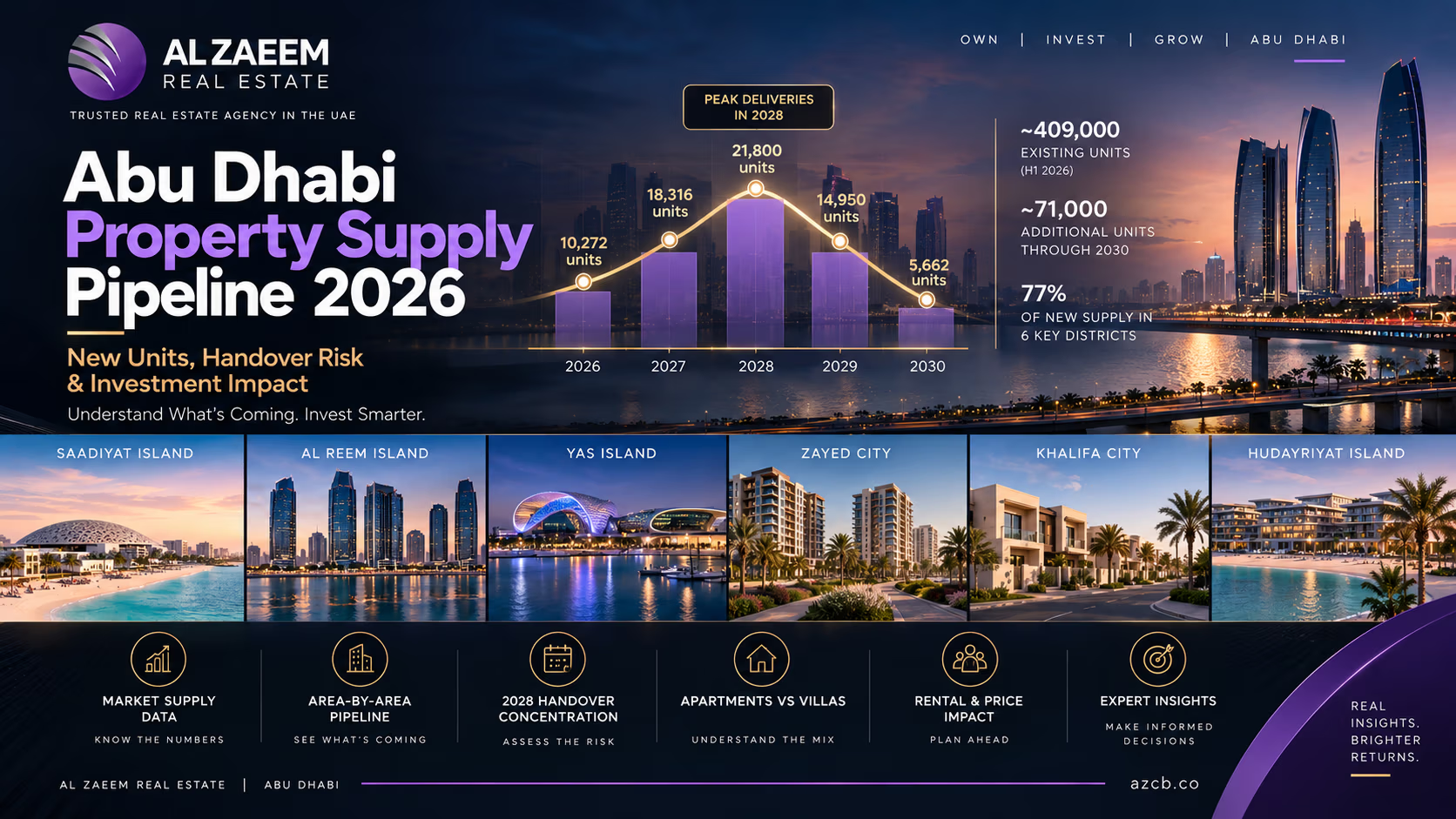
According to the Abu Dhabi Real Estate Centre’s H1 2026 market report, Abu Dhabi currently has approximately 409,000 residential units, with around 71,000 additional homes projected through 2030. Deliveries are expected to reach their highest point in 2028, at approximately 21,800 units.
That means Abu Dhabi is entering an important development cycle.
But the correct conclusion is not:
“71,000 new homes means oversupply.”
Nor is it:
“Demand is strong, so future supply does not matter.”
Both conclusions are too simplistic.
The real question is:
How much directly competing supply will exist in the specific location, property type, price bracket and handover period in which I am investing?
This guide explains how to answer that question.
Quick Answer
The most important current supply figures are:
| Indicator | Current ADREC Data |
|---|---|
| Existing Abu Dhabi residential supply | ~409,000 units |
| Additional units projected through 2030 | ~71,000 units |
| Peak delivery year | 2028 |
| Approx. 2028 deliveries | 21,800 units |
| Abu Dhabi Region share of current stock | 79% |
| Investment-zone stock | ~72,000 units |
| Al Reem Island investment-zone stock | 27,500 units |
| Six districts’ share of future incremental supply | 77% |
| Major developers’ share of development pipeline | 76% |
The six districts expected to drive 77% of projected incremental supply are:
Saadiyat Island, Al Reem Island, Yas Island, Zayed City, Khalifa City and Hudayriyat Island.
For investors, the most important date is not necessarily 2030.
It may be 2028.
If your off-plan unit hands over during the same period as thousands of comparable apartments or villas, you may face increased competition for:
renters;
buyers;
property-management attention;
and resale liquidity.
But supply can also improve a community by bringing more infrastructure, retail, schools, hospitality and population.
Supply is therefore neither automatically positive nor automatically negative.
How Large Is the Abu Dhabi Supply Pipeline?
ADREC reports approximately 409,000 residential units across the emirate in H1 2026, after average annual supply growth of 2.9% since 2022.
Abu Dhabi Region represents approximately 79% of this stock and has recorded average annual residential-supply growth of 3.3% since 2022.
If approximately 71,000 additional units were added to today’s 409,000-unit base, the pipeline would be equivalent to roughly 17% of current residential stock.
That does not mean the market will simply become 17% more competitive.
Population, household formation, investor demand, tourism-linked demand, employment growth and housing preferences are also changing.
Supply must always be analysed alongside demand.
Near-Term Supply: 2026 and 2027
ADREC’s Q1 2026 reporting provides more detail for the Abu Dhabi Region specifically.
Residential supply in the region was projected to increase from 314,976 units to 325,248 units during 2026, an increase of 10,272 units.
For 2027, regional residential supply was projected to reach 333,564 units.
These numbers are useful because they show that the new supply wave is not something beginning only in 2028.
It is already building.
However, 2028 is expected to represent the largest annual delivery concentration in the current forecast.
Why 2028 Matters
ADREC expects approximately 21,800 residential units to be delivered in 2028, making it the peak delivery year in the current pipeline through 2030.
For an investor buying off-plan in 2026, that matters because many current projects may reach completion between:
2027;
2028;
The handover year can affect the investment almost as much as the launch price.
Imagine two otherwise similar properties.
Property A
Handover: 2027
Only a limited number of comparable units enter the surrounding market.
Property B
Handover: 2028
Hundreds or thousands of comparable units across nearby projects complete around the same period.
Property B may still outperform.
But the investor should recognise that the competitive environment could be different.
Handover Risk Is Not Only Construction Risk
When buyers hear “handover risk,” they often think only about:
delays;
construction;
developer delivery;
snagging.
There is another form of handover risk:
Market-Congestion Risk
This occurs when many owners receive keys at approximately the same time and begin competing for the same:
tenants;
resale buyers;
property managers;
furnishing suppliers;
and mortgage-ready purchasers.
A project can therefore be delivered successfully while still entering a challenging rental or resale window.
Demand Is Currently Strong — Which Changes the Supply Discussion
The supply pipeline needs to be viewed in the context of unusually strong current demand.
ADREC recorded AED 70.4 billion of residential unit sales in H1 2026, compared with AED 25.3 billion in H1 2025. Off-plan accounted for 89% of residential sales value and 82% of transaction volume.
ADREC’s Q1 update had already stated that demand continued to outpace supply, while 16 new real-estate projects were registered during the quarter.
So as of the latest official data, Abu Dhabi is not being described as a market currently overwhelmed by residential supply.
The key investment question concerns the future balance.
Rental Demand Also Remains Strong
Abu Dhabi recorded approximately 233,000 active residential lease contracts in H1 2026, worth AED 9.3 billion.
New-lease prices increased:
17% for apartments
and
9% for villas
year-on-year across the emirate.
Within investment zones, the increases were even stronger:
21% for apartments
and
16% for villas.
These figures help explain why new development can currently be absorbed.
But investors should not extrapolate recent rental increases indefinitely.
The arrival of substantial new stock may change future rent-growth rates differently across individual communities.
The Six Districts Driving Most Future Supply
ADREC expects six areas to account for 77% of projected incremental residential supply through 2030:
- Saadiyat Island
- Al Reem Island
- Yas Island
- Zayed City
- Khalifa City
- Hudayriyat Island
This concentration is one of the most important facts in the current Abu Dhabi investment market.
It means supply risk should not be analysed evenly across the entire emirate.
1. Saadiyat Island
Saadiyat is already one of Abu Dhabi’s most valuable residential and lifestyle destinations and is also among the six districts expected to contribute heavily to future supply.
Residential sales on Saadiyat reached approximately AED 13.3 billion in H1 2026, making it one of the emirate’s largest residential sales markets by value.
For a Saadiyat investor, the question should not simply be:
“How many new Saadiyat units are coming?”
Instead ask:
How many future properties will genuinely compete with mine?
A highly differentiated beachfront residence does not necessarily compete directly with every apartment launched elsewhere on the island.
The investor should compare:
beachfront vs inland;
apartment vs villa;
branded vs non-branded;
entry-level luxury vs ultra-luxury;
ready vs future handover.
2. Al Reem Island
Al Reem is particularly important because it already contains the largest stock within Abu Dhabi’s investment zones.
ADREC reports approximately 27,500 residential units on Al Reem Island, within around 72,000 units across investment zones overall. Al Raha, Yas and Saadiyat follow Reem among the major existing investment-zone stocks.
Reem therefore presents a different supply question from an emerging island.
The area already has:
mature residential stock;
established rental demand;
ready inventory;
and a large resident base.
New supply does not enter an empty market.
Investors should compare future projects with existing buildings on:
age;
quality;
service charges;
views;
amenities;
unit efficiency;
rental demand.
3. Yas Island
Yas Island generated approximately AED 7.3 billion of residential unit sales in H1 2026, while also being identified by ADREC as one of the six major future supply districts.
That combination makes Yas a useful example of why:
high demand
and
high supply
can exist simultaneously.
A growing destination can absorb substantial development if residential demand, amenities and economic activity grow with it.
But not every Yas property will perform identically.
Investors should separate:
waterfront;
golf;
theme-park proximity;
villa communities;
mid-market apartments;
premium apartments;
short-term-stay-oriented stock.
4. Zayed City
Zayed City appears among the six districts expected to drive most residential expansion through 2030.
For an emerging area, supply can actually be part of the investment thesis.
A larger population can support:
retail;
schools;
services;
public amenities;
transport;
and community maturity.
The risk is timing.
An early investor may benefit from destination growth, but a landlord can face competition if many similar properties hand over before the tenant base matures sufficiently.
5. Khalifa City
Khalifa City is also listed among the six key supply-growth districts.
Here, buyers need to pay particular attention to property format.
New apartments, villas and community-led development do not necessarily compete for the same residents.
An investor should understand whether future supply is expanding:
family villa inventory;
apartment stock;
townhouses;
or mixed-use residential communities.
The label “Khalifa City supply” alone is too broad for an investment decision.
6. Hudayriyat Island
Hudayriyat is perhaps the most striking example of how Abu Dhabi’s residential map is changing.
The island recorded approximately AED 19 billion of residential sales in H1 2026, representing about 27% of total residential sales value and making it the leading residential district by sales value during the period.
At the same time, Hudayriyat is one of the six districts expected to contribute heavily to future residential supply.
This means buyers are simultaneously seeing:
large development;
strong transaction activity;
and significant future delivery.
For Hudayriyat, future performance will depend heavily on how:
community infrastructure;
luxury positioning;
amenities;
scarcity;
and buyer demand
develop alongside the supply.
Investment Zones Are Becoming More Important
Investment zones represented more than 22% of Abu Dhabi’s residential stock in H1 2026, with approximately 72,000 units.
These zones matter disproportionately to international and expatriate investors because they are where much of the investable residential development is concentrated.
Therefore, the supply numbers relevant to a foreign investor can look very different from emirate-wide averages.
An investor should avoid saying:
“Abu Dhabi has only X new properties coming.”
Instead ask:
How much new property is coming into the zones in which I am legally and commercially likely to buy?
Development Projects vs Ordinary Building Permits
ADREC estimates that development projects will account for 77% of Abu Dhabi Region’s supply growth between H2 2026 and 2030, compared with 23% arising from building permits.
This distinction matters.
A development-project pipeline may create:
large master-planned communities;
multiple phases;
coordinated amenities;
significant marketing;
large simultaneous handovers.
That can produce very different market effects from isolated individual buildings.
Developer Concentration
Nine major developers account for approximately 76% of the development-project pipeline, according to ADREC.
The pipeline includes both high-end and mid-market apartment and villa communities, predominantly within investment zones.
From an investor perspective, concentrated development can have two opposite effects.
On the positive side:
large developers can coordinate infrastructure and destination development.
On the risk side:
multiple phases from the same developer can create internal competition.
Your resale buyer may have a choice between:
your existing unit;
a newly launched phase;
a newer payment plan;
or developer inventory.
Off-Plan Dominance Makes Supply Analysis More Important
Off-plan property represented 89% of residential sales value and 82% of residential transactions in H1 2026.
This is critical.
Most of the current sales market is therefore purchasing future supply, not only existing housing.
That means today’s transaction boom partly becomes tomorrow’s handover pipeline.
An off-plan buyer should therefore investigate:
how many phases exist;
how many units remain to launch;
which years they complete;
and whether newer phases could compete with earlier phases.
New Supply Does Not Automatically Mean Oversupply
This is one of the most important concepts in this guide.
Imagine a city adds:
10,000 homes.
If household demand grows by:
15,000 homes,
the market could still tighten.
Now imagine supply increases by:
5,000 homes
but demand increases by only:
1,000.
Competition could increase even though absolute supply growth is smaller.
Therefore:
Oversupply is a demand-relative concept.
The number of new properties alone is not sufficient.
What Is “Comparable Competing Supply”?
For investment analysis, the most useful supply measure is not:
Total Abu Dhabi Supply.
It is:
Comparable Competing Supply
Suppose you buy a:
two-bedroom;
waterfront;
high-floor;
premium apartment;
on Yas Island;
handover 2028;
priced around AED 3 million.
Your relevant competition is not every residential property delivered in Abu Dhabi.
A labour-accommodation unit, inland villa or studio in another district is not directly competing with you.
Instead, identify future units with similar:
location;
property type;
bedroom count;
quality;
view;
handover date;
price;
buyer profile.
The Comparable Supply Test
Before buying, ask:
Location
How many similar units are coming within the same district?
Property Type
Apartment, townhouse or villa?
Bedrooms
Are hundreds of identical one-bedrooms being delivered?
Price
What competes within ±15–20% of my expected resale price?
Handover
How much stock completes within 6–12 months of mine?
Developer
Will the developer still be selling brand-new inventory when I try to resell?
Payment Plan
Will a future buyer prefer a new developer payment plan over paying me in the secondary market?
This is much more useful than a headline market-supply number.
Why Newer Phases Can Compete With Your Resale
Suppose you buy Phase 1 for:
AED 2 million
and want to resell in 2028 for:
AED 2.3 million.
But the developer is still offering Phase 4 at:
AED 2.35 million
with:
10% down;
construction instalments;
and 50% on handover.
A secondary buyer may ask:
Why pay AED 2.3M to the reseller when AED 2.35M buys a brand-new unit directly from the developer with better cash-flow terms?
This can constrain resale pricing even if the underlying project remains desirable.
Supply Can Affect Rental Yield in Two Ways
New supply influences yield through:
Rent
More landlord competition may reduce rent growth.
Purchase Price
More buyer choice may influence resale values.
Suppose:
Property value: AED 2 million
Rent: AED 140,000
Gross yield:
7%
Now suppose new supply causes achievable rent to settle at:
AED 126,000.
Gross yield becomes:
6.3%
If property values remain unchanged, rental return falls.
But if new infrastructure increases demand and the property value and rent both rise, the result could be completely different.
Supply must always be analysed dynamically.
Example: AED 1 Million Apartment
Assume a ready apartment costs:
AED 1,000,000
Current rent:
AED 70,000
Gross yield:
7%
Now model three scenarios.
| Scenario | Future Annual Rent | Gross Yield on Cost |
|---|---|---|
| Strong absorption | AED 77,000 | 7.7% |
| Stable | AED 70,000 | 7.0% |
| Supply pressure | AED 63,000 | 6.3% |
The investor should not ask which scenario is guaranteed.
They should ask:
Would I still be comfortable owning the property under the supply-pressure scenario?
AED 2 Million Property Scenario
Purchase price:
AED 2,000,000
Expected rent:
AED 140,000
Expected service/operating costs:
AED 35,000
Expected NOI:
AED 105,000
Net operating yield:
5.25%
Now imagine competition pushes annual rent down 8%.
New rent:
approximately AED 128,800
Assuming operating costs remain AED 35,000:
NOI becomes:
AED 93,800
Net operating yield becomes:
approximately:
4.69%
An 8% change in rent reduced NOI by more than 10%.
This shows why highly leveraged landlords need to model supply risk carefully.
Supply Can Affect Capital Appreciation
In our previous Abu Dhabi Property Appreciation 2026 analysis, we looked at capital growth through:
location;
scarcity;
rents;
demand;
infrastructure;
and supply.
Supply is one of the strongest variables because property value ultimately depends partly on how easily a buyer can find substitutes.
If your property is one of:
20 similar units,
scarcity is strong.
If it is one of:
2,000 interchangeable units,
the buyer has more negotiating power.
Scarcity Can Protect Value
This is why a large market pipeline does not necessarily hurt every property equally.
Potentially more defensible characteristics include:
rare waterfront orientation;
limited villa plots;
exceptional views;
unique layouts;
low-density projects;
prime cultural or leisure adjacency;
high-quality completed buildings;
properties with strong tenant demand.
Scarcity needs to be real.
“Luxury” written in a brochure does not create scarcity by itself.
Apartment vs Villa Supply
Investors should not combine apartments and villas into one supply calculation.
They serve different household structures and investor profiles.
An apartment investor needs to understand:
tower completions;
bedroom mix;
rental stock;
service charges;
investor-owned unit concentration.
A villa investor should pay attention to:
new family communities;
plot supply;
townhouse competition;
school access;
landscape and amenity completion.
The broader 71,000-unit figure is therefore only the first layer of analysis.
Supply Can Improve a Community
There is another side of the argument.
Imagine an early-stage destination currently has:
few residents;
limited retail;
limited schools;
limited restaurants.
More residential delivery can create enough population to support:
supermarkets;
cafés;
schools;
clinics;
parks;
hotels;
public transport;
community services.
As the destination becomes functional, demand can increase.
In such a case:
more supply contributes to more value.
This is particularly relevant in master-planned destinations.
The “Too Early” vs “Too Late” Problem
Property investors often face a timing trade-off.
Buying Very Early
Potential advantages:
lower entry pricing;
more unit selection;
greater community-growth upside.
Risks:
long wait;
uncertain future supply;
unfinished infrastructure;
unproven rental market.
Buying Later
Potential advantages:
visible community;
actual rents;
actual service charges;
established amenities.
Risks:
higher price;
less appreciation already available;
fewer prime units.
The strongest investment is not necessarily the earliest or latest.
It is the one where remaining upside still compensates for remaining risk.
What Should Investors Watch in 2027?
2027 will provide important evidence on whether current demand remains strong as the delivery pipeline expands.
ADREC’s earlier 2026 projection put Abu Dhabi Region residential stock at approximately 333,564 units in 2027, following projected 2026 stock of 325,248.
Investors should monitor:
actual deliveries;
handover delays;
rental absorption;
new launch pricing;
secondary-market discounts;
and vacancy.
If substantial scheduled inventory is delayed, the effective supply curve can move later.
That can make the 2028–2029 window even more concentrated.
The Pipeline Is a Projection, Not a Promise
A forecasted handover is not the same as a completed home.
Projects can:
accelerate;
delay;
change phasing;
modify unit counts;
or launch new phases.
Therefore, supply projections should be updated regularly.
A buyer purchasing in September 2026 should not assume the current 2030 projection will remain identical throughout their entire holding period.
2028 Investor Stress Test
If your property is expected to complete in 2028, run this stress test.
Assume:
Scenario 1 — Strong Absorption
High population and tenant growth.
Rent meets projection.
Resale remains liquid.
Scenario 2 — Normal Competition
Many units complete.
Rent is flat for 12–18 months.
Resale takes longer.
Scenario 3 — Heavy Competition
Developers still have stock.
Landlords discount rents.
Secondary sellers compete aggressively.
Scenario 4 — Delayed Supply
Several competing projects move into 2029.
Your project temporarily benefits from lower immediate competition.
A property that works only under Scenario 1 has a weaker risk profile.
Supply and Mortgage Risk
A leveraged investor must pay particular attention to the handover environment.
Suppose:
property purchase price: AED 2 million;
handover valuation expected: AED 2.2 million.
The investor assumes financing will cover the balance.
If heavy comparable supply or weaker market conditions reduce the bank valuation to:
AED 1.9 million,
the buyer may need more cash than expected.
Supply therefore has a connection not only with:
rent;
but also with:
valuation;
financing;
and handover liquidity.
Supply and Off-Plan Assignment
Investors planning to sell before handover should ask a difficult question:
Who will buy my contract if the developer is still offering new inventory?
The answer may depend on:
your purchase price;
unit rarity;
construction progress;
developer pricing;
remaining payment plan;
and resale restrictions.
An off-plan investor should not assume:
“new launch prices are higher, therefore my unit is automatically easy to sell.”
Developer pricing and actual secondary-market liquidity are not the same thing.
Supply and Ready Property
Ready property can sometimes benefit from a heavy off-plan pipeline.
Why?
Because a buyer or tenant may prefer:
immediate occupancy;
known service charges;
established amenities;
existing community;
visible build quality.
When future supply is still years away, a strong ready property can offer certainty.
But when thousands of new units actually complete, older ready properties may need to compete harder on:
price;
maintenance;
facilities;
and rent.
Ageing Buildings vs New Supply
This is an underappreciated risk.
Suppose an apartment building is already 10–15 years old when a wave of newer properties enters the same area.
The older building may face:
higher maintenance;
less modern amenities;
dated common areas;
less efficient layouts;
greater service needs.
It may need to offer:
lower rent;
or lower resale pricing
to remain competitive.
Therefore, future supply analysis is especially important when buying older buildings in rapidly redeveloping areas.
New Supply Can Also Make Old Property More Valuable
The reverse is possible.
A new development wave may improve:
roads;
public realm;
retail;
schools;
transport;
destination reputation.
An older but well-located building can benefit from these improvements without requiring the owner to pay new-development pricing.
The question becomes:
Does new development make my existing property obsolete — or does it improve the neighbourhood around it?
Investor Framework: Supply Risk Score
Before purchasing, score the property from 1 to 5 in each category.
| Factor | 1 = Strong | 5 = Higher Risk |
|---|---|---|
| Number of comparable units coming | Low → High | |
| Handover concentration | Low → High | |
| Developer unsold inventory | Low → High | |
| Similar future phases | Few → Many | |
| Current rental demand | Strong → Weak | |
| Building differentiation | High → Low | |
| Property scarcity | High → Low | |
| Future buyer pool | Broad → Narrow | |
| Service-charge competitiveness | Strong → Weak | |
| Community maturity at handover | Mature → Early |
A property scoring mostly 1–2 has relatively strong supply positioning.
A property scoring mostly 4–5 deserves deeper investigation.
This is not a valuation model.
It is a decision filter.
What Should a Long-Term Investor Do?
A five-to-ten-year investor should generally focus less on one specific handover year and more on:
total community development;
long-term competing supply;
rent sustainability;
population;
infrastructure;
maintenance;
and resale quality.
Short-term supply fluctuations may matter less if the property has durable fundamentals.
What Should a Rental Investor Do?
Rental investors should focus heavily on:
handover volume;
bedroom mix;
tenant profile;
current occupancy;
new-lease trends;
service charges;
property-management quality.
The key question is:
When my property becomes available, how many landlords will be chasing the same tenant?
What Should an Off-Plan Investor Do?
Off-plan investors should analyse:
launch pricing;
future phases;
payment-plan advantage;
assignment rules;
handover year;
mortgage availability;
and comparable secondary supply.
The investment needs an exit strategy even if the current plan is to hold.
What Should an End User Do?
End users have a different advantage.
If you are buying a home for yourself, additional supply can improve:
choice;
negotiating power;
community amenities;
school access;
and property quality.
An end user may be less concerned with 12-month rental competition and more concerned with:
quality of life;
community completion;
long-term value.
20 Questions to Ask Before Buying Into a Supply Wave
- How many units are in this project?
- How many phases remain?
- How many units are still unsold?
- When will neighbouring projects hand over?
- How many directly comparable units will complete within one year?
- What is the apartment/villa mix?
- What is the bedroom mix?
- Is the area already occupied?
- What are current vacancy levels?
- What are actual achieved rents?
- How much future stock is investor-owned?
- Will new developer inventory compete with my resale?
- What payment plans will future buyers have access to?
- What makes my unit scarce?
- What is my expected service charge?
- How will the community change before handover?
- What infrastructure is expected?
- What happens if rent is 10% below projection?
- What happens if resale takes 12 months?
- Would I still buy this property if capital appreciation were zero for three years?
If the property still looks attractive after these questions, the investment thesis is much stronger.
Frequently Asked Questions
How many new residential units are coming to Abu Dhabi?
ADREC currently projects around 71,000 additional residential units across the emirate through 2030, on top of approximately 409,000 existing units in H1 2026.
What year will Abu Dhabi have the most new property handovers?
Current ADREC projections indicate 2028, with approximately 21,800 residential units expected to be delivered.
Does Abu Dhabi face an oversupply problem?
The latest ADREC data states that demand currently continues to outpace supply. Future supply is significant, but oversupply cannot be determined simply from the number of new units; demand and comparable stock also matter.
Which Abu Dhabi areas will receive the most future supply?
ADREC identifies Saadiyat Island, Al Reem Island, Yas Island, Zayed City, Khalifa City and Hudayriyat Island as the six districts responsible for 77% of projected incremental residential supply through 2030.
How many properties are currently in Abu Dhabi investment zones?
Approximately 72,000 residential units, representing more than 22% of total residential stock in H1 2026.
Which investment zone currently has the most residential units?
Al Reem Island, at approximately 27,500 units.
Will new supply reduce rents?
It can increase competition and moderate rental growth, but this depends on demand, unit type, location and the amount of directly comparable supply. Current H1 2026 lease data remains strong, with new apartment leases up 17% year-on-year and villa leases up 9%.
Are rents rising in investment zones?
ADREC reports H1 2026 year-on-year increases of 21% for new apartment leases and 16% for villas within investment zones.
Can supply affect property prices?
Yes. More comparable stock can increase buyer choice and reduce scarcity, while well-planned development can simultaneously improve a destination and increase demand.
Is 2028 a bad year to have an off-plan property hand over?
Not automatically. It is simply the current peak delivery year, meaning buyers should model potentially stronger competition.
Is Saadiyat at risk because more property is coming?
No conclusion can be made from total supply alone. Different Saadiyat products target different buyer segments and have different scarcity characteristics.
Is Reem Island oversupplied?
ADREC does not describe Reem simply as oversupplied. Reem has the largest existing investment-zone residential stock and is also among future supply-growth districts, so building-level analysis is especially important.
Does high off-plan activity increase future supply risk?
It can increase future handover concentration. Off-plan represented 89% of residential sales value and 82% of deals in H1 2026, so a significant portion of today’s transaction activity relates to future properties.
How concentrated is Abu Dhabi’s development pipeline?
Nine major developers account for approximately 76% of the development-project pipeline.
Is new supply always bad for existing properties?
No. New development can improve infrastructure, population, amenities and destination recognition.
What is comparable supply?
Properties that genuinely compete with yours based on location, unit type, bedrooms, quality, price and timing.
Should investors avoid areas with many new projects?
Not automatically. Some of Abu Dhabi’s strongest transaction markets are also its largest development areas.
What should investors watch most closely?
Handover timing, directly competing supply, achieved rents, future phases, unsold developer inventory and community demand.
Can handover delays reduce supply risk?
They can postpone competition temporarily, but may also shift more inventory into a later year and increase future concentration.
How often should supply projections be reviewed?
At least before purchase, before handover, and before a planned resale or refinancing. Development pipelines evolve.
Final Takeaway
Abu Dhabi currently has approximately:
409,000 residential units
with around:
71,000 additional units projected through 2030.
And according to ADREC:
2028 is currently expected to be the peak delivery year, at around 21,800 homes.
Six districts — Saadiyat, Reem, Yas, Zayed City, Khalifa City and Hudayriyat — are expected to account for 77% of the incremental supply. Nine developers represent approximately 76% of the development-project pipeline.
At the same time, current demand remains strong.
Residential sales reached AED 70.4 billion in H1 2026, off-plan represented 89% of sales value, 233,000 residential lease contracts were active, rents rose strongly, and expatriate residents plus non-resident foreign buyers accounted for 70% of residential sales value.
So the investment conclusion should not be:
“Too much supply is coming.”
Nor should it be:
“Demand is strong, so supply does not matter.”
The smarter conclusion is:
Know what competes with your property.
A buyer considering one two-bedroom apartment on Yas Island does not need to fear every one of Abu Dhabi’s 71,000 future homes.
They need to understand the subset that competes directly with:
their location;
their handover year;
their unit type;
their tenant;
their buyer;
and their price.
That is the supply number that matters.
Al Zaeem Real Estate — Analyse the Market Beyond the Launch
Before buying an Abu Dhabi property, Al Zaeem Real Estate can help investors compare not only:
price;
payment plan;
and
developer;
but also:
future competing supply;
handover timing;
rental demand;
ready-market alternatives;
resale positioning;
and
long-term investment fit.
This article should naturally connect with:
Abu Dhabi Property Appreciation 2026
Abu Dhabi Property ROI Calculator 2026
Abu Dhabi Off-Plan vs Ready Property 2026
Abu Dhabi Off-Plan Payment Plans Compared 2026
Best Areas to Invest in Abu Dhabi 2026
Property Research & Investor Insights
and the Abu Dhabi Real Estate Knowledge Hub.
Existing confirmed internal pages include:
Abu Dhabi Real Estate Knowledge Hub
Al Zaeem Real Estate: +971 (50) 991 5454
Disclaimer
This guide is for general educational and real-estate research purposes only and does not constitute investment, financial, mortgage, legal or tax advice.
Residential-supply figures are projections and may change as projects, construction schedules, permits and handover dates evolve.
The AED 1 million and AED 2 million examples and rental stress scenarios in this article are illustrative calculations only and are not forecasts of future rent, yield or property performance.
Future supply does not guarantee falling rents or prices, and strong current demand does not guarantee that all future inventory will be absorbed at current pricing.
Buyers should evaluate the specific project, unit, developer, handover timing, comparable future inventory, current rents and personal financial circumstances before making a significant investment decision.
Last reviewed: September 2026.