


Property investors often focus first on rental yield.
But rent is only one way real estate can create wealth.
The second is capital appreciation — the increase in the market value of the property itself.
A buyer who purchases an Abu Dhabi apartment for AED 1.5 million and later sells it for AED 1.8 million has experienced AED 300,000 of nominal capital appreciation.
Simple enough.
But the real investment question is harder:
Why did the property increase in value, can that growth reasonably continue, and how much profit remains after acquisition, ownership and selling costs?
That question matters particularly in Abu Dhabi in 2026.
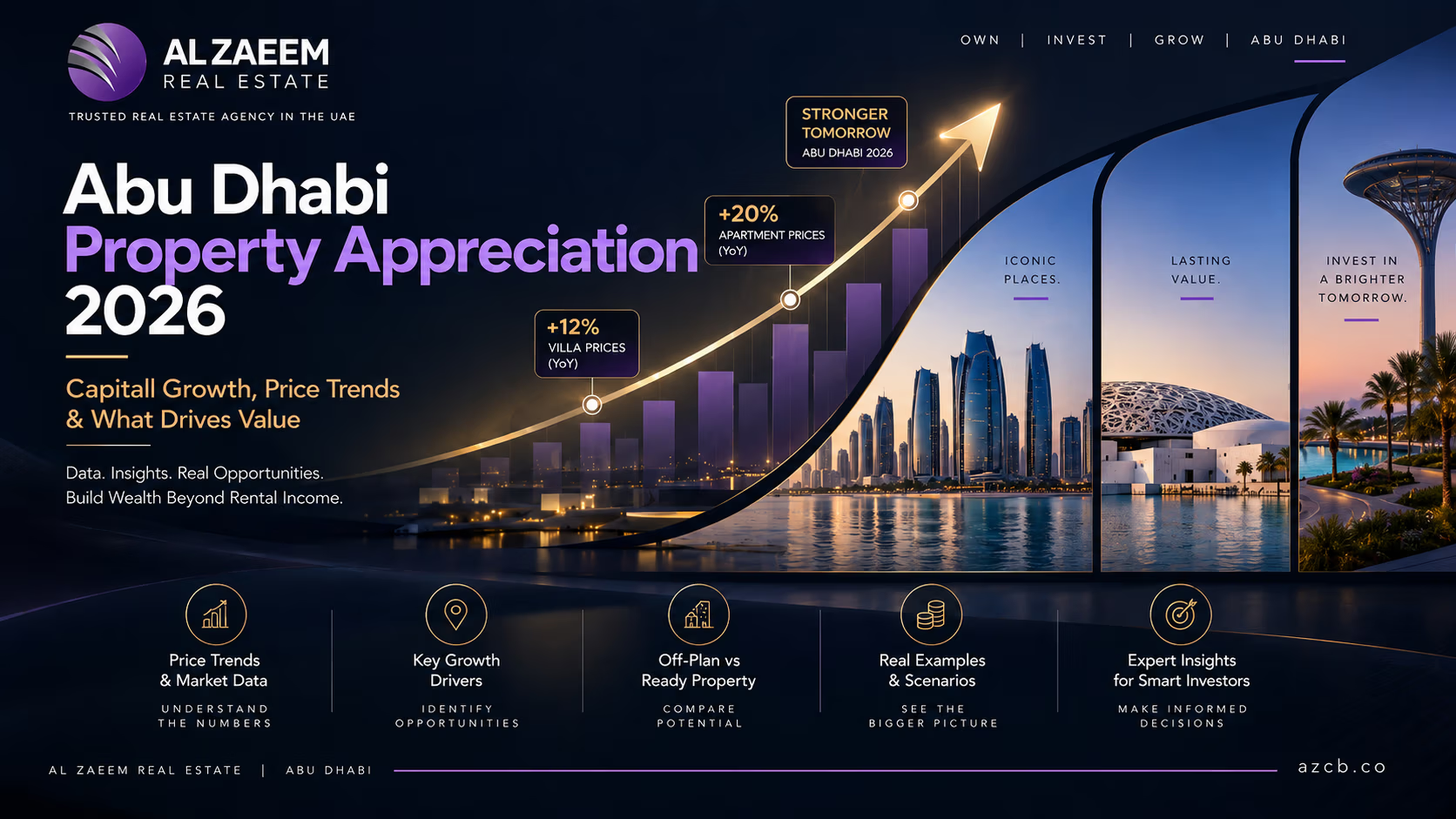
The latest official Abu Dhabi Real Estate Centre data shows that repeat-sale residential prices increased 20% year-on-year for apartments and 12% for villas in H1 2026. At the same time, residential sales reached AED 70.4 billion, with off-plan property accounting for 89% of sales value.
Those are substantial market movements.
They are also historical figures.
They do not mean every Abu Dhabi apartment appreciated by 20%, every villa increased by 12%, or a buyer purchasing today should expect the same increase over the next twelve months.
Property appreciation is highly specific to:
location;
purchase price;
developer;
project quality;
property type;
view;
layout;
supply;
market timing;
future infrastructure;
and the price at which the property can actually be sold.
This guide explains how capital growth works, what Abu Dhabi’s 2026 numbers really mean, and how investors can distinguish sustainable appreciation from marketing hype.
Quick Answer
Abu Dhabi entered 2026 with strong residential price momentum.
According to ADREC’s H1 2026 registered market data:
| Indicator | H1 2026 |
|---|---|
| Apartment repeat-sale price growth | +20% YoY |
| Villa repeat-sale price growth | +12% YoY |
| Residential unit sales | AED 70.4B |
| Off-plan share of residential sales value | 89% |
| Off-plan share of residential transaction volume | 82% |
| Existing residential supply | ~409,000 units |
| Additional units projected through 2030 | ~71,000 units |
| Expected delivery peak | 2028 |
ADREC also reported AED 117 billion in total real-estate transactions during H1 2026 and AED 13.8 billion of foreign direct investment, with non-resident investors representing 116 nationalities.
The market is clearly active.
But market-wide appreciation should never be used as a substitute for property-level valuation.
What Is Property Appreciation?
Property appreciation is the increase in a property’s market value over time.
The simplest formula is:
Current Market Value − Original Purchase Price = Capital Appreciation
Suppose:
Purchase price: AED 2,000,000
Current market value: AED 2,300,000
Nominal capital appreciation:
AED 300,000
Percentage increase:
AED 300,000 ÷ AED 2,000,000 × 100
=
15% appreciation
That tells us how much the property’s estimated value has increased.
It does not yet tell us how much money the investor actually made.
Appreciation Is Not the Same as Profit
Consider the same AED 2 million property.
Purchase price:
AED 2,000,000
Sale price:
AED 2,300,000
At first glance:
Profit = AED 300,000.
But perhaps the investor also paid:
purchase registration;
brokerage;
VAT on professional services;
mortgage costs;
maintenance;
service charges;
and later selling expenses.
The real equation is therefore closer to:
**Net Sale Proceeds
- Rental Income Received
− Acquisition Costs
− Ownership Costs
− Finance Costs
− Selling Costs
= True Investment Profit**
This is why our Abu Dhabi Property ROI Calculator 2026 guide separates capital appreciation from total investment return.
A property can appreciate strongly while producing a modest overall return if its ownership and financing costs are high.
The reverse can also happen: a property with moderate price growth can still be an excellent investment because it produced strong rental cash flow along the way.
What Does the 20% Apartment Price Increase Actually Mean?
ADREC reported that repeat-sale apartment prices increased 20% year-on-year in H1 2026, while villa repeat-sale prices increased 12%.
The wording matters.
This is not:
Every apartment +20%.
It is a market-level registered-data indicator.
Individual performance can vary dramatically.
One apartment may have increased 25%.
Another 8%.
Another may have remained largely unchanged.
A poorly purchased unit could even lose value while the overall market rises.
Real estate is not a single stock with one quoted price.
Repeat-Sale Prices vs Asking Prices
Investors should understand another distinction:
Asking price
What an owner wants.
Transaction price
What a buyer actually pays.
Repeat-sale movement
Observed price movement from resold properties in the market.
An owner listing an apartment for AED 2.5 million does not make the property worth AED 2.5 million.
A transaction is stronger evidence.
ADREC’s May 2026 market update showed that approximately 90% of active listings were either unchanged or increased in price, with adjustments generally modest. The same update showed stable ready-property transaction activity, including 529 ready-unit sales worth approximately AED 1.6 billion in April.
That combination is useful because it provides context from both seller expectations and completed-market activity.
Why Abu Dhabi Property Values Rise
Capital appreciation is usually the result of several forces operating together rather than one single factor.
For Abu Dhabi property, some of the most important are:
| Growth Driver | Why It Can Matter |
|---|---|
| Location | Scarcity and buyer demand |
| Purchase price | Entry valuation determines future upside |
| Developer | Brand, execution and buyer confidence |
| Community maturity | Completed amenities can reduce uncertainty |
| Rental demand | Strong rent can support investor valuations |
| Infrastructure | Better accessibility can expand demand |
| Views / waterfront | Scarce characteristics can command premiums |
| Unit layout | Efficient layouts often have broader resale appeal |
| Supply pipeline | Limited competing stock can support pricing |
| Foreign investment | Expands the buyer pool |
| Financing availability | Influences purchasing power |
| Market liquidity | Determines how easily gains can be realised |
The key is not to identify one positive factor.
It is to determine whether several factors reinforce each other.
1. Entry Price Is the Foundation of Capital Growth
Investors sometimes think appreciation begins with the future.
It actually begins with the purchase price today.
Suppose two buyers acquire identical apartments.
Buyer A pays:
AED 1.8 million
Buyer B pays:
AED 2.0 million
Three years later, both apartments are worth:
AED 2.2 million
Buyer A’s nominal appreciation:
AED 400,000 = 22.2%
Buyer B’s:
AED 200,000 = 10%
Same building.
Same market.
Same future selling price.
Very different investment result.
Therefore:
A good property bought at the wrong price can become a poor investment.
2. Location and Scarcity
Real estate value is heavily influenced by scarcity.
Abu Dhabi cannot create an unlimited number of:
Saadiyat beachfront homes;
prime Yas waterfront units;
direct sea-view apartments;
specific island plots;
or residences beside major cultural, commercial or leisure destinations.
Scarcity can protect pricing when demand remains strong.
But investors must distinguish:
true scarcity
from
marketing scarcity.
“Only 10 units remaining” does not necessarily mean the wider market has limited competing supply.
The better question is:
How many genuinely comparable properties will exist when I want to sell?
Where Was Residential Buying Concentrated in H1 2026?
ADREC’s H1 2026 report provides useful evidence of where substantial residential capital was being deployed.
| Area | Residential Sales Value H1 2026 |
|---|---|
| Hudayriyat Island | AED 19.0B |
| Saadiyat Island | AED 13.3B |
| Al Reem + Al Maryah | AED 10.5B |
| Yas Island | AED 7.3B |
Hudayriyat alone represented approximately 27% of residential sales value.
These numbers demonstrate transaction concentration.
They do not prove that these four locations will deliver the highest future appreciation.
Sales volume and capital appreciation are different metrics.
However, high transaction activity can reveal where buyer attention and development capital are concentrated.
3. Developer Reputation
In off-plan markets, buyers are purchasing something that may not yet physically exist.
Therefore the developer’s reputation becomes part of the property’s economic value.
Buyers may place a premium on developers associated with:
quality;
delivery;
community management;
strong master planning;
high-quality amenities;
and established resale demand.
This is one reason we created separate buyer-focused guides covering major Abu Dhabi developers including Aldar, Modon, Bloom, IMKAN, Reportage and Ohana.
But a strong developer name does not automatically guarantee appreciation.
The individual project still needs to make sense.
4. Master-Planned Communities
A standalone building and a master-planned destination can behave differently over time.
A large community may gradually gain:
schools;
parks;
retail;
restaurants;
transport;
beaches;
sports facilities;
offices;
hospitality;
and public realm.
Early buyers sometimes benefit as the destination evolves from:
plan
to
construction
to
completed community.
Part of the uncertainty disappears at each stage.
But again, appreciation is not automatic.
If thousands of similar units are delivered simultaneously, increased competition may offset some benefits of community maturity.
5. Rental Growth Can Support Capital Values
Property investors do not value real estate only by emotion.
Income matters.
Suppose an apartment produces:
AED 80,000 annual rent.
Later, comparable rent becomes:
AED 110,000.
Even if investor yield expectations remain similar, buyers may become willing to pay more for the asset because the income stream is stronger.
Abu Dhabi recorded 233,000 active residential leases worth AED 9.3 billion in H1 2026. New-lease prices increased 17% year-on-year for apartments and 9% for villas, while within investment zones the increases were 21% and 16% respectively.
Strong rental performance can therefore help explain why purchase prices have also moved.
But rents cannot rise indefinitely.
Investors should not project a single strong year’s growth forever.
6. Foreign Investment Expands the Buyer Pool
A property becomes more liquid when there are more potential buyers.
ADREC reported AED 13.8 billion of foreign direct investment in H1 2026, representing a 309% year-on-year increase and exceeding the amount recorded during the whole of 2025. Non-resident investors from 116 nationalities participated.
The United Kingdom, China, Russia, the United States, Germany and France were among the leading sources of foreign direct investment.
Abu Dhabi also approved eight additional investment zones during the period, taking the emirate-wide total to 50.
A broader international buyer base can support market depth.
But foreign capital can also be more responsive to:
global interest rates;
exchange rates;
economic conditions;
and alternative investment opportunities.
So international demand is a positive driver, not a guarantee.
7. Supply Is One of the Biggest Future Variables
Appreciation is fundamentally influenced by:
demand relative to supply.
ADREC estimates Abu Dhabi’s residential stock at approximately 409,000 units, with around 71,000 additional units projected through 2030. Deliveries are currently expected to peak at approximately 21,800 units in 2028.
Six districts are expected to account for 77% of incremental supply:
Saadiyat Island;
Al Reem Island;
Yas Island;
Zayed City;
Khalifa City;
Hudayriyat Island.
That future pipeline matters enormously.
A community can enjoy strong appreciation today and face greater resale competition later as new projects are handed over.
Supply Is Not Automatically Bad
More supply can actually strengthen a destination.
New projects can bring:
retail;
schools;
hotels;
landscaping;
transport;
employment;
restaurants;
population;
and international visibility.
The relevant question is not:
“Is more property being built?”
It is:
“Is demand likely to grow faster than the supply of comparable properties?”
Those are very different questions.
8. Property Type Matters
Apartments and villas do not always move together.
ADREC’s H1 2026 data itself demonstrates this:
Apartments: +20% repeat-sale prices
Villas: +12%
Both increased.
But by different amounts.
Within each category, performance will vary further.
A studio is not economically identical to a four-bedroom penthouse.
A townhouse is not the same as a waterfront mansion.
A mass-market apartment is not the same as a branded residence.
Capital appreciation should therefore be analysed at the most specific comparable level available.
9. View, Floor and Layout Can Affect Appreciation
Two apartments in the same building can perform differently.
Imagine:
Apartment A
direct sea view;
efficient layout;
high floor;
good balcony;
bright living area.
Apartment B
internal view;
awkward layout;
larger unusable corridors;
lower floor;
less natural light.
If both launch at similar pricing, Apartment A may later command a larger premium.
This is why investors should compare:
price per square foot
but not rely on it alone.
Usable quality matters.
10. The Cheapest Unit Is Not Always the Best Capital-Growth Unit
Investors sometimes choose the lowest-priced unit because it appears easier to resell.
That can work.
But not always.
Suppose a development contains:
200 nearly identical studios
and
20 highly desirable two-bedroom corner apartments.
The studio is cheaper.
The corner unit may be scarcer.
Future appreciation depends on future competition, not simply initial ticket size.
Off-Plan Appreciation
Off-plan investors often expect price appreciation between:
launch
and
handover.
This can happen for several reasons.
The earliest phase may be priced attractively.
Later phases may launch at higher prices.
Construction progress reduces development uncertainty.
The surrounding area may mature.
Market-wide prices may rise.
The project’s strongest units may become harder to obtain.
But off-plan appreciation requires careful analysis because the market can create paper gains before a buyer has actually completed an exit.
Example: Off-Plan Price Increase
Purchase price:
AED 2,000,000
Later comparable market value:
AED 2,300,000
Nominal appreciation:
AED 300,000
or:
15%
But suppose the buyer has only paid 40%:
AED 800,000
The AED 300,000 increase is equivalent to:
37.5% of cash paid so far.
That sounds extraordinary.
But the investor still has:
AED 1.2 million of contractual payment obligations.
So it would be misleading to say:
“I earned 37.5% with no additional risk.”
The full liability matters.
Launch Price vs Genuine Market Appreciation
One of the most important off-plan distinctions is:
Developer price increase
versus
Resale-market appreciation.
Suppose:
Phase 1 launches at AED 1.8 million.
Phase 2 launches at AED 2.0 million.
That is evidence that the developer has increased its new-sale price.
It does not automatically prove an existing Phase 1 buyer can sell today for AED 2 million.
For true market appreciation, check whether:
secondary buyers;
actual assignments;
or comparable resales
are supporting the higher valuation.
Off-Plan Price Growth Can Be Distorted by Product Mix
Suppose last year’s project sold mostly:
one-bedroom apartments.
This year the developer launches:
luxury penthouses.
Average transaction values will increase.
But that does not mean the same one-bedroom apartment appreciated by the same percentage.
ADREC’s earlier market reporting has explicitly noted that growth in sales value can be affected by stronger higher-end product positioning and luxury off-plan transactions.
This is why repeat-sale evidence is so useful.
Ready Property Appreciation
Ready property is generally easier to analyse because buyers can observe:
actual unit condition;
actual rent;
actual service charges;
actual building operations;
actual views;
actual resale transactions.
There is less development uncertainty.
That does not mean ready property has less appreciation potential.
A mature building can still benefit from:
rental growth;
limited future supply;
community improvement;
infrastructure development;
population growth;
or changing buyer preferences.
Ready vs Off-Plan Capital Growth
| Factor | Ready Property | Off-Plan |
|---|---|---|
| Current market value | Easier to establish | More assumption-dependent |
| Rental evidence | Available | Usually projected |
| Building quality | Visible | Future expectation |
| Construction risk | Minimal | Present |
| Developer payment plan | Usually irrelevant | Major factor |
| Early-stage pricing opportunity | Lower | Potentially higher |
| Community maturity upside | Depends | Often meaningful |
| Immediate resale evidence | Usually stronger | Can be limited |
| Handover funding risk | No | Yes |
| Capital appreciation certainty | Never guaranteed | Never guaranteed |
The correct decision depends on the investor.
How to Calculate Annualised Appreciation
A 20% total increase over four years is not the same as 20% per year.
To compare investments properly, calculate the Compound Annual Growth Rate — CAGR.
Formula:
CAGR = (Ending Value ÷ Beginning Value)^(1 ÷ Number of Years) − 1
Example:
Purchase price:
AED 2,000,000
Value after five years:
AED 2,500,000
Total appreciation:
25%
But annualised appreciation is approximately:
4.56% per year
That is the number that can be more sensibly compared with other long-term investment growth rates.
AED 1 Million Property — Capital Growth Scenarios
These examples are illustrative scenarios, not forecasts.
| Scenario | Value After 5 Years | Nominal Gain | Approx. CAGR |
|---|---|---|---|
| 0% annual growth | AED 1,000,000 | AED 0 | 0% |
| 2% annual growth | AED 1,104,081 | AED 104,081 | 2% |
| 3% annual growth | AED 1,159,274 | AED 159,274 | 3% |
| 5% annual growth | AED 1,276,282 | AED 276,282 | 5% |
| 7% annual growth | AED 1,402,552 | AED 402,552 | 7% |
This table demonstrates why compounding matters.
AED 2 Million Property — Five-Year Scenarios
| Annual Growth Assumption | Estimated Year-5 Value | Nominal Appreciation |
|---|---|---|
| 0% | AED 2,000,000 | AED 0 |
| 2% | AED 2,208,162 | AED 208,162 |
| 3% | AED 2,318,548 | AED 318,548 |
| 5% | AED 2,552,563 | AED 552,563 |
| 7% | AED 2,805,103 | AED 805,103 |
A small difference in annual growth becomes a large difference over time.
AED 5 Million Property — Five-Year Scenarios
| Annual Growth Assumption | Estimated Year-5 Value | Nominal Appreciation |
|---|---|---|
| 0% | AED 5,000,000 | AED 0 |
| 2% | AED 5,520,404 | AED 520,404 |
| 3% | AED 5,796,370 | AED 796,370 |
| 5% | AED 6,381,408 | AED 1,381,408 |
| 7% | AED 7,012,759 | AED 2,012,759 |
Again, these figures are mathematical scenarios.
They are not Al Zaeem forecasts of future Abu Dhabi prices.
Never Build the Investment Case Around 20% Annual Growth
This point is important.
Abu Dhabi apartments recorded 20% year-on-year repeat-sale price growth in the latest H1 2026 official data.
That is impressive.
But if an investor builds a five-year model assuming 20% every year:
AED 2 million would theoretically become almost:
AED 5 million
after five years.
That would be an extremely aggressive assumption.
A responsible investment model should distinguish:
observed recent market performance
from
future planning assumptions.
Use Multiple Appreciation Scenarios
A more sensible model uses several outcomes.
| Scenario | Example Assumption |
|---|---|
| Stress | −5% initial decline |
| Flat | 0% growth |
| Conservative | 2% annual growth |
| Moderate | 3–5% |
| Strong | Higher growth, but explicitly treated as upside |
The exact percentages should be adjusted to the property and investor.
The purpose of scenario analysis is not to predict the future.
It is to answer:
Does this investment still make sense if the future is less exciting than the sales brochure?
Price Appreciation and Rental Yield Can Work Together
Property return has two major engines:
Income
Rent.
Growth
Capital appreciation.
Suppose a property delivers:
4.5% net rental yield
plus
4% annualised appreciation.
That can create a very different total return from a property generating:
7% yield
but
0% appreciation.
Neither is automatically better.
It depends on:
risk;
liquidity;
financing;
holding period;
and investor objective.
High-Growth Areas Can Have Lower Yield
Premium capital-growth locations sometimes produce lower rental yields because buyers pay a higher price for:
scarcity;
prestige;
waterfront access;
luxury;
future potential.
For example:
Rent: AED 200,000
Property value: AED 5 million
Gross yield:
4%
A cheaper investment elsewhere might yield 7%.
But if the AED 5 million property has stronger long-term capital growth, the final total return could still be competitive.
That is why yield and appreciation must be analysed together.
Appreciation and Leverage
Mortgage leverage can amplify the investor’s return on equity.
Suppose:
Property price:
AED 2 million.
Investor equity:
AED 800,000.
Mortgage:
AED 1.2 million.
Property appreciates 10%:
New value:
AED 2.2 million.
Property gain:
AED 200,000.
Relative to property price:
10%
Relative to the original AED 800,000 equity contribution:
25%
before finance, acquisition, disposal and other costs.
Leverage increases upside.
It also magnifies downside.
A 10% decline is still:
AED 200,000.
That would equal 25% of the same AED 800,000 initial equity.
Appreciation Should Be Measured Against Total Capital
Another common exaggeration is:
“I bought at AED 2 million and sold at AED 2.2 million, so I made 10%.”
Maybe.
But suppose purchase costs were:
AED 65,000.
And selling costs:
AED 50,000.
Total:
AED 115,000.
Nominal price difference:
AED 200,000.
Actual capital gain after these transaction costs:
approximately:
AED 85,000
before rental income, holding costs and financing.
That is why the AED 200,000 property appreciation and AED 85,000 transaction-level capital profit should not be confused.
Nominal Appreciation vs Real Appreciation
There is also a broader financial concept:
Nominal appreciation
How much the property price increased in dirhams.
Real appreciation
How much purchasing power increased after inflation.
If property prices rise 4% while general prices rise 3%, real wealth growth is much smaller than the headline 4%.
For most everyday property comparisons, nominal appreciation is sufficient.
For long-term wealth planning, real return becomes more meaningful.
What Makes Appreciation Sustainable?
Sustainable appreciation usually has fundamental support.
Examples include:
higher rents;
growing population;
strong employment;
new infrastructure;
limited comparable supply;
high-quality community completion;
deeper foreign demand;
improved accessibility;
scarcity.
Less sustainable appreciation may rely mainly on:
rapid speculative flipping;
developer price increases unsupported by resales;
unrealistic asking prices;
excessive leverage;
or buyers assuming someone else will always pay more.
How to Tell Whether Appreciation Is Real or Hype
Instead of asking only:
“How much has this project gone up?”
ask for evidence.
| Evidence | Stronger or Weaker? |
|---|---|
| Registered resale transaction | Strong |
| Multiple comparable resales | Stronger |
| Bank valuation | Useful |
| Current achieved rent | Useful |
| Developer’s newest launch price | Context only |
| Broker asking-price screenshot | Weak |
| One online listing | Weak |
| Social-media claim | Very weak |
| “Units are selling fast” | Not valuation evidence |
This discipline protects buyers from confusing marketing momentum with actual capital growth.
Price per Square Foot Can Help
Suppose:
Property A:
AED 2.0 million
1,000 sq ft
Price:
AED 2,000/sq ft
Property B:
AED 2.2 million
1,200 sq ft
Price:
AED 1,833/sq ft
The cheaper total property is actually more expensive on an area basis.
But price per square foot still needs context.
Views, floor, layout, terrace size, finishing, amenities and scarcity can justify differences.
Use it as a valuation tool, not a verdict.
Future Supply Could Change the Appreciation Story
The expected 71,000 additional residential units through 2030 are one of the most important variables investors should watch.
The impact will not be uniform.
Suppose a future development brings:
10,000 new apartments.
If your existing property competes directly with 5,000 of them, capital growth could be affected.
If your property is a rare beachfront villa that the new supply does not replicate, the impact may be much smaller.
Therefore:
total supply
is less useful than:
comparable supply.
2028 Deserves Attention
ADREC currently expects residential deliveries to peak around 21,800 units in 2028.
For someone buying in 2026 with a three-to-five-year investment horizon, that year could matter.
It does not automatically mean prices will fall.
But investors should analyse:
what is scheduled for completion;
where;
at what price point;
and in what property category.
A strong market can absorb significant supply.
A weak sub-market may struggle.
Developer Concentration Matters Too
ADREC reported that the ten leading developers accounted for 90% of primary off-plan residential sales, worth AED 51 billion in H1 2026.
Ten individual projects accounted for 43% of all residential unit sales, worth approximately AED 30 billion.
That level of concentration tells investors something important:
headline Abu Dhabi market growth can be heavily influenced by a relatively small number of major launches and destinations.
So always move from:
Abu Dhabi market
to
area
to
project
to
building
to
specific unit.
The Five Layers of Appreciation Analysis
A useful framework is:
Market → Location → Project → Building → Unit
Imagine the overall Abu Dhabi market is strong.
But:
your area has excessive future supply;
your project underperforms;
your building is poorly maintained;
and your unit has a weak view.
The strong macro market may not save the investment.
Now reverse it.
The overall market slows, but:
your location is scarce;
your building is excellent;
your unit is exceptional;
and your entry price was attractive.
That property may remain resilient.
Holding Period Matters
Capital appreciation requires time.
Short holding periods expose investors more heavily to:
transaction costs;
market volatility;
assignment restrictions;
brokerage;
registration costs;
and temporary pricing changes.
A longer holding period gives the investment more opportunity to benefit from:
rental income;
community maturation;
mortgage principal reduction;
infrastructure development;
and compounded price growth.
That does not mean every property should be held forever.
It means the exit horizon should be considered before purchasing.
Three-Year vs Five-Year Growth
Suppose a property appreciates at a hypothetical 4% annually.
Purchase price:
AED 2,000,000
After three years:
approximately AED 2.25 million
After five years:
approximately AED 2.43 million
The extra two years contribute more than simply another 8% of the original value because appreciation compounds.
Time can be one of the investor’s strongest advantages.
When Should an Investor Sell?
There is no universal answer.
A rational exit can be triggered by:
the property reaching your target return;
better investment opportunities elsewhere;
future supply risk increasing;
rental yield becoming unattractive relative to market value;
maintenance costs rising;
community prospects deteriorating;
or a major appreciation event creating unusually attractive liquidity.
The important principle is:
Do not own a property merely because you already own it.
Periodically reassess the investment based on current numbers.
Rental Yield Can Signal When to Reassess
Imagine:
You bought for AED 1 million.
Rent:
AED 70,000.
Initial gross yield:
7%.
Years later, the property is worth:
AED 1.6 million.
Rent:
AED 80,000.
Yield on your original purchase price:
8%.
Looks excellent.
But current yield on market value is:
80,000 ÷ 1,600,000
=
5%.
Now ask:
If I had AED 1.6 million cash today, would I still buy this exact property for a 5% gross yield?
That is a much better hold-or-sell question.
Capital Appreciation Checklist
Before buying primarily for capital growth, evaluate the following:
| Question | What to Check |
|---|---|
| Is the current asking price supported? | Recent transactions |
| Has the unit already risen sharply? | Historical pricing |
| Is appreciation transaction-based? | Resales, not listings |
| How much similar supply is coming? | Pipeline through handover/exit |
| What makes the property scarce? | View, plot, location, layout |
| Is rental demand strong? | Achieved rents and occupancy |
| Is the developer credible? | Track record and delivery |
| Will the community improve? | Infrastructure and amenities |
| Who will buy from me later? | Future buyer pool |
| Is resale permitted? | SPA / regulatory conditions |
| Are service charges reasonable? | Net economics |
| Is financing likely for future buyers? | Mortgageability |
| What happens at 0% growth? | Stress test |
| What happens at −10%? | Equity risk |
| What is the five-year CAGR scenario? | Annualised growth |
| What are acquisition costs? | True investment basis |
| What are selling costs? | True exit profit |
| What is rental return meanwhile? | Total ROI |
| Am I using leverage? | Equity exposure |
| What evidence contradicts my thesis? | Avoid confirmation bias |
If the investment still makes sense after answering those questions conservatively, the capital-growth thesis is much stronger.
Frequently Asked Questions
How much did Abu Dhabi property prices increase in 2026?
The latest official ADREC H1 2026 data reports year-on-year repeat-sale price increases of 20% for apartments and 12% for villas. These are market-level indicators and do not mean every individual property increased by those percentages.
Will Abu Dhabi property prices continue rising?
No future appreciation rate can be guaranteed. Prices depend on demand, supply, financing, economic conditions, foreign investment, rental performance and property-specific characteristics.
What is capital appreciation in property?
It is the increase in a property’s market value compared with the price at which it was purchased.
Is capital appreciation the same as ROI?
No. ROI can include rental income, capital gains, financing, transaction costs and ownership costs. Appreciation measures only the change in property value.
What is a good annual appreciation rate?
There is no universal benchmark. A sustainable moderate increase combined with rental income may create a stronger investment than a short period of rapid speculative growth.
Do apartments or villas appreciate more in Abu Dhabi?
It changes over time. In H1 2026, ADREC reported stronger year-on-year repeat-sale price growth for apartments at 20% versus 12% for villas.
Does off-plan property appreciate faster?
It can, particularly where early launch pricing, construction progress and community development support demand. But off-plan appreciation is more assumption-dependent and carries construction, payment and handover risks.
Does a developer increasing prices prove my property appreciated?
Not necessarily. The strongest evidence is actual comparable resale activity rather than new launch pricing alone.
Which Abu Dhabi areas have the strongest capital growth?
There is no single answer. Hudayriyat, Saadiyat, Reem/Maryah and Yas recorded substantial residential sales values in H1 2026, but transaction volume does not automatically equal future appreciation.
Is Saadiyat Island guaranteed to appreciate?
No location has guaranteed appreciation.
Does waterfront property appreciate more?
Scarcity and waterfront demand can support premiums, but entry price, future supply, property quality and buyer demand remain decisive.
How do I calculate annual appreciation?
For one year:
(Ending Value − Beginning Value) ÷ Beginning Value × 100
For multiple years, CAGR provides a more useful annualised figure.
Should I include buying costs when calculating capital gain?
Yes, if you want to calculate true investment profit rather than simple property-price appreciation.
Should selling costs be included?
Yes. Brokerage and other exit costs reduce realised profit.
Can property prices fall even in a strong Abu Dhabi market?
Yes. Individual properties and market segments can decline even when broader indicators are positive.
What is the biggest future risk to appreciation?
There is no single risk, but investors should closely monitor future supply, valuation, financing conditions, rental demand and the amount of competing inventory entering their exact segment.
How much new residential supply is expected?
ADREC currently projects around 71,000 additional residential units through 2030, with deliveries expected to peak at about 21,800 units in 2028.
Is foreign demand important?
Yes. ADREC recorded AED 13.8 billion in foreign direct investment in H1 2026, with non-resident investors from 116 nationalities participating.
Can mortgage leverage improve capital-growth returns?
It can increase return on invested equity when prices rise, but it also magnifies equity losses when prices fall.
Is a high-growth property always better than a high-yield property?
No. The correct comparison is total risk-adjusted return, including rental income, capital growth, operating costs, liquidity and financing.
Can Al Zaeem guarantee future capital appreciation?
No responsible real-estate agency can guarantee future market prices. The role of professional property advice is to compare evidence, fundamentals, risks and realistic scenarios.
Final Takeaway
Abu Dhabi’s latest official market data shows powerful price momentum.
Apartments recorded 20% year-on-year repeat-sale price growth in H1 2026.
Villas recorded 12%.
Residential sales reached AED 70.4 billion.
Foreign direct investment reached AED 13.8 billion.
And investors from around the world are increasingly participating in the market.
But strong market numbers should make investors more analytical — not less.
The correct question is not:
“How much are Abu Dhabi prices going up?”
It is:
“Why should this specific property become more valuable, who will pay me more for it later, and what will my actual profit be after all costs?”
Capital growth is strongest when several fundamentals align:
the right location;
the right property;
the right developer;
the right supply environment;
strong end-user or rental demand;
and, most importantly,
the right entry price.
Buy at an inflated price and future appreciation may simply repair your mistake.
Buy a strong asset at a defensible valuation and time can work in your favour.
That is the difference between chasing price movement and investing for long-term capital growth.
Al Zaeem Real Estate — Buy for Today, Analyse for Tomorrow
Al Zaeem Real Estate can help investors compare Abu Dhabi opportunities using current transaction evidence, property-specific pricing, rental economics, developer positioning, ready and off-plan options, future supply and realistic investment scenarios.
This article should naturally connect internally with:
Abu Dhabi Property ROI Calculator 2026
Abu Dhabi Property Taxes & Annual Ownership Costs 2026
Abu Dhabi Property Fees & Closing Costs 2026
Abu Dhabi Off-Plan vs Ready Property 2026
Abu Dhabi Off-Plan Payment Plans Compared 2026
Best Areas to Invest in Abu Dhabi 2026
Property Research & Investor Insights
and the Abu Dhabi Real Estate Knowledge Hub.
For current Abu Dhabi properties and investment guidance:
Al Zaeem Real Estate Knowledge Hub
Al Zaeem Real Estate: +971 (50) 991 5454
Disclaimer
This article is for general educational and real-estate research purposes only and does not constitute investment, financial, mortgage, tax or legal advice.
Historical property-price increases do not guarantee future capital appreciation.
The AED 1 million, AED 2 million and AED 5 million examples and the 0%, 2%, 3%, 5% and 7% appreciation scenarios are mathematical illustrations only, not forecasts of Abu Dhabi property performance.
Actual investment returns depend on purchase price, rental income, property condition, developer performance, location, service charges, financing, future supply, market liquidity and selling costs.
Market figures referenced in this guide are based primarily on registered data published by the Abu Dhabi Real Estate Centre.
Last reviewed: September 2026.