


Two apartments can generate exactly the same annual rent and still produce very different investment returns.
Consider two properties priced at:
AED 2 million each.
Both rent for:
AED 140,000 per year.
At first glance, both generate a:
7% gross rental yield.
But Property A has annual service charges of:
AED 18,000.
Property B costs:
AED 35,000 per year.
Before considering maintenance, vacancy, management or financing, their income after service charges becomes:
Property A: AED 122,000
versus
Property B: AED 105,000.
The advertised gross yield was identical.
The investment economics were not.
That is why serious Abu Dhabi investors should never compare properties using rent and purchase price alone.
Service charges are one of the main bridges between gross rental yield and the return an owner actually keeps.
They also matter even if the property is never rented.
In Abu Dhabi, service charges are paid by owners to fund the management, operation and maintenance of common parts and facilities. Service-charge budgets require ADREC approval, and the owner remains responsible for those charges even when the unit is leased to a tenant.
For investors, the practical question is therefore not:
“Does this project have a low service charge?”
It is:
“What am I paying, what am I receiving for it, and what does it do to my net return?”
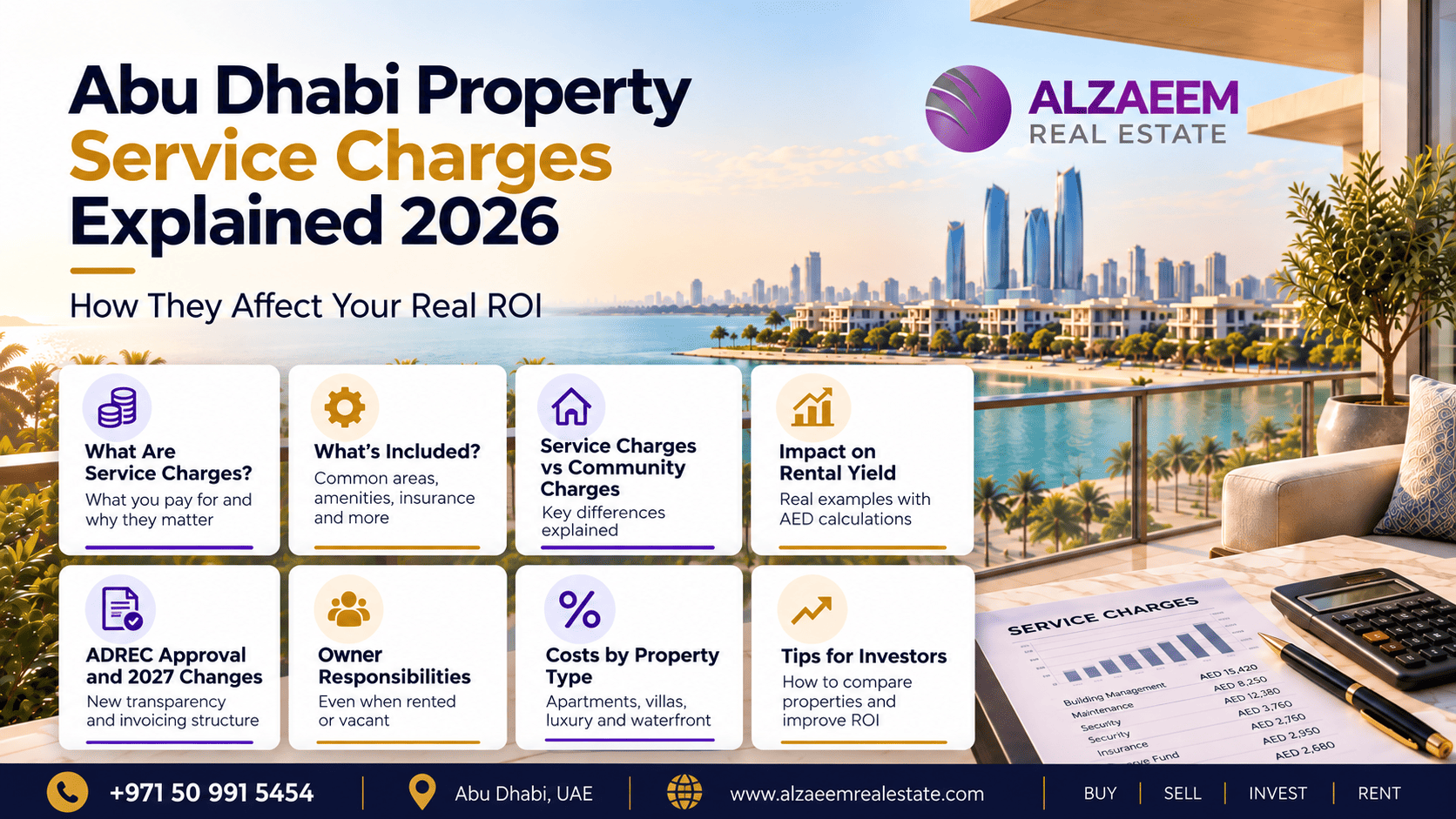
What Are Property Service Charges in Abu Dhabi?
ADREC defines service charges as charges paid by unit owners to cover the costs associated with:
management,
operation,
maintenance,
and repair
of the common areas of jointly owned property.
In an apartment development, those common areas can include:
lobbies,
corridors,
lifts,
swimming pools,
gyms,
landscaping,
parking common areas,
security systems,
building systems,
cleaning,
and other shared facilities.
The exact budget depends on the development.
A small building with limited amenities should not necessarily have the same operating cost structure as a:
waterfront resort,
branded residence,
large landscaped community,
or high-service luxury tower.
Service Charge Is Not Simply “Money to the Developer”
This misconception is common.
Under Abu Dhabi’s regulatory framework, service charges operate through an approved annual budget.
ADREC states that Community Management Companies submit the service-charge budget for review, and invoices can be issued to owners based on the budget once approved.
The legislation also requires service-charge funds to be placed into a designated bank account and used for the management, operation, maintenance and repair of the common property. A separate reserve account is maintained for emergencies or replacement of common equipment and assets.
So buyers should think of service charges as:
the operating budget of the shared property
rather than simply another transaction fee.
Service Charges vs Community Charges
These terms should not automatically be treated as identical.
ADREC’s regulatory material distinguishes between:
Service Charges
and
Community Charges.
Service charges relate to management, operation and maintenance of common areas within the jointly owned property.
Community charges relate more broadly to infrastructure, facilities, services or areas within the wider real-estate development or master community.
This distinction is particularly relevant in:
large islands,
masterplanned developments,
multi-building communities,
and developments where an individual building sits inside a wider destination.
Why an Owner Can Pay More Than One Layer of Charges
Imagine an apartment tower within a large waterfront district.
The building itself requires:
lift maintenance,
lobby cleaning,
security,
pool operations,
common-area electricity,
building insurance,
and MEP maintenance.
Those are building-level costs.
But the wider district may also include:
roads,
landscaping,
parks,
waterfront public areas,
community infrastructure,
and shared master-community services.
That creates the possibility of:
building service costs
plus
wider community costs.
Investors should therefore ask for the complete ownership-cost structure rather than asking only:
“What is the service charge per square foot?”
What Do Service Charges Usually Pay For?
The exact budget varies from project to project, but ADREC’s framework allows approved budgets to fund the operation and maintenance of shared property and facilities.
Building insurance is also included within approved service-charge costs for jointly owned property. ADREC’s owner guidance states that the Community Management Company procures and renews insurance covering the building and common parts, with the cost calculated within the approved service charges.
Public-service provider costs relating to joint property or a master compound can also form part of the approved service/community budget under the applicable regulatory rules.
This is why investors need to understand not simply the total charge, but what sits inside it.
The Reserve Fund Matters
Not every dirham collected should necessarily be consumed during the current year.
Abu Dhabi’s framework requires a separate reserve account for funds allocated to emergencies or replacement of equipment and devices in common parts. That reserve cannot normally be used for unrelated purposes without ADREC approval.
For owners, this matters because buildings eventually need major expenditure.
Examples include:
lift replacement,
major mechanical equipment,
waterproofing,
façade works,
pool systems,
or other capital-intensive common assets.
A properly structured reserve reduces dependence on unexpected owner contributions when major work becomes necessary.
Cheap Service Charges Are Not Automatically Better
Investors often celebrate the lowest possible service charge.
That can be a mistake.
Suppose Building A charges:
AED 10 per sq ft
while Building B charges:
AED 18 per sq ft.
Building A appears better.
But what if Building B offers:
superior maintenance,
better security,
cleaner common areas,
proper reserve funding,
high-quality landscaping,
and functioning amenities?
Those characteristics can support:
tenant satisfaction,
rental retention,
buyer perception,
and long-term resale value.
The objective is not necessarily to find the lowest charge.
It is to find:
an efficient and justifiable charge relative to the property and services delivered.
Expensive Service Charges Are Not Automatically Bad Either
A luxury development with:
private beach facilities,
large pools,
concierge services,
extensive landscaping,
spa facilities,
club areas,
multiple lifts,
and substantial common space
will usually be more expensive to operate than a simple residential building.
If tenants and future buyers value those facilities enough to support:
higher rents
and
higher property values,
the service charge can be economically rational.
The problem begins when:
ownership cost rises substantially
without producing a corresponding advantage in:
rent,
occupancy,
quality
or resale demand.
Service Charges Directly Reduce Rental Yield
This is the key investment calculation.
The most basic gross yield formula is:
Annual Rent ÷ Purchase Price × 100
Suppose:
Purchase price = AED 1,000,000
Annual rent = AED 80,000
Gross rental yield:
8%.
That number looks attractive.
But now assume the apartment is:
900 sq ft
and the illustrative annual service charge works out to:
AED 15 per sq ft.
Annual service charges:
AED 13,500.
Rent remaining after service charges:
AED 80,000 − AED 13,500
= AED 66,500.
Return after service charges alone:
AED 66,500 ÷ AED 1,000,000
= 6.65%.
Your 8% headline yield has already fallen to:
6.65%
before vacancy, management, repairs or financing.
AED 1 Million Property Example
Consider this hypothetical apartment:
| Metric | Amount |
|---|---|
| Purchase price | AED 1,000,000 |
| Annual rent | AED 80,000 |
| Gross yield | 8.0% |
| Illustrative service charges | AED 13,500 |
| Income after service charges | AED 66,500 |
| Yield after service charges | 6.65% |
Service charges reduce the investor’s annual income by:
16.9% of the gross rent.
That is meaningful.
AED 2 Million Property Example
Now consider:
Purchase price:
AED 2,000,000
Annual rent:
AED 140,000
Gross yield:
7%.
Assume the property’s approved ownership costs result in:
AED 26,000 annual service/community charges.
Rental income remaining:
AED 140,000 − AED 26,000
= AED 114,000.
Yield after service/community charges:
5.7%.
Again:
7% headline yield
becomes:
5.7%
before other expenses.
AED 5 Million Property Example
Now consider a premium villa or high-value residence.
Purchase price:
AED 5,000,000
Annual rent:
AED 300,000
Gross yield:
6%.
Assume total annual service/community charges of:
AED 50,000.
Income after these charges:
AED 250,000.
Return after service/community charges:
5%.
This example is intentionally based on an annual-charge assumption rather than a per-square-foot rate because different property types and communities can allocate charges differently.
This Is Why “Yield” Needs a Definition
When someone says:
“This property gives 7%.”
Ask:
7% what?
Gross rental yield?
Net yield after service charges?
Net yield after all operating costs?
Cash-on-cash return after mortgage?
Total return including appreciation?
Those are completely different metrics.
Service charges are one of the largest reasons:
gross yield ≠ net yield.
Compare Properties Using Net Income, Not Just Gross Rent
Imagine two AED 2 million apartments.
Property A
Rent:
AED 135,000.
Service charges:
AED 15,000.
Income after service charge:
AED 120,000.
Property B
Rent:
AED 150,000.
Service charges:
AED 35,000.
Income after service charge:
AED 115,000.
Property B rents for:
AED 15,000 more.
Yet Property A produces:
AED 5,000 more
after service charges.
The higher-rent property is not necessarily the higher-return property.
Calculate Service Charge as a Percentage of Rent
This is a useful metric many investors overlook.
Formula:
Annual Service Charge ÷ Annual Rent × 100
Suppose:
Annual rent:
AED 100,000.
Annual service charges:
AED 20,000.
Then:
20% of the property’s gross rental income is being consumed by service charges.
Compare that with another property:
Rent:
AED 100,000.
Service charges:
AED 10,000.
Only:
10%
is being consumed.
This ratio can make comparisons much clearer.
Service Charge Per Square Foot Can Be Useful — But Be Careful
Market discussions commonly express service charges as:
AED X per sq ft per year.
That is useful for quick comparison.
But investors should not assume every property’s invoice is calculated in exactly the simplistic way:
unit size × advertised rate.
Abu Dhabi’s regulatory framework links the owner’s contribution to the approved property/community structure, with older legislative provisions referring to the unit’s volumetric proportion of the jointly owned property.
Therefore:
use per-square-foot figures as a comparison tool,
but verify the actual approved charge for the exact unit.
Ask for the Actual Invoice
If you are buying a ready property, one of the simplest due-diligence requests is:
“Show me the latest service-charge invoice.”
That can be much more useful than:
broker estimates,
portal comments,
or a rough AED/sq-ft figure.
For a ready property, you may be able to see:
the actual charge,
invoice frequency,
community component,
and whether anything unusual appears.
For an off-plan property, there may be no final operating history yet.
That requires a different approach.
Off-Plan Service Charges Require More Caution
An off-plan project has not yet operated as a completed community.
That means the eventual service-charge budget may depend on:
actual utility consumption,
management contracts,
facility requirements,
staffing,
insurance,
maintenance,
landscaping,
and final operational structure.
If a salesperson provides an estimated service charge, treat it as:
an estimate
unless the applicable charge has actually been approved.
Do not build a 10-year investment model assuming a preliminary estimate will remain unchanged forever.
Read the Amenities List as an Operating-Cost List
When buyers see:
infinity pool,
cinema,
spa,
concierge,
private lounge,
gym,
children’s club,
landscaped podium,
multiple water features,
and extensive public spaces,
they often think:
value.
An investor should also think:
operating cost.
Every amenity requires some combination of:
staff,
cleaning,
maintenance,
electricity,
water,
replacement,
insurance,
and management.
Amenities are not free after handover.
Amenity Quality Can Still Improve ROI
This does not mean investors should avoid amenities.
A beautiful pool,
premium gym,
private waterfront,
or exceptional landscaping
can support:
higher rent,
faster tenant acquisition,
better occupancy,
stronger tenant retention,
and better resale perception.
The correct test is:
Does the amenity create more economic value than the ownership cost it adds?
That is much smarter than simply choosing:
the cheapest service charge.
Apartment vs Villa Service Charges
Apartment developments usually have extensive shared building infrastructure.
That may include:
lifts,
corridors,
lobbies,
mechanical systems,
security,
central facilities,
and shared amenities.
Villas can have a different cost structure.
The villa owner may be directly responsible for more of the maintenance inside the plot while still paying community charges for:
landscaping,
roads,
security,
parks,
club facilities,
or wider master-community infrastructure.
So comparing:
AED/sq-ft apartment service charge
against
villa community charge
can be misleading.
Compare the total annual ownership cost instead.
Branded Residences Require Extra Attention
Branded residences can offer:
premium service,
hospitality-style operations,
concierge,
luxury common spaces,
and a globally recognised brand.
Those benefits may support:
premium rents
and
capital values.
But owners should also investigate:
operating charges,
brand-related fees where applicable,
management structures,
and additional services.
A property being branded does not automatically mean its higher operating cost will be recovered through higher rental yield.
Waterfront Properties Can Carry Additional Operating Complexity
Waterfront buildings can have:
high-value landscaping,
marine exposure,
extensive glazing,
pools,
decks,
waterfront facilities
and more demanding exterior maintenance.
Again, none of this automatically makes them unattractive.
Waterfront scarcity may support substantial value.
But investors should understand:
premium location
and
premium operation
can arrive together.
Who Pays Service Charges When the Property Is Rented?
The owner.
ADREC’s owner guidance explicitly states that the unit owner remains responsible for paying service charges even where the unit is leased.
That means an investor should not calculate:
rent received = income kept.
The landlord must still account for:
service charges
and other owner-side expenses.
Can the Owner Simply Pass Service Charges to the Tenant?
Commercial arrangements can vary, and the lease may allocate particular costs between landlord and tenant.
But from the community-management perspective, ADREC identifies the unit owner as responsible for the service-charge obligation.
Investors therefore should not build their acquisition model on the assumption that:
“The tenant will handle everything.”
Verify the exact tenancy structure.
Service Charges Matter Even When the Property Is Empty
A vacant property does not stop being:
part of the building,
part of the community,
or part of the shared operating structure.
An investor experiencing:
three months’ vacancy
can therefore face a double hit:
lost rent
while
service charges continue.
This is why vacancy and service charges should both appear in a proper net-yield model.
The Developer Pays for Unsold Units
Abu Dhabi’s service-charge framework provides that the developer is responsible for its contribution in respect of unsold units.
This is important in newly completed developments where:
many units may still be held by the developer.
It helps prevent the sold-unit owners from simply being expected to fund the entire shared property because other units remain unsold.
ADREC Approval Is Important
A Community Management Company cannot simply invent an annual charge and invoice owners without the regulatory process.
ADREC’s current Community Affairs system provides for service-charge budgets to be submitted for review and approval before invoices are issued based on those approved charges.
This gives owners a regulated budget framework.
It does not mean charges can never change.
Operating costs change.
Communities age.
Contracts are renewed.
Major maintenance requirements emerge.
Investors should therefore model reasonable future increases rather than assuming the first year’s charge lasts forever.
Abu Dhabi Has Previously Reduced Approved Charges
ADREC reported that service and community charges across development projects were reduced by approximately 6% in 2023, representing around AED 39.7 million compared with the previous year.
The authority also reported reductions of:
18.1% in 2020,
8.3% in 2021,
and more than 6% in 2022
under the fee-monitoring framework.
That historical evidence demonstrates active regulatory oversight.
It should not be interpreted to mean that every individual building’s charge will necessarily fall each year.
Major Transparency Changes Begin With 2027 Budgets
This is one of the most important current developments for Abu Dhabi owners.
ADREC announced in April 2026 that it is standardising service-charge budgeting and invoicing across the market.
Beginning with 2027 budgets, annual service-charge rates will be separated into three categories:
Community Service Charges
Master Community Fees
Surplus / Deficits based on community audit reports.
ADREC says owners will receive between two and four invoices showing the relevant components, while unit owners will also receive quarterly financial statements.
This should make it easier for owners to understand:
what they are paying,
where the money is allocated,
and how the community is performing financially.
Why Surplus and Deficit Reporting Matters
Suppose a community’s approved budget expected:
AED 10 million of expenditure.
Actual audited spending was:
AED 9 million.
There may be a surplus to account for.
Conversely, if actual legitimate costs exceeded the budget, the community can show a deficit.
The 2027 framework explicitly separates the surplus/deficit element using community audit reporting.
For investors, this improves the quality of ownership-cost analysis.
Instead of seeing one opaque figure, owners should have greater visibility into the components.
Quarterly Financial Statements Matter Too
Property investors routinely monitor:
rent,
property value,
mortgage balance,
and cash flow.
Community financial information deserves similar attention.
Under ADREC’s announced 2027 framework, unit owners are to receive quarterly financial statements.
That can help owners understand:
community expenditure,
financial performance,
and the relationship between approved budgets and actual operations.
For serious long-term investors, this is useful data.
Owners Can Raise Concerns
ADREC’s current guidance confirms that owners can raise questions or concerns regarding service charges through:
the Community Management Company,
the Owner Committee,
and ultimately ADREC according to the applicable procedure.
This is another reason investors should retain:
invoices,
statements,
official communication,
and ownership records.
Owner Committees Matter
Owner committees provide a structured channel through which qualifying owners can engage with community-management issues.
Under Abu Dhabi’s current rules, owner-committee participation also requires service and community charges to be settled.
For an investor considering a mature community, the effectiveness of:
community management
and
owner engagement
can influence the quality of the property long after construction ends.
What Happens If Service Charges Are Not Paid?
Ignoring the invoice is not a sensible investment strategy.
ADREC states that legal action may be taken against owners who fail to pay service charges.
The 2026 collection framework requires management companies to notify owners of outstanding balances, with owners then given up to 60 days to settle following the applicable notice process.
Service charges are therefore not optional simply because:
the owner disagrees with the amount,
does not use the pool,
or keeps the property vacant.
You Cannot Avoid Service Charges by Saying You Do Not Use the Amenities
A resident may never use:
the gym,
pool,
clubhouse,
or landscaped garden.
That does not remove the ownership obligation.
The common property still:
exists,
requires maintenance,
and forms part of the development.
The legislation expressly prevents an owner from giving up their interest in the common areas merely to avoid paying their service-charge contribution.
Service-Charge Clearance Matters When You Sell
This is particularly important for investors planning an exit.
ADREC’s owner guidance states that outstanding service charges must be settled before the completion of a sale or transfer and that a service-charge clearance certificate is required.
That means unpaid charges can become:
an exit problem.
Do not wait until you find a buyer to discover that the property has:
outstanding invoices,
disputes,
or unresolved balances.
Service Charges Therefore Affect Resale Liquidity Too
Suppose two similar buildings have:
similar apartments,
similar rent,
and similar selling prices.
But one building has:
significantly higher annual ownership costs.
A resale buyer—particularly an investor—may capitalise that difference into the price they are willing to pay.
That means service charges potentially influence:
not only current rental return
but also
future resale attractiveness.
High Service Charge Can Reduce the Buyer Pool
An end user may accept:
AED 30,000 annual service charge
because they highly value:
the pool,
gym,
waterfront,
concierge
and community.
An investment buyer may see the exact same AED 30,000 as:
a deduction from yield.
Therefore, buildings with high operating costs may appeal differently to:
end users
and
yield-focused investors.
Understanding the future buyer pool is part of exit planning.
Low Service Charges Can Support Resale — If Quality Is Maintained
A well-run building that delivers:
good maintenance,
clean common areas,
functional amenities
and low ownership cost
can become attractive in the secondary market.
That creates a useful combination:
good lifestyle + efficient ownership.
Those developments are worth identifying.
But do not confuse:
low cost
with
under-maintenance.
Look at the Building Five Years After Handover
Service charges become easier to judge with time.
At launch, everything is theoretical.
Five years later you can inspect:
façade condition,
lift reliability,
landscaping,
pool condition,
common areas,
cleanliness,
parking,
security
and maintenance responsiveness.
Then compare that physical result with:
what owners are paying.
That is a much stronger analysis than simply asking whether:
AED 12
or
AED 18 per sq ft
sounds cheap.
Developer Due Diligence and Service Charges Are Connected
This is why the previous article on evaluating an Abu Dhabi property developer matters.
A developer’s older communities give you evidence about:
how its projects age,
what amenities cost to operate,
how community management works,
and whether buyers continue to value those projects after handover.
For an off-plan buyer, completed communities are one of the few available clues about:
future ownership economics.
Include Service Charges in Your ROI Calculator
A proper rental-property model should distinguish between:
gross income,
service/community charges,
other operating expenses,
financing,
and appreciation.
A useful structure is:
| ROI Component | Example |
|---|---|
| Annual rent | AED 140,000 |
| Service/community charges | -AED 26,000 |
| Property management | -AED 7,000 |
| Maintenance reserve | -AED 5,000 |
| Vacancy allowance | -AED 7,000 |
| Net operating cash flow | AED 95,000 |
Against a AED 2 million purchase price:
AED 95,000 ÷ AED 2,000,000
= 4.75% operating return
before financing and capital appreciation.
Compare that with the headline:
7% gross yield.
This is why net analysis matters.
Do Not Double Count Expenses
When calculating ROI, first establish exactly what the service charge already includes.
For example:
building insurance,
common-area maintenance,
security
or certain facilities
may already sit within the approved service-charge budget.
Do not then automatically subtract the same expense again from your personal investment model.
Separate:
common-property costs
from
unit-owner costs.
Unit-Level Maintenance Is Different
Service charges maintain:
shared property.
They do not mean the owner will never pay for:
appliance repairs,
internal plumbing,
air-conditioning components inside the unit where owner responsibility applies,
painting,
furniture,
or tenant-related wear and tear.
That is why:
service-charge-adjusted yield
is still not necessarily the final net yield.
Furnished Properties Need Another Cost Layer
If you furnish an apartment for:
AED 50,000
and furniture requires periodic replacement,
that cost is separate from building service charges.
Investors should therefore calculate:
property operating costs
plus
unit operating costs.
A glamorous building with a 7% gross yield can quickly become a much more ordinary investment once all ownership expenses are considered.
Mortgage Investors Need to Go One Step Further
For a financed property, service charges reduce the rent available to service the mortgage.
Example:
Rent:
AED 140,000.
Service charge:
AED 26,000.
Net before other costs:
AED 114,000.
Mortgage payments:
AED 90,000.
The margin becomes:
AED 24,000
before vacancy, maintenance and management.
This is very different from looking at:
AED 140,000 rent
against
AED 90,000 mortgage payments
and assuming a:
AED 50,000 surplus.
High Leverage Makes Service Charges More Important
A cash investor may tolerate:
an extra AED 10,000 annual service charge.
A highly leveraged investor with thin cash flow may not.
When the mortgage already consumes most rental income, service-charge increases can turn:
positive cash flow
into
negative cash flow.
This is why financing analysis and service-charge analysis should happen together.
Model Future Increases
Suppose current annual service charges are:
AED 20,000.
Do not necessarily forecast:
AED 20,000
for each of the next ten years.
Operating costs can change because of:
labour,
utilities,
maintenance,
insurance,
contract renewal,
community ageing
and capital requirements.
For investment modelling, run:
a base case
and
a higher-cost case.
If the property only produces an acceptable return when service charges remain frozen indefinitely, the model is fragile.
New Buildings Can Change After the Early Years
A newly completed development may initially have:
new equipment,
developer involvement,
warranties,
and relatively limited replacement needs.
As the property matures:
maintenance patterns can change.
This does not mean service charges must inevitably rise dramatically.
It means investors should avoid assuming the first operating year represents:
the permanent long-term cost structure.
A Simple Purchase Comparison
Suppose you are choosing between:
Apartment A
Price: AED 1.8M
Rent: AED 125K
Service charges: AED 15K
Income after service charges:
AED 110K
Return:
6.11%
Apartment B
Price: AED 1.8M
Rent: AED 135K
Service charges: AED 30K
Income after service charges:
AED 105K
Return:
5.83%
Apartment B rents higher.
Apartment A produces more income after service charges.
But the decision still is not complete.
What if Apartment B has:
better view,
stronger appreciation potential,
better tenant demand
and superior resale liquidity?
Then the extra operating cost may still be justified.
This is why service charge is:
a major variable
but not the only variable.
Evaluate Service Charges With Four Questions
When comparing Abu Dhabi properties, the useful framework is:
| Question | What You Are Testing |
|---|---|
| What is the actual approved annual charge? | Current ownership cost |
| What services and facilities does it fund? | Value received |
| What percentage of rent does it consume? | Impact on net yield |
| Does the development remain attractive after those costs? | Investment quality |
This framework is much more useful than simply ranking buildings by:
lowest AED/sq-ft charge.
For Ready Property, Ask for Historical Charges
If available, compare:
current year,
previous year,
and earlier service-charge history.
You are looking for:
stability,
large changes,
special circumstances,
and whether management quality changed alongside the budget.
A single year’s invoice provides:
a snapshot.
Several years provide:
a pattern.
For Off-Plan Property, Ask Better Questions
Instead of asking only:
“What will the service charge be?”
Ask:
What facilities will the community operate?
Is there a master-community charge?
Who is expected to manage the building?
What do comparable completed communities from the same developer cost?
Is the figure being quoted:
approved,
estimated,
or illustrative?
That language matters.
Never Advertise an Estimated Charge as Guaranteed
For agencies and brokers, accuracy matters.
If an off-plan service charge is:
estimated,
describe it as estimated.
Do not convert:
“expected AED 15–18/sq ft”
into:
“service charge AED 15/sq ft.”
The second statement sounds definitive.
The first correctly signals uncertainty.
FAQs — Abu Dhabi Property Service Charges
What are service charges in Abu Dhabi?
They are owner-paid charges used to fund the management, operation, maintenance and repair of shared/common property and facilities. Annual service-charge budgets are subject to ADREC approval.
Who pays service charges on a rented property?
The unit owner remains responsible for paying the service charges even when the property is leased.
Are service charges approved by ADREC?
Yes. Community Management Companies submit service-charge budgets for review and approval, after which invoices may be issued based on the approved charges.
Are service charges the same as community charges?
Not necessarily. Abu Dhabi’s framework distinguishes service charges relating to common property from community charges associated with wider development infrastructure, facilities and services.
Do service charges affect rental yield?
Yes. Service charges reduce the rental income retained by the owner, so a property’s net yield can be significantly lower than its headline gross yield.
Is the lowest service charge always the best?
No. Very low charges can be attractive if the building remains properly maintained, but the quality and scope of services should be considered alongside cost.
Do luxury developments usually cost more to operate?
They can, particularly where they include extensive amenities, staffing, landscaping and common areas. Whether the higher cost is justified depends on the rent, lifestyle value and resale demand those facilities support.
Does the owner pay service charges on a vacant unit?
The ownership obligation continues even where a property is vacant. An owner cannot avoid the charge simply by not using the common facilities.
Does the developer contribute for unsold units?
Abu Dhabi’s framework provides that the developer pays the relevant contribution for unsold units.
Are service-charge funds held separately?
Yes. The management company must deposit collected service charges into the designated account, while reserve funds for emergencies and replacement of common assets are held separately under the regulatory framework.
Can owners question their service charges?
Yes. ADREC states that owners can raise concerns through the Community Management Company, Owner Committee and, where necessary, ADREC.
What happens if service charges are unpaid?
ADREC says legal action can be taken, and its 2026 collection framework provides a notice process under which owners are given up to 60 days to settle outstanding amounts following notification.
Do I need to clear service charges before selling?
Yes. ADREC states that outstanding service charges must be settled and a service-charge clearance certificate is required before completing a sale or transfer.
What changes are coming in 2027?
ADREC’s updated framework will separate annual charges into Community Service Charges, Master Community Fees and Surplus/Deficits. Owners are expected to receive between two and four invoices and quarterly financial statements. The change applies to 2027 budgets onward.
Final Takeaway — Service Charge Is Part of the Investment, Not an Afterthought
An investor should never evaluate an Abu Dhabi property using only:
purchase price
and
rent.
The meaningful question is:
How much income remains after the cost of owning and operating the property?
A property producing:
8% gross yield
can become:
6.5%,
5.5%
or lower
once ownership costs are included.
At the same time, a building with higher service charges can still be a strong investment if those charges support:
premium facilities,
better tenant demand,
stronger rents,
excellent maintenance,
and stronger resale value.
So do not automatically choose:
the cheapest service charge.
Choose the property where the cost makes sense relative to:
the income, asset quality and long-term investment value.
For a ready property, request the actual approved service-charge information and recent invoices.
For an off-plan property, treat future charges conservatively, examine comparable completed projects and understand the facilities you will eventually be paying to operate.
And when comparing two investments, move beyond:
gross rental yield.
Calculate:
rent minus service/community charges
then continue deducting:
vacancy,
management,
maintenance,
financing,
and other applicable ownership costs.
That is how you move from:
marketing yield
to
real investment return.
For buyers comparing Abu Dhabi apartments, villas and off-plan projects, Al Zaeem Real Estate can help assess service-charge exposure alongside rent, purchase price, payment structure, unit quality and resale potential before purchase.
Call: +971 50 991 5454
Abu Dhabi, UAE
Primary Official Sources
ADREC’s Community Affairs guidance confirms the service-charge approval process, owner responsibility, insurance treatment, owner complaint channels, clearance requirements, 2026 collection procedures and the new 2027 budget/invoicing structure.
Abu Dhabi’s Real Estate Regulations establish the framework for service and community charges, designated accounts, reserve funds, annual budgets and common-property operating costs.
ADREC’s historical fee-monitoring reporting shows that regulatory review has previously resulted in market-wide reductions in approved service and community charges.
Disclaimer
This article is for general real-estate research and educational purposes only. It does not constitute legal, financial or investment advice. Service charges vary by property, community, approved budget and year. Illustrative AED amounts and per-square-foot examples in this guide are hypothetical and are not presented as current charges for any specific Abu Dhabi development. Buyers should verify the latest approved service/community charges for the exact property through the seller, Community Management Company and applicable ADREC records before completing a purchase.