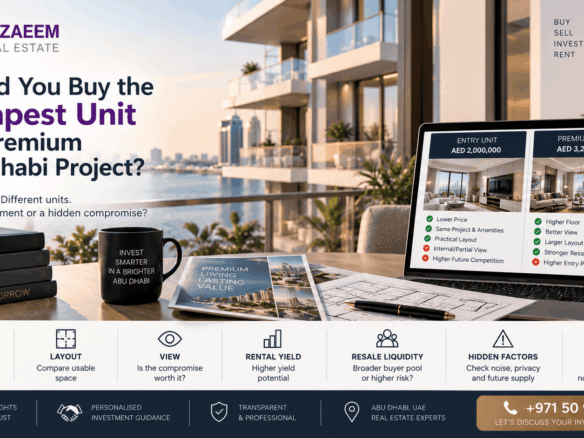




Two investors can buy apartments in the same project, on the same launch day, from the same developer and end up with dramatically different investment results.
One chooses a well-proportioned corner unit with an open view, efficient layout and limited future competition.
The other chooses whatever was still available because the launch was “selling fast.”
Both buyers own the same project.
But they do not own the same investment.
This distinction is becoming increasingly important in Abu Dhabi because off-plan property now dominates residential sales activity. During H1 2026, Abu Dhabi recorded AED 70.4 billion in residential sales, with off-plan transactions accounting for 89% of residential sales value and 82% of transaction volume. At the same time, approximately 71,000 additional residential units are projected through 2030, meaning future buyers and tenants will have more choice.
That creates a simple investment reality:
As supply expands, the difference between an average unit and an exceptional unit becomes more important.
Choosing the developer matters.
Choosing the project matters.
But once those decisions are made, choosing the right individual unit can determine:
- rental demand;
- achieved rent;
- resale liquidity;
- buyer competition;
- long-term capital appreciation;
- and how easily you can exit before or after handover.
This guide explains how to evaluate an Abu Dhabi off-plan unit properly before signing the SPA.
The Unit Selection Hierarchy
Before comparing unit numbers, use this order:
1. Project
Is the overall project worth buying?
2. Building or Cluster
Which building, phase, village or cluster is strongest?
3. Unit Stack
Where is the apartment or villa positioned?
4. Floor
How does elevation affect the view, noise, privacy and price?
5. Layout
Is the usable space efficient?
6. View and Orientation
What does the unit face now—and what could it face later?
7. Price Premium
How much extra are you paying for those advantages?
8. Exit Liquidity
Will another buyer understand and value the same advantages?
The mistake is starting at Step 4.
A twentieth-floor apartment in the wrong building is not necessarily better than a fifth-floor unit in the right building.
First Rule: Do Not Buy the Project — Buy the Exact Unit
Marketing tends to sell projects.
Secondary buyers purchase units.
That difference becomes critical after launch.
A developer may market:
“waterfront living.”
But one unit might directly face the water.
Another could have a partial side angle.
Another may overlook the internal courtyard.
Another may face the parking entrance.
Another could eventually face another residential building.
All technically belong to the same “waterfront project.”
Their resale values do not have to behave identically.
When buying off-plan, think like the person who might buy from you five years later.
They will compare:
your actual unit against every alternative available at that time.
Floor Selection — Higher Is Not Automatically Better
One of the most common assumptions in apartment investment is:
Higher floor = better unit.
Sometimes that is correct.
Sometimes it is an expensive oversimplification.
Higher floors can provide:
- wider views;
- greater privacy;
- less street noise;
- stronger prestige;
- potentially better resale presentation.
But they can also carry:
- significant floor premiums;
- greater elevator dependence;
- stronger wind exposure on balconies;
- no meaningful view advantage if the surroundings are already open.
The investment question is not:
“How high is the floor?”
It is:
“What additional benefit am I receiving for each additional dirham paid?”
The Floor Premium Test
Imagine identical two-bedroom apartments.
Floor 6
Price:
AED 2.20 million
Floor 16
Price:
AED 2.35 million
Difference:
AED 150,000
Ask:
What exactly does the extra AED 150,000 buy?
If Floor 16 provides:
- permanent open water view;
- substantially greater privacy;
- clear separation from road noise;
then the premium may be defensible.
If both units effectively see the same internal garden, the investor may be paying AED 150,000 mainly for the number 16.
That premium still needs to be recovered at resale.
Low Floors Can Be Excellent Investments
Low-floor units are sometimes dismissed too quickly.
They can make sense when they provide:
- direct garden relationship;
- pool access;
- larger terraces;
- podium landscaping;
- shorter elevator travel;
- better value per sq ft;
- easier family use.
A first- or second-floor residence facing a beautiful landscaped park may outperform a high-floor apartment overlooking another tower.
The word low-floor should not automatically mean inferior.
What matters is what the floor actually interacts with.
But Be Careful With Very Low Floors
Very low floors can also introduce issues such as:
- traffic noise;
- pedestrian visibility;
- service roads;
- lobby entrances;
- loading zones;
- restaurant noise;
- podium equipment;
- pool activity;
- lower privacy.
Always inspect the masterplan around the building footprint.
Do not evaluate the apartment in isolation.
High Floors: When the Premium Makes More Sense
Higher floors are most defensible when elevation creates genuine scarcity.
Examples include:
unobstructed sea view
museum or cultural-district outlook
golf-course panorama
marina view
skyline view
clear horizon above future neighbouring structures
In those cases, height is not merely status.
It creates a physical difference that another buyer can immediately understand.
That is what makes a premium easier to defend.
View — Probably the Most Powerful Unit-Level Value Driver
Views are emotional.
And real estate is partly emotional.
People will often pay significantly more for:
- sea;
- marina;
- golf;
- park;
- mangroves;
- cultural landmarks;
- skyline.
But a view only creates strong investment value when it passes three tests.
Is it attractive?
Is it permanent?
Is the premium reasonable?
Fail any one of those and the investment case weakens.
Permanent View vs Temporary View
This is one of the most important distinctions in off-plan buying.
A sales representative may show you an open view today.
But the land between your unit and that view may be:
another development plot.
Once a future tower rises, the view can change materially.
Before paying a premium, request:
- masterplan;
- plot map;
- future building heights where available;
- unit orientation;
- neighbouring parcel information.
ADREC requires registered off-plan projects to provide project information including unit types, floor plans, pricing and projected handover details as part of formal project registration, and registered projects receive official Project IDs.
The regulatory system verifies the project.
Your job is still to verify the specific unit position inside that project.
Full View vs Partial View
Be careful with marketing terminology.
Possible descriptions include:
full sea view
partial sea view
side sea view
community view
park-facing
marina-facing
Two words can represent a large price difference.
Ask for the actual architectural orientation.
If possible, mark the exact balcony direction on the site plan.
Do not rely entirely on a rendering created from a flattering camera angle.
Water View Premiums — When They Make Sense
Waterfront generally has strong emotional and resale appeal in Abu Dhabi.
But not all waterfront views are equal.
Compare:
Direct uninterrupted water
Strongest.
Marina or canal
Potentially excellent, especially with active waterfront lifestyle.
Side-angle water glimpse
Useful but should not command the same premium.
Water visible beyond another building
Much weaker.
If an apartment costs AED 300,000 more because of the word water, determine exactly how much water future buyers will actually see.
Golf View — A Different Type of Scarcity
Golf-facing units can benefit from:
- open landscape;
- greenery;
- lower chance of dense construction directly ahead;
- peaceful views;
- premium villa environment.
But orientation matters.
A property overlooking:
fairway + landscape
can be very different from one facing:
clubhouse parking + service access.
Again, buy the actual orientation.
Not the marketing category.
Park Views Can Be Undervalued
Investors sometimes assume sea views are automatically superior.
Families may value a park view more.
Especially when the property offers:
- direct pedestrian access;
- children’s play areas;
- greenery;
- walkability;
- quieter surroundings.
A park-facing apartment in a family-oriented development can have a strong end-user resale market.
That matters because end users often pay more emotionally than purely yield-focused investors.
Avoid the “View Premium Trap”
Suppose:
Internal-view apartment:
AED 2 million
Sea-view apartment:
AED 2.6 million
The sea view costs:
AED 600,000 extra.
Will rent be AED 600,000 better?
Obviously not.
Will future resale value justify the entire difference?
Possibly—but it needs analysis.
Premium units can protect value better.
But investors can also overpay for them.
The strongest unit is not always the strongest investment.
Layout — Built-Up Area Can Mislead You
Two apartments may both be listed at:
1,500 sq ft.
But their usable living experience can be completely different.
Unit A might have:
- efficient rectangular living room;
- well-proportioned bedrooms;
- practical kitchen;
- useful storage;
- good balcony;
- minimal corridor.
Unit B may waste significant area on:
- long hallways;
- awkward corners;
- structural columns;
- oversized entrance;
- unusable circulation.
Both are 1,500 sq ft.
Only one may feel like it.
Usable Space Is More Important Than Headline Size
When comparing floorplans, mentally divide the unit into:
Functional space
Living room
Bedrooms
Kitchen
Storage
Balcony
Utility
Circulation space
Hallways
Entrances
Passages
You are paying for both.
But tenants and future buyers value the first category far more.
An efficient 1,250 sq ft apartment can sometimes feel superior to a poorly planned 1,450 sq ft alternative.
The Corridor Test
Look at the floorplan.
If a large percentage of the property is essentially a hallway, ask why.
Long corridors:
- add purchase cost;
- add cooling area;
- add flooring;
- rarely improve lifestyle.
Luxury villas can naturally require more circulation.
But in investment apartments, excessive corridor space often hurts efficiency.
Bedroom Size Matters More Than Bedroom Count
A property can technically be marketed as:
three bedrooms.
But if the third bedroom barely accommodates a proper bed and wardrobe, future buyers will notice.
A strong family layout should allow:
- reasonable bed position;
- wardrobes;
- walking space;
- usable windows.
Do not let the headline bedroom count replace floorplan analysis.
Kitchen Layout Can Affect Tenant Demand
Different buyer segments prefer different kitchens.
Open kitchens can work well for:
- smaller apartments;
- younger professionals;
- contemporary layouts.
Families may value:
- enclosed kitchen;
- wet kitchen;
- larger storage;
- utility areas.
Some high-end villas offer both wet and dry kitchens.
There is no universally superior format.
The correct layout depends on the likely future resident.
Storage Is Quietly Valuable
Storage rarely dominates a developer brochure.
Residents notice it immediately after moving in.
Useful storage includes:
- built-in wardrobes;
- utility room;
- pantry;
- laundry;
- external storage;
- villa garage storage.
An apartment without adequate storage can look beautiful in a staged rendering but become frustrating in real life.
And frustrating homes are harder to retain tenants in.
Balcony Size — Useful or Expensive Decoration?
Large terraces can create major value.
Particularly when they have:
- meaningful view;
- privacy;
- usable depth;
- good orientation.
But some developments allocate large amounts of sellable area to narrow balconies that are difficult to furnish.
Ask:
Can a table fit?
Can chairs fit?
Is it deep enough to use?
Is the balcony exposed to severe wind?
Does it overlook something worth sitting outside for?
Paying indoor-level pricing for unusable outdoor area can weaken value.
Corner Units — Often Strong, Not Automatically
Corner apartments can offer:
- more windows;
- better natural light;
- dual aspect;
- fewer shared walls;
- stronger privacy.
That can improve resale appeal.
But check:
what both sides face.
A dual-aspect unit looking toward:
water + park
can be excellent.
A dual-aspect unit facing:
road + service area
is not automatically premium simply because it is a corner.
Orientation — Where Does the Sun Hit?
Abu Dhabi’s climate makes orientation relevant.
West-facing units can receive strong afternoon sun.
That may create beautiful sunset views but can also increase glare and heat load depending on façade design, glazing and shading.
North-facing units can receive softer daylight in many building configurations.
East-facing homes may receive morning sun.
South exposure varies significantly with building design and shading.
Do not reduce this to:
“north good, west bad.”
The more useful questions are:
What does the glazing face?
How much external shading exists?
Is the balcony recessed?
What is the view?
Would the target buyer value sunset exposure?
Architecture can materially change the experience.
Privacy — Often Underpriced at Launch
Privacy becomes more valuable after people move in.
At launch, two facing buildings can look harmless on a masterplan.
After completion, residents may discover their bedrooms and balconies directly overlook each other.
Check:
- building-to-building distance;
- balcony alignment;
- bedroom windows;
- neighbouring tower orientation.
A unit with fewer direct sightlines can become more desirable at resale.
Elevator Position
Look at where your front door sits relative to:
- elevators;
- service lift;
- fire stairs;
- refuse room;
- mechanical rooms.
Being close to an elevator can be convenient.
Being directly opposite a high-traffic elevator bank can reduce privacy.
Similarly, proximity to refuse facilities may create noise or odour concerns.
These are small details during launch.
They become real after handover.
Service-Core Risk
Ask what lies behind each wall.
Possible neighbours include:
- lift shaft;
- mechanical riser;
- electrical room;
- refuse room;
- service corridor.
A bedroom sharing a wall with mechanical infrastructure can be less attractive than one adjoining another residential room.
Floorplans do not always make this obvious.
Request the broader floorplate.
How Many Units Are on the Floor?
Compare:
Building A
4 residences per floor.
Building B
16 residences per floor.
The second building may still be an excellent investment.
But density affects:
- privacy;
- elevator traffic;
- corridor activity;
- exclusivity;
- future internal resale competition.
Low-density floors can command stronger premiums in luxury projects because the scarcity is physical and easy to understand.
The Stack Matters More Than the Floor Number
A stack is the vertical line of similar units running through the building.
If Stack 03 has the best layout and direct sea orientation, then:
Floor 7 Stack 03
may be better than:
Floor 18 Stack 09.
Do not select floor first.
Select the best stacks.
Then choose the appropriate floor within them.
Study the Entire Floorplate
Your unit does not exist alone.
Look at:
- neighbouring units;
- service rooms;
- elevators;
- emergency stairs;
- corridor;
- refuse area;
- mechanical spaces.
This reveals information a single-unit floorplan cannot.
For villa communities, use the same concept at neighbourhood level.
Study the plot map.
Villa Plot Selection Is Even More Important
For villas, the equivalent of apartment stack selection is plot selection.
Two identical villas can perform very differently because of:
- plot size;
- corner position;
- park frontage;
- golf frontage;
- waterfront;
- road location;
- neighbour distance;
- rear privacy;
- orientation.
Land is difficult to change.
Interior finishes are not.
Corner Villa vs Internal Villa
Corner villas may provide:
- larger plots;
- additional side space;
- fewer immediate neighbours;
- stronger privacy.
But they can also face:
- more road exposure;
- traffic;
- pedestrian movement.
Do not automatically pay a corner premium without checking the specific road hierarchy.
A quiet internal corner differs significantly from a major junction.
End Plot — Potentially Valuable
Townhouses at row ends can provide:
- extra windows;
- more side garden;
- only one shared wall;
- greater privacy.
These advantages can make the property easier to resell.
But again, verify what the side boundary faces.
A landscaped path is valuable.
A transformer or service road is less compelling.
Park-Front Villa vs Internal Street
Families often value direct park access.
Potential benefits include:
- children;
- greenery;
- walkability;
- open outlook.
But a park directly outside can also create:
- pedestrian traffic;
- evening noise;
- reduced privacy.
Choose based on the target end user.
Main Road Exposure
Property facing a major internal boulevard may have:
- easy access;
- attractive streetscape.
But can also experience:
- headlights;
- traffic;
- noise.
A quieter secondary street often appeals more to family villa buyers.
Location inside the community matters almost as much as location of the community itself.
Distance From Amenities
Being near amenities is positive.
Being directly above or beside them may not be.
Examples:
Near school
Convenient.
Directly beside school entrance
Potential morning traffic.
Near retail
Useful.
Directly above late-night restaurant
Possible noise and smells.
Near pool
Desirable.
Ground-floor bedroom beside pool deck
Reduced privacy.
There is a difference between:
accessible
and
too close.
Parking Allocation
For investment apartments, check:
- number of spaces;
- location;
- whether spaces are deeded or allocated;
- visitor parking.
For larger family apartments and villas, inadequate parking can weaken end-user demand.
A four-bedroom premium residence with one inconvenient parking space may become frustrating.
View, Layout or Floor — Which Should You Prioritise?
There is no universal answer.
But for many investment properties, a useful hierarchy is:
Permanent view → efficient layout → privacy → floor
A beautiful layout survives even when the market slows.
A permanent view creates scarcity.
Privacy strengthens end-user appeal.
Floor number matters, but often less than people assume.
Do Not Overpay for the “Best Unit”
An investment can fail because the unit was too average.
It can also fail because the buyer paid too much for perfection.
Imagine:
Excellent two-bedroom:
AED 2.2 million
Exceptional two-bedroom:
AED 2.75 million
The exceptional one has:
- better floor;
- better view;
- corner position.
The question becomes:
Is it AED 550,000 better?
You are not buying a beauty contest.
You are buying an investment.
Calculate the Premium in Percentage Terms
Always convert premiums into percentages.
Base unit:
AED 2 million
Premium unit:
AED 2.4 million
Premium:
AED 400,000
Percentage:
20%
Now ask:
Will the premium unit realistically rent for 20% more?
Will it resell for 20% more?
Does its scarcity justify 20%?
This makes comparisons more rational.
Rental Premium vs Purchase Premium
Suppose:
Internal unit:
Purchase price AED 2 million
Expected rent AED 140,000
Sea-view unit:
Purchase price AED 2.5 million
Expected rent AED 160,000
Purchase premium:
25%
Rental premium:
approximately 14%
The sea-view apartment may still be the stronger long-term asset.
But it is not automatically the stronger yield investment.
Know which return you are targeting.
Exit Liquidity — The Most Important Unit Test
Ask:
How many people could realistically want this exact unit when I sell?
That is exit liquidity.
A property with strong liquidity typically has:
- understandable advantages;
- broad buyer appeal;
- reasonable price;
- manageable service charges;
- useful layout;
- limited direct substitutes.
The future buyer should be able to look at your unit and immediately understand why it is desirable.
The “One-Sentence Resale Test”
Before buying, describe the unit in one sentence.
For example:
High-floor corner two-bedroom with permanent marina view and oversized balcony.
Good.
Or:
Internal one-bedroom on Floor 8.
Less differentiated.
If you cannot identify what makes the unit special, your future broker may struggle too.
Scarcity Must Be Real
Statements such as:
“Only 10 units left.”
do not necessarily create real estate scarcity.
That may only mean the current launch release is almost sold.
Real scarcity looks like:
- only a handful of corner stacks;
- very limited direct waterfront units;
- rare oversized plots;
- one penthouse floor;
- very few park-front villas;
- unique layout.
That type of scarcity survives after marketing ends.
How Many Identical Units Exist?
This question is extremely important.
Suppose a project has:
500 identical one-bedrooms.
When investors begin reselling, your property could compete with dozens of comparable units.
Now suppose another project has:
24 units of your configuration.
That creates a different resale environment.
Internal supply matters.
Future Developer Inventory Competes With You
Your future resale buyer may compare your property with:
- remaining developer stock;
- later phase;
- new building;
- newer payment plan.
This can materially affect your exit.
Abu Dhabi’s current forward supply is substantial: ADREC projects approximately 71,000 additional homes through 2030, with delivery volumes expected to peak in 2028.
That does not mean avoid new developments.
It means prioritise units that can remain distinguishable as the market expands.
The Cheapest Unit Can Sometimes Be the Smartest
A lower-priced unit can produce strong investment economics when:
- layout is still efficient;
- building is strong;
- view is acceptable;
- rent differential is small;
- entry discount is meaningful.
For example, a community-facing one-bedroom may rent for only AED 10,000 less than a sea-view unit despite costing AED 300,000 less.
For yield investors, the cheaper unit might perform better.
But the Cheapest Unit Can Also Be the Hardest to Sell
Sometimes it is cheap for a reason.
Possible issues:
- lowest floor;
- parking view;
- service road;
- mechanical equipment;
- awkward layout;
- future construction.
The correct strategy is not:
buy cheapest.
It is:
buy the strongest value.
Mid-Market Units Often Have the Broadest Buyer Pool
Ultra-premium units can achieve exceptional prices.
But their buyer pool is naturally smaller.
A sensibly priced one- or two-bedroom apartment can attract:
- investors;
- couples;
- professionals;
- first-time buyers.
That can improve liquidity.
Likewise, family-focused three- and four-bedroom townhouses often benefit from genuine end-user demand.
Understand who your future buyer is.
Buy for the Next Buyer, Not Just Yourself
Even if you intend to live in the property, resale matters.
Personal preferences can be highly specific.
Investment-friendly preferences are broader.
Examples of broad appeal:
- efficient layout;
- useful balcony;
- good natural light;
- privacy;
- open view;
- adequate storage.
Highly personalised features may not add equivalent resale value.
Unit Selection for Rental Investors
Rental investors should prioritise:
- acquisition price;
- tenant-friendly layout;
- reasonable service charges;
- practical floor;
- transport/access;
- target tenant;
- rental competition.
The most expensive view is not always necessary.
The unit should be easy to rent repeatedly.
Unit Selection for Capital-Growth Investors
Growth-oriented buyers can justify paying more attention to:
- scarce views;
- corner positioning;
- land;
- premium stacks;
- low-density floors;
- unique layouts.
Their future return depends more heavily on resale demand.
Scarcity therefore matters more.
Unit Selection for End Users
End users can place greater weight on:
- daily comfort;
- sun;
- school access;
- privacy;
- storage;
- parking;
- community facilities.
An end user can rationally pay a premium that a yield investor would reject.
That is not necessarily overpaying.
Their return includes lifestyle.
Unit Selection Matrix
A simple practical scoring framework can help.
Score each candidate from 1 to 5 on:
| Factor | Weight |
|---|---|
| Layout efficiency | 20% |
| View permanence | 20% |
| Entry price | 20% |
| Privacy / noise | 10% |
| Floor / elevation | 10% |
| Internal scarcity | 10% |
| Rental appeal | 5% |
| Resale liquidity | 5% |
Do not treat the final number as scientific valuation.
Use it to force yourself to compare units consistently rather than emotionally.
Example Comparison
Unit A
High floor
Sea view
Poor layout
AED 2.6 million
Unit B
Mid floor
Park and partial-water view
Excellent layout
AED 2.25 million
Unit C
Low floor
Internal view
Good layout
AED 2 million
There is no automatic winner.
Yield investor
Might prefer Unit C.
Balanced investor
Could prefer Unit B.
Luxury end user
May prefer Unit A.
The objective determines the unit.
Launch-Day Pressure Is the Enemy of Unit Selection
Developers can genuinely receive heavy demand.
But statements such as:
“Choose now or lose it.”
can push investors into weak units.
If your preferred stacks are gone, it may be rational to:
not buy.
There will be other launches.
Buying a compromised property simply because the project is popular can turn short-term urgency into long-term illiquidity.
Verify the Project Before Comparing Units
Unit selection only matters after regulatory verification.
ADREC states that off-plan projects must be formally registered, backed by an approved escrow account, and licensed for marketing through the regulated framework before off-plan sales proceed. Registered SPAs are then recorded in the system.
Madhmoun also provides a verified MLS framework, and ADREC offers an online verification function for Madhmoun permits.
So the correct order is:
verify transaction first
then
optimise the unit.
The Complete Unit-Selection Checklist
Before reserving any off-plan property, confirm:
- Exact building or cluster.
- Unit number.
- Floor.
- Stack.
- Full floorplate.
- Unit layout.
- Net functional space.
- Balcony dimensions.
- Orientation.
- Current view.
- Future view.
- Adjacent development parcels.
- Building-to-building distance.
- Elevator position.
- Service-core position.
- Refuse-room proximity.
- Parking allocation.
- Number of identical units.
- Number of units per floor.
- Price premium versus weaker alternatives.
- Rental premium versus weaker alternatives.
- Developer inventory remaining.
- Later phases planned.
- Likely future buyer.
- Likely future tenant.
- Service-charge assumptions.
- Resale or assignment requirements.
- Relevant SPA provisions.
That list may sound excessive.
For a multimillion-dirham purchase, it is not.
FAQs — Choosing an Off-Plan Unit in Abu Dhabi
Is a high-floor apartment always better?
No. High floors can offer better views and privacy, but the premium may not be justified if the view and layout are similar to lower floors.
Which is more important: floor or view?
Usually the quality and permanence of the view matter more than the floor number itself. A lower-floor unit with a strong permanent view can outperform a higher internal-facing unit.
Are corner apartments better investments?
They can be because of additional light, dual aspect and privacy, but their actual outlook and price premium still need to be evaluated.
Is a sea-view apartment always worth more?
It generally has stronger lifestyle appeal, but whether it is the better investment depends on the price premium relative to rent and future resale value.
Should I buy the cheapest unit in a development?
Only if its lower price is not caused by a major weakness such as poor view, road exposure, inefficient layout or service-area proximity.
What is a property stack?
A stack is the vertical group of similar apartments aligned through multiple floors of a building. Selecting the strongest stack can matter more than simply selecting the highest floor.
What should I check on a villa plot?
Plot size, frontage, privacy, road exposure, adjacent plots, community amenities, orientation, open-space relationship and whether the plot is corner, internal, waterfront, park-facing or golf-facing.
Is larger BUA always better?
No. Layout efficiency matters. A smaller well-designed property can offer more useful living space than a larger property with excessive circulation.
How important is a balcony?
A genuinely usable balcony with a strong view can add substantial lifestyle and resale appeal. Narrow or poorly positioned balconies may add little value despite increasing sellable area.
How do I know if an off-plan view will remain open?
Review the wider masterplan, neighbouring plots, planned building heights and exact unit orientation. Do not rely only on marketing renderings.
Why does the number of identical units matter?
Large numbers of similar units can create greater competition at rental and resale, particularly around handover.
Should rental investors pay for premium views?
Sometimes, but the rental premium should be compared with the additional purchase price. A premium view can improve liquidity even when it does not maximise yield.
Can I verify an Abu Dhabi off-plan project?
Yes. ADREC operates the regulated project-development framework and Madhmoun verified listing ecosystem and provides document and permit verification services.
Final Takeaway — The Project Gets You In, the Unit Gets You Out
A strong developer can create confidence.
A strong masterplan can create demand.
A strong location can create appreciation.
But when you eventually sell, buyers do not purchase the developer’s entire masterplan.
They purchase:
your exact unit.
That is why off-plan investors should spend as much time choosing the apartment, villa or plot as they spend choosing the project.
The strongest units usually combine several qualities:
efficient layout
defensible price
permanent or attractive outlook
privacy
real scarcity
broad tenant or end-user demand
and
clear resale differentiation.
In Abu Dhabi’s rapidly expanding market, this matters more than ever. Off-plan transactions already represent 89% of residential sales value, while another 71,000 homes are projected through 2030.
More supply does not eliminate opportunity.
It increases the importance of selecting assets that future buyers will still want when they have more alternatives.
So before reserving, do not ask only:
“Is this a good project?”
Ask:
“Why would somebody choose this exact unit over every other unit available when I eventually want to sell?”
If you have a convincing answer, you are much closer to making a disciplined property decision.
For buyers comparing off-plan units across Abu Dhabi, Al Zaeem Real Estate can help assess floorplans, views, stacks, plot positions, price premiums, ready-market alternatives and future resale competition before purchase.
Call: +971 50 991 5454
Abu Dhabi, UAE
Useful Al Zaeem Resources
Abu Dhabi Off-Plan Propertieshttps://azcb.co/status/off-plan
Abu Dhabi Property Investor Insightshttps://azcb.co/special-post/abu-dhabi-property-investor-insights
Best Areas to Invest in Abu Dhabihttps://azcb.co/special-post/best-areas-invest-abu-dhabi
Primary Official Sources
ADREC — H1 2026 Abu Dhabi Real Estate Market Report: current residential sales, off-plan share, price trends and projected supply through 2030.
ADREC — Developer Journey: official off-plan project registration, Project ID, escrow, Madhmoun licensing and registered SPA framework.
ADREC — Project Development: regulatory lifecycle and requirement for registered, escrow-backed off-plan projects.
ADREC — Madhmoun / Document Verification: current verified-listing and permit-verification framework for Abu Dhabi property.
Disclaimer
This article is for general real-estate research and educational purposes only. Unit selection, rental demand, resale liquidity and future appreciation vary according to the specific property, price, development, market conditions and contractual terms. Views, surrounding development, floorplans and project details can change subject to approved plans and contractual provisions. Buyers should verify the specific unit, official developer documents, ADREC registration, applicable SPA and current market comparables before committing funds.