


A rising property market does not tell you where you are in the cycle.
It only tells you where prices have been.
That distinction matters enormously in Abu Dhabi in 2026.
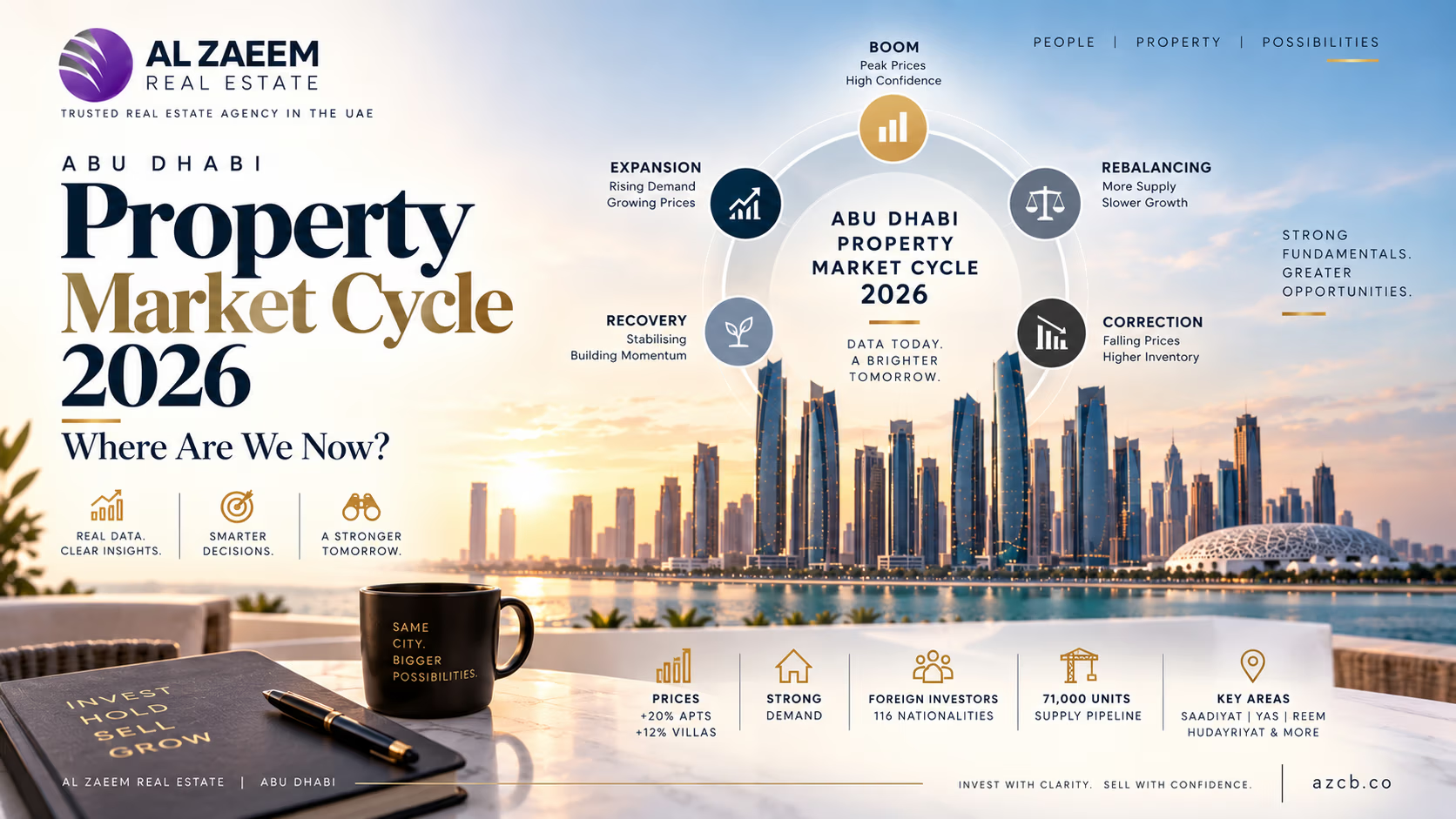
The emirate’s residential property market is experiencing exceptionally strong momentum. In H1 2026, residential unit sales reached AED 70.4 billion, compared with AED 25.3 billion in H1 2025. Repeat-sale apartment prices increased 20% year-on-year, while villa prices rose 12%. New-lease prices increased 17% for apartments and 9% for villas.
At the broader market level, Abu Dhabi recorded AED 117 billion of real-estate transactions in the first six months of 2026, up 112% in value and 61.7% in transaction volume year-on-year. Foreign direct investment reached AED 13.8 billion, while buyers from 116 nationalities participated.
These numbers clearly describe a strong market.
But they do not answer the more difficult question:
Is Abu Dhabi still in the middle of an expansion, entering a late-cycle phase, approaching a peak, or beginning a transition toward a more balanced market?
Our assessment is that, as of September 2026, Abu Dhabi does not show the characteristics of a broad property-market contraction.
The evidence instead points to:
an advanced expansion phase with exceptionally strong momentum — but with increasing reasons for investors to become more selective.
This is an Al Zaeem analytical assessment, not an official ADREC classification.
The distinction is important.
An advanced expansion can continue for years.
It can also gradually turn into a more balanced market without a crash.
The objective of this guide is therefore not to announce that the market has “peaked.”
It is to identify the indicators that tell investors where Abu Dhabi appears to be today, what might come next, and what would cause us to change that view.
Quick Answer: Where Is Abu Dhabi in the Property Cycle?
Our September 2026 assessment:
| Cycle Indicator | Current Signal |
|---|---|
| Transaction activity | Strong expansion |
| Price growth | Strong / elevated |
| Rental demand | Strong |
| Rental growth | Elevated |
| Ready-market activity | Stable and active |
| Off-plan activity | Extremely strong |
| Foreign investment | Strong expansion |
| Cash buyer participation | Strong |
| Current supply-demand balance | Demand still ahead of supply |
| Future supply | Increasing materially |
| Listing-price reductions | Limited so far |
| 2028 handovers | Important future rebalancing risk |
Overall Cycle View
Advanced Expansion / High-Momentum Phase
Not yet enough evidence for:
broad market contraction;
broad distress;
or
a confirmed cyclical peak.
However, the market is no longer an environment where investors should assume:
“Everything will rise because Abu Dhabi is rising.”
The next phase is likely to place greater importance on:
entry price;
property quality;
resale liquidity;
future supply;
end-user demand;
and holding period.
What Is a Property Market Cycle?
Real-estate markets do not move in straight lines.
They generally move through phases created by changes in:
demand;
supply;
credit;
prices;
rents;
construction;
investor psychology;
and economic conditions.
There is no single universally accepted cycle model, but a useful framework is:
1. Recovery
Demand begins improving after weakness.
Vacancies decline.
Transactions recover.
Prices stabilise.
Construction remains limited.
2. Expansion
Employment and population support housing demand.
Occupancy improves.
Rents rise.
Prices increase.
Development activity accelerates.
3. High-Momentum / Late Expansion
Price growth becomes strong.
Investor participation increases.
Developers launch aggressively.
Off-plan activity expands.
Future supply begins accumulating.
Buyers increasingly price in future appreciation.
4. Rebalancing
New supply catches up.
Price growth slows.
Tenants and buyers gain more choice.
Different projects begin performing very differently.
5. Contraction or Correction
Demand weakens materially relative to supply.
Transaction volumes may fall.
Discounting increases.
Vacancy rises.
Prices can decline.
6. Stabilisation and Recovery
Excess inventory is absorbed.
Values find support.
Construction slows.
The next cycle begins.
Real markets rarely move cleanly from one box to another.
Several phases can overlap.
Different areas can also occupy different positions at the same time.
Why Abu Dhabi Looks Like an Expansion Rather Than a Contraction
Start with transaction activity.
Abu Dhabi’s total real-estate transaction value reached AED 97 billion in 2024. It then increased to approximately AED 142 billion in 2025, with transaction volume also rising strongly.
Then, in just the first half of 2026:
AED 117 billion
of real-estate transactions were recorded.
That represents 112% year-on-year growth in transaction value and 61.7% growth in transaction volume.
Those are not typical contraction indicators.
A downturn normally becomes more credible when we start seeing combinations such as:
falling transaction volume;
increasing forced selling;
weak mortgage activity;
large discounts;
rising vacancy;
and falling prices.
The current official data does not show that pattern.
Residential Sales Have Accelerated Even Faster
The residential market is particularly striking.
ADREC’s 2025 report recorded approximately AED 76 billion of residential-unit sales for the full year.
H1 2026 alone produced:
AED 70.4 billion.
In other words, residential sales during the first six months of 2026 came close to the entire residential sales value recorded during 2025.
That is a powerful expansion signal.
But it is also exactly why investors should start thinking about the cycle.
Rapid acceleration cannot automatically be extrapolated forever.
Price Growth Is Strong Enough to Require Discipline
Repeat-sale prices increased year-on-year by:
20% for apartments
and:
12% for villas
in H1 2026.
That is evidence of significant appreciation.
For existing owners, this can be excellent.
For a new buyer, however, strong historical appreciation creates a different question:
How much future growth has already been incorporated into today’s price?
A property purchased before a 20% rise and a property purchased after a 20% rise may be the same asset.
But they are not the same investment.
Entry valuation changes the risk.
Strong Price Growth Does Not Automatically Mean a Bubble
The word bubble is often used too casually in property discussions.
Rapid price growth alone is not enough to prove one.
Investors need to examine whether growth is being supported by:
population;
employment;
rents;
cash buyers;
foreign investment;
end-user demand;
and actual transactions.
Abu Dhabi currently has evidence in several of those areas.
This makes the market more complex than simply saying:
“Prices rose too quickly, therefore they must fall.”
Rental Demand Supports the Expansion Case
Abu Dhabi recorded approximately:
233,000 active residential lease contracts
in H1 2026.
Their combined lease value reached:
AED 9.3 billion.
Rental units represented 69% of occupied residential units in Abu Dhabi Region.
That demonstrates a deep rental economy.
New-lease prices increased:
17% for apartments
and:
9% for villas.
Inside investment zones, the increases were 21% and 16%, respectively.
Rising prices supported by rising rents are generally more defensible than rising prices occurring while rents collapse.
But rents also cannot rise indefinitely faster than household affordability.
That becomes a late-cycle consideration.
The Rental Freeze Is a Useful Market-Cycle Signal
In June 2026, Abu Dhabi temporarily changed the annual rental increase percentage for tenancy renewals from 5% to 0% until further notice.
The official announcement specifically referenced several years of demand exceeding supply, record-high occupancy, and strong increases in new-lease prices.
This should not be interpreted as:
“The property cycle is ending.”
But it does tell investors something important.
The rental market became strong enough that affordability and continuity required regulatory attention.
That is more consistent with:
tight conditions
than:
weak demand.
Are Yields Starting to Compress?
This is a question investors should increasingly watch.
If:
property prices rise faster than rents,
gross rental yields generally decline.
Headline H1 2026 figures show:
apartments +20% repeat-sale prices versus +17% new-lease prices;
villas +12% repeat-sale prices versus +9% new-lease prices.
However, these measures are not sufficiently identical in methodology or property sample to calculate a precise yield-compression rate from them.
So we should not claim:
“Abu Dhabi yields fell by X%.”
The more defensible conclusion is:
Price growth has been very strong relative to already-strong rental growth, making property-specific net-yield analysis increasingly important.
This is another sign of a market moving beyond the easy early stages of expansion.
Off-Plan Dominance Is One of the Most Important Cycle Signals
In H1 2026, off-plan transactions accounted for:
89% of residential sales value
and:
82% of residential transactions.
That is extraordinary market dominance.
It does not mean off-plan is unhealthy.
Abu Dhabi is actively expanding and creating new master-planned communities.
Off-plan is therefore a natural part of the emirate’s growth.
But high off-plan concentration matters because it indicates that a large portion of current demand is being directed toward:
future housing;
future communities;
future handovers;
and future expectations.
Why Off-Plan Dominance Can Characterise an Advanced Expansion
Early in a cycle, investors may buy existing undervalued properties.
As confidence grows:
developers launch more;
buyers become comfortable purchasing future supply;
payment plans expand access;
and expectations of appreciation become more influential.
This can generate powerful growth.
Eventually, however, today’s off-plan sales become tomorrow’s completed inventory.
That is why high off-plan activity is both:
a strength today
and:
a future-cycle variable.
Primary Sales Are Also Highly Concentrated
The ten leading developers accounted for approximately:
90% of primary off-plan residential sales
in H1 2026.
Ten projects alone represented approximately:
43% of total residential-unit sales.
This does not imply a problem.
Major developers often dominate high-quality master-planned markets.
But concentration can create an important cycle effect.
A very successful launch or several major launches can materially lift market-wide transaction statistics.
Therefore investors should distinguish:
overall Abu Dhabi sales growth
from:
secondary-market demand for a particular existing property.
The Ready Market Helps Confirm Underlying Demand
This is why the ready market matters.
In March 2026, approximately:
482 ready residential units
transacted for around AED 1.2 billion.
April recorded:
529 ready units
for approximately AED 1.6 billion.
ADREC described April activity as consistent with recent historical norms after some March moderation.
This is reassuring.
It tells us the market is not functioning exclusively through developer launches.
There remains real activity in completed property.
Cash Purchases Strengthen the Current Cycle
ADREC reports that:
61% of ready-market residential purchases
in H1 2026 were completed in cash.
Cash participation matters because it reduces dependence on:
mortgage approvals;
interest rates;
and bank valuations.
A property market driven exclusively by highly leveraged buyers can be more sensitive to tightening credit.
Abu Dhabi’s substantial cash component is therefore a positive cycle indicator.
It does not eliminate risk.
But it improves resilience.
Foreign Capital Has Accelerated Dramatically
Real-estate foreign direct investment reached:
AED 13.8 billion
in H1 2026.
That represented:
309% year-on-year growth.
The first six months of 2026 alone exceeded the real-estate FDI recorded during the whole of 2025.
Non-resident investors represented:
116 nationalities
compared with 82 nationalities in the same period a year earlier.
Diversification across nationalities is constructive because it reduces dependence on a single overseas buyer group.
But accelerated foreign capital is also a cycle indicator investors should monitor carefully.
International capital can grow rapidly.
It can also respond quickly to changing global conditions.
Domestic Demand Is Strong Too
The market is not simply an international-investor story.
Emirati buyers committed:
AED 21 billion
to residential property during H1 2026, compared with AED 8.9 billion in H1 2025.
Resident expatriates and non-resident foreign buyers together accounted for 70% of residential sales value.
This broad participation is healthier than a market relying on one buyer category.
It creates several possible future exit pools:
Emirati owners;
resident expatriates;
international investors;
landlords;
and end users.
Economic Fundamentals Still Support Expansion
The broader Abu Dhabi economy remains supportive.
Abu Dhabi’s economy grew 7.7% year-on-year in Q3 2025, while the non-oil economy expanded 7.6%. Across the first nine months of 2025, non-oil economic activity grew 6.8%.
Business formation also remained strong into 2026.
New economic licences increased 21% year-on-year in Q1 2026, while the number of active licences increased 12%.
These are important real-estate fundamentals because sustainable property demand eventually needs:
jobs;
business activity;
household income;
and residents.
Population Growth Is Another Fundamental Demand Driver
The latest published annual population count shows Abu Dhabi reaching:
4,135,985 residents in 2024
after growth of:
7.5% during the year.
Over the preceding decade, the population increased substantially.
Population growth helps explain:
rental absorption;
household creation;
commercial demand;
and eventually homeownership demand.
The important cycle question is whether demographic expansion continues strongly enough to absorb future construction.
The Biggest Change Ahead: Supply
This is where the cycle becomes more interesting.
Residential supply currently stands at approximately:
409,000 units.
ADREC projects around:
71,000 additional residential units through 2030.
Deliveries are currently expected to peak in:
2028
at approximately:
21,800 units.
This is the strongest argument against assuming today’s market conditions will remain unchanged indefinitely.
Supply Growth Does Not Mean Oversupply
This distinction is essential.
Adding 71,000 units does not automatically mean:
“Abu Dhabi will have 71,000 excess homes.”
Population will change.
Employment will change.
Household formation will change.
Some projects may be delayed.
Different properties serve different segments.
The correct cycle equation is:
new comparable supply versus new effective demand.
Not simply:
number of units.
Why 2028 May Become the Cycle’s Most Important Test
Current projections show deliveries peaking around 21,800 residential units in 2028.
When those properties complete, owners will broadly choose to:
occupy;
rent;
hold vacant;
or sell.
If population and employment growth remain strong, many units may be absorbed smoothly.
If demand slows while handovers accelerate, the market could begin rebalancing.
The first pressure may not appear as:
“prices crash.”
It may appear through:
longer rental periods;
more resale listings;
greater incentives;
slower appreciation;
and stronger negotiations.
Six Districts Will Carry Most Future Supply
Approximately 77% of projected incremental residential supply through 2030 is expected to come from six areas:
Saadiyat Island
Al Reem Island
Yas Island
Zayed City
Khalifa City
Hudayriyat Island.
This means there may be no single “Abu Dhabi market cycle.”
Instead, we may increasingly see:
multiple micro-cycles.
Saadiyat Can Be in a Different Cycle From Reem
A scarce beachfront residence on Saadiyat may have:
limited substitutes;
global buyers;
high-end end-user demand.
A one-bedroom apartment in a high-density district may face:
dozens of direct substitutes;
new tower completions;
investor competition.
Both are technically “Abu Dhabi property.”
Their cycle exposure can be completely different.
Apartments and Villas Can Also Occupy Different Cycle Positions
Apartment repeat-sale prices increased 20% year-on-year in H1 2026.
Villa prices increased 12%.
Apartment growth has therefore recently been stronger at the headline level.
But apartments can also be easier to reproduce at scale.
New towers can add:
studios;
one-bedrooms;
two-bedrooms
relatively quickly.
Prime villas may benefit more from:
land scarcity;
family demand;
and limited waterfront plots.
The cycle should therefore be analysed by:
segment, not headline average.
Is Abu Dhabi in a Boom?
Possibly in some segments, but the term needs care.
We would describe current conditions as:
high-momentum expansion
rather than declaring the entire market a speculative boom.
Why?
Because several current indicators still have fundamental support:
high rental occupancy;
rising leases;
population growth;
economic growth;
cash purchases;
foreign capital;
domestic buying;
and active ready transactions.
A purely speculative boom would normally be more concerning if prices and launches were accelerating while:
rents weakened;
occupancy declined;
ready transactions disappeared;
and buyers relied heavily on leverage.
That is not the pattern shown by current official data.
But Some Late-Cycle Behaviours Are Worth Watching
Even fundamentally supported markets can become overheated.
Potential late-cycle signals include:
rapid price appreciation;
very strong launch activity;
heavy off-plan concentration;
buyers assuming guaranteed future appreciation;
short holding-period speculation;
increasing price premiums between launch phases;
and large future development pipelines.
Some of those characteristics are visible today.
Therefore:
Strong market does not mean low-risk market.
Listing Prices Do Not Yet Show Broad Distress
ADREC’s review of March and April 2026 found that approximately:
90% of listings
were either unchanged in asking price or had increased.
Among listings that were reduced, around 85–90% of decreases were less than 10% of the previous asking price.
That is not evidence of widespread seller capitulation.
It suggests pricing remained relatively firm.
However, asking-price behaviour should not be treated as the same thing as completed transactions.
The more useful warning signal would be:
increasing discounts combined with falling transaction activity.
Volume Can Turn Before Prices
This is one of the most important cycle lessons.
A market does not necessarily move directly from:
prices rising
to:
prices falling.
Often the sequence is:
Stage 1
Prices rise and transactions rise.
Stage 2
Prices remain high but transactions stop accelerating.
Stage 3
Properties take longer to sell.
Stage 4
Seller discounts increase.
Stage 5
Completed prices begin softening.
Therefore, investors who watch only price indices may identify a turning point late.
What Should We Watch First?
Before worrying about a crash, watch for:
declining transaction volume;
ready-market weakness;
more listing reductions;
longer sale periods;
rising rental vacancy;
developer incentives;
assignment discounts;
mortgage valuation gaps;
and handover-related resale inventory.
One indicator alone is rarely enough.
Several deteriorating simultaneously would matter.
Developer Incentives Can Be an Early Cycle Indicator
Developers do not always reduce headline prices when competition increases.
Instead, they may offer:
lower deposits;
extended payment plans;
post-handover terms;
fee support;
furniture;
or other incentives.
Therefore:
Stable advertised launch prices do not necessarily mean unchanged effective pricing.
Investors should compare the total economic package.
Off-Plan Resale Can Reveal Investor Sentiment
Another useful signal is the relationship between:
original launch price;
current developer price;
and secondary assignment price.
Suppose:
developer new-phase price = AED 1.8M;
secondary investor asks AED 1.75M;
then AED 1.65M;
while construction continues.
That could indicate weakening investor liquidity even while headline project prices remain high.
Conversely, consistent resale premiums supported by actual transactions can indicate strength.
Rental Vacancy May Be More Important Than Rent Growth
A landlord can ask:
AED 150,000.
That tells us little.
The better questions are:
How quickly was the unit leased?
How many competing properties existed?
Were incentives required?
Did the tenant renew?
What happened to effective rent?
If vacancy begins increasing while asking rents remain high, the cycle may be starting to rebalance.
The 2026 Rental Measure Complicates Rental Analysis
Because renewal increases are temporarily set at 0%, investors should distinguish between:
existing-tenancy economics
and:
new-leasing conditions.
This means future rental-market analysis needs more than one headline average.
It should examine:
new leases;
renewals;
vacancy;
active lease counts;
and actual achieved rent.
Market Cycle Does Not Mean “Buy” or “Sell”
This is where investors often misuse cycle analysis.
They ask:
“If this is late expansion, should I sell everything?”
Not necessarily.
A strong property bought well may remain attractive through multiple cycles.
Likewise, an early-cycle market does not make every property a good purchase.
Cycle position should influence:
risk tolerance;
pricing discipline;
leverage;
holding period;
and asset selection.
It should not replace property-level analysis.
Early-Cycle Investor Behaviour
Earlier in an expansion, investors can often justify:
greater value exposure;
revitalising locations;
higher operating risk;
because entry valuations may be lower.
The emphasis is often:
buying recovery.
Mid-Cycle Investor Behaviour
As fundamentals strengthen:
occupancy rises;
rents improve;
values rise.
Investors increasingly focus on:
growth plus income.
The emphasis becomes:
participating in expansion.
Advanced Expansion Investor Behaviour
This is where Abu Dhabi appears closer today.
At this stage, investors should increasingly prioritise:
quality;
scarcity;
cash flow;
liquidity;
future supply;
and defensible valuation.
The emphasis becomes:
protecting against overpaying while still participating in growth.
Why Entry Price Matters More Now
Imagine two investors buy the same type of apartment.
Investor A:
AED 1.2 million.
Investor B, later:
AED 1.5 million.
Future market value:
AED 1.65 million.
Investor A gain:
AED 450,000
before costs.
Investor B gain:
AED 150,000
before costs.
The property performed well.
But the investments performed very differently.
A strong market cannot rescue every entry price.
The Zero-Growth Test
Before buying in an advanced expansion, ask:
Would I still be comfortable owning this property if its price did not increase for three years?
If the answer is yes because:
rent is attractive;
you intend to live there;
location is exceptional;
the asset is scarce;
or long-term fundamentals are strong,
the investment is more resilient.
If the entire thesis depends on:
“Someone will pay 20% more next year,”
cycle risk is much higher.
The 10% Correction Test
Now assume a property purchased for:
AED 2,000,000
temporarily falls to:
AED 1,800,000.
Could you:
continue holding?
continue paying the mortgage?
continue covering service charges?
continue renting it?
If yes, a temporary market correction may be manageable.
If no, the investment is dependent on continuously favourable conditions.
That is not market risk alone.
It is portfolio design risk.
Hold, Sell, Buy or Wait?
There is no universal cycle answer.
Consider Buying When
The property is competitively priced.
Rental/end-user demand is real.
Future supply is manageable.
Holding period is long enough.
You can tolerate volatility.
Consider Holding When
The investment still produces acceptable economics.
Selling would create unnecessary friction.
The property remains differentiated.
Long-term thesis remains intact.
Consider Selling When
Your original investment thesis has been fulfilled.
The asset has become overpriced relative to alternatives.
Future competing supply is significant.
Your portfolio is too concentrated.
Or you need liquidity.
Consider Waiting When
Pricing makes no sense.
Comparable transactions do not support the ask.
You do not understand future supply.
Your financing would be too aggressive.
Waiting is itself an investment decision.
Al Zaeem Market Cycle Dashboard
The following is an Al Zaeem analytical framework, not an official ADREC index.
Score each category:
1 = contraction
2 = weak/stabilising
3 = balanced
4 = expansion
5 = very strong / potentially overheated
| Indicator | Current Direction |
|---|---|
| Transaction Value | 5 |
| Transaction Volume | 5 |
| Residential Price Growth | 5 |
| Rental Demand | 5 |
| Rental Growth | 5 |
| Ready-Market Activity | 4 |
| Off-Plan Activity | 5 |
| Foreign Investment | 5 |
| Cash Buyer Depth | 4–5 |
| Current Supply Tightness | 4–5 |
| Future Supply Risk | 2–3 |
| Listing-Price Stability | 4 |
| Economic Fundamentals | 4–5 |
The overall picture is clearly expansionary.
But the elevated scores themselves are why investors should monitor signs of future normalisation.
What Would Make Us More Bullish?
We would become more constructive on the next stage of the cycle if several things happened together:
Population growth remained strong.
New jobs continued expanding.
Ready-market transactions strengthened.
Active lease counts kept rising.
Future deliveries were absorbed quickly.
Foreign investment remained diversified.
2028 supply projections were reduced or delayed.
Rental vacancy stayed low.
Secondary off-plan resales remained healthy.
In that scenario, current expansion could continue longer than many investors expect.
What Would Make Us More Cautious?
We would become more cautious if we saw:
transaction volumes declining for several periods;
ready sales weakening materially;
listing reductions becoming widespread;
large assignment discounts;
rising vacancy;
developer incentives increasing sharply;
completed properties sitting unsold;
foreign capital slowing;
bank valuations becoming conservative;
and 2028 handovers arriving faster than demand.
One sign alone would not prove a cycle change.
A cluster of them would.
What Would Confirm a Rebalancing Phase?
A rebalancing market could look like:
prices still relatively firm;
rent growth slower;
transaction growth moderating;
more buyer negotiation;
more project differentiation;
greater importance of incentives;
new supply being absorbed but less easily.
This would not necessarily be bad.
In fact, normalisation can make a market healthier.
What Would Confirm a Downturn?
A genuine broad downturn would require stronger evidence, such as:
persistent transaction contraction;
falling achieved rents;
higher vacancy;
significant secondary-market discounts;
widespread price declines;
weak mortgage activity;
forced selling;
and supply materially exceeding effective demand.
As of September 2026, current official market data does not show that combination.
Why “Slower Growth” Is Not the Same as “Crash”
Suppose apartment price growth changes from:
20%
to:
7%.
Prices are still rising.
But headlines may call it:
“market slowdown.”
Suppose growth changes to:
0%.
That means values are broadly stable.
Still not a crash.
A correction requires actual price declines.
Cycle analysis should distinguish:
deceleration
from:
stagnation
from:
correction.
They are different conditions.
The Best Properties Can Outperform the Cycle
Even if Abu Dhabi eventually enters a more balanced period, certain properties may remain strong because of:
scarcity;
waterfront location;
land;
views;
schools;
walkability;
low service charges;
high-quality management;
or established end-user demand.
This is why the goal is not simply:
Predict the market perfectly.
It is:
Own an asset that does not require a perfect market.
Frequently Asked Questions
What stage of the Abu Dhabi property cycle are we in?
Based on current September 2026 data, Al Zaeem’s analytical view is that Abu Dhabi is in an advanced expansion / high-momentum phase rather than a broad contraction.
Is this an official ADREC cycle classification?
No. ADREC publishes registered market data, not the Al Zaeem cycle labels used in this article.
Is Abu Dhabi property currently booming?
Market activity, prices, rents and investment are growing strongly. Some segments could reasonably be described as boom-like, but we prefer the more precise term high-momentum expansion for the overall market.
Are Abu Dhabi property prices rising?
Yes. H1 2026 repeat-sale apartment prices rose 20% year-on-year and villa prices rose 12%.
Are rents rising?
New-lease prices increased 17% for apartments and 9% for villas in H1 2026, with stronger increases inside investment zones.
Does strong price growth mean a crash is coming?
No. Strong appreciation alone does not prove a future correction.
What is the strongest current market signal?
Several indicators are strong simultaneously: transaction value, volume, prices, rents, foreign investment and off-plan sales.
What is the biggest risk?
One major medium-term issue is how future demand absorbs approximately 71,000 additional residential units projected through 2030.
Why is 2028 important?
ADREC currently projects residential handovers to peak at approximately 21,800 units in 2028.
Is Abu Dhabi oversupplied?
Current ADREC reporting says demand continues to outpace supply. Future supply is increasing, but that is not the same as current oversupply.
Is off-plan dominating the market?
Yes. Off-plan represented 89% of residential sales value and 82% of residential transactions in H1 2026.
Is that dangerous?
Not automatically. Abu Dhabi is expanding its residential stock and investment zones. The risk depends on pricing, buyer quality, future demand and handover concentration.
Is the ready market still active?
Yes. ADREC reported ready-market activity in April 2026 broadly consistent with recent historical levels.
Are buyers heavily dependent on mortgages?
Not entirely. ADREC reports that 61% of ready residential purchases in H1 2026 were completed in cash.
Is foreign demand still expanding?
Yes. H1 2026 real-estate FDI reached AED 13.8 billion, with non-resident buyers representing 116 nationalities.
When does a rising market become late-cycle?
There is no precise threshold. Investors typically become more cautious when strong appreciation combines with heavy development activity, speculative behaviour, stretched valuations and growing future supply.
What should investors monitor first?
Transaction volumes, ready sales, rents, vacancy, listing reductions, new supply, developer incentives and secondary resale activity.
Should I sell because Abu Dhabi is in advanced expansion?
Not automatically. Cycle position is only one factor. Property quality, entry price, tax position, cash flow, holding period and personal objectives matter more.
Should I stop buying?
No. Strong assets can still be attractive, but investment discipline should increase as prices rise.
Which is more important: market cycle or property selection?
Property selection. A strong asset bought sensibly can survive imperfect cycle timing better than a weak asset bought at the “right” time.
Could Abu Dhabi continue expanding through 2030?
Yes. Strong population, economic and foreign-investment demand could absorb much of the future pipeline. But this should be monitored rather than assumed.
Final Takeaway
Abu Dhabi’s 2026 property market is showing virtually every major characteristic of a strong expansion:
Residential sales reached:
AED 70.4 billion in H1 2026.
Repeat-sale apartment prices rose:
20%.
Villa prices rose:
12%.
Total real-estate transactions reached:
AED 117 billion.
Transaction volume increased:
61.7%.
Real-estate FDI reached:
AED 13.8 billion.
And buyers from:
116 nationalities
participated in the market.
Rental fundamentals are also strong, with 233,000 active residential lease contracts and significant new-lease price growth.
This does not look like a market in broad contraction.
But the same numbers that demonstrate strength also justify greater selectivity.
Off-plan now represents:
89% of residential sales value.
Approximately:
71,000 new homes
are projected through 2030.
And:
2028 is expected to be the peak delivery year.
For that reason, Al Zaeem’s current cycle assessment is:
Advanced Expansion — Strong Fundamentals, Strong Momentum, Rising Selectivity
That is very different from saying:
“the market is about to crash.”
It is also very different from saying:
“buy anything because prices are rising.”
The intelligent investor should now ask:
What happens to this specific property if market growth slows from exceptional to normal?
What happens when buyers have more choice?
What happens when today’s off-plan inventory becomes completed stock?
Will tenants still want this property?
Will end users still want it?
Can I hold it through a slower market?
And finally:
Would I still be happy owning it if appreciation stopped for three years?
A property that survives those questions is much more valuable than a property that depends entirely on the next buyer paying more.
That is how investors should think about the Abu Dhabi property cycle in 2026.
Al Zaeem Real Estate — Invest Through the Cycle
Al Zaeem Real Estate helps buyers look beyond headline market growth.
Before selecting a property, we can help compare:
current transaction evidence;
price history;
rental demand;
ready vs off-plan positioning;
future competing supply;
developer strength;
service charges;
resale liquidity;
buyer depth;
and:
cycle risk.
The objective is not to predict the exact top or bottom of the market.
It is to buy assets capable of performing across more than one market condition.
Al Zaeem Real Estate: +971 (50) 991 5454
Recommended Internal Links
This article should connect directly to the authority cluster we have already built:
Abu Dhabi Real Estate Knowledge Hub
Abu Dhabi Property Investor Insights
Best Areas to Invest in Abu Dhabi
Also internally link this article to the newly completed:
Abu Dhabi Property Appreciation 2026
Abu Dhabi Property Supply Pipeline 2026
Abu Dhabi Property Demand Drivers 2026
Abu Dhabi Real Estate Outlook 2027–2030
Abu Dhabi Property Liquidity & Resale Guide 2026
Abu Dhabi Property ROI Calculator 2026
because collectively these form a very strong market-analysis cluster.
Disclaimer
This article is provided for general educational and real-estate research purposes only. It does not constitute financial, investment, mortgage, legal, tax or valuation advice.
The terms Recovery, Expansion, Advanced Expansion, Rebalancing, Correction and Contraction, as well as the Al Zaeem Market Cycle Dashboard, are analytical frameworks used by Al Zaeem Real Estate for explanatory purposes. They are not official classifications or forecasts issued by ADREC or any government authority.
The assessment that Abu Dhabi is currently in an advanced expansion / high-momentum phase is an interpretation of available September 2026 market evidence and should not be treated as a guarantee of future prices.
Historical appreciation, rental growth, transaction activity and foreign investment do not guarantee future performance.
The approximately 71,000-unit future supply figure and approximately 21,800-unit 2028 handover peak are current ADREC projections and may change due to new launches, delays, project phasing or other market developments.
The temporary 0% rental increase measure may also be changed or withdrawn after publication.
Every property has its own risk profile based on location, developer, unit type, purchase price, future supply, service charges, financing, tenant demand and resale liquidity.
Last reviewed: September 2026.